
- Buy Crypto
- Markets
- Futures
- Spot
- Copy Trade
 WE-Launch
Market's Darkest Hour: Global Assets Plunge in Sync, Crypto Market Cap Down 10%, When Will the Dawn Break?

Original Article Title: "Market Dark Hour: Global Assets Simultaneously Plunge, Crypto Total Market Cap Down 10%, When Will the Dawn Come?"
Original Article Author: Luke, Mars Finance
Asset Meltdown: Global Market in Turmoil
The global financial market is currently experiencing a dark hour as a storm triggered by U.S. President Donald Trump's new tariff policy sweeps through major asset classes. At the Monday opening, the U.S. stock futures market was bleak, with S&P 500 futures down 3.2%, Nasdaq 100 futures plummeting 5.7%, the VIX fear index futures skyrocketing by 34.4% to 45.8, reaching the highest level since 2022. Safe-haven sentiment drove up the price of the 10-year U.S. Treasury bond, the Japanese yen appreciated by 1.3% against the U.S. dollar, and spot gold fell to $2988.61 per ounce.
Last Thursday, the S&P 500 Index plunged 4.8% to close at 4850 points, marking the largest single-day drop since 2024. On Friday, the selling frenzy further engulfed the market, with the Dow Jones Industrial Average plummeting 2231 points, a 5.5% decline, closing at 38900 points, wiping out nearly two months of gains. The tech-heavy Nasdaq Composite Index fell by 11.8% over two days, officially entering bear market territory. Big Tech performed poorly: Apple fell to $205, a 5.5% drop; Tesla plunged by 10.3% intraday, closing at $310; NVIDIA saw its market value evaporate by over $300 billion in a single day, a 9.1% drop. Global stock markets came under pressure simultaneously, with the Japanese Nikkei 225 Index falling by 5.6% at Monday's opening, triggering a 7% circuit breaker during the session, halting trading for 15 minutes; the South Korean KOSPI Index fell by 4.9%, hitting a six-month low; and the European STOXX 600 Index opened down by 3.8%.
The commodities market also did not escape unscathed. Gold broke below the $3000 per ounce psychological barrier, hitting a low of $2988.61, a 1.9% drop, while silver fell by 2.3% to $34.50 per ounce. The energy market suffered heavy losses, with WTI crude oil futures dropping to $59.80 per barrel, a 12% decline from the previous week's high, hitting a new low since April 2021; Brent crude fell to $63.20 per barrel. Industrial metal prices slid, with COMEX copper falling by 8.2% to $3.85 per pound, reflecting the market's pessimistic outlook on global manufacturing. The foreign exchange market saw heightened volatility, with the Australian dollar falling by 1.1% against the U.S. dollar to 0.6350, the euro weakening by 0.9% against the U.S. dollar to 1.0450, and the U.S. dollar index rising to 104.50, reaching a three-month high.
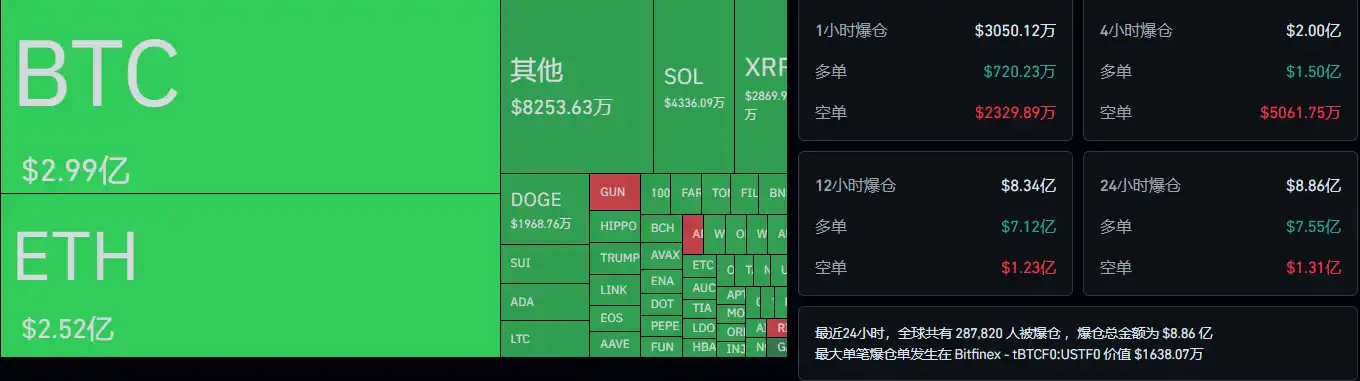
The cryptocurrency market has failed to escape its fate as a risk asset. CoinMarketCap data shows that the global crypto market cap has shrunk from $2.4 trillion to $2.16 trillion, a 10% decrease. Bitcoin fell by 6%, hitting a low of $77,100; Ethereum dropped by 12.4% to $1,540; the crypto market's performance is highly synchronized with the Nasdaq, highlighting its nature as a "high-beta asset." The total liquidation amount across the market in the past 24 hours was $886 million.
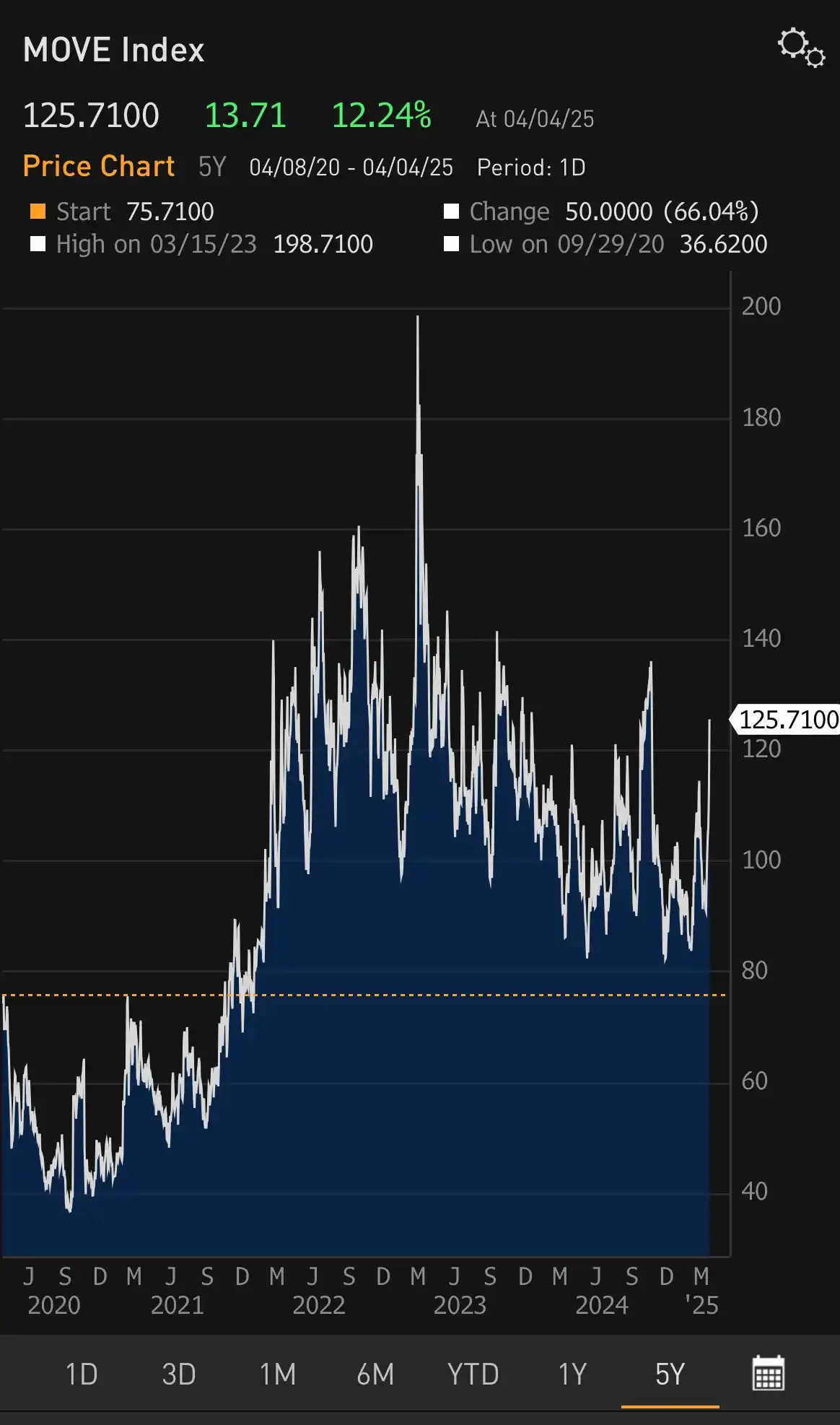
Concerns in the bond market are also escalating. The MOVE Index (Merrill Lynch Option Volatility Estimate Index), a gauge of the implied volatility of U.S. bonds, has surged from 108.50 at the end of March to 125.71, a 15.8% increase. BitMEX co-founder Arthur Hayes pointed out, "To predict when the Fed will capitulate and ease significantly, the MOVE Index is a key indicator. The higher the index, the higher the margin requirements for bond and credit financing trades, and selling pressure will sweep through the market. This is an area the Fed will fight to the death to defend. If it breaks above 140, easing is inevitable." The current level is just a step away from the critical point, indicating that greater turmoil is on the horizon.
Trump's Gambit and the Market Standoff
Facing a market meltdown, the Trump administration has shown an unusually calm demeanor. Treasury Secretary Steven Mnuchin stated on Sunday, "Market volatility is temporary, and the economic fundamentals have not collapsed." Commerce Secretary Robert Lighthizer took a tough stance, saying, "Tariffs are a necessary safeguard for the U.S. economy and will not retreat." Trump posted on the social platform "True Social," saying, "Don't be afraid, this is just a little episode on the way to prosperity." Hayes analyzed, "Many of Trump's core voters do not hold stocks or financial assets. For them, a market downturn even brings a psychological satisfaction towards the 'Wall Street elite.' This gives Trump the confidence to push tariffs because he knows the votes will not be lost."
However, the market remains unmoved. U.S. federal funds futures show that investors are betting on a 120-basis-point interest rate cut by the Fed this year, implying an expectation of five 25-basis-point rate cuts. JPMorgan predicts that the Fed may start cutting rates from May onwards and lower the federal funds rate to 2.75%-3.0% by January 2026. Goldman Sachs warns that if tariffs are fully implemented, the U.S.' GDP growth rate for 2025 may be revised down to 1.2%, while the inflation rate could rise to 3.8%, putting the Fed in a dilemma. An anonymous Wall Street hedge fund manager stated, "Investors no longer believe in the government's optimistic promises, they only look at the data and the Fed's next move."
Trump's remarks have further exacerbated uncertainty. He shared a video on "Truth Social," implying his intention to cause a 20% stock market drop to boost Treasury demand, weaken the dollar, and lower mortgage rates. White House economic advisor Kevin Hassett urgently clarified: "This is just the President's personal idea, not a policy objective." However, market trust has been severely damaged, with the VIX index rising further to 47.2 in pre-market trading on Monday.
A Lesson from History: Bitcoin Struggles to Stand Alone, Seeks Opportunity in Crisis
The current situation evokes historical crisis moments. In 1987, on "Black Monday," the Dow Jones Industrial Average plummeted by 22.6% after a weekend panic, setting a record for the largest single-day drop. The meltdown crisis triggered by the COVID-19 pandemic in March 2020 was more recent, with the S&P 500 index hitting the circuit breaker four times in 10 days:
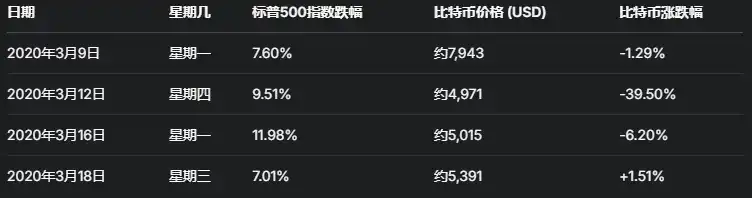
In this crisis, the S&P 500 index dropped from 3393 points at the end of February to 2237 points on March 23, a drop of over 34%. Bitcoin's performance was particularly brutal, plummeting by 39.5% on March 12, marking a rare single-day drop in the crypto market. Notably, Bitcoin failed to break away with an independent trend but instead became highly correlated with the Nasdaq, amplifying the tech stock performance. CNBC commentator Jim Cramer pointed out: "The lesson of 2020 is that Bitcoin is no longer a safe haven asset but rather a 'large-cap Nasdaq,' with a risk exposure far exceeding the traditional stock market." Today, the same pattern is repeating: Bitcoin's correlation with the Nasdaq 100 has recently risen to 0.85, much higher than gold's 0.12, indicating its vulnerability in a panic environment.
History also reveals a turning point. After each circuit breaker in 2020, the market's short-term panic intensified, but the Federal Reserve promptly cut interest rates to zero and launched unlimited QE, ultimately stabilizing the situation. While the turmoil caused by Trump's tariffs was policy-driven, the panic eruption on Monday followed a similar pattern. Cramer added: "The commonality between 1987 and 2020 is that fear brewing over the weekend spiraled out of control on Monday. Today, the opacity of the trade war leaves investors nowhere to hide."
Global Impact and the Comeback of Safe-Haven Assets
The ripple effects of this storm have swept across the globe. China's Ministry of Commerce stated on Sunday: "Resolute measures will be taken to counteract." The EU's trade commissioner warned of possible tariffs on U.S. cars and agricultural products. India and Brazil are also evaluating retaliatory measures. A 7.2 magnitude earthquake in Myanmar last week further disrupted the rare earth and semiconductor supply chain, driving up tech manufacturing costs. Morgan Stanley estimates that if the supply chain crisis persists, global economic growth could be revised down by 0.5 percentage points by 2025.
Hedge assets have become a rare bright spot. The 10-year U.S. Treasury yield fell by 10 basis points to 3.89%, while the 2-year yield fell by 19 basis points to 3.46%. Bloomberg data shows that the global negative-yield bond market has grown to $16.5 trillion, reaching a high not seen since 2023. The Japanese yen rose to 148.50 against the U.S. dollar, and the Swiss franc increased by 0.8%. Although gold has experienced a short-term pullback, it remains attractive in the long run, with UBS predicting it may return to $3100 per ounce by year-end.
The Fed's Turning Point: The Alarm of the MOVE Index
The Federal Reserve is facing unprecedented pressure. Tariffs may raise import costs, and inflation concerns have emerged—Goldman Sachs estimates that if a 34% tariff is implemented, the U.S. CPI could rise by 1.2 percentage points in 12 months. However, a market crash and bond volatility are forcing accommodation. Hayes's MOVE Index theory has become a focal point: "As the MOVE Index rises, the financing cost of bond trading surges, and selling pressure will transmit to the financial system. The Fed has no choice but to act. 140 is the critical point." The current index has reached 125.71, and if panic intensifies on Monday, it may quickly surpass this level.
There is disagreement within the Fed. Hawkish officials advocate waiting for inflation data, while doves warn that delays could trigger systemic risks. Chicago Fed President Evans stated, "When markets are in disarray, monetary policy must be decisive." The market expects the May FOMC meeting to potentially initiate a rate cut, with a magnitude of up to 50 basis points.
Where is the Turning Point: Dawn After the Earthquake
Hedge fund manager Bill Ackman has proposed another possibility: "If Trump announces a tariff delay on Monday to seek negotiation space, the market may catch its breath." However, he also warns that if the policy remains tough, the S&P 500 could fall another 10%, and the risk of an economic recession could increase from the current 35% to 60%. Ackman concludes, "In any case, this Monday will determine the direction of the next few months."
Although this earthquake is chilling, it may herald a turning point. After the 2020 circuit breaker, the Fed's decisive intervention reversed the decline. Now, with the MOVE Index sounding the alarm, the pressure for rate cuts is mounting. If the Fed gives in, accommodative policies could inject vitality into the market and reignite investor confidence. History tells us that the deepest darkness often comes before the dawn. The tug-of-war between Trump's tough stance and the market's fragility makes the Fed's decision a decisive variable.
The calls for rate cuts are growing louder—perhaps this is the first ray of sunshine after the storm. For investors, the gold pullback may be a buying opportunity, and the tech stock slump is a litmus test of patience. As Ackman said, this Monday will go down in history, and the Fed's actions may unexpectedly bring this crisis to a close.
You may also like

Unveiling the Movement Liquidity Provider Sell-Off Scandal: Secret Contracts, Shadow Advisors, and Hidden Intermediaries
Key Market Insight Discrepancy on May 2nd - A Must-Read! | Alpha Morning Report
Arthur Hayes Interview: Bitcoin Has Bottomed, Which Tokens Can Outperform Bitcoin?
WLFI Holdings Token Analysis: Did the Trump Family's Crypto Investment Pay Off?
Key Market Information Gap on April 24th, A Must-See! | Alpha Morning Report
Arthur Hayes New Article: Bitcoin to Return to “Gold Tier” Safe Haven, Altseason to Potentially Follow
SEC Watershed Moment? 2025 Could Be the 'Altcoin ETF' Year, Which Tokens Are Most Likely to Be Approved
Rate Cut Countdown: $9 Trillion National Debt "Maturity Wall" Could Be the Cryptocurrency Market's Most Powerful Catalyst
Global Stock Markets Face Worst 3-Day Performance in 50 Years, Can the Crypto Market Hold Up?
Just one week after U.S. President Trump signed the executive order on "reciprocal tariffs," the U.S. stock market experienced a two-day crash, with a market value loss of about $6.6 trillion. Despite Trump's "tariff" turmoil washing over the global markets, he seems unconcerned and instead went to his private club in Florida to vacation and play golf.
On his way back from Florida to Washington on April 6, aboard Air Force One, Trump gave a media interview about the global market turmoil caused by last week's stock market crash. His view on the current market plunge was, "Sometimes you have to take medicine to solve a problem." After Trump made the "take medicine" remark, Nasdaq 100 futures continued to decline, dropping over 6%. Can taking medicine really solve the problem?
Following Trump's "take medicine" remark, global stock markets and the cryptocurrency market entered a waterfall crash mode. The cryptocurrency market took a heavy blow this morning, with Bitcoin falling below $78,000, a 6.89% drop in 24 hours. Ethereum fell below $1,600, a 13.19% drop in 24 hours. SOL dropped below $110, a 11.94% drop in 24 hours. According to Alternative data, today's crypto fear and greed index dropped to 23, compared to the weekly average and yesterday's both at 34, indicating the market sentiment is in a state of "extreme fear."
In the past 24 hours, a total of 290,000 users globally have been liquidated, with a total liquidation amount of $893 million, of which long positions account for $762 million.
The Nikkei Futures Index opened for trading for 10 minutes, and the Nikkei average index plummeted by over 8%, dropping more than 2,500 points, breaking through the key level of 32,000 points. An announcement on the Japan Exchange Group website stated that the TOPIX futures circuit breaker was triggered at 08:45:31 Japan time and was restored at 08:55:41. This is the first time since August 5 last year that the index has fallen by more than 2,500 points, when concerns about the U.S. economy led to a single-day stock market plunge of more than 4,000 points, dubbed the "Reiwa Black Monday."
The Korea Composite Stock Price Index (KOSPI) reported 2,357.28 points at 9:02 am local time, a sharp drop of 108.14 points, representing a 4.39% decline from the previous trading day. KOSPI also activated the sidecar mechanism, suspending trading for 10 minutes. European stock index futures continued last week's declines, with EURO STOXX 50 index futures dropping by 4.3%, Germany's DAX index futures falling by 5.0%, and the UK's FTSE 100 index futures declining by 4.1%. After the Taiwan Stock Exchange opened, a circuit breaker was triggered, with TSMC and Foxconn both dropping by nearly 10%, and the Taiwan Weighted Index falling by close to 10%.
According to The Kobeissi Letter, the U.S. stock market lost $11.1 trillion in value over 44 trading days, roughly equivalent to 38% of the U.S. GDP. The S&P 500 futures extended their losses to -4.5%, with a cumulative drop of -15% over the past three days.
Due to the U.S. stock market futures declining by over -15% for three consecutive days, brokerages issued a circuit breaker warning yesterday. The Chicago Mercantile Exchange has circuit breakers set at 7%, 13%, and 20%. A 7% or 13% circuit breaker would trigger a 15-minute trading halt; if the level reaches 20%, the market would close for the day. According to the Daily Mail, hedge funds are facing Lehman-style margin calls due to the market collapse triggered by President Trump's tariff measures.
Note: Lehman-style margin calls refer to an extreme scenario where a market experiences a sharp decline, investors or institutions face significant losses due to high leverage, and brokerages or clearinghouses demand additional margin. However, because of illiquidity or panic, investors are unable to raise funds, ultimately leading to forced liquidation or bankruptcy. This situation could potentially trigger broader systemic risks, similar to the "domino effect" seen during the Lehman Brothers bankruptcy.
Some professionals have pointed out that Nasdaq 100 index futures are down 6.07%, and S&P 500 index futures are down 5.97%. If this situation is accurate, it will be the worst three days for the market performance since "Black Monday" in 1987, even worse than during the COVID-19 pandemic.
Just as the week has begun, the market has delivered a shock to the world, and several key meetings this week will serve as a turning point for the market. Among them, the "reciprocal tariffs" measures may start on April 10, the Federal Reserve's March monetary policy meeting minutes will be released on April 10, March PPI inflation data and University of Michigan consumer sentiment data on April 11.
Treasury Secretary Benson stated, "My current advice to every country is not to retaliate, not to take action, observe the situation, and see how things develop. Because if you retaliate, the situation will escalate. If you don't retaliate, then the current situation is capped."
The countries depicted on the "reciprocal tariffs" sign have split into two camps over the past week: those bowing to the U.S. and adopting a wait-and-see approach, and those strongly retaliating. Currently, Vietnam, Argentina, and Israel have eliminated all tariffs on the U.S., India intends to impose nearly zero tariffs on the U.S., while Mexico, Japan, and the UK do not plan to impose U.S. tariffs.
Singapore Prime Minister Lee Hsien Loong delivered a speech on April 4, stating, "This marks a significant shift in the global order. The rules-based globalisation and free trade era has ended, and we are now entering a new age, a more dangerous phase of rising protectionism. The calm and stability of the global economy that we are familiar with will not return quickly."
On the other hand, China has become the world's first country to retaliate with "tit-for-tat tariffs," announcing a 34% retaliatory tariff against the United States. President Trump, on his social media platform "Trust Social," stated that China made the wrong decision in this matter. The European Union is also preparing to vote on April 9 on how to impose retaliatory tariffs on certain U.S. products. European Trade Commissioner Phil Hogan, after meeting with U.S. officials, stated that the EU is willing to negotiate but is also prepared to defend its own interests.
However, BitMEX's co-founder Arthur Hayes is quite optimistic about this. He believes that volatility is back and says it will be an interesting week. He also mentioned that the Bond Volatility Index, "MOVE Index," is deeply related to when the Federal Reserve will back off and start up the printing press. "The higher this index rises, the more likely institutions trading leveraged government or corporate bonds are to be forced to sell due to increased margin requirements, and these are precisely the two markets where the Fed will fight tooth and nail to support. When MOVE breaks above 140 (currently at 127), it will be an opportunity for the market to get rich after the market crash and the Fed's liquidity injection."
On April 7, Donald Trump Jr., serving as a strategic advisor, made a prediction through the prediction market Kalshi that the likelihood of a U.S. economic recession by 2025 has surged to 68%, reaching the highest level in months. J.P. Morgan Chase also seems to share the same concerns, according to Watcherguru's report, J.P. Morgan is calling on the Federal Reserve to cut interest rates before the next meeting.
Meanwhile, some traders believe that this crisis may also be an opportunity. Top trader Eugene Ng Ah Sio expressed in his personal channel, "This downturn is not only in the cryptocurrency market but also an unprecedented turbulence in the entire stock market. I vaguely feel that, as long as the response is appropriate, when this storm passes, perhaps it can create enough wealth to change destinies. But for now, survival is key."
Founder of Formula News, Vida, believes that "the current U.S. stock market is similar to 2022, where it overprices an expectation that is not actually as serious. This round of U.S. stock market correction is similar to 2018, 2022, occurring periodically (every 2-3 years), rather than a financial crisis like 2008, 2020 (every 10 years)." He predicts that the market's turning point will occur in Q1 2026, and during this period, he will gradually begin buying shares of his favorite U.S. tech companies. If there is another major market plunge during this period, he will accelerate his buying pace.
However, the true market trend still needs to be validated over time. Nevertheless, we have entered a phase where conservative investment is necessary. Sometimes we may have to swallow "this pill," but what every investor must learn is how to navigate the risk after swallowing the pill.
VC Short-Sightedness and Long-Term Pain: Why Over-Betting on Public Blockchains Has Plunged the Crypto World into an "Empty Block" Crisis?
This Week in Review | Binance Reports Employee "Front-Running"; Hyperliquid Faces Another Attack, Performs "Pulling the Plug" Self-Rescue
From Traditional to Innovative: Can Backpack Seize the Future Opportunity in Crypto Derivatives?
Key Market Intelligence on March 26th, how much did you miss?
Fake Volume, Pump and Dump: Exposing High FDV Token Manipulation
Key Market Information Discrepancy on March 26th - A Must-Read! | Alpha Morning Report
OKX Friends Session 9 | In Conversation with a Visionary, Reflections on the Past, Present, and Future
The Altcoin ETF Battle Has Begun: Who Will Be Approved First?
Week 9 On-Chain Data: Extreme Fear Sentiment, When Will the Sell-Off End?
Unveiling the Movement Liquidity Provider Sell-Off Scandal: Secret Contracts, Shadow Advisors, and Hidden Intermediaries
Key Market Insight Discrepancy on May 2nd - A Must-Read! | Alpha Morning Report
Arthur Hayes Interview: Bitcoin Has Bottomed, Which Tokens Can Outperform Bitcoin?
WLFI Holdings Token Analysis: Did the Trump Family's Crypto Investment Pay Off?
Key Market Information Gap on April 24th, A Must-See! | Alpha Morning Report
Arthur Hayes New Article: Bitcoin to Return to “Gold Tier” Safe Haven, Altseason to Potentially Follow
Popular coins
Latest Crypto News


Customer Support:@weikecs
Business Cooperation:@weikecs
Quant Trading & MM:bd@weex.com
VIP Services:support@weex.com
 App
App