
- Buy Crypto
- Markets
- Futures
- Spot
- Copy Trade
 Earn
Earn- More
TRUMP-Attracted Crypto Outsiders, Are They Still Making Money?

Let's rewind back to January 17, just two days before the inauguration of the new US pro-crypto president.
On this day, out of the blue, Trump suddenly announced the launch of a crypto MEME coin called $TRUMP on his social platform, Truth Social, catching everyone off guard.
In a matter of seconds, $TRUMP ignited the start of the 2025 crypto market, becoming the most bullish celebrity coin in history. Within 24 hours of its launch, it was swiftly listed on top exchanges like Coinbase and Binance, with a trading volume surpassing $10 billion, more than three times that of Bitcoin's 24-hour volume.
Apart from conspiracy theorists, the early birds of the 24/7 meme coin trading world were the first to make money on $TRUMP. Even amidst suspicions like "Trump's official account must have been hacked," a group led by 0xSun leveraged their years of on-chain data monitoring expertise to act swiftly and buy early. Around the 10th minute of $TRUMP's launch, 0xSun started buying, investing $600,000 in half an hour at an average cost of just $0.6, yielding over $27.5 million in profits, a legendary feat.
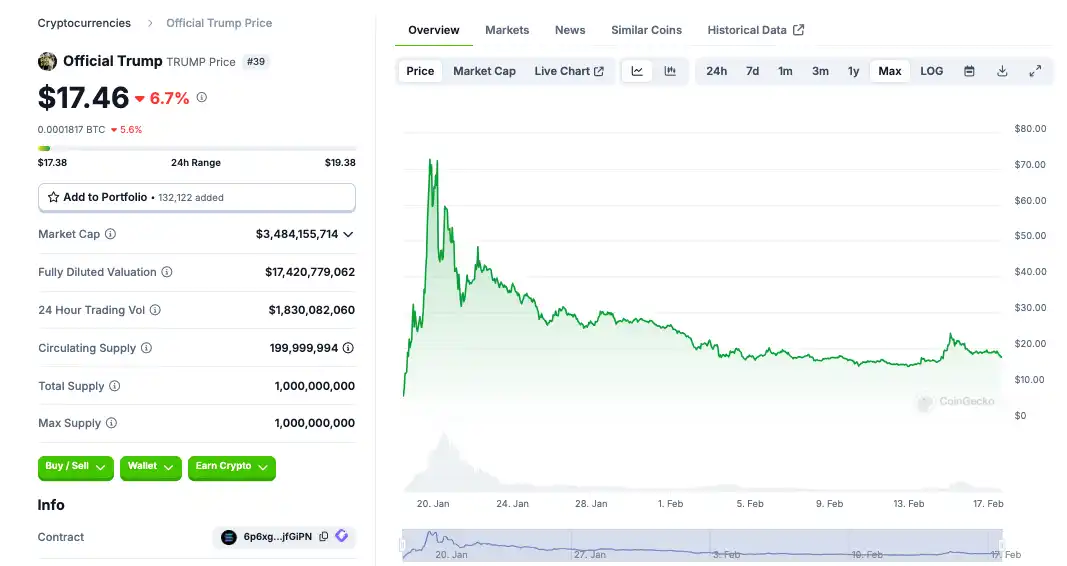
However, the issue lies in the fact that the MEME coin market is a typical zero-sum game; devoid of technological innovation, fundamentals, or value creation, it solely depends on timing the buy-ins, so not everyone can be as lucky as 0xSun. As the hype faded and Trump's wife coin issuance led to an indirect increase in the supply of $TRUMP, the coin's price plummeted from a peak of $72 to currently hover around $17.
Early statistics indicate a clear bell-curve distribution of profitable addresses, with still 560,000 addresses at a loss and only 300,000 addresses in profit.
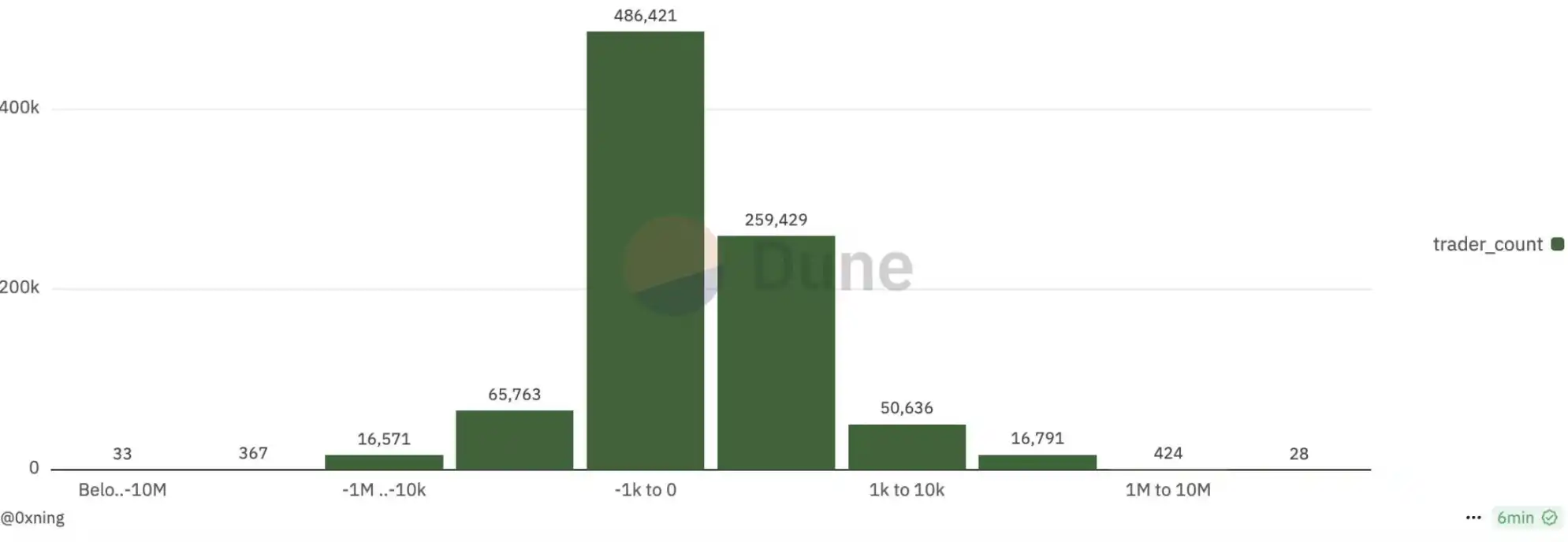
Data Source: Dune
PHD Student Koha Also Falls Victim to Holding the Bag
The market isn't always kind to everyone. Koha is a case in point; he is one of those 560,000 individuals trapped in losses.
KOHA is a Canadian engineering Ph.D. candidate who occasionally dabbles in U.S. stock investments. In 2024, he took a gamble on Trump winning the presidency and bought shares of DJT stock ahead of time, ultimately making a small profit. This success instilled confidence in Trump's business model in him, leading him to mistakenly believe that $TRUMP coin would have long-term value similar to DJT stock.
However, the cryptocurrency market moves much faster than the stock market.
At the time of $TRUMP coin's release, it was Saturday morning in Beijing time, but late Friday night in the U.S. and Canada time zones. Like many locals who were resting at that time, KOHA did not pay immediate attention to this event. By the time he learned of the $TRUMP release, it was already the next day for KOHA.
Due to Trump's frequent unfriendly policy adjustments towards the international student community, coupled with the close relationship between Canada and the U.S., lucky KOHA found himself in an environment highly attentive to Trump's actions. During the next day, KOHA learned about Trump's coin issuance in the international student group chat, with $TRUMP already soaring from the initial price all the way to $28.
He immediately took action, attempting to purchase $TRUMP through the Moonshot platform, but due to identity verification, uploading a driver's license for KYC procedures, and learning how to make the purchase, some time was wasted. By the time he finally managed to buy, the price had risen to $30. Nevertheless, he hesitated very little and decided to enter the market.
"This four-year term has just begun, and Trump is very authoritarian in this administration. The U.S. president can only serve two terms, so everyone recognizes that during the second term, it's about making money, doing business. Everyone in the world wants to do business with him. In the future, whoever wants to do business with him, $TRUMP is a pathway and a threshold," KOHA's logic was straightforward.
In KOHA's view, the more people there are who want to establish a connection with Trump through this method, the higher the price of Trumpcoin will be. "This scheme is obviously much easier to manipulate than DJT, with no need to report to the SEC upon sale. The total supply is 1 billion, with only 200 million in circulation, and 80% of the tokens are still held in their own hands. I immediately sold all DJT and bought $TRUMP coins."
KOHA is not the only investor who believes that Trump's business model can be replicated in the crypto market. In fact, many people see Trump's $TRUMP issuance as part of his financial strategy.
“Trump cannot fit in, cannot blend in, and he cannot even attempt to merge. The discord between him and his daughter Ivanka is actually a discord between two factions of financial ideology, a discord between capital. Even blood ties cannot merge.” KOHA analyzed, in his view, “the traditional financial market is controlled by the Jewish capital of Wall Street and the Democratic Party,” Trump has never been able to integrate into this system, and his only way out is to go against the trend, leveraging the decentralized nature of cryptocurrency to establish his own financial order.
KOHA's understanding of the crypto industry is as the “unexpected beneficiary of the discord between two capitals.” Trump has indeed shown a friendly attitude in his policies: easing cryptocurrency regulations to provide a more open trading environment; Bitcoin breaking through $75,000, ushering in a bull market frenzy; Republican lawmakers pushing to establish a Bitcoin strategic reserve, further enhancing market confidence. All these factors have given KOHA a grand investment narrative, making him believe that $TRUMP is a long-term asset.
When KOHA discovered that $TRUMP had been on a constant upward trend and reloaded at $40, but by the following Monday, two days later, $TRUMP had moved from the FOMO (fear of missing out) stage to the profit-taking stage. With decreasing market liquidity and declining buy orders, the coins in KOHA's hands gradually became illiquid and trapped, with an average price of $36.
This Cycle is a Game of Open Cards
Another person trapped along with KOHA is Li Yi.
However, unlike KOHA, who has no experience in the crypto world and is not even aware of the major exchanges, Li Yi has been in this market for some time. Compared to newcomers who are not even familiar with exchanges, Li Yi at least knows where to trade and understands that the logic of the crypto world is not important; emotions are the only determining factor. Li Yi frequents multiple pump-and-dump trading groups, closely follows market trends, and tracks trades by some self-proclaimed “old hands” in the crypto world.
He did indeed make a profit.
During the early price action of $TRUMP, he managed to buy in at a low of $17 with his “no wisdom, must follow” strategy, and successfully sold at the peak of the price surge, making a profit. However, after making money, he became somewhat overconfident.
After making money, Li Yi did not choose to exit but instead began looking for the "next $TRUMP."
Sure enough, the Trump family did not disappoint Li Yi. Just two days after the release of Trump Coin, Melania Trump Coin ($MELANIA) was launched. At the same time, in cryptocurrency trading groups, the concept of "family coins" began to gain popularity.
Although not receiving official support, the name of Trump's youngest son, Barron, was used by the community under the banner of the "Trump family." Against the backdrop of the soaring price of $TRUMP, they boasted about the "future president's coin," and there were even rumors in the streets that even the Trump family nanny had issued a coin, quickly attracting a wave of funds to enter the market. And Li Yi was one of them.
Naively, he believed that the logic of these coins was the same as $TRUMP and that they could also skyrocket like $TRUMP. So, he invested most of his profits in the wife's coin and son's coin.
But the market did not give him a second chance.
The rest of the family coins quickly went to zero, Li Yi's principal was trapped, and his profits evaporated instantly. Currently, he has begun to inquire about how to buy World Liberty Financial (WLFI, the Trump family's decentralized finance project), attempting to recover his losses through a new speculative project. "Let's gamble again; WLFI may perhaps continue the legitimacy of Trump Coin," Li Yi said.
This round of the cycle, the biggest change is that everyone has laid their cards on the table.

No longer needing packaging, no longer needing to pretend to be a project with technological innovation, and certainly not needing to spend $5000 to hire a gun to write an extravagant English whitepaper, stacking a bunch of obscure new concepts.
The play style of this bull market is straightforward—directly hype emotions, hype celebrities, hype topics, and hype cognitive dissonance. Utilizing the FOMO emotion, they create a series of new meme coins, exploiting the fantasies of newbies.
In the past, new chain projects would still make a little effort, disguising themselves as a seemingly innovative project. Looking back at the early days of BSC, Aptos, and Arbitrum launching new chains, the market experienced the same scene—a swarm of anonymous "innovative project factories" taking advantage of the new chain effect to harvest TVL and users. Once the market hype subsides, they simply shut down communities and websites, taking the funds and disappearing without a trace.
Behind these projects are often a group of familiar faces, just disguised differently, changed a few lines of code, and turned into new trending coins. They were initially the first popular projects on a new public chain, anonymous, mysterious, without well-known backers, or audits by major companies but always being hyped up by KOLs. Relying on the FOMO sentiment in the community, they hype wave after wave of wealth myths.
But now, the market seems to have reached another kind of consensus: that this is a new gambling table, a wealth transfer game.
No one talks about the "technological revolution" anymore, no one talks about "changing the world" anymore, everyone tacitly understands—this round is lost, just wait for the next game, if you're willing to gamble and lose, come join, the crypto world was originally made for this. It is said that even the hustlers in Hangzhou nightlife know to short meme coins now.
And Li Yi is just another participant in this wealth transfer game.
Are Short Sellers the Winners?
Among the newcomers to the crypto world interviewed in this round, the only one who made money and left was Professor L.
In the $TRUMP coin storm, most people were betting on the rise, desperately chasing highs, only to end up trapped at the peak. However, there were also those who chose the opposite direction—to short—and successfully profited against the market frenzy.
Professor L, a finance professor, and a seasoned futures trader. He has long studied market structure and knows well that the price fluctuations of cryptocurrencies are far more volatile than traditional financial markets, and $TRUMP, as a meme coin, has no fundamental support, relying entirely on market sentiment, meaning it is likely to plummet after a short-term surge.
But his trading strategy is not simply betting on a market downturn, but rather a basic futures trading strategy of "hedging":
He bought $50,000 worth of spot to ensure he wouldn't miss out on the profit from the rise. At the same time, he shorted $10,000 in $TRUMP contracts leveraging 5x as a risk hedge. If $TRUMP continues to rise, his spot gains can offset the contract's losses. If $TRUMP plunges, his short position can make up for the loss, even bringing in excess returns.
Professor L does not agree with many retail investors' gambling-style leveraged trading; "The essence of a contract is to diversify risk, not to amplify returns." But most people do not understand this principle.
At the same time, Professor L also agrees with Peter Lynch's point: "The big money short sellers do not short at the peak but rather after the market has been halved, waiting for retail investors to think the drop won't continue and start bottom fishing, the short sellers like to short at that point." And this is precisely why Professor L chose not to close his short position hastily amidst the rapid decline following $TRUMP's frenzy surge.
In the crypto trading group chat, there are always people boasting about their high-leverage achievements: "Today, I opened another 50x leverage short position and made $2000!" "Yesterday, my long position got liquidated, but today my short position made it back!" However, the truth is, this kind of strategy is ultimately gambling.
The success of Professor L stands in stark contrast to those retail investors who blindly use high leverage and gamble on their luck. With the market's violent fluctuations combined with high leverage, an account can be wiped out in an instant with just one adverse price movement. Many retail investors went crazy opening leveraged long positions at the peak of $TRUMP, fantasizing about further price surges, only to be hit hard by the market's reversal, leading to immediate liquidation and loss of all funds.
Ultimately, as the price of $TRUMP retraced from its peak, Professor L's hedging strategy allowed him to secure stable profits. He did not rely on front-running like 0xSun to reap benefits nor did he fall prey to FOMO sentiment like Li Yi. Instead, he depended on rational risk management to survive in the extreme market conditions of the cryptocurrency world and consistently make money.
How Many Pitfalls Should a Newbie Expect in the Crypto World?
Amid the frenzy of Trump Coin, not only inexperienced newcomers entered the market but also many seasoned players from traditional investment markets. They had previously navigated through the A-share market, commodity futures, and even the tea speculation market, experiencing various forms of capital games.
Professor L was fortunate, but not all veterans could replicate their past successes in the crypto world based on their experience. In other words, they had to stumble through many pitfalls before fully engaging in trading.
"In the A-share market, bulls are short-lived, and bears are enduring. Speculating on small-cap stocks with low liquidity spreads is the way to survive." This is the consensus among many domestic stock investors, including "Pancake Brother." Over the years, the speculative nature of the A-share market has made them accustomed to short-term swing trading, picking up low-priced stocks, and playing with market emotions.
When Pancake Brother saw a coin like $TRUMP with a strong hype concept, he immediately felt a sense of familiarity — "Isn't this just a high-locked small-cap stock?" As a result, he decided to "take a risk."
Pancake Brother, who bought over 4,000 RMB worth of $TRUMP at the high of $69, tried to calculate the possibility of breakeven. As the price of the coin continued to drop, during an interview with BlockBeats, the price of $TRUMP was $26 per coin, which meant that if the price surged by 5%, he would need to invest an additional 50,000 RMB to lower his average cost price. However, he himself knew that this was just a "fool's dream."
After getting trapped, Pancake Brother realized that the rules of the crypto world were much more brutal than those of the A-share market: "There are no price limits, and the inflow and outflow of funds follow no established rules; whales can wash out positions in an instant. There is no regulation, and market makers can drain liquidity at any time, controlling as they please. There is no time constraint, with 24-hour trading; the market never sleeps, giving retail investors no chance to catch their breath." Pancake Brother, filled with emotions, felt like venting for days on end.
Many investors who were used to short-term strategies in A-shares not only failed to make money in $TRUMP, but instead, due to attempting to engage in scalping and repeatedly entering and exiting positions, ended up losing their principal.
However, the cryptocurrency circle is a ruthless place. After overcoming the mismatch between traditional stock trading and cryptocurrency trading, Pancake Bro realized that he had stepped into another pitfall.
"I thought there was no hope of breaking even, so I prepared to cut my losses, only to find out that what I had bought was a fake coin." Before the spot trading platform went live, Pancake Bro followed the operations of the senior members in the trading group and purchased his first $TRUMP using a web3 wallet on a certain trading platform.
Since he had never used a web3 wallet before, he had been relying on the group's quotes. After making the purchase, he didn't bother to check further until he was ready to sell. It was then that he discovered his money hadn't actually entered the real market but had been swallowed by a hacker-deployed "fake coin contract."
And this was just a relatively straightforward way of getting "rekt" in the crypto world. There are many more pitfalls waiting for "Pancake Bro."
These mixed-quality pump-and-dump groups in the cryptocurrency world are like boiling a frog in warm water. Initially free, they use some female bloggers' beautiful photos, screenshots that suggest earnings, or photos of buying cars and houses to attract people. Inside, the senior members warmly teach newcomers how to open an account on a trading platform and how to trade, and at this stage, the senior members can earn a tuition fee through rebates from the trading platform.
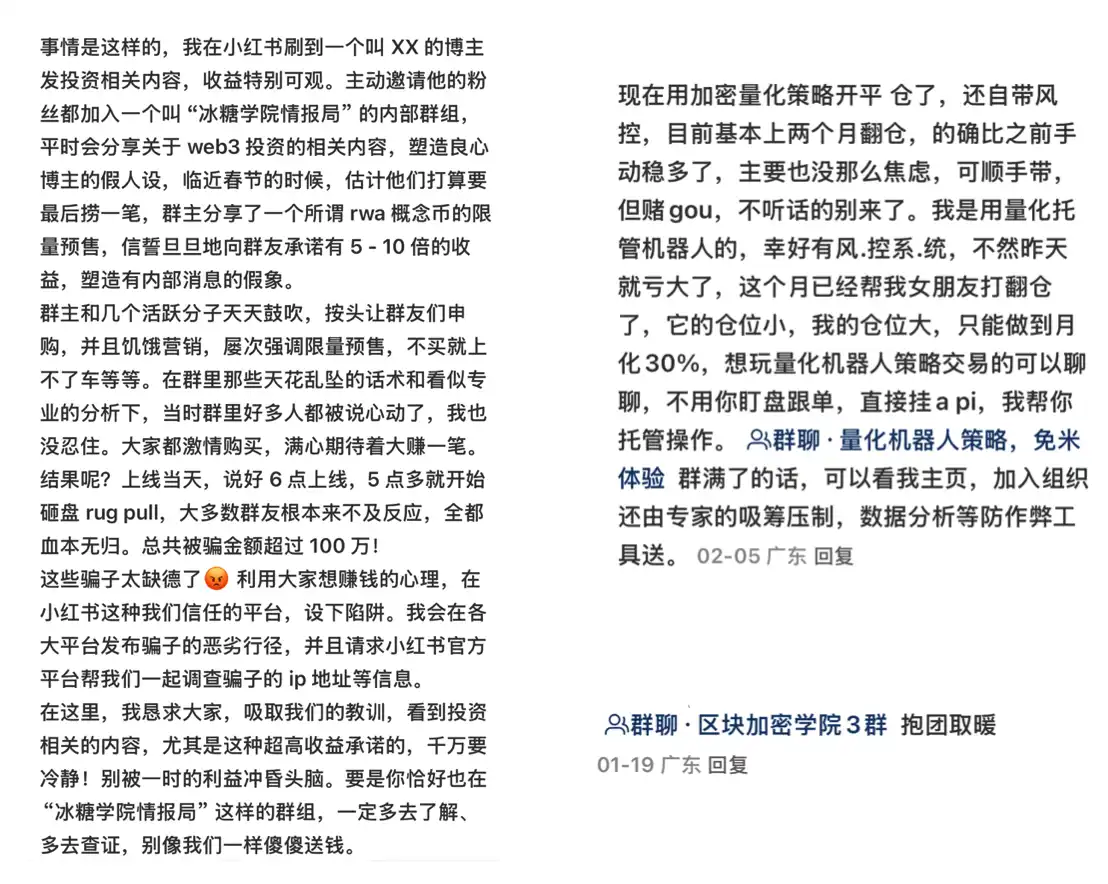
Using retail investors' funds to create artificial buy/sell walls or to generate transaction fees is considered mild. The most direct approach is to lead the group and coordinate the rug pull. They claim to have "precise insider information," but in reality, it's a premeditated scam. Currently, the most common scam on Xiaohongshu (Little Red Book) is the so-called "quantitative robot trading strategy," which claims a monthly return of 30%.
However, the cryptocurrency world is a completely different realm. The game here is a high-frequency battle measured in "seconds," where every missed second could mean a huge loss. What's worse is that many veteran players, relying on substantial capital, often adopt a "heavy re-entry of capital" strategy, only to become targets at the market's "peak." The market manipulators, long before these "whales" entered, were already prepared, waiting for these "big fish" to take the bait and swiftly absorb their funds.
In this no-smoke battlefield PvP showdown, the flow of funds and control of the market always remain in the hands of a few. For players still clinging to traditional market thinking, the rules of the crypto world often catch them off guard because here, risk and opportunity coexist, but more often, it's the risk that prevails.
When these seasoned players regained their senses, they found that not only did they not earn a hefty fortune in the crypto world through years of experience, but instead became a typical example of being "rug pulled" upon entry. The familiar rules of thumb were rendered useless in the face of this brand new market,
and all of this was the tuition fee they had to pay when entering this industry.
You may also like

$COIN Joins S&P 500, but Coinbase Isn't Celebrating
On May 13, S&P Dow Jones Indices announced that Coinbase would officially replace Discover Financial Services in the S&P 500 on May 19. While other companies like Block and MicroStrategy, closely tied to Bitcoin, were already part of the S&P 500, Coinbase became the first cryptocurrency exchange whose primary business is in the index. This also signifies that cryptocurrency is gradually moving from the fringes to the mainstream in the U.S.
On the day of the announcement, Coinbase's stock price surged by 23%, surpassing the $250 mark. However, just 3 days later, Coinbase was hit by two consecutive events: a hack where employees were bribed to steal customer data and a demand for a $20 million ransom, and an investigation by the U.S. Securities and Exchange Commission (SEC) into the authenticity of its claim of having over 100 million "verified users" in its securities filings and marketing materials. These two events acted as mini-bombs, and at the time of writing, Coinbase's stock had already dropped by over 7.3%.
Coincidentally, Discover Financial Services, being replaced by Coinbase, can also be considered the "Coinbase" of the previous payment era. Discover is a U.S.-based digital banking and payment services company headquartered in Illinois, founded in 1960. Its payment network, Discover Network, is the fourth largest payment network apart from Visa, Mastercard, and American Express.
In April, after the approval of the acquisition of Discover by the sixth-largest U.S. bank, Capital One, this well-established digital banking company of over 60 years smoothly handed over its S&P 500 "seat" to this emerging cryptocurrency "bank." This unexpected coincidence also portrayed the handover between the new and old eras in Coinbase's entry into the S&P 500, resembling a relay race scene. However, this relay baton also brought Coinbase's accumulated "external troubles and internal strife" to a tipping point.
Over the past decade, cryptocurrency exchanges have been the most stable "profit machines." They play a role in providing liquidity to the entire industry and rely on trading fees to sustain their operations. However, with the comprehensive rollout of ETF products in the U.S. market, this profit model is facing unprecedented challenges. As the leader in the "American stack," with over 80% of its business coming from the U.S., Coinbase is most affected by this.
Starting from the approval of Bitcoin and Ethereum spot ETFs, traditional financial capital has significantly onboarded users and funds that originally belonged to exchanges in a more cost-effective, compliant, and transparent manner. The transaction fee revenue of cryptocurrency exchanges has started to decline, and this trend may further intensify in the coming months.
According to Coinbase's 2024 Q4 financial report, the platform's total trading revenue was $417 million, a 45% year-on-year decrease. The contribution of BTC and ETH's trading revenue dropped from 65% in the same period last year to less than 50%.
This decline is not a result of a decrease in market enthusiasm. In fact, since the approval of the Bitcoin ETF in January 2024, the inflow of BTC into the U.S. market has continued to reach new highs, with asset management giants like BlackRock and Fidelity rapidly expanding their management scale. Data shows that BlackRock's iShares Bitcoin ETF (IBIT) alone has surpassed $17 billion in assets under management. As of mid-May 2025, the cumulative net inflow of 11 major institutional Bitcoin spot ETFs on the market has exceeded $41.5 billion, with a total net asset value of $1214.69 billion, accounting for approximately 5.91% of the total Bitcoin market capitalization.
Institutional investors and some retail investors are shifting towards ETF products, partly due to compliance and tax considerations. On one hand, ETFs have much lower trading costs compared to cryptocurrency exchanges. While Coinbase's spot trading fee rate varies annually in a tiered manner but averages around 1.49%, for example, the management fee for IBIT ETF is only 0.25%, and the majority of ETF institution fees fluctuate around 0.15% to 0.25%.
In other words, the more rational users are, the more likely they are to move from exchanges to ETF products, especially for investors aiming for long-term holdings.
According to multiple sources, several institutions, including VanEck and Grayscale, have submitted applications to the SEC for a Solana (SOL) ETF, with some institutions also planning to submit an XRP ETF proposal. Once approved, this may trigger a new round of fund migration. According to a report submitted by Coinbase to the SEC, as of April, the platform's trading revenue from XRP and Solana accounted for 18% and 10%, nearly one-third of the platform's fee revenue.
However, the Bitcoin and Ethereum ETFs passed in 2024 also reduced the fees for these two tokens on Coinbase from 30% and 15% to 26% and 10%, respectively. If the SOL and XRP ETFs are approved, it will further undermine the core fee revenue of exchanges like Coinbase.
The expansion of ETF products is gradually weakening the financial intermediary status of cryptocurrency exchanges. From their original roles as matchmakers and clearers to now gradually becoming mere "on-ramps and off-ramps" for funds, exchanges are seeing their marginal value squeezed by ETFs.
On May 12, 2025, SEC Chairman Paul S. Atkins gave a keynote speech at the Tokenization and Cryptocurrency Working Group roundtable. The theme of his speech revolved around "It is a new day at the SEC," where he indicated that the SEC would not approach enforcement and regulation the same way as before but would instead pave the way for cryptocurrency assets in the U.S. market.
With signs of cryptocurrency compliance such as the SEC's "NEW DAY" declaration, an increasing number of traditional brokerages are attempting to enter the cryptocurrency industry. One of the most representative cases is the well-known U.S. brokerage Robinhood, which began expanding its crypto business in 2018. By the time of its IPO in 2021, Robinhood's crypto business revenue accounted for over 50% of the company, with a significant boost from the Dogecoin "moonshot" promoted by Musk.
In Q1 2025 earnings report, Robinhood showcased strong growth, especially in revenue from cryptocurrency and options trading. Fueled by Trump's Memecoin, cryptocurrency-related revenue reached $250 million, nearly doubling year-over-year. Consequently, Robinhood Gold subscription users reached 3.5 million, a 90% increase from the previous year, with the rapid growth of Robinhood Gold providing the company with a stable source of income.
Meanwhile, RobinHood is actively pursuing acquisitions in the cryptocurrency space. In 2024, it announced a $2 billion acquisition of the long-standing European cryptocurrency exchange Bitstamp. Additionally, Canada's largest cryptocurrency CEX, WonderFi, which recently went public on the Toronto Stock Exchange, also announced its integration with RobinHood Crypto. After obtaining virtual asset licenses in the UK, Canada, Singapore, and other markets, RobinHood has taken a proactive approach in the compliant cryptocurrency trading market.
Furthermore, an increasing number of brokerage firms are exploring the same path. Futu Securities, Tiger Brokers, and others are also dipping their toes into cryptocurrency trading, with some having applied for or obtained the VA license from the Hong Kong SFC. Although their user bases are currently small, traditional brokerages have a natural advantage in user trust, regulatory licenses, and low fee structures. This could pose a threat to native cryptocurrency platforms in the future.
In April 2025, security researchers discovered that some Coinbase user data was leaked on the dark web. While the platform initially responded by attributing it to a "technical misinformation," it still raised concerns among users regarding its security and privacy protection. Just two days before Dow Jones Indexes announced Coinbase's addition to the S&P 500 Index, on May 11, 2025, Coinbase received an email from an unknown threat actor claiming to have obtained customer account information and internal documents, demanding a $20 million ransom to keep the data private. Subsequent investigations confirmed the data breach.
Cybercriminals obtained the data by bribing overseas customer service agents and support staff, mainly in "non-U.S. regions such as India." These agents abused their access to Coinbase's internal customer support system and stole customer data. As early as February this year, blockchain detective ZachXBT revealed on X platform that between December 2024 and January 2025, Coinbase users lost over $65 million to social engineering scams, with the actual amount potentially higher.
Among the victims was a well-known figure, 67-year-old Ed Suman, an established artist in the art world for nearly two decades, having been involved in the creation of artworks such as Jeff Koons' "Balloon Dog" sculpture. Earlier this year, he fell victim to an impersonation scam involving fake Coinbase customer support, resulting in a loss of over $2 million in cryptocurrency. ZachXBT critiqued Coinbase for its inadequate handling of such scams, noting that other major exchanges have not faced similar issues and recommending Coinbase to enhance its security measures.
Amidst a series of ongoing social engineering incidents, although there has not been any impact on user assets at the technical level so far, it has raised concerns among many retail and institutional investors. Especially institutions holding massive assets on Coinbase. Just considering the U.S. BTC ETF institutions, as of mid-May 2025, they collectively hold nearly 840,000 BTC, and 75% of these are custodied by Coinbase. If we price BTC at $100,000, this amount reaches a staggering $63 billion, which is equivalent to the nominal GDP of two Iceland in the year 2024.
In addition, Coinbase Custody also serves over 300 institutional clients, including hedge funds, family offices, pension funds, and endowments. As of the Q1 2025 financial report, Coinbase's total assets under management (including institutional and retail clients) reached $404 billion. The specific amount of institutional custodied assets was not explicitly disclosed in the latest report, but it should still be over 50% based on the Q4 2024 report.
Once this security barrier is breached, not only could the rate of user attrition far exceed expectations, but more importantly, institutional trust in it would undermine the foundation of its business. Therefore, after a hacking event, Coinbase's stock price plummeted significantly.
Facing a decline in spot trading fee revenue, Coinbase is also accelerating its transformation, attempting to find growth opportunities in derivatives and emerging assets. Coinbase acquired a stake in the options platform Deribit at the end of 2024 and announced the official launch of perpetual contract products in 2025. This acquisition fills in Coinbase's gap in options trading and its relatively small global market share.
Deribit has a strong presence in non-U.S. markets, especially in Asia and Europe. The acquisition has enabled Coinbase to gain a dominant position in bitcoin and ethereum options trading on Deribit, accounting for approximately 80% of the global options trading volume, with daily trading volume remaining above $2 billion.
Meanwhile, 80-90% of Deribit's customer base consists of institutional investors, with their professionalism and liquidity in the Bitcoin and Ethereum options market highly favored by institutions. Coinbase's compliance advantage, coupled with its already robust institutional ecosystem, makes it even more suitable. By using institutions as an entry point, it can face the squeeze from giants like Binance and OKX in the derivatives market.
Facing a similar dilemma is Kraken, which is attempting to replicate Binance Futures' model in non-U.S. markets. Since the derivatives market relies more on professional users, fee rates are relatively higher and stickiness is stronger, making it a significant source of revenue for exchanges. In the first half of 2025, Kraken completed the acquisition of TradeStation Crypto and a futures exchange, aiming to build a complete derivatives trading ecosystem to hedge the risk of declining spot transaction fee income.
With the surge of Memecoin in 2024, Binance, OKX, and various CEX platforms began massively listing small-market-cap, highly volatile tokens to activate active trading users. Due to the wealth effect and trading activity of Memecoins, Coinbase was also forced to join the battle, successively listing popular tokens from the Solana ecosystem such as BOOK OF MEME and Dogwifhat. Although these coins are controversial, they are frequently traded, with fee rates several times higher than mainstream coins, serving as a "blood-boosting" method for spot trading.
However, due to its status as a publicly traded company, this practice is a riskier endeavor for Coinbase. Even in the current crypto-friendly environment, the SEC is still investigating whether tokens like SOL, ADA, and SAND constitute securities.
In addition to the forced transformation strategies carried out by the aforementioned CEXs, they are also starting to lay out RWAs and the most talked-about stablecoin payment fields, such as the PYUSD launched through a collaboration between Coinbase and Paypal, Coinbase's support for the Euro stablecoin EURC by Circle that complies with EU MiCA regulatory requirements, or the USD1 launched through a collaboration between Binance and WIFL. In the increasingly crowded trading field, many CEXs have shifted their focus from just the trading market to the application field.
The golden age of transaction fees has quietly ended, and the second half of the crypto exchange platform game has silently begun.
President's 'Official' Coin Issuance, Market Performance 'Desensitized'; Trump's Crypto Empire Lacks Novelty
Taking Stock of the Top 10 Emerging Launchpad Platforms: Who Will Succeed in Disrupting Pump.fun?
GoRich Officially Launched: On-Chain Transactions with Zero Barrier to Entry, Even Beginners Can Catch 100x Meme Coins
Exclusive Interview with AllianceDAO Partner qw: Crypto Entrepreneurs Are Fleeing to AI, 90% of Crypto+AI Projects Are Misleading
From the Pokémon Scandal to Doubling Trading Volume, Unveiling the Logic Behind Sui's Recent Strong Rally
From Cantor to Securitize, Crypto Industry Buys Up Washington
Key Market Insights from April 27th, How Much Did You Miss?
This Week in Review | Trump to Host Dinner for TRUMP Holders; Musk and US Treasury Secretary Engage in Heated Argument at the White House
Key Market Information Discrepancy on April 27th - A Must-Read! | Alpha Morning Report
April 25th Market Key Insights - How Much Did You Miss?
ZORA Airdrop Disaster: Early Users "HODL" for Four Years, Average Per Person Less Than $40
Emotions are down, data is holding strong: Can the Memecoin make a comeback?
History Doesn’t Repeat, But It Rhymes — Don’t Miss It This Time
From BTC to SOL: A New Direction for Traditional Corporate Crypto Asset Allocation
Who Will Have Dinner with Trump?
April 24th Market Key Insights, How Much Did You Miss?
PVP Arena Heat is Back, Can PumpSwap Reignite the Solana Ecosystem?
$COIN Joins S&P 500, but Coinbase Isn't Celebrating
On May 13, S&P Dow Jones Indices announced that Coinbase would officially replace Discover Financial Services in the S&P 500 on May 19. While other companies like Block and MicroStrategy, closely tied to Bitcoin, were already part of the S&P 500, Coinbase became the first cryptocurrency exchange whose primary business is in the index. This also signifies that cryptocurrency is gradually moving from the fringes to the mainstream in the U.S.
On the day of the announcement, Coinbase's stock price surged by 23%, surpassing the $250 mark. However, just 3 days later, Coinbase was hit by two consecutive events: a hack where employees were bribed to steal customer data and a demand for a $20 million ransom, and an investigation by the U.S. Securities and Exchange Commission (SEC) into the authenticity of its claim of having over 100 million "verified users" in its securities filings and marketing materials. These two events acted as mini-bombs, and at the time of writing, Coinbase's stock had already dropped by over 7.3%.
Coincidentally, Discover Financial Services, being replaced by Coinbase, can also be considered the "Coinbase" of the previous payment era. Discover is a U.S.-based digital banking and payment services company headquartered in Illinois, founded in 1960. Its payment network, Discover Network, is the fourth largest payment network apart from Visa, Mastercard, and American Express.
In April, after the approval of the acquisition of Discover by the sixth-largest U.S. bank, Capital One, this well-established digital banking company of over 60 years smoothly handed over its S&P 500 "seat" to this emerging cryptocurrency "bank." This unexpected coincidence also portrayed the handover between the new and old eras in Coinbase's entry into the S&P 500, resembling a relay race scene. However, this relay baton also brought Coinbase's accumulated "external troubles and internal strife" to a tipping point.
Over the past decade, cryptocurrency exchanges have been the most stable "profit machines." They play a role in providing liquidity to the entire industry and rely on trading fees to sustain their operations. However, with the comprehensive rollout of ETF products in the U.S. market, this profit model is facing unprecedented challenges. As the leader in the "American stack," with over 80% of its business coming from the U.S., Coinbase is most affected by this.
Starting from the approval of Bitcoin and Ethereum spot ETFs, traditional financial capital has significantly onboarded users and funds that originally belonged to exchanges in a more cost-effective, compliant, and transparent manner. The transaction fee revenue of cryptocurrency exchanges has started to decline, and this trend may further intensify in the coming months.
According to Coinbase's 2024 Q4 financial report, the platform's total trading revenue was $417 million, a 45% year-on-year decrease. The contribution of BTC and ETH's trading revenue dropped from 65% in the same period last year to less than 50%.
This decline is not a result of a decrease in market enthusiasm. In fact, since the approval of the Bitcoin ETF in January 2024, the inflow of BTC into the U.S. market has continued to reach new highs, with asset management giants like BlackRock and Fidelity rapidly expanding their management scale. Data shows that BlackRock's iShares Bitcoin ETF (IBIT) alone has surpassed $17 billion in assets under management. As of mid-May 2025, the cumulative net inflow of 11 major institutional Bitcoin spot ETFs on the market has exceeded $41.5 billion, with a total net asset value of $1214.69 billion, accounting for approximately 5.91% of the total Bitcoin market capitalization.
Institutional investors and some retail investors are shifting towards ETF products, partly due to compliance and tax considerations. On one hand, ETFs have much lower trading costs compared to cryptocurrency exchanges. While Coinbase's spot trading fee rate varies annually in a tiered manner but averages around 1.49%, for example, the management fee for IBIT ETF is only 0.25%, and the majority of ETF institution fees fluctuate around 0.15% to 0.25%.
In other words, the more rational users are, the more likely they are to move from exchanges to ETF products, especially for investors aiming for long-term holdings.
According to multiple sources, several institutions, including VanEck and Grayscale, have submitted applications to the SEC for a Solana (SOL) ETF, with some institutions also planning to submit an XRP ETF proposal. Once approved, this may trigger a new round of fund migration. According to a report submitted by Coinbase to the SEC, as of April, the platform's trading revenue from XRP and Solana accounted for 18% and 10%, nearly one-third of the platform's fee revenue.
However, the Bitcoin and Ethereum ETFs passed in 2024 also reduced the fees for these two tokens on Coinbase from 30% and 15% to 26% and 10%, respectively. If the SOL and XRP ETFs are approved, it will further undermine the core fee revenue of exchanges like Coinbase.
The expansion of ETF products is gradually weakening the financial intermediary status of cryptocurrency exchanges. From their original roles as matchmakers and clearers to now gradually becoming mere "on-ramps and off-ramps" for funds, exchanges are seeing their marginal value squeezed by ETFs.
On May 12, 2025, SEC Chairman Paul S. Atkins gave a keynote speech at the Tokenization and Cryptocurrency Working Group roundtable. The theme of his speech revolved around "It is a new day at the SEC," where he indicated that the SEC would not approach enforcement and regulation the same way as before but would instead pave the way for cryptocurrency assets in the U.S. market.
With signs of cryptocurrency compliance such as the SEC's "NEW DAY" declaration, an increasing number of traditional brokerages are attempting to enter the cryptocurrency industry. One of the most representative cases is the well-known U.S. brokerage Robinhood, which began expanding its crypto business in 2018. By the time of its IPO in 2021, Robinhood's crypto business revenue accounted for over 50% of the company, with a significant boost from the Dogecoin "moonshot" promoted by Musk.
In Q1 2025 earnings report, Robinhood showcased strong growth, especially in revenue from cryptocurrency and options trading. Fueled by Trump's Memecoin, cryptocurrency-related revenue reached $250 million, nearly doubling year-over-year. Consequently, Robinhood Gold subscription users reached 3.5 million, a 90% increase from the previous year, with the rapid growth of Robinhood Gold providing the company with a stable source of income.
Meanwhile, RobinHood is actively pursuing acquisitions in the cryptocurrency space. In 2024, it announced a $2 billion acquisition of the long-standing European cryptocurrency exchange Bitstamp. Additionally, Canada's largest cryptocurrency CEX, WonderFi, which recently went public on the Toronto Stock Exchange, also announced its integration with RobinHood Crypto. After obtaining virtual asset licenses in the UK, Canada, Singapore, and other markets, RobinHood has taken a proactive approach in the compliant cryptocurrency trading market.
Furthermore, an increasing number of brokerage firms are exploring the same path. Futu Securities, Tiger Brokers, and others are also dipping their toes into cryptocurrency trading, with some having applied for or obtained the VA license from the Hong Kong SFC. Although their user bases are currently small, traditional brokerages have a natural advantage in user trust, regulatory licenses, and low fee structures. This could pose a threat to native cryptocurrency platforms in the future.
In April 2025, security researchers discovered that some Coinbase user data was leaked on the dark web. While the platform initially responded by attributing it to a "technical misinformation," it still raised concerns among users regarding its security and privacy protection. Just two days before Dow Jones Indexes announced Coinbase's addition to the S&P 500 Index, on May 11, 2025, Coinbase received an email from an unknown threat actor claiming to have obtained customer account information and internal documents, demanding a $20 million ransom to keep the data private. Subsequent investigations confirmed the data breach.
Cybercriminals obtained the data by bribing overseas customer service agents and support staff, mainly in "non-U.S. regions such as India." These agents abused their access to Coinbase's internal customer support system and stole customer data. As early as February this year, blockchain detective ZachXBT revealed on X platform that between December 2024 and January 2025, Coinbase users lost over $65 million to social engineering scams, with the actual amount potentially higher.
Among the victims was a well-known figure, 67-year-old Ed Suman, an established artist in the art world for nearly two decades, having been involved in the creation of artworks such as Jeff Koons' "Balloon Dog" sculpture. Earlier this year, he fell victim to an impersonation scam involving fake Coinbase customer support, resulting in a loss of over $2 million in cryptocurrency. ZachXBT critiqued Coinbase for its inadequate handling of such scams, noting that other major exchanges have not faced similar issues and recommending Coinbase to enhance its security measures.
Amidst a series of ongoing social engineering incidents, although there has not been any impact on user assets at the technical level so far, it has raised concerns among many retail and institutional investors. Especially institutions holding massive assets on Coinbase. Just considering the U.S. BTC ETF institutions, as of mid-May 2025, they collectively hold nearly 840,000 BTC, and 75% of these are custodied by Coinbase. If we price BTC at $100,000, this amount reaches a staggering $63 billion, which is equivalent to the nominal GDP of two Iceland in the year 2024.
In addition, Coinbase Custody also serves over 300 institutional clients, including hedge funds, family offices, pension funds, and endowments. As of the Q1 2025 financial report, Coinbase's total assets under management (including institutional and retail clients) reached $404 billion. The specific amount of institutional custodied assets was not explicitly disclosed in the latest report, but it should still be over 50% based on the Q4 2024 report.
Once this security barrier is breached, not only could the rate of user attrition far exceed expectations, but more importantly, institutional trust in it would undermine the foundation of its business. Therefore, after a hacking event, Coinbase's stock price plummeted significantly.
Facing a decline in spot trading fee revenue, Coinbase is also accelerating its transformation, attempting to find growth opportunities in derivatives and emerging assets. Coinbase acquired a stake in the options platform Deribit at the end of 2024 and announced the official launch of perpetual contract products in 2025. This acquisition fills in Coinbase's gap in options trading and its relatively small global market share.
Deribit has a strong presence in non-U.S. markets, especially in Asia and Europe. The acquisition has enabled Coinbase to gain a dominant position in bitcoin and ethereum options trading on Deribit, accounting for approximately 80% of the global options trading volume, with daily trading volume remaining above $2 billion.
Meanwhile, 80-90% of Deribit's customer base consists of institutional investors, with their professionalism and liquidity in the Bitcoin and Ethereum options market highly favored by institutions. Coinbase's compliance advantage, coupled with its already robust institutional ecosystem, makes it even more suitable. By using institutions as an entry point, it can face the squeeze from giants like Binance and OKX in the derivatives market.
Facing a similar dilemma is Kraken, which is attempting to replicate Binance Futures' model in non-U.S. markets. Since the derivatives market relies more on professional users, fee rates are relatively higher and stickiness is stronger, making it a significant source of revenue for exchanges. In the first half of 2025, Kraken completed the acquisition of TradeStation Crypto and a futures exchange, aiming to build a complete derivatives trading ecosystem to hedge the risk of declining spot transaction fee income.
With the surge of Memecoin in 2024, Binance, OKX, and various CEX platforms began massively listing small-market-cap, highly volatile tokens to activate active trading users. Due to the wealth effect and trading activity of Memecoins, Coinbase was also forced to join the battle, successively listing popular tokens from the Solana ecosystem such as BOOK OF MEME and Dogwifhat. Although these coins are controversial, they are frequently traded, with fee rates several times higher than mainstream coins, serving as a "blood-boosting" method for spot trading.
However, due to its status as a publicly traded company, this practice is a riskier endeavor for Coinbase. Even in the current crypto-friendly environment, the SEC is still investigating whether tokens like SOL, ADA, and SAND constitute securities.
In addition to the forced transformation strategies carried out by the aforementioned CEXs, they are also starting to lay out RWAs and the most talked-about stablecoin payment fields, such as the PYUSD launched through a collaboration between Coinbase and Paypal, Coinbase's support for the Euro stablecoin EURC by Circle that complies with EU MiCA regulatory requirements, or the USD1 launched through a collaboration between Binance and WIFL. In the increasingly crowded trading field, many CEXs have shifted their focus from just the trading market to the application field.
The golden age of transaction fees has quietly ended, and the second half of the crypto exchange platform game has silently begun.


 App
App