
- Buy Crypto
- Markets
- Futures
- Spot
- Copy Trade
 WE-Launch
2025 Whale Saga: Mansion Kidnapping, Supply Chain Poisoning, and Billions Liquidated

Original Title: "Top 10 Hard Lessons of the 2025 Crypto Market: From Contract Liquidation to Trusting 'Customer Service,' Whales Paid Hundreds of Millions in 'Tuition'"
Original Author: angelilu, Foresight News
The 2025 crypto market was like a high-speed express train. Looking back from the platform, people could only see the survivors inside the train raising their glasses in celebration, but few paid attention to those passengers who were thrown off track.
This year, we not only witnessed gamblers going crazy in the futures market but also saw the Web3 Dark Forest Rule cruelly seep into the physical world. The stories of getting rich quick were similar, but the ways of getting liquidated were diverse. We reconstructed the losing records of several typical figures in 2025 — among them were billionaires, tech geeks, legendary gamblers, and even ordinary people who just wanted to save money.
Trading Section
Machi Big Brother Becomes the On-Chain 'Liquidation Champion'
· Identity: Renowned singer, entrepreneur, NFT whale
· Loss: Liquidated 71 times in just 19 days 11 months ago; Daily loss of $21.28 million
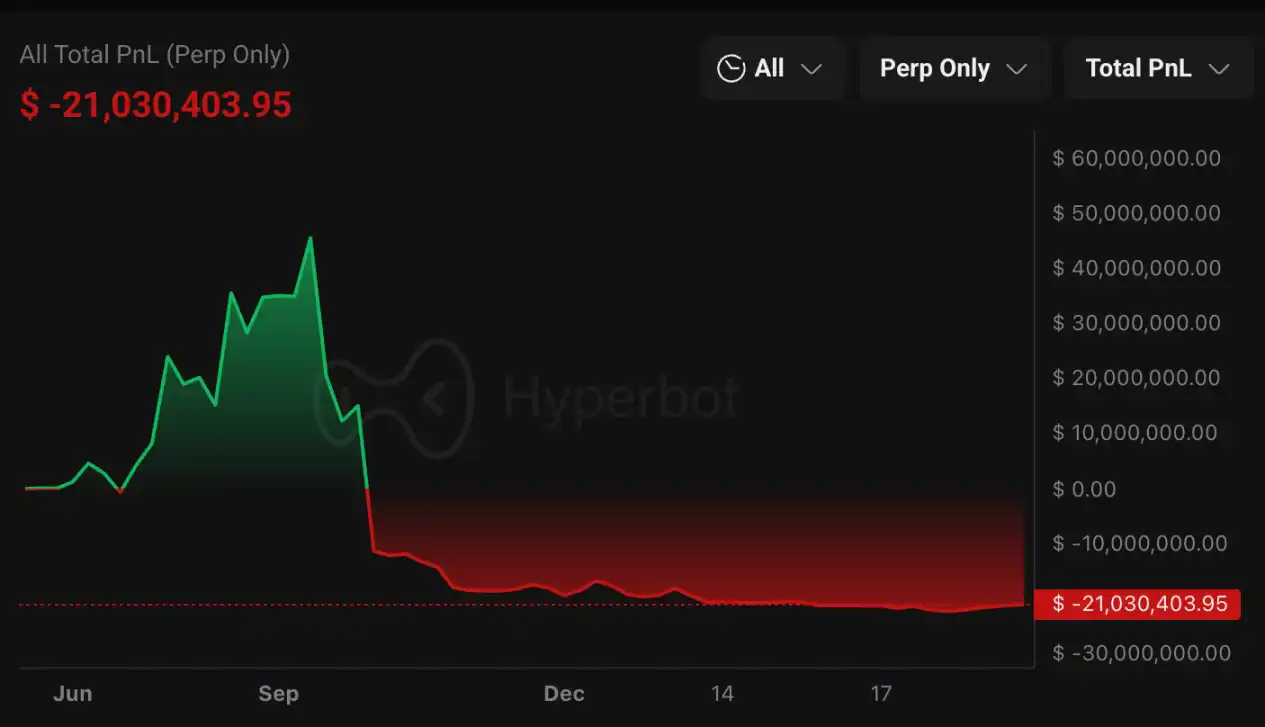
Huang Licheng's PnL Curve Chart, Source: Hyperbot
If we turn the clock back three months, Machi Big Brother was still the winner in the Hyperliquid ecosystem, with a paper gain of over $44 million at one point, heavily invested in HYPE, XPL, and ETH. By the end of September and the beginning of October, the XPL price collapsed (with a maximum drawdown of 46%), and HYPE also saw a significant pullback. He did not take profits in time, leading to a rapid expansion of the unrealized losses of a single coin to over $8.7 million.
With the "10.11" market crash, Machi Big Brother officially turned into a loss. However, this turning point into a loss was not the end for Machi Big Brother but the starting point of his infinite martingale strategy. He tried to recoup his losses by longing ETH with high leverage. He held long positions of around 7,000 to 30,000 ETH (leverage ratios often between 20x and 25x), but every time ETH took a nosedive, it would trigger his liquidation.
In just 19 days from November 1 to 19, Machi Big Brother was forcibly liquidated 71 times. This means that in nearly three weeks, he experienced nearly 4 liquidations per day on average, claiming the title of the on-chain "Liquidation Champion," but he kept topping up, getting liquidated, topping up again, and getting liquidated again. As of the time of writing, his total perpetual contract loss on Hyperliquid has reached $21.20 million. From earning $45.66 million to losing $21.20 million, in less than 3 months, he experienced a withdrawal of assets exceeding $66 million. Despite a brief recovery, he is still deeply in loss and in a state of frequent fund injections and liquidations.
Unlike ordinary people, Brother Ma, Licheng Huang, has even shouldered the aura of a superstar. In the 1990s, he was the soul of Taiwan's L.A. Boyz, a pioneering idol who brought pure American hip-hop into the Chinese music scene. This was not Brother Ma's first time playing the role of a "retail savior." Everyone surely remembers the NFT battlefield of 2023. In order to compete for BLUR's airdrop points, he once frenziedly traded in this abyss. The outcome was tragic: he did receive airdropped tokens worth 1.9 million USD, but at the cost of losing 12,000 ETH (worth 25 million USD at the time).
James Wynn's Billion-Dollar Gamble
· Name: James Wynn
· Loss: Opened a 1.25 billion USD Bitcoin long position, lost 100 million USD in a week
If Brother Ma is considered "the pastime of the wealthy," then James Wynn's story is like that of a mortal who flew too high and ultimately had his wings melted by the sun.
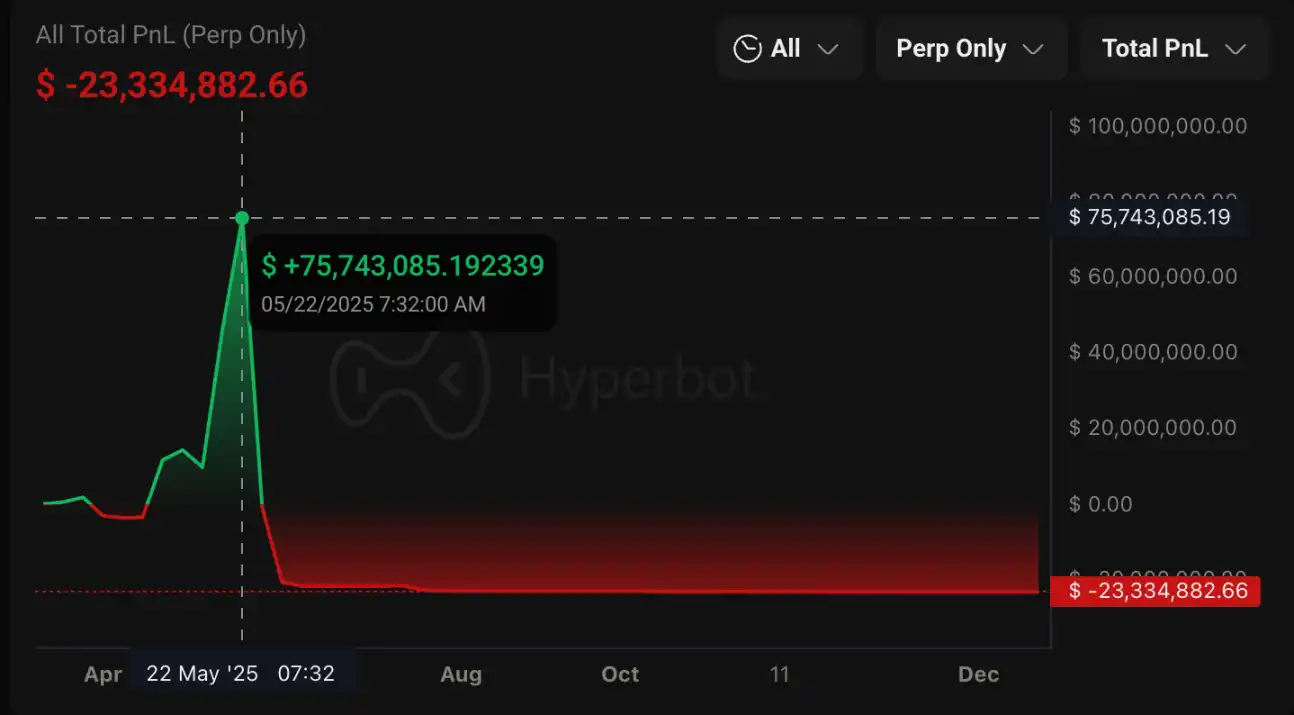
Also involved in a smart contract transaction, James Wynn's legend began with PEPE but erupted in the Hyperliquid contract battlefield. In March 2025, James Wynn, armed with the massive 25 million USD he earned from PEPE, plunged into Hyperliquid to start contract trading. This 25 million USD windfall was earned by heavily betting on the meme coin PEPE with a capital of just 7,600 USD in 2023. Unsatisfied with spot trading gains, he aggressively leveraged long positions on PEPE and ETH from March to April, once again profiting 25 million USD, becoming a super whale holding 50 million USD.
In May 2025, James Wynn turned his attention to Bitcoin, when BTC was challenging the historical high of 110,000 USD. At that time, James Wynn did something monumental on-chain: near Bitcoin's historical high of around 108,000 USD, he went all-in with 40x leverage, crazily opening a massive long position worth a nominal 12.5 billion USD. What does this number represent? His on-chain position alone exceeded the treasury reserves of many small countries. He attempted to use this 12.5 billion USD leverage to pry open the door to becoming the world's richest man.
However, a sharp Bitcoin retracement that broke through the 105,000 USD mark became James Wynn's nightmare. In just one week, his invaluable contract melted away like an iceberg in the sun. Ultimately, he had to liquidate his position, losing nearly 100 million USD. Overnight, almost all of the astronomical figures he earned through PEPE were returned to the market. In the aftermath, he left a nihilistic quote on Twitter: "Money isn't real."
Unyielding, James Wynn attempted to "turn the tables" in November, but misjudged his direction — he bet that Bitcoin would drop below $92,000 and went all in on a short position. Data recorded his final madness: in just 2 months, he was liquidated 45 times; on his worst day, he was liquidated 12 times within 12 hours. The once "Meme Coin Oracle" has now become a gambler shouting at the candlesticks. He vowed on social media, "I will sell all stablecoins to go short. Either make billions or go completely bankrupt."
Spot Whale Loses $125 Million, "Cuts Losses" and Exits
· Identity: Whale shorting 66,000 ETH
· Loss: Single position floating loss of $125 million; transferred $140 million to Binance to dump within 8 hours
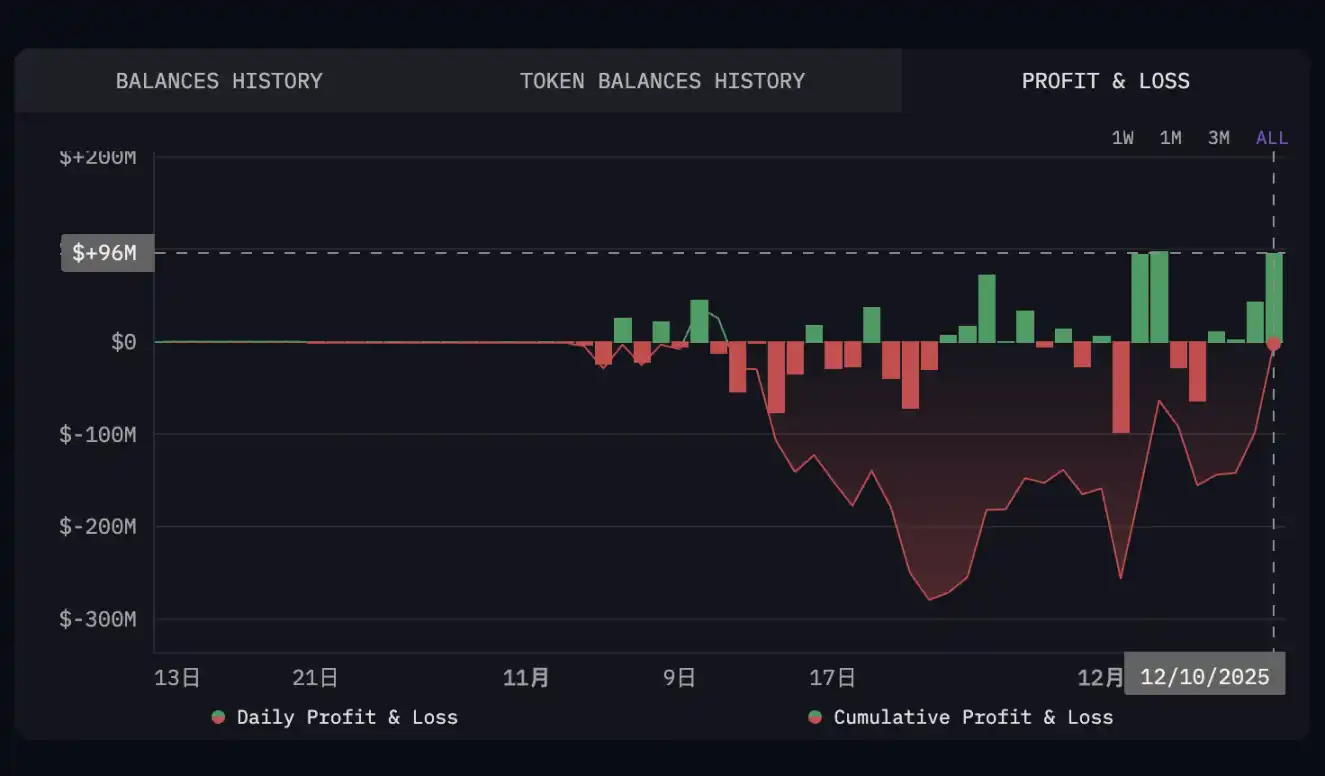
In addition to futures contracts, whales holding spot positions also suffered massive losses. The "whale shorting 66,000 ETH" was once a hunter in the market, skilled at conducting large-scale short arbitrage using lending protocols. But this time, the hunter became the hunted.
Earning $24 million through shorting did not satisfy him; he wanted more — he wanted to "short the market twice." On November 5, after closing his short positions, he immediately reversed course and began to bottom fish recklessly. Within just 9 days until November 14, like a man possessed, he transferred a total of $1.187 billion to Binance, withdrew 422,000 ETH, and raised his average holding price to $3,413. For this high-stakes gamble, he even used on-chain leverage loans amounting to as high as $485 million.
The market dealt the greediest one the harshest blow. As the ETH price plummeted, breaking below the $3,000 mark, his "bottom fishing" turned into a "deep trap." On-chain data recorded his most desperate moment: during November's darkest period, his massive long position saw a floating loss of up to $133 million. The $24.48 million profit previously hard-earned through shorting was instantly swallowed by this massive loss, with even the principal entirely wiped out to the tune of a full billion. The former "Shorting War God," along with borrowed money, turned into a "leveraged gambler" burdened with $480 million in debt.
On November 16, the whale began a large-scale retreat, redeeming 177,000 ETH from Aave and starting to gradually deposit 44,000 ETH to Binance (worth $140 million), realizing a $125 million loss.
The Whale Who Fell in the "Chinese Meme" Trap
· Identity: High-profile holder of Chinese Meme tokens
· Loss: Total loss of 3.598 million dollars (Single-asset loss of 2.49 million)
Aside from holding onto ETH for dear life, many have also experienced significant losses due to holding onto Meme coins.
In October 2025, as the market hype rotated between AI and mainstream coins, this whale found himself trapped in the narrative maze of "Chinese Meme."
Like a determined stamp collector, he invested 4.49 million dollars and went on a frenzy to accumulate a series of Chinese Meme tokens on the BSC chain: "Binance Life," "Customer Service Xiao He," "Hakimi." He heavily bought into "Binance Life" at an average price of $0.3485 and continued to buy the dip until his holdings reached 4.08 million dollars, becoming the 7th largest individual holder of the token. The market gave him numerous opportunities to exit, but he chose to be a "diamond hand."
After holding for an initial 8 days, his meme assets shrank by 56.5%, with a floating loss of over 3 million dollars. All tokens except "Hakimi" collapsed, but he did not liquidate and continued to chase the price up. Finally, in early November, his faith collapsed in the face of the gravity of the zeroing candlesticks, and he liquidated all tokens in 50 minutes. The outcome was brutal: a total loss of 3.598 million dollars. Of this, the token "Binance Life" alone caused him a loss of 2.49 million dollars.
This whale paid 3.6 million dollars for a lesson: in the world of Meme coins, what is scarier than the contract is liquidity depletion; once the trend sours, every second is a window to escape, and HODLing only leads to zero.
The "Unnamed Hacker's" "Karmic Retribution"
· Identity: On-chain hacker / Top-tier "counter indicator"
· Loss: A loss of only 8.88 million dollars in October trades
This may be the most "spiritually fulfilling" loss story of 2025. We usually think of hackers as cold, rational predators, but this "unnamed hacker" proved through actions: he only understands code, not candlesticks.
In March and August of this year, he stole a huge amount of funds through technical means, and he should have disappeared quietly to enjoy his wealth. However, he made a fatal mistake—trying to use the stolen money to trade coins. As it turns out, the whales of the crypto market are more ruthless than hackers.
Practicing "buy high, sell low" skillfully on ETH, at the beginning of October, he aggressively bought 8637 ETH at an average price of $4400 (approximately $38.01 million). Holding for only 10 days, he encountered the "10·11" flash crash. Instead of holding, he panicked and market sold at a floor price of $3778, resulting in a loss of $5.37 million.
In mid-October, during another dip, he panic-sold again, resulting in a $3.24 million loss. The most ludicrous scene occurred just an hour after his sell-off—watching the price bounce back, he couldn't resist buying back over 2000 ETH at a higher price. The price dropped again, forcing him to sell once more. As of October 18, in just half a month, due to frequent buying high and selling low, he accumulated a total loss of $8.88 million.
This trader's firsthand experience tells us: stealing money requires technical skills, but safeguarding wealth requires the right mindset. In the face of volatile price action, even a trader is merely a tender green onion.
Attack Section
User Babur, failed "multisig," and costly "double-spend"
· Identity: On-chain whale
· Loss: Approximately $27 million (some funds have been washed through Tornado Cash)
If some losses are due to overly complex technology, then Babur's $27 million loss was due to "extremely poor habits."
By the end of December 2025, SlowMist Founder Cao and CertiK successively disclosed this incident. Whale Babur's Solana and Ethereum addresses were drained, resulting in a massive $27 million loss. What is heartbreaking is that Babur actually had a certain level of security awareness—he used an industry-leading safe multisig wallet to store his assets.
In theory, a multisig wallet requires multiple private key signatures for transfers, ensuring high security. However, an investigation revealed a fatal rookie mistake: Babur had stored the two required signing private keys on the same computer. It's as if you bought the most secure safe in the world (multisig), requiring two keys to open, but then hung both keys on the safe's door handle.
When he double-clicked on a malicious file on the computer ("supply chain attack"), the virus effortlessly took all the private keys. Cao commented on this, saying, "A real supply chain attack is probably very simple, with no advanced skills, and many threats are also very common."
Subsequently, CertiK detected that the hacker had transferred 4250 ETH (approximately $14 million) to Tornado Cash for mixing. Babur paid a high price of $27 million for a very basic lesson: even the most advanced multisig is just a layer of glass if the private key is not physically isolated.
Suji Yan, the "Vanishing 11 Minutes" at His Birthday Party
· Identity: Mask Network Founder
· Loss: $4 million (the nightmare on his 29th birthday)
On February 27, 2025, what should have been a joyful celebration of Mask Network founder Suji Yan's 29th birthday turned into a nightmarish scenario reminiscent of a locked-room mystery. It was not a sophisticated cyberattack from the dark web but a chilling crisis involving someone close. According to Suji's account, he was celebrating his birthday at a private gathering with a dozen friends. Just because he took a trip to the restroom and his phone was out of sight for a few minutes, the gears of fate started turning.
On-chain data revealed that, in the following 11 minutes, the hacker craftily and deliberately siphoned off over $4 million from his public wallet through manual transactions. Slowmist Labs co-founder Wu Xing confirmed that these funds were rapidly converted to ETH and dispersed to 7 addresses.
"The operation was manual and lasted for over 11 minutes." This meant that behind the laughter and cheers, someone (or perhaps lurking malicious software) exploited this brief window to carry out the heist right under his nose. Suji admitted, "I trusted my friends, but this is a nightmare for anyone." This incident became the chilling lesson of Web3 in 2025: never store a significant amount of assets in a hot wallet's private key kept in a phone carried around for socializing and photography.
Sam Altman's Ex-Boyfriend's Night of Terror
· Identity: Prominent Tech Investor, Ex-Boyfriend of Sam Altman
· Loss: $11 million + Physical Harm
If on-chain theft is considered a financial loss, Lachy Groom's experience shattered the illusion that decentralized assets are safer. On a Saturday in November, an armed robber disguised as a delivery person deceived his way into Lachy's mansion in San Francisco. Lachy not only faced an armed kidnapping but was also bound with duct tape and physically assaulted. In a harrowing 90-minute ordeal, the robber coerced him to reveal his password and emptied his account of $11 million worth of crypto assets. This incident symbolizes a worrying trend in Web3 crime: hackers no longer need to breach your code; they just need to breach your front door.
Recommended Reading: "Even ChatGPT's Creator's Ex-Boyfriend Was Robbed of Millions of Dollars, How Crazy Is Foreign Robbery"
Furthermore, according to Bloomberg, over the past three years, there has been a significant increase in "Sim Swapping" attacks targeting cryptocurrency holders. According to a database maintained by Jameson Lopp, co-founder of cryptocurrency security company Casa, around 60 such attacks have been recorded globally this year, resulting in tens of millions of dollars in losses.
TikTok Buyer, the Cold Wallet "Poisoned" by the Supply Chain
· Identity: Ordinary Investor
· Loss: 50 million RMB (approximately $7.08 million)
This is a typical case of "cognitive harvesting." An investor, in pursuit of so-called absolute security, decided to use a hardware cold wallet to store assets. However, he made a fatal mistake: he purchased a "discounted" cold wallet on TikTok.
Unbeknownst to him, this wallet had already been tampered with before leaving the factory, and the private key had long been leaked. When he confidently deposited 50 million RMB, he actually sent the money directly to the hacker. A few hours later, the assets were laundered through Huione, leaving no trace. This costly lesson tells us that the biggest security vulnerability is often human greed for bargains.
Believing "Official Customer Service," a Whale Loses $91.4 Million
· Identity: A "compliant" whale with $300 million in Bitcoin
· Loss: 783 Bitcoins (valued at approximately $91.4 million at the time)
On August 19, 2025, a whale fell victim to a "social engineering attack." He did not click on any links recklessly or download any viruses; he simply answered a phone call. On the other end was a gentle, professional voice claiming to be a "hardware wallet official senior engineer," informing him of a critical vulnerability in his device that required immediate "firmware upgrade." Over a phone call lasting an hour, under the "guidance," this whale completely let his guard down and willingly handed over 783 Bitcoins worth around $91.4 million. After the malicious transfer, the funds began undergoing the typical money laundering process, being repeatedly deposited into Wasabi Wallet (a privacy tool commonly used for obfuscation and tracing).
A similar case occurred in 2024, with an even larger amount involved, where the victim lost around $300 million worth of Bitcoin.
Survivorship Bias
These 10 names, with their billion-dollar tuition, show us the true face of the Web3 dark forest: There are no absolute winners here, hackers steal code only to lose to whales in the secondary market; there is no absolute security as Babur's technical defenses succumb to the physical world's "poisoning"; there are also no impregnable fortresses, as Lachy's mansion cannot withstand the robber's gun, and whales trusting "official support" cannot resist the deep-seated human tendency to blind obedience.
Every person on this list was once at the top of their respective field or was simply lucky. If there is one survival rule that must be remembered in 2025, it may not be "how to get rich quick," but rather "how to survive."
In the crypto market, staying alive is far more important than how much you earn. After all, only those who survive will be able to tell the story of next year.
You may also like

December 24th Market Key Intelligence, How Much Did You Miss?

Venture Capital Post-Mortem 2025: Hashrate is King, Narrative is Dead

Are Those High-Raised 2021 Projects Still Alive?

Aave Community Governance Drama Escalates, What's the Overseas Crypto Community Talking About Today?

Where Did $362 Million Go? Hyperliquid Counters FUD in Decentralization Showdown

Key Market Information Discrepancy on December 24th - A Must-See! | Alpha Morning Report

Believing in the Capital Market - The Essence and Core Value of Cryptocurrency

Absorb Polymarket Old Guard, Coinbase Plunges Into Prediction Market Abyss

Ether pumps to outsiders, dumps in-house. Can Tom Lee's team still be trusted?

Coinbase Joins Prediction Market, AAVE Governance Dispute - What's the Overseas Crypto Community Talking About Today?
Over the past 24 hours, the crypto market has shown strong momentum across multiple dimensions. The mainstream discussion has focused on Coinbase's official entry into the prediction market through the acquisition of The Clearing Company, as well as the intense controversy within the AAVE community regarding token incentives and governance rights.
In terms of ecosystem development, Solana has introduced the innovative Kora fee layer aimed at reducing user transaction costs; meanwhile, the Perp DEX competition has intensified, with the showdown between Hyperliquid and Lighter sparking widespread community discussion on the future of decentralized derivatives.
This week, Coinbase announced the acquisition of The Clearing Company, marking another significant move to deepen its presence in this field after last week's announcement of launching a prediction market on its platform.
The Clearing Company's founder, Toni Gemayel, and the team will join Coinbase to jointly drive the development of the prediction market business.
Coinbase's Product Lead, Shan Aggarwal, stated that the growth of the prediction market is still in its early stages and predicts that 2026 will be the breakout year for this field.
The community has reacted positively to this, generally believing that Coinbase's entry will bring significant traffic and compliance advantages to the prediction market. However, this has also sparked discussions about the industry's competitive landscape.
Jai Bhavnani, Founder of Rivalry, commented that for startups, if their product model proves to be successful, industry giants like Coinbase have ample reason to replicate it.
This serves as a reminder to all entrepreneurs in the crypto space that they must build significant moats to withstand competition pressure from these giants.
Regulated prediction market platform Kalshi launched its research arm, Kalshi Research, this week, aimed at opening its internal data to the academic community and researchers to facilitate exploration of prediction market-related topics.
Its inaugural research report highlights Kalshi's outperformance in predicting inflation compared to Wall Street's traditional models. Kalshi co-founder Luana Lopes Lara commented that the power of prediction markets lies in the valuable data they generate, and it is now time to better utilize this data.
Meanwhile, Kalshi announced its support for the BNB Chain (BSC), allowing users to deposit and withdraw BNB and USDT via the BSC network.
This move is seen as a significant step for Kalshi to open its platform to a broader crypto user base, aiming to unlock access to the world's largest prediction market. Furthermore, Kalshi also revealed plans to host the first Prediction Market Summit in 2026 to further drive industry engagement and development.
The AAVE community recently engaged in heated debates around an Aave Improvement Proposal (AIP) titled "AAVE Tokenomics Alignment Phase One - Ownership Governance," aiming to transfer ownership and control of the Aave brand from Aave Labs to Aave DAO.
Aave founder Stani Kulechov publicly stated his intention to vote against the proposal, believing it oversimplifies the complex legal and operational structure, potentially slowing down the development process of core products like Aave V4.
The community's reaction was polarized. Some criticized Stani for adopting a "double standard" in governance and questioned whether his team had siphoned off protocol revenue, while others supported his cautious stance, arguing that significant governance changes require more thorough discussion.
This controversy highlights the tension between the ideal of DAO governance in DeFi projects and the actual power held by core development teams.
Despite governance disputes putting pressure on the AAVE token price, on-chain data shows that Stani Kulechov himself has purchased millions of dollars' worth of AAVE in the past few hours.
Simultaneously, a whale address, 0xDDC4, which had been quiet for 6 months, once again spent 500 ETH (approximately $1.53 million) to purchase 9,629 AAVE tokens. Data indicates that this whale has accumulated nearly 40,000 AAVE over the past year but is currently in an unrealized loss position.
The founder and whale's increased holdings during market volatility were interpreted by some investors as a confidence signal in AAVE's long-term value.
In this week's top article, Morpho Labs' "Curator Explained" detailed the role of "curators" in DeFi.
The article likened curators to asset managers in traditional finance, who design, deploy, and manage on-chain vaults, providing users with a one-click diversified investment portfolio.
Unlike traditional fund managers, DeFi curators execute strategies automatically through non-custodial smart contracts, allowing users to maintain full control of their assets. The article offered a new perspective on the specialization and risk management in the DeFi space.
Another widely circulated article, "Ethereum 2025: From Experiment to Global Infrastructure," provided a comprehensive summary of Ethereum's development over the past year. The article noted that 2025 is a crucial year for Ethereum's transition from an experimental project to global financial infrastructure. Through the Pectra and Fusaka hard forks, Ethereum achieved significant reductions in account abstraction and transaction costs.
Furthermore, the SEC's clarification of Ethereum's "non-securities" nature and the launch of tokenized funds on the Ethereum mainnet by traditional financial giants like JPMorgan marked Ethereum's gaining recognition from mainstream institutions. The article suggested that whether it is the continued growth of DeFi, the thriving L2 ecosystem, or the integration with the AI field, Ethereum's vision as the "world computer" is gradually becoming a reality.
The Solana Foundation engineering team released a fee layer solution called Kora this week.
Kora is a fee relayer and signatory node designed to provide the Solana ecosystem with a more flexible transaction fee payment method. Through Kora, users will be able to achieve gas-free transactions or choose to pay network fees using any stablecoin or SPL token. This innovation is seen as an important step in lowering the barrier of entry for new users and improving Solana network's availability.
Additionally, a deep research report on propAMM (proactive market maker) sparked community interest. The report's data analysis of propAMMs on Solana like HumidiFi indicated that Solana has achieved, or even surpassed, the level of transaction execution quality in traditional finance (TradFi) markets.
For example, on the SOL-USDC trading pair, HumidiFi is able to provide a highly competitive spread for large trades (0.4-1.6 bps), which is already better than the trading slippage of some mid-cap stocks in traditional markets.
Research suggests that propAMM is making the vision of the "Internet Capital Market" a reality, with Solana emerging as the prime venue for all of this to happen.
The competition in the perpetual contract DEX (Perp DEX) space is becoming increasingly heated.
In its latest official article, Hyperliquid has positioned its emerging competitor, Lighter, alongside centralized exchanges like Binance, referring to it as a platform utilizing a centralized sequencer. Hyperliquid emphasizes its transparency advantage of being "fully on-chain, operated by a validator network, and with no hidden state."
The community widely interprets this as Hyperliquid declaring "war" on Lighter. The technical differences between the two platforms have also become a focal point of discussion: Hyperliquid focuses on ultimate on-chain transparency, while Lighter emphasizes achieving "verifiable execution" through zero-knowledge proofs to provide users with a Central Limit Order Book (CLOB)-like trading experience.
This battle over the future direction of decentralized derivatives exchanges is expected to peak in 2026.
Meanwhile, discussions about Lighter's trading fees have surfaced. Some users have pointed out that Lighter charged as much as 81 basis points (0.81%) for a $2 million USD/JPY forex trade, far exceeding the near-zero spreads of traditional forex brokers.
Some argue that Lighter does not follow a B-book model that bets against market makers, instead anchoring its prices to the TradFi market, and the high fees may be related to the current liquidity or market maker balance incentives. Providing a more competitive spread for real-world assets (RWA) in the highly volatile crypto market is a key issue Lighter will need to address in the future.

2025 Asset Review: Why Did Bitcoin Significantly Underperform Gold and US Stocks?

Why Did Market Sentiment Completely Collapse in 2025? Decoding Messari's Ten-Thousand-Word Annual Report
Twitter 上的「虚假流量」是指通过操纵关注者数量、喜欢和转发等指标来人为增加一条推文的影响力和可信度。下面是一些常见的制造虚假流量的方法: 1. <b>购买关注者:</b> 一些用户会通过购买关注者来迅速增加他们的关注者数量,从而让他们的账号看起来更受欢迎。 2. <b>使用机器人账号:</b> 制造虚假流量的另一种常见方法是使用机器人账号自动执行喜欢、转发和评论等互动操作,从而提高一条推文的互动量。 3. <b>推文交换:</b> 一些用户之间会进行推文交换,即互相喜欢、转发对方的推文...

Audiera Sees Massive Price Surge – Key Cryptocurrency Updates
Key Takeaways Audiera (BEAT) has witnessed significant growth, experiencing a 70.10% increase in the past week. Despite the…

In Vietnam, USDT’s Use and the Reality of Web3 Adoption
Key Takeaways Vietnam has emerged as a leading nation in the adoption of cryptocurrencies, despite cultural and regulatory…
Market Outlook: The Future of Cryptocurrency by 2026
Key Takeaways The report focuses on the impact of critical factors like Bitcoin, Ethereum, and Solana, alongside regulatory…

Understanding Messari’s 2025 Crypto Market Collapse Analysis
Key Takeaways Emotional Year, Stable System: 2025 saw an all-time low in market sentiment but was not marked…
Major Cryptocurrency Exchange Updates and Insights
Key Takeaways Cryptocurrency exchanges are continually evolving, adapting to new technologies, and regulatory environments. Decentralized Finance (DeFi) is…
December 24th Market Key Intelligence, How Much Did You Miss?
Venture Capital Post-Mortem 2025: Hashrate is King, Narrative is Dead
Are Those High-Raised 2021 Projects Still Alive?
Aave Community Governance Drama Escalates, What's the Overseas Crypto Community Talking About Today?
Where Did $362 Million Go? Hyperliquid Counters FUD in Decentralization Showdown
Key Market Information Discrepancy on December 24th - A Must-See! | Alpha Morning Report
Popular coins
Latest Crypto News


Customer Support:@weikecs
Business Cooperation:@weikecs
Quant Trading & MM:bd@weex.com
VIP Services:support@weex.com
 App
App