
- Buy Crypto
- Markets
- Futures
- Spot
- Copy Trade
 WE-Launch
Why Did Market Sentiment Completely Collapse in 2025? Decoding Messari's Ten-Thousand-Word Annual Report

Original Title: "Why Did Market Sentiment Completely Collapse in 2025? | Interpreting the Messari Ten-Thousand-Word Annual Report (Part One)"
Original Source: Merkle3s Capital
This article is based on Messari's annual report released in December 2025 The Crypto Theses 2026. The report is over ten thousand words long, with an official estimated reading time of 401 minutes. The information in this article is for reference only, does not constitute any investment advice or invitation, we do not take responsibility for the accuracy of the content, nor do we bear any consequences arising from it.
Introduction | This Is the Worst Year for Sentiment, But Not the Most Fragile Year for the System
If we only look at sentiment indicators, the crypto market in 2025 could almost be sentenced to "death penalty".
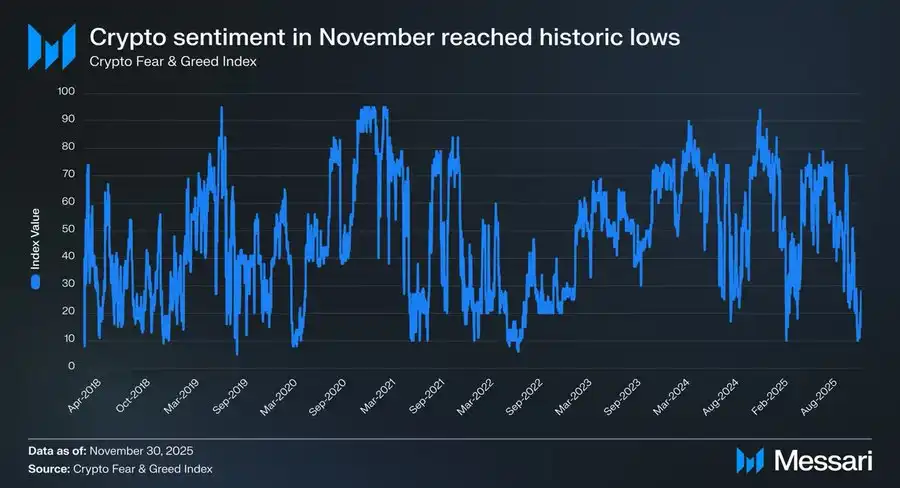
In November 2025, the Crypto Fear & Greed Index dropped to 10, entering the "extreme fear" zone.
In history, there have been few moments when sentiment has dropped to this level:
- March 2020, liquidity stampede triggered by the global pandemic
- May 2021, cascading liquidations due to leverage
- May-June 2022, systemic collapse of Luna and 3AC
- 2018-2019, industry-level bear market
These periods all have one thing in common: the industry itself is failing, and the future is highly uncertain.
But 2025 does not fit this description. There was no top exchange misappropriating user funds, no Ponzi projects with multi-billion dollar market caps dominating the narrative, the total market cap did not fall below the previous cycle high, stablecoin volumes instead hit a historical high, and the regulatory and institutionalization processes continued to advance.
On a "factual level," this was not a year in which the industry was collapsing. However, on a "perception level," it may have been the most painful year for many practitioners, investors, and longstanding users.
Why Did Sentiment Collapse?
Messari started its report with a highly impactful comparison:
If you were allocating crypto assets in a Wall Street office, 2025 might have been the best year since you entered this industry. But if you were staying up late watching charts on Telegram or Discord, searching for Alpha, this was probably the year you most missed the "old days."
Same market, two almost completely opposite experiences. This is not just a random emotional swing, nor a simple bull-to-bear transition, but a deeper structural misalignment: the market is changing participants, yet most people are still using old identities to engage with the new system.
This Is Not a Market Recap
This article is not intended to discuss short-term price trends or attempt to answer "will it go up next."
It is more like a structural explanation:
· Why, as institutions, funds, and infrastructure continue to strengthen,
· has market sentiment slid to historic lows?
· Why do many feel they've "picked the wrong track," yet the system itself has not failed?
In this hundred-thousand-word report, Messari chooses to start from an extremely basic question: If crypto assets ultimately are a form of "money," then who truly deserves to be treated as money?
Understanding this is key to understanding the full-scale meltdown of market sentiment in 2025.
Chapter One | Why Is Sentiment Abnormally Low?
Looking only at the outcome, the sentiment collapse in 2025 is nearly "incomprehensible."
In a scenario where there was no exchange platform rug pull, no systemic credit collapse, and no core narrative bankruptcy, the market provided feedback close to historic lows in sentiment.
Messari's assessment is very straightforward: this is an extreme case of "decoupling of emotion from reality."
1. Sentiment Indicators Have Entered "Historic Anomaly Territory"
The Crypto Fear & Greed Index dropping to 10 is not a normal pullback signal.
Over the past decade, this value has only appeared in very few moments, and each time it did, it was accompanied by a real and profound industry-level crisis:
· Financial System Breakdown
· Credit Chain Collapse
· Market Doubt About the "Existence of the Future"
However, none of these issues arose in 2025.
There was no core infrastructure failure, no mainstream assets liquidated to zero, and no systemic event significant enough to shake the industry's legitimacy. From a statistical standpoint, this sentiment reading does not match any known historical template.
2. The Market Did Not Fail; It Was the "Individual Experience" That Failed
The collapse of sentiment did not come from the market itself but from the subjective experiences of participants. Messari repeatedly emphasized in the report a fact that had been overlooked: 2025 was a year in which institutional experiences far surpassed retail experiences.
For institutions, this was an extremely clear and even comfortable environment:
· ETFs provided a low-friction, low-risk allocation channel
· Digital Asset Treasuries (DAT) became stable, predictable long-term buyers
· Regulatory frameworks started to clarify, and compliance boundaries gradually became visible
But for a large number of participants under old structures, this year was unusually harsh:
· Alpha significantly decreased
· Narrative rotation failed
· Most assets long-term underperformed BTC
· The relationship between "effort" and "result" was completely broken
The market did not reject people; it just changed its reward mechanism.
3. "Not Making Money" Was Misinterpreted as "Industry Decline"
The true trigger of sentiment was not the price drop but a cognitive gap. In multiple past cycles, the implicit assumption in crypto was: as long as you were diligent enough, early enough, and aggressive enough, you could achieve outsized returns.
However, in 2025, this assumption was systematically shattered for the first time.
· Most assets no longer received a premium for their "storytelling"
· L1 ecosystem growth no longer automatically translated into token returns
· High volatility no longer meant high returns
As a result, many participants began to fall into a misconception: if I didn't make money, then the entire industry must be in trouble. Yet, Messari's conclusion was precisely the opposite: the industry is becoming more like a mature financial system rather than a machine that continues to generate speculative returns.
4. The Essence of Emotional Breakdown is Identity Misalignment
Considering all phenomena, the implicit answer given by Messari is only one: The emotional breakdown in 2025 is fundamentally an identity misalignment.
· The market is tilting towards "asset allocators," "long-term holders," and "institutional participants"
· However, a large number of participants still exist in the identity of "short-term Alpha seekers"
When the incentive logic of the system changes, and participation does not adjust synchronously, emotions will inevitably collapse first. This is not a matter of individual capability but the friction cost of role transition in the era.
Summary | Emotions Do Not Tell You the Truth
The market sentiment in 2025 truly reflects the participants' pain but does not accurately reflect the state of the system.
· Emotional breakdown ≠ Industry failure
· Intensified pain ≠ Value disappearance
It simply indicates one thing: the old way of participation is rapidly becoming obsolete. Understanding this point is a prerequisite for entering the next chapter.
Chapter 2 | The True Root of Emotional Breakdown: The Monetary System is Failing
If we only stay at the market structure level, the explanation of the emotional breakdown in 2025 is still incomplete. The real problem is not:
· Alpha diminishing
· BTC being too strong
· Institutions coming in
These are all superficial phenomena. A deeper judgment given by Messari in the report is: The collapse of market sentiment fundamentally stems from a long-overlooked fact—the monetary system we are in is continually pressuring savers.
A Must-Be-Confronted Chart: Global Government Debt Out of Control
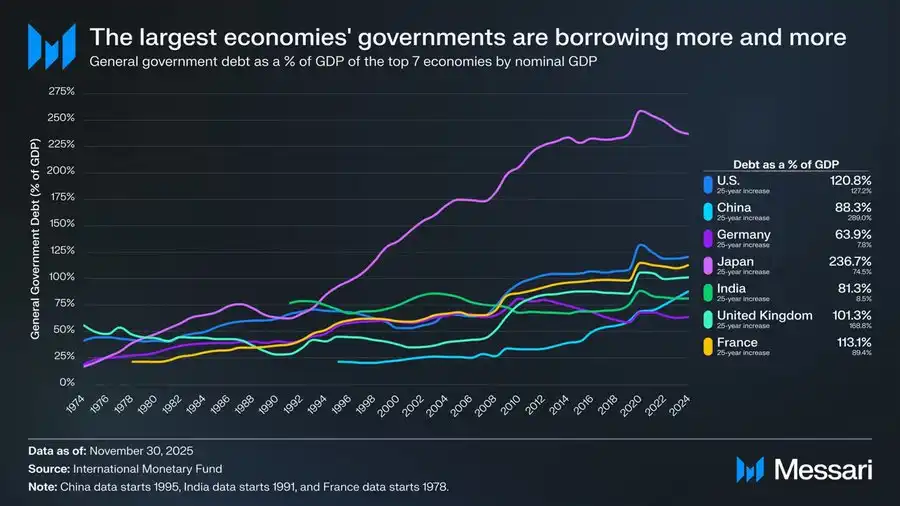
This chart is not a decorative macro background but the logical starting point of the entire Cryptomoney argument.
Over the past 50 years, the government debt-to-GDP ratio of major global economies has shown a highly consistent and almost irreversible upward trend:
· US: 120.8%
· Japan: 236.7%
· France: 113.1%
· UK: 101.3%
· China: 88.3%
· India: 81.3%
· Germany: 63.9%
This is not the result of governance failure in any one country, but a common outcome spanning institutions, political structures, and stages of development. Whether in democratic countries, authoritarian states, advanced economies, or emerging markets, government debt has outpaced economic growth in the long run.
What this chart truly illustrates is not "high debt," but "savings being systematically sacrificed"
When government debt grows faster than economic output over the long term, the system can only maintain stability through three means:
1. Inflation
2. Long-term low real interest rates
3. Financial repression (capital controls, withdrawal restrictions, regulatory intervention)
Regardless of which path is taken, the ultimate cost will be borne by the same group of people: savers. Messari used a highly restrained but weighty phrase in the report: When debt grows faster than economic output, the costs fall most heavily on savers. In other words, when debt outpaces growth, savers are destined to be the sacrificed party.
Why will sentiment collapse in 2025?
Because in 2025, an increasing number of participants will clearly realize this for the first time.
Prior to this:
· "Inflation is just temporary"
· "Cash is always safe"
· "In the long run, fiat is stable"
And reality is continuously refuting these assumptions.
When people realize:
· Hard work ≠ Wealth preservation
· Saving behavior itself is continually eroding
· Asset allocation difficulty has significantly increased
The collapse of sentiment is not from Crypto, but from a shaken confidence in the entire financial system. Crypto is just the first place where this impact is perceived.
The significance of Cryptomoney is not in "higher returns"
This is also a point that Messari emphasizes repeatedly but is easily misinterpreted. Cryptomoney does not exist to promise higher returns.
Its core value lies in:
· Predictable rules
· Monetary policy not subject to arbitrary changes by a single entity
· Assets that can be self-custodied
· Value that can be transferred across borders without permission
In other words, it doesn't provide a "get-rich-quick scheme," but rather: a reempowerment of individual currency choice in a high-debt, low-certainty world.
Emotional Collapse is Actually a Form of "Awakening"
When you juxtapose this debt chart with the market sentiment of 2025, you'll arrive at a counterintuitive conclusion: Extreme emotional pessimism doesn't signify industry failure but instead signals an increasing realization that the issues in the old system are indeed real.
Crypto's issue has never been "uselessness." The real issue is: It no longer creates effortless outsized returns for everyone.
Summary | From Emotion, to Structure, to the Currency Itself
This chapter tackles a fundamental question: Why, in the absence of a systemic collapse, did market sentiment plummet to historic lows? The answer isn't in the candlestick charts but in the currency's structure.
· Emotional collapse is a symptom
· Paradigm rupture is a process
· Monetary system imbalance is the root cause
And this is precisely why Messari chose to start this entire report from "money" rather than from "applications."
Chapter Three | Why Only BTC Is Regarded as "Real Money"
If you've read this far, you might easily raise a question: If the issue lies within the monetary system, why is BTC the answer and not something else?
Messari's judgment in the report is exceptionally clear: BTC is no longer on the same competitive plane as other crypto assets.
1. Money is Not a Technical Issue, but a Consensus Issue
This is the first key to understanding BTC. Messari repeatedly emphasizes in the original text a fact that engineers easily overlook: Money is a social consensus, not a technical optimization problem. In other words:
· Money isn't about being the "fastest"
· Not about being the "cheapest"
· Nor is it about being the "most feature-rich"
It's about being perceived as a long-term, stable store of value. From this perspective, Bitcoin's triumph is not mysterious.
2. Three Years of Data, and the Answer is Already Clear
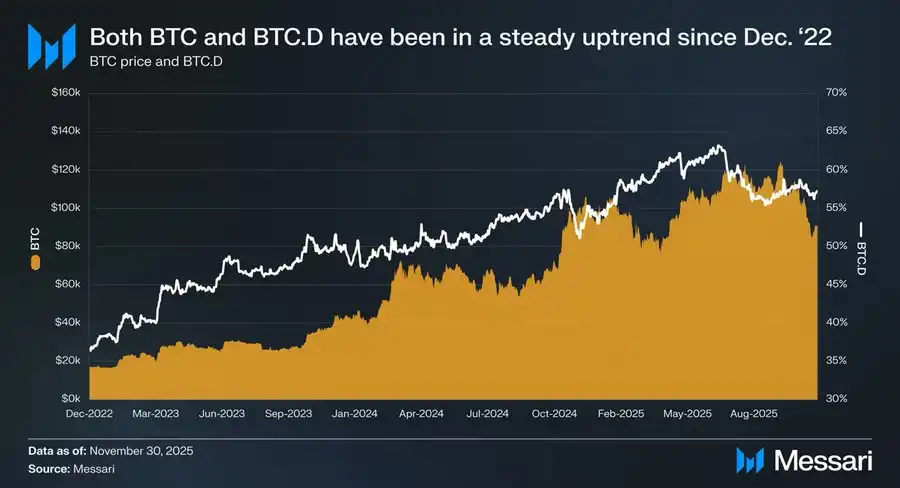
From December 1, 2022, to November 30, 2025:
· BTC has appreciated by 429%
· Market cap has grown from $318 billion to $1.81 trillion
· Entered the top ten global asset ranking
More importantly, the relative performance: BTC.D has grown from 36.6% to 57.3%. In a period that theoretically should have seen an altcoin frenzy, funds have continued to flow back to BTC. This is not a fluke of a market cycle; this is a market reclassifying assets.
3. ETFs and Corporate Treasury Strategies are Essentially Formalizing Consensus
Messari's assessment of ETFs is very restrained, yet the conclusion is profound. A Bitcoin ETF is not merely about "new buying pressure"; what it truly changes is: who is buying + why they are buying + how long they can hold
· An ETF transforms BTC into a compliant asset
· A Corporate Treasury Strategy makes BTC a part of a company's balance sheet
· National reserves elevate BTC to a "strategic asset" level
When BTC is held by these actors, it is no longer seen as: a high volatility asset that can be dumped at any time, but rather as: a currency asset that must be held long term and cannot be easily mismanaged. Once money is treated this way, it's hard to revert.
4. Why the More "Boring" BTC Gets, the More It Resembles Money
This might be the most counterintuitive point of 2025:
· BTC has no use case
· No narrative shift
· No ecosystem story
· There is not even any "new thing"
But precisely because of this, it meets all the characteristics of "money":
· Does not rely on future promises
· Does not need a growth narrative
· Does not require ongoing team delivery
It just needs to not be wrong.
And in a high-debt, low-certainty world, "not being wrong" itself is a scarce asset.
5. BTC's Strength is Not a Market Failure
Many people's pain comes from a misconception: "BTC's strength means the market is not right." Messari's assessment is quite the opposite: BTC's strength is the market becoming more rational.
When the system begins to reward:
· Stability
· Predictability
· Long-term credibility
Then all strategies relying on "high volatility equals high returns" will increasingly appear painful. This is not an issue with BTC; it is an issue with the method of participation.
Summary | BTC Didn't Win, It Was Chosen
BTC did not "beat" other assets. It was simply repeatedly validated by the market in an era where the monetary system was continuously failing as:
· The least explanatory asset
· The least reliant on trust asset
· The asset least in need of future commitments
This is not the result of a single market cycle but a confirmation of a role.
Chapter 4 | When the Market Only Needs One Kind of "Money," the L1 Story Begins to Malfunction
After confirming that BTC has been chosen by the market as the "main Cryptomoney," one question cannot be avoided: if money already has an answer, what is left for Layer 1? Messari did not directly provide a conclusion, but after reading through this section, a trend is very clear: L1 valuation is being forced to transition from "future narratives" back to "real-world constraints."
1. A Harsh but True Fact: 81% of Market Value is in the "Money" Narrative
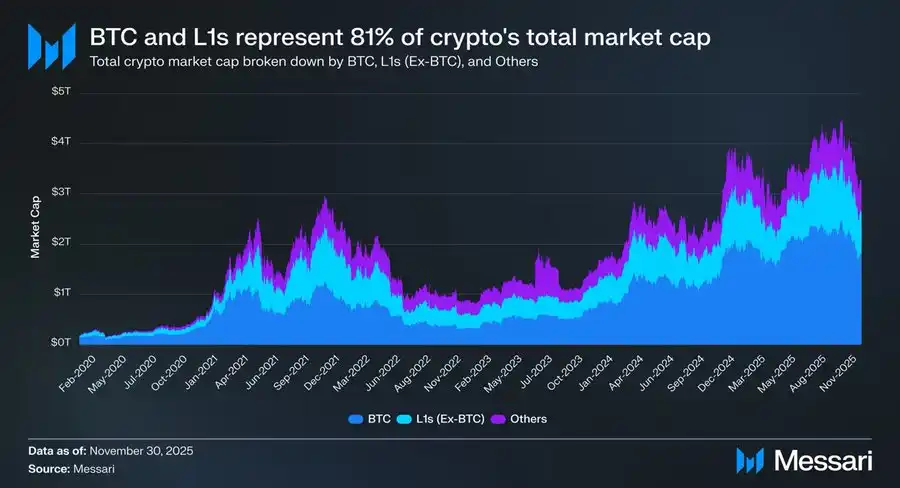
By the end of 2025, the entire crypto market cap is about $3.26T:
· BTC: $1.80T
· Other L1: ~$0.83T
· Other Assets: <$0.63T
Overall, approximately 81% of the cryptocurrency asset market cap is considered "money" or "potential money" by the market in terms of pricing. What does this mean? It means that the valuation of L1 is no longer based on the pricing logic of being an "application platform" but rather on the pricing logic of "whether it qualifies as money."
2. The Issue Is: Most L1s Are Not Worthy
The data provided by Messari is very straightforward and quite stark.
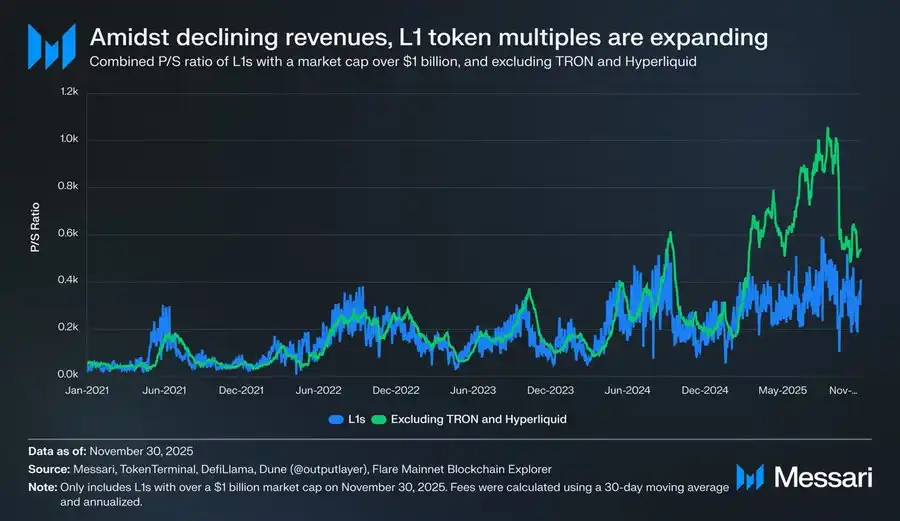
After excluding outliers like TRON and Hyperliquid with unusually high revenue:
· The overall revenue of L1s is continuously declining
· But the valuation multiple is continuously increasing
The adjusted P/S ratios are as follows:
· 2021: 40x
· 2022: 212x
· 2023: 137x
· 2024: 205x
· 2025: 536x
Meanwhile, the total L1 revenue during the same period is:
· 2021: $12.3B
· 2022: $4.9B
· 2023: $2.7B
· 2024: $3.6B
· 2025 (annualized): $1.7B
This is a discrepancy that cannot be reasonably explained by "future growth."
3. L1s Are Not "Undervalued" but "Reclassified"
Many people's anguish stems from a misunderstanding: "Has the market mistakenly underestimated L1s?" Messari's assessment is quite the opposite: the market has not underestimated L1s but has reduced their 'monetary imagination space.'
If an asset:
· Cannot function as a stable store of value
· Cannot be held long term
· And cannot provide a predictable cash flow
Then it ultimately only has one way to be priced: as a high-beta risk asset.
4. The Example of Solana Actually Says It All
SOL is one of the few L1s that outperformed BTC in 2025. However, Messari pointed out a highly impactful fact:
· SOL's ecosystem data grew 20–30 times
· Price only outperformed BTC by 87%
In other words: in order to achieve "significant alpha" against BTC, an L1 needs a order-of-magnitude ecosystem explosion. This is not due to "not trying hard enough," but because the reward function has been rewritten.
5. When BTC Becomes "Money," the Burden on L1s Becomes Heavier
This is a structural change that many people have not realized. Before BTC had a clear monetary status:
· L1s could tell a story of "becoming money in the future"
· The market was willing to prepay for this possibility
And now:
· BTC has solidified its position
· The market is no longer willing to pay the same premium for "second money"
Therefore, L1s face a tougher question: If you are not money, then what are you?
Conclusion|The Issue with L1s is Not Competition, But Positioning
L1s did not "lose to BTC." What they lost in is:
· In the monetary dimension
· The market no longer needs more answers
And once the protection of the "money narrative" is lost, all valuations must realign with reality.
This is the direct source of the emotional breakdown of many participants in 2025.
You may also like

December 24th Market Key Intelligence, How Much Did You Miss?

Kalshi First Research Report: When Predicting CPI, Crowd Wisdom Beats Wall Street Analysts

Venture Capital Post-Mortem 2025: Hashrate is King, Narrative is Dead

Are Those High-Raised 2021 Projects Still Alive?

Aave Community Governance Drama Escalates, What's the Overseas Crypto Community Talking About Today?

Where Did $362 Million Go? Hyperliquid Counters FUD in Decentralization Showdown
Key Market Information Discrepancy on December 24th - A Must-See! | Alpha Morning Report

2025 Token Postmortem: 84% Peak at Launch, High-Cap Project Turns into a "Rug Pull" Epicenter?

CFTC Welcomes New Chairman, Which Way Will Crypto Regulation Go?

2025 Whale Saga: Mansion Kidnapping, Supply Chain Poisoning, and Billions Liquidated

Believing in the Capital Market - The Essence and Core Value of Cryptocurrency

Absorb Polymarket Old Guard, Coinbase Plunges Into Prediction Market Abyss

Ether pumps to outsiders, dumps in-house. Can Tom Lee's team still be trusted?

Coinbase Joins Prediction Market, AAVE Governance Dispute - What's the Overseas Crypto Community Talking About Today?
Over the past 24 hours, the crypto market has shown strong momentum across multiple dimensions. The mainstream discussion has focused on Coinbase's official entry into the prediction market through the acquisition of The Clearing Company, as well as the intense controversy within the AAVE community regarding token incentives and governance rights.
In terms of ecosystem development, Solana has introduced the innovative Kora fee layer aimed at reducing user transaction costs; meanwhile, the Perp DEX competition has intensified, with the showdown between Hyperliquid and Lighter sparking widespread community discussion on the future of decentralized derivatives.
This week, Coinbase announced the acquisition of The Clearing Company, marking another significant move to deepen its presence in this field after last week's announcement of launching a prediction market on its platform.
The Clearing Company's founder, Toni Gemayel, and the team will join Coinbase to jointly drive the development of the prediction market business.
Coinbase's Product Lead, Shan Aggarwal, stated that the growth of the prediction market is still in its early stages and predicts that 2026 will be the breakout year for this field.
The community has reacted positively to this, generally believing that Coinbase's entry will bring significant traffic and compliance advantages to the prediction market. However, this has also sparked discussions about the industry's competitive landscape.
Jai Bhavnani, Founder of Rivalry, commented that for startups, if their product model proves to be successful, industry giants like Coinbase have ample reason to replicate it.
This serves as a reminder to all entrepreneurs in the crypto space that they must build significant moats to withstand competition pressure from these giants.
Regulated prediction market platform Kalshi launched its research arm, Kalshi Research, this week, aimed at opening its internal data to the academic community and researchers to facilitate exploration of prediction market-related topics.
Its inaugural research report highlights Kalshi's outperformance in predicting inflation compared to Wall Street's traditional models. Kalshi co-founder Luana Lopes Lara commented that the power of prediction markets lies in the valuable data they generate, and it is now time to better utilize this data.
Meanwhile, Kalshi announced its support for the BNB Chain (BSC), allowing users to deposit and withdraw BNB and USDT via the BSC network.
This move is seen as a significant step for Kalshi to open its platform to a broader crypto user base, aiming to unlock access to the world's largest prediction market. Furthermore, Kalshi also revealed plans to host the first Prediction Market Summit in 2026 to further drive industry engagement and development.
The AAVE community recently engaged in heated debates around an Aave Improvement Proposal (AIP) titled "AAVE Tokenomics Alignment Phase One - Ownership Governance," aiming to transfer ownership and control of the Aave brand from Aave Labs to Aave DAO.
Aave founder Stani Kulechov publicly stated his intention to vote against the proposal, believing it oversimplifies the complex legal and operational structure, potentially slowing down the development process of core products like Aave V4.
The community's reaction was polarized. Some criticized Stani for adopting a "double standard" in governance and questioned whether his team had siphoned off protocol revenue, while others supported his cautious stance, arguing that significant governance changes require more thorough discussion.
This controversy highlights the tension between the ideal of DAO governance in DeFi projects and the actual power held by core development teams.
Despite governance disputes putting pressure on the AAVE token price, on-chain data shows that Stani Kulechov himself has purchased millions of dollars' worth of AAVE in the past few hours.
Simultaneously, a whale address, 0xDDC4, which had been quiet for 6 months, once again spent 500 ETH (approximately $1.53 million) to purchase 9,629 AAVE tokens. Data indicates that this whale has accumulated nearly 40,000 AAVE over the past year but is currently in an unrealized loss position.
The founder and whale's increased holdings during market volatility were interpreted by some investors as a confidence signal in AAVE's long-term value.
In this week's top article, Morpho Labs' "Curator Explained" detailed the role of "curators" in DeFi.
The article likened curators to asset managers in traditional finance, who design, deploy, and manage on-chain vaults, providing users with a one-click diversified investment portfolio.
Unlike traditional fund managers, DeFi curators execute strategies automatically through non-custodial smart contracts, allowing users to maintain full control of their assets. The article offered a new perspective on the specialization and risk management in the DeFi space.
Another widely circulated article, "Ethereum 2025: From Experiment to Global Infrastructure," provided a comprehensive summary of Ethereum's development over the past year. The article noted that 2025 is a crucial year for Ethereum's transition from an experimental project to global financial infrastructure. Through the Pectra and Fusaka hard forks, Ethereum achieved significant reductions in account abstraction and transaction costs.
Furthermore, the SEC's clarification of Ethereum's "non-securities" nature and the launch of tokenized funds on the Ethereum mainnet by traditional financial giants like JPMorgan marked Ethereum's gaining recognition from mainstream institutions. The article suggested that whether it is the continued growth of DeFi, the thriving L2 ecosystem, or the integration with the AI field, Ethereum's vision as the "world computer" is gradually becoming a reality.
The Solana Foundation engineering team released a fee layer solution called Kora this week.
Kora is a fee relayer and signatory node designed to provide the Solana ecosystem with a more flexible transaction fee payment method. Through Kora, users will be able to achieve gas-free transactions or choose to pay network fees using any stablecoin or SPL token. This innovation is seen as an important step in lowering the barrier of entry for new users and improving Solana network's availability.
Additionally, a deep research report on propAMM (proactive market maker) sparked community interest. The report's data analysis of propAMMs on Solana like HumidiFi indicated that Solana has achieved, or even surpassed, the level of transaction execution quality in traditional finance (TradFi) markets.
For example, on the SOL-USDC trading pair, HumidiFi is able to provide a highly competitive spread for large trades (0.4-1.6 bps), which is already better than the trading slippage of some mid-cap stocks in traditional markets.
Research suggests that propAMM is making the vision of the "Internet Capital Market" a reality, with Solana emerging as the prime venue for all of this to happen.
The competition in the perpetual contract DEX (Perp DEX) space is becoming increasingly heated.
In its latest official article, Hyperliquid has positioned its emerging competitor, Lighter, alongside centralized exchanges like Binance, referring to it as a platform utilizing a centralized sequencer. Hyperliquid emphasizes its transparency advantage of being "fully on-chain, operated by a validator network, and with no hidden state."
The community widely interprets this as Hyperliquid declaring "war" on Lighter. The technical differences between the two platforms have also become a focal point of discussion: Hyperliquid focuses on ultimate on-chain transparency, while Lighter emphasizes achieving "verifiable execution" through zero-knowledge proofs to provide users with a Central Limit Order Book (CLOB)-like trading experience.
This battle over the future direction of decentralized derivatives exchanges is expected to peak in 2026.
Meanwhile, discussions about Lighter's trading fees have surfaced. Some users have pointed out that Lighter charged as much as 81 basis points (0.81%) for a $2 million USD/JPY forex trade, far exceeding the near-zero spreads of traditional forex brokers.
Some argue that Lighter does not follow a B-book model that bets against market makers, instead anchoring its prices to the TradFi market, and the high fees may be related to the current liquidity or market maker balance incentives. Providing a more competitive spread for real-world assets (RWA) in the highly volatile crypto market is a key issue Lighter will need to address in the future.

2025 Asset Review: Why Did Bitcoin Significantly Underperform Gold and US Stocks?
Twitter 上的「虚假流量」是指通过操纵关注者数量、喜欢和转发等指标来人为增加一条推文的影响力和可信度。下面是一些常见的制造虚假流量的方法: 1. <b>购买关注者:</b> 一些用户会通过购买关注者来迅速增加他们的关注者数量,从而让他们的账号看起来更受欢迎。 2. <b>使用机器人账号:</b> 制造虚假流量的另一种常见方法是使用机器人账号自动执行喜欢、转发和评论等互动操作,从而提高一条推文的互动量。 3. <b>推文交换:</b> 一些用户之间会进行推文交换,即互相喜欢、转发对方的推文...

Audiera Sees Massive Price Surge – Key Cryptocurrency Updates
Key Takeaways Audiera (BEAT) has witnessed significant growth, experiencing a 70.10% increase in the past week. Despite the…

In Vietnam, USDT’s Use and the Reality of Web3 Adoption
Key Takeaways Vietnam has emerged as a leading nation in the adoption of cryptocurrencies, despite cultural and regulatory…
December 24th Market Key Intelligence, How Much Did You Miss?
Kalshi First Research Report: When Predicting CPI, Crowd Wisdom Beats Wall Street Analysts
Venture Capital Post-Mortem 2025: Hashrate is King, Narrative is Dead
Are Those High-Raised 2021 Projects Still Alive?
Aave Community Governance Drama Escalates, What's the Overseas Crypto Community Talking About Today?
Where Did $362 Million Go? Hyperliquid Counters FUD in Decentralization Showdown
Popular coins
Latest Crypto News


Customer Support:@weikecs
Business Cooperation:@weikecs
Quant Trading & MM:bd@weex.com
VIP Services:support@weex.com
 App
App