
- Buy Crypto
- Markets
- Futures
- Spot
- Copy Trade
 WE-Launch
Behind Free Data, Roam Refactors Deflation Narrative with "Point-Token Two-way Burn"

With projects like Aave and Jupiter embarking on buyback dividends and other operations traditionally seen in publicly traded companies, a return to fundamentals has become an increasingly clear consensus in the cryptocurrency industry. The "to the moon and back" candlestick chart of $AUCTION is not sustainable, and mere token speculation is gradually waning. Investors and users are starting to pay more attention to a project's actual utility and profit-making ability. More and more projects are no longer solely focused on conceptual hype and grand narratives but are turning to building business models with a solid foundation and sustainable revenue.
Aside from seeking breakthroughs in the financial markets, for a crypto project to have a solid business foundation, it needs to identify areas that are still plagued by inefficient or centralized models in traditional economic markets and leverage blockchain technology to provide better solutions. Examples include USDT's remittance settlement business in Africa and Latin America, the Southeast Asian mobility service TADA, or the essential online network service Roam for today's global Web3 users.
The Three Flywheels Behind Free Traffic
Roam's business model focuses on establishing an open global wireless network through DePIN, operating communication services with an internet mindset. It leverages Web3's flywheel effect to drive ecosystem development and user base expansion and breaks down data barriers through an open network to embrace the AI era.
Traditional operators are trapped by the high costs of 5G infrastructure and the pressure from users for tariff reductions. Roam chooses to break through with distributed nodes and Web3 incentives, starting from essential needs, breaking the ice with practicality. By integrating 2.8 million global WiFi nodes and smart eSIM technology, users can seamlessly roam internationally at 30% of the cost of traditional operators.
This "need and reliance" on real demand becomes the best entry point for its Web3 incentive mechanism. Users sharing network resources receive points rewards, miners deploying router nodes earn token income, and the high-frequency network check-in behavior continuously generates privacy-protected data, laying the groundwork for the upcoming AI data flywheel.
User Flywheel: Community validators, i.e., app users, earn points and sticker rewards by verifying the operation status of mining rigs, which can be redeemed for free traffic or participation in token burns;
Node Flywheel: Miner owners earn points rewards by providing network services (such as CDNs, IP-based services, etc.), and the distribution method will gradually transition from equal distribution to differential distribution based on service capabilities;
AI Data Flywheel: For the future AI data flywheel, Roam plans to launch a similar incentive mechanism in the second half of 2025, with spatial-temporal data collected by distributed nodes fueling the training of AI models in vertical domains.
Related Reading: "Roam Economic System Design: Can It Be a Game Changer?"
This triple helix structure has gradually revealed Roam's moat. By the end of 2024, its network had covered 200 countries, with users clocking in over 10 million check-ins per day. The accrued spacetime data is equivalent to the annual data volume of 10 medium-sized national carriers.
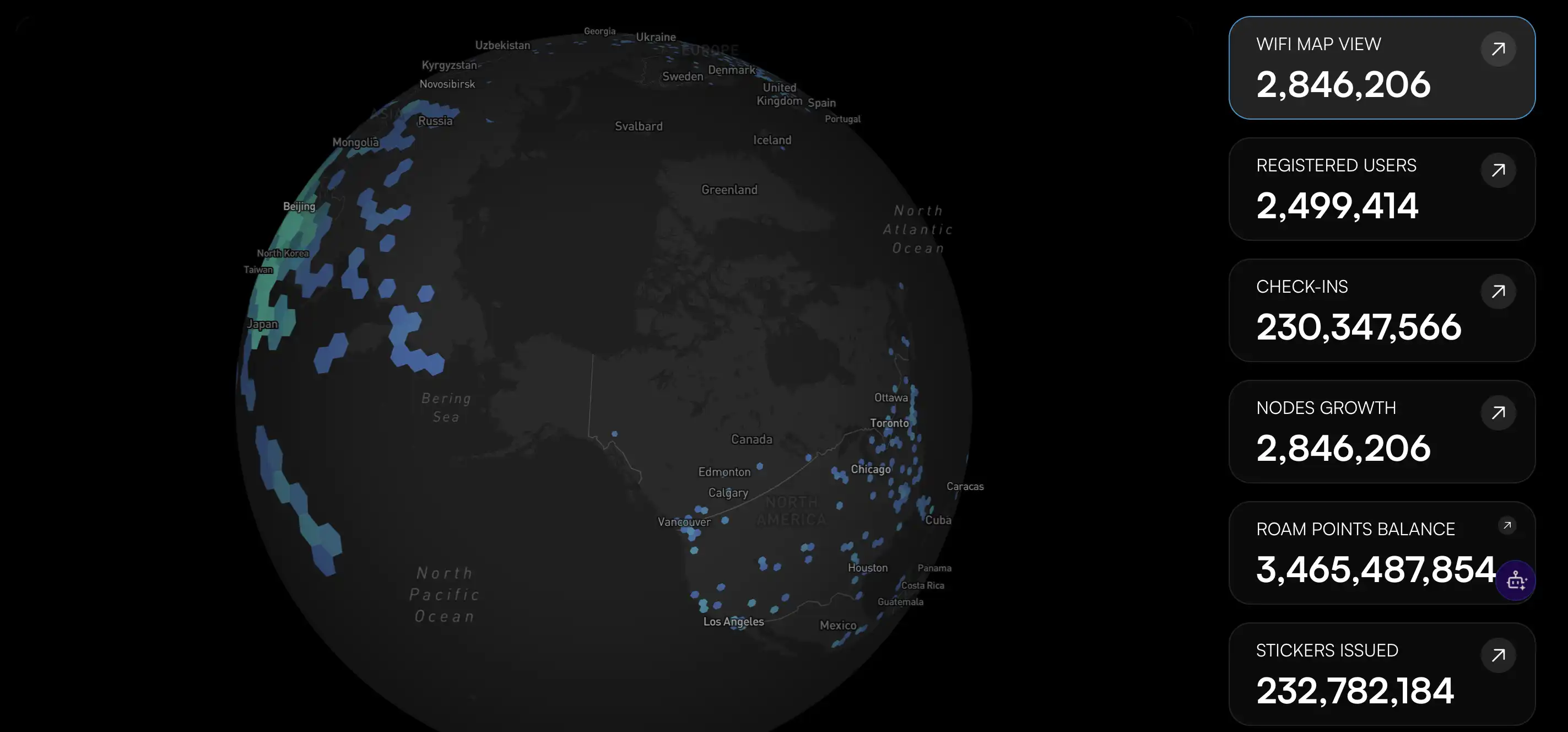
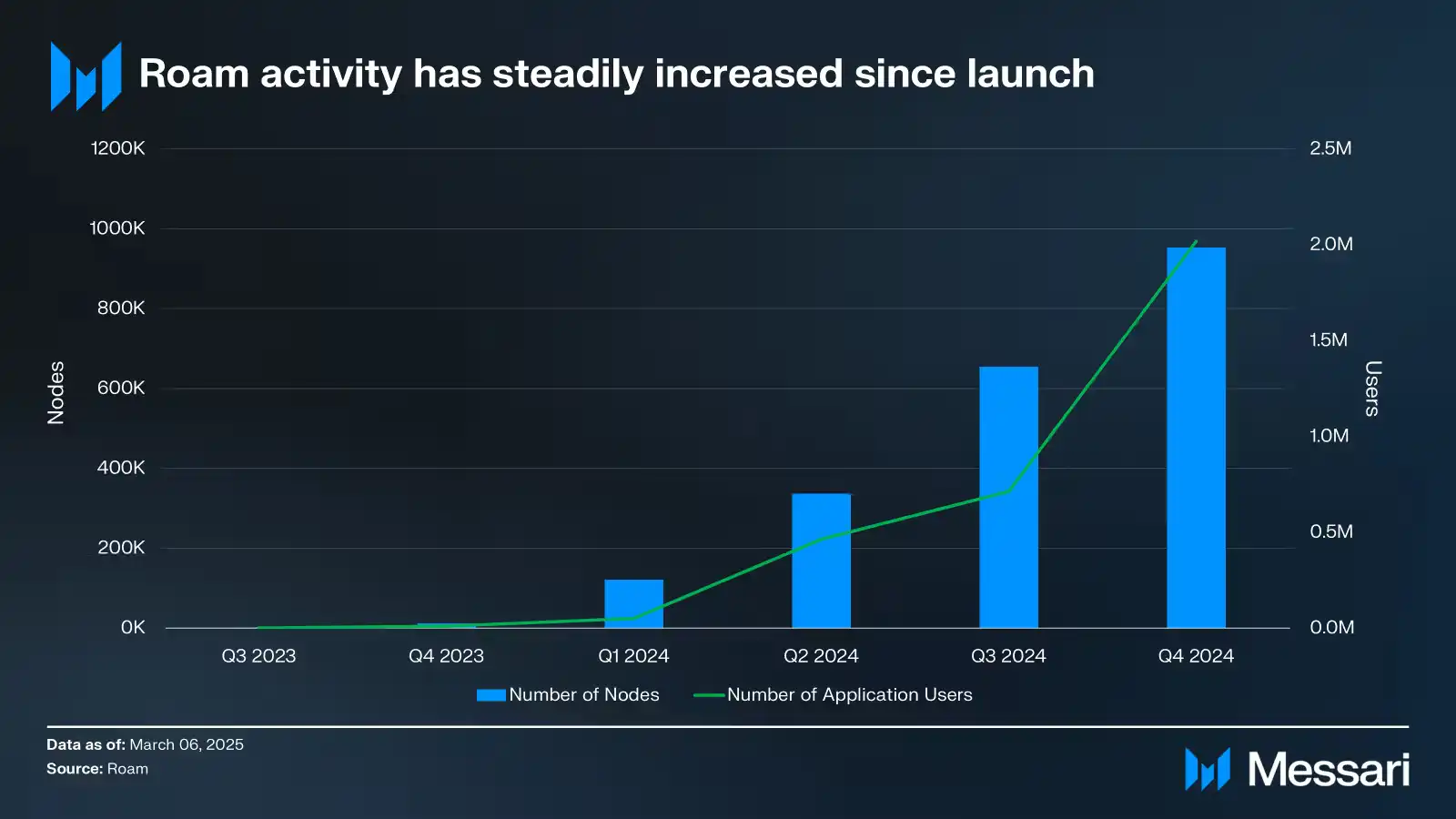
Roam's ace in the hole is binding Web3 incentives with communication essentials. Users staking 100 $ROAM tokens (around $17) can unlock 5GB of global data every 28 days, costing only a third of traditional roaming plans. Node operators can earn up to 200% APY by sharing WiFi. This earn-more-as-you-use model propelled Roam's growth against the bear market, with a 380% surge in Southeast Asian users in Q2 2024, surpassing the combined node density of the top three local carriers.
"Dual Burn of Points and Tokens": Rethinking the Dual Deflation Mechanism
Roam's native token $ROAM has a total supply of 1 billion tokens. 12% is allocated to the founding team with a 6-year linear vesting period to align team interests with long-term project growth. 28% of the tokens are earmarked for rewarding early and potential future investors, including airdrop incentives. The remaining 60% of tokens are generated through mining, where network participants are rewarded for providing services and contributing.
Roam's token release curve draws inspiration from Bitcoin's exponential decay model. In the initial stages, approximately 0.6% of tokens are released monthly, gradually decreasing over time. After 5 years, the monthly release rate drops to 0.35%, 0.2% after 10 years, 0.05% after 20 years, and only 0.001% after 50 years. This predefined, gradually decreasing release mechanism provides support for the token's long-term value.
Roam's economic system adopts a dual-layer structure of points and tokens.
Points circulate within the ecosystem for settlement and rewarding network participants. For instance, miners receive points instead of tokens directly, effectively avoiding sell pressure from price volatility and maintaining reasonable service pricing.
Tokens serve as the value carrier of the entire ecosystem, with a predetermined release curve. Users can acquire tokens by "burning" points, and the exchange rate is determined by the market's supply and demand. Conversely, tokens can also be burned and converted into points.
In addition to points and tokens, Roam's economic system also introduces two types of assets: NFTs and stickers. NFTs represent ownership of cloud miners, allowing users to deploy miners in high-traffic areas through Roam's agent team and share profits. Stickers serve as proof of network validation and are a core element of the ecosystem. Stickers determine the user's burning limit in the sticker pool and can be used in the future to synthesize staking acceleration cards in a similar way to blockchain games. They can serve as props in ecosystem GameFi and SocialFi, act as discount coupons in economic activities, and more.
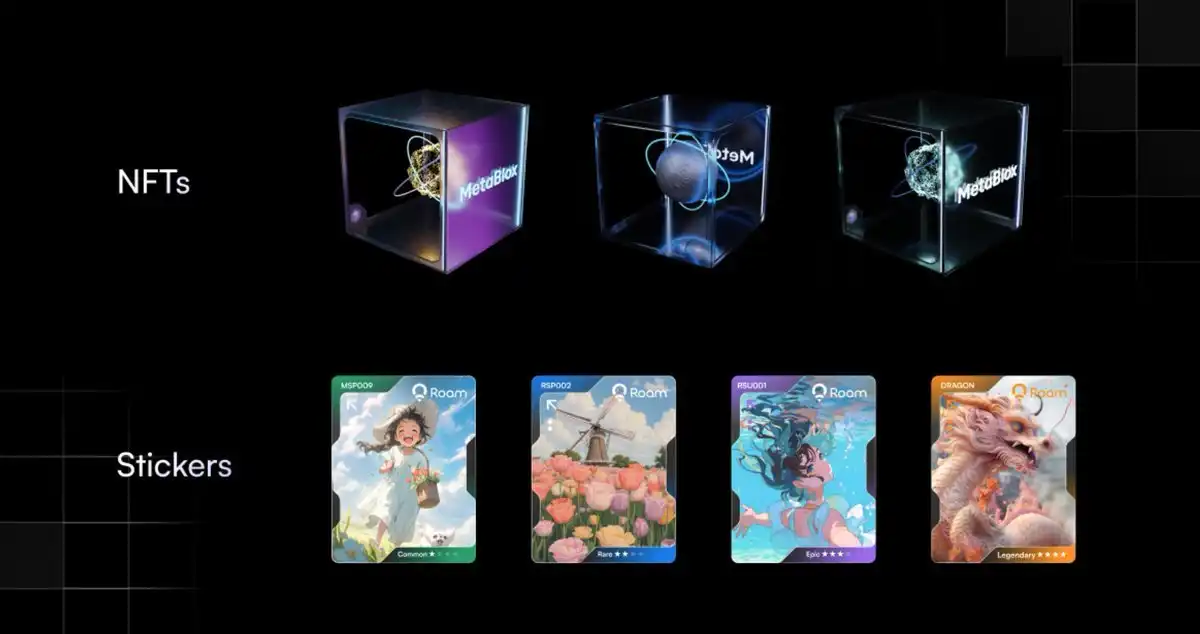
If traditional cryptocurrencies' deflation relies on a mechanical halving mechanism, Roam achieves deflation through a "point-token bidirectional burn" design, making deflation a natural result of market behavior. The cleverness of this mechanism lies in using arbitrage impulses to drive ecosystem prosperity and using burning pressure to force value deposition.
Let's first look at the dynamics of the burn pools. Roam's economic system has three core burn pools:
1. Miner Pool: Participation is limited to miners who use mining-earned points, with an early exchange rate of 1:54.5;
2. Sticker Pool: Requires the consumption of stickers obtained from clock-ins, with an exchange rate of 1:139.1;
3. Common Pool: Open to all users, with an exchange rate of 1:523.3.
The exchange rate for each burn cycle is dynamically determined by market supply and demand. This design has fostered an "arbitrage class," where professional players monitor pool exchange rate fluctuations through algorithms and trigger burning operations at the optimal time.
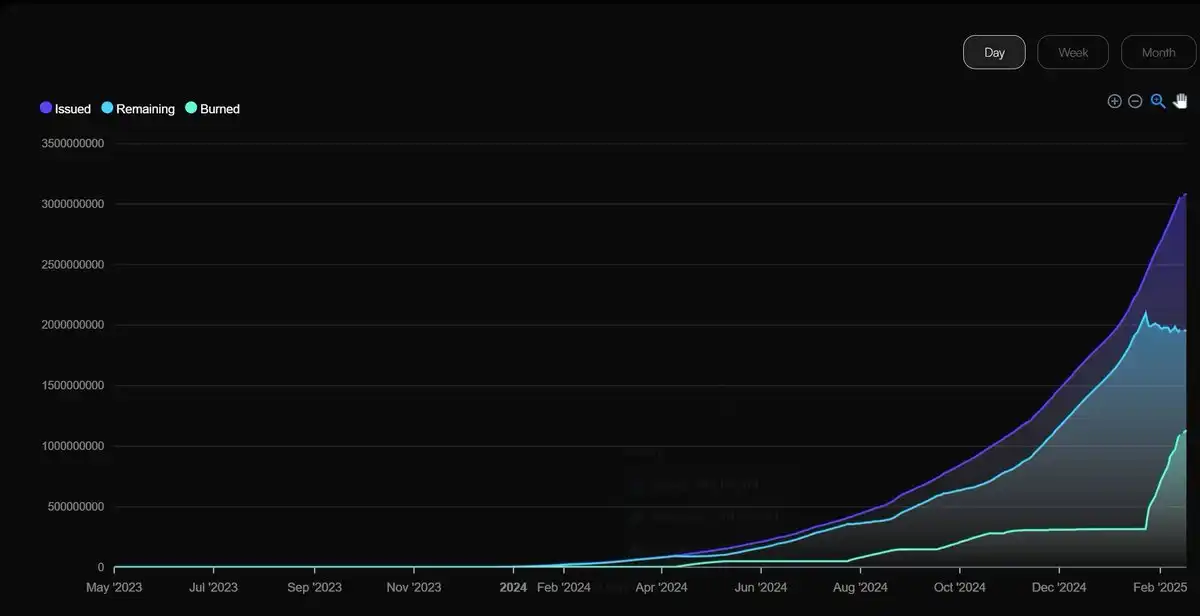
More innovative is the "point-token" reverse conversion, i.e., reverse burning design. Users can burn ROAM tokens and exchange them for points at the historical average price of the sticker pool and common pool. These points can be used to participate in the sticker pool burn, allowing users to acquire more tokens. While this mechanism may seem to increase circulation, it actually drives absolute deflation through a very high token burn rate, while deeply binding users to core behaviors such as network validation and data generation.
This "burn is mining" arbitrage mechanism transforms speculative behavior into deflationary momentum. As the AI data flywheel kicks off in 2025, points consumption scenarios will further expand to fields such as model training and agent services, forming a positive cycle of "usage is deflation."
The Coexistence of Short-Term Arbitrage and Long-Term Value
In the Vietnamese community practice, Roam has developed a unique node deployment model—according to Roam founder YZ's disclosure, there exists a professional team that deploys nodes using motorcycles, and members earn rewards by upgrading roadside WiFi to OpenRoaming nodes. Top players, through refined operations, can earn tens of thousands of points in rewards daily through this model. Based on the exchange rate estimation during the test burn pool phase, their income can reach several times that of local white-collar salaries.
This "human flesh mining rig" model may seem primitive, but as users continuously add nodes and participate in validation to optimize their earnings, they are objectively driving an exponential growth in network density, becoming the core force behind the expansion of the Roam network. When the node density surpasses a critical point, the cost advantage of traditional operators in the last mile is completely eroded, not only achieving data assetization but also forming an edge computing network.
It is worth mentioning that Roam cleverly integrates free eSIM data and DePIN+AI fundamentals. By staking the $ROAM token, users can receive free global eSIM data. At the current token price, staking around $34 worth of $ROAM can provide 12GB of global data, which is undoubtedly highly attractive for Web3 "jetsetters" who frequently travel.
Even more imaginatively, Roam plans to launch an AI data layer in the second half of this year, when Roam routers will not only mine but also be used to train large models. Through Web3 incentives, Roam can generate a large amount of DID-tagged location and time data combined with privacy protection, supporting AI agents and AI avatars. This not only expands the application scenarios of $ROAM but also injects new momentum into Roam's long-term value growth.
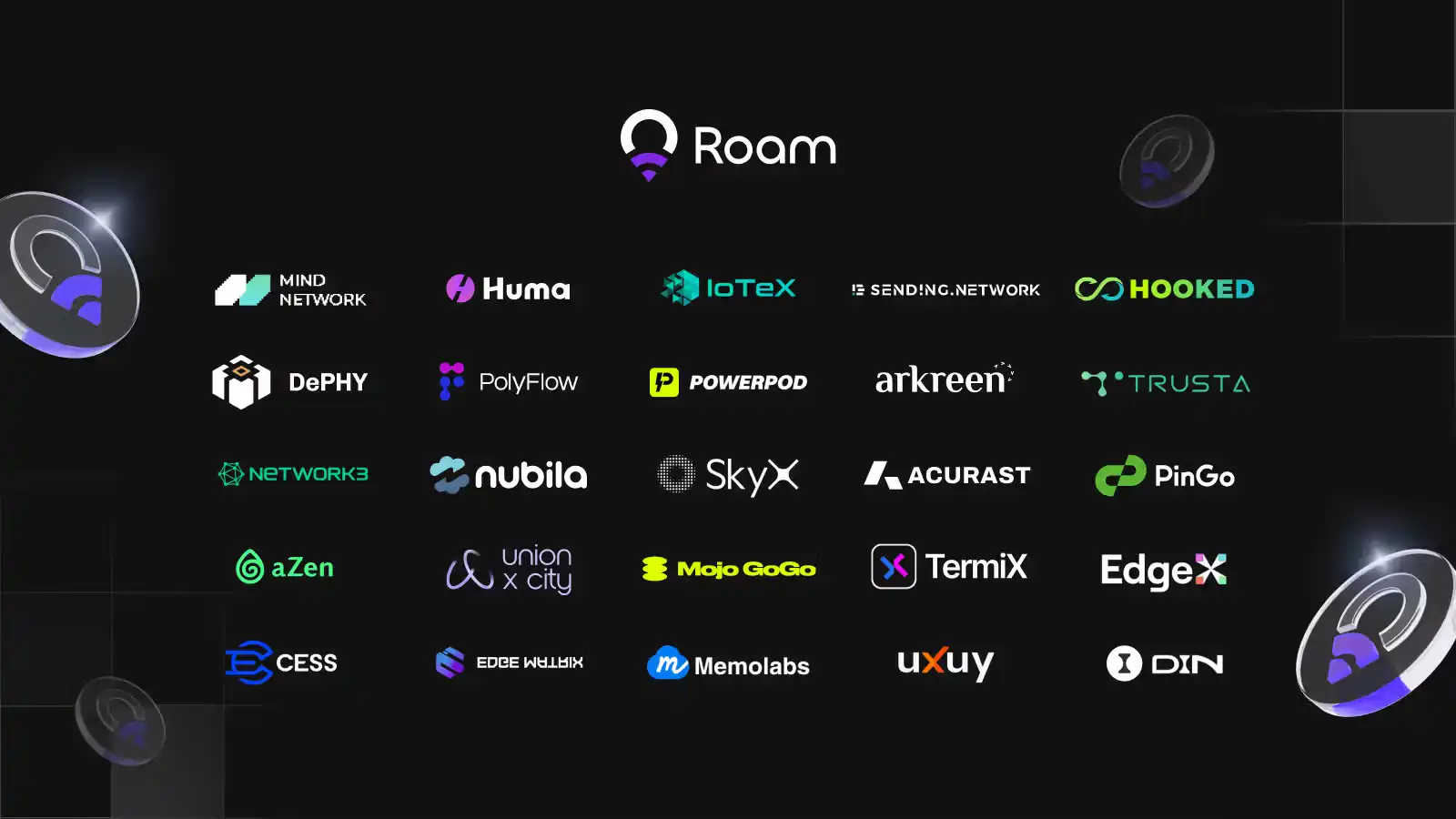
By the end of last year, through the Roam Discovery plan, over 20 projects have connected to its economic system, such as the blockchain game BitBang allowing the purchase of props with points and the social app MojoGogo offering tweet promotion services in exchange for tokens.
Bear Market Survival (Breaking the Cycle) Experiment
While most DePIN projects were trapped in a vicious cycle of "miners selling coins - price drop - network contraction," Roam built a comprehensive defense system.
Roam's airdrop strategy is quite distinctive. Unlike many projects' scattergun-style airdrops, Roam sees airdrops as a customer acquisition channel competing with Web2 eSIM and WiFi providers, precisely targeting valuable and new users. This not only enhances user quality but also avoids resource waste.
Even in a bear market environment, Roam's economic model has multiple coping strategies. When network activity experiences a 10% fluctuation, its used difficulty adjustment mechanism will automatically calibrate the token release rate, effectively buffering the impact of inflation. Additionally, Roam generates cash flow through CDN services and upcoming data transactions, and a similar-scale edge node network can generate monthly revenue in the millions of dollars.
According to Roam founder YZ, a Southeast Asia community survey revealed that a large number of Roam users first encountered the cryptographic mechanism through scenarios such as points games and social interactions—when people exchange points for data packages or participate in blockchain games to obtain props, they are essentially undergoing Web3's subconscious enlightenment. In a world where people are addicted to financial games, Roam has chosen a more clumsy but solid path—making the blockchain disappear in a seamless experience and letting the tokens settle in real needs.
As YZ said in the podcast, "The premise of cryptocurrency mass adoption is that the public naturally owns and uses it." When users stake tokens for free data, exchange points for AI services, or even participate in ecosystem governance through burning, cryptocurrency ceases to be a speculative symbol and instead becomes a tool integrated into daily life, just like mobile data. Perhaps this experiment of "using network density to counter volatility and defining value through user behavior" is the true answer for Web3 to transcend the cycle.
You may also like

a16z Leads $18M Seed Round for Catena Labs, Crypto Industry Bets on Stablecoin AI Payment
Pharos, deeply integrated with AntChain, is about to launch. How can we get involved?
The End and Rebirth of NFTs: How the Meme Coin Craze Ended the PFP Era?
Key Market Intelligence on May 14th, how much did you miss out on?
1.Binance Alpha Launches HIPPO, BLUE, and Other Tokens
2.Believe Ecosystem Tokens See General Rise, LAUNCHCOIN Surges Over 250% in 24 Hours
3.Tiger Securities Introduces Cryptocurrency Deposit and Withdrawal Service, Supports Mainstream Cryptocurrencies such as BTC and ETH
4.Current Bitcoin Rally Possibly Driven by Institutions, Retail Traders Yet to Join
5.Binance Wallet's New TGE Privasea AI Participation Requires a 198 Point Threshold, with a Point Consumption of 15
Source: Overheard on CT (tg: @overheardonct), Kaito
PUMP: Today's discussions about PUMP focus on its new creator revenue-sharing model: the platform will allocate 50% of PumpSwap revenue to token creators, sparking varied reactions from users. Some criticize the move as insufficient or even misleading, while others view it as a positive step the platform is taking to reward creators. Meanwhile, PUMP faces market pressure from emerging competitors like LetsBONKfun and Raydium, which are rapidly gaining market share. Users also express concerns about PUMP's sustainability and potential regulatory risks in the U.S., with discussions extending to the platform's impact on the entire memecoin ecosystem.
COINBASE: Today, Coinbase became the first crypto company to join the S&P 500 Index, replacing Discover Financial Services, sparking widespread industry attention. The entire crypto community views this milestone as a significant development, signaling that crypto assets are further integrating into the mainstream financial system. The news has sparked lively discussions on Twitter, with many users pointing out that this may attract more institutional investors to enter the Bitcoin and other cryptocurrency markets.
XRP: XRP became the focal point of today's crypto discussion, with its significant market movements and strategic advances drawing attention. XRP has surpassed USDT to become the third-largest cryptocurrency by market capitalization, sparking market excitement and discussions about its future potential. The surge in market capitalization and price is believed to be related to increasing institutional interest, deepening strategic partnerships, and its role in the crypto ecosystem. Additionally, XRP's integration into multiple financial systems and its potential as a macro asset class are also seen as key factors driving the current market sentiment.
DYDX: Today's discussions about DYDX mainly focused on the dYdX Yapper Leaderboard launched by KaitoAI. The leaderboard aims to identify the most active community participants, with a total of $150,000 in rewards to be distributed over the first three seasons. This initiative has sparked broad community participation, with many users discussing the potential rewards and the incentive effect on the DYDX ecosystem. Meanwhile, progress on the ethDYDX to dYdX native chain migration and historical airdrop events have also been topics of discussion.
1. "What Is 'ICM'? Holding Up the $4 Billion Market Cap Solana's New Narrative"
Overnight, the hottest narrative in the crypto space has become "Internet Capital Markets," with a host of crypto projects and founders, led by the Solana ecosystem's new Launchpad platform Believe, releasing this phrase. Together with "Believe in something," it has become the new slogan heralding the onset of a bull market. What exactly is the so-called "Internet Capital Market," will it become a short-lived hype phrase like the Base ecosystem's previous Content Coin, and what related targets are available for selection?2.《LaunchCoin Surges 20x in One Day, How Did Believe Create a $200M Market Cap Shiba Inu After Going to Zero?|100x Retrospective》
LAUNCHCOIN broke through a $200 million market cap today, with the long-lost liquidity and such a high market cap "Memecoin" almost bringing half of the on-chain crypto community CT into the fray. The community is crazily discussing this token, with half of it being FOMO and the other half being FUD. This token, originally issued by Believe founder Ben Pasternak under his personal identity, transformed into a new platform token after a renaming. From once going to zero to a $200 million market cap, what happened in between?May 14 On-chain Fund Flow
Within 24 hours, GOONC's market cap soared to 70 million, could GOONC be the next billion-dollar dog on the Believe platform?
Bitcoin has broken $100,000, Ethereum has surpassed 2500, and is Solana's hot streak about to make a comeback?
The current market is in a state of macro euphoria, with GOONC riding the wave today, skyrocketing 10x in just a few hours, reaching a market cap of tens of millions of dollars, trading volume soaring past 50 million, and rumors swirling that the developer may be from OpenAI (unconfirmed but intriguing enough).
A ludicrous and absurd Solana meme that some actually buy into.
GOONC is a meme coin that has sprouted from the "gooning" subculture, offering no technological innovation or practical use, its sole function being speculation.
It takes inspiration from an NSFW term "gooning," which refers to a person being deeply immersed in certain content (you know what), eventually entering a nearly religious-like trance.
In Reddit (such as r/GOONED, r/GoonCaves) and some counterculture media outlets (such as MEL Magazine in 2020), "gooning" has gradually transitioned from an adult label to a meme-addicted, digital content and virtual self-indulgence synonym, arguably the epitome of Degen spirit.
GOONC is playing around with this concept, packaging the addictive nature, uselessness, and irony of gooning into a tradable financial product. The project team has made it clear: "We do not solve blockchain problems, we only trade absurdity." Blunt but oddly genuine.
GOONC launched on May 13, 2025, using the meme coin launch platform Believe App's LaunchCoin module on Solana. This tool is highly Degen: zero technical barriers, a few clicks to create a coin, perfect for projects like GOONC that can come up with ideas out of the blue.
The mastermind behind GOONC is also quite something and is the most talked-about, with KOL @basedalexandoor on X platform (alias "Pata van Goon") personally involved. His profile even caught the attention of Marc Andreessen, co-founder of a16z, making onlookers unable to resist speculating if GOONC has a hint of OpenAI lineage.
While this 'OpenAI Endorsement' is currently just community speculation, it is definitely a good card to play to fuel hype. Saying "we are pure speculation" on one hand, while tagging a few "AI + a16z" on the other.
GOONC took off as soon as it launched. After its launch on May 13, 2025, its market capitalization skyrocketed to $22 million within 4 hours, with a trading volume exceeding $25.6 million in 24 hours. According to platform data, the first day of trading saw an astonishing +41,100% surge, soaring from $0.0000001 to $0.02, becoming a "missed-the-boat" situation.
GOONC quickly formed an active trading community post-launch, with a lot of discussion and trading signals appearing on X platform (such as the 292x return signal provided by DeBot). Liquidity pools on exchanges like Raydium and Meteora grew rapidly, supporting high trading volumes and price increases.
The real climax occurred between May 13 and May 14, with the market cap rising to $5.5 million in the morning and directly surpassing $55 million in the afternoon. By the 14th, it briefly approached a $70 million market cap, with the trading volume soaring to $59 million. Some community members even posted screenshots claiming an increase of +85,000%, creating a new myth out of the ruins.
As of 1:30 pm on May 14, the price stabilized around $0.039, with a total market cap and FDV both around $39.6 million, and a 24-hour trading volume of $5.43 million. Active platforms include XT.COM, LBank, Meteora, and others.
Although there was a slight pullback from the peak ($0.07), the coin's popularity remains strong. For a coin that relies purely on "irony + community + X post" to thrive, this performance is already at a stellar level.
Currently, the background of the token's development team is not transparent, increasing the potential risk of a rug pull. Rugcheck.xyz warns that the creator of the GOONC contract may have permission to modify the contract (e.g., change fees or mint additional tokens), posing certain security risks.
Community members speculate that the meteoric rise of GOONC may be the "last hurrah".
How to Get Rich in Crypto Without Relying on Luck? Financial Veteran Raoul Pal's Macro Insights and Investment Path
Stablecoins Driving Global B2B Payment Innovation: How to Break Through Workflow Bottlenecks and Unlock Trillion-Dollar Market Potential?
These startups are building cutting-edge AI models without the need for a data center
Science Equity Movement: DeSci's Trillion-Dollar Knowledge Economy Reconstruction Revolution
Sentient In-Depth Research Report: Secures $85 Million in Funding to Build a Decentralized AGI New Paradigm
April 30th Market Key Intelligence, How Much Did You Miss?
Interview with Virtuals Co-Founder empty: AI Startups Don't Need a Lot of Funding, Crypto is One of the Answers
a16z Leads $25M Investment, 0xMiden to Run a Privacy Chain on Your Phone
Sui Q1 Advanced Report: The Rise of BTCfi Infrastructure, the Boom of Lending Protocols, and the Future of Rollup-Based Scalability
Gate.io MemeBox has officially integrated with the Solana ecosystem, providing lightning-fast on-chain asset trading.
Key Market Information Discrepancy on April 30th - A Must-Read! | Alpha Morning Report
Taking Stock of the Top 10 Emerging Launchpad Platforms: Who Will Succeed in Disrupting Pump.fun?
April 29th Market Key Insights, How Much Did You Miss?
a16z Leads $18M Seed Round for Catena Labs, Crypto Industry Bets on Stablecoin AI Payment
Pharos, deeply integrated with AntChain, is about to launch. How can we get involved?
The End and Rebirth of NFTs: How the Meme Coin Craze Ended the PFP Era?
Key Market Intelligence on May 14th, how much did you miss out on?
1.Binance Alpha Launches HIPPO, BLUE, and Other Tokens
2.Believe Ecosystem Tokens See General Rise, LAUNCHCOIN Surges Over 250% in 24 Hours
3.Tiger Securities Introduces Cryptocurrency Deposit and Withdrawal Service, Supports Mainstream Cryptocurrencies such as BTC and ETH
4.Current Bitcoin Rally Possibly Driven by Institutions, Retail Traders Yet to Join
5.Binance Wallet's New TGE Privasea AI Participation Requires a 198 Point Threshold, with a Point Consumption of 15
Source: Overheard on CT (tg: @overheardonct), Kaito
PUMP: Today's discussions about PUMP focus on its new creator revenue-sharing model: the platform will allocate 50% of PumpSwap revenue to token creators, sparking varied reactions from users. Some criticize the move as insufficient or even misleading, while others view it as a positive step the platform is taking to reward creators. Meanwhile, PUMP faces market pressure from emerging competitors like LetsBONKfun and Raydium, which are rapidly gaining market share. Users also express concerns about PUMP's sustainability and potential regulatory risks in the U.S., with discussions extending to the platform's impact on the entire memecoin ecosystem.
COINBASE: Today, Coinbase became the first crypto company to join the S&P 500 Index, replacing Discover Financial Services, sparking widespread industry attention. The entire crypto community views this milestone as a significant development, signaling that crypto assets are further integrating into the mainstream financial system. The news has sparked lively discussions on Twitter, with many users pointing out that this may attract more institutional investors to enter the Bitcoin and other cryptocurrency markets.
XRP: XRP became the focal point of today's crypto discussion, with its significant market movements and strategic advances drawing attention. XRP has surpassed USDT to become the third-largest cryptocurrency by market capitalization, sparking market excitement and discussions about its future potential. The surge in market capitalization and price is believed to be related to increasing institutional interest, deepening strategic partnerships, and its role in the crypto ecosystem. Additionally, XRP's integration into multiple financial systems and its potential as a macro asset class are also seen as key factors driving the current market sentiment.
DYDX: Today's discussions about DYDX mainly focused on the dYdX Yapper Leaderboard launched by KaitoAI. The leaderboard aims to identify the most active community participants, with a total of $150,000 in rewards to be distributed over the first three seasons. This initiative has sparked broad community participation, with many users discussing the potential rewards and the incentive effect on the DYDX ecosystem. Meanwhile, progress on the ethDYDX to dYdX native chain migration and historical airdrop events have also been topics of discussion.
1. "What Is 'ICM'? Holding Up the $4 Billion Market Cap Solana's New Narrative"
Overnight, the hottest narrative in the crypto space has become "Internet Capital Markets," with a host of crypto projects and founders, led by the Solana ecosystem's new Launchpad platform Believe, releasing this phrase. Together with "Believe in something," it has become the new slogan heralding the onset of a bull market. What exactly is the so-called "Internet Capital Market," will it become a short-lived hype phrase like the Base ecosystem's previous Content Coin, and what related targets are available for selection?2.《LaunchCoin Surges 20x in One Day, How Did Believe Create a $200M Market Cap Shiba Inu After Going to Zero?|100x Retrospective》
LAUNCHCOIN broke through a $200 million market cap today, with the long-lost liquidity and such a high market cap "Memecoin" almost bringing half of the on-chain crypto community CT into the fray. The community is crazily discussing this token, with half of it being FOMO and the other half being FUD. This token, originally issued by Believe founder Ben Pasternak under his personal identity, transformed into a new platform token after a renaming. From once going to zero to a $200 million market cap, what happened in between?May 14 On-chain Fund Flow
Within 24 hours, GOONC's market cap soared to 70 million, could GOONC be the next billion-dollar dog on the Believe platform?
Bitcoin has broken $100,000, Ethereum has surpassed 2500, and is Solana's hot streak about to make a comeback?
The current market is in a state of macro euphoria, with GOONC riding the wave today, skyrocketing 10x in just a few hours, reaching a market cap of tens of millions of dollars, trading volume soaring past 50 million, and rumors swirling that the developer may be from OpenAI (unconfirmed but intriguing enough).
A ludicrous and absurd Solana meme that some actually buy into.
GOONC is a meme coin that has sprouted from the "gooning" subculture, offering no technological innovation or practical use, its sole function being speculation.
It takes inspiration from an NSFW term "gooning," which refers to a person being deeply immersed in certain content (you know what), eventually entering a nearly religious-like trance.
In Reddit (such as r/GOONED, r/GoonCaves) and some counterculture media outlets (such as MEL Magazine in 2020), "gooning" has gradually transitioned from an adult label to a meme-addicted, digital content and virtual self-indulgence synonym, arguably the epitome of Degen spirit.
GOONC is playing around with this concept, packaging the addictive nature, uselessness, and irony of gooning into a tradable financial product. The project team has made it clear: "We do not solve blockchain problems, we only trade absurdity." Blunt but oddly genuine.
GOONC launched on May 13, 2025, using the meme coin launch platform Believe App's LaunchCoin module on Solana. This tool is highly Degen: zero technical barriers, a few clicks to create a coin, perfect for projects like GOONC that can come up with ideas out of the blue.
The mastermind behind GOONC is also quite something and is the most talked-about, with KOL @basedalexandoor on X platform (alias "Pata van Goon") personally involved. His profile even caught the attention of Marc Andreessen, co-founder of a16z, making onlookers unable to resist speculating if GOONC has a hint of OpenAI lineage.
While this 'OpenAI Endorsement' is currently just community speculation, it is definitely a good card to play to fuel hype. Saying "we are pure speculation" on one hand, while tagging a few "AI + a16z" on the other.
GOONC took off as soon as it launched. After its launch on May 13, 2025, its market capitalization skyrocketed to $22 million within 4 hours, with a trading volume exceeding $25.6 million in 24 hours. According to platform data, the first day of trading saw an astonishing +41,100% surge, soaring from $0.0000001 to $0.02, becoming a "missed-the-boat" situation.
GOONC quickly formed an active trading community post-launch, with a lot of discussion and trading signals appearing on X platform (such as the 292x return signal provided by DeBot). Liquidity pools on exchanges like Raydium and Meteora grew rapidly, supporting high trading volumes and price increases.
The real climax occurred between May 13 and May 14, with the market cap rising to $5.5 million in the morning and directly surpassing $55 million in the afternoon. By the 14th, it briefly approached a $70 million market cap, with the trading volume soaring to $59 million. Some community members even posted screenshots claiming an increase of +85,000%, creating a new myth out of the ruins.
As of 1:30 pm on May 14, the price stabilized around $0.039, with a total market cap and FDV both around $39.6 million, and a 24-hour trading volume of $5.43 million. Active platforms include XT.COM, LBank, Meteora, and others.
Although there was a slight pullback from the peak ($0.07), the coin's popularity remains strong. For a coin that relies purely on "irony + community + X post" to thrive, this performance is already at a stellar level.
Currently, the background of the token's development team is not transparent, increasing the potential risk of a rug pull. Rugcheck.xyz warns that the creator of the GOONC contract may have permission to modify the contract (e.g., change fees or mint additional tokens), posing certain security risks.
Community members speculate that the meteoric rise of GOONC may be the "last hurrah".
How to Get Rich in Crypto Without Relying on Luck? Financial Veteran Raoul Pal's Macro Insights and Investment Path
Popular coins
Latest Crypto News


Customer Support:@weikecs
Business Cooperation:@weikecs
Quant Trading & MM:bd@weex.com
VIP Services:support@weex.com
 App
App