
- Buy Crypto
- Markets
- Futures
- Spot
- Copy Trade
 Earn
Earn- More
BNB Chain 2025 Year-End Review: Self-Traversal, Trade Everything

In recent days, with the launch effect of Binance, Meme on BSC has once again received market attention. The huge wealth effect and traffic have brought the market's focus back to this five-year-old public chain. However, peeling back the performance and taking a closer look, what we actually see is a fundamental transformation of the ecosystem.
If the initial BNB Chain in 2020 was more of a response to the high gas fees and low efficiency of ETH, resulting in initial user and transaction accumulation, then 2025 was a pivotal year for BNB Chain to proactively undergo self-transformation.
Looking back at this year, BNB Chain is no longer just a cheaper alternative but has begun to possess the foundational capability to sustain real-world financial and payment scenarios in the long term.
User, liquidity, and transaction volume have all hit record highs, with TVL growing by 40.5%. The market cap of on-chain stablecoins has grown by over 100%, reaching $14 billion, and RWA asset size exceeds $1.8 billion.
In terms of results, on-chain activity on BNB Chain is not a short-lived spike but rather demonstrates a continuous, stable growth trend.
Core scenarios such as yearly transactions, stablecoins, payments, and RWA have maintained high-frequency usage. The network must continue to operate under long-term high loads, not relying on occasional peaks to prove performance. It is in such a real production environment that BNB Chain has been tested, running smoothly without downtime throughout the year, maintaining stable operation under high-intensity transaction and asset circulation.
Underlying these data is not a single technological breakthrough but a year-long advancement of core engineering capabilities. In 2025, BNB Chain underwent deep iterations of the underlying protocol and client, with block time and throughput systematically redesigned to make the chain itself capable of high concurrency, low latency, and long-term scalability. Block time has been compressed from the previous 3-second range to sub-second levels, finality significantly accelerated, and network bandwidth expanded to over 133 million gas per second, allowing the chain to sustainably process up to 5 trillion gas in daily loads in a high-concurrency environment. Accompanied by the frictionless stablecoin payment network and the introduction of standardized RWA compliant assets, BNB Chain has made a key leap in technology, assets, and ecosystem.
Through multidimensional driving forces, BNB Chain has touched the threshold of a billion-user infrastructure. Moreover, it is no longer just serving crypto-native users but is beginning to provide a blockchain foundation that can be accepted and used by a broader audience and the traditional financial system.
The significance of 2025 for BNB Chain lies not in any extreme metric but in validating one thing: under real, continuous, high-intensity usage conditions, a public chain can operate as infrastructure, rather than remain in the theoretical performance stage. It is this experience that forms the practical basis for the 2026 technical roadmap, aiming for higher TPS, lower latency, fairer execution, and more sophisticated middleware and development tools.
2025 Daily Active Users First, Is Technology Still Important?
During the AMA session at the BNB Chain's fifth-anniversary celebration, CZ once stated that for a project to attract more Web3 users, it needs a powerful and appealing product.
This statement neatly encapsulated the strategic theme of BNB Chain's development throughout 2025.
Back in early 2025, amid significant cost reductions through modularity and a background of widespread L2 adoption, the narrative of BNB Chain was not particularly enticing, and its moat was not very wide. BNB Chain was not eager to chase hot trends but instead focused on fundamental technological reengineering, laying the groundwork for its explosive growth and daily active user peak in the latter half of the year.
Through the Lorentz and Maxwell hard forks, BNB Chain's block time was compressed from 3 seconds to 0.75 seconds, further to the upcoming Fermi at 0.45 seconds, reaching a network throughput of the order of 133 million gas/s. Transaction confirmation time entered the sub-2-second range, MEV sandwich attacks were reduced by 95%, and transaction costs were significantly lowered in high-concurrency scenarios.
For some users, these changes may seem merely like "faster" parameters. However, in practical terms, the shortened block time enabled high-frequency interactive applications to achieve usability for the first time. The increased throughput allowed the chain to handle sudden surges in traffic without throttling. The reduced confirmation time and fees directly altered the average user's psychological expectation of whether on-chain operations were worthwhile.
In other words, the work in the first half of the year addressed a core contradiction of BNB Chain: how to achieve performance comparable to centralized servers without sacrificing decentralization.
The effects were evident as high-frequency activities such as stablecoin trading, DEX interactions, on-chain transfers, etc., saw rapid growth. BNB Chain became one of the public chains with the highest number of daily active addresses in multiple time windows. The latest data from Token Terminal shows that BNB Chain's daily active users reached 4.4 million, leading the blockchain rankings. The average daily on-chain transaction volume in 2025 stabilized at the tens of millions, reaching a historical peak of 31 million transactions in a single day in October, a 150% year-on-year increase. At the same time, TVL increased by 40.5% year-on-year, stablecoin market cap on-chain doubled, peaking at $14 billion.
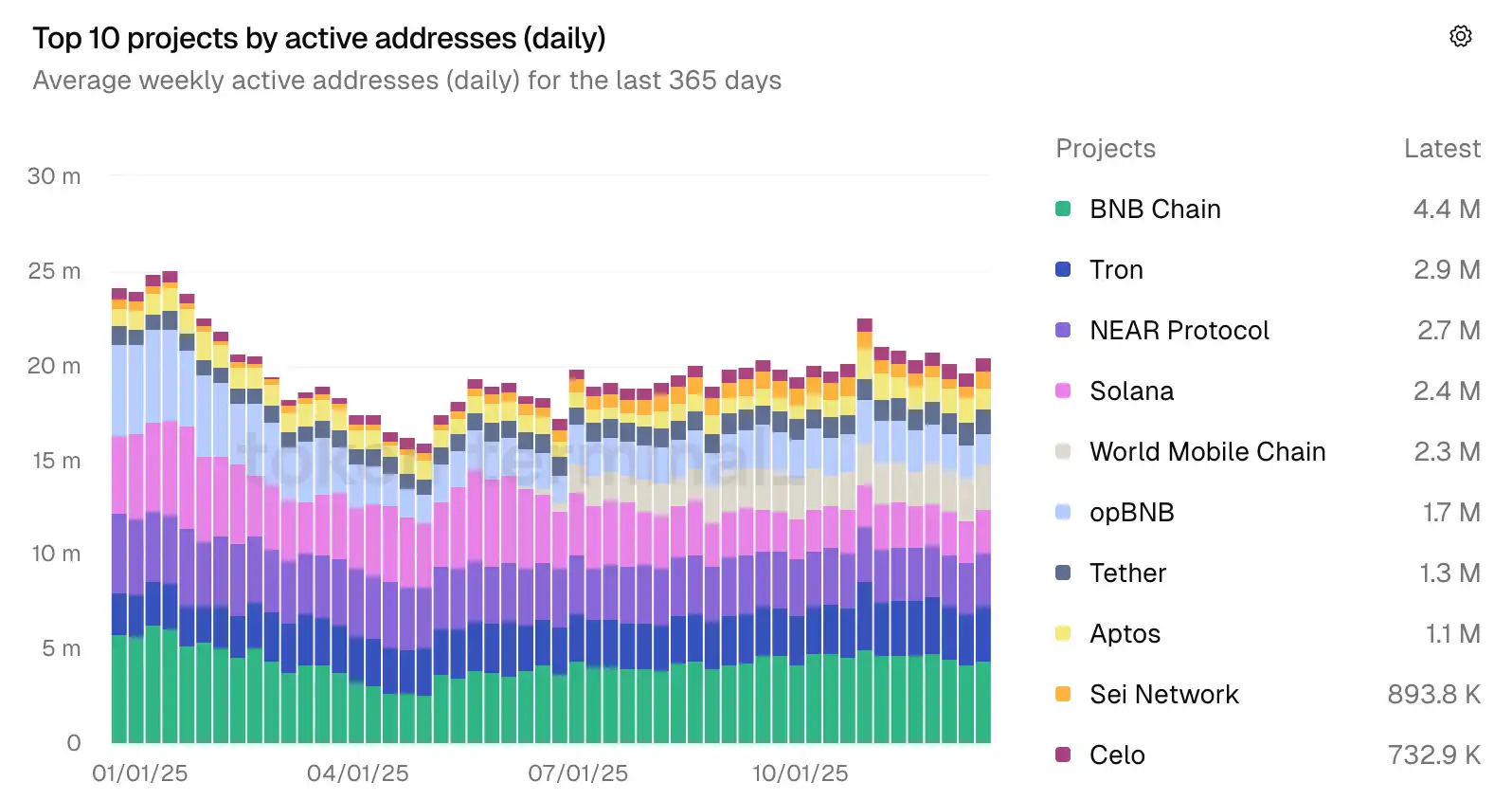
Image Source: Token Terminal
Entering the second half of 2025, BNB Chain rapidly shifted gears from an engineer to a product manager. Leveraging a strong foundation from the first half of the year, it successfully took on the massive stablecoin payment and RWA demand.
$147 Billion Stablecoin Supply and 4 Million Daily Active Users
If the crypto industry before 2024 was primarily driven by speculation, 2025 saw a transformation into a utility-focused stablecoin era. In this year, the stablecoin USDC issuer Circle went public, and the $1.6 trillion AUM Franklin D. Templeton launched JUSD.
Stablecoins are evolving from mere transactional mediums to channels bridging the traditional financial world and the Web3 space. Stablecoins are no longer just tools for DeFi but are starting to take on a role closer to real-world payments and fund circulation.
In this transformation, BNB Chain, with its 2-second settlement and transaction fees as low as $0.005, has become the fastest-growing platform. The latest data shows that the stablecoin value on the BNB Chain network has exceeded $147 billion, with BSC and opBNB serving over 4 million daily active users.
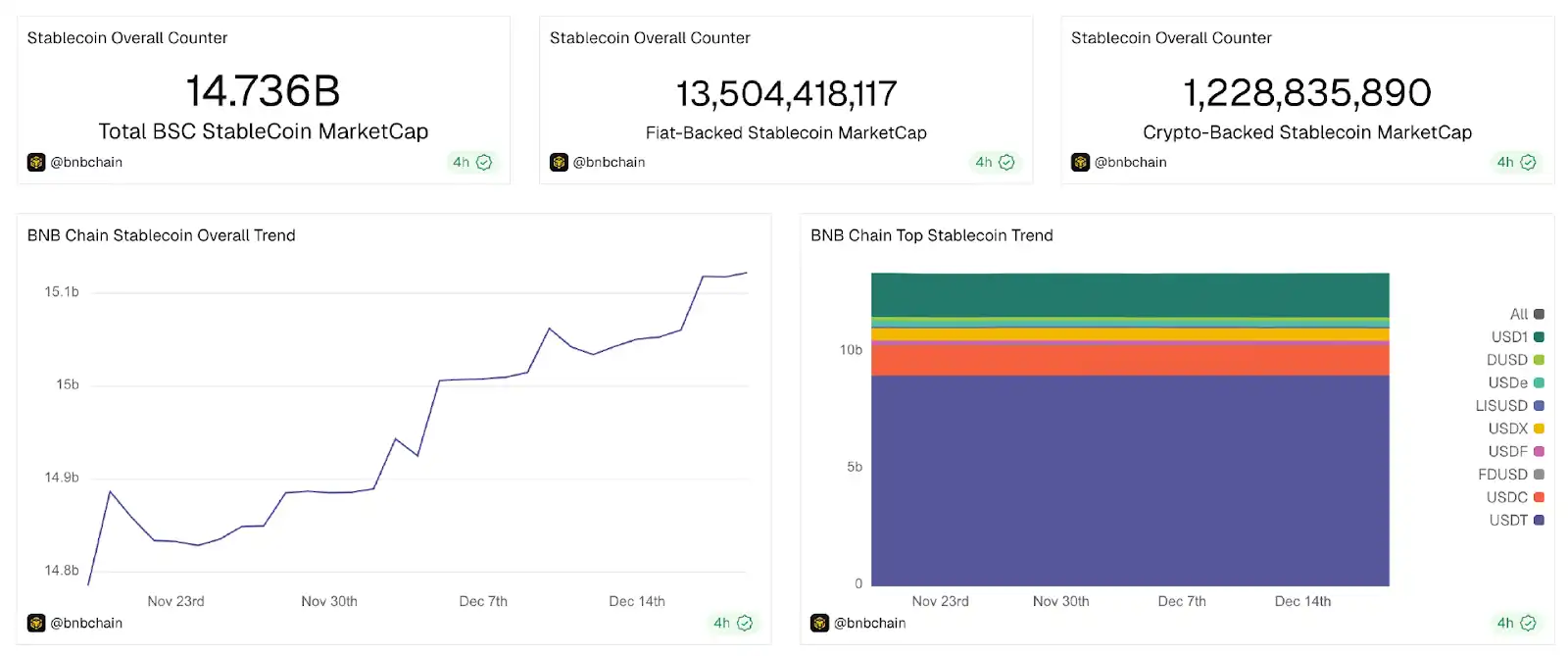
Image Source: Dune
The mainstream adoption of stablecoins does not just depend on the asset itself but also on its operating environment. For stablecoins to serve billions of users, the chain itself must have characteristics like low cost, speed, and seamlessness. The first-half-year upgrades of BNB Chain laid the foundation for the widespread use of stablecoins.
Through initiatives like gas-free transactions, opBNB, and other expansion solutions, the cost of stablecoin transfers has been compressed to near-zero levels, significantly reducing the barrier to using stablecoins for payments. On BSC and opBNB, stablecoin transfers are nearly instant, providing a near Web2 experience for on-chain payments, salary disbursements, and merchant settlements.
The on-chain stablecoin supply on BNB Chain has doubled to around $14 billion, making it one of the most active stablecoin networks globally. Against this backdrop, the stablecoin ecosystem itself has begun to change. United Stables chose to natively issue stablecoin U on BNB Chain. Unlike traditional stablecoins relying on a single collateral asset, U adopts a multi-stablecoin reserve model, allowing mainstream dollar-pegged stablecoins like USDT, USDC, and USD1 to be directly used as collateral to mint U.
From an ecological perspective, the introduction of U is not an isolated event but a natural outcome of the BNB Chain stablecoin system maturing. As the on-chain stablecoin scale continues to expand and address activity increases, the demand for unified liquidity and higher capital efficiency also grows. The multi-collateral model of United Stables is a response to this demand. United Stables' design reduces the efficiency loss caused by repeated splitting among different stablecoins, helps integrate on-chain liquidity, and simplifies the use of funds in trading, payments, and DeFi applications.

Image Source: BNB Chain
In 2025, a landmark event occurred when Abu Dhabi MGX invested $2 billion in Binance through the stablecoin USD1. USD1 is an anchor-to-dollar stablecoin launched by the Trump family-backed World Liberty Financial, backed by highly liquid assets, deployed on BNB Chain and other mainstream blockchains like ETH.
This investment sent a clear signal that stablecoins are no longer limited to the crypto industry but have become a tool to connect traditional capital with on-chain finance. And BNB Chain is a key infrastructure for this channel.
Furthermore, BNB Chain, in collaboration with YZi Labs, launched a Builder Fund of up to $1 billion to accelerate the development of existing and future developers on BNB Chain, especially those applications that can truly mobilize stablecoins. This fund not only provides funding but also offers technical incubation and compliance consulting.
According to the development blueprint disclosed by BNB Chain, areas such as on-chain salary systems, programmable treasuries, stablecoin-native credit cards, invoice tokenization, CBDC bridging and custody, green finance, and supply chain automation will experience explosive growth. These upcoming tracks share similar characteristics of being efficient, automated, and globally accessible, rather than focusing on cryptographic attributes. The positioning of stablecoins in these is closer to a digital economic unit, while BNB Chain aims to be the underlying operating system that supports these functions.
It is worth noting that the growth of the BNB Chain network's stablecoin ecosystem is not a single-point explosion but deeply tied to RWA.
BNB Chain and RWA Mutual Achievements
This year, we are no longer discussing the feasibility of on-chain assets. Traditional financial giants such as BlackRock, CMB International, VanEck, Franklin Templeton, and others are transferring hundreds of billions of dollars in assets to the blockchain. In this on-chain movement, BNB Chain, with its massive user base and ecosystem strategy, has become one of the key infrastructures for hosting RWA funds.
BlackRock, with the technological support of Securitize and Wormhole, has deployed its USD institutional digital liquidity fund, BUIDL Fund, to BNB Chain. Additionally, this fund can also be used as collateral on the Binance trading platform. This means that on-chain funds are no longer exotic financial products but have become a liquidity layer in the crypto market.
CMB International has brought its USD money market fund with assets under management exceeding $3.8 billion to BNB Chain. Reportedly, this fund is ranked first among similar funds in the Asia-Pacific region by Bloomberg, and investors can subscribe to shares on BNB Chain using stablecoins.
Image Source: BNB Chain
The deployment of various RWA assets on BNB Chain is not a one-way benefit but a deeper two-way promoting relationship. RWAs and BNB Chain are forming a mutually reinforcing positive feedback loop.
On-chain assetization is just the first step. If there is a lack of sufficient trading depth and turnover rate, then these tokens are just on-chain digital certificates and cannot unleash true financial value. Liquidity depletion is the biggest pain point hindering the large-scale outbreak of RWAs.
As a mature ecosystem, BNB Chain provides three key elements for RWA assets: high throughput, low fees, and a massive user base. Compared to other expensive blockchains, BNB Chain's low gas fees and high TPS make high-frequency trading and instant settlement possible, significantly reducing the threshold for user participation in RWA investments. Additionally, BNB Chain users are one of the most active Web3 communities, meaning that once RWA assets are launched, they can directly reach a massive number of potential investors.
In fact, CZ had already revealed in the AMA for BNB Chain's 5th anniversary that the key to the prosperity of RWAs on BNB Chain is, "Without users, there are no trades; without trades, there is no liquidity."
When Ondo Global Markets announced the introduction of 100+ US stocks and ETFs to BNB Chain and deep integration into the Binance Wallet, the market experienced a significant chemical reaction. Thanks to BNB Chain's large daily active user base, Ondo's tokenized stock trading volume surged from a previous single-day peak of $84 million to $170 million.
Image Source: rwa.xyz
As we stand at the beginning of 2026 and look back at the entire year of 2025, it was a milestone year for BNB Chain. BNB Chain transitioned from competing in the public chain space based on performance and cost to positioning itself based on real-world adoption, operational stability, and regulatory accessibility, aligning with the global traditional financial and internet payment systems. Over the past year, continuous high-throughput and zero-downtime operation, the growth of stablecoins and RWAs, and systemic optimization of underlying performance and cost structure have collectively demonstrated that BNB Chain has moved beyond the phase of just technical feasibility.
Looking ahead, the focus of BNB Chain's development will no longer be solely on chasing higher metrics but on further enhancing execution quality and user experience beyond its current scale. This includes faster confirmation speeds, lower usage costs, a more equitable trading environment, and middleware and tooling systems that are more friendly to complex scenarios like stablecoins, RWAs, payments, and AI.
Looking into 2026, BNB Chain aims to solidify its sub-second performance, global payment capability, and compliant asset support as default capabilities, allowing developers to build applications that offer an experience close to Web2 on top of it. This will enable ordinary users to utilize blockchain services without perceiving the underlying complexity. When blockchain is no longer seen as a new technology but naturally integrated into daily economic activities like a network or payment system, the true mass adoption of Web3 will arrive. And in 2025, BNB Chain took a decisive step towards this direction.
You may also like

Binance Removes Multiple Trading Pairs as of January 16
Key Takeaways Binance is set to remove several spot trading pairs, with the cessation of trading scheduled for…

Gate Alpha Launches 144th Points Airdrop: How to Claim GT Tokens
Key Takeaways Gate Alpha begins its 144th points airdrop with different tiers for users based on their Gate…

Price Alert Feature Is Now Live
Stay Informed of Key Market Movements with our new Price Alert feature!

Alibaba Backed Latin America Stablecoin Company, Why VelaFi?

The New Era in Bitcoin Core Development: The Rise of Core Maintainer TheCharlatan
Key Takeaways Integration of a New Maintainer: For the first time in three years, a new Bitcoin Core…

Binance Wallet Partners with Aster, Launches Seamless On-chain Perpetual Contract Trading
Key Takeaways: Binance Wallet has integrated with Aster to offer a streamlined and stable perpetual contract trading feature…

Life Candlestick Drama Escalates: Fund Established, ‘Cyber Altruism Box’ Feature Launched; Founder Denies Meme Coin Issuance
Key Takeaways The “Life K-Line” phenomenon combines traditional Chinese astrology with modern stock chart analysis, rapidly gaining popularity…

Fogo Launch and Market Cap Potential: A Deeper Dive into Binance’s Prime Sale and High-Performance Blockchain
Key Takeaways The Fogo public chain launched its FOGO token sale on Binance Wallet’s Pre-TGE Prime Sale, set…

XMR Surges Over 50% in One Week: Who's Buying?

For the first time in three years, a new Bitcoin Core maintainer has been added to the ranks,

CZ Joins as Advisor, YZI Labs Invests Millions, Genius Point Farming Guide
Fogo Launches on Binance Exchange Countdown, Can FDV Reach $300 Million Market Cap?

Life Candlestick Drama Escalates: Fund Established, 'Cyber Altruism Box' Feature Launched; Founder Denies Meme Coin Issuance

Dissecting the South Korean Crypto Market: Behind 16 Million Users, Who Is Dominating Trading and Narrative?

Space Featured in Binance Research Ecosystem Report: Key Signals of the Predictive Market Leverage Layer are Emerging

a16z Raises $15 Billion in New Fund: Long Criticized, Why Has It Become the "Best Storytelling" Venture Capitalist?

UK Lawmakers Urge Ban on Political Donations in Crypto
Key Takeaways: A group of senior UK lawmakers is pushing for a legislative ban on political donations in…
Key Market Intel on January 12th - A Must Read! | Alpha Morning Report
Binance Removes Multiple Trading Pairs as of January 16
Key Takeaways Binance is set to remove several spot trading pairs, with the cessation of trading scheduled for…
Gate Alpha Launches 144th Points Airdrop: How to Claim GT Tokens
Key Takeaways Gate Alpha begins its 144th points airdrop with different tiers for users based on their Gate…
Price Alert Feature Is Now Live
Stay Informed of Key Market Movements with our new Price Alert feature!
Alibaba Backed Latin America Stablecoin Company, Why VelaFi?
The New Era in Bitcoin Core Development: The Rise of Core Maintainer TheCharlatan
Key Takeaways Integration of a New Maintainer: For the first time in three years, a new Bitcoin Core…
Binance Wallet Partners with Aster, Launches Seamless On-chain Perpetual Contract Trading
Key Takeaways: Binance Wallet has integrated with Aster to offer a streamlined and stable perpetual contract trading feature…


 App
App