
- Buy Crypto
- Markets
- Futures
- Spot
- Copy Trade
 WE-Launch
Brevis Pico: A High-Performance Modular General-Purpose ZK Virtual Machine

Source: Brevis

The Brevis team is excited to introduce Pico — a modular and efficient zero-knowledge virtual machine (zkVM). Pico allows developers to flexibly build a zkVM tailored to their application's computational needs, similar to assembling LEGO bricks, in order to optimize performance and user experience. Developers can freely choose from a rich set of built-in options, and even fully customize the proof backends and VM instances to create a bespoke computational flow that meets their specific requirements.
Pico redefines the "Glue-and-Coprocessor" architecture, supporting not only underlying coprocessors (such as using precompiled modules to accelerate specific VM instruction operations) but also natively integrating Brevis' on-chain data zkCoprocessor, boosting application performance utilizing blockchain historical data by up to 32 times.
While a complete GPU-accelerated cluster solution for Pico has yet to be introduced, it has already achieved world-class performance on the CPU side. Compared to other industry zkVMs like RISC0, SP1, and OpenVM, Pico boasts a CPU speed improvement of 70% to 155%, setting a new performance benchmark.
With the release of Pico v1.0, we have introduced the world's first zkVM supporting a customizable compute architecture, allowing developers to adjust the following key parameters flexibly:
Selectable Proof Backend: Supporting STARK on KoalaBear and BabyBear, as well as CircleSTARK on Mersenne31.
Flexible Proofing Process: Optimizing security, scalability, proof generation efficiency to adapt to various application requirements.
On-chain Historical Data Access: Through the built-in on-chain data zkCoprocessor, developers can freely query, compute historical blockchain data to build dApps, achieving optimal computational performance and programming flexibility.
Pico is compatible with the RISC-V instruction set and supports the Rust development toolchain. Due to its modular architecture, Pico is future-proof and can easily adapt to the latest ZK theoretical research innovations. Whether it's the next generation of ZK applications or cutting-edge explorations in the ZK field, Pico provides developers with a stable and powerful computing foundation.
Feel free to visit the Pico Developer Guide, explore the GitHub code repository, and join the Telegram or Discord discussion groups to stay updated and contribute, together shaping the future of ZK computing.
Why Pico?
Brevis's first product—the on-chain data zkCoprocessor—has been widely used in DeFi and other fields. Many partners have deployed innovative features based on Brevis on the mainnet, including Kwenta, Usual, Algebra Labs, JoJo Exchange, Trusta, and more. In addition, PancakeSwap, Celer, Gamma, Quickswap, Frax, Mask Network, Kernel, BeraBorrow, Thena, Kim Protocol, 0G, Bedrock, Mellow Finance, ZettaBlock, Hemera
and Mendi Finance and other top protocols and applications are also developing next-generation products and features based on Brevis.
However, in the process of collaborating with these cutting-edge teams, we found that the practical application needs of zk computation are becoming more diverse and face the following core challenges:
1. Adapting to Different Application Needs
The business logic of different projects varies, and their performance requirements differ greatly. The traditional "one-size-fits-all" zkVM or fixed ZK circuit solutions struggle to meet the changing needs. If there is a lack of flexible customization of the proof process or an inability to integrate custom circuits (whether at the opcode level or application level), the scalability of zkVM will be limited.
2. Embracing Cutting-Edge ZK Technology
The ZK field is rapidly evolving, with new proof backends, frameworks, and cryptographic breakthroughs emerging constantly. Many existing zk solutions, due to their closed architecture, find it challenging to quickly integrate these innovative technologies, resulting in outdated proofs, poor performance, high computational costs, and limited optimization space.
Pico's Modular Approach: Truly Flexible and Scalable
To address these challenges, Pico adopts a modular architecture, providing:
· Support for Multiple Proof Backends: Easily switch or upgrade to the latest proof backend to ensure computational performance and compatibility.
· Customizable Proof Processes: Developers can freely customize the proof generation pipeline to meet specific application requirements.
· Scalable Coprocessor Integration: Supporting the building or integration of dedicated coprocessors, without being limited to a fixed zkVM framework.
Innovative Glue-and-Coprocessor Architecture: Breaking Through the Bottleneck of Traditional zkVM
Pico adopts the "Glue-and-Coprocessor" architecture, combining efficient dedicated circuits (Coprocessors) with a universal zkVM (Glue) to balance performance, generality, and scalability.
Coprocessors: Optimize intensive tasks such as arithmetic operations, cryptographic computations, machine learning, etc., to enhance ZK proof efficiency.
Universal zkVM (Glue): Manages the overall proof and verification process to ensure all logical computations can proceed securely.
What are the advantages of this architecture?
Compared to traditional zkVMs, Pico achieves faster proof generation and higher programmability by combining the generality and computational power of dedicated circuits.
Precompiles are a common type of coprocessor that extends the RISC-V instruction set to accelerate fundamental operations like hashing and signature verification. Pico supports developers in customizing precompiled modules based on their requirements and offers out-of-the-box optimization solutions.
However, relying solely on precompiles is insufficient to meet all application performance needs. For example, if a developer wants to prove that a trader executed 10,000 Uniswap trades totaling $50 million in the past 30 days, performing the computation using only zkVM would require writing Merkle tree inclusion proofs and RLP decoding programs, incurring high costs.
How to overcome this limitation?
Pico natively integrates Brevis's on-chain data zkCoprocessor as an application-level coprocessor, enabling developers to efficiently access and compute on-chain historical data, achieving a 32x performance improvement while reducing costs by 67%.
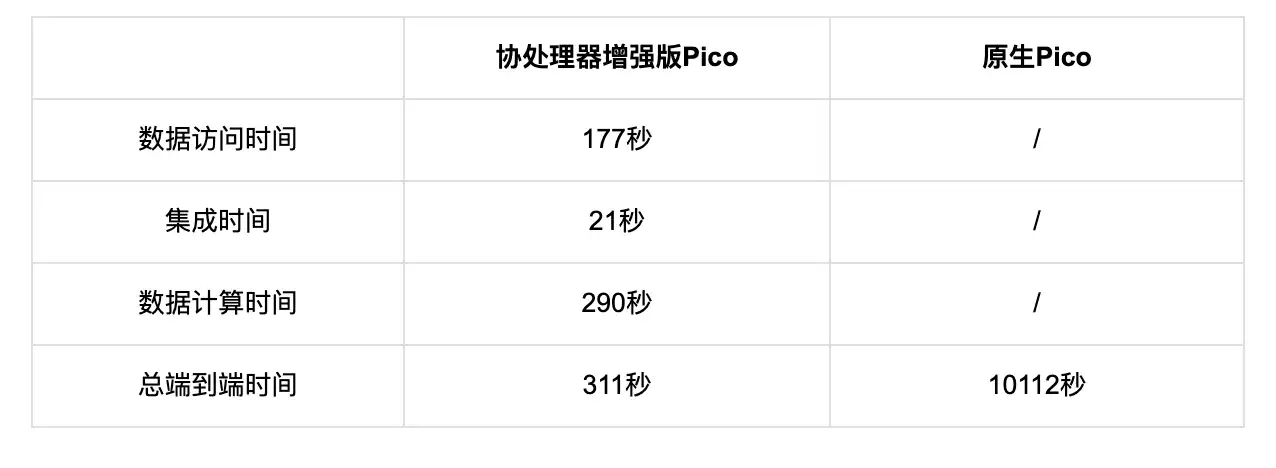
Table 1: Performance Comparison between Coprocessor-Enhanced Pico and Native Pico (4096 transactions, log size: 40)
Pico further extends this architecture to support verifiable AI inference, Reth, and other application-level coprocessors to further enhance zk computation efficiency.
By combining Coprocessors and the universal zkVM (Glue), Pico provides developers with a powerful and flexible tool to balance performance, programmability, and adaptability in ZK-driven applications.
Flexible Proof Backend with Customizable Computing Flow
1. Flexible Support for Multiple Proof Backends
Pico is compatible with multiple zero-knowledge proof systems, including:
STARK (KoalaBear, BabyBear)
CircleSTARK (Mersenne 31)
For example, the Poseidon2 hash function is widely used in zkVM recursive proofs. Under the same STARK system, KoalaBear proof efficiency far exceeds BabyBear, and a significant performance improvement can be achieved by simply switching the proof backend without modifying the computing logic.
2. Customizable Proof Workflow
Pico allows developers to freely adjust the proof generation process to optimize scalability, cost, and latency.
· Instance-Level Optimization: Developers can customize the computing flow of each VM instance (including proof backend, computing chip, memory management, etc.).
· ProverChain Proof Chain: Through modular processes such as RISCV → CONVERT → COMBINE → COMPRESS → EMBED → ONCHAIN, computing efficiency is optimized.
· Optional Decentralized Verification: Developers can choose whether to conduct on-chain verification on the EVM based on their needs to balance performance and decentralization.
Setting New Industry Performance Records: Establishing the New Benchmark for zkVM
In the latest performance benchmark tests, Pico has comprehensively surpassed existing zkVM solutions and demonstrated remarkable performance improvements in a CPU computing environment. We compared RISC0, SP1, and OpenVM, covering the following core computing tasks:
· Fibonacci Calculation
· Tendermint Block Consensus
· Ethereum Reth Block #17106222 Proof
All tests were conducted on an AWS r7a.48xlarge instance (192-core CPU, 1.5TB RAM) to ensure the consistency of the computing environment. The results show:
· Pico's runtime in all tasks is faster than the second fastest solution by up to 155%, setting a new performance record for zkVM computation!
· Pico's CPU computational power is significantly ahead, especially suitable for applications requiring efficient computation.
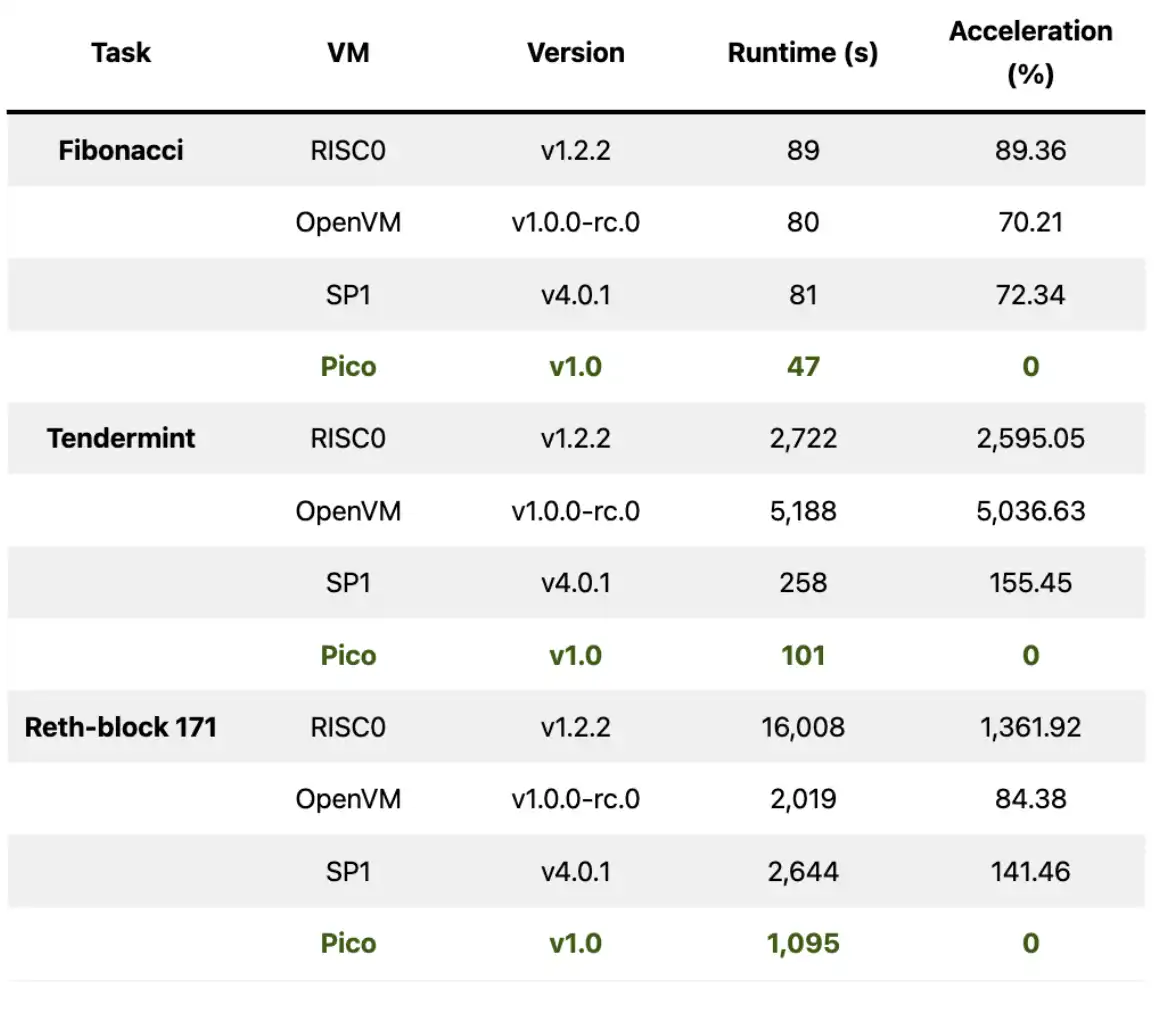
Table 2: Performance Benchmark Test Results of RISC0, OpenVM, SP1, and Pico on Fibonacci, Tendermint, and Reth-block 171 tasks on AWS r7a.48xlarge (192-core, 1.5TB memory)
GPU Accelerated Version Coming Soon
While the current data is based on CPU testing, Pico is developing a GPU-accelerated version expected to be released in the coming months. The GPU-accelerated version of Pico will further enhance zk computation capabilities, providing increased throughput and computational efficiency. A comprehensive GPU performance test report will be released in the future.
Standing on the Shoulders of Giants
Pico draws inspiration from the following projects, each representing cutting-edge advancements in zero-knowledge proof systems.
By building on these innovative foundations, Pico offers a modular and high-performance zkVM:
Plonky3: Pico's proof backend is based on Plonky3, extending its modular features to the zkVM layer, allowing developers to flexibly choose the proof domain and proof system that best suit their applications.
SP1: Pico gains important insights from SP1's chip design and constraint system, including the design of the recursion compiler and precompiles.
Valida: Pico's implementation of cross-table lookups is inspired by Valida's pioneering work in this field.
RISC0: Pico's Rust toolchain is directly based on the toolchain originally developed for RISC0.
Join the Pico Developer Community
Brevis has always believed that the future of zero-knowledge technology lies in collaboration and innovation. Pico is not just a zkVM but also a development platform that empowers building the next generation of zk applications.
· Read the Pico Developer Documentation: Pico Docs
· Explore the GitHub Repository: GitHub Repo
· Join the Community Discussions: Telegram or Discord
Let's work together to expand the boundaries of zero-knowledge computing and to build an intelligent, trustless, decentralized world!
This article is contributed content and does not represent the views of BlockBeats.
You may also like

a16z Leads $18M Seed Round for Catena Labs, Crypto Industry Bets on Stablecoin AI Payment
Pharos, deeply integrated with AntChain, is about to launch. How can we get involved?
The End and Rebirth of NFTs: How the Meme Coin Craze Ended the PFP Era?
Key Market Intelligence on May 14th, how much did you miss out on?
1.Binance Alpha Launches HIPPO, BLUE, and Other Tokens
2.Believe Ecosystem Tokens See General Rise, LAUNCHCOIN Surges Over 250% in 24 Hours
3.Tiger Securities Introduces Cryptocurrency Deposit and Withdrawal Service, Supports Mainstream Cryptocurrencies such as BTC and ETH
4.Current Bitcoin Rally Possibly Driven by Institutions, Retail Traders Yet to Join
5.Binance Wallet's New TGE Privasea AI Participation Requires a 198 Point Threshold, with a Point Consumption of 15
Source: Overheard on CT (tg: @overheardonct), Kaito
PUMP: Today's discussions about PUMP focus on its new creator revenue-sharing model: the platform will allocate 50% of PumpSwap revenue to token creators, sparking varied reactions from users. Some criticize the move as insufficient or even misleading, while others view it as a positive step the platform is taking to reward creators. Meanwhile, PUMP faces market pressure from emerging competitors like LetsBONKfun and Raydium, which are rapidly gaining market share. Users also express concerns about PUMP's sustainability and potential regulatory risks in the U.S., with discussions extending to the platform's impact on the entire memecoin ecosystem.
COINBASE: Today, Coinbase became the first crypto company to join the S&P 500 Index, replacing Discover Financial Services, sparking widespread industry attention. The entire crypto community views this milestone as a significant development, signaling that crypto assets are further integrating into the mainstream financial system. The news has sparked lively discussions on Twitter, with many users pointing out that this may attract more institutional investors to enter the Bitcoin and other cryptocurrency markets.
XRP: XRP became the focal point of today's crypto discussion, with its significant market movements and strategic advances drawing attention. XRP has surpassed USDT to become the third-largest cryptocurrency by market capitalization, sparking market excitement and discussions about its future potential. The surge in market capitalization and price is believed to be related to increasing institutional interest, deepening strategic partnerships, and its role in the crypto ecosystem. Additionally, XRP's integration into multiple financial systems and its potential as a macro asset class are also seen as key factors driving the current market sentiment.
DYDX: Today's discussions about DYDX mainly focused on the dYdX Yapper Leaderboard launched by KaitoAI. The leaderboard aims to identify the most active community participants, with a total of $150,000 in rewards to be distributed over the first three seasons. This initiative has sparked broad community participation, with many users discussing the potential rewards and the incentive effect on the DYDX ecosystem. Meanwhile, progress on the ethDYDX to dYdX native chain migration and historical airdrop events have also been topics of discussion.
1. "What Is 'ICM'? Holding Up the $4 Billion Market Cap Solana's New Narrative"
Overnight, the hottest narrative in the crypto space has become "Internet Capital Markets," with a host of crypto projects and founders, led by the Solana ecosystem's new Launchpad platform Believe, releasing this phrase. Together with "Believe in something," it has become the new slogan heralding the onset of a bull market. What exactly is the so-called "Internet Capital Market," will it become a short-lived hype phrase like the Base ecosystem's previous Content Coin, and what related targets are available for selection?2.《LaunchCoin Surges 20x in One Day, How Did Believe Create a $200M Market Cap Shiba Inu After Going to Zero?|100x Retrospective》
LAUNCHCOIN broke through a $200 million market cap today, with the long-lost liquidity and such a high market cap "Memecoin" almost bringing half of the on-chain crypto community CT into the fray. The community is crazily discussing this token, with half of it being FOMO and the other half being FUD. This token, originally issued by Believe founder Ben Pasternak under his personal identity, transformed into a new platform token after a renaming. From once going to zero to a $200 million market cap, what happened in between?May 14 On-chain Fund Flow
Within 24 hours, GOONC's market cap soared to 70 million, could GOONC be the next billion-dollar dog on the Believe platform?
Bitcoin has broken $100,000, Ethereum has surpassed 2500, and is Solana's hot streak about to make a comeback?
The current market is in a state of macro euphoria, with GOONC riding the wave today, skyrocketing 10x in just a few hours, reaching a market cap of tens of millions of dollars, trading volume soaring past 50 million, and rumors swirling that the developer may be from OpenAI (unconfirmed but intriguing enough).
A ludicrous and absurd Solana meme that some actually buy into.
GOONC is a meme coin that has sprouted from the "gooning" subculture, offering no technological innovation or practical use, its sole function being speculation.
It takes inspiration from an NSFW term "gooning," which refers to a person being deeply immersed in certain content (you know what), eventually entering a nearly religious-like trance.
In Reddit (such as r/GOONED, r/GoonCaves) and some counterculture media outlets (such as MEL Magazine in 2020), "gooning" has gradually transitioned from an adult label to a meme-addicted, digital content and virtual self-indulgence synonym, arguably the epitome of Degen spirit.
GOONC is playing around with this concept, packaging the addictive nature, uselessness, and irony of gooning into a tradable financial product. The project team has made it clear: "We do not solve blockchain problems, we only trade absurdity." Blunt but oddly genuine.
GOONC launched on May 13, 2025, using the meme coin launch platform Believe App's LaunchCoin module on Solana. This tool is highly Degen: zero technical barriers, a few clicks to create a coin, perfect for projects like GOONC that can come up with ideas out of the blue.
The mastermind behind GOONC is also quite something and is the most talked-about, with KOL @basedalexandoor on X platform (alias "Pata van Goon") personally involved. His profile even caught the attention of Marc Andreessen, co-founder of a16z, making onlookers unable to resist speculating if GOONC has a hint of OpenAI lineage.
While this 'OpenAI Endorsement' is currently just community speculation, it is definitely a good card to play to fuel hype. Saying "we are pure speculation" on one hand, while tagging a few "AI + a16z" on the other.
GOONC took off as soon as it launched. After its launch on May 13, 2025, its market capitalization skyrocketed to $22 million within 4 hours, with a trading volume exceeding $25.6 million in 24 hours. According to platform data, the first day of trading saw an astonishing +41,100% surge, soaring from $0.0000001 to $0.02, becoming a "missed-the-boat" situation.
GOONC quickly formed an active trading community post-launch, with a lot of discussion and trading signals appearing on X platform (such as the 292x return signal provided by DeBot). Liquidity pools on exchanges like Raydium and Meteora grew rapidly, supporting high trading volumes and price increases.
The real climax occurred between May 13 and May 14, with the market cap rising to $5.5 million in the morning and directly surpassing $55 million in the afternoon. By the 14th, it briefly approached a $70 million market cap, with the trading volume soaring to $59 million. Some community members even posted screenshots claiming an increase of +85,000%, creating a new myth out of the ruins.
As of 1:30 pm on May 14, the price stabilized around $0.039, with a total market cap and FDV both around $39.6 million, and a 24-hour trading volume of $5.43 million. Active platforms include XT.COM, LBank, Meteora, and others.
Although there was a slight pullback from the peak ($0.07), the coin's popularity remains strong. For a coin that relies purely on "irony + community + X post" to thrive, this performance is already at a stellar level.
Currently, the background of the token's development team is not transparent, increasing the potential risk of a rug pull. Rugcheck.xyz warns that the creator of the GOONC contract may have permission to modify the contract (e.g., change fees or mint additional tokens), posing certain security risks.
Community members speculate that the meteoric rise of GOONC may be the "last hurrah".
Deconstructing Binance Alpha2.0's New "Asia-Led Liquidity Mining" Model
How to Get Rich in Crypto Without Relying on Luck? Financial Veteran Raoul Pal's Macro Insights and Investment Path
Stablecoins Driving Global B2B Payment Innovation: How to Break Through Workflow Bottlenecks and Unlock Trillion-Dollar Market Potential?
These startups are building cutting-edge AI models without the need for a data center
After CEX and Wallet, OKX enters the payment game
Science Equity Movement: DeSci's Trillion-Dollar Knowledge Economy Reconstruction Revolution
Sentient In-Depth Research Report: Secures $85 Million in Funding to Build a Decentralized AGI New Paradigm
April 30th Market Key Intelligence, How Much Did You Miss?
Interview with Virtuals Co-Founder empty: AI Startups Don't Need a Lot of Funding, Crypto is One of the Answers
a16z Leads $25M Investment, 0xMiden to Run a Privacy Chain on Your Phone
Sui Q1 Advanced Report: The Rise of BTCfi Infrastructure, the Boom of Lending Protocols, and the Future of Rollup-Based Scalability
Gate.io MemeBox has officially integrated with the Solana ecosystem, providing lightning-fast on-chain asset trading.
Key Market Information Discrepancy on April 30th - A Must-Read! | Alpha Morning Report
a16z Leads $18M Seed Round for Catena Labs, Crypto Industry Bets on Stablecoin AI Payment
Pharos, deeply integrated with AntChain, is about to launch. How can we get involved?
The End and Rebirth of NFTs: How the Meme Coin Craze Ended the PFP Era?
Key Market Intelligence on May 14th, how much did you miss out on?
1.Binance Alpha Launches HIPPO, BLUE, and Other Tokens
2.Believe Ecosystem Tokens See General Rise, LAUNCHCOIN Surges Over 250% in 24 Hours
3.Tiger Securities Introduces Cryptocurrency Deposit and Withdrawal Service, Supports Mainstream Cryptocurrencies such as BTC and ETH
4.Current Bitcoin Rally Possibly Driven by Institutions, Retail Traders Yet to Join
5.Binance Wallet's New TGE Privasea AI Participation Requires a 198 Point Threshold, with a Point Consumption of 15
Source: Overheard on CT (tg: @overheardonct), Kaito
PUMP: Today's discussions about PUMP focus on its new creator revenue-sharing model: the platform will allocate 50% of PumpSwap revenue to token creators, sparking varied reactions from users. Some criticize the move as insufficient or even misleading, while others view it as a positive step the platform is taking to reward creators. Meanwhile, PUMP faces market pressure from emerging competitors like LetsBONKfun and Raydium, which are rapidly gaining market share. Users also express concerns about PUMP's sustainability and potential regulatory risks in the U.S., with discussions extending to the platform's impact on the entire memecoin ecosystem.
COINBASE: Today, Coinbase became the first crypto company to join the S&P 500 Index, replacing Discover Financial Services, sparking widespread industry attention. The entire crypto community views this milestone as a significant development, signaling that crypto assets are further integrating into the mainstream financial system. The news has sparked lively discussions on Twitter, with many users pointing out that this may attract more institutional investors to enter the Bitcoin and other cryptocurrency markets.
XRP: XRP became the focal point of today's crypto discussion, with its significant market movements and strategic advances drawing attention. XRP has surpassed USDT to become the third-largest cryptocurrency by market capitalization, sparking market excitement and discussions about its future potential. The surge in market capitalization and price is believed to be related to increasing institutional interest, deepening strategic partnerships, and its role in the crypto ecosystem. Additionally, XRP's integration into multiple financial systems and its potential as a macro asset class are also seen as key factors driving the current market sentiment.
DYDX: Today's discussions about DYDX mainly focused on the dYdX Yapper Leaderboard launched by KaitoAI. The leaderboard aims to identify the most active community participants, with a total of $150,000 in rewards to be distributed over the first three seasons. This initiative has sparked broad community participation, with many users discussing the potential rewards and the incentive effect on the DYDX ecosystem. Meanwhile, progress on the ethDYDX to dYdX native chain migration and historical airdrop events have also been topics of discussion.
1. "What Is 'ICM'? Holding Up the $4 Billion Market Cap Solana's New Narrative"
Overnight, the hottest narrative in the crypto space has become "Internet Capital Markets," with a host of crypto projects and founders, led by the Solana ecosystem's new Launchpad platform Believe, releasing this phrase. Together with "Believe in something," it has become the new slogan heralding the onset of a bull market. What exactly is the so-called "Internet Capital Market," will it become a short-lived hype phrase like the Base ecosystem's previous Content Coin, and what related targets are available for selection?2.《LaunchCoin Surges 20x in One Day, How Did Believe Create a $200M Market Cap Shiba Inu After Going to Zero?|100x Retrospective》
LAUNCHCOIN broke through a $200 million market cap today, with the long-lost liquidity and such a high market cap "Memecoin" almost bringing half of the on-chain crypto community CT into the fray. The community is crazily discussing this token, with half of it being FOMO and the other half being FUD. This token, originally issued by Believe founder Ben Pasternak under his personal identity, transformed into a new platform token after a renaming. From once going to zero to a $200 million market cap, what happened in between?May 14 On-chain Fund Flow
Within 24 hours, GOONC's market cap soared to 70 million, could GOONC be the next billion-dollar dog on the Believe platform?
Bitcoin has broken $100,000, Ethereum has surpassed 2500, and is Solana's hot streak about to make a comeback?
The current market is in a state of macro euphoria, with GOONC riding the wave today, skyrocketing 10x in just a few hours, reaching a market cap of tens of millions of dollars, trading volume soaring past 50 million, and rumors swirling that the developer may be from OpenAI (unconfirmed but intriguing enough).
A ludicrous and absurd Solana meme that some actually buy into.
GOONC is a meme coin that has sprouted from the "gooning" subculture, offering no technological innovation or practical use, its sole function being speculation.
It takes inspiration from an NSFW term "gooning," which refers to a person being deeply immersed in certain content (you know what), eventually entering a nearly religious-like trance.
In Reddit (such as r/GOONED, r/GoonCaves) and some counterculture media outlets (such as MEL Magazine in 2020), "gooning" has gradually transitioned from an adult label to a meme-addicted, digital content and virtual self-indulgence synonym, arguably the epitome of Degen spirit.
GOONC is playing around with this concept, packaging the addictive nature, uselessness, and irony of gooning into a tradable financial product. The project team has made it clear: "We do not solve blockchain problems, we only trade absurdity." Blunt but oddly genuine.
GOONC launched on May 13, 2025, using the meme coin launch platform Believe App's LaunchCoin module on Solana. This tool is highly Degen: zero technical barriers, a few clicks to create a coin, perfect for projects like GOONC that can come up with ideas out of the blue.
The mastermind behind GOONC is also quite something and is the most talked-about, with KOL @basedalexandoor on X platform (alias "Pata van Goon") personally involved. His profile even caught the attention of Marc Andreessen, co-founder of a16z, making onlookers unable to resist speculating if GOONC has a hint of OpenAI lineage.
While this 'OpenAI Endorsement' is currently just community speculation, it is definitely a good card to play to fuel hype. Saying "we are pure speculation" on one hand, while tagging a few "AI + a16z" on the other.
GOONC took off as soon as it launched. After its launch on May 13, 2025, its market capitalization skyrocketed to $22 million within 4 hours, with a trading volume exceeding $25.6 million in 24 hours. According to platform data, the first day of trading saw an astonishing +41,100% surge, soaring from $0.0000001 to $0.02, becoming a "missed-the-boat" situation.
GOONC quickly formed an active trading community post-launch, with a lot of discussion and trading signals appearing on X platform (such as the 292x return signal provided by DeBot). Liquidity pools on exchanges like Raydium and Meteora grew rapidly, supporting high trading volumes and price increases.
The real climax occurred between May 13 and May 14, with the market cap rising to $5.5 million in the morning and directly surpassing $55 million in the afternoon. By the 14th, it briefly approached a $70 million market cap, with the trading volume soaring to $59 million. Some community members even posted screenshots claiming an increase of +85,000%, creating a new myth out of the ruins.
As of 1:30 pm on May 14, the price stabilized around $0.039, with a total market cap and FDV both around $39.6 million, and a 24-hour trading volume of $5.43 million. Active platforms include XT.COM, LBank, Meteora, and others.
Although there was a slight pullback from the peak ($0.07), the coin's popularity remains strong. For a coin that relies purely on "irony + community + X post" to thrive, this performance is already at a stellar level.
Currently, the background of the token's development team is not transparent, increasing the potential risk of a rug pull. Rugcheck.xyz warns that the creator of the GOONC contract may have permission to modify the contract (e.g., change fees or mint additional tokens), posing certain security risks.
Community members speculate that the meteoric rise of GOONC may be the "last hurrah".
Deconstructing Binance Alpha2.0's New "Asia-Led Liquidity Mining" Model
Popular coins
Latest Crypto News


Customer Support:@weikecs
Business Cooperation:@weikecs
Quant Trading & MM:bd@weex.com
VIP Services:support@weex.com
 App
App