
- Buy Crypto
- Markets
- Futures
- Spot
- Copy Trade
 WE-Launch
Frequent Regulatory Easing: Is the Cryptocurrency Spring Coming to the US Market?

Recently, there have been continuous signals of regulatory optimism for the cryptocurrency industry in the United States: in the early hours of February 26, the U.S. Securities and Exchange Commission (SEC) announced the termination of its three-year investigation into Uniswap Labs, without taking any enforcement action; market maker giants Wintermute and Citadel Securities began to enter the U.S. market; Tornado Cash founder Alexey Pertsev was granted permission by a Dutch court and was temporarily released... The new government has been constantly "reversing" the previous harsh accusations against the cryptocurrency industry, welcoming the influx of fresh blood, which has also sparked discussions on whether the cryptocurrency regulatory framework is shifting towards "loosening." How to regulate in a way that better fits decentralized institutions has always been an issue that financial regulators have not been able to properly address, leading to many long-standing controversial litigation cases.
Uniswap: SEC Investigation Terminated After Three Years
As early as 2021, the SEC began investigating Uniswap Labs, questioning whether it was operating as an unregistered securities exchange and whether its UNI token constituted an illegal securities issuance. On April 11, 2024, the SEC issued a warning to Uniswap Labs, which was issued in the form of a Wells Notice, planning to take enforcement action against the company. On May 22, Uniswap Labs responded for the first time in writing to the notice received from the SEC in April, stating that the Uniswap Protocol is a secure, low-cost, and transparent infrastructure, that its protocol does not meet the definition of an exchange, and that the UNI token does not meet the standard of an "investment contract." Uniswap Labs argued that the SEC should embrace open-source technology that improves outdated business and financial systems, rather than attempting to eliminate it through litigation. On July 10, Uniswap Labs Chief Legal Officer Katherine Minarik posted on social media, stating that Uniswap Labs urged the SEC not to continue advancing its proposed rulemaking process, which inappropriately expanded the definition of a "trading platform" to include DeFi and more.
Key points of Uniswap Labs' defense included:
The Uniswap protocol, website, and wallet do not meet the legal definition of a securities exchange or broker;
The UNI token is held by over 300,000 holders, its value is not dependent on Uniswap Labs' efforts, similar to Bitcoin and Ethereum, it is decentralized and should not be considered a security.
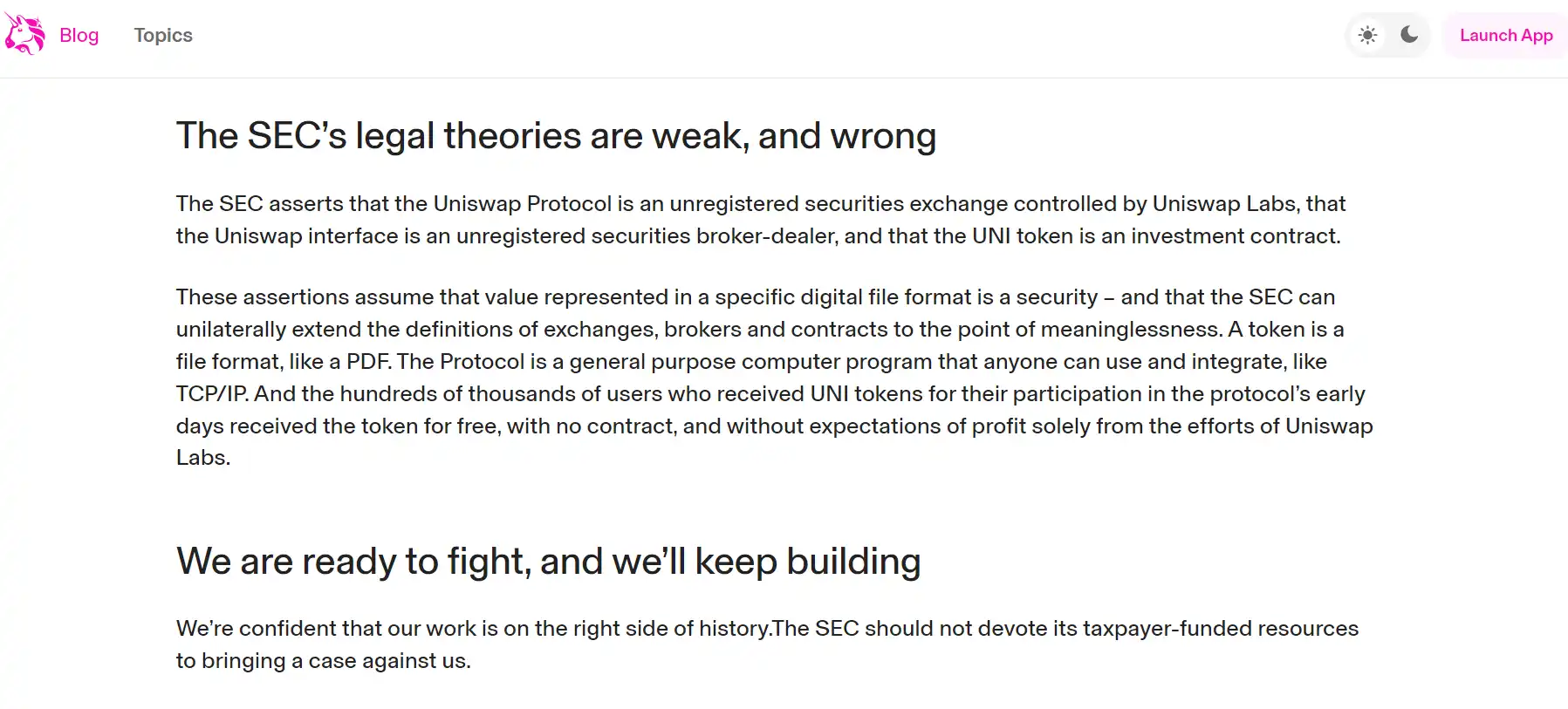
Image Source: Uniswap Blog
On February 26, 2025, after previously accusing Uniswap Labs of operating an unregistered securities exchange, broker-dealer, or clearing agency, and potentially issuing unregistered securities, the SEC finally concluded its investigation and dropped all charges. Uniswap founder Hayden Adams stated that the SEC's enforcement lacked a clear legal basis and, as a form of selective enforcement strategy, the SEC attempted to forcefully fit DeFi into an unsuitable regulatory framework while refusing to provide clear rules or compliance paths. This investigation lasted over 3 years, wasting significant time and millions of dollars. The UNI token also saw a brief spike of nearly 10%, indicating a strong market response.
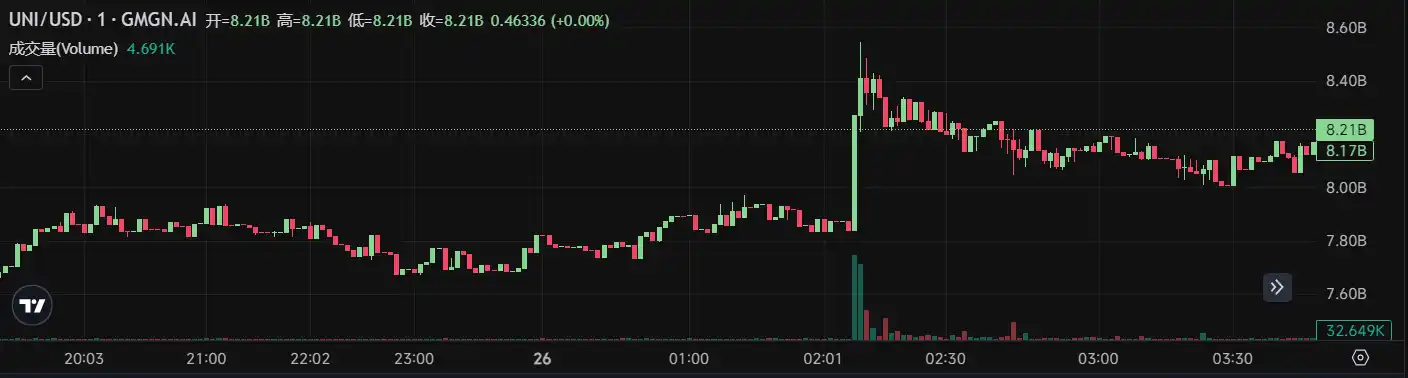
This saga has finally come to an end, with Uniswap Labs calling it a "major DeFi victory," emphasizing, "This once again proves the fact we have always believed in—that the technology we have built stands on the right side of the law, and our work stands on the right side of history."
Uniswap's victory is not only a victory for decentralization but also a reminder that relevant authorities should establish appropriate regulatory policies. DeFi provides an alternative to traditional financial services through blockchain smart contracts, such as lending, trading, and asset management, aiming to eliminate centralized institutions' influence on the market. However, its decentralized nature complicates regulation, as existing legal frameworks primarily target centralized financial institutions. Regulators lack understanding and experience in regulating decentralized platforms. Although the SEC and other regulatory bodies attempt to apply Anti-Money Laundering (AML) and Know Your Customer (KYC) regulations to DeFi, enforcement is challenging.
Former SEC Chairman Gary Gensler once referred to DeFi as the "Wild West," emphasizing the need for stricter regulation. The Uniswap case demonstrates that existing securities laws may not fully apply to decentralized platforms, suggesting that future congressional legislation may be necessary to establish a specialized DeFi regulatory framework.
Tornado Cash Case Sees a Turning Point
Another typical case that was once severely sanctioned by US regulatory agencies, only to later achieve victory after a lengthy legal battle, is Tornado Cash.
Tornado Cash is an Ethereum-based privacy protocol that can obfuscate transaction origins, destinations, and counterparts, aiming to indiscriminately facilitate anonymous transactions without attempting to trace their origins. It was designed to protect user privacy but also drew regulatory attention due to its misuse in money laundering.
In August 2022, the U.S. Department of the Treasury's Office of Foreign Assets Control (OFAC) sanctioned Tornado Cash. In its statement, the Treasury Department stated that since its creation in 2019, Tornado Cash has been used to launder over $7 billion in cryptocurrency, including $455 million stolen by the North Korean government-backed hacker group Lazarus Group; additionally, Tornado Cash was also used to launder over $96 million of illicit funds from the Harmony Bridge hack on June 24, 2022, and at least $7.8 million from the Nomad hack on August 2, 2022.
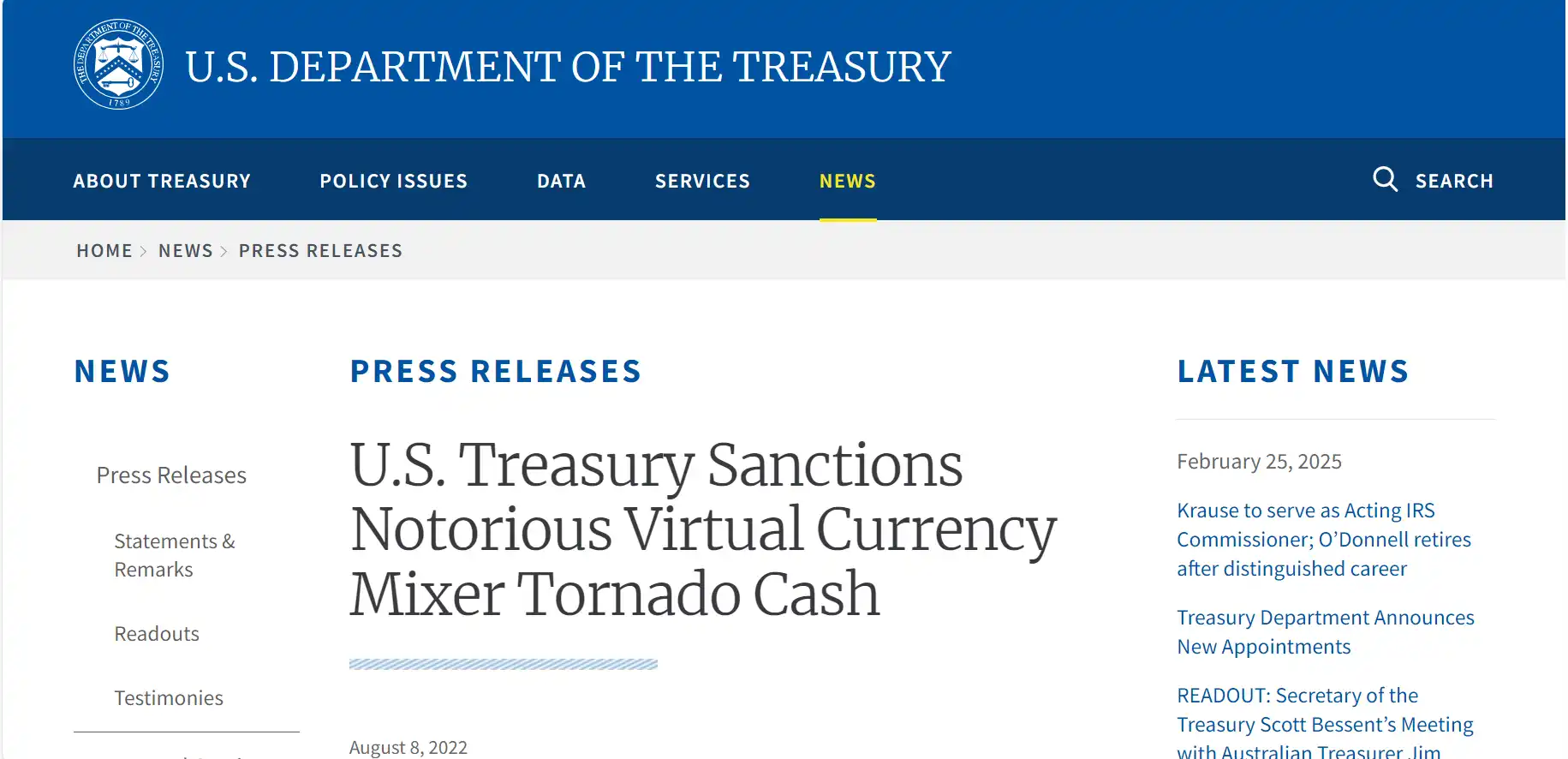
Image Source: US Treasury Official Website
The Treasury Department's sanctions primarily include prohibiting access, banning entities and individuals from interacting with it, preventing U.S. institutions or platforms from engaging in financial transactions with it, and freezing all assets owned or controlled by Tornado Cash within the United States.
Furthermore, in May 2024, a Dutch court found Tornado Cash founder Alexey Pertsev guilty of assisting in laundering $22 billion in cryptocurrency and sentenced him to 64 months in prison. The prosecution accused him of failing to prevent criminal organizations (such as the North Korean Lazarus Group) from using the protocol for money laundering, despite the defense highlighting the protocol's "decentralization" and "uncontrollability." However, the court believed that developers are still responsible for abusive behavior.
The Tornado Cash incident signifies an escalation in the ongoing struggle between "cryptographic protocols" and "regulation." This sanction against Tornado Cash is a direct regulatory attack on the protocol, as the Treasury Department believes that creating a privacy protocol available for criminals to use is a criminal act, not recognizing the protocol's "decentralization" and "uncontrollability."

Image Source: CoinDesk, Crowd rallying in support of protecting cryptographic technology and privacy
The shift occurred at the end of 2024. On November 28, 2024, the court ruled that the immutable smart contract of Tornado Cash is not considered property and cannot be sanctioned under current law, rendering the Treasury Department's previous sanctions on Tornado Cash illegal. As stated in a report to investors by 10X Research, "While this ruling does not condone money laundering, it sets a precedent allowing programmers to develop and release smart contract protocols without fees without fear of sanctions." Balaji Srinivasan, former CTO of Coinbase and a prominent cryptocurrency entrepreneur, tweeted, "Privacy won. Smart contracts won. Tornado Cash won. And OFAC lost." The Tornado Cash protocol token, TORN, also saw a rapid surge in price following the ruling, rising from a low of $3.7 to a high of $43 within an hour.
In January 2025, a Texas court once again supported the overturning of sanctions, stating that the U.S. Treasury Department's approval of interacting with Tornado Cash exceeded its authority, further confirming the invalidity of the sanctions.
Shedding the "illegal" shackles, over two months later, Alexey Pertsev also posted that a Dutch court had agreed to temporarily suspend his pre-trial detention under electronic monitoring conditions, and he would be temporarily released on February 7 at 10 a.m. Pertsev stated that this would give him the opportunity to continue his appeal, fight for justice, and thanked all supporters for their help.
Related Read: "Landmark Ruling: Sanctions on Tornado Cash Ruled Illegal, TORN Skyrockets Over 10x Before Falling Back"
Long-standing Market Maker Joins U.S. Market
At the Consensus Hong Kong 2025 conference a week ago, Wintermute CEO Evgeny Gaevoy, in an interview with Bloomberg, stated that the company's business expansion plan had changed. While the focus was previously primarily on the Asian market, it is now shifting emphasis to the U.S., expressing hopes for favorable cryptocurrency regulatory policies in the U.S.
On February 25, according to Bloomberg, Citadel Securities, a traditional financial industry giant with a market value of $650 billion, plans to enter the cryptocurrency market-making sector, marking a significant shift in its previous cautious stance on the cryptocurrency sector. The company is already planning to join the market-making roster of several exchanges, such as Coinbase Global, Binance, and Crypto.com, potentially initially establishing market-making teams outside the U.S.
Citadel Securities and Wintermute, one a veteran market maker in the traditional financial sector and the other a market-making giant with long-standing involvement in the crypto space. Their entry will undoubtedly directly increase liquidity in the U.S. crypto market. Especially with the entry of the traditional financial giant Citadel, it directly drives the crypto market from the "wild west" period towards maturity, promoting comprehensive enhancement of the market in liquidity, trading efficiency, and regulatory compliance dimensions. It also indicates that as U.S. regulatory laws evolve, institutional confidence in the crypto industry continues to grow, and the U.S. crypto market may be entering a new growth stage.
Related Read: "Regulation Continues to Loosen, Are U.S. Crypto Market Makers Coming Back?"
As Hayden Adams mentioned today, "It is great to see the new SEC leadership take a more constructive approach and look forward to working with Congress and regulatory agencies to develop rules that truly fit DeFi — encouraging innovation, enhancing transparency and financial market access, allowing this technology to thrive in the United States, rather than being forced overseas." With the continued release of regulatory positive signals, DeFi's best days may be ahead, and the U.S. may be on the brink of a crypto spring where all flowers bloom.
You may also like
Arthur Hayes Interview: Bitcoin Has Bottomed, Which Tokens Can Outperform Bitcoin?
April 15th Market Key Insights, How Much Did You Miss?
Is USDT's cross-chain version, USDT0, reliable?
Splurging $80 Million in Growth "Subsidies," Uniswap is Taking Big Steps
The Truth About Liquidity: 2024 Exchange Listing Effect Research Report
Gold Panning in the Sandbox: Seeking Long-Term Investment Opportunities That Weather Market Ups and Downs (Part 2)
Market Maintains Sideways Movement, BNB Chain Meme Trend Emerges
Uniswap Makes a Splash with $1.65 Billion Ecosystem Incentive - Can It Revitalize the DeFi Market?
Frame-by-Frame Analysis of the White House Crypto Summit: What Market Whisperings Have Gone Unnoticed?
Original Translation: zhouzhou, BlockBeats
Editor's Note: The cryptocurrency summit hosted by Donald Trump marks the United States' leadership in the digital finance sector. The summit discussed cryptocurrency regulation and policies, with the government emphasizing the importance of Bitcoin as a strategic asset and announcing the establishment of a Bitcoin reserve. Despite the introduction of a long-term regulatory strategy, the market was disappointed by the lack of clear regulatory measures and the uncertainty surrounding altcoins.
Below is the original content (rearranged for ease of reading comprehension):
Donald Trump fooled the entire cryptocurrency community, the US cryptocurrency reserve was canceled, taxes still exist, I analyzed the full cryptocurrency summit, and here is everything you need to know and the future of cryptocurrency
On March 7, 2025, the cryptocurrency summit hosted by President Donald Trump became a milestone event for the industry.
· This was the first summit in the US entirely dedicated to shaping cryptocurrency regulation and future policy.
· The government has increasingly shown support for Bitcoin, highlighting Bitcoin's strategic role in maintaining US digital economic dominance.
· The event was live-streamed through social media, attracting widespread attention from investors and the public.
· However, the market reaction was quite negative, with a significant drop in Bitcoin and other altcoins.
· The summit discussed the future of cryptocurrency regulation and its impact on the US financial industry
· The government reaffirmed its commitment to keeping the US a leading force in digital finance
· Bitcoin and digital assets were deeply discussed in terms of economic policy and financial stability
· The goal was to establish a sustainable and innovation-friendly regulatory environment for the cryptocurrency industry
Donald Trump presided over the summit, representing the US government's position in the cryptocurrency field
· David Sachs, serving as the White House cryptocurrency and artificial intelligence advisor, led high-level discussions with industry leaders
· Beau Haynes, head of the Digital Assets Working Group, played a key role in shaping strategic policies
·White House senior officials participated in the dialogue, advocating for the government's interest in the crypto space
·Michael Saylor, Founder of MicroStrategy, lobbied for supportive Bitcoin policies and engaged in direct conversations with U.S. officials.
·Brian Armstrong, CEO of Coinbase, expressed concerns about cryptocurrency regulation, representing the exchange industry's voice.
·Cameron and Tyler Winklevoss, Founders of Gemini, shared their investment views, emphasizing market growth and innovation.
·Anthony Scaramucci, representing Ripple Labs, advocated for XRP and its role in the global financial system.
·Executives from Ethereum, Solana, and other blockchain networks discussed the evolving role of altcoins in the economy.
The summit marked a significant turning point, formally integrating cryptocurrency into U.S. financial discussions; however, market sentiment shifted to the negative as no substantive regulatory measures were announced. Expectations for transformative policy changes went unmet, leaving investors disillusioned. Despite the introduction of long-term strategies, short-term market volatility persists.
The U.S. government established a Bitcoin reserve consisting of 200,000 seized bitcoins. The Treasury Department will oversee this reserve without imposing additional burdens on taxpayers. There are no plans to acquire more bitcoins, leading to uncertainty in the market. Bitcoin has been formally classified as a strategic asset, akin to gold's status in the U.S. financial reserves.
The U.S. plans to enact federal stablecoin regulation by August 2025. The proposed framework aims to enhance oversight and stability for major stablecoins, including USDT and USDC. One key objective is to strengthen the U.S. dollar's role as the dominant global reserve currency. This legislation will prohibit the issuance and circulation of stablecoins pegged to foreign fiat currencies.
The U.S. government has designated Bitcoin as a strategic asset, distinguishing it from other cryptocurrencies. Ethereum, XRP, and Solana face ongoing regulatory uncertainty with no clear guidelines. There is mention of potentially establishing a separate fund for altcoins, but details remain vague.
The current lack of clarity on altcoins has led to market speculation and instability. David Sachs has announced that alongside the Bitcoin Act, a digital asset reserve will be created. This reserve will be composed of non-Bitcoin crypto assets obtained through legal seizures, with the legislation strictly prohibiting the government from acquiring any asset beyond the scope of a seizure case.
An analysis of the U.S. government's crypto asset portfolio indicates that certain altcoins may be included in the digital asset reserve. Potential assets include $ETH, $BNB, $TRX, $UNI, $LINK, and $SAND.
- Brian Armstrong views this summit as a milestone event but notes the lack of tax incentives for cryptocurrency investors.
- Cameron and Tyler Winklevoss praise the summit's significance while expressing concerns about unclear altcoin regulations.
- Anthony Scaramucci supports a focus on stablecoins but emphasizes the urgent need for regulatory clarity on XRP.
The White House emphasizes that this summit has solidified the U.S.'s position as a leader in the digital finance space. Government officials assure that the Bitcoin reserve will not incur any additional costs for taxpayers. The event highlighted the long-term goals of crypto regulation and industry development.
The aftermath of the summit has brought uncertainty to the crypto market, with Bitcoin dropping to $85,000, leading to widespread losses in altcoins. Short-term volatility persists as investors react to the lack of decisive policy action. Market recovery may occur if the government implements favorable measures.
Many expected the U.S. government to heavily acquire Bitcoin, but this has not been confirmed. Tax incentives were the main expectation for investors but were entirely absent from the discussions. Trump's speech failed to provide clear information, exacerbating market skepticism. The market's overbought condition has made it vulnerable to a sharp post-summit correction.
Although the summit has laid the groundwork for future growth, the short-term market response has been negative. Unless the government takes decisive action, market volatility is expected to continue. Regulatory uncertainty further intensifies investor doubts and hesitancy.
By 2025, stablecoin regulation and the introduction of Bitcoin reserves could support long-term market growth, with the recovery of Bitcoin and altcoins depending on the implementation of committed regulatory measures. Tracking stablecoin policies and reserve management is crucial, and the future of the U.S. crypto industry continues to be heavily influenced by government policy changes.
The future of cryptocurrency depends on regulation and institutional adoption. Clear policies can boost growth, while uncertainty can exacerbate volatility. Bitcoin still holds a dominant position, but DeFi and stablecoins are expanding. Mass adoption is inevitable, but the path will be tumultuous.
「Original Article Link」
Can the Uniswap Foundation's massive investment plan solve the token value capture dilemma?
Can the Uniswap Foundation's massive investment plan solve the token value capture dilemma?
a16z: Understanding the 7 Crypto Asset Categories and the Value of Cryptocurrency
Copycat ETF Applications Surge, Is the Era of ETF 2.0 Approaching?
Open Intents: Can ERC-7683 Become the "Walmart" of Ethereum Cross-Chain Intent Coordination?
Key Market Intelligence on February 26th, how much did you miss out on?
1.Selected AI Sector Tokens Rebound, SWARMS Surges 35.4% in 24 Hours
2.Opinion: Continuous Growth of Global M2 Money Supply May Trigger Significant Bitcoin Price Surge
3.Oklahoma House Committee Passes Bitcoin Strategic Reserve Bill, Heads to Full House Vote
4.Strive CEO Writes to GameStop, Suggests Adding Bitcoin to Company Reserves to Become "Premier Bitcoin Treasury Company in Gaming Industry"
5.Hong Kong to Issue Second Virtual Asset Policy Statement
Source: Overheard on CT (tg: @overheardonct), Kaito
DOT: Today's discussions around DOT primarily revolved around Grayscale's Polkadot ETF application submitted to Nasdaq, causing significant excitement as a positive development for Polkadot. This move is expected to attract institutional investment and boost DOT ecosystem liquidity. Additionally, there is high anticipation for Polkadot 2.0, which promises significant changes such as the Parathread model and OpenGov, aiming to enhance network flexibility and community governance.
UNI: Today's main UNI discussions focused on the SEC dropping its investigation into Uniswap Labs, seen as a major win for the DeFi space. This decision has sparked positive sentiments and discussions on regulatory transparency and its impact on the future of decentralized finance. Furthermore, there were mentions of new features and improvements in Uniswap V4, along with broader discussions on SEC's recent actions affecting other crypto platforms like Coinbase and Robinhood.
BABYLON: Today, the discussion around BABYLON is mainly focused on the $BABY token airdrop registration launched by Babylon Labs, which is open until March 15. Eligibility criteria include Phase 1 stakers, Vanguard Pass NFT holders, Phase 1 finality providers, and contributors to specific GitHub repositories. The project has garnered attention for its innovative approach to Bitcoin staking, providing a trustless self-custody protocol that combines Bitcoin's security with a PoS chain. Babylon's collaboration with major players such as Binance and OKX, as well as the strong support from Paradigm and Polychain, has also been notable.
REDSTONE: Today, discussions around REDSTONE (ticker: $RED) surged as it was announced that the token would be listed on the Binance Launchpool, making it the 64th project on the platform. Pre-market trading is set to commence on February 28, 2025, introducing a new circuit breaker mechanism. Users can stake BNB, FDUSD, and USDC to mine $RED, with 4% of the total supply allocated for this purpose. The project is known for its modular oracle solution and has been gaining attention for its integration with Movement Labs' Layer 2 network, enhancing its role in the Ethereum ecosystem.
1. "CEX Liquidation Discrepancy: Is the Market Situation Worse Than Reported?"
threesigmaxyz
This article explores the significant gap between CEX-reported liquidation data and actual liquidation activity. By comparing Hyperliquid's transparent liquidation data with CEX's reported data, it reveals that CEX may underreport liquidation data to mask market volatility or manage public perception. The article also emphasizes the importance of transparency in understanding market risk and systemic risk, pointing out that exchanges like Bybit are taking more open approaches to releasing liquidation data to push the industry towards greater transparency.2. "Pectra Begins Upgrade Process: What Updates Will Ethereum See?"
Francesco
This upgrade has released a clear signal of Ethereum. We know that these upgrades have been on the agenda for a long time and are not a response to recent criticism. Nevertheless, this upgrade focuses on making the Ethereum network more secure, improving Ethereum accounts, and extending the processing capabilities of "data blobs," which aligns with some of the most critical development needs.Token price movement on February 26, sorted and ranked by transaction volume
1. $IP
2. $TIA
3. $MKR
1. $B3
2. $VR
3. $OSOL
On-chain fund movement on February 26
After 3 years and millions of dollars spent, Uniswap has withstood the SEC investigation.
Cryptocurrency ETF Institutional Onslaught Incoming, 2025 Crypto Industry Poised for New Heights
February 18 Market Key Insights, How Much Did You Miss?
1.CZ Donates 150 BNB to Community Charity Event
2.OKX Officially Becomes One of the First Global Crypto Exchanges to Obtain MiCA License and Operate in Europe
3.Following Musk xAI Grok 3 Release, X Sees Significant Increase in Premium+ Subscription Price
4.DeFiTuna Reveals LIBRA Issuance Advisor Previously Rug Pulled Multiple Projects Harvesting Over $200M
5.Inaugural Solana Global Hackathon Now Open for Registration
Source: Overheard on CT (tg: @overheardonct), Kaito
FTT: Today's discussions about FTT primarily revolve around the upcoming FTX settlements, which are expected to inject a significant amount of liquidity into the market, potentially impacting Solana as a large amount of SOL is scheduled to be released on March 1. Market sentiment is mixed, with some anticipating market volatility while others see it as a bullish opportunity. Additionally, there are comparisons to past events like the FTX collapse, with some users expressing skepticism about the current market conditions and potential scams.
MET: Today's discussions about MET mainly focus on the allegations of financial misconduct against Meteora and its co-founder Ben Chow. Ben Chow has resigned amid allegations of insider trading and market manipulation related to the LIBRA Memecoin issuance. Controversies include coordinated schemes with Kelsier Ventures and other entities, leading to significant financial losses for retail investors. Meteora denies any wrongdoing and has hired a third-party law firm to investigate these allegations. This situation has sparked widespread debate and scrutiny within the crypto community.
FABLEBORNE: Fableborne has attracted significant attention today due to its Kingdoms NFT presale on the Ronin network, which saw over a 17,000% oversubscription, raising over $21 million with participation from over 5,000 individuals. The success of the presale is attributed to strong community support and the game's innovative integration of ARPG and strategy elements. The high demand for the presale and the upcoming $POWER token launch have positioned Fableborne as a leading project in the Web3 gaming space, with discussions emphasizing its potential impact on the gaming industry.
UNI: Today's discussion about UNI has primarily focused on the latest developments of Uniswap and its impact on the DeFi ecosystem. Key topics include the release of Uniswap V4, seen as a significant innovation in decentralized finance and liquidity management, as well as the operational budget for the Uniswap 2025-2026 fiscal year. Additionally, the community has shown significant interest in Uniswap's TVL decline and its position in the DeFi space, drawing comparisons with other protocols like Aave and Lido. The community is also discussing the potential integration of Uniswap V4 with Coinbase DEX, highlighting Uniswap's strategic importance in the broader crypto ecosystem.
1. Clip of Melei's on-stage presentation to the media, @tier10k
2. DeFiTuna exposes LIBRA's issuance advisor for manipulating projects like MELANIA to rug pull over $200 million, @SolanaFloor
1. "Going Back to Basics: Distinguishing Between Memecoin and Shitcoin"
Original Compiled by: Azuma, Odaily
From Dawkins defining a meme as a "cultural unit" to the birth of DOGE in 2013, memecoins have become the intersection of Internet culture and decentralized finance. Now, what's most important is to distinguish those true memecoins—cultural artifacts stemming from community humor, shared values, and organic dissemination—from shitcoins designed to capitalize on speculative frenzy. Mixing the two is not just a semantic mistake; it also undermines the cultural foundation that makes memecoins so captivating. A memecoin is a narrative that can be traded as an asset, with its value being merely a byproduct of collective belief.2. "Several Projects Harvesting 200 Million? Insider Reveals How Kelsier Ventures Dumped"
by shushu, BlockBeats
On January 31, Argentine President Milei tweeted from his X account: "He's providing me with advice on the impact and application of blockchain technology and artificial intelligence in the country," along with a photo of himself with a young man in a suit and gold-rimmed glasses. That person is Hayden Mark Davis, a key figure in the LIBRA token issuance controversy.Token Price Movement on February 18, sorted and ranked by trading volume
1. $ACH
2. $IP
3. $MKR
1. $FARTCOIN
2. $SHELL
3.$AI16Z
On-chain Fund Movement on February 18th
Arthur Hayes Interview: Bitcoin Has Bottomed, Which Tokens Can Outperform Bitcoin?
April 15th Market Key Insights, How Much Did You Miss?
Is USDT's cross-chain version, USDT0, reliable?
Splurging $80 Million in Growth "Subsidies," Uniswap is Taking Big Steps
The Truth About Liquidity: 2024 Exchange Listing Effect Research Report
Gold Panning in the Sandbox: Seeking Long-Term Investment Opportunities That Weather Market Ups and Downs (Part 2)
Popular coins
Latest Crypto News


Customer Support:@weikecs
Business Cooperation:@weikecs
Quant Trading & MM:bd@weex.com
VIP Services:support@weex.com
 App
App