
- Buy Crypto
- Markets
- Futures
- Spot
- Copy Trade
 WE-Launch
Can the Uniswap Foundation's massive investment plan solve the token value capture dilemma?

Original Title: Uniswap Foundation votes on a massive $165.5m USD funding.
Original Author: Ignas
Original Translation: Tim, PANews
The Uniswap Foundation has voted on a $165.5 million USD investment plan, but why?
Because the performance of Uniswap v4 and Unichain post-release has fallen far short of market expectations.
In over a month:
· Uni v4's Total Value Locked (TVL) is only $85 million
· Unichain's TVL is only $8.2 million
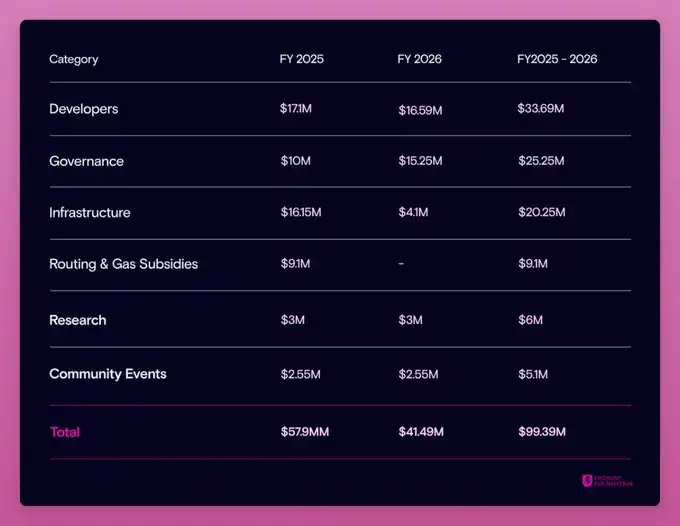
To drive growth, the Uniswap Foundation has proposed allocating $165.5 million in funding towards the following:
· $95.4 million for Grants (developer initiatives, core contributors, validators);
· $25.1 million for Operations (team expansion, governance tooling);
· $45 million for Liquidity Incentives.
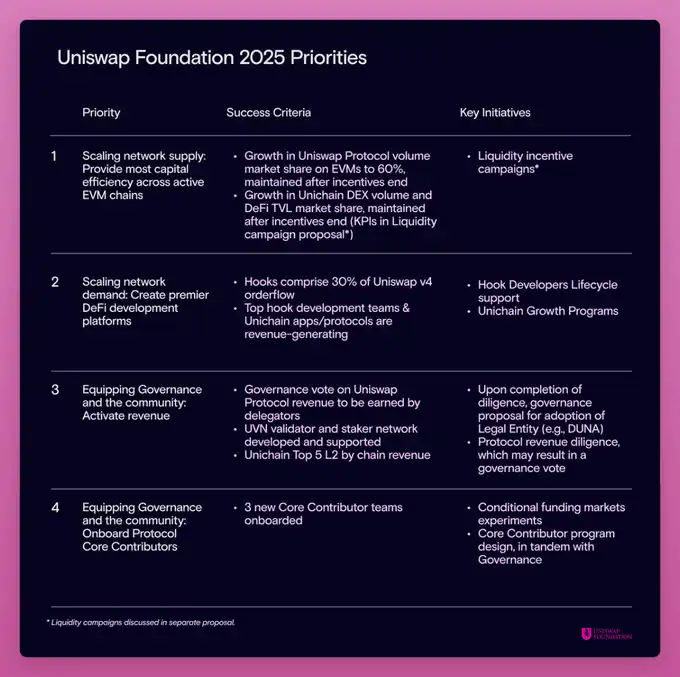
As you can see, Uni v4 is not just a DEX but also a liquidity platform, and Hooks are applications built on top of it.
Hooks are meant to drive the ecosystem growth of Uni v4, hence the need to accelerate this process through a funding initiative.
A breakdown of the funding budget:
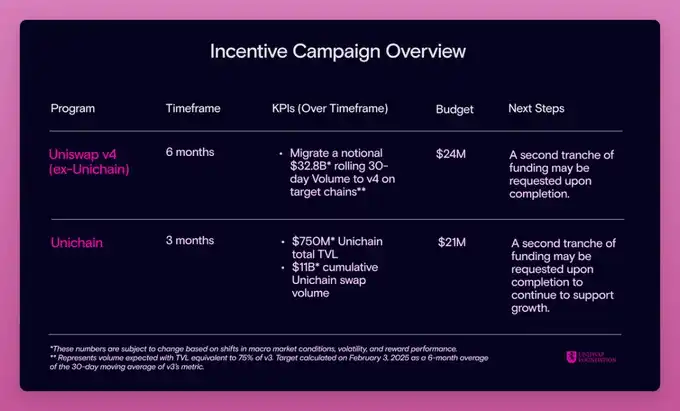
The $45 million Liquidity Provider (LP) Incentives will be used as follows:
· $24 million (distributed over 6 months): To incentivize liquidity migration from other platforms to Uni v4;
· $21 million (distributed over 3 months): To drive Unichain's Total Value Locked (TVL) from the current $8.2 million to $750 million.
On the other hand, Aerodrome mints approximately $40-50 million worth of AERO tokens per month for Liquidity Provider (LP) incentives.
The proposal has passed the temperature check phase but still faces some criticism:
Amidst industry shifts, Aave proposes a weekly buyback of $1 million worth of AAVE tokens, Maker plans a monthly buyback of $30 million, and UNI holders are likened to a "cash cow" that has never had its token value captured.
UNI tokens do not enable a fee-sharing mechanism, yet Uniswap Labs has earned $171 million over two years through frontend fees.
The key to the whole system lies in Uniswap's organizational design:
· Uniswap Labs: Focuses on protocol tech development;
· Uniswap Foundation: Drives ecosystem growth, governance, and funding initiatives (such as grants, liquidity incentives).
Quite a savvy legal team.
Aave and Maker have established a closer alignment of interests with token holders, and I don't understand why Uniswap's frontend fees cannot be shared with UNI holders.
In conclusion, other criticisms mainly revolve around the core team's high salaries, Gauntlet's responsibility for liquidity incentive execution, and the establishment of a new centralized DAO legal structure (DUNA).
As a small governance representative for Uniswap, I have voted in favor of this proposal, but I still have significant concerns about the future of UNI holders: the incentive mechanism has failed to align with holders' interests.
However, I am a loyal fan of Uniswap and highly appreciate its driving role in the DeFi space. The current stagnation of Uni v4 and Unichain is very concerning, and they need to introduce incentive measures to foster development.
The next Uni DAO vote should focus on the UNI token's value-capture mechanism.
You may also like
Science Equity Movement: DeSci's Trillion-Dollar Knowledge Economy Reconstruction Revolution
Sentient In-Depth Research Report: Secures $85 Million in Funding to Build a Decentralized AGI New Paradigm
Taking Stock of the Top 10 Emerging Launchpad Platforms: Who Will Succeed in Disrupting Pump.fun?
Arthur Hayes Interview: Bitcoin Has Bottomed, Which Tokens Can Outperform Bitcoin?
Ika Receives Strategic Investment from Sui Foundation, Total Funding Exceeds $21 Million
Switzerland Zug, April 28, 2025, Chainwire
The world's fastest parallel MPC network, Ika, is set to launch on the Sui blockchain, announces a strategic investment from the Sui Foundation. Previously, Ika successfully completed a record-breaking 1.4 million SUI NFT art event on Sui. Ika is the world's first sub-second MPC network, capable of achieving zero-trust interoperability among hundreds of signing nodes, unprecedented in scale and rock-solid security.
Ika's core values of performance, speed, and high decentralization align perfectly with Sui. With its upcoming launch on the Sui blockchain, Ika will bring its unparalleled MPC technology into the Sui ecosystem, providing Sui Move smart contract developers with secure cross-Web3 interoperability. This further solidifies Sui's position as the preferred solution in cross-chain DeFi, decentralized custody, chain abstraction, AI-agent defense, native Bitcoin programmability, leveraging the first truly scalable and secure MPC signature scheme.
Ika addresses key bottlenecks of existing MPC networks and delivers unparalleled performance through innovative 2PC-MPC encryption scheme and Sui's Mysticeti consensus protocol:
1. Record Throughput: Ika's transaction processing capability is up to 10,000 times higher than current MPC networks, supporting unprecedented transaction volumes.
2. Ultra-Low Latency: While traditional network signatures may experience delays of 30 seconds or more, Ika can generate signatures in sub-seconds, supporting cross-chain real-time applications.
3. Tremendous Scalability: Ika breaks the conventional limit of 4-8 nodes, and the 2PC-MPC can scale to hundreds or even thousands of signers, enhancing decentralization without sacrificing performance.
4. Zero-Trust Security: Ika's architecture ensures that even in the most extreme scenarios, user assets remain secure, setting a new standard for decentralized security.
Ika's ultra-fast MPC network supports various applications on the Sui blockchain, and several Sui developers have utilized Ika to build tech, including:
· DeFi Interoperability: Ika's sub-second speed and scalability enable instant secure operations within the Web3 ecosystem, bringing liquidity from chains like Bitcoin and Ethereum into Sui. Sui developers Full Sail and Rhei have announced upcoming tech launches based on Ika.
· Decentralized Custody: Ika provides a secure, decentralized custody solution for digital assets on Sui, delivering unparalleled security for both institutional and individual users. Sui developers Aeon and Human Tech have announced the integration of Ika into their technology.
· Chain Abstraction: Ika helps Sui developers abstract away multi-chain complexity for users, combining with Sui's zkLogin feature to deliver a seamless user experience. Sui developers Covault and Lucky Kat have announced the integration of Ika into their technology.
· Programmable Bitcoin: Ika unlocks new possibilities for native BTC on Sui, enabling programmable and secure DeFi and custody. Sui developers Native and Nativerse have announced the upcoming launch of Ika-based technology.
· AI Agent Protection: Ika enhances AI applications on Sui by providing secure MPC protection, ensuring AI agents do not possess unrestricted power and safeguarding user asset security. Sui developers Atoma and Ekko have announced the upcoming launch of Ika-based technology.
The strategic investment in Ika by the Sui Foundation underscores Sui's commitment to driving cutting-edge technology for high performance and decentralization. This amplifies the technical synergy within the Sui ecosystem, propelling Sui and Ika to the forefront of the Web3 revolution, jointly advancing the future of secure, scalable, decentralized infrastructure.
Ika has raised over $21 million in funding, with a peak private valuation of $6 billion FDV, backed by support from Sui Foundation, DCG, Big Brain Holdings, Blockchange, Node Capital, Amplify Partners, Liquid2 Ventures, FalconX, Tykhe Block Ventures, Lightshift, Token Bay Capital, Collider, Zero Knowledge Ventures, NoLimit Holdings, Rubik Ventures, Dispersion Capital, Insignius Capital, Impatient Ventures, Cerulean Ventures, Earl Grey Capital, HDI Ventures, Flowdesk, TPC Ventures, Purechain Capital, Solr DAO, Heroic Ventures, Naval Ravikant, NotVCs, G-20 Group, Artifact Capital, DSRV, Encapsulate, and many other key players in the Web3 space.
Ika also demonstrated the strong support of Sui users by launching the "MF Squid Market" NFT art event, which became the largest and most successful NFT event in Sui's history, raising over 1.4 million SUI and establishing an active grassroots community.
The IKA token is set to native launch on the Sui blockchain, unlocking new decentralized security features and utilities. As the native token of the Ika MPC Network, IKA will play a key role in its ultra-fast, scalable infrastructure, used for paying MPC signature services, enabling seamless transactions within the Web3 ecosystem. Leveraging Sui's unparalleled speed and performance, Ika enhances the security and scalability of the entire ecosystem, introducing the most promising MPC technology in blockchain to the fastest-growing L1 of Web3.
Ika is the world's fastest parallel MPC network, offering sub-second latency, unprecedented scale and decentralization, and zero-trust security. As the preferred choice for interoperability, decentralized custody, and chain abstraction, Ika will fundamentally transform digital asset security and multi-chain DeFi.
Sui is the first Layer 1 blockchain and smart contract platform designed from the ground up to provide fast, private, secure, and inclusive digital assets. Built on the Move programming language, its object-centric model supports parallel execution, sub-second finality, and rich on-chain assets. Through horizontally scalable processing and storage capacity, Sui supports widespread applications at low cost with unparalleled speed. Sui represents a significant advancement in blockchain technology, offering creators and developers a platform to build exceptional user experiences.
Contact:
Ika PR
pr@ika.xyz (mailto:pr@ika.xyz)
AI Track Regains Momentum, Thoroughly Reviewing Potential Projects and Market Hype Logic
Bitcoin is Just the Beginning: Trillion-Dollar Asset Manager Hamilton Lane Dives into How Tokenization is Disrupting Traditional Finance
This is the Winter of VC, yet the Spring of KOL Agency.
After the RTFKT "Image Missing" Incident, Nike Faces $5 Million Class Action Lawsuit, Where Does the Future of NFTs Stand?
This Week in Review | Trump to Host Dinner for TRUMP Holders; Musk and US Treasury Secretary Engage in Heated Argument at the White House
Privacy Dark Horse Inco Raises $5 Million in Funding, a16z CSX Leads Investment Igniting FHE Craze
Bitcoin Surges Back to $90,000: Which Altcoins Are Worth Watching?
RaveDAO at Terra Solis by Tomorrowland: A Female-Led Techno Night Where Web3 Culture Converges
MCP In-Depth Research Report: Protocol New Infrastructure in the AI+Crypto Mega Trend
12-Hour Market Cap Surpasses $25 Million, Is $JOS Legit or Another "Rug Pull"?
Web3 PvZ: Transforming GameFi with "Plants vs. Zombies" Gameplay, AI-Driven Wealth Metamorphosis Cryptocurrency
AI Token Skyrockets: Comprehensive Overview of the Next Potential Breakout in Crypto AI
In October 2024, since the launch of the AI Meme—GOAT, the AI Agent concept, Crypto has begun to accelerate its integration with AI. Concepts such as Game+AI, DeFAI, AI Agent Hive, etc., have sprung up, with almost a new batch of concept projects appearing every week, until January 18th of this year when Trump announced the issuance of MemeCoin, directly draining market liquidity, causing the premature bursting of the CryptoAI bubble. Two days later, DeepSeek announced the open-source R1 model, and after several weeks of fermentation, the AI concept stocks in the US stock market also saw their bubble burst.
With just $6 million, one could create a large model; however, those holding out for the $60 million market cap of CryptoAI were once defined by the community as "undereducated cabbage." Such trends were rampant, coupled with the collective plunge of AI concept stocks in the US market, naturally causing the coin price to spiral downwards, leading to the gradual silence of the AI concept in Crypto.
One quarter later, the CryptoAI uproar returned to the market, and this time, it seemed to bring some new concepts.
Following Pumpfun's success story, Crypto sparked a trend of asset issuance platforms. During the previous AI Agent craze, frameworks and AI distribution networks/LaunchPads were the two highest FDV areas. However, after the concept of framework akin to Ai16z's developer community had developed to a certain extent, the community realized the limited capabilities of frameworks, especially in capturing the value layer in Crypto. Thus, the existing frameworks gradually transitioned into LaunchPads. However, AI LaunchPads also faced challenges because the existing LaunchPads could not meet the needs of AI product launches. In preparation for the next wave of AI resurgence, project teams began looking for solutions.
Despite experiencing a recent incident where the SN28 subnet was exploited to turn it into a MemeCoin and drive TAO into Meme Coin hype, ultimately being centrally intervened by the foundation, over time, the foundation's control over the Bittensor subnet will diminish. This has sparked community concerns about its future potential to become a "attention network" pan-incentive project. A longtime follower of the Bittensor project, known as "Quirky Mind," also published an article stating that this could be a scam.
Further Reading: "Opinion: Why Bittensor Is a Scam and TAO Is Heading to Zero?"
However, purely from an investment perspective, Bittensor's ecosystem liquidity is better than that of other AI Agent ecosystems. For example, Virtuals, because LP and Virtuals are paired, this will lead to higher volatility for liquidity providers. There is approximately a 3% to 7% slippage when investors invest in agent tokens within the platform. When funds are invested in dTAO subnet tokens, the slippage is usually 0.05% to 0.1%.
It is for this reason that VC or large AI project participants tend to lean towards making long-term investments in Bittensor. Just last week, former Messari analyst and Crucible Labs partner Sami Kassab announced that he and his friend Seth Bloomberg, who has similar work experience, will establish a fund specifically for providing liquidity to Bittensor.
The "First Mover" of Bittensor, Rayon Labs, has created several products that offer a glimpse into the preferences of Bittensor's project parties, who are often more "practical" and long-term oriented.
SN64 "Chutes" provides a serverless way to easily deploy AI infrastructure, with the project team stating that a previous AWS outage was a prime example of why we need "serverless." Because if reliant on centralized service providers, once an outage occurs, AI applications may crash due to a single point of failure, and the crypto industry being money-intensive, the probability of losses is much higher than traditional AI.
SN56 "Gradients" is a zero-code platform for deploying AI models, where users can train their own AI models on Gradients (for specific use cases, image generation, custom LLM), and the recently launched v3 has a competitive advantage in terms of pricing compared to similar products.
SN19 "Nineteen" is a fast, scalable, decentralized AI inference platform.
As one of the most complete AI projects combining ecosystem building with a value flywheel in the previous cycle, Virtuals Protocol's token price has slowed along with the ecosystem's momentum as the market quieted down. Following this, the $45 billion market cap bubble was burst, experiencing a drop of over 90%, and significant decrease in participation from launchpad contributors. However, Virtuals did not give up. In this AI bear market, they began to Build.
First, Virtuals refined their own project development ecosystem by launching the VPN plan "Virtuals Partners Network." From the beginning, Virtuals' plan was to onboard more AI people into the Crypto space. This plan will interconnect multiple ecosystem positions, including investors, experts from various fields, scholars, and developers. Essentially, as long as you have an idea, resources can be obtained through this plan from investors to liquidity providers, marketers, and even professionals. This "one-stop service" incubator can be said to be the best choice for anyone looking to enter Crypto to collaborate with Virtuals.
To expand the influence and interactivity of AI Agents in the ecosystem, Virtuals has designed a protocol called ACP "Agent Commerce Protocol." It can be seen as a realization of the previous Swarm, Ai16z, and similar projects' hive concepts. ACP has built a commercial ecosystem composed of AI agents – a virtual nation where AI Agents can autonomously interact, cooperate, and transact with each other. It is worth mentioning that after this, Google also released a similar A2A concept. A slight difference is that ACP is connected by smart contracts, whereas A2A is connected by protocols.
In April, Virtuals just launched a new model of Virgen points and Genesis launch mode. Users can earn points through investing in Sentient and Prototype Agents, holding Virtuals, staking VADER, among other methods, and points serve as the basis for participating in the Genesis launchpad project. The Genesis launchpad is an IDO-style project launch method, where users receive investment quotas based on the points they hold. Currently, not everyone can participate in this launch mode, as it requires official approval from Virtuals.
This model has several benefits. First, it increases the stickiness of its platform users through rewards. In the words of founder Ethermage, "Our principle is to reward believoors." Staking points to participate in the Genesis project allocation is a fairer start, with participants usually of higher quality, allowing the project to develop more sustainably.
What was the most interesting project at the Virtuals Protocol hackathon?
In addition to the projects on Genesis worth noting, Virtuals just announced the winners of this hackathon on April 21, with more than 100 project teams participating. The judging panel was also quite impressive, including LucaCurran, who is in charge of AI and DEPIN sector development at Base, KunPeng, the founder of the Stanford Blockchain Community, and Anand Iyer, a partner at Canonical Crypto. Interestingly, Anand's Tag on X is AI.
The Intern
The Intern is an AI assistant for operations. He can help with promotion, replies, and community management on X. By deep diving into the community, he can understand its culture and can generate images using TADA. He has now teamed up with Pudgypenguins to launch the Penguin Intern, running his own Twitter. From the quality of Twitter operations, if it is entirely AI-operated and can be scaled to this level, it would be a good product.
BuzzingClub
BuzzingClub is a prediction market platform where the project team believes that the future of prediction markets should be in the hands of the participants, rather than a central authority, stating that "everyone should be able to freely create, share, and express their opinions," making Buzzing more free compared to other prediction platforms.
In Buzzing, all users can create prediction markets by proposing topics or questions, with AI generating rules. Subsequently, an AI algorithm filters out some spam and low-quality prediction markets, and finally, an AI oracle automatically retrieves internet search data, rather than human-generated data, to determine the outcome of the prediction question.
Burnie
Burnie is a code-learning platform that can enhance the skills of users who want to learn to code, and players can earn rewards by completing the tasks he publishes.
Arc and Ai16z, as the framework development stagnated, have also transformed into distribution platforms for AI Agents. Since the launch of the distribution platform forge by Arc, it has disappeared from the spotlight since the first product, AskJimmy. Ai16z's AutoFun went live a few days ago, but the currently publicly supported projects have not gone online, and its development path is still unknown. From a product framework perspective, AutoFun seems more inclined to create a community UGC culture platform, with little difference in value retention compared to traditional LaunchPads.
Arc plans to launch the new Agentic App Store Ryzome, while Myshell's existing AIApp Store has yet to officially launch, and the latter lacks activity, with most of the products appearing to be similar.
In this scenario, dev.fun, which previously appeared with the concept of AppFi, seems more conventional. At first glance, it looks similar to Pumpfun in everything from color scheme to UI but appears to have more vitality on some level. Although from a token price perspective, dev.fun, like other AI projects, has experienced a significant drop in this cycle. Surprisingly, there are currently nearly 13,000 Apps born on this platform.
dev.fun has provided a feature that allows users to generate apps through AI chat, similar to the previously YC-backed Replit. In addition to being able to issue project/meme tokens, users can also choose their own trading pairs. The Buidl, which currently has the most supporters, has a total of 1400 apps and has been run nearly 70,000 times.
The currently popular projects in the market are divided into several categories. One is development tools, including frameworks, AI Coplit's programming tools, and MCP infrastructure. The second is consumer AI applications, including AI agents, games, DeFAI (Alpha signals, funds, automated LP), and GambleFAI. The third is decentralized AI infrastructure, such as decentralized computing, validation, storage, etc. The first two are usually more favored by retail investors, while the third is preferred by VCs or investors, and such projects often require a relatively high valuation to participate.
These projects have a broader range of use cases and project concepts, but many times they are also the preferred choice of scam project teams because to retail investors, there is no "visible" product. The feedback cycle of such products is often longer, and whether it is "usable" or can generate viral spread (someone using it) is key. Therefore, creating such products requires a high level of technical expertise and marketing skills for a team.
A recent hot project, the MCP project Dark, is one of the projects that has done both well. Launched DARK under the influence of the MTN DAO and delivered a visible game product, "Dark Forest," within two weeks.
In this field, the most widely spread project in the market right now is probably Solana's "prodigal son" SEND AI, which gained fame by hosting a large AI hackathon for Solana in the past. The Solana Agent Kit is also used in many products. ALCHEMIST AI continues to build up, dropping to a $1.4 million market cap from February, and has now returned to a $14 million market cap.
Autonome
Autonome is a platform created by the Rollups protocol AltLayer that provides developers and users with the ability to build, deploy, and distribute verifiable AI agents without code. It has been active since the previous cycle and has not yet issued tokens.
Game
Smol
Recently, Treasure announced that it would shift the project's focus from the gaming chain and game operations to AI+NFT. Today, SMOL has provided the first response to this initiative by announcing the release of the "Virtual Companions" feature. This feature can turn NFTs into AI agents, and these agents will be able to use social media, play GameFi or DeFi on their own, and have created a marketplace for AI agents to trade skills, memories, and other data.
The first game to go live is the on-chain RPG game Gigaverse by Abstract. The community has generally praised it, and as a result, Treasure's token price has rebounded. After plummeting to a $20 million market cap following the previous announcement of exiting the GameFi business, today it has returned to an $80 million market cap. Besides the anticipation of the NFT AI transformation technology, the prospect of having AI agents play GameFi may be more appealing. The issues of no one playing for GameFi project teams and uninteresting games for players may potentially be solved in the future by assetized AI agents.
DeFAI
Almanak
After 18 months of development, Almanak announced last week on April 17, 2025, that it will conduct the token generation event (TGE). Almanak is an end-to-end platform that allows users to create, optimize, and manage complex financial strategies using AI agents. Functions such as market data analysis, strategy formulation, optimization, and high-speed execution can all be automated. The team has received support from numerous top-tier venture capital firms and advisors, such as RockawayX, Delphi Labs, Hashkey, AppWorks, Matrix Partners, Bankless Ventures, and more.
GambleFAI
Sportstensor
Sportstensor is an SN41 subnet on the dTAO that is an AI platform for sports event prediction, enabling participants (miners and validators) to collaborate in developing and optimizing sports prediction models. Participants with better models and datasets that can predict sports match outcomes profit from their participation. Users can engage with the project either technically by "developing models" or non-technically by "using prediction results."
For example, in an NBA game between the Celtics and the Magic with odds of 0.92:0.08, if you follow the market odds and bet on the Celtics (the popularly favored team), your win rate is about 92%. However, even with such a high win rate, after multiple bets, most people's return on investment is negative. While the popularly favored team often has a higher win rate, they also have higher odds, meaning that even if the prediction is correct, the winnings are lower. People tend to bet on their favored team, leading to a low win rate for the underdog, which means that if you bet on the underdog and win, you can earn a lot of money.
This is where the advantage of the Sportstensor model lies: miners use their own data to run their machine learning models to achieve the best results. Sportstensor then takes their averages/medians and uses them as an intelligent indicator to identify market advantages. The difference between the model-predicted odds and market odds is the part where users can profit in the long run.
Such products are among the earliest concepts of integrating Crypto with AI, as seen in projects like Grass. There have been countless similar products in the past, but sustaining them has been challenging. The key to decentralized computing power is how to optimize synchronous computing power and offer it at a price below that of traditional computing power providers. On the other hand, the key to decentralized training is the cost of data transmission itself, which was difficult to achieve during the infrastructure's early days. However, once achieved, it has the potential to tap into a significant underserved market, making it a focus of venture capitalists.
PrimeIntellect
PrimeIntellect was co-founded by Vincent Weisser and Johannes Hagemann, both of whom were previously key members of Desci's leading VitaDAO. PrimeIntellect is a platform that commodifies computing power and models. The investment lineup is quite impressive, with a $5 million seed round led by CoinFund and Distributed Global, and a $15 million second round led by Founders Fund. Individual investors include prominent figures in the industry such as Polygon co-founder Sandeep Nailwal, notable investors, and former Coinbase CTO Balaji.
Recently, renowned OpenAI researcher Yaoshunyu published an article titled "The Second Half," where he stated that we are currently at AI's halftime, with the second half soon approaching. If the first half of AI focused on gaming and exam-solving, the second half will see AI build valuable products to establish companies worth tens of billions or trillions of dollars in value. This will undoubtedly present opportunities for CryptoAI as well.
So stay tuned and welcome to the second half.
Life and Death Struggle of the Primary Market: How Does Blockchain Venture Capital Navigate the Value Winter Cycle?
Science Equity Movement: DeSci's Trillion-Dollar Knowledge Economy Reconstruction Revolution
Sentient In-Depth Research Report: Secures $85 Million in Funding to Build a Decentralized AGI New Paradigm
Taking Stock of the Top 10 Emerging Launchpad Platforms: Who Will Succeed in Disrupting Pump.fun?
Arthur Hayes Interview: Bitcoin Has Bottomed, Which Tokens Can Outperform Bitcoin?
Ika Receives Strategic Investment from Sui Foundation, Total Funding Exceeds $21 Million
Switzerland Zug, April 28, 2025, Chainwire
The world's fastest parallel MPC network, Ika, is set to launch on the Sui blockchain, announces a strategic investment from the Sui Foundation. Previously, Ika successfully completed a record-breaking 1.4 million SUI NFT art event on Sui. Ika is the world's first sub-second MPC network, capable of achieving zero-trust interoperability among hundreds of signing nodes, unprecedented in scale and rock-solid security.
Ika's core values of performance, speed, and high decentralization align perfectly with Sui. With its upcoming launch on the Sui blockchain, Ika will bring its unparalleled MPC technology into the Sui ecosystem, providing Sui Move smart contract developers with secure cross-Web3 interoperability. This further solidifies Sui's position as the preferred solution in cross-chain DeFi, decentralized custody, chain abstraction, AI-agent defense, native Bitcoin programmability, leveraging the first truly scalable and secure MPC signature scheme.
Ika addresses key bottlenecks of existing MPC networks and delivers unparalleled performance through innovative 2PC-MPC encryption scheme and Sui's Mysticeti consensus protocol:
1. Record Throughput: Ika's transaction processing capability is up to 10,000 times higher than current MPC networks, supporting unprecedented transaction volumes.
2. Ultra-Low Latency: While traditional network signatures may experience delays of 30 seconds or more, Ika can generate signatures in sub-seconds, supporting cross-chain real-time applications.
3. Tremendous Scalability: Ika breaks the conventional limit of 4-8 nodes, and the 2PC-MPC can scale to hundreds or even thousands of signers, enhancing decentralization without sacrificing performance.
4. Zero-Trust Security: Ika's architecture ensures that even in the most extreme scenarios, user assets remain secure, setting a new standard for decentralized security.
Ika's ultra-fast MPC network supports various applications on the Sui blockchain, and several Sui developers have utilized Ika to build tech, including:
· DeFi Interoperability: Ika's sub-second speed and scalability enable instant secure operations within the Web3 ecosystem, bringing liquidity from chains like Bitcoin and Ethereum into Sui. Sui developers Full Sail and Rhei have announced upcoming tech launches based on Ika.
· Decentralized Custody: Ika provides a secure, decentralized custody solution for digital assets on Sui, delivering unparalleled security for both institutional and individual users. Sui developers Aeon and Human Tech have announced the integration of Ika into their technology.
· Chain Abstraction: Ika helps Sui developers abstract away multi-chain complexity for users, combining with Sui's zkLogin feature to deliver a seamless user experience. Sui developers Covault and Lucky Kat have announced the integration of Ika into their technology.
· Programmable Bitcoin: Ika unlocks new possibilities for native BTC on Sui, enabling programmable and secure DeFi and custody. Sui developers Native and Nativerse have announced the upcoming launch of Ika-based technology.
· AI Agent Protection: Ika enhances AI applications on Sui by providing secure MPC protection, ensuring AI agents do not possess unrestricted power and safeguarding user asset security. Sui developers Atoma and Ekko have announced the upcoming launch of Ika-based technology.
The strategic investment in Ika by the Sui Foundation underscores Sui's commitment to driving cutting-edge technology for high performance and decentralization. This amplifies the technical synergy within the Sui ecosystem, propelling Sui and Ika to the forefront of the Web3 revolution, jointly advancing the future of secure, scalable, decentralized infrastructure.
Ika has raised over $21 million in funding, with a peak private valuation of $6 billion FDV, backed by support from Sui Foundation, DCG, Big Brain Holdings, Blockchange, Node Capital, Amplify Partners, Liquid2 Ventures, FalconX, Tykhe Block Ventures, Lightshift, Token Bay Capital, Collider, Zero Knowledge Ventures, NoLimit Holdings, Rubik Ventures, Dispersion Capital, Insignius Capital, Impatient Ventures, Cerulean Ventures, Earl Grey Capital, HDI Ventures, Flowdesk, TPC Ventures, Purechain Capital, Solr DAO, Heroic Ventures, Naval Ravikant, NotVCs, G-20 Group, Artifact Capital, DSRV, Encapsulate, and many other key players in the Web3 space.
Ika also demonstrated the strong support of Sui users by launching the "MF Squid Market" NFT art event, which became the largest and most successful NFT event in Sui's history, raising over 1.4 million SUI and establishing an active grassroots community.
The IKA token is set to native launch on the Sui blockchain, unlocking new decentralized security features and utilities. As the native token of the Ika MPC Network, IKA will play a key role in its ultra-fast, scalable infrastructure, used for paying MPC signature services, enabling seamless transactions within the Web3 ecosystem. Leveraging Sui's unparalleled speed and performance, Ika enhances the security and scalability of the entire ecosystem, introducing the most promising MPC technology in blockchain to the fastest-growing L1 of Web3.
Ika is the world's fastest parallel MPC network, offering sub-second latency, unprecedented scale and decentralization, and zero-trust security. As the preferred choice for interoperability, decentralized custody, and chain abstraction, Ika will fundamentally transform digital asset security and multi-chain DeFi.
Sui is the first Layer 1 blockchain and smart contract platform designed from the ground up to provide fast, private, secure, and inclusive digital assets. Built on the Move programming language, its object-centric model supports parallel execution, sub-second finality, and rich on-chain assets. Through horizontally scalable processing and storage capacity, Sui supports widespread applications at low cost with unparalleled speed. Sui represents a significant advancement in blockchain technology, offering creators and developers a platform to build exceptional user experiences.
Contact:
Ika PR
pr@ika.xyz (mailto:pr@ika.xyz)
AI Track Regains Momentum, Thoroughly Reviewing Potential Projects and Market Hype Logic
Popular coins
Latest Crypto News


Customer Support:@weikecs
Business Cooperation:@weikecs
Quant Trading & MM:bd@weex.com
VIP Services:support@weex.com
 App
App