
- Buy Crypto
- Markets
- Futures
- Spot
- Copy Trade
 WE-Launch
Public Blockchain Moat only 3 points? Alliance DAO Founder's Comments Spark Crypto Community Debate

Original Article Title: "Is the Moat of Public Chains Only 3 Points? Alliance DAO Founder's Comments Sparked a Crypto Community Debate"
Original Article Author: Wenser, Odaily Planet Daily
Recently, Alliance DAO founder qw (@QwQiao) put forward a stunning point of view: "Blockchain moats are limited," and rated the moat of L1 public chains as only 3/10.
This statement quickly ignited the overseas crypto community, sparking heated discussions among crypto VCs, public chain builders, and KOLs. Dragonfly partner Haseeb angrily retorted that rating "the blockchain moat as 3/10" is simply absurd, even Aave founder Santi, who is averse to the industry's gambling atmosphere, never believed that blockchain has "no moat."
The debate over the meaning, value, and business model of blockchain and cryptocurrency constantly resurfaces in cycles. The crypto industry continues to oscillate between idealism and reality: people both cherish the decentralized original intention and aspire to have the status and recognition of the traditional financial industry while also being deeply mired in self-doubt about whether it is merely a repackaged casino. Perhaps the root of all these contradictions lies in scale—the total market value of the crypto industry has always hovered around 3-4 trillion dollars, which still seems small compared to the traditional financial giants with market capitalizations often in the hundreds of billions or trillions of dollars.
As professionals in the field, everyone has a contradictory mentality that is both arrogant and self-deprecating—arrogant because they have adhered to Satoshi Nakamoto's ideal of demonetization and the spirit of decentralization since the birth of blockchain, and the crypto industry has indeed become a burgeoning financial industry that is gradually gaining mainstream attention, acceptance, and participation. The self-deprecating aspect is probably like a poor boy who always feels that what he is doing is not particularly glorious, filled with the blood, sweat, tears, bitterness, and pain of a zero-sum game. In short, the limitation of industry scale has given rise to this cyclical identity anxiety, self-doubt, and self-denial.
Today, we will take advantage of the topic of "Moat Business Ratings" proposed by qw to discuss the existing chronic illnesses and core strengths of the crypto industry.
Origin of the Debate: Is Liquidity the Moat of the Crypto Industry?
This industry-wide discussion about "whether the crypto industry has a moat" actually originally stemmed from a statement by Paradigm team researcher frankie: "The greatest trick the devil ever pulled was convincing crypto people that liquidity is a moat."
It is evident that as a "purebred" VC, Frankie somewhat scoffs at the current trend in the crypto industry that highly esteems "liquidity is everything." After all, for an investor and research expert who holds financial and informational advantages, they often hope that the money they manage can be spent on projects and businesses with real-world use cases, capable of generating actual cash flow and providing them with continuous financial returns.
This viewpoint has also received agreement from many in the comments section:
· Multicoin partner Kyle Samani directly stated "+1";
· Ethereum Foundation member binji believes that "trust is the true moat, even if trust may flow due to opportunities in the short term, liquidity will always be placed where trust is."
· Chris Reis of the Arc blockchain team under Circle pointed out: "TVL always seems like the wrong North Star metric (business guidance goal)."
· Justin Alick of the Aura Foundation jokingly remarked, "Liquidity is like a capricious woman, she may leave you at any time."
· DeFi researcher Defi Peniel bluntly stated, "Relying solely on liquidity is not a moat, hype can disappear overnight."
Of course, there are also many who have refuted this:
· DFDV COO and CIO Parker commented, "What are you talking about? USDT is the worst stablecoin, but it holds absolute dominance. Bitcoin is the worst-performing blockchain, but it absolutely dominates."
· Former Sequoia Capital investor, now Folius Ventures investor KD gave a rhetorical question, "Isn't it?"
· Fabric VC investor Thomas Crow pointed out, "In a trading platform, liquidity is a moat— the deeper the liquidity, the better the user experience; this is the most critical feature in this vertical industry, without exception. That is why the main innovation of crypto asset trading is focused on solving the problem of insufficient liquidity (resulting in a poorer user experience). Examples include Uniswap, which obtains long-tail asset liquidity through LP, and Pump.Fun, which attracts liquidity before token launch through standardized contracts and pooled curves."
· Pantera investor Mason Nystrom retweeted and commented, "Liquidity is definitely a moat." He then provided different examples to illustrate: in public chains, Ethereum's current lead is due to DeFi liquidity (and developers); in CEXs, Binance, Coinbase, etc.; in lending platforms, Aave, MakerDAO; in stablecoins, USDT; in DEXs, Uniswap, Pancakeswap.
Then, we had the Alliance DAO founder qw's moat rating tweet:
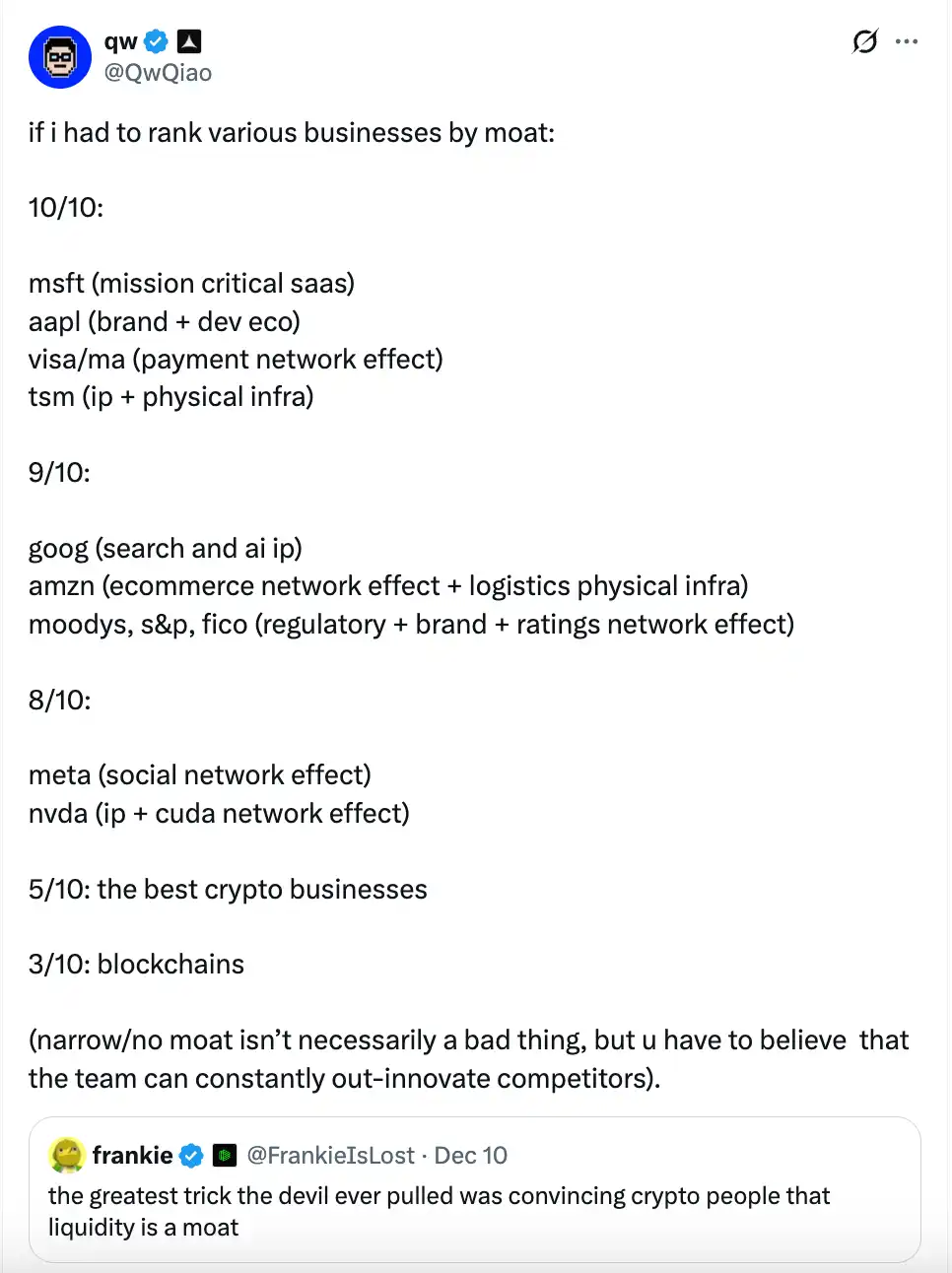
In his view, the moat of a blockchain (public chain) itself is very limited, with a rating of only 3/10.
- He believes that Microsoft (key SaaS), Apple (brand + development ecosystem), Visa/Mastercard (payment network effect), TSMC (IP + physical infrastructure) can achieve a rating of 10/10 (strongest moat);
- Google (search and AI IP), Amazon (e-commerce network effect + logistics infrastructure), rating agencies like Moody's, S&P, FICO (regulation-driven + brand + rating network effect), large cloud providers (AWS/Azure/GCP, etc.) can achieve a rating of 9/10;
- Meta (social network effect), Nvidia (IP + CUDA network effect) have a rating of 8/10;
- The best crypto businesses in the crypto industry have a rating of 5/10;
- Public chains (blockchains) have a rating of only 3/10 (narrow moat).
qw further stated that a low moat rating is not necessarily a bad thing, but it means the team must be able to consistently lead innovation; otherwise, they will be quickly replaced. Subsequently, perhaps feeling that the previous ratings were too hasty, qw provided some additional ratings in the comments:
- The big three cloud service providers have a rating of 9/10;
- Bitcoin's moat rating is 9/10 (Odaily Planet Daily Note: qw pointed out that no one can replicate BTC's public chain founding story and the " Lindy Effect," but deducted 1 point because it is unclear if it can handle security budgets and quantum threats);
- Tesla 7/10 (Odaily Planet Daily Note: qw believes that the IP for autonomous driving is very impressive, but the automotive industry is commoditized, and humanoid robots may be similar);
- ASML, the lithography machine manufacturer, has a perfect 10/10 rating.
- AAVE's moat rating may be higher than 5 points (out of 10), with qw's reason being, "As a user, you must trust that their smart contract security testing is thorough enough not to lose your funds."
Of course, when seeing qw arrogantly acting as a "sharp critic," in addition to the debate on the "moat system" in the comments section, some people also made irrelevant sarcasm about qw's remarks. Someone even mentioned, "What about those completely failed launch platforms you invested in?" (Odaily Planet Daily Note: After launching pump.fun, Alliance DAO's subsequent investments in one-click launch platforms (such as Believe) have underperformed, to the point that he himself does not want to rate them)
With such a highly inflammatory focal point, Dragonfly partner Haseeb then made an angry retort.
Dragonfly Partner's Inner OS: Nonsense. I Have Never Seen Such Shamelessness
Regarding qw's "moat rating system," Dragonfly partner Haseeb wrote in a post: "What? Blockchain Moat: 3/10? This is a bit absurd. Even Santi doesn't believe that a public blockchain has no moat."
Ethereum has dominated for 10 consecutive years, with hundreds of challengers raising over $10 billion, trying to gain market share. After ten years of competitors trying to beat it, Ethereum has successfully defended its throne every time. If this still cannot demonstrate that Ethereum has a moat, I really don't know what a moat is.
In the tweet's comments section, qw also expressed his views: "What you are saying is all about looking back (the past ten years) and is factually incorrect (Ethereum no longer holds the throne on several metrics)."
Subsequently, the two engaged in several rounds of discussion on "What is a moat?" and "Does Ethereum really have a moat?" qw even brought up a post he made in November, pointing out that in his view, "moat" is actually revenue/profit. However, Haseeb then provided a counterexample—prominent crypto projects like OpenSea, Axie, and BitMEX, which, although once had high revenue, did not actually have a moat. A true moat should focus on whether "it can be replaced by a competitor."
Abra Global's Head of Asset Management, Marissa, also joined the discussion: "I agree (with Haseeb's point). qw's statement is a bit odd—switching costs and network effects can be strong moats—Solana and Ethereum both have these. I think over time, they will become stronger than other blockchains. They both have a strong brand and developer ecosystem, which is clearly part of the moat. Perhaps he is referring to those other blockchains that do not have these advantages."
Haseeb continued to mock Laman: "qw is just sophistry, bringing trouble upon oneself."
Building upon the above discussion, perhaps we should dissect what elements constitute the "true moat" of the public blockchain industry.
The 7 Major Components of a Public Blockchain Moat: From Characters to Business, from Origin to Network
In the author's view, the reason why qw's "moat scoring system" is somewhat unconvincing mainly lies in:
Firstly, its evaluation criteria only consider current industry status and revenue, disregarding a multi-dimensional assessment. Whether it is infrastructure like Microsoft, Apple, Amazon Web Services, or payment giants like Visa, Mastercard, qw's high ratings are mainly due to their strong revenue models. This clearly oversimplifies and superficializes the moat of a corporate giant's business. Moreover, Apple's global market share is not dominant, and payment giants like Visa are also facing challenges such as market contraction and declining regional business.
Secondly, it overlooks the complexity and uniqueness of blockchain projects and crypto assets compared to traditional internet businesses. As challengers to the fiat system, cryptocurrency and blockchain technology, as well as subsequent public chains and crypto projects, are based on the inherent "anonymity" and "node-based" nature of decentralized networks, which traditional revenue-driven businesses often cannot achieve.
Therefore, personally, I believe that the moat of a public blockchain business mainly lies in 7 aspects, including:
1. Technological Philosophy. This is also the greatest strength and differentiating factor of networks like Bitcoin, Ethereum, Solana, and numerous other public chain projects. As long as there is human vigilance against centralized systems, authoritarian governments, and fiat systems, and an acceptance of sovereign individuality and related concepts, the true demand for decentralized networks will persist;
2. Founder Charm. Satoshi Nakamoto, after inventing Bitcoin and ensuring the smooth operation of the Bitcoin network, disappeared without a trace, holding billions of dollars in assets yet unmoved. From a passionate World of Warcraft player who suffered at the hands of a game company to a co-founder of Ethereum, Vitalik courageously embarked on his decentralized spiritual journey. Solana's founder, Toly, and others were elite professionals in American tech giants, yet unsatisfied, they embarked on their path of building the "capital internet." Not to mention the various major public chains built on the legacy of the Meta Libra network using the Move language. The personal charm and charisma of founders are crucial in the crypto industry. Countless crypto projects have been favored by VCs, embraced by communities, and flooded with funds due to their founders, but also faded into obscurity due to founder resignations or accidents. A good founder is where the true essence of a public chain or a crypto project lies;
3. Developers and User Network. At this point, as emphasized by the Metcalfe Effect and Lindy Effect, the stronger the network effect of the same thing and the longer it exists, the more sustainable it is. The developer and user network is the cornerstone of public chains and many cryptocurrency projects because developers can be considered the first users of a crypto public chain or project and the most long-lasting users;
4. Application Ecosystem. If a tree only has roots but no branches, it will also find it hard to survive, and the same goes for crypto projects. Therefore, a rich and self-sustaining application ecosystem that generates synergies is crucial. Public chains like Ethereum and Solana have been able to survive through crypto winters because of the various application projects that have been consistently developed. Furthermore, the more robust the application ecosystem, the more sustainable the public chain's growth and contribution;
5. Token Market Value. If the aforementioned points are the inner core and foundation of a "moat," then the token market value is the external form and brand image of a public chain and a crypto project. Only when you "appear expensive," will more people believe you "have a lot of money," and you are a "land of opportunity," both individually and as a project;
6. External Openness. In addition to building its internal ecosystem, public chains and other crypto projects need to maintain openness and operability with the external environment, exchanging value with the outside world. Therefore, external openness is also crucial. Taking public chains like Ethereum and Solana as examples, their convenience and scalability lie in their bridging with traditional finance, user funds inflow and outflow, and various industries through payment, lending, and other gateways;
7. Long-Term Roadmap. A truly solid moat not only plays a supporting role in the short term but also needs continuous updates, innovation, and vitality in the long term. For public chains, a long-term roadmap is both a guiding star indicator and a powerful lever to encourage continuous development and innovation within and outside the ecosystem. Ethereum's success is closely related to its long-term roadmap planning.
Based on the elements above, a public chain can move from zero to one, from nothing to something, gradually pass through the period of rapid growth, and enter a mature iterative period. Correspondingly, liquidity and user stickiness naturally follow suit.
Conclusion: The Crypto Industry Has Not Yet Reached the "Talent Showdown" Stage
Recently, Moore Threads, known as the "Chinese version of NVIDIA," successfully landed on the Hong Kong stock market, achieving a milestone of 300 billion RMB on its first day of trading; shortly after, its stock price skyrocketed, reaching another astonishing breakthrough of over 400 billion RMB market cap today.
Compared to Ethereum, which took 10 years to finally reach a market cap of $300 billion, in just a few days, the Moore's Law thread has covered only 1/7 of the former's journey. And compared to the trillion-dollar market cap giants of the US stock market, the crypto industry is truly David to their Goliath.
This also inevitably makes us ponder once again that, with a funding scale and user involvement scale much smaller than those of the traditional financial industry and the internet industry today, we are far from the "talent competition" stage. The only pain point in the current crypto industry is that we do not yet have enough people, the attracted funds are not large enough, and the involved industries are not broad enough. Instead of worrying about those macro, broad "moats," perhaps what we should think about more is how cryptocurrencies can more quickly, at a lower cost, and more conveniently meet the real needs of a broader market user base.
You may also like

How to Evaluate a Curator?

December 24th Market Key Intelligence, How Much Did You Miss?

Base's 2025 Report Card: Revenue Grows 30X, Solidifies L2 Leadership

From Aave to Ether.fi: Who Captured the Most Value in the On-Chain Credit System?

Venture Capital Post-Mortem 2025: Hashrate is King, Narrative is Dead

DeFi Hasn't Collapsed, So Why Has It Lost Its Allure?

Are Those High-Raised 2021 Projects Still Alive?

NIGHT, with a daily trading volume of nearly $10 billion, is actually coming from the "has-been" Cardano?

Aave Community Governance Drama Escalates, What's the Overseas Crypto Community Talking About Today?

Key Market Information Discrepancy on December 24th - A Must-See! | Alpha Morning Report

2025 Token Postmortem: 84% Peak at Launch, High-Cap Project Turns into a "Rug Pull" Epicenter?
Polymarket Announces In-House L2, Is Polygon's Ace Up?
2025 Whale Saga: Mansion Kidnapping, Supply Chain Poisoning, and Billions Liquidated

Believing in the Capital Market - The Essence and Core Value of Cryptocurrency

Absorb Polymarket Old Guard, Coinbase Plunges Into Prediction Market Abyss

Ether pumps to outsiders, dumps in-house. Can Tom Lee's team still be trusted?

Coinbase Joins Prediction Market, AAVE Governance Dispute - What's the Overseas Crypto Community Talking About Today?
Over the past 24 hours, the crypto market has shown strong momentum across multiple dimensions. The mainstream discussion has focused on Coinbase's official entry into the prediction market through the acquisition of The Clearing Company, as well as the intense controversy within the AAVE community regarding token incentives and governance rights.
In terms of ecosystem development, Solana has introduced the innovative Kora fee layer aimed at reducing user transaction costs; meanwhile, the Perp DEX competition has intensified, with the showdown between Hyperliquid and Lighter sparking widespread community discussion on the future of decentralized derivatives.
This week, Coinbase announced the acquisition of The Clearing Company, marking another significant move to deepen its presence in this field after last week's announcement of launching a prediction market on its platform.
The Clearing Company's founder, Toni Gemayel, and the team will join Coinbase to jointly drive the development of the prediction market business.
Coinbase's Product Lead, Shan Aggarwal, stated that the growth of the prediction market is still in its early stages and predicts that 2026 will be the breakout year for this field.
The community has reacted positively to this, generally believing that Coinbase's entry will bring significant traffic and compliance advantages to the prediction market. However, this has also sparked discussions about the industry's competitive landscape.
Jai Bhavnani, Founder of Rivalry, commented that for startups, if their product model proves to be successful, industry giants like Coinbase have ample reason to replicate it.
This serves as a reminder to all entrepreneurs in the crypto space that they must build significant moats to withstand competition pressure from these giants.
Regulated prediction market platform Kalshi launched its research arm, Kalshi Research, this week, aimed at opening its internal data to the academic community and researchers to facilitate exploration of prediction market-related topics.
Its inaugural research report highlights Kalshi's outperformance in predicting inflation compared to Wall Street's traditional models. Kalshi co-founder Luana Lopes Lara commented that the power of prediction markets lies in the valuable data they generate, and it is now time to better utilize this data.
Meanwhile, Kalshi announced its support for the BNB Chain (BSC), allowing users to deposit and withdraw BNB and USDT via the BSC network.
This move is seen as a significant step for Kalshi to open its platform to a broader crypto user base, aiming to unlock access to the world's largest prediction market. Furthermore, Kalshi also revealed plans to host the first Prediction Market Summit in 2026 to further drive industry engagement and development.
The AAVE community recently engaged in heated debates around an Aave Improvement Proposal (AIP) titled "AAVE Tokenomics Alignment Phase One - Ownership Governance," aiming to transfer ownership and control of the Aave brand from Aave Labs to Aave DAO.
Aave founder Stani Kulechov publicly stated his intention to vote against the proposal, believing it oversimplifies the complex legal and operational structure, potentially slowing down the development process of core products like Aave V4.
The community's reaction was polarized. Some criticized Stani for adopting a "double standard" in governance and questioned whether his team had siphoned off protocol revenue, while others supported his cautious stance, arguing that significant governance changes require more thorough discussion.
This controversy highlights the tension between the ideal of DAO governance in DeFi projects and the actual power held by core development teams.
Despite governance disputes putting pressure on the AAVE token price, on-chain data shows that Stani Kulechov himself has purchased millions of dollars' worth of AAVE in the past few hours.
Simultaneously, a whale address, 0xDDC4, which had been quiet for 6 months, once again spent 500 ETH (approximately $1.53 million) to purchase 9,629 AAVE tokens. Data indicates that this whale has accumulated nearly 40,000 AAVE over the past year but is currently in an unrealized loss position.
The founder and whale's increased holdings during market volatility were interpreted by some investors as a confidence signal in AAVE's long-term value.
In this week's top article, Morpho Labs' "Curator Explained" detailed the role of "curators" in DeFi.
The article likened curators to asset managers in traditional finance, who design, deploy, and manage on-chain vaults, providing users with a one-click diversified investment portfolio.
Unlike traditional fund managers, DeFi curators execute strategies automatically through non-custodial smart contracts, allowing users to maintain full control of their assets. The article offered a new perspective on the specialization and risk management in the DeFi space.
Another widely circulated article, "Ethereum 2025: From Experiment to Global Infrastructure," provided a comprehensive summary of Ethereum's development over the past year. The article noted that 2025 is a crucial year for Ethereum's transition from an experimental project to global financial infrastructure. Through the Pectra and Fusaka hard forks, Ethereum achieved significant reductions in account abstraction and transaction costs.
Furthermore, the SEC's clarification of Ethereum's "non-securities" nature and the launch of tokenized funds on the Ethereum mainnet by traditional financial giants like JPMorgan marked Ethereum's gaining recognition from mainstream institutions. The article suggested that whether it is the continued growth of DeFi, the thriving L2 ecosystem, or the integration with the AI field, Ethereum's vision as the "world computer" is gradually becoming a reality.
The Solana Foundation engineering team released a fee layer solution called Kora this week.
Kora is a fee relayer and signatory node designed to provide the Solana ecosystem with a more flexible transaction fee payment method. Through Kora, users will be able to achieve gas-free transactions or choose to pay network fees using any stablecoin or SPL token. This innovation is seen as an important step in lowering the barrier of entry for new users and improving Solana network's availability.
Additionally, a deep research report on propAMM (proactive market maker) sparked community interest. The report's data analysis of propAMMs on Solana like HumidiFi indicated that Solana has achieved, or even surpassed, the level of transaction execution quality in traditional finance (TradFi) markets.
For example, on the SOL-USDC trading pair, HumidiFi is able to provide a highly competitive spread for large trades (0.4-1.6 bps), which is already better than the trading slippage of some mid-cap stocks in traditional markets.
Research suggests that propAMM is making the vision of the "Internet Capital Market" a reality, with Solana emerging as the prime venue for all of this to happen.
The competition in the perpetual contract DEX (Perp DEX) space is becoming increasingly heated.
In its latest official article, Hyperliquid has positioned its emerging competitor, Lighter, alongside centralized exchanges like Binance, referring to it as a platform utilizing a centralized sequencer. Hyperliquid emphasizes its transparency advantage of being "fully on-chain, operated by a validator network, and with no hidden state."
The community widely interprets this as Hyperliquid declaring "war" on Lighter. The technical differences between the two platforms have also become a focal point of discussion: Hyperliquid focuses on ultimate on-chain transparency, while Lighter emphasizes achieving "verifiable execution" through zero-knowledge proofs to provide users with a Central Limit Order Book (CLOB)-like trading experience.
This battle over the future direction of decentralized derivatives exchanges is expected to peak in 2026.
Meanwhile, discussions about Lighter's trading fees have surfaced. Some users have pointed out that Lighter charged as much as 81 basis points (0.81%) for a $2 million USD/JPY forex trade, far exceeding the near-zero spreads of traditional forex brokers.
Some argue that Lighter does not follow a B-book model that bets against market makers, instead anchoring its prices to the TradFi market, and the high fees may be related to the current liquidity or market maker balance incentives. Providing a more competitive spread for real-world assets (RWA) in the highly volatile crypto market is a key issue Lighter will need to address in the future.
The Secret Centralization Landscape of Stablecoin Payments: 85% of Transaction Volume Controlled by Top 1000 Wallets
How to Evaluate a Curator?
December 24th Market Key Intelligence, How Much Did You Miss?
Base's 2025 Report Card: Revenue Grows 30X, Solidifies L2 Leadership
From Aave to Ether.fi: Who Captured the Most Value in the On-Chain Credit System?
Venture Capital Post-Mortem 2025: Hashrate is King, Narrative is Dead
DeFi Hasn't Collapsed, So Why Has It Lost Its Allure?
Popular coins
Latest Crypto News


Customer Support:@weikecs
Business Cooperation:@weikecs
Quant Trading & MM:bd@weex.com
VIP Services:support@weex.com
 App
App