
- Buy Crypto
- Markets
- Futures
- Spot
- Copy Trade
 WE-Launch
Telegram Escape Roomer

Last week, Yescoin's team's hostile takeover split brought the spotlight back to the "TON ecosystem." After a long time without hearing about the TON chain, we started reminiscing about this three-year period on the verge of takeoff, which ultimately only saw a few months of hype for the Telegram-backed public chain.
During its peak, exchanges scrambled to list tokens related to Telegram's small games. Over a span of more than 4 months, the world's largest cryptocurrency exchange, Binance, successively listed 5 tokens from the TON ecosystem. Hundreds of small games emerged in a short period, with over 2000 in preparation for launch. Notcoin had a monthly revenue exceeding $300,000, while Catizen achieved over $16 million in revenue. The Total Value Locked (TVL) on the TON chain grew 70-fold. TON's price also surged from $2 to a peak of $8. The market's expectations for the TON ecosystem were pushed to the highest point, with both inside and outside the industry believing that Web3's "traffic goldmine" had finally found a new outbreak point.
However, this seemingly thriving ecosystem was nothing more than a short-lived speculative game. In the summer of 2024, the market came to a sudden halt—the exchanges ceased listing TON ecosystem coins, Telegram's founder was arrested, the project teams collectively fell silent, and the player communities turned into "ghost towns." Overnight, this so-called "traffic goldmine" track turned into a depleted mine, leaving only a data black hole, an overdrawn market, and abandoned developers.
What exactly happened during this period? BlockBeats conducted interviews with three former Telegram small game projects to dissect the true reasons behind the TON ecosystem's "flash in the pan."
False Prosperity; Black Box Traffic
The remarkably low customer acquisition cost of Telegram small games had always been a topic of discussion and one of the main reasons most Telegram small game project teams chose to undertake their projects. Today, looking back, it was also the root cause of the entire ecosystem's bubble.
"In Web3, a company such as an exchange or a large-scale blockchain game has a customer acquisition cost of around $10 to $15, but through Telegram small games, this cost can be much lower, well below $1, around $0.7," said KinKin, a project team member who left Telegram small games six months ago and has now shifted to AI Agent research. She further told BlockBeats, "In some regions, it's even more extreme, such as in India, where the customer acquisition cost can be as low as $0.002 to $0.05."
This ultra-compressed user acquisition cost has created a paradise for project factories, where real users have become a kind of optional presence.
“Before listing, I didn't really need some real users; the studio's volume was enough. We achieved a volume of 200,000 to 300,000 in a very short time. This volume is a qualifying line for a Telegram mini-game, considered a lightweight and medium-sized volume.” Xiaoguang has orchestrated the token launches of multiple Telegram mini-games. When faced with inquiries from BlockBeats, he didn't shy away from discussing the industry's operational model.
This play has already been standardized and process-driven in the industry. Several studios with long-term collaborations are very experienced, even outlasting most Web3 projects. “How much volume is needed in the early stages of the project, how much volume needs to be added before the TGE (Token Generation Event), the project team and the studio will agree on it,” Xiaoguang explained. If simply increasing volume is not enough, they will amplify the data through “volume exchange.”
The decline in the ratio of real users has further exacerbated the market's false prosperity. “In the early games, like Hamster Kombat, the ratio of real users was relatively good, probably around 60%. But as the ecosystem expanded, this ratio kept decreasing, and by the end, having 40% is already considered remarkable,” Xiaoguang revealed to BlockBeats.
Even within this 40%, the “airdrop tax” from professional airdrop hunters has not been excluded; their goal is not to play the game but to receive airdrop rewards. “When we calculate paying users, among the remaining real users, 90% of the addresses are held by the same group of people. They are specifically here for airdrop benefits, play and leave immediately afterward.”
This user structure directly determines the vicious cycle of the Telegram mini-games ecosystem. In the short term, data inflation masks the true situation, allowing investors and trading platforms to continue footing the bill. However, in the long run, the entire ecosystem suffers from extremely poor user quality and low stickiness.
From the perspective of trading platforms and investors, the surface-level monthly active data of Telegram mini-games is astonishing, with immense traffic. However, the real user retention rate and conversion rate are abysmally low. "If the sole purpose is to manufacture monthly active data and wallet addresses to show trading platforms and investors, then this low-cost traffic is sufficient," said Sleepy, the founder of the Ghost NFT, who confirmed this month that they have temporarily suspended mini-game development on Telegram.
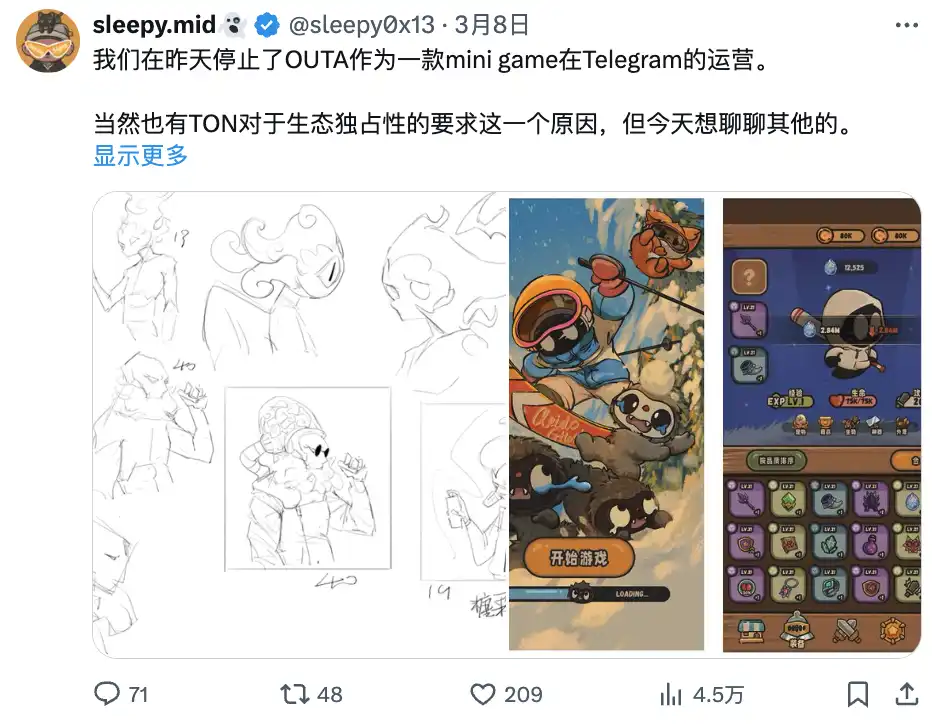
"But if you want truly active users, users who are willing to play your game, use your app, then it is absolutely impossible to obtain them with such low acquisition costs," Sleepy expressed. "It seems that, looking at it now, the saying still holds true—one gets what one pays for."
Our promotion method still relies on Crypto Twitter, community promotion, and crypto ad channels, along with exchanges between projects," Sleepy stated. "However, in these exchanges, we have never been able to break out of this circle."
In other words, the traffic only flows from one project to another, but the water in the entire pool remains stagnant, with no fresh inflow.
The TON ecosystem has never truly bridged the gap between Telegram's 9 billion users and Web3. It seems that the TON Foundation and Telegram have not built a truly effective distribution channel to allow Crypto apps to reach a broader audience. Sleepy remarked, "Perhaps they are trying, but I have not seen the results yet."
TON and Telegram have never been the same.
TON Foundation: Vacuum of Power and Uncontrolled Direction
In the past six months, when discussing the TON Foundation with industry insiders, they always mention the "factional struggles" within the TON Foundation: the Russian team, the Taiwanese team, and the Dubai team after TON obtained the Dubai Financial License. These three teams did not bring synergies but instead made the resource allocation within the TON ecosystem extremely uneven—whether one can receive support within the TON ecosystem often depends on the relationship with the Russian team.
The TON Foundation was originally founded by two core members, one of whom is the current Foundation President, Steve Yun, who is still active in various online and offline events. The other member is Andrew Rogozov, who was the former CEO of VK (the predecessor of Telegram, the first social platform created by Telegram's founder, similar to the Russian version of Facebook), and is considered by some to be a "key figure" in the inner circle.
However, at some point, the power structure of the TON Foundation underwent a subtle change—Andrew Rogozov seemed to fade out of the core management of the Foundation and founded TOP (The Open Platform). This organization now seems more like a true foundation than the TON Foundation, or perhaps like Consensys in the TON ecosystem, and even leads the core ecosystem development of TON.
"To be honest, as a foundation, the information we actually receive from Telegram is not much. Pavel Durov and his team do not discuss anything with us at all. In fact, they only communicate with the wallet team because the wallet is the only real integration point. And that is not our team, it's a completely different company called TOP." This was said by Jack Booth, the Marketing Director of the TON Foundation, in an interview in July 2024, indirectly confirming the influence of TOP.
TOP's influence has gradually surpassed that of the TON Foundation, not only investing in and supporting the most crucial projects on TON but also controlling the ecosystem's infrastructure. They are responsible for running the Telegram official wallet TON Space, supporting the most active wallet in the TON ecosystem, Tonkeeper, and the largest DEX Stonfi in terms of trading volume. Even the only staking protocol Tonstakers is also supported by TOP. From the perspective of key nodes in the TON ecosystem, TOP has become the de facto "core builder" of TON, while the TON Foundation seems more like a publicity organ, with its power gradually being marginalized.
Then on January 14, 2025, the TON Foundation announced the appointment of board member and Kingsway Capital founder Manuel Stotz as the new CEO, with former CEO Steve Yun continuing to serve on the board.
In the face of such "power erosion," it is also understandable why there are rumors that "the TON Foundation, mainly led by a Taiwan team, has almost no say in many affairs."
The vulnerability of the TON Foundation's Chinese community in ecosystem resource allocation has become more apparent. "The Taiwan team has little say, and core technical decisions are still in the hands of the Russian team," Xiaoguang pointed out. "If they can maintain a good relationship with the Russian team, they can get the most support. For example, Catizen has a very good relationship with the Russian team, received investment, and gained a lot of resources."
Xiaoguang's words were indirectly confirmed in TOP's investment list, which includes Catizen's game developer, Pluto Studio.
Another blockbuster indie game, Notcoin, founder Sasha Plotvinov, openly stated that he has a close relationship with the TON Foundation. This relationship not only allowed Notcoin to take the lead in the TON ecosystem but also made it a benchmark project in the Telegram indie game track. It is worth noting that Sasha Plotvinov is also the CEO of Open Builders, and Open Builders' products largely overlap with TOP's and belong to the "core circle." "DOGS is also made by the Notcoin team. They are all part of Russia's own control," Xiaoguang said, "showing many similarities in trend."
Looking at the trend charts of the three coins from August last year to date, the trends are indeed very similar. Furthermore, looking at March 16 yesterday, influenced by the news that "Telegram founder Pavel Durov was allowed to leave France," some tokens in the TON ecosystem surged. Among them: TON's 24-hour gain is 20.7%, currently priced at $3.53; NOT's 24-hour gain is 18.7%, currently priced at $0.002543; DOGS' 24-hour gain is 10%, currently priced at $0.0001475. (Prices are as of March 17th at the time of writing)
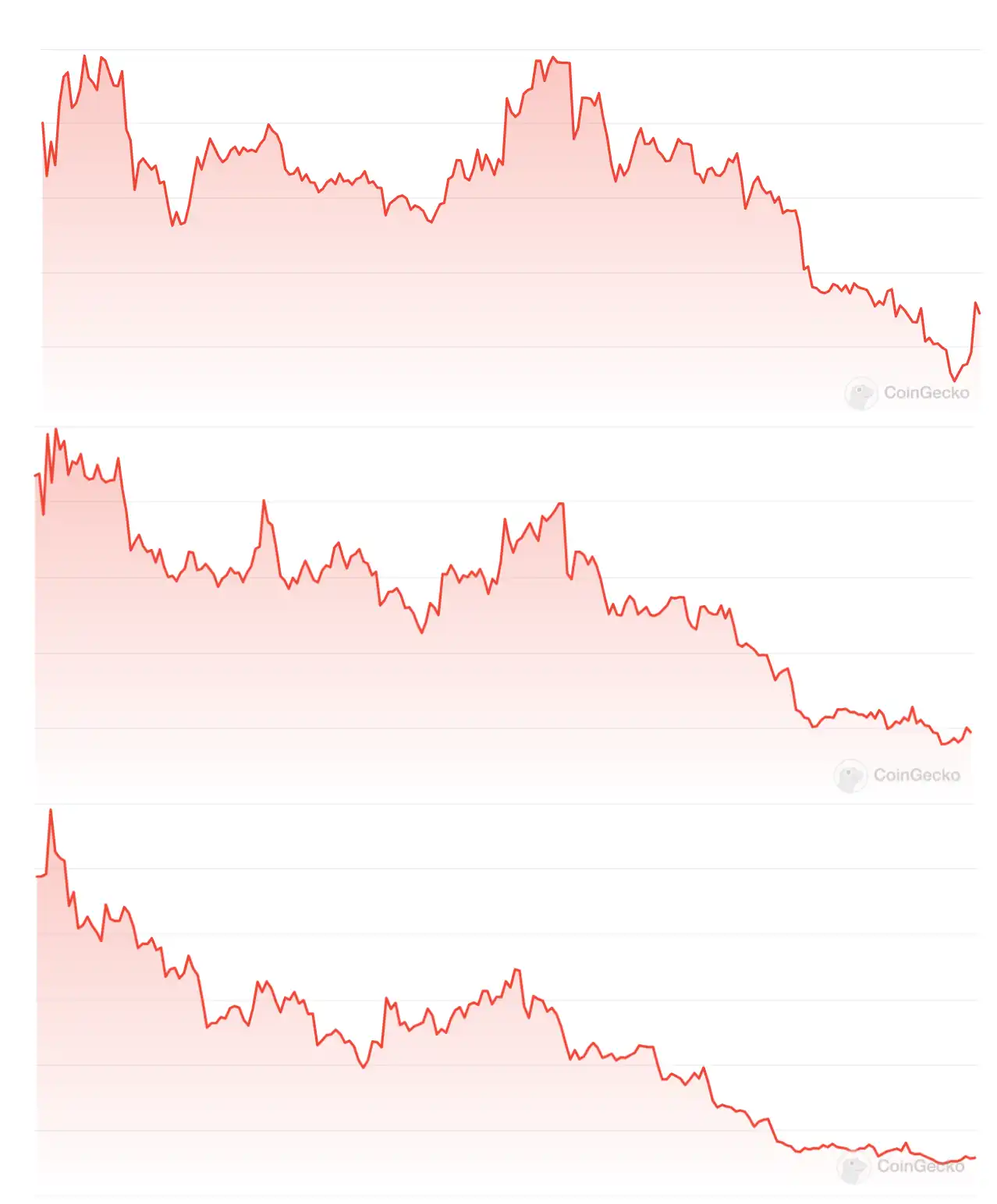
From top to bottom are: TON, NOT, DOGS
The success of Catizen and Notcoin is to some extent not a success in the track, but a result of the high centralization of TON core resources. These two projects started half a year earlier than most indie games and received full support from the foundation. In other words, the prosperity of TON indie games is not a true "open ecosystem" but a game of resource allocation.
Another fatal problem in the TON ecosystem is the confusion and abrupt turn in strategic direction. At the resource support level, the TON Foundation's focus swiftly shifted from Telegram small games to DeFi, directly causing many small game developers to be forced to abandon their projects.
"When we were in contact with the Foundation, we could clearly feel that, at some point, they basically stopped paying attention to all game projects and started frantically searching for DeFi projects," Sleepy said. "This shift came too suddenly and was a huge blow to teams that were seriously developing products, causing a significant loss of developers and users."
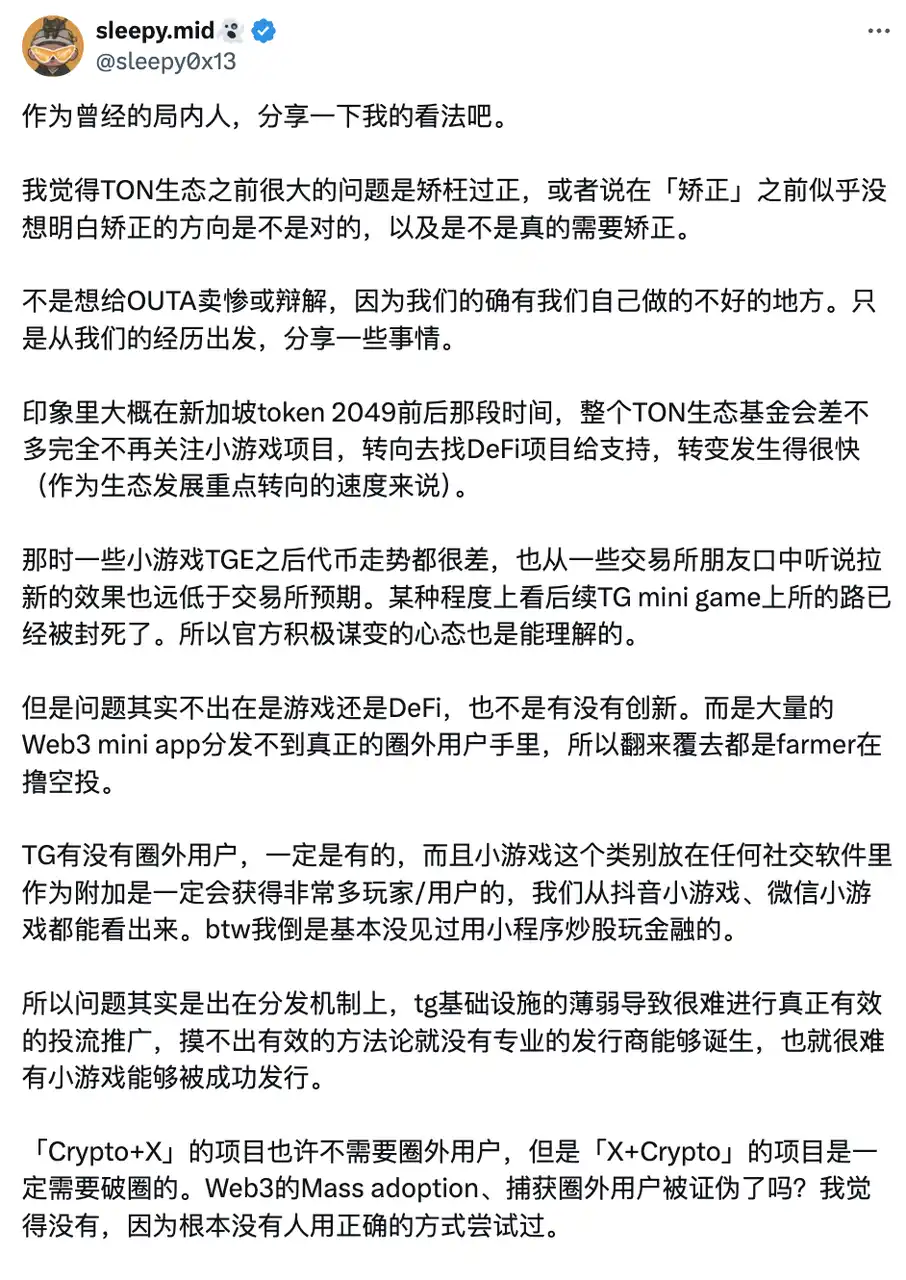
Sleepy strongly disagrees with the direction change made by the TON ecosystem: "I think TON should not simply copy what other public chains are doing. Without relying on Telegram, TON cannot achieve its current user base in terms of performance, language, and development difficulty. Therefore, TON should plan its next steps according to the characteristics of a social platform, rather than blindly following other public chains."
"Our initial assessment of TON was that its ecosystem would be similar to WeChat Mini Games or TikTok Mini Games, becoming part of a social platform's traffic monetization." However, the TON Foundation's decisions completely deviated from this direction. "They are doing stablecoins, they are doing DeFi, these are all huge mistakes, just like WeChat creating a stock trading mini program. Would you use a WeChat mini program for stock trading?" Sleepy bluntly stated.
This strategic mistake by the TON Foundation not only caused the ecosystem to miss the right narrative direction but also directly triggered a crisis—In August 2024, TON founder Pavel Durov was arrested in France. This event dealt a huge blow to the TON ecosystem, plunging the Foundation into chaos.
"The reason is actually because they added a function similar to fiat-to-stablecoin, which involved compliance and political factors, especially against the backdrop of the Russia-Ukraine war," Xiaoguang revealed to BlockBeats. Prior to this, BlockBeats had also heard similar opinions from other sources, indicating that a stablecoin-related feature drew regulatory scrutiny.
The original TON ecosystem had already been thrown into chaos due to strategic swings and uneven power distribution, and the founder's sudden event further deprived this ecosystem of its last support.
"Death Accelerator": Project Factory and Trading Platform
In addition to the traffic black box, factional struggles within the TON Foundation, and sudden shifts in resource support, the project factory and trading platforms were also key factors accelerating the demise of the Telegram mini-game track. The frenzy in this ecosystem was essentially a short-lived capital game, and true user growth had long been stagnant.
Within this track, game development was highly industrialized, with project factories mass-producing various mini-games in a assembly line fashion, experimenting in the market, and inevitably, a few projects would succeed. "For example, the game developer behind Catizen, Pluto Studio, initially ran more than a dozen games, and ultimately found that the cat-breeding model was the best, so they decided to focus on it," KinKin remarked.
In other words, Catizen's success was not accidental but rather the result of intensive project experiments. This model is essentially high-turnover, low-cost, rapid trial and error.
"The cost of this is actually very low," KinKin explained, "Many game developers directly go to the WeChat Mini Program market to find validated games, get the game code, change the H5 skin, then wrap it in a Telegram IDK (Integrated Development Kit), and they can go live directly. Moreover, in the later stages, the price of these mini-game codes becomes cheaper and cheaper.
Low cost, short cycle, quick deployment, have made these game projects highly speculative. More importantly, once a game model has been market-validated, it will be quickly replicated and scaled up, with the top players often having "pricing power." KinKin mentioned, "Catizen was very aggressive in negotiating with the trading platform and even leaned towards OKX, demanding $500,000."
Once a project succeeds, its bargaining power will increase significantly. The reason Catizen was able to negotiate strongly was that after the failure of multiple game projects, it accumulated enough market experience and precisely identified the user base willing to spend money. "Small games like Catizen that have been validated through a dozen projects do have mature products and have attracted a wave of users willing to spend money," KinKin said.
The success of top projects has also brought another problem—highly concentrated resources. "The traffic of a project like Hamster Kombat is almost equivalent to that of a medium-sized trading platform."
However, the Telegram mini-game ecosystem never saw a "living water" influx, lacking external incremental market entry. The high-density "bombardment" by project factories left almost no room for other mini-games to survive, let alone Web2 game developers—they hold a large amount of abandoned, unlisted games, with very low trial and error costs. In this competitive environment, the Telegram mini-game track accelerated its decline.
Another driving factor is the game theory of the trading platforms. The traffic brought by the TON mini-game has shown the platforms a new growth point. In the short term, frequent listings have led to the market being oversold prematurely. Looking back at Binance's listing timeline, it can be observed that the interval between listings for new projects is becoming shorter:
May 16: Notcoin listing;
84 days later: TON listing;
13 days later: DOGS listing;
23 days later: Catizen listing;
13 days later: Hamster Kombat listing
"During the DOGS listing, all trading platforms were competing for this data, even offering rewards through activities like 'Withdraw from my platform, and I'll give you back some DOGS.' Why did they know DOGS had traffic? Because NotCoin had already proven it once. NotCoin and DOGS are from the same team, just with a different skin repeating the same path as NotCoin," KinKin told BlockBeats.
A deeper issue is that the user growth rate in this cycle has fallen far behind the previous cycle. At least before Trump launched his coin, the market's anxiety about Web3 user growth was very evident, and this anxiety naturally transferred to the trading platforms. Although the user quality in the Telegram mini-game track is uneven, at least in the early stages, the conversion of TON's traffic could still bring some data growth to the trading platforms. However, this data growth is fundamentally unsustainable.
Ultimately, the more projects in the pipeline of the project factory, the faster the listing frequency on trading platforms, and the faster the cool-down of the race track.
After several rounds of listings, the user increment on trading platforms gradually dries up, losing the motivation to continue listings. For latecomers, the first-mover advantage has been maximized, and the space for latecomer projects and coins is getting smaller and smaller. All of this makes the collapse of the Telegram mini-game ecosystem inevitable.
TG+ Web3, Is It Really a False Proposition?
"Have you ever envied those projects that can list on Binance?" Faced with BlockBeats' question, Sleepy responded quickly, clearly having considered this question long ago.
"It depends on how you define success. Many people think that getting listed on a trading platform is a kind of industry recognition, but I don't feel that way. For me, issuing a coin is not the project's end point. If you treat it as the end point, it will be very hurtful, hurting yourself, the community, and the investors. Because everyone can see that the performance of these coins after listing is very poor, and the effect of attracting new users is far from the trading platform's expectations," Sleepy said.
The "Fast Money Logic" of the TON ecosystem makes everything simple and brutal—changing to a new narrative every three weeks, the quick-money traders lead the market's rhythm, while teams that truly want to build become the eliminated "outliers." In this ecosystem, idealists ultimately have only two choices: either abandon their beliefs and go with the flow, or be eliminated.
Sleepy and his team ultimately chose the latter. He cut 80% of the team, several core members agreed to delay their salaries, and allocated some resources to do Web2 design outsourcing to sustain the team.
"In addition, we are also in talks with some public chains for grants. We have already received the first Launch Grant and will continue to do some development work to complete the remaining KPIs. We have also applied for hackathons like Monad Madness to see if we can achieve some results. Currently, the income from the past few months is already more than what we earned from gaming on TON," he self-deprecatingly said.
After the collapse of the TON ecosystem, various people who were once active in it have found their own new paths.
KinKin has now shifted to the AI Agent track and is very optimistic about the future of the BASE chain. Meanwhile, Xiaoguang, who excelled at creating narratives, is researching memes. He understood early on that "Telegram mini-games business is structural, not a sustainable model, and the window of opportunity is only a few months." A former member who once worked hard to promote the TON ecosystem at the foundation has left and started studying the Kaia public chain that merges Korea and Japan.
In an ecosystem that prioritizes traffic above all else, only traffic remains in the end. The TON ecosystem did not become the "future of crypto-social," it was merely another cyclical Web3 narrative, a market game that is shorter, faster, and more extreme in profits than public chains or ZK tracks.
Looking back on this frenzy today, for developers, the TON ecosystem once disguised itself as the hope for "social + Web3," attracting them to enter this market, but ultimately turned them into producers of black-box data; for players, airdrops created the illusion of "overnight wealth," but the result was simply a $0.99 game bundle becoming the "cyber incense money" of a new era.
Looking at the entire industry again, the rise and fall of Telegram mini-games is not an isolated phenomenon, it is merely an extreme "microcosm" of the entire Web3 industry. In fact, whether it is a public chain, ZK Rollup, or Layer 2, the essence of many tracks is the same, just packaged more "grandiosely," with higher costs and longer cycles. Most Web3 projects are essentially running a large-scale Telegram mini-game, some with longer lifecycles, some shorter.
「Telegram + Web3, Is It Really a False Proposition?」
Each interviewee gave their own answer, but I decided not to write it down because, dear reader, this time, I want to hear your thoughts.
This article thanks all the interviewees for providing information. To protect privacy, some interviewee information has been blurred.
You may also like
a16z Leads $18M Seed Round for Catena Labs, Crypto Industry Bets on Stablecoin AI Payment
Pharos, deeply integrated with AntChain, is about to launch. How can we get involved?
The End and Rebirth of NFTs: How the Meme Coin Craze Ended the PFP Era?
Key Market Intelligence on May 14th, how much did you miss out on?
1.Binance Alpha Launches HIPPO, BLUE, and Other Tokens
2.Believe Ecosystem Tokens See General Rise, LAUNCHCOIN Surges Over 250% in 24 Hours
3.Tiger Securities Introduces Cryptocurrency Deposit and Withdrawal Service, Supports Mainstream Cryptocurrencies such as BTC and ETH
4.Current Bitcoin Rally Possibly Driven by Institutions, Retail Traders Yet to Join
5.Binance Wallet's New TGE Privasea AI Participation Requires a 198 Point Threshold, with a Point Consumption of 15
Source: Overheard on CT (tg: @overheardonct), Kaito
PUMP: Today's discussions about PUMP focus on its new creator revenue-sharing model: the platform will allocate 50% of PumpSwap revenue to token creators, sparking varied reactions from users. Some criticize the move as insufficient or even misleading, while others view it as a positive step the platform is taking to reward creators. Meanwhile, PUMP faces market pressure from emerging competitors like LetsBONKfun and Raydium, which are rapidly gaining market share. Users also express concerns about PUMP's sustainability and potential regulatory risks in the U.S., with discussions extending to the platform's impact on the entire memecoin ecosystem.
COINBASE: Today, Coinbase became the first crypto company to join the S&P 500 Index, replacing Discover Financial Services, sparking widespread industry attention. The entire crypto community views this milestone as a significant development, signaling that crypto assets are further integrating into the mainstream financial system. The news has sparked lively discussions on Twitter, with many users pointing out that this may attract more institutional investors to enter the Bitcoin and other cryptocurrency markets.
XRP: XRP became the focal point of today's crypto discussion, with its significant market movements and strategic advances drawing attention. XRP has surpassed USDT to become the third-largest cryptocurrency by market capitalization, sparking market excitement and discussions about its future potential. The surge in market capitalization and price is believed to be related to increasing institutional interest, deepening strategic partnerships, and its role in the crypto ecosystem. Additionally, XRP's integration into multiple financial systems and its potential as a macro asset class are also seen as key factors driving the current market sentiment.
DYDX: Today's discussions about DYDX mainly focused on the dYdX Yapper Leaderboard launched by KaitoAI. The leaderboard aims to identify the most active community participants, with a total of $150,000 in rewards to be distributed over the first three seasons. This initiative has sparked broad community participation, with many users discussing the potential rewards and the incentive effect on the DYDX ecosystem. Meanwhile, progress on the ethDYDX to dYdX native chain migration and historical airdrop events have also been topics of discussion.
1. "What Is 'ICM'? Holding Up the $4 Billion Market Cap Solana's New Narrative"
Overnight, the hottest narrative in the crypto space has become "Internet Capital Markets," with a host of crypto projects and founders, led by the Solana ecosystem's new Launchpad platform Believe, releasing this phrase. Together with "Believe in something," it has become the new slogan heralding the onset of a bull market. What exactly is the so-called "Internet Capital Market," will it become a short-lived hype phrase like the Base ecosystem's previous Content Coin, and what related targets are available for selection?2.《LaunchCoin Surges 20x in One Day, How Did Believe Create a $200M Market Cap Shiba Inu After Going to Zero?|100x Retrospective》
LAUNCHCOIN broke through a $200 million market cap today, with the long-lost liquidity and such a high market cap "Memecoin" almost bringing half of the on-chain crypto community CT into the fray. The community is crazily discussing this token, with half of it being FOMO and the other half being FUD. This token, originally issued by Believe founder Ben Pasternak under his personal identity, transformed into a new platform token after a renaming. From once going to zero to a $200 million market cap, what happened in between?May 14 On-chain Fund Flow
Within 24 hours, GOONC's market cap soared to 70 million, could GOONC be the next billion-dollar dog on the Believe platform?
Bitcoin has broken $100,000, Ethereum has surpassed 2500, and is Solana's hot streak about to make a comeback?
The current market is in a state of macro euphoria, with GOONC riding the wave today, skyrocketing 10x in just a few hours, reaching a market cap of tens of millions of dollars, trading volume soaring past 50 million, and rumors swirling that the developer may be from OpenAI (unconfirmed but intriguing enough).
A ludicrous and absurd Solana meme that some actually buy into.
GOONC is a meme coin that has sprouted from the "gooning" subculture, offering no technological innovation or practical use, its sole function being speculation.
It takes inspiration from an NSFW term "gooning," which refers to a person being deeply immersed in certain content (you know what), eventually entering a nearly religious-like trance.
In Reddit (such as r/GOONED, r/GoonCaves) and some counterculture media outlets (such as MEL Magazine in 2020), "gooning" has gradually transitioned from an adult label to a meme-addicted, digital content and virtual self-indulgence synonym, arguably the epitome of Degen spirit.
GOONC is playing around with this concept, packaging the addictive nature, uselessness, and irony of gooning into a tradable financial product. The project team has made it clear: "We do not solve blockchain problems, we only trade absurdity." Blunt but oddly genuine.
GOONC launched on May 13, 2025, using the meme coin launch platform Believe App's LaunchCoin module on Solana. This tool is highly Degen: zero technical barriers, a few clicks to create a coin, perfect for projects like GOONC that can come up with ideas out of the blue.
The mastermind behind GOONC is also quite something and is the most talked-about, with KOL @basedalexandoor on X platform (alias "Pata van Goon") personally involved. His profile even caught the attention of Marc Andreessen, co-founder of a16z, making onlookers unable to resist speculating if GOONC has a hint of OpenAI lineage.
While this 'OpenAI Endorsement' is currently just community speculation, it is definitely a good card to play to fuel hype. Saying "we are pure speculation" on one hand, while tagging a few "AI + a16z" on the other.
GOONC took off as soon as it launched. After its launch on May 13, 2025, its market capitalization skyrocketed to $22 million within 4 hours, with a trading volume exceeding $25.6 million in 24 hours. According to platform data, the first day of trading saw an astonishing +41,100% surge, soaring from $0.0000001 to $0.02, becoming a "missed-the-boat" situation.
GOONC quickly formed an active trading community post-launch, with a lot of discussion and trading signals appearing on X platform (such as the 292x return signal provided by DeBot). Liquidity pools on exchanges like Raydium and Meteora grew rapidly, supporting high trading volumes and price increases.
The real climax occurred between May 13 and May 14, with the market cap rising to $5.5 million in the morning and directly surpassing $55 million in the afternoon. By the 14th, it briefly approached a $70 million market cap, with the trading volume soaring to $59 million. Some community members even posted screenshots claiming an increase of +85,000%, creating a new myth out of the ruins.
As of 1:30 pm on May 14, the price stabilized around $0.039, with a total market cap and FDV both around $39.6 million, and a 24-hour trading volume of $5.43 million. Active platforms include XT.COM, LBank, Meteora, and others.
Although there was a slight pullback from the peak ($0.07), the coin's popularity remains strong. For a coin that relies purely on "irony + community + X post" to thrive, this performance is already at a stellar level.
Currently, the background of the token's development team is not transparent, increasing the potential risk of a rug pull. Rugcheck.xyz warns that the creator of the GOONC contract may have permission to modify the contract (e.g., change fees or mint additional tokens), posing certain security risks.
Community members speculate that the meteoric rise of GOONC may be the "last hurrah".
Deconstructing Binance Alpha2.0's New "Asia-Led Liquidity Mining" Model
How to Get Rich in Crypto Without Relying on Luck? Financial Veteran Raoul Pal's Macro Insights and Investment Path
Stablecoins Driving Global B2B Payment Innovation: How to Break Through Workflow Bottlenecks and Unlock Trillion-Dollar Market Potential?
These startups are building cutting-edge AI models without the need for a data center
After CEX and Wallet, OKX enters the payment game
Science Equity Movement: DeSci's Trillion-Dollar Knowledge Economy Reconstruction Revolution
Sentient In-Depth Research Report: Secures $85 Million in Funding to Build a Decentralized AGI New Paradigm
April 30th Market Key Intelligence, How Much Did You Miss?
Interview with Virtuals Co-Founder empty: AI Startups Don't Need a Lot of Funding, Crypto is One of the Answers
a16z Leads $25M Investment, 0xMiden to Run a Privacy Chain on Your Phone
Sui Q1 Advanced Report: The Rise of BTCfi Infrastructure, the Boom of Lending Protocols, and the Future of Rollup-Based Scalability
Gate.io MemeBox has officially integrated with the Solana ecosystem, providing lightning-fast on-chain asset trading.
Key Market Information Discrepancy on April 30th - A Must-Read! | Alpha Morning Report
a16z Leads $18M Seed Round for Catena Labs, Crypto Industry Bets on Stablecoin AI Payment
Pharos, deeply integrated with AntChain, is about to launch. How can we get involved?
The End and Rebirth of NFTs: How the Meme Coin Craze Ended the PFP Era?
Key Market Intelligence on May 14th, how much did you miss out on?
1.Binance Alpha Launches HIPPO, BLUE, and Other Tokens
2.Believe Ecosystem Tokens See General Rise, LAUNCHCOIN Surges Over 250% in 24 Hours
3.Tiger Securities Introduces Cryptocurrency Deposit and Withdrawal Service, Supports Mainstream Cryptocurrencies such as BTC and ETH
4.Current Bitcoin Rally Possibly Driven by Institutions, Retail Traders Yet to Join
5.Binance Wallet's New TGE Privasea AI Participation Requires a 198 Point Threshold, with a Point Consumption of 15
Source: Overheard on CT (tg: @overheardonct), Kaito
PUMP: Today's discussions about PUMP focus on its new creator revenue-sharing model: the platform will allocate 50% of PumpSwap revenue to token creators, sparking varied reactions from users. Some criticize the move as insufficient or even misleading, while others view it as a positive step the platform is taking to reward creators. Meanwhile, PUMP faces market pressure from emerging competitors like LetsBONKfun and Raydium, which are rapidly gaining market share. Users also express concerns about PUMP's sustainability and potential regulatory risks in the U.S., with discussions extending to the platform's impact on the entire memecoin ecosystem.
COINBASE: Today, Coinbase became the first crypto company to join the S&P 500 Index, replacing Discover Financial Services, sparking widespread industry attention. The entire crypto community views this milestone as a significant development, signaling that crypto assets are further integrating into the mainstream financial system. The news has sparked lively discussions on Twitter, with many users pointing out that this may attract more institutional investors to enter the Bitcoin and other cryptocurrency markets.
XRP: XRP became the focal point of today's crypto discussion, with its significant market movements and strategic advances drawing attention. XRP has surpassed USDT to become the third-largest cryptocurrency by market capitalization, sparking market excitement and discussions about its future potential. The surge in market capitalization and price is believed to be related to increasing institutional interest, deepening strategic partnerships, and its role in the crypto ecosystem. Additionally, XRP's integration into multiple financial systems and its potential as a macro asset class are also seen as key factors driving the current market sentiment.
DYDX: Today's discussions about DYDX mainly focused on the dYdX Yapper Leaderboard launched by KaitoAI. The leaderboard aims to identify the most active community participants, with a total of $150,000 in rewards to be distributed over the first three seasons. This initiative has sparked broad community participation, with many users discussing the potential rewards and the incentive effect on the DYDX ecosystem. Meanwhile, progress on the ethDYDX to dYdX native chain migration and historical airdrop events have also been topics of discussion.
1. "What Is 'ICM'? Holding Up the $4 Billion Market Cap Solana's New Narrative"
Overnight, the hottest narrative in the crypto space has become "Internet Capital Markets," with a host of crypto projects and founders, led by the Solana ecosystem's new Launchpad platform Believe, releasing this phrase. Together with "Believe in something," it has become the new slogan heralding the onset of a bull market. What exactly is the so-called "Internet Capital Market," will it become a short-lived hype phrase like the Base ecosystem's previous Content Coin, and what related targets are available for selection?2.《LaunchCoin Surges 20x in One Day, How Did Believe Create a $200M Market Cap Shiba Inu After Going to Zero?|100x Retrospective》
LAUNCHCOIN broke through a $200 million market cap today, with the long-lost liquidity and such a high market cap "Memecoin" almost bringing half of the on-chain crypto community CT into the fray. The community is crazily discussing this token, with half of it being FOMO and the other half being FUD. This token, originally issued by Believe founder Ben Pasternak under his personal identity, transformed into a new platform token after a renaming. From once going to zero to a $200 million market cap, what happened in between?May 14 On-chain Fund Flow
Within 24 hours, GOONC's market cap soared to 70 million, could GOONC be the next billion-dollar dog on the Believe platform?
Bitcoin has broken $100,000, Ethereum has surpassed 2500, and is Solana's hot streak about to make a comeback?
The current market is in a state of macro euphoria, with GOONC riding the wave today, skyrocketing 10x in just a few hours, reaching a market cap of tens of millions of dollars, trading volume soaring past 50 million, and rumors swirling that the developer may be from OpenAI (unconfirmed but intriguing enough).
A ludicrous and absurd Solana meme that some actually buy into.
GOONC is a meme coin that has sprouted from the "gooning" subculture, offering no technological innovation or practical use, its sole function being speculation.
It takes inspiration from an NSFW term "gooning," which refers to a person being deeply immersed in certain content (you know what), eventually entering a nearly religious-like trance.
In Reddit (such as r/GOONED, r/GoonCaves) and some counterculture media outlets (such as MEL Magazine in 2020), "gooning" has gradually transitioned from an adult label to a meme-addicted, digital content and virtual self-indulgence synonym, arguably the epitome of Degen spirit.
GOONC is playing around with this concept, packaging the addictive nature, uselessness, and irony of gooning into a tradable financial product. The project team has made it clear: "We do not solve blockchain problems, we only trade absurdity." Blunt but oddly genuine.
GOONC launched on May 13, 2025, using the meme coin launch platform Believe App's LaunchCoin module on Solana. This tool is highly Degen: zero technical barriers, a few clicks to create a coin, perfect for projects like GOONC that can come up with ideas out of the blue.
The mastermind behind GOONC is also quite something and is the most talked-about, with KOL @basedalexandoor on X platform (alias "Pata van Goon") personally involved. His profile even caught the attention of Marc Andreessen, co-founder of a16z, making onlookers unable to resist speculating if GOONC has a hint of OpenAI lineage.
While this 'OpenAI Endorsement' is currently just community speculation, it is definitely a good card to play to fuel hype. Saying "we are pure speculation" on one hand, while tagging a few "AI + a16z" on the other.
GOONC took off as soon as it launched. After its launch on May 13, 2025, its market capitalization skyrocketed to $22 million within 4 hours, with a trading volume exceeding $25.6 million in 24 hours. According to platform data, the first day of trading saw an astonishing +41,100% surge, soaring from $0.0000001 to $0.02, becoming a "missed-the-boat" situation.
GOONC quickly formed an active trading community post-launch, with a lot of discussion and trading signals appearing on X platform (such as the 292x return signal provided by DeBot). Liquidity pools on exchanges like Raydium and Meteora grew rapidly, supporting high trading volumes and price increases.
The real climax occurred between May 13 and May 14, with the market cap rising to $5.5 million in the morning and directly surpassing $55 million in the afternoon. By the 14th, it briefly approached a $70 million market cap, with the trading volume soaring to $59 million. Some community members even posted screenshots claiming an increase of +85,000%, creating a new myth out of the ruins.
As of 1:30 pm on May 14, the price stabilized around $0.039, with a total market cap and FDV both around $39.6 million, and a 24-hour trading volume of $5.43 million. Active platforms include XT.COM, LBank, Meteora, and others.
Although there was a slight pullback from the peak ($0.07), the coin's popularity remains strong. For a coin that relies purely on "irony + community + X post" to thrive, this performance is already at a stellar level.
Currently, the background of the token's development team is not transparent, increasing the potential risk of a rug pull. Rugcheck.xyz warns that the creator of the GOONC contract may have permission to modify the contract (e.g., change fees or mint additional tokens), posing certain security risks.
Community members speculate that the meteoric rise of GOONC may be the "last hurrah".
Deconstructing Binance Alpha2.0's New "Asia-Led Liquidity Mining" Model
Popular coins
Latest Crypto News


Customer Support:@weikecs
Business Cooperation:@weikecs
Quant Trading & MM:bd@weex.com
VIP Services:support@weex.com
 App
App