
- Buy Crypto
- Markets
- Futures
- Spot
- Copy Trade
 WE-Launch
Unveiling the Crypto VC Network: Who Is Joining Forces to Build the Next Unicorn?

Original Article Title: Networks in Crypto VC
Original Author: @Decentralisedco, Web3 Consulting Firm
Original Translation: 律动小 deep
Editor's Note: The article explores the network relationships in crypto venture capital, analyzing how VCs choose co-investors and historical investment patterns. Researchers revealed which funds frequently co-invest, how their investments perform, and how large funds support their portfolio companies through follow-on funding. The article emphasizes that understanding VC networks and co-investment habits can help founders optimize their fundraising strategy, while pointing out that capital is increasingly concentrating in a few top funds, co-investment relies more on partner relationships than fund brands, and the future may evolve towards private equity.
The following is the original content (slightly restructured for better readability):
We studied how crypto venture capital selects co-investors and the historical patterns in their investment strategies. The tools mentioned in the article can be accessed here.
As an asset class, venture capital follows an extreme power law distribution. However, the extent of this phenomenon has not been fully researched as we are always caught up in chasing the latest market narrative. As a founder, understanding which VCs frequently co-invest can save time and optimize your fundraising strategy. Each transaction is like a fingerprint, and once we visualize them as graphs, the underlying story can be revealed.
In other words, we can track the nodes responsible for a majority of the funding in the cryptocurrency space. We try to find the "ports" in the modern trading network, similar to merchants from a millennium ago.
We believe there are two reasons why this is an interesting experiment:
1. We operate a somewhat "fight club" like VC network. No one is really throwing punches (at least not yet), but we also don't talk about it much publicly. This VC network includes about 80 funds. Across the entire crypto VC space, around 240 funds have invested over $500,000 in seed-stage rounds. This means we directly engage with about 1/3 of the funds, and nearly 2/3 of the funds read our content. This coverage exceeds my expectations, but that's the current state of affairs.
Nevertheless, tracking who actually invests where remains quite challenging. Sending founder updates to each fund would turn into noise. The emergence of this tracking tool is to filter out which funds have invested in which areas and with whom they co-invest.
2. For a founder, understanding capital flows is just the first step. More importantly, it is crucial to comprehend how these funds have performed and with whom they typically co-invest. To figure this out, we calculated the historical probability of a fund's portfolio companies receiving follow-on funding post their investment, although data tends to become murky in later stages (such as Series B) as companies often opt for token issuance rather than traditional equity financing.
Assisting founders in identifying active investors in cryptocurrency venture capital is the first step. The next is understanding which funding sources have shown better performance. Once we have this data, we can explore which co-investments by funds can lead to the best outcomes. Of course, this is not rocket science. No one can guarantee a Series A funding with just one check, just like no one can guarantee marriage after the first date. However, understanding the landscape you are stepping into, be it in dating or risk financing, can be highly beneficial.
Building Success
We used some basic logic to identify funds in the portfolio that have participated in the most follow-on funding rounds. If a fund's multiple companies receive funding post-seed round, they have likely done something right. Venture capital sees an increase in investment value when a company raises the next round at a higher valuation. Therefore, follow-on funding is a good indicator of performance.
We selected the top 20 funds in the portfolio with the most follow-on funding rounds and then calculated the total number of companies they invested in at the seed stage. You can effectively calculate the founder's probability of receiving follow-on funding from this. If a fund invested in 100 companies at the seed stage, out of which 30 received follow-on funding within two years, we would calculate the follow-on funding "graduation probability" as 30%.
The limitation here is that we set a strict two-year time filter. Typically, startups may choose not to raise funds at all or may do so much later.
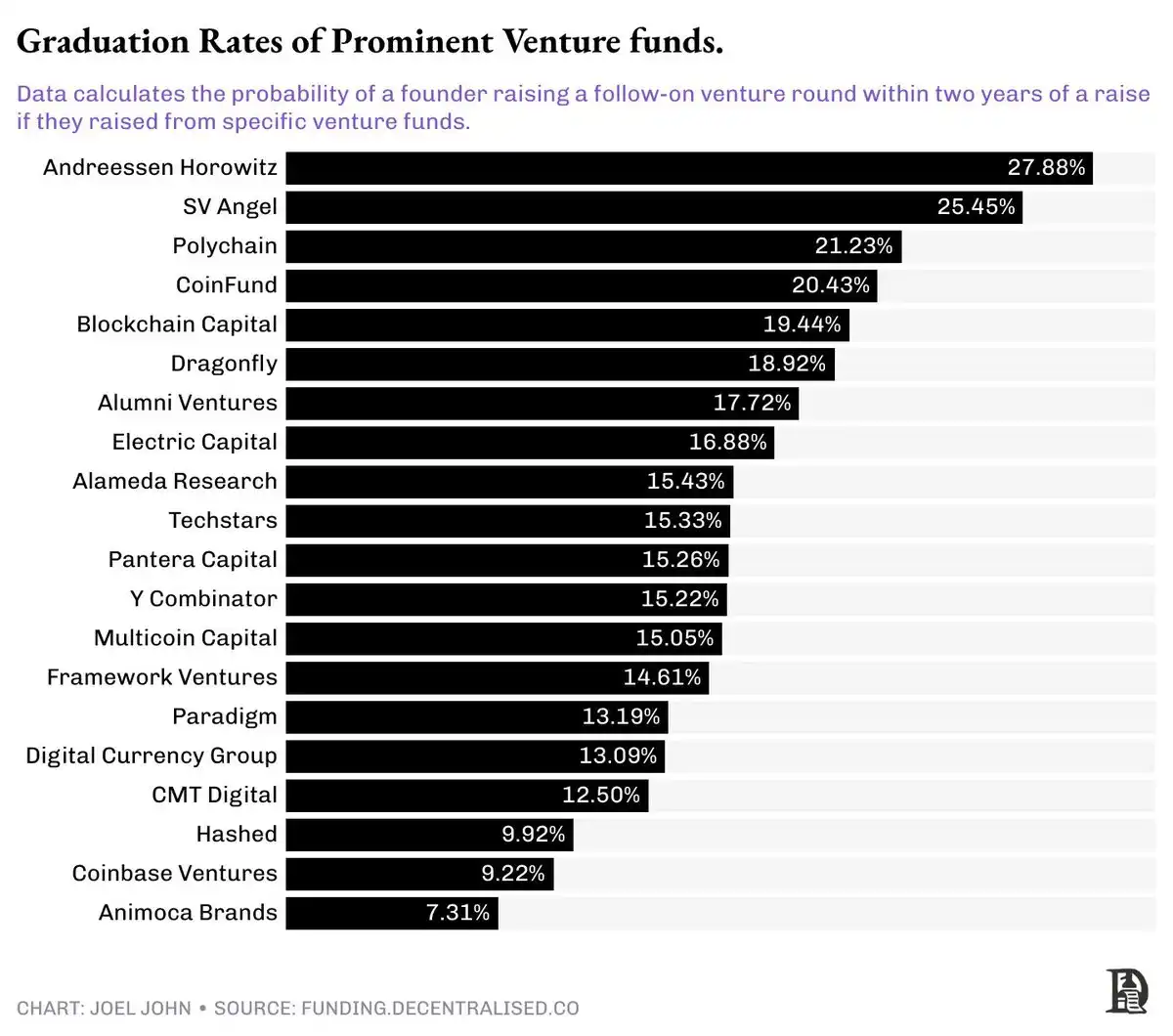
Even among the top 20 ranked funds, the power law distribution is quite extreme. For instance, receiving funding from A16z means you have a 1/3 chance of raising another round within two years. In other words, for every three startups backed by A16z, one will proceed to a Series A round. Considering the probability on the other end is 1/16, this is quite a high graduation rate.
For funds closer to the 20th rank (in this top 20 follow-on funding list), the probability of their portfolio companies receiving follow-on funding is 7%. These numbers might seem similar, but for context, a 1/3 probability is like rolling a die and getting a number less than 3, while a 1/14 probability is roughly equivalent to the chance of having twins. These are vastly different outcomes, both literally and probabilistically.
Joking aside, this illustrates the level of concentration within cryptocurrency venture capital funds. Some venture funds may even strategize follow-on funding for their portfolio companies as they also have growth-stage funds. Therefore, they will invest in the same company in both the seed round and Series A. When a venture fund doubles down on an investment in the same company, it often sends a strong signal to later-stage investors. In other words, whether a venture firm internally has a growth-stage fund significantly impacts the company's likelihood of success in the coming years.
In the long run, cryptocurrency venture capital may evolve into private equity investments for revenue-generating projects.
We have a theoretical argument for this transition. But what do the data actually show? To investigate this, we looked at the number of startups in our investor group that received follow-on funding. We then calculated the percentage of companies where the same venture fund participated again in subsequent funding rounds.
In other words, if a company received seed funding from A16z, what is the probability that A16z will reinvest in their Series A?
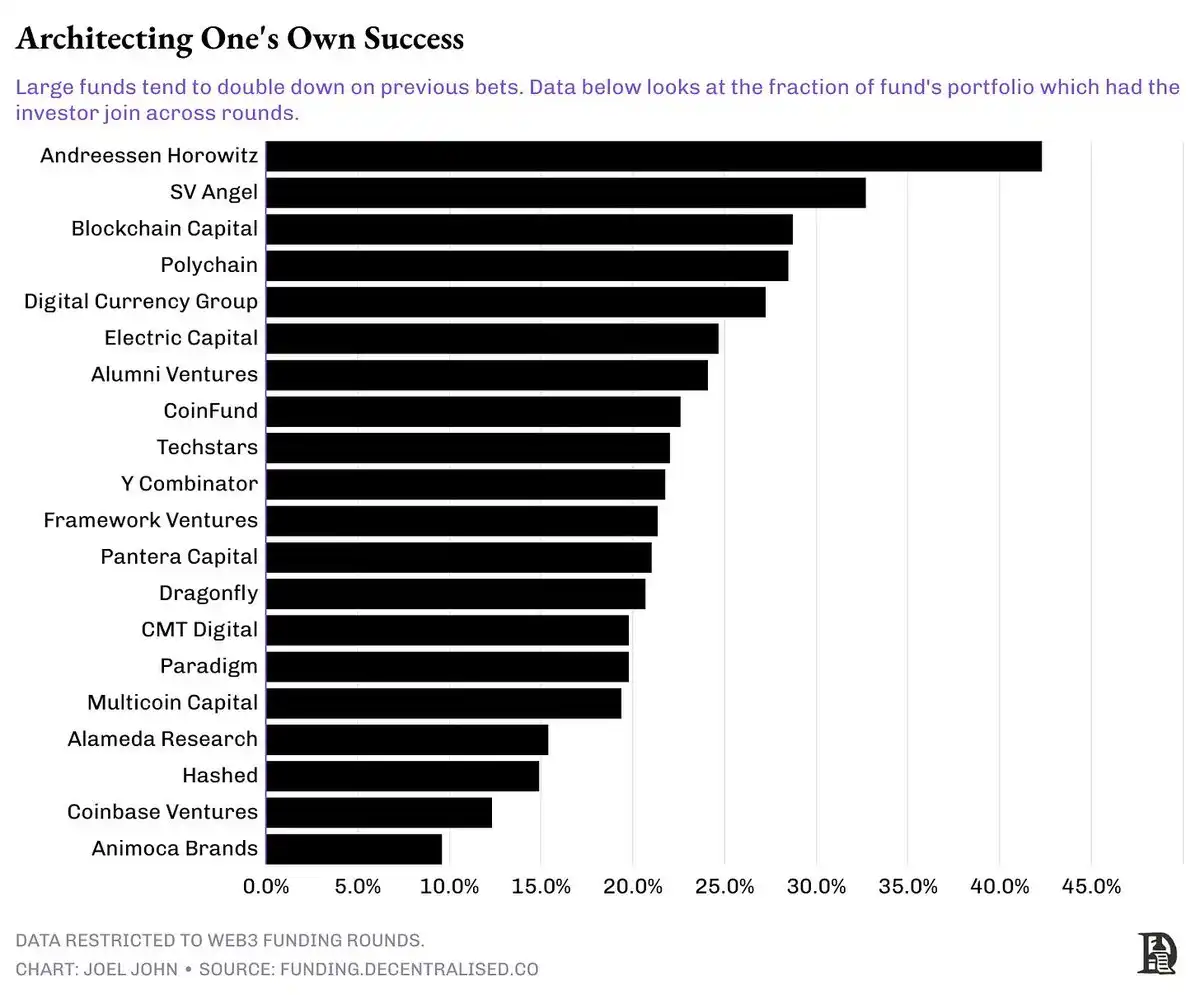
A pattern quickly emerged. Larger funds managing over $1 billion tend to engage in follow-on investments more frequently. For example, 44% of startups in A16z's portfolio had A16z participate in follow-on rounds when they raised additional funding. Blockchain Capital, DCG, and Polychain made follow-on investments in a quarter of the companies that received follow-on funding in their portfolios.
In other words, who you raise from in the seed or pre-seed round is much more critical than you might think, as these investors often tend to consistently support their companies.
Habitual Co-Investment
These patterns are the result of post hoc observations. We are not implying that companies funded by non-top-tier VCs are destined to fail. The ultimate goal of all economic activity is either growth or profit creation. Startups that can achieve both functions will see their valuations rise over time. However, increasing the probability of success certainly helps. If you cannot secure funding from these top 20 funds, one way to improve the odds is through their networks. In other words, connect to these hubs of capital.
The image below shows the network relationships of all venture capitalists in the cryptocurrency space over the past decade. There are 1000 investors sharing approximately 22,000 connections. When one investor co-invests with another, a connection is formed. It may look crowded, even like too many options.
However, this includes funds that have already closed, never returned capital, or are no longer investing.
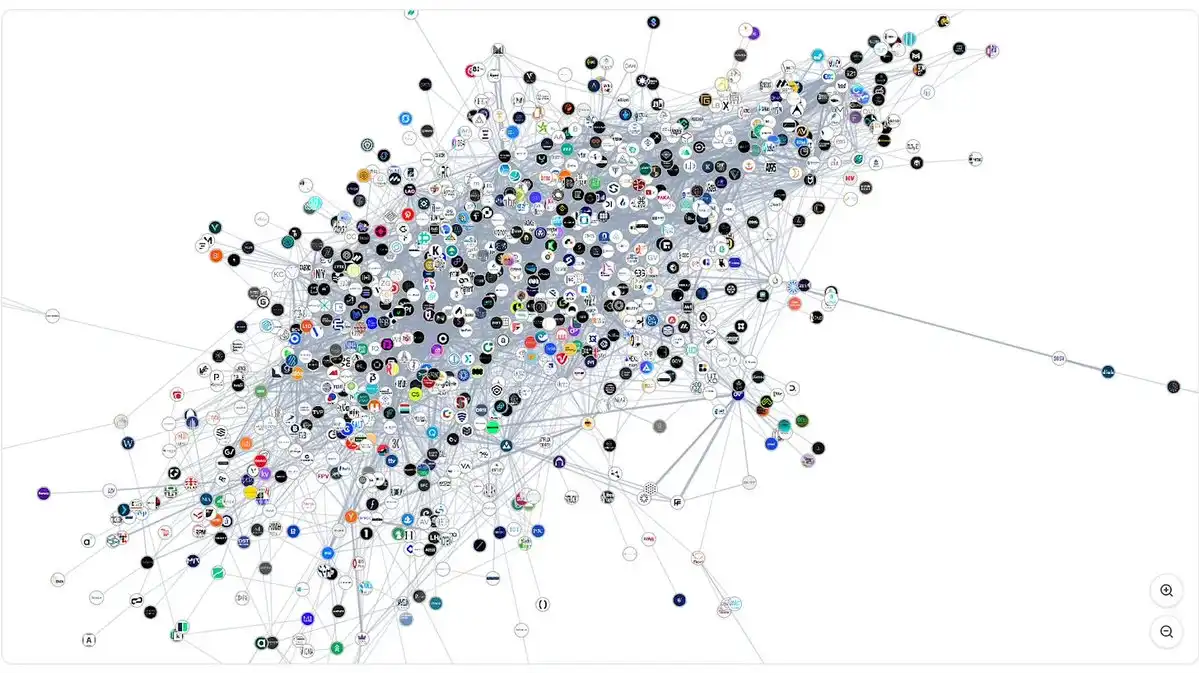
I know, it's messy.
The following image provides a clearer view of the future direction of our market. If you are a founder looking to raise a Series A round with a fund size of over $2 million, there are approximately 50 funds. The investor network participating in these rounds consists of around 112 funds. These funds are increasingly inclined towards consolidation, showing a stronger preference for co-investing with specific partners.
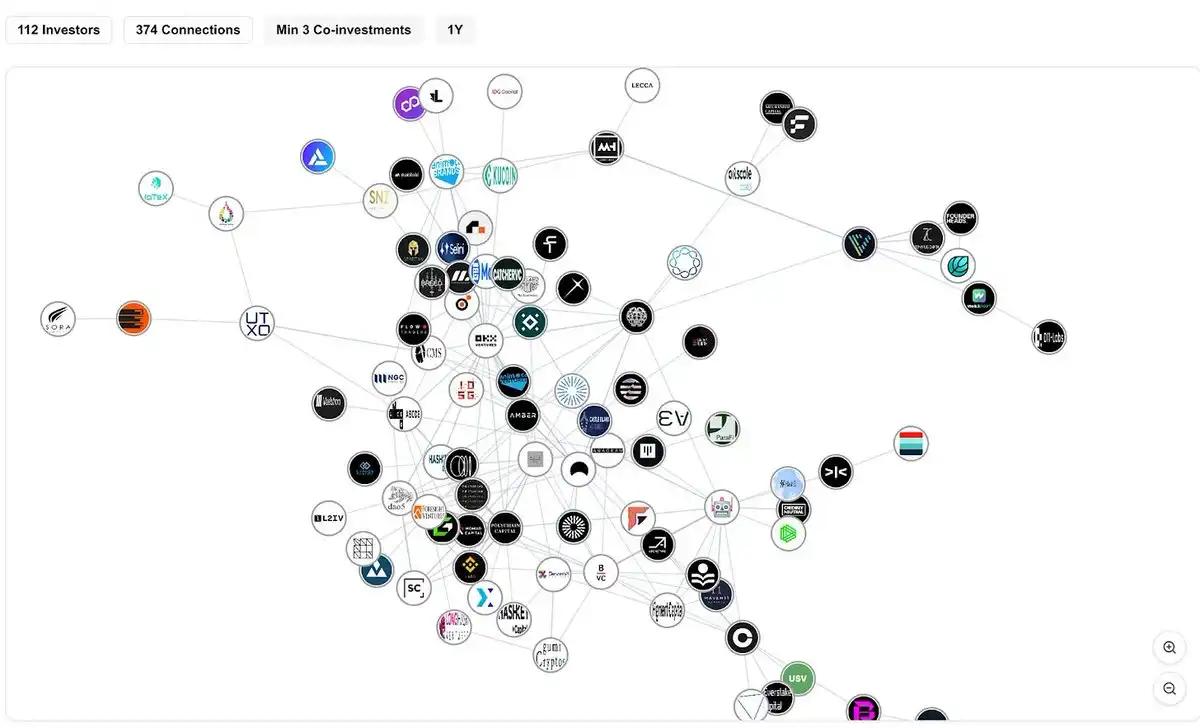
Seed Round to Series A Investor Ocean
It appears that over time, funds have developed a habit of co-investing. This means that when one fund invests in an entity, it often brings along another peer fund, either due to complementary skills (such as technical expertise or marketing assistance) or based on partner relationships. To understand how these relationships work, we began exploring the co-investment patterns between funds over the past year.
For example, in the past year:
· Polychain and Nomad Capital had 9 shared co-investments.
· Bankless and Robot Ventures had 9 shared co-investments.
· Binance and Polychain had 7 shared co-investments.
· Binance also had 7 shared co-investments with HackVC.
· OKX and Animoca had 7 shared co-investments.
Larger funds are becoming increasingly selective about co-investors.
· For example, out of Paradigm's 10 investments last year, Robot Ventures participated in 3.
· In its total of 13 investments, DragonFly shared 3 rounds with Robot Ventures and Founders Fund.
· Similarly, Founders Fund had 3 co-investments with Dragonfly out of its total of 9 investments.
In other words, we are transitioning to an era where a small number of funds are making large investments, there are fewer co-investors, and these co-investors are often well-established, reputable funds.
Entering the Matrix
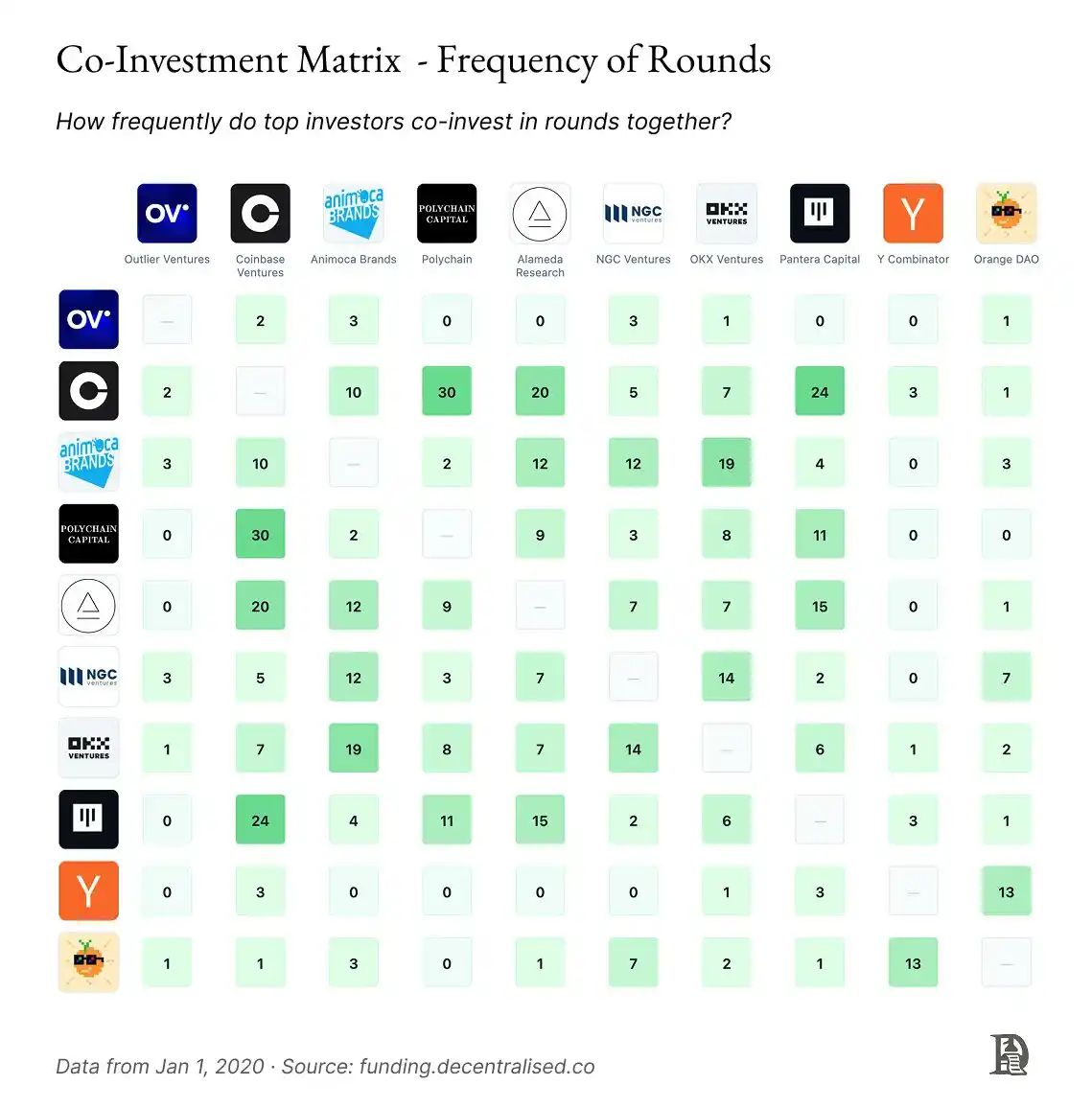
Another way of analyzing data is by studying the behavior of the most active investors. The matrix above considers the most frequently investing funds since 2020 and how their relationships unfold. You will notice that joint investments between accelerators (such as Y Combinator or Outlier Venture) and exchanges (such as Coinbase Ventures) are rare.
On the other hand, you will also find that exchanges typically have their own preferences. For example, OKX Ventures and Animoca Brands have a high degree of joint investments. Coinbase Ventures has over 30 joint investments with Polychain and 24 with Pantera.
What we observe are three structural tendencies:
1. Despite a high investment frequency, joint investments between accelerators and exchanges or large funds are scarce, possibly due to different stage preferences.
2. Major exchanges show a strong preference for growth-stage venture funds. Currently, Pantera and Polychain lead in this aspect.
3. Exchanges tend to collaborate with local players. OKX Ventures and Coinbase exhibit distinct joint investment preferences, highlighting the global nature of Web3 capital allocation.
So, as venture funds consolidate, where does the next marginal capital come from? I have noticed an interesting pattern: corporate ventures have their own clusters. For instance, Goldman Sachs has had 2 joint investment rounds historically with PayPal Ventures and Kraken. Coinbase Ventures has 37 joint investments with Polychain, 32 with Pantera, and 24 with Electric Capital.
Unlike venture capital, corporate pools of capital typically target growth-stage companies with significant product-market fit. Therefore, as early-stage risk financing declines, the behavior of this pool of capital still needs to be observed.
The Evolving Network
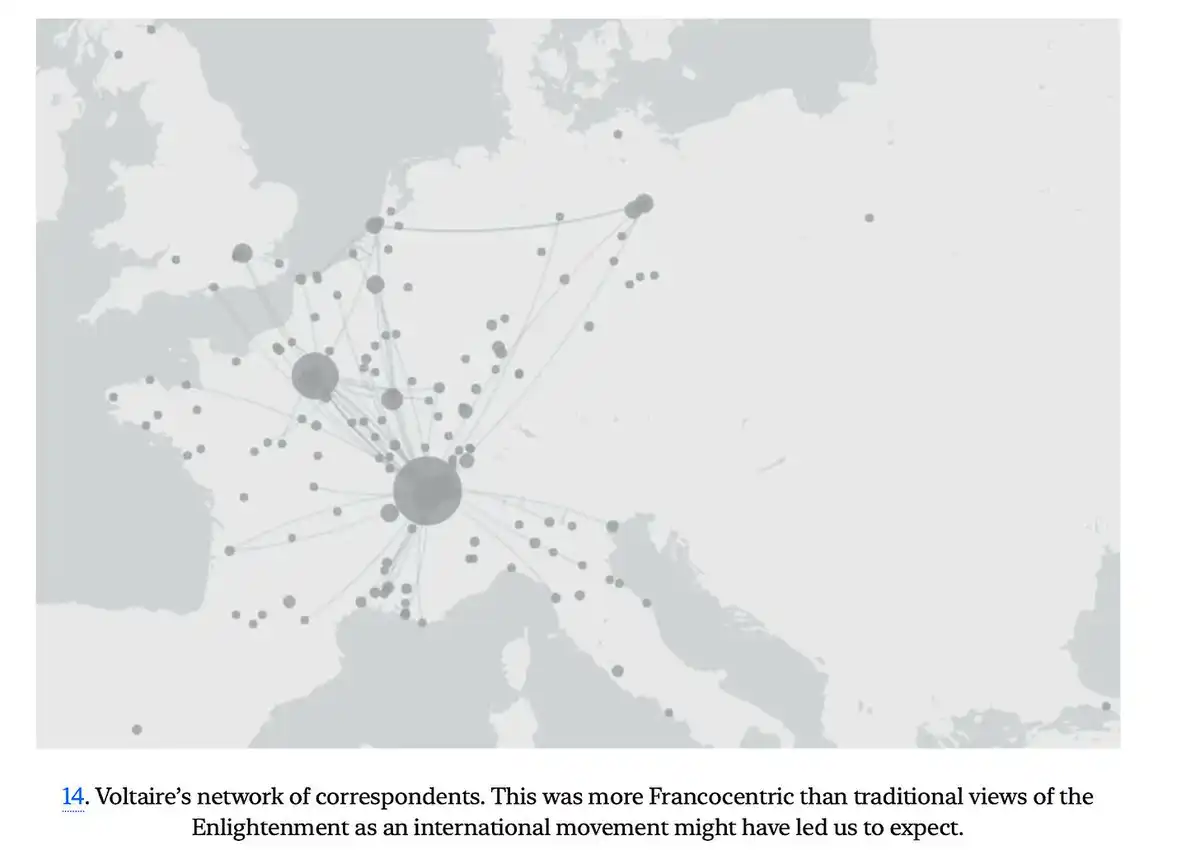
Excerpt from "Squares and Towers"
A few years ago, after reading Niall Ferguson's "The Square and the Tower," I became interested in exploring the relationship networks within cryptocurrency. This book revealed how the spread of ideas, products, and even diseases is tied to networks. It wasn't until a few weeks ago when we built a funding dashboard that I realized visualizing the connected network of cryptocurrency capital sources was possible.
I believe that such a dataset and the economic interactions between these entities could be used to design (and execute) mergers and token M&A. We are internally exploring both of these. They could also be used for business development and partnership initiatives. We are still researching how to allow specific companies access to this dataset.
But let's get back to the point at hand.
Can networks really help funds achieve alpha returns?
The answer is somewhat complex.
The ability for a fund to select the right team and provide substantial capital will become increasingly important, surpassing its connections with other funds. However, what truly matters are the personal relationships between General Partners (GPs) and other co-investors. Venture capital doesn't share deal flow with brands; they share it with people. When a partner switches funds, these relationships simply transfer to the new fund.
I have an intuition about this, but the means to validate this argument are limited. Luckily, a study in 2024 examined the performance of the top 100 VCs over time. In fact, they looked at 38,000 funding rounds involving 11,084 companies, even breaking down the market by seasonality. Their key points can be summarized as follows:
1. Past co-investments do not necessarily imply future collaborations. If previous investments failed, a fund may choose not to work with another fund again.
2. During boom times, co-investments often increase as funds seek to deploy capital more aggressively. VCs rely more on social signals during a boom, reducing due diligence. In bear markets, funds are cautious in deployment, usually investing solo due to lower valuations.
3. Funds select partners based on complementary skills. Therefore, having investors with the same expertise crowded in a round typically spells trouble.
As I mentioned before, ultimately, co-investments happen at the partner level, not at the fund level. Throughout my career, I have seen individuals switch between different institutions. The goal is often to work with the same person, regardless of which fund they join. In an age where AI is taking over human jobs, knowing that relationships are still the bedrock of early-stage venture capital is reassuring.
There is still much work to be done on how cryptocurrency venture capital networks are formed. For example, I am interested in studying the preferences of hedge funds in capital allocation, or how late-stage cryptocurrency deployment evolves with market seasonality, or how M&A and private equity play into this. The answers are in our data today, but it will take time to pose the right questions.
You may also like
a16z Leads $18M Seed Round for Catena Labs, Crypto Industry Bets on Stablecoin AI Payment
Pharos, deeply integrated with AntChain, is about to launch. How can we get involved?
The End and Rebirth of NFTs: How the Meme Coin Craze Ended the PFP Era?
Key Market Intelligence on May 14th, how much did you miss out on?
1.Binance Alpha Launches HIPPO, BLUE, and Other Tokens
2.Believe Ecosystem Tokens See General Rise, LAUNCHCOIN Surges Over 250% in 24 Hours
3.Tiger Securities Introduces Cryptocurrency Deposit and Withdrawal Service, Supports Mainstream Cryptocurrencies such as BTC and ETH
4.Current Bitcoin Rally Possibly Driven by Institutions, Retail Traders Yet to Join
5.Binance Wallet's New TGE Privasea AI Participation Requires a 198 Point Threshold, with a Point Consumption of 15
Source: Overheard on CT (tg: @overheardonct), Kaito
PUMP: Today's discussions about PUMP focus on its new creator revenue-sharing model: the platform will allocate 50% of PumpSwap revenue to token creators, sparking varied reactions from users. Some criticize the move as insufficient or even misleading, while others view it as a positive step the platform is taking to reward creators. Meanwhile, PUMP faces market pressure from emerging competitors like LetsBONKfun and Raydium, which are rapidly gaining market share. Users also express concerns about PUMP's sustainability and potential regulatory risks in the U.S., with discussions extending to the platform's impact on the entire memecoin ecosystem.
COINBASE: Today, Coinbase became the first crypto company to join the S&P 500 Index, replacing Discover Financial Services, sparking widespread industry attention. The entire crypto community views this milestone as a significant development, signaling that crypto assets are further integrating into the mainstream financial system. The news has sparked lively discussions on Twitter, with many users pointing out that this may attract more institutional investors to enter the Bitcoin and other cryptocurrency markets.
XRP: XRP became the focal point of today's crypto discussion, with its significant market movements and strategic advances drawing attention. XRP has surpassed USDT to become the third-largest cryptocurrency by market capitalization, sparking market excitement and discussions about its future potential. The surge in market capitalization and price is believed to be related to increasing institutional interest, deepening strategic partnerships, and its role in the crypto ecosystem. Additionally, XRP's integration into multiple financial systems and its potential as a macro asset class are also seen as key factors driving the current market sentiment.
DYDX: Today's discussions about DYDX mainly focused on the dYdX Yapper Leaderboard launched by KaitoAI. The leaderboard aims to identify the most active community participants, with a total of $150,000 in rewards to be distributed over the first three seasons. This initiative has sparked broad community participation, with many users discussing the potential rewards and the incentive effect on the DYDX ecosystem. Meanwhile, progress on the ethDYDX to dYdX native chain migration and historical airdrop events have also been topics of discussion.
1. "What Is 'ICM'? Holding Up the $4 Billion Market Cap Solana's New Narrative"
Overnight, the hottest narrative in the crypto space has become "Internet Capital Markets," with a host of crypto projects and founders, led by the Solana ecosystem's new Launchpad platform Believe, releasing this phrase. Together with "Believe in something," it has become the new slogan heralding the onset of a bull market. What exactly is the so-called "Internet Capital Market," will it become a short-lived hype phrase like the Base ecosystem's previous Content Coin, and what related targets are available for selection?2.《LaunchCoin Surges 20x in One Day, How Did Believe Create a $200M Market Cap Shiba Inu After Going to Zero?|100x Retrospective》
LAUNCHCOIN broke through a $200 million market cap today, with the long-lost liquidity and such a high market cap "Memecoin" almost bringing half of the on-chain crypto community CT into the fray. The community is crazily discussing this token, with half of it being FOMO and the other half being FUD. This token, originally issued by Believe founder Ben Pasternak under his personal identity, transformed into a new platform token after a renaming. From once going to zero to a $200 million market cap, what happened in between?May 14 On-chain Fund Flow
Within 24 hours, GOONC's market cap soared to 70 million, could GOONC be the next billion-dollar dog on the Believe platform?
Bitcoin has broken $100,000, Ethereum has surpassed 2500, and is Solana's hot streak about to make a comeback?
The current market is in a state of macro euphoria, with GOONC riding the wave today, skyrocketing 10x in just a few hours, reaching a market cap of tens of millions of dollars, trading volume soaring past 50 million, and rumors swirling that the developer may be from OpenAI (unconfirmed but intriguing enough).
A ludicrous and absurd Solana meme that some actually buy into.
GOONC is a meme coin that has sprouted from the "gooning" subculture, offering no technological innovation or practical use, its sole function being speculation.
It takes inspiration from an NSFW term "gooning," which refers to a person being deeply immersed in certain content (you know what), eventually entering a nearly religious-like trance.
In Reddit (such as r/GOONED, r/GoonCaves) and some counterculture media outlets (such as MEL Magazine in 2020), "gooning" has gradually transitioned from an adult label to a meme-addicted, digital content and virtual self-indulgence synonym, arguably the epitome of Degen spirit.
GOONC is playing around with this concept, packaging the addictive nature, uselessness, and irony of gooning into a tradable financial product. The project team has made it clear: "We do not solve blockchain problems, we only trade absurdity." Blunt but oddly genuine.
GOONC launched on May 13, 2025, using the meme coin launch platform Believe App's LaunchCoin module on Solana. This tool is highly Degen: zero technical barriers, a few clicks to create a coin, perfect for projects like GOONC that can come up with ideas out of the blue.
The mastermind behind GOONC is also quite something and is the most talked-about, with KOL @basedalexandoor on X platform (alias "Pata van Goon") personally involved. His profile even caught the attention of Marc Andreessen, co-founder of a16z, making onlookers unable to resist speculating if GOONC has a hint of OpenAI lineage.
While this 'OpenAI Endorsement' is currently just community speculation, it is definitely a good card to play to fuel hype. Saying "we are pure speculation" on one hand, while tagging a few "AI + a16z" on the other.
GOONC took off as soon as it launched. After its launch on May 13, 2025, its market capitalization skyrocketed to $22 million within 4 hours, with a trading volume exceeding $25.6 million in 24 hours. According to platform data, the first day of trading saw an astonishing +41,100% surge, soaring from $0.0000001 to $0.02, becoming a "missed-the-boat" situation.
GOONC quickly formed an active trading community post-launch, with a lot of discussion and trading signals appearing on X platform (such as the 292x return signal provided by DeBot). Liquidity pools on exchanges like Raydium and Meteora grew rapidly, supporting high trading volumes and price increases.
The real climax occurred between May 13 and May 14, with the market cap rising to $5.5 million in the morning and directly surpassing $55 million in the afternoon. By the 14th, it briefly approached a $70 million market cap, with the trading volume soaring to $59 million. Some community members even posted screenshots claiming an increase of +85,000%, creating a new myth out of the ruins.
As of 1:30 pm on May 14, the price stabilized around $0.039, with a total market cap and FDV both around $39.6 million, and a 24-hour trading volume of $5.43 million. Active platforms include XT.COM, LBank, Meteora, and others.
Although there was a slight pullback from the peak ($0.07), the coin's popularity remains strong. For a coin that relies purely on "irony + community + X post" to thrive, this performance is already at a stellar level.
Currently, the background of the token's development team is not transparent, increasing the potential risk of a rug pull. Rugcheck.xyz warns that the creator of the GOONC contract may have permission to modify the contract (e.g., change fees or mint additional tokens), posing certain security risks.
Community members speculate that the meteoric rise of GOONC may be the "last hurrah".
How to Get Rich in Crypto Without Relying on Luck? Financial Veteran Raoul Pal's Macro Insights and Investment Path
Stablecoins Driving Global B2B Payment Innovation: How to Break Through Workflow Bottlenecks and Unlock Trillion-Dollar Market Potential?
These startups are building cutting-edge AI models without the need for a data center
Science Equity Movement: DeSci's Trillion-Dollar Knowledge Economy Reconstruction Revolution
Sentient In-Depth Research Report: Secures $85 Million in Funding to Build a Decentralized AGI New Paradigm
April 30th Market Key Intelligence, How Much Did You Miss?
Interview with Virtuals Co-Founder empty: AI Startups Don't Need a Lot of Funding, Crypto is One of the Answers
a16z Leads $25M Investment, 0xMiden to Run a Privacy Chain on Your Phone
Sui Q1 Advanced Report: The Rise of BTCfi Infrastructure, the Boom of Lending Protocols, and the Future of Rollup-Based Scalability
Gate.io MemeBox has officially integrated with the Solana ecosystem, providing lightning-fast on-chain asset trading.
Key Market Information Discrepancy on April 30th - A Must-Read! | Alpha Morning Report
Taking Stock of the Top 10 Emerging Launchpad Platforms: Who Will Succeed in Disrupting Pump.fun?
April 29th Market Key Insights, How Much Did You Miss?
a16z Leads $18M Seed Round for Catena Labs, Crypto Industry Bets on Stablecoin AI Payment
Pharos, deeply integrated with AntChain, is about to launch. How can we get involved?
The End and Rebirth of NFTs: How the Meme Coin Craze Ended the PFP Era?
Key Market Intelligence on May 14th, how much did you miss out on?
1.Binance Alpha Launches HIPPO, BLUE, and Other Tokens
2.Believe Ecosystem Tokens See General Rise, LAUNCHCOIN Surges Over 250% in 24 Hours
3.Tiger Securities Introduces Cryptocurrency Deposit and Withdrawal Service, Supports Mainstream Cryptocurrencies such as BTC and ETH
4.Current Bitcoin Rally Possibly Driven by Institutions, Retail Traders Yet to Join
5.Binance Wallet's New TGE Privasea AI Participation Requires a 198 Point Threshold, with a Point Consumption of 15
Source: Overheard on CT (tg: @overheardonct), Kaito
PUMP: Today's discussions about PUMP focus on its new creator revenue-sharing model: the platform will allocate 50% of PumpSwap revenue to token creators, sparking varied reactions from users. Some criticize the move as insufficient or even misleading, while others view it as a positive step the platform is taking to reward creators. Meanwhile, PUMP faces market pressure from emerging competitors like LetsBONKfun and Raydium, which are rapidly gaining market share. Users also express concerns about PUMP's sustainability and potential regulatory risks in the U.S., with discussions extending to the platform's impact on the entire memecoin ecosystem.
COINBASE: Today, Coinbase became the first crypto company to join the S&P 500 Index, replacing Discover Financial Services, sparking widespread industry attention. The entire crypto community views this milestone as a significant development, signaling that crypto assets are further integrating into the mainstream financial system. The news has sparked lively discussions on Twitter, with many users pointing out that this may attract more institutional investors to enter the Bitcoin and other cryptocurrency markets.
XRP: XRP became the focal point of today's crypto discussion, with its significant market movements and strategic advances drawing attention. XRP has surpassed USDT to become the third-largest cryptocurrency by market capitalization, sparking market excitement and discussions about its future potential. The surge in market capitalization and price is believed to be related to increasing institutional interest, deepening strategic partnerships, and its role in the crypto ecosystem. Additionally, XRP's integration into multiple financial systems and its potential as a macro asset class are also seen as key factors driving the current market sentiment.
DYDX: Today's discussions about DYDX mainly focused on the dYdX Yapper Leaderboard launched by KaitoAI. The leaderboard aims to identify the most active community participants, with a total of $150,000 in rewards to be distributed over the first three seasons. This initiative has sparked broad community participation, with many users discussing the potential rewards and the incentive effect on the DYDX ecosystem. Meanwhile, progress on the ethDYDX to dYdX native chain migration and historical airdrop events have also been topics of discussion.
1. "What Is 'ICM'? Holding Up the $4 Billion Market Cap Solana's New Narrative"
Overnight, the hottest narrative in the crypto space has become "Internet Capital Markets," with a host of crypto projects and founders, led by the Solana ecosystem's new Launchpad platform Believe, releasing this phrase. Together with "Believe in something," it has become the new slogan heralding the onset of a bull market. What exactly is the so-called "Internet Capital Market," will it become a short-lived hype phrase like the Base ecosystem's previous Content Coin, and what related targets are available for selection?2.《LaunchCoin Surges 20x in One Day, How Did Believe Create a $200M Market Cap Shiba Inu After Going to Zero?|100x Retrospective》
LAUNCHCOIN broke through a $200 million market cap today, with the long-lost liquidity and such a high market cap "Memecoin" almost bringing half of the on-chain crypto community CT into the fray. The community is crazily discussing this token, with half of it being FOMO and the other half being FUD. This token, originally issued by Believe founder Ben Pasternak under his personal identity, transformed into a new platform token after a renaming. From once going to zero to a $200 million market cap, what happened in between?May 14 On-chain Fund Flow
Within 24 hours, GOONC's market cap soared to 70 million, could GOONC be the next billion-dollar dog on the Believe platform?
Bitcoin has broken $100,000, Ethereum has surpassed 2500, and is Solana's hot streak about to make a comeback?
The current market is in a state of macro euphoria, with GOONC riding the wave today, skyrocketing 10x in just a few hours, reaching a market cap of tens of millions of dollars, trading volume soaring past 50 million, and rumors swirling that the developer may be from OpenAI (unconfirmed but intriguing enough).
A ludicrous and absurd Solana meme that some actually buy into.
GOONC is a meme coin that has sprouted from the "gooning" subculture, offering no technological innovation or practical use, its sole function being speculation.
It takes inspiration from an NSFW term "gooning," which refers to a person being deeply immersed in certain content (you know what), eventually entering a nearly religious-like trance.
In Reddit (such as r/GOONED, r/GoonCaves) and some counterculture media outlets (such as MEL Magazine in 2020), "gooning" has gradually transitioned from an adult label to a meme-addicted, digital content and virtual self-indulgence synonym, arguably the epitome of Degen spirit.
GOONC is playing around with this concept, packaging the addictive nature, uselessness, and irony of gooning into a tradable financial product. The project team has made it clear: "We do not solve blockchain problems, we only trade absurdity." Blunt but oddly genuine.
GOONC launched on May 13, 2025, using the meme coin launch platform Believe App's LaunchCoin module on Solana. This tool is highly Degen: zero technical barriers, a few clicks to create a coin, perfect for projects like GOONC that can come up with ideas out of the blue.
The mastermind behind GOONC is also quite something and is the most talked-about, with KOL @basedalexandoor on X platform (alias "Pata van Goon") personally involved. His profile even caught the attention of Marc Andreessen, co-founder of a16z, making onlookers unable to resist speculating if GOONC has a hint of OpenAI lineage.
While this 'OpenAI Endorsement' is currently just community speculation, it is definitely a good card to play to fuel hype. Saying "we are pure speculation" on one hand, while tagging a few "AI + a16z" on the other.
GOONC took off as soon as it launched. After its launch on May 13, 2025, its market capitalization skyrocketed to $22 million within 4 hours, with a trading volume exceeding $25.6 million in 24 hours. According to platform data, the first day of trading saw an astonishing +41,100% surge, soaring from $0.0000001 to $0.02, becoming a "missed-the-boat" situation.
GOONC quickly formed an active trading community post-launch, with a lot of discussion and trading signals appearing on X platform (such as the 292x return signal provided by DeBot). Liquidity pools on exchanges like Raydium and Meteora grew rapidly, supporting high trading volumes and price increases.
The real climax occurred between May 13 and May 14, with the market cap rising to $5.5 million in the morning and directly surpassing $55 million in the afternoon. By the 14th, it briefly approached a $70 million market cap, with the trading volume soaring to $59 million. Some community members even posted screenshots claiming an increase of +85,000%, creating a new myth out of the ruins.
As of 1:30 pm on May 14, the price stabilized around $0.039, with a total market cap and FDV both around $39.6 million, and a 24-hour trading volume of $5.43 million. Active platforms include XT.COM, LBank, Meteora, and others.
Although there was a slight pullback from the peak ($0.07), the coin's popularity remains strong. For a coin that relies purely on "irony + community + X post" to thrive, this performance is already at a stellar level.
Currently, the background of the token's development team is not transparent, increasing the potential risk of a rug pull. Rugcheck.xyz warns that the creator of the GOONC contract may have permission to modify the contract (e.g., change fees or mint additional tokens), posing certain security risks.
Community members speculate that the meteoric rise of GOONC may be the "last hurrah".
How to Get Rich in Crypto Without Relying on Luck? Financial Veteran Raoul Pal's Macro Insights and Investment Path
Popular coins
Latest Crypto News


Customer Support:@weikecs
Business Cooperation:@weikecs
Quant Trading & MM:bd@weex.com
VIP Services:support@weex.com
 App
App