
- Buy Crypto
- Markets
- Futures
- Spot
- Copy Trade
 WE-Launch
Market Maker Insider: The Industry is Wild, "Order Book" Spread and Options are Key Profit Drivers

Original Article Title: "About Market Maker | Project Team's Dark Forest Self-Rescue Guide"
Original Article Author: Maxxx, Head of Metalpha Ecosystem
A confession from a frontline Market Maker, a dark forest self-rescue guide for project teams, hoping to be of some help to you :)
Allow me to introduce myself: I'm Max, a post-00s who feels very old, originally a struggling finance student in Hong Kong, but has been in the crypto world since 2021 (thanks for saving the industry). Although my time in the industry is not long, I initially entered as part of a project team, then later started my own ventures in developer communities and accelerators, always in close proximity to frontline entrepreneurs. Now, I am in charge of our Market Maker business line at @MetalphaPro, thanks to the boss for the opportunity, giving me the title of Head of Ecosystem, but in reality, I handle BD and sales. Over the past year or so, I have worked with @binance, @okx, @Bybit_Official, and second-tier exchanges, handling listings and market-making for a dozen or so coins in total, gaining some shallow experience.
Recently, amidst a tumultuous spring, the topic of Market Makers is in the spotlight. I have always wanted to systematically discuss the unique role of Market Makers in the industry, and I took the opportunity to organize some thoughts. I may not be an expert in this field, so I ask for forgiveness for any oversight. This article only represents my own views and is 100% from my own hands. If you find it helpful, please consider liking and sharing to help this laborer meet their KPIs. Thank you.
Starting from the GPS "Observation Tag"...
I heard that Binance had placed a "watch tag" on GPS. At that time, I was chatting with a project founder whom I had known for over a year and who planned to list in Q2. This young and capable founder appeared tired during our conversation. The project had raised a few million, achieved some good results, everything seemed to be going smoothly, but the funds raised by the founder were actually debt. After more than a year of continuous pivoting, amidst the tough market conditions, they were trying to close a new round of funding while struggling to negotiate with mainstream exchanges, watching as tokens one after another plummeted in price, worrying about how to explain to investors. Only friends who have gone through a project can understand the bitterness, worry, and confusion. Just as we were deep in conversation, Binance's notice suddenly caught our eye. Although we had not cooperated with the project on market making, coincidentally, we had been in contact with some team members for the past two years. In an instant, we were filled with emotion.
Regarding this matter, I will not analyze or comment too much. Gossip is annoying, so let's wait for Binance and the project team's official notification and announcement. However, over the past two years, I have indeed seen too many project teams and retail investors being pitifully rug pulled by market makers. It just so happened that I took this opportunity to write this article, hoping to help project teams and industry friends. Alright, enough chit-chat, let's get to the point.
Market Maker Business Model: Not as Magical as Rumored, Just a "Order placer"
Market maker is not a new term in crypto. It also exists in the traditional financial industry, but this service has a more straightforward name, called Greenshoe (because in 1963, the Green Shoe Company in Boston, USA, used this mechanism for the first time during an IPO). Although the mechanism is slightly different, the responsibilities are generally the same, which is to make both buy and sell orders during an IPO to maintain market liquidity and relatively stable prices. However, due to strict compliance regulations, the Greenshoe business is a set of very standard trading desk sideline services with not much room for maneuvering, and not a single major exchange would proudly announce that they are conducting this particular business. Paradoxically, this standard business has become a godlike entity for many in the crypto industry, seen as a scythe that controls the market.
However, if market makers really adhere to industry norms and provide liquidity in a regulatory manner, there is no need to talk about any "scythe." The so-called liquidity provision mainly involves making bids on both sides of the order book. Of course, in the broader sense, market makers in the crypto industry have other categories and business models, but today we will only focus on the most relevant one that serves project tokens. This narrower category can be broadly categorized into several business models:
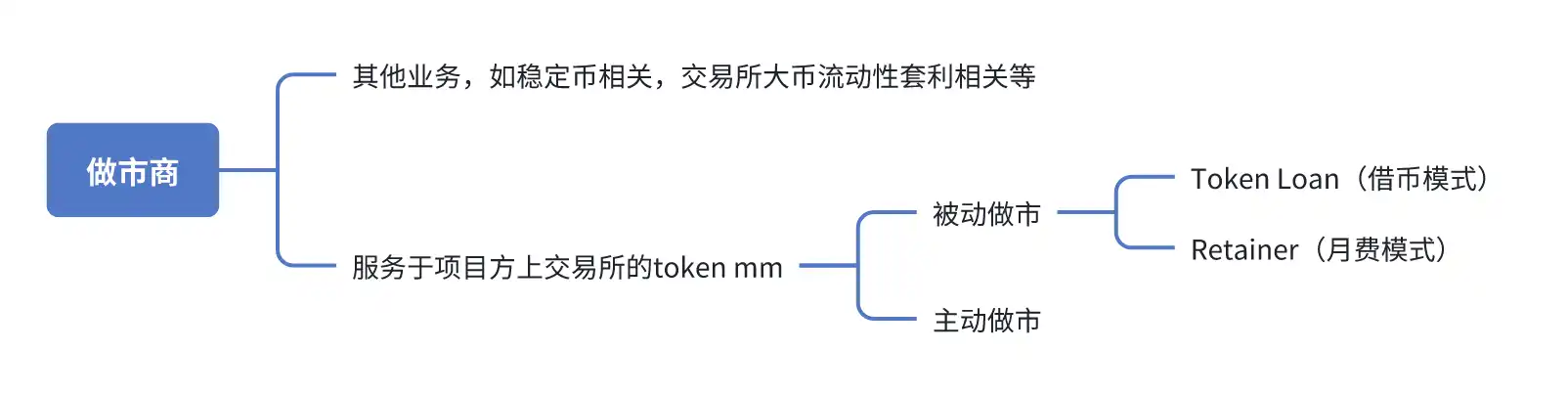
Active Market Maker
In fact, much of the demonization of market makers in the industry comes largely from the presence and actions of active market makers in the early days of the industry. There is a Cantonese saying "doing the kitchen," or in Mandarin "running the bank," active market makers fulfill the market's every fantasy about market makers. Generally, active market makers cooperate with projects to directly manipulate market prices, pump and dump, and profit from it, harvesting retail investors, and sharing the gains with the project. The terms of their cooperation vary, involving borrowing coins, accessing APIs, leveraging, profit-sharing, and other models. There are even rogue market makers who do not communicate with the project team, directly use their own funds to rush into the market, manipulate the market after accumulating enough chips.
Which active market makers are in the market?
Actually, the market's active market makers who are active in PR, event organization, and relatively well-known are all passive market makers, or at least they must claim to be, to avoid compliance issues, let alone flaunting their marketing activities (but it cannot be ruled out that some market makers may have engaged in some active cases in the early days of the industry or are currently engaging in secret activities).
Most active market makers are very low-key and do not have a public presence because they are not compliant. As the industry gradually standardizes, previously high-profile entities like ZMQ and Gotbit have been named by the FBI and faced serious compliance issues. The remaining active market makers have become more secretive, with some of the larger ones having participated in so-called "successful cases" and thus having a certain "reputation." Most deals are also made through referrals from acquaintances.
Passive Market Makers
Passive market makers, including ourselves and many other peers, fall into this category. They mainly engage in providing liquidity to the market by placing maker orders on both sides of the order book on centralized exchanges. The business model is mainly divided into two types:
· Token Loan
· Retainer (Monthly Fee)
Token Loan Model
This is currently the mainstream and most widely adopted partnership model. In essence, it involves lending coins to market makers for a certain period, who in turn provide market-making services.
A typical token loan deal consists of several aspects:
· Loaned Amount x%: Usually a percentage of the total token supply
· Loan Term x Months: The duration of the loan, with services ending upon maturity, and settlement based on a pre-negotiated option
· Option Structure: The market price at which the service ends
· Liquidity KPI: The depth of the market maker's order book, potentially across different exchanges and price ranges
How do market makers make money in this model?
Market makers earn money in two main ways: firstly, from the spread between buy and sell orders during order book placement, which is generally a small portion; secondly, from the options granted by the project team, which typically represent a larger portion.
If you are familiar with finance, you may know that the value of an option on the day it is signed is significant. This value is a percentage of the borrowed coin's value. For instance, if I borrowed a total of 1 million units of a coin, and the option's initial value is 3%, then strictly following an algorithm (delta hedge) to place orders would potentially result in a relatively certain profit of $30,000. Under normal circumstances (extreme market movements such as a skyrocketing or crashing price where efficient delta hedging is not possible), the revenue from this collaboration would be $30,000 plus some profits from the spread during order placement.
Do you feel like liquidity providers are not making as much profit as you thought? But in reality, the profit margin I mentioned is not completely detached from reality. Liquidity providers are currently also very active, and competitive option prices are increasingly transparent.
Retainer (Monthly Fee Model)
This is currently the second relatively mainstream model, which refers to the project side not lending the token to the liquidity provider but keeping it in their own trading account, and the liquidity provider provides liquidity through API access. The advantage of this model is that the token remains in the project side's hands, and all operations in the trading account are transparent to the project side. In theory, the project side can withdraw funds from the account at any time, so there is no need to worry about the risk of the liquidity provider acting maliciously. However, in this model, the project side needs to prepare tokens and U in the account for two-sided liquidity provisioning, and generally, they need to pay the liquidity provider's service fee monthly.
In this case, the liquidity provider provides liquidity based on the client's liquidity KPI, earning the service fee each month. The funds in the account are unrelated to the liquidity provider. In extreme cases of poor liquidity or front-running, the liquidity provision may result in losses, and these losses are borne by the project side.
I believe that Token Loan and Retainer each have their own advantages and disadvantages. Some exchanges only focus on one of them, while others, like us, can do both. The project side should choose according to their needs and the project's situation.
Several Common Misconceptions
Liquidity providers are responsible for "pumping," "price manipulation," and "wash trading."
A qualified passive liquidity provider is neutral and does not actively participate in pumping, market manipulation, or exploitation.
Liquidity providers providing liquidity is synonymous with "volume faking."
Exchange order books have two types of orders: maker orders and taker orders. Passive liquidity providers mainly place maker orders, and the taker order proportion is minimal. Even with deep maker orders on the order book, if there are no takers from the counterparty to match, it does not directly increase the trading volume. However, if a participant trades against their own maker order, known as "self-trading," there are compliance risks. Leading exchanges also closely monitor such behavior, and if the self-trade proportion is too high, both the liquidity provider's account and the token could face warnings and actions from the exchange.
So, it sounds like passive liquidity providers are useless?
Not directly responsible for the coin price, not directly responsible for the trading volume, it sounds like it, but it's useless. However, good liquidity is the foundation of everything. Small-volume money cares about the coin price trend, while large capital wants to enter, the first thing they look at is the trading volume and depth. An actively traded token with a healthy price and the project's product strength and marketing ability are closely related and indeed require close cooperation with market makers. Stepping back, even top-tier exchanges rarely list a project without a professional MM; otherwise, the opening will most likely be a mess. MMs need to register in advance, so at this stage, cooperation with passive market makers is still a step that every project listing on a top-tier CEX must go through.
It sounds like market-making is just placing orders, and the threshold is not high, so can projects do it themselves?
Yes and no. If you do have a proprietary trading team, and the project is relatively large, some second-tier exchanges may allow you to do it yourself. But if you don't have one, or need to build a team from scratch, I suggest leaving the professional work to the professionals. On the one hand, the cost and risk of building a team are not as good as finding a reliable market maker; on the other hand, if you are not familiar with MM, placing orders yourself can really lose a lot of money in the face of various extreme market conditions.
Market Maker's Ecological Position: Opening liquidity is the most valuable resource
After explaining the business model, let's talk about the current situation, which may help you understand better.
What will the crypto space look like in 2024-2025?
From a liquidity perspective, this is how I see it:
· BTC has an independent market trend, rising all the way, with sufficient top-tier liquidity. There has been a recent pullback, but it does not shake the foundation. Miners are happy as mining costs are in the 5 to 6 digits, and traditional institutions entering the space are also happy.
· Fierce battle in the tail end, liquidity was once relatively sufficient. @pumpdotfun, @gmgnai, @solana, @base, and @BNBCHAIN have seen young traders losing money addictively (I have also contributed a bit, damn it), outliers and insiders have also made money happily.
· Drying up of liquidity in the mid-range, reaching its peak with trump and libra, sucking almost dry the liquidity and buying interest of the mid-range, and structurally irreversibly moving from inside the circle to outside. Tokens with market caps of hundreds of millions to tens of billions are in an awkward position. Tokens newly listed on first and second-tier exchanges have no buyers, and within two months of listing, trading volume drops sharply. Most of the trading volume and depth occur at the opening, quickly dropping below the VCs' primary price. When VCs unlock, they will most likely lose money, and when team tokens unlock, they will most likely go to zero.
This cycle, these mid-cap tokens seem to be having the worst time. But another harsh reality is that over 90% of the so-called "web3 native" professionals in our industry, who are truly the ones receiving and spending wages, attending meetings, conducting business on a daily basis, including VCs, project teams, accelerators, business development, marketing, developers, and so on, everyone is doing business with mid-cap tokens. If you look at fundraising, product development, marketing, community engagement, and listing on exchanges, this series of activities actually revolves around these mid-cap project teams listed on centralized exchanges. Therefore, in this cycle, many professionals have not made money, and times have been tough for everyone.
Only market makers, in my opinion, hold the scarcest resource of mid-cap tokens: "Listing Liquidity." Yes, having liquidity alone is not enough; liquidity needs to be there early, right at listing, because once the project goes to zero, having more tokens on hand is useless. A project with, for example, a 15% circulating supply at listing offers 1 to 2 percentage points, or even more, to market makers. This liquidity, unlocked right at listing, is an extremely valuable resource in the current market conditions. Therefore, not only are market makers becoming more crowded, but many VCs and project teams are also stepping in to temporarily form teams and start market making. Some teams may not even have basic trading abilities, but they take the tokens first, as they will end up at zero anyway and are not afraid of being unable to cash out.
The Dark Forest of Gresham's Law: Honest Contribution-Based Character Can't Beat the "Scoundrel"
In the evolution of this market scenario, we have formed a very unique ecosystem for market makers today:
On one hand, market makers are increasing, and quoting has become absurdly competitive. On the other hand, there is a huge disparity in service quality and professional capabilities, often resulting in various after-sales issues, with the most common being draining liquidity and defaulting to dump the price. Firstly, it should be clear that market makers are not prohibited from selling tokens. In fact, if a token skyrockets, following the algorithm to place sell orders is necessary because the borrowed tokens need to be returned, and the settlement with the project team is in USD (for those who do not understand, please review the section on token loan options again). However, a qualified passive market maker should place orders normally according to the algorithm, rather than aggressively taking liquidity from the order book. Such actions are extremely harmful to the project.
Why do market makers do this?
Going back to the part we just talked about regarding options, a market maker who has received a token loan can place orders according to the algorithm. If the market remains stagnant, he should successfully realize the value of the option and earn 3%. However, if he believes that the project will go to zero at settlement, he can achieve a 100% return by aggressively dumping at listing, which is essentially 33 times the return of normal market making. Of course, this is the most direct and extreme example, and most real-world operations will be much more complex. However, the underlying logic is to short the token, sell during high prices and good liquidity, and buy back on settlement.
Of course, aside from being unethical and non-compliant, there are additional risks to this approach. On one hand, the market maker is completely unable to provide liquidity according to the KPI within the contract period because they lack a healthy inventory. On the other hand, if the token takes a wrong turn, a lot of money can be lost with no way to cash out.
Why is this behavior so common?
In the end, the industry's compliance is still in its early stages. Regarding the token loan model, although the market maker will report to the project party on the service situation through daily reports, weekly reports, dashboards, and other means, there are third-party supervisory organizations and tools in the market. However, what the coin does in the market maker's account is ultimately a black box, and the market lacks effective regulatory measures. After all, the only conclusive evidence that can see each trade made by the market maker is the centralized exchange itself. However, many market makers are clients of centralized exchanges' V8 and V9, bringing in hundreds of millions of dollars in fees and liquidity to the exchange each year. The exchanges also have an obligation to protect the privacy of their clients, so how could they possibly disclose the details of their trades to help the project party enforce their rights?
At this point, one cannot help but admire @heyibinance and @cz_binance for their swift actions. In my impression, this is the first time the complete trading details of a market maker have been publicly disclosed, including precise times, operational details, and cash-out amounts. Whether such behavior should be done is worth considering, but the original intention must be good.
Both the project party and the entire industry need to strengthen their understanding of market makers. Actually, I am very surprised that I have talked to many top-tier investors, founders of projects that have raised tens of millions of dollars, and even industry practitioners, and they do not have much understanding of the market maker profession. This is also a significant reason why I wrote this content. Because most project parties are actually experiencing this for the "first time," while market makers are battle-hardened "bad boys."
As a frontline practitioner, sometimes when I see the project party choosing the so-called "better terms," I also ask myself if I am matching the outrageous terms offered by competitors to secure the deal first. In this dark forest of market makers, it is difficult to hold the bottom line. Therefore, pretending to be a profound bad boy will always be more attractive than being an honest person. Only when everyone's understanding of the industry aligns can we avoid the continued occurrence of bad money driving out good.
How to Choose Your Market Maker
There are several important questions and tips that I believe are key:
Is Passivity Always the Wrong Choice?
Actually, when the project party asks me this question, I will not outrightly say that passive market makers should not be chosen. If we set aside compliance, I believe this is a debatable issue. Some projects have indeed achieved a better-looking chart, more trading volume, and more cashouts through close collaboration with passive market makers, with countless instances of overspending. At this point, I only express one viewpoint: you need to realize that those who can really bring you tangible benefits will also definitely cut you mercilessly. And there is only so much liquidity in the market. At the end of the day, you are on opposing sides, and the market's money will either be earned by you or by your passive market maker.
Which Collaboration Method to Choose: Token Loan or Retainer?
Currently, the token loan model is still more mainstream, but the market share of retainers is gradually increasing. This is a matter of project team preference and needs. For example, a project team with strict fundraising controls may be unwilling to have uncontrollable large-scale liquidity from external sources. Additionally:
Try Not to Choose Only One Passive Market Maker
Don't put all your eggs in one basket. You can choose 2-4 market makers, compare terms with each other, and have backups in case one goes down. Furthermore, market makers usually propose various additional value-adds to win the deal. Selecting multiple market makers can get you help from more people. However, to avoid the "three monks have no water to drink" problem, it is recommended to allocate different exchanges to different market makers, as monitoring them together can significantly increase the complexity.
Don't Choose Your Market Maker Solely Based on Investment
You can accept investments from market makers, and having more runway is always good. However, you also need to understand that market maker investments and VC investments are not playing the same game. As market makers control a considerable portion of the opening liquidity, they can lock prices, hedge, and perform other operations on the tokens they have yet to unlock from their investments. Therefore, for the project team, it may not always be a good thing that a market maker holding a token loan also has a significant portion of their token investment position.
Don't Choose Your Market Maker Solely Based on Liquidity KPIs
It is challenging to thoroughly verify liquidity KPIs in practice, so do not select a market maker solely based on liquidity KPIs. Terms may look good on paper, but if they cannot be delivered, they are useless. Before lending the tokens, you are in control, but once you lend them to the market maker, you become dependent on them. They have many ways to deceive you.
Change Your Mindset: Be a "Scumbag" Yourself
Remember, you are the first party. Before signing any agreements, compare terms thoroughly and discuss extensively how to monitor and prevent market maker defaults. Choose a solution that suits your project's development. You can use one party's terms to pressure the other, compare back and forth, ensure there is no ambiguity in the terms, and if something is unclear, don't speculate, ask directly.
A Little Reflection
I am a newcomer to the industry and I deeply cherish the opportunity to perceive and engage with the industry at this level. I often feel the industry's dirtiness and chaos, but I also constantly sense its vitality and energy. I never consider myself the smartest in the bunch; many of my peers in the industry are excellent, quickly finding their own position. However, more young people are actually lost without the web3 industry, making it hard to find a path to success.
I also have a boss with extremely positive values and a highly skilled trading team working in the background. Our stable asset management business allows us to support the team without relying on market-making business, using the market-making business to make friends instead. I have always followed my own pace, using the logic of making friends with the project teams, missing out on some deals, but also proud of a few deals I've closed. Although some projects didn't turn into business deals, I have also become friends with the project teams.
I have rambled on a lot. I was very conflicted about posting this article. On one hand, I'm afraid of not being knowledgeable enough about the business or not expressing myself well, potentially misleading the project teams and readers. On the other hand, market makers have always been elusive in the industry, and I'm afraid of not handling the disclosure properly and intruding on someone's territory.
However, I truly believe that as the industry evolves, compliance will gradually become mainstream, and one day, the role of market makers will no longer be demonized. They will return to the spotlight. I hope this article can have a small impact.
You may also like

$COIN Joins S&P 500, but Coinbase Isn't Celebrating
On May 13, S&P Dow Jones Indices announced that Coinbase would officially replace Discover Financial Services in the S&P 500 on May 19. While other companies like Block and MicroStrategy, closely tied to Bitcoin, were already part of the S&P 500, Coinbase became the first cryptocurrency exchange whose primary business is in the index. This also signifies that cryptocurrency is gradually moving from the fringes to the mainstream in the U.S.
On the day of the announcement, Coinbase's stock price surged by 23%, surpassing the $250 mark. However, just 3 days later, Coinbase was hit by two consecutive events: a hack where employees were bribed to steal customer data and a demand for a $20 million ransom, and an investigation by the U.S. Securities and Exchange Commission (SEC) into the authenticity of its claim of having over 100 million "verified users" in its securities filings and marketing materials. These two events acted as mini-bombs, and at the time of writing, Coinbase's stock had already dropped by over 7.3%.
Coincidentally, Discover Financial Services, being replaced by Coinbase, can also be considered the "Coinbase" of the previous payment era. Discover is a U.S.-based digital banking and payment services company headquartered in Illinois, founded in 1960. Its payment network, Discover Network, is the fourth largest payment network apart from Visa, Mastercard, and American Express.
In April, after the approval of the acquisition of Discover by the sixth-largest U.S. bank, Capital One, this well-established digital banking company of over 60 years smoothly handed over its S&P 500 "seat" to this emerging cryptocurrency "bank." This unexpected coincidence also portrayed the handover between the new and old eras in Coinbase's entry into the S&P 500, resembling a relay race scene. However, this relay baton also brought Coinbase's accumulated "external troubles and internal strife" to a tipping point.
Over the past decade, cryptocurrency exchanges have been the most stable "profit machines." They play a role in providing liquidity to the entire industry and rely on trading fees to sustain their operations. However, with the comprehensive rollout of ETF products in the U.S. market, this profit model is facing unprecedented challenges. As the leader in the "American stack," with over 80% of its business coming from the U.S., Coinbase is most affected by this.
Starting from the approval of Bitcoin and Ethereum spot ETFs, traditional financial capital has significantly onboarded users and funds that originally belonged to exchanges in a more cost-effective, compliant, and transparent manner. The transaction fee revenue of cryptocurrency exchanges has started to decline, and this trend may further intensify in the coming months.
According to Coinbase's 2024 Q4 financial report, the platform's total trading revenue was $417 million, a 45% year-on-year decrease. The contribution of BTC and ETH's trading revenue dropped from 65% in the same period last year to less than 50%.
This decline is not a result of a decrease in market enthusiasm. In fact, since the approval of the Bitcoin ETF in January 2024, the inflow of BTC into the U.S. market has continued to reach new highs, with asset management giants like BlackRock and Fidelity rapidly expanding their management scale. Data shows that BlackRock's iShares Bitcoin ETF (IBIT) alone has surpassed $17 billion in assets under management. As of mid-May 2025, the cumulative net inflow of 11 major institutional Bitcoin spot ETFs on the market has exceeded $41.5 billion, with a total net asset value of $1214.69 billion, accounting for approximately 5.91% of the total Bitcoin market capitalization.
Institutional investors and some retail investors are shifting towards ETF products, partly due to compliance and tax considerations. On one hand, ETFs have much lower trading costs compared to cryptocurrency exchanges. While Coinbase's spot trading fee rate varies annually in a tiered manner but averages around 1.49%, for example, the management fee for IBIT ETF is only 0.25%, and the majority of ETF institution fees fluctuate around 0.15% to 0.25%.
In other words, the more rational users are, the more likely they are to move from exchanges to ETF products, especially for investors aiming for long-term holdings.
According to multiple sources, several institutions, including VanEck and Grayscale, have submitted applications to the SEC for a Solana (SOL) ETF, with some institutions also planning to submit an XRP ETF proposal. Once approved, this may trigger a new round of fund migration. According to a report submitted by Coinbase to the SEC, as of April, the platform's trading revenue from XRP and Solana accounted for 18% and 10%, nearly one-third of the platform's fee revenue.
However, the Bitcoin and Ethereum ETFs passed in 2024 also reduced the fees for these two tokens on Coinbase from 30% and 15% to 26% and 10%, respectively. If the SOL and XRP ETFs are approved, it will further undermine the core fee revenue of exchanges like Coinbase.
The expansion of ETF products is gradually weakening the financial intermediary status of cryptocurrency exchanges. From their original roles as matchmakers and clearers to now gradually becoming mere "on-ramps and off-ramps" for funds, exchanges are seeing their marginal value squeezed by ETFs.
On May 12, 2025, SEC Chairman Paul S. Atkins gave a keynote speech at the Tokenization and Cryptocurrency Working Group roundtable. The theme of his speech revolved around "It is a new day at the SEC," where he indicated that the SEC would not approach enforcement and regulation the same way as before but would instead pave the way for cryptocurrency assets in the U.S. market.
With signs of cryptocurrency compliance such as the SEC's "NEW DAY" declaration, an increasing number of traditional brokerages are attempting to enter the cryptocurrency industry. One of the most representative cases is the well-known U.S. brokerage Robinhood, which began expanding its crypto business in 2018. By the time of its IPO in 2021, Robinhood's crypto business revenue accounted for over 50% of the company, with a significant boost from the Dogecoin "moonshot" promoted by Musk.
In Q1 2025 earnings report, Robinhood showcased strong growth, especially in revenue from cryptocurrency and options trading. Fueled by Trump's Memecoin, cryptocurrency-related revenue reached $250 million, nearly doubling year-over-year. Consequently, Robinhood Gold subscription users reached 3.5 million, a 90% increase from the previous year, with the rapid growth of Robinhood Gold providing the company with a stable source of income.
Meanwhile, RobinHood is actively pursuing acquisitions in the cryptocurrency space. In 2024, it announced a $2 billion acquisition of the long-standing European cryptocurrency exchange Bitstamp. Additionally, Canada's largest cryptocurrency CEX, WonderFi, which recently went public on the Toronto Stock Exchange, also announced its integration with RobinHood Crypto. After obtaining virtual asset licenses in the UK, Canada, Singapore, and other markets, RobinHood has taken a proactive approach in the compliant cryptocurrency trading market.
Furthermore, an increasing number of brokerage firms are exploring the same path. Futu Securities, Tiger Brokers, and others are also dipping their toes into cryptocurrency trading, with some having applied for or obtained the VA license from the Hong Kong SFC. Although their user bases are currently small, traditional brokerages have a natural advantage in user trust, regulatory licenses, and low fee structures. This could pose a threat to native cryptocurrency platforms in the future.
In April 2025, security researchers discovered that some Coinbase user data was leaked on the dark web. While the platform initially responded by attributing it to a "technical misinformation," it still raised concerns among users regarding its security and privacy protection. Just two days before Dow Jones Indexes announced Coinbase's addition to the S&P 500 Index, on May 11, 2025, Coinbase received an email from an unknown threat actor claiming to have obtained customer account information and internal documents, demanding a $20 million ransom to keep the data private. Subsequent investigations confirmed the data breach.
Cybercriminals obtained the data by bribing overseas customer service agents and support staff, mainly in "non-U.S. regions such as India." These agents abused their access to Coinbase's internal customer support system and stole customer data. As early as February this year, blockchain detective ZachXBT revealed on X platform that between December 2024 and January 2025, Coinbase users lost over $65 million to social engineering scams, with the actual amount potentially higher.
Among the victims was a well-known figure, 67-year-old Ed Suman, an established artist in the art world for nearly two decades, having been involved in the creation of artworks such as Jeff Koons' "Balloon Dog" sculpture. Earlier this year, he fell victim to an impersonation scam involving fake Coinbase customer support, resulting in a loss of over $2 million in cryptocurrency. ZachXBT critiqued Coinbase for its inadequate handling of such scams, noting that other major exchanges have not faced similar issues and recommending Coinbase to enhance its security measures.
Amidst a series of ongoing social engineering incidents, although there has not been any impact on user assets at the technical level so far, it has raised concerns among many retail and institutional investors. Especially institutions holding massive assets on Coinbase. Just considering the U.S. BTC ETF institutions, as of mid-May 2025, they collectively hold nearly 840,000 BTC, and 75% of these are custodied by Coinbase. If we price BTC at $100,000, this amount reaches a staggering $63 billion, which is equivalent to the nominal GDP of two Iceland in the year 2024.
In addition, Coinbase Custody also serves over 300 institutional clients, including hedge funds, family offices, pension funds, and endowments. As of the Q1 2025 financial report, Coinbase's total assets under management (including institutional and retail clients) reached $404 billion. The specific amount of institutional custodied assets was not explicitly disclosed in the latest report, but it should still be over 50% based on the Q4 2024 report.
Once this security barrier is breached, not only could the rate of user attrition far exceed expectations, but more importantly, institutional trust in it would undermine the foundation of its business. Therefore, after a hacking event, Coinbase's stock price plummeted significantly.
Facing a decline in spot trading fee revenue, Coinbase is also accelerating its transformation, attempting to find growth opportunities in derivatives and emerging assets. Coinbase acquired a stake in the options platform Deribit at the end of 2024 and announced the official launch of perpetual contract products in 2025. This acquisition fills in Coinbase's gap in options trading and its relatively small global market share.
Deribit has a strong presence in non-U.S. markets, especially in Asia and Europe. The acquisition has enabled Coinbase to gain a dominant position in bitcoin and ethereum options trading on Deribit, accounting for approximately 80% of the global options trading volume, with daily trading volume remaining above $2 billion.
Meanwhile, 80-90% of Deribit's customer base consists of institutional investors, with their professionalism and liquidity in the Bitcoin and Ethereum options market highly favored by institutions. Coinbase's compliance advantage, coupled with its already robust institutional ecosystem, makes it even more suitable. By using institutions as an entry point, it can face the squeeze from giants like Binance and OKX in the derivatives market.
Facing a similar dilemma is Kraken, which is attempting to replicate Binance Futures' model in non-U.S. markets. Since the derivatives market relies more on professional users, fee rates are relatively higher and stickiness is stronger, making it a significant source of revenue for exchanges. In the first half of 2025, Kraken completed the acquisition of TradeStation Crypto and a futures exchange, aiming to build a complete derivatives trading ecosystem to hedge the risk of declining spot transaction fee income.
With the surge of Memecoin in 2024, Binance, OKX, and various CEX platforms began massively listing small-market-cap, highly volatile tokens to activate active trading users. Due to the wealth effect and trading activity of Memecoins, Coinbase was also forced to join the battle, successively listing popular tokens from the Solana ecosystem such as BOOK OF MEME and Dogwifhat. Although these coins are controversial, they are frequently traded, with fee rates several times higher than mainstream coins, serving as a "blood-boosting" method for spot trading.
However, due to its status as a publicly traded company, this practice is a riskier endeavor for Coinbase. Even in the current crypto-friendly environment, the SEC is still investigating whether tokens like SOL, ADA, and SAND constitute securities.
In addition to the forced transformation strategies carried out by the aforementioned CEXs, they are also starting to lay out RWAs and the most talked-about stablecoin payment fields, such as the PYUSD launched through a collaboration between Coinbase and Paypal, Coinbase's support for the Euro stablecoin EURC by Circle that complies with EU MiCA regulatory requirements, or the USD1 launched through a collaboration between Binance and WIFL. In the increasingly crowded trading field, many CEXs have shifted their focus from just the trading market to the application field.
The golden age of transaction fees has quietly ended, and the second half of the crypto exchange platform game has silently begun.
Arthur Hayes: Why I'm Betting on ETH While the Market Is Obsessed with SOL
May 16 Key Market Information Gap, A Must-Read! | Alpha Morning Report
Key Market Intelligence on May 14th, how much did you miss out on?
1.Binance Alpha Launches HIPPO, BLUE, and Other Tokens
2.Believe Ecosystem Tokens See General Rise, LAUNCHCOIN Surges Over 250% in 24 Hours
3.Tiger Securities Introduces Cryptocurrency Deposit and Withdrawal Service, Supports Mainstream Cryptocurrencies such as BTC and ETH
4.Current Bitcoin Rally Possibly Driven by Institutions, Retail Traders Yet to Join
5.Binance Wallet's New TGE Privasea AI Participation Requires a 198 Point Threshold, with a Point Consumption of 15
Source: Overheard on CT (tg: @overheardonct), Kaito
PUMP: Today's discussions about PUMP focus on its new creator revenue-sharing model: the platform will allocate 50% of PumpSwap revenue to token creators, sparking varied reactions from users. Some criticize the move as insufficient or even misleading, while others view it as a positive step the platform is taking to reward creators. Meanwhile, PUMP faces market pressure from emerging competitors like LetsBONKfun and Raydium, which are rapidly gaining market share. Users also express concerns about PUMP's sustainability and potential regulatory risks in the U.S., with discussions extending to the platform's impact on the entire memecoin ecosystem.
COINBASE: Today, Coinbase became the first crypto company to join the S&P 500 Index, replacing Discover Financial Services, sparking widespread industry attention. The entire crypto community views this milestone as a significant development, signaling that crypto assets are further integrating into the mainstream financial system. The news has sparked lively discussions on Twitter, with many users pointing out that this may attract more institutional investors to enter the Bitcoin and other cryptocurrency markets.
XRP: XRP became the focal point of today's crypto discussion, with its significant market movements and strategic advances drawing attention. XRP has surpassed USDT to become the third-largest cryptocurrency by market capitalization, sparking market excitement and discussions about its future potential. The surge in market capitalization and price is believed to be related to increasing institutional interest, deepening strategic partnerships, and its role in the crypto ecosystem. Additionally, XRP's integration into multiple financial systems and its potential as a macro asset class are also seen as key factors driving the current market sentiment.
DYDX: Today's discussions about DYDX mainly focused on the dYdX Yapper Leaderboard launched by KaitoAI. The leaderboard aims to identify the most active community participants, with a total of $150,000 in rewards to be distributed over the first three seasons. This initiative has sparked broad community participation, with many users discussing the potential rewards and the incentive effect on the DYDX ecosystem. Meanwhile, progress on the ethDYDX to dYdX native chain migration and historical airdrop events have also been topics of discussion.
1. "What Is 'ICM'? Holding Up the $4 Billion Market Cap Solana's New Narrative"
Overnight, the hottest narrative in the crypto space has become "Internet Capital Markets," with a host of crypto projects and founders, led by the Solana ecosystem's new Launchpad platform Believe, releasing this phrase. Together with "Believe in something," it has become the new slogan heralding the onset of a bull market. What exactly is the so-called "Internet Capital Market," will it become a short-lived hype phrase like the Base ecosystem's previous Content Coin, and what related targets are available for selection?2.《LaunchCoin Surges 20x in One Day, How Did Believe Create a $200M Market Cap Shiba Inu After Going to Zero?|100x Retrospective》
LAUNCHCOIN broke through a $200 million market cap today, with the long-lost liquidity and such a high market cap "Memecoin" almost bringing half of the on-chain crypto community CT into the fray. The community is crazily discussing this token, with half of it being FOMO and the other half being FUD. This token, originally issued by Believe founder Ben Pasternak under his personal identity, transformed into a new platform token after a renaming. From once going to zero to a $200 million market cap, what happened in between?May 14 On-chain Fund Flow
RWA Evergreen Product Crisis: Why is the GLP Model Doomed to Collapse Under RWA Evergreen?
Week 16 On-Chain Data: Intensifying Structural Supply-Demand Imbalance, Data Reveals Solid Blueprint for Next Bull Run?
Sui Q1 Advanced Report: The Rise of BTCfi Infrastructure, the Boom of Lending Protocols, and the Future of Rollup-Based Scalability
Crypto Developer: The Trump Family's Coin Minting Real Estate Business
SignalPlus Macro Analysis: The Tariff-Torn M2 Narrative and the Return of TradFi-Style FOMO
After El Salvador's President Nayib Bukele signed it, which U.S. states have been **"good, good"** in advancing Bitcoin strategic reserve legislation?
PENGU Experiences Strong Rebound from Bottom with 360% Surge, How Will the Fat Penguin Leverage IP Marketing for a Comeback?
Arthur Hayes Interview: Bitcoin Has Bottomed, Which Tokens Can Outperform Bitcoin?
Ika Receives Strategic Investment from Sui Foundation, Total Funding Exceeds $21 Million
Switzerland Zug, April 28, 2025, Chainwire
The world's fastest parallel MPC network, Ika, is set to launch on the Sui blockchain, announces a strategic investment from the Sui Foundation. Previously, Ika successfully completed a record-breaking 1.4 million SUI NFT art event on Sui. Ika is the world's first sub-second MPC network, capable of achieving zero-trust interoperability among hundreds of signing nodes, unprecedented in scale and rock-solid security.
Ika's core values of performance, speed, and high decentralization align perfectly with Sui. With its upcoming launch on the Sui blockchain, Ika will bring its unparalleled MPC technology into the Sui ecosystem, providing Sui Move smart contract developers with secure cross-Web3 interoperability. This further solidifies Sui's position as the preferred solution in cross-chain DeFi, decentralized custody, chain abstraction, AI-agent defense, native Bitcoin programmability, leveraging the first truly scalable and secure MPC signature scheme.
Ika addresses key bottlenecks of existing MPC networks and delivers unparalleled performance through innovative 2PC-MPC encryption scheme and Sui's Mysticeti consensus protocol:
1. Record Throughput: Ika's transaction processing capability is up to 10,000 times higher than current MPC networks, supporting unprecedented transaction volumes.
2. Ultra-Low Latency: While traditional network signatures may experience delays of 30 seconds or more, Ika can generate signatures in sub-seconds, supporting cross-chain real-time applications.
3. Tremendous Scalability: Ika breaks the conventional limit of 4-8 nodes, and the 2PC-MPC can scale to hundreds or even thousands of signers, enhancing decentralization without sacrificing performance.
4. Zero-Trust Security: Ika's architecture ensures that even in the most extreme scenarios, user assets remain secure, setting a new standard for decentralized security.
Ika's ultra-fast MPC network supports various applications on the Sui blockchain, and several Sui developers have utilized Ika to build tech, including:
· DeFi Interoperability: Ika's sub-second speed and scalability enable instant secure operations within the Web3 ecosystem, bringing liquidity from chains like Bitcoin and Ethereum into Sui. Sui developers Full Sail and Rhei have announced upcoming tech launches based on Ika.
· Decentralized Custody: Ika provides a secure, decentralized custody solution for digital assets on Sui, delivering unparalleled security for both institutional and individual users. Sui developers Aeon and Human Tech have announced the integration of Ika into their technology.
· Chain Abstraction: Ika helps Sui developers abstract away multi-chain complexity for users, combining with Sui's zkLogin feature to deliver a seamless user experience. Sui developers Covault and Lucky Kat have announced the integration of Ika into their technology.
· Programmable Bitcoin: Ika unlocks new possibilities for native BTC on Sui, enabling programmable and secure DeFi and custody. Sui developers Native and Nativerse have announced the upcoming launch of Ika-based technology.
· AI Agent Protection: Ika enhances AI applications on Sui by providing secure MPC protection, ensuring AI agents do not possess unrestricted power and safeguarding user asset security. Sui developers Atoma and Ekko have announced the upcoming launch of Ika-based technology.
The strategic investment in Ika by the Sui Foundation underscores Sui's commitment to driving cutting-edge technology for high performance and decentralization. This amplifies the technical synergy within the Sui ecosystem, propelling Sui and Ika to the forefront of the Web3 revolution, jointly advancing the future of secure, scalable, decentralized infrastructure.
Ika has raised over $21 million in funding, with a peak private valuation of $6 billion FDV, backed by support from Sui Foundation, DCG, Big Brain Holdings, Blockchange, Node Capital, Amplify Partners, Liquid2 Ventures, FalconX, Tykhe Block Ventures, Lightshift, Token Bay Capital, Collider, Zero Knowledge Ventures, NoLimit Holdings, Rubik Ventures, Dispersion Capital, Insignius Capital, Impatient Ventures, Cerulean Ventures, Earl Grey Capital, HDI Ventures, Flowdesk, TPC Ventures, Purechain Capital, Solr DAO, Heroic Ventures, Naval Ravikant, NotVCs, G-20 Group, Artifact Capital, DSRV, Encapsulate, and many other key players in the Web3 space.
Ika also demonstrated the strong support of Sui users by launching the "MF Squid Market" NFT art event, which became the largest and most successful NFT event in Sui's history, raising over 1.4 million SUI and establishing an active grassroots community.
The IKA token is set to native launch on the Sui blockchain, unlocking new decentralized security features and utilities. As the native token of the Ika MPC Network, IKA will play a key role in its ultra-fast, scalable infrastructure, used for paying MPC signature services, enabling seamless transactions within the Web3 ecosystem. Leveraging Sui's unparalleled speed and performance, Ika enhances the security and scalability of the entire ecosystem, introducing the most promising MPC technology in blockchain to the fastest-growing L1 of Web3.
Ika is the world's fastest parallel MPC network, offering sub-second latency, unprecedented scale and decentralization, and zero-trust security. As the preferred choice for interoperability, decentralized custody, and chain abstraction, Ika will fundamentally transform digital asset security and multi-chain DeFi.
Sui is the first Layer 1 blockchain and smart contract platform designed from the ground up to provide fast, private, secure, and inclusive digital assets. Built on the Move programming language, its object-centric model supports parallel execution, sub-second finality, and rich on-chain assets. Through horizontally scalable processing and storage capacity, Sui supports widespread applications at low cost with unparalleled speed. Sui represents a significant advancement in blockchain technology, offering creators and developers a platform to build exceptional user experiences.
Contact:
Ika PR
pr@ika.xyz (mailto:pr@ika.xyz)
Exclusive Interview with AllianceDAO Partner qw: Crypto Entrepreneurs Are Fleeing to AI, 90% of Crypto+AI Projects Are Misleading
Stablecoin Showdown: Six Rising Stars Enter the Fray, Will the Market Structure Shift?
Deep Dive into Dubai's Crypto Dream: Illusion, Capital, and Decentralized Empire
Large companies buying Bitcoin has become a trend, but Asian companies hold less than 1% of the total supply
The "Yearn Finance" Effect: Cryptocurrency Funds Experience the Calm Before the Dawn
$COIN Joins S&P 500, but Coinbase Isn't Celebrating
On May 13, S&P Dow Jones Indices announced that Coinbase would officially replace Discover Financial Services in the S&P 500 on May 19. While other companies like Block and MicroStrategy, closely tied to Bitcoin, were already part of the S&P 500, Coinbase became the first cryptocurrency exchange whose primary business is in the index. This also signifies that cryptocurrency is gradually moving from the fringes to the mainstream in the U.S.
On the day of the announcement, Coinbase's stock price surged by 23%, surpassing the $250 mark. However, just 3 days later, Coinbase was hit by two consecutive events: a hack where employees were bribed to steal customer data and a demand for a $20 million ransom, and an investigation by the U.S. Securities and Exchange Commission (SEC) into the authenticity of its claim of having over 100 million "verified users" in its securities filings and marketing materials. These two events acted as mini-bombs, and at the time of writing, Coinbase's stock had already dropped by over 7.3%.
Coincidentally, Discover Financial Services, being replaced by Coinbase, can also be considered the "Coinbase" of the previous payment era. Discover is a U.S.-based digital banking and payment services company headquartered in Illinois, founded in 1960. Its payment network, Discover Network, is the fourth largest payment network apart from Visa, Mastercard, and American Express.
In April, after the approval of the acquisition of Discover by the sixth-largest U.S. bank, Capital One, this well-established digital banking company of over 60 years smoothly handed over its S&P 500 "seat" to this emerging cryptocurrency "bank." This unexpected coincidence also portrayed the handover between the new and old eras in Coinbase's entry into the S&P 500, resembling a relay race scene. However, this relay baton also brought Coinbase's accumulated "external troubles and internal strife" to a tipping point.
Over the past decade, cryptocurrency exchanges have been the most stable "profit machines." They play a role in providing liquidity to the entire industry and rely on trading fees to sustain their operations. However, with the comprehensive rollout of ETF products in the U.S. market, this profit model is facing unprecedented challenges. As the leader in the "American stack," with over 80% of its business coming from the U.S., Coinbase is most affected by this.
Starting from the approval of Bitcoin and Ethereum spot ETFs, traditional financial capital has significantly onboarded users and funds that originally belonged to exchanges in a more cost-effective, compliant, and transparent manner. The transaction fee revenue of cryptocurrency exchanges has started to decline, and this trend may further intensify in the coming months.
According to Coinbase's 2024 Q4 financial report, the platform's total trading revenue was $417 million, a 45% year-on-year decrease. The contribution of BTC and ETH's trading revenue dropped from 65% in the same period last year to less than 50%.
This decline is not a result of a decrease in market enthusiasm. In fact, since the approval of the Bitcoin ETF in January 2024, the inflow of BTC into the U.S. market has continued to reach new highs, with asset management giants like BlackRock and Fidelity rapidly expanding their management scale. Data shows that BlackRock's iShares Bitcoin ETF (IBIT) alone has surpassed $17 billion in assets under management. As of mid-May 2025, the cumulative net inflow of 11 major institutional Bitcoin spot ETFs on the market has exceeded $41.5 billion, with a total net asset value of $1214.69 billion, accounting for approximately 5.91% of the total Bitcoin market capitalization.
Institutional investors and some retail investors are shifting towards ETF products, partly due to compliance and tax considerations. On one hand, ETFs have much lower trading costs compared to cryptocurrency exchanges. While Coinbase's spot trading fee rate varies annually in a tiered manner but averages around 1.49%, for example, the management fee for IBIT ETF is only 0.25%, and the majority of ETF institution fees fluctuate around 0.15% to 0.25%.
In other words, the more rational users are, the more likely they are to move from exchanges to ETF products, especially for investors aiming for long-term holdings.
According to multiple sources, several institutions, including VanEck and Grayscale, have submitted applications to the SEC for a Solana (SOL) ETF, with some institutions also planning to submit an XRP ETF proposal. Once approved, this may trigger a new round of fund migration. According to a report submitted by Coinbase to the SEC, as of April, the platform's trading revenue from XRP and Solana accounted for 18% and 10%, nearly one-third of the platform's fee revenue.
However, the Bitcoin and Ethereum ETFs passed in 2024 also reduced the fees for these two tokens on Coinbase from 30% and 15% to 26% and 10%, respectively. If the SOL and XRP ETFs are approved, it will further undermine the core fee revenue of exchanges like Coinbase.
The expansion of ETF products is gradually weakening the financial intermediary status of cryptocurrency exchanges. From their original roles as matchmakers and clearers to now gradually becoming mere "on-ramps and off-ramps" for funds, exchanges are seeing their marginal value squeezed by ETFs.
On May 12, 2025, SEC Chairman Paul S. Atkins gave a keynote speech at the Tokenization and Cryptocurrency Working Group roundtable. The theme of his speech revolved around "It is a new day at the SEC," where he indicated that the SEC would not approach enforcement and regulation the same way as before but would instead pave the way for cryptocurrency assets in the U.S. market.
With signs of cryptocurrency compliance such as the SEC's "NEW DAY" declaration, an increasing number of traditional brokerages are attempting to enter the cryptocurrency industry. One of the most representative cases is the well-known U.S. brokerage Robinhood, which began expanding its crypto business in 2018. By the time of its IPO in 2021, Robinhood's crypto business revenue accounted for over 50% of the company, with a significant boost from the Dogecoin "moonshot" promoted by Musk.
In Q1 2025 earnings report, Robinhood showcased strong growth, especially in revenue from cryptocurrency and options trading. Fueled by Trump's Memecoin, cryptocurrency-related revenue reached $250 million, nearly doubling year-over-year. Consequently, Robinhood Gold subscription users reached 3.5 million, a 90% increase from the previous year, with the rapid growth of Robinhood Gold providing the company with a stable source of income.
Meanwhile, RobinHood is actively pursuing acquisitions in the cryptocurrency space. In 2024, it announced a $2 billion acquisition of the long-standing European cryptocurrency exchange Bitstamp. Additionally, Canada's largest cryptocurrency CEX, WonderFi, which recently went public on the Toronto Stock Exchange, also announced its integration with RobinHood Crypto. After obtaining virtual asset licenses in the UK, Canada, Singapore, and other markets, RobinHood has taken a proactive approach in the compliant cryptocurrency trading market.
Furthermore, an increasing number of brokerage firms are exploring the same path. Futu Securities, Tiger Brokers, and others are also dipping their toes into cryptocurrency trading, with some having applied for or obtained the VA license from the Hong Kong SFC. Although their user bases are currently small, traditional brokerages have a natural advantage in user trust, regulatory licenses, and low fee structures. This could pose a threat to native cryptocurrency platforms in the future.
In April 2025, security researchers discovered that some Coinbase user data was leaked on the dark web. While the platform initially responded by attributing it to a "technical misinformation," it still raised concerns among users regarding its security and privacy protection. Just two days before Dow Jones Indexes announced Coinbase's addition to the S&P 500 Index, on May 11, 2025, Coinbase received an email from an unknown threat actor claiming to have obtained customer account information and internal documents, demanding a $20 million ransom to keep the data private. Subsequent investigations confirmed the data breach.
Cybercriminals obtained the data by bribing overseas customer service agents and support staff, mainly in "non-U.S. regions such as India." These agents abused their access to Coinbase's internal customer support system and stole customer data. As early as February this year, blockchain detective ZachXBT revealed on X platform that between December 2024 and January 2025, Coinbase users lost over $65 million to social engineering scams, with the actual amount potentially higher.
Among the victims was a well-known figure, 67-year-old Ed Suman, an established artist in the art world for nearly two decades, having been involved in the creation of artworks such as Jeff Koons' "Balloon Dog" sculpture. Earlier this year, he fell victim to an impersonation scam involving fake Coinbase customer support, resulting in a loss of over $2 million in cryptocurrency. ZachXBT critiqued Coinbase for its inadequate handling of such scams, noting that other major exchanges have not faced similar issues and recommending Coinbase to enhance its security measures.
Amidst a series of ongoing social engineering incidents, although there has not been any impact on user assets at the technical level so far, it has raised concerns among many retail and institutional investors. Especially institutions holding massive assets on Coinbase. Just considering the U.S. BTC ETF institutions, as of mid-May 2025, they collectively hold nearly 840,000 BTC, and 75% of these are custodied by Coinbase. If we price BTC at $100,000, this amount reaches a staggering $63 billion, which is equivalent to the nominal GDP of two Iceland in the year 2024.
In addition, Coinbase Custody also serves over 300 institutional clients, including hedge funds, family offices, pension funds, and endowments. As of the Q1 2025 financial report, Coinbase's total assets under management (including institutional and retail clients) reached $404 billion. The specific amount of institutional custodied assets was not explicitly disclosed in the latest report, but it should still be over 50% based on the Q4 2024 report.
Once this security barrier is breached, not only could the rate of user attrition far exceed expectations, but more importantly, institutional trust in it would undermine the foundation of its business. Therefore, after a hacking event, Coinbase's stock price plummeted significantly.
Facing a decline in spot trading fee revenue, Coinbase is also accelerating its transformation, attempting to find growth opportunities in derivatives and emerging assets. Coinbase acquired a stake in the options platform Deribit at the end of 2024 and announced the official launch of perpetual contract products in 2025. This acquisition fills in Coinbase's gap in options trading and its relatively small global market share.
Deribit has a strong presence in non-U.S. markets, especially in Asia and Europe. The acquisition has enabled Coinbase to gain a dominant position in bitcoin and ethereum options trading on Deribit, accounting for approximately 80% of the global options trading volume, with daily trading volume remaining above $2 billion.
Meanwhile, 80-90% of Deribit's customer base consists of institutional investors, with their professionalism and liquidity in the Bitcoin and Ethereum options market highly favored by institutions. Coinbase's compliance advantage, coupled with its already robust institutional ecosystem, makes it even more suitable. By using institutions as an entry point, it can face the squeeze from giants like Binance and OKX in the derivatives market.
Facing a similar dilemma is Kraken, which is attempting to replicate Binance Futures' model in non-U.S. markets. Since the derivatives market relies more on professional users, fee rates are relatively higher and stickiness is stronger, making it a significant source of revenue for exchanges. In the first half of 2025, Kraken completed the acquisition of TradeStation Crypto and a futures exchange, aiming to build a complete derivatives trading ecosystem to hedge the risk of declining spot transaction fee income.
With the surge of Memecoin in 2024, Binance, OKX, and various CEX platforms began massively listing small-market-cap, highly volatile tokens to activate active trading users. Due to the wealth effect and trading activity of Memecoins, Coinbase was also forced to join the battle, successively listing popular tokens from the Solana ecosystem such as BOOK OF MEME and Dogwifhat. Although these coins are controversial, they are frequently traded, with fee rates several times higher than mainstream coins, serving as a "blood-boosting" method for spot trading.
However, due to its status as a publicly traded company, this practice is a riskier endeavor for Coinbase. Even in the current crypto-friendly environment, the SEC is still investigating whether tokens like SOL, ADA, and SAND constitute securities.
In addition to the forced transformation strategies carried out by the aforementioned CEXs, they are also starting to lay out RWAs and the most talked-about stablecoin payment fields, such as the PYUSD launched through a collaboration between Coinbase and Paypal, Coinbase's support for the Euro stablecoin EURC by Circle that complies with EU MiCA regulatory requirements, or the USD1 launched through a collaboration between Binance and WIFL. In the increasingly crowded trading field, many CEXs have shifted their focus from just the trading market to the application field.
The golden age of transaction fees has quietly ended, and the second half of the crypto exchange platform game has silently begun.
Arthur Hayes: Why I'm Betting on ETH While the Market Is Obsessed with SOL
May 16 Key Market Information Gap, A Must-Read! | Alpha Morning Report
Key Market Intelligence on May 14th, how much did you miss out on?
1.Binance Alpha Launches HIPPO, BLUE, and Other Tokens
2.Believe Ecosystem Tokens See General Rise, LAUNCHCOIN Surges Over 250% in 24 Hours
3.Tiger Securities Introduces Cryptocurrency Deposit and Withdrawal Service, Supports Mainstream Cryptocurrencies such as BTC and ETH
4.Current Bitcoin Rally Possibly Driven by Institutions, Retail Traders Yet to Join
5.Binance Wallet's New TGE Privasea AI Participation Requires a 198 Point Threshold, with a Point Consumption of 15
Source: Overheard on CT (tg: @overheardonct), Kaito
PUMP: Today's discussions about PUMP focus on its new creator revenue-sharing model: the platform will allocate 50% of PumpSwap revenue to token creators, sparking varied reactions from users. Some criticize the move as insufficient or even misleading, while others view it as a positive step the platform is taking to reward creators. Meanwhile, PUMP faces market pressure from emerging competitors like LetsBONKfun and Raydium, which are rapidly gaining market share. Users also express concerns about PUMP's sustainability and potential regulatory risks in the U.S., with discussions extending to the platform's impact on the entire memecoin ecosystem.
COINBASE: Today, Coinbase became the first crypto company to join the S&P 500 Index, replacing Discover Financial Services, sparking widespread industry attention. The entire crypto community views this milestone as a significant development, signaling that crypto assets are further integrating into the mainstream financial system. The news has sparked lively discussions on Twitter, with many users pointing out that this may attract more institutional investors to enter the Bitcoin and other cryptocurrency markets.
XRP: XRP became the focal point of today's crypto discussion, with its significant market movements and strategic advances drawing attention. XRP has surpassed USDT to become the third-largest cryptocurrency by market capitalization, sparking market excitement and discussions about its future potential. The surge in market capitalization and price is believed to be related to increasing institutional interest, deepening strategic partnerships, and its role in the crypto ecosystem. Additionally, XRP's integration into multiple financial systems and its potential as a macro asset class are also seen as key factors driving the current market sentiment.
DYDX: Today's discussions about DYDX mainly focused on the dYdX Yapper Leaderboard launched by KaitoAI. The leaderboard aims to identify the most active community participants, with a total of $150,000 in rewards to be distributed over the first three seasons. This initiative has sparked broad community participation, with many users discussing the potential rewards and the incentive effect on the DYDX ecosystem. Meanwhile, progress on the ethDYDX to dYdX native chain migration and historical airdrop events have also been topics of discussion.
1. "What Is 'ICM'? Holding Up the $4 Billion Market Cap Solana's New Narrative"
Overnight, the hottest narrative in the crypto space has become "Internet Capital Markets," with a host of crypto projects and founders, led by the Solana ecosystem's new Launchpad platform Believe, releasing this phrase. Together with "Believe in something," it has become the new slogan heralding the onset of a bull market. What exactly is the so-called "Internet Capital Market," will it become a short-lived hype phrase like the Base ecosystem's previous Content Coin, and what related targets are available for selection?2.《LaunchCoin Surges 20x in One Day, How Did Believe Create a $200M Market Cap Shiba Inu After Going to Zero?|100x Retrospective》
LAUNCHCOIN broke through a $200 million market cap today, with the long-lost liquidity and such a high market cap "Memecoin" almost bringing half of the on-chain crypto community CT into the fray. The community is crazily discussing this token, with half of it being FOMO and the other half being FUD. This token, originally issued by Believe founder Ben Pasternak under his personal identity, transformed into a new platform token after a renaming. From once going to zero to a $200 million market cap, what happened in between?May 14 On-chain Fund Flow
RWA Evergreen Product Crisis: Why is the GLP Model Doomed to Collapse Under RWA Evergreen?
Week 16 On-Chain Data: Intensifying Structural Supply-Demand Imbalance, Data Reveals Solid Blueprint for Next Bull Run?
Popular coins
Latest Crypto News


Customer Support:@weikecs
Business Cooperation:@weikecs
Quant Trading & MM:bd@weex.com
VIP Services:support@weex.com
 App
App