
- Buy Crypto
- Markets
- Futures
- Spot
- Copy Trade
 Earn
Earn- More
Send an anonymous survey to 42 key Solana figures to gather their perspectives on the crypto industry.

Original Title: We surveyed 42 Solana founders. Here's what they said.
Original Author: Jack Kubinec, Blockworks
Original Translation: Blockchain Basics
Lightspeed conducted an anonymous survey and distributed it to Solana's founders, heavy users, etc., aiming to truly understand their views on other ecosystems, venture capital firms, startups, etc.
The survey questions covered a variety of options and provided a write-in space, which was edited for grammar and clarity.
Here are the survey results from our 42 founders:
1. Besides Solana, which blockchain would you choose?
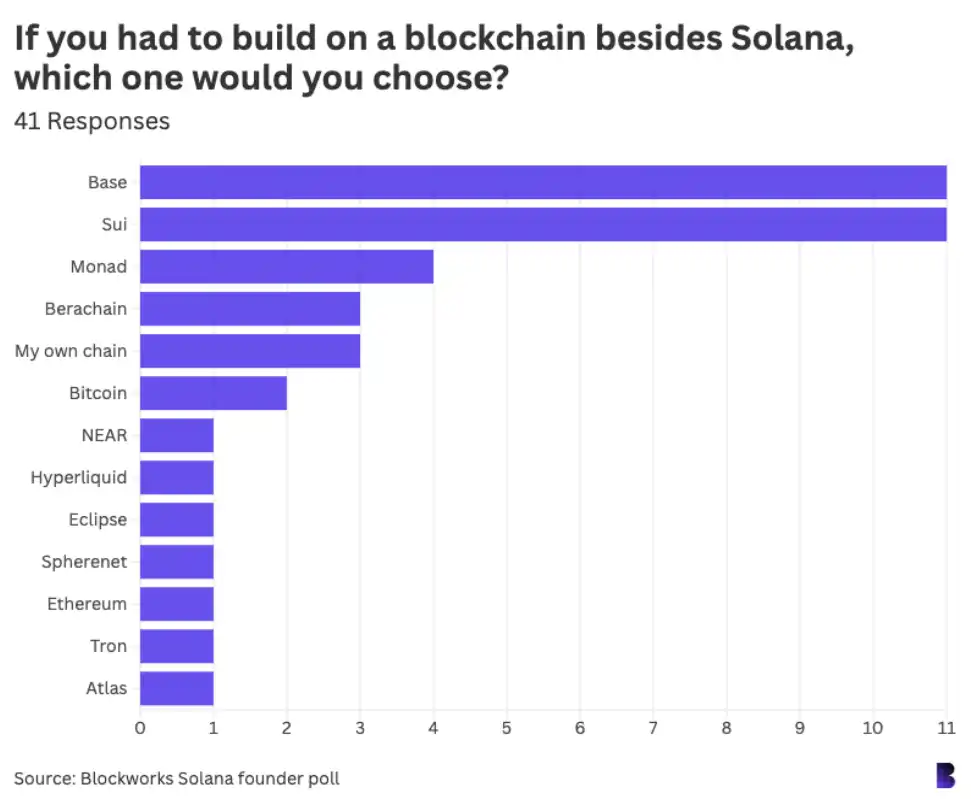
Some founders also expressed: "If not for Solana, I wouldn't be involved in cryptocurrency."
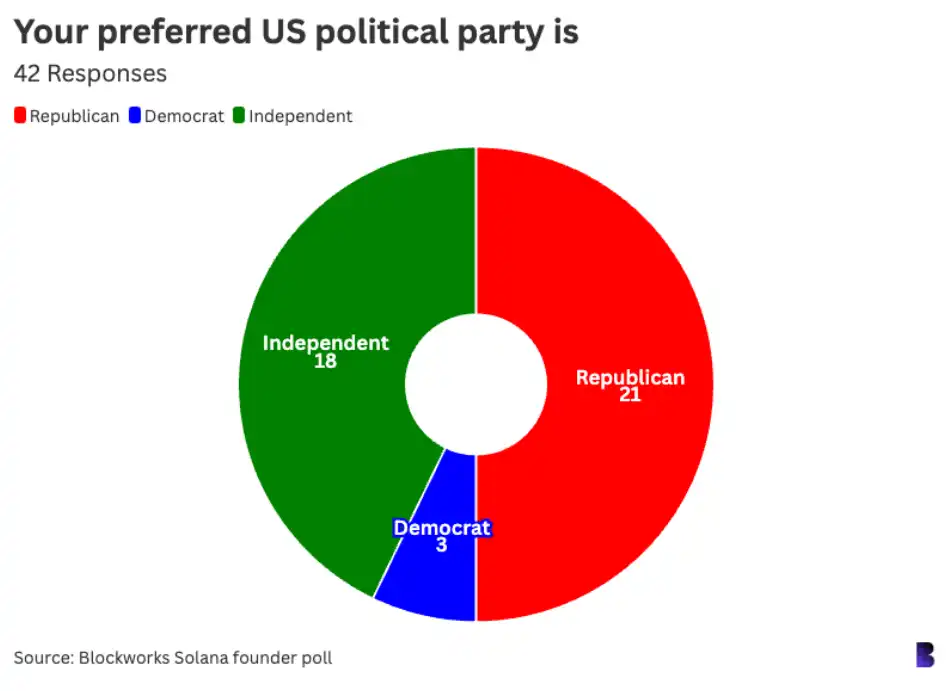
2. What is your favorite U.S. political party?
3. Which crypto VC do you rate the highest?
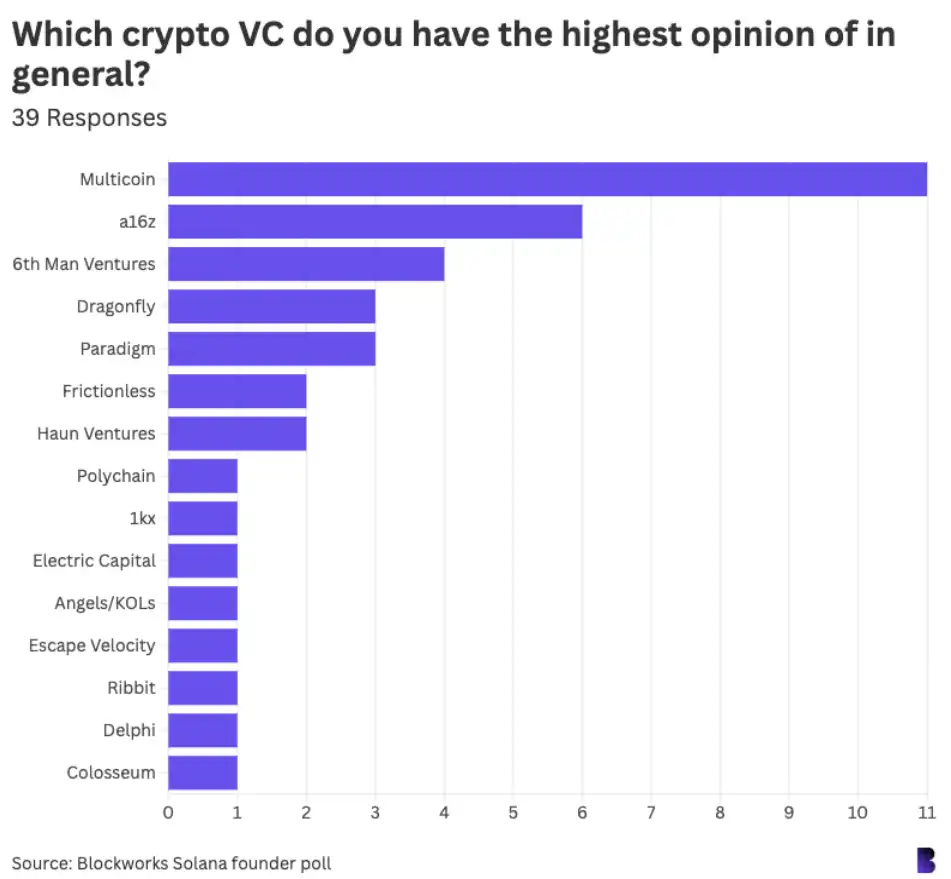
Founders also stated: "Picking one is unfair."
4. Which crypto VC do you view the least favorably?
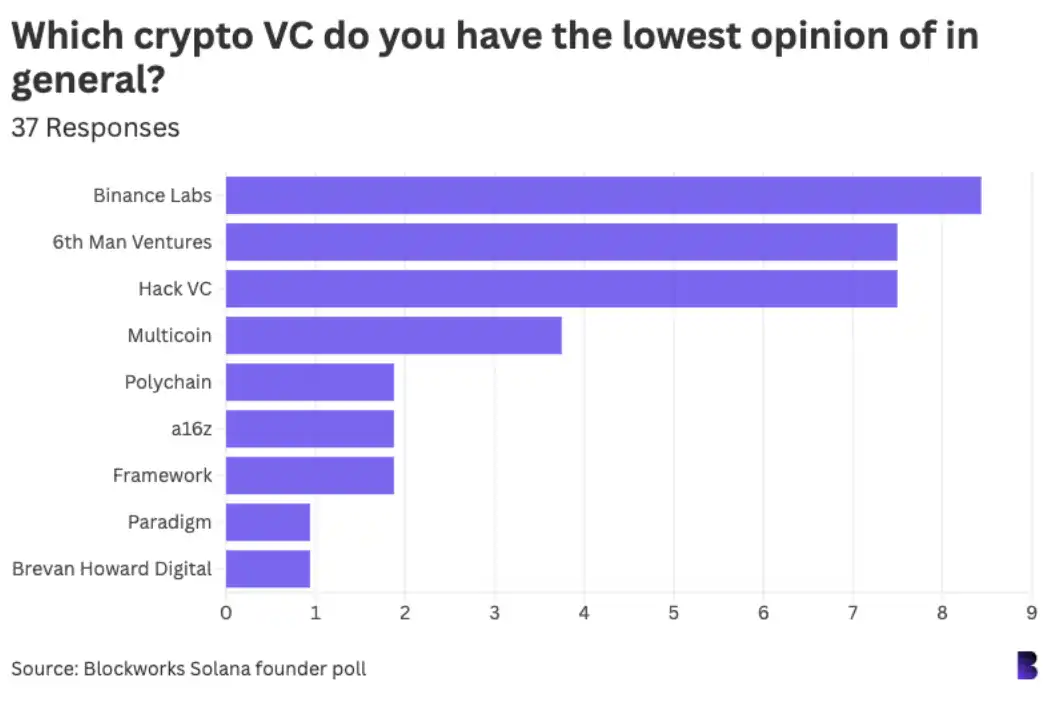
Founders also stated: "Blindly following Asian venture capital firms that follow lead investors based on who they are is also not very okay."
5. It is said that the Solana inner circle is deeply interconnected. To drive the development of in-group projects, non-in-group projects are often sacrificed. What are your thoughts on this?
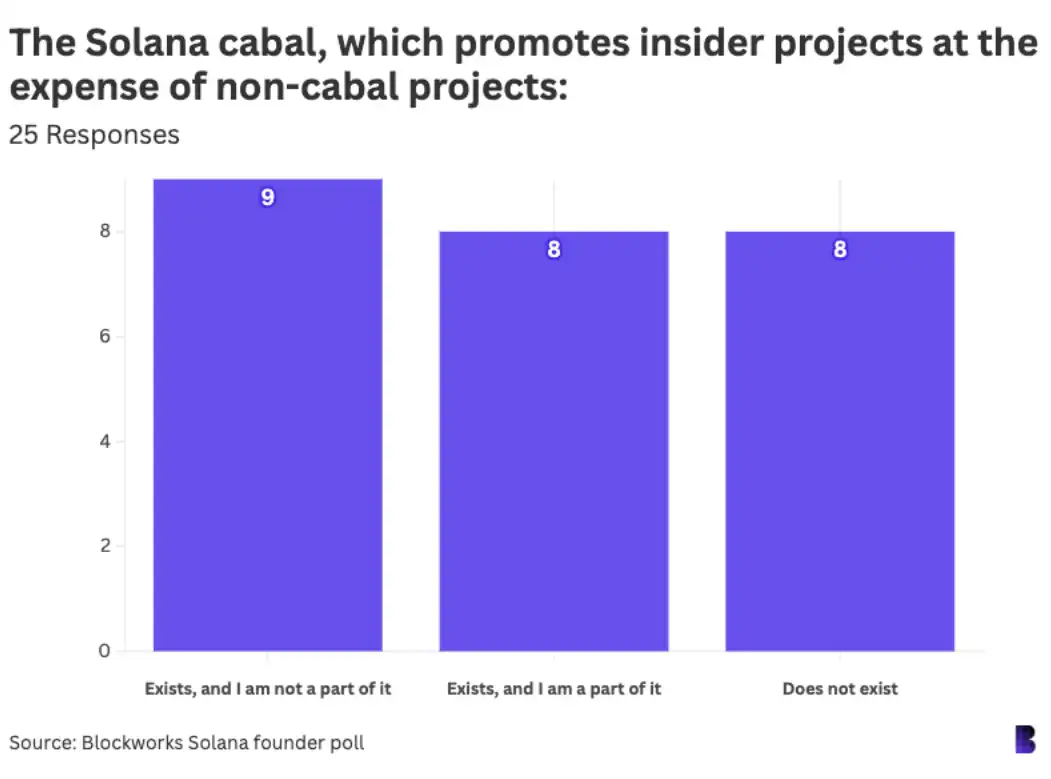
Founders also stated:
"I don't know, it's all the same, not much of a difference."
"I don't like this question, it feels like provoking controversy rather than providing information."
"It does exist, and I am also a part of it, but it's not 'sacrificing non-in-group projects.' Because I have also invested a significant amount of time and money in 'non-in-group projects.' It's mutual—you give, you also receive."
「It does not exist, yet I am a part of it.」
「In the early days and during bear markets, personal relationship networks were formed. Those who valued collaboration and helping Solana naturally built closer relationships over the years. Some individuals (including those from the OG Solana Labs team) later became influential figures with large followings. This is natural. Almost all surviving teams also received VC funding and support from Solana Ventures. These are facts, but I don't see malice in it. The Solana Foundation has done an excellent job actively diversifying this influence and supporting those who have performed well in the ecosystem (e.g., Superteam). In my view, Toly is particularly good at impartially supporting builders based not on personal preferences but on 1) the coolness of the projects they are building and 2) their sincerity.」
6. What is currently Solana's biggest issue?
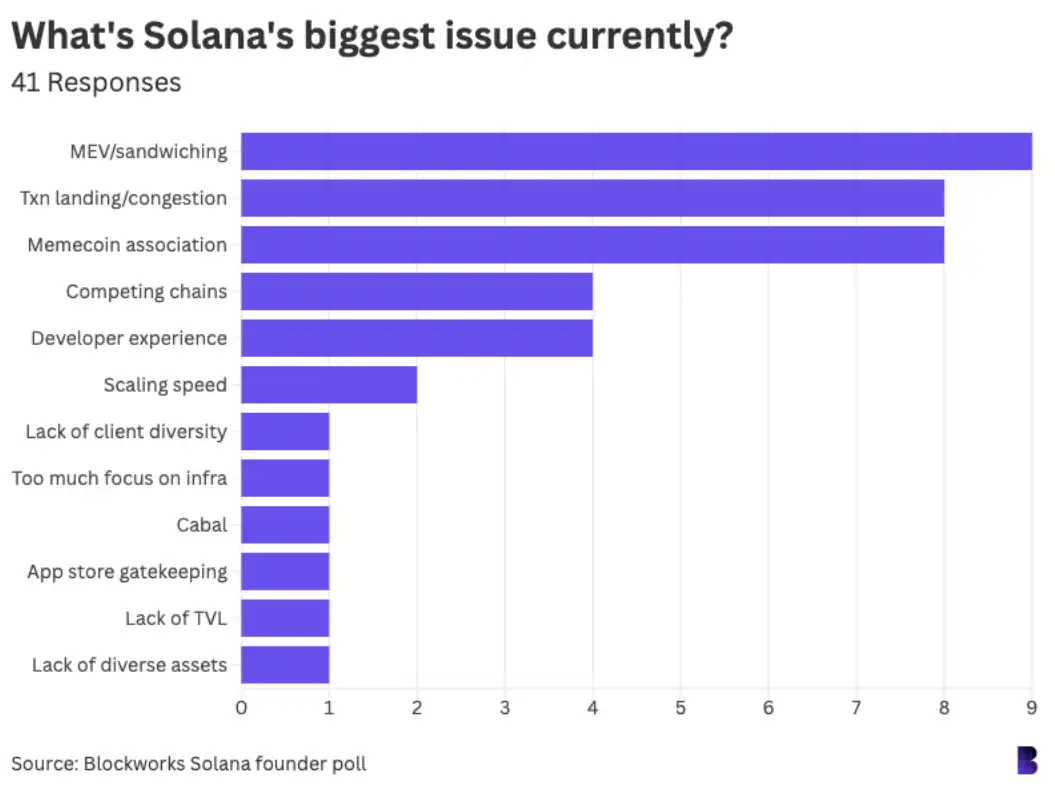
The founders also state: "There is an urgent need for more block space. Demand has increased by 5x + prices have doubled = to keep app developer costs constant, we need to increase block size by 10x!"
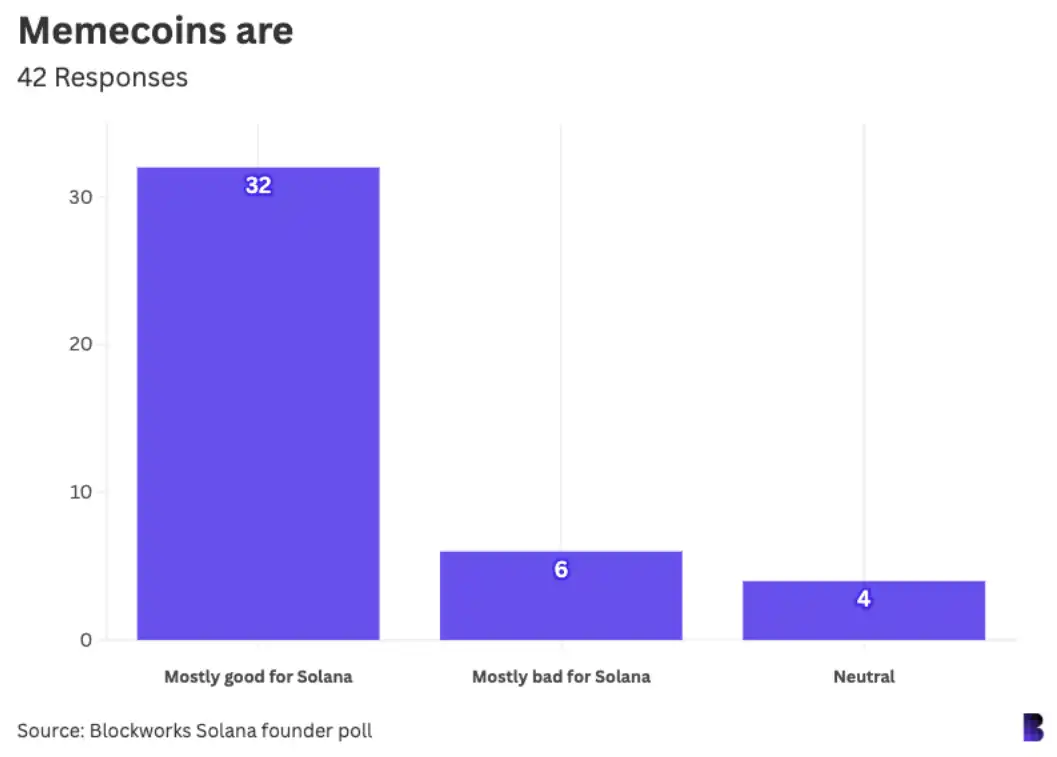
7. How do you view Memecoins' significance for Solana?
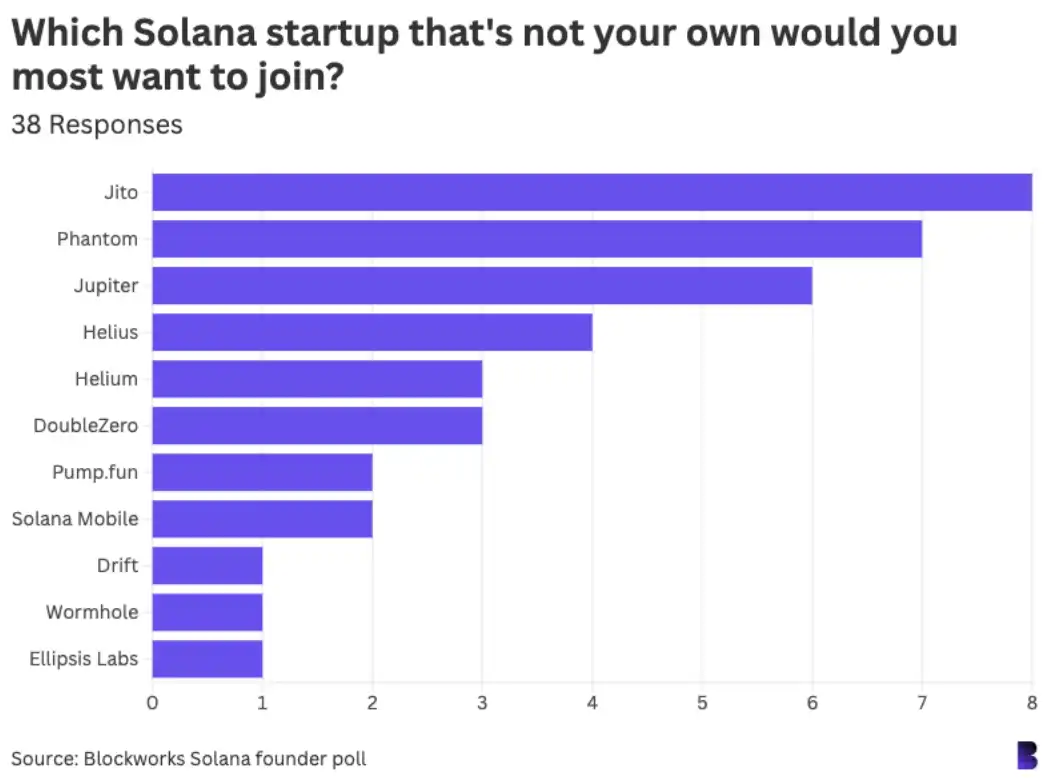
8. Solana has many startups that are not your own creations; which one do you most want to join?
9. Which one do you least want to join?
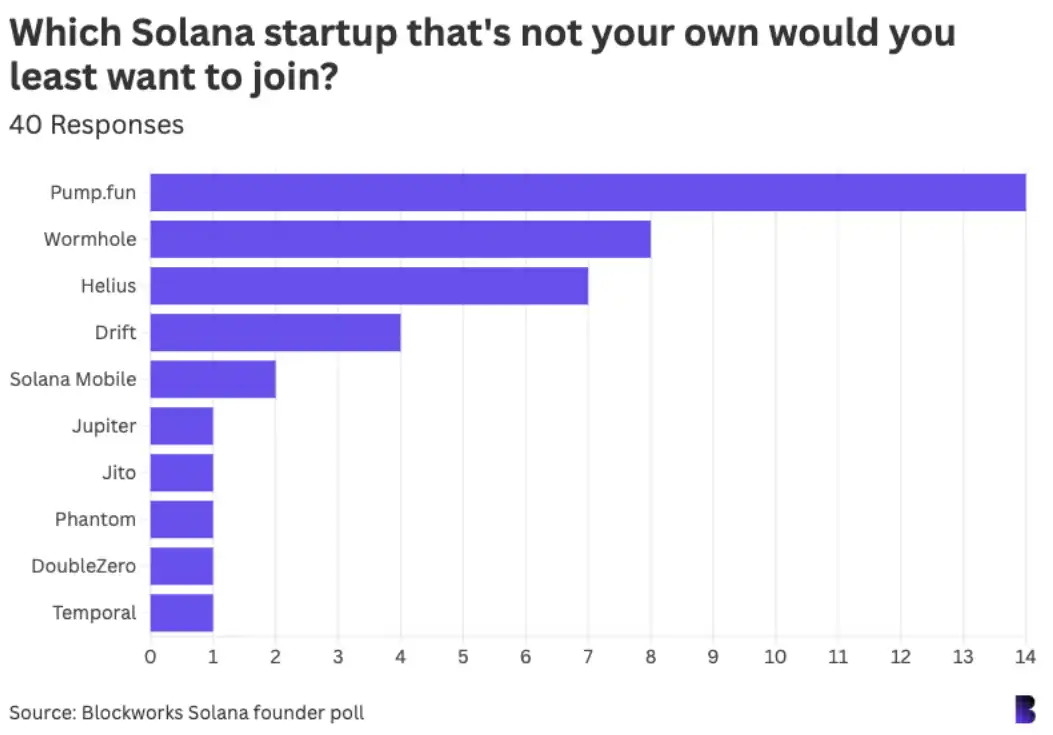
The founders also state: "Companies that have not yet shown promise are also not desirable to join."
10. What is the most overrated Solana sector?
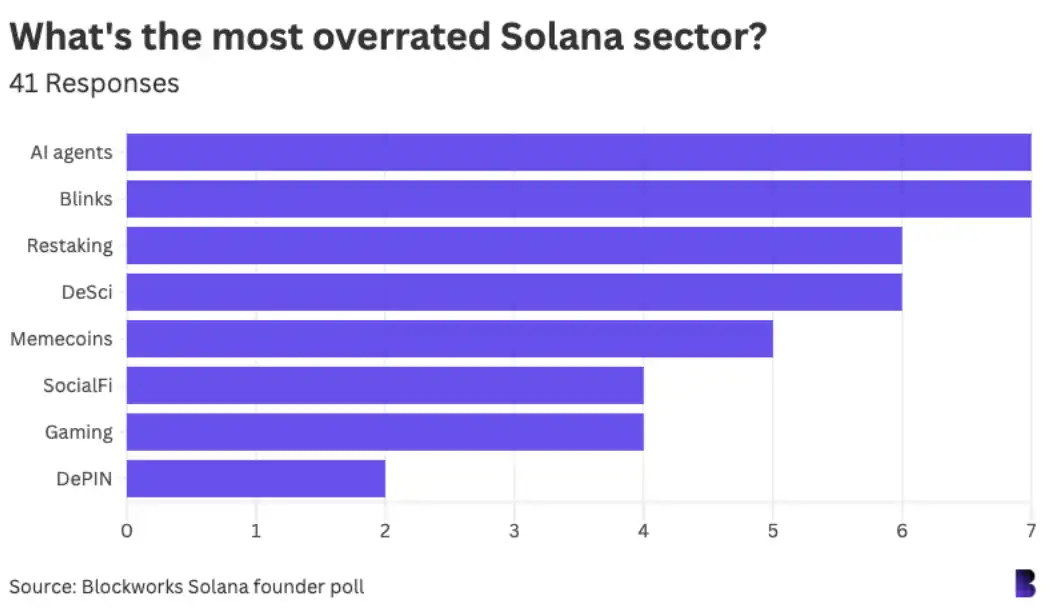
The founders also state: "SocialFi, DeSci, and gaming still have potential."
11. What is the most underrated Solana sector?
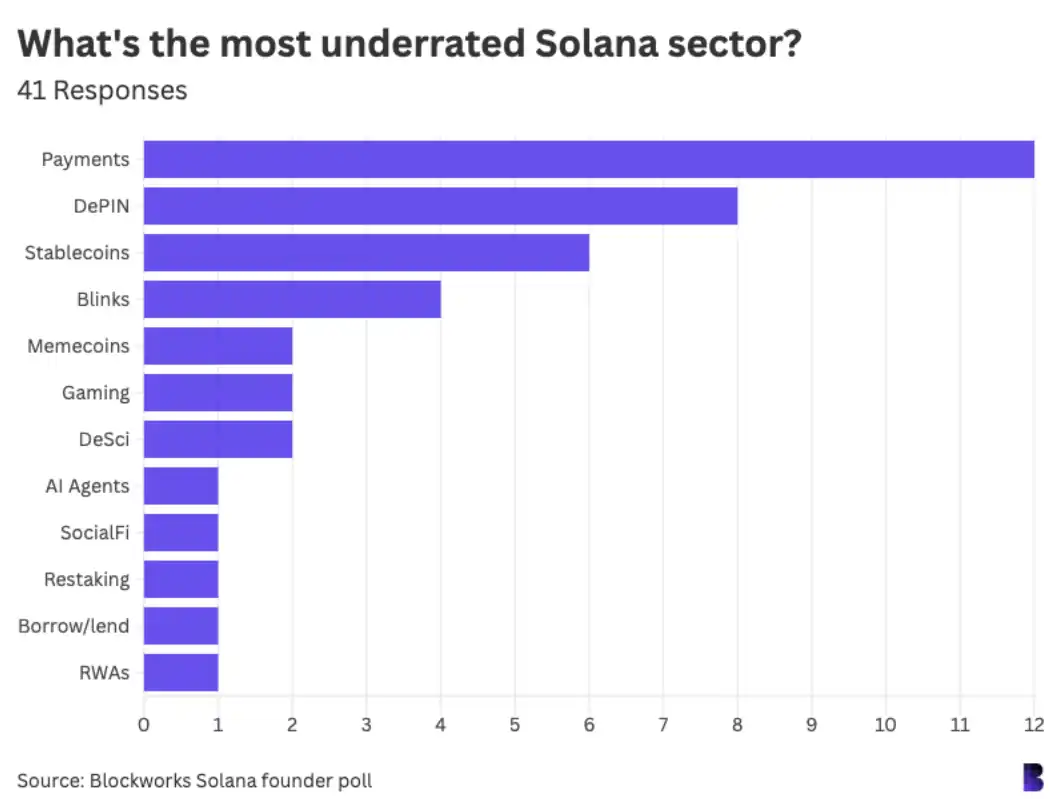
12. Which of the following items has caused the most damage to Solana's reputation?
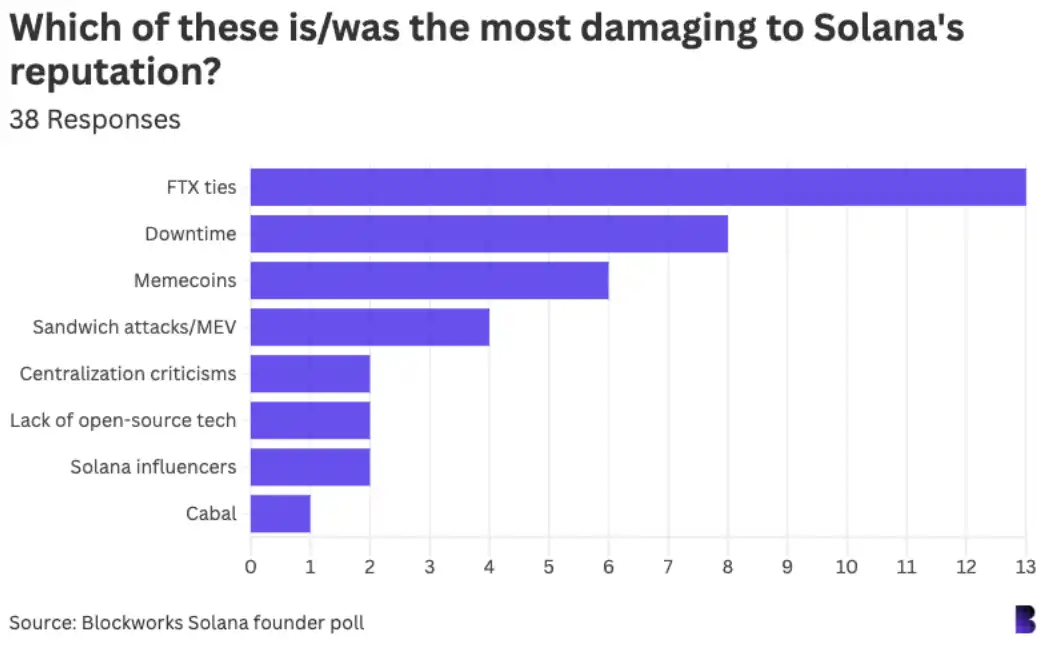
The founders also said: "FTX was both the best and worst early on, haha."
There is a lot to unpack here, but I found a few points particularly noteworthy: other founders had low opinions of pump.fun, but they generally believed memecoins were beneficial to the ecosystem. Base and Sui seem to be the most attractive Solana competitors at the moment.
As a journalist, getting founders to speak openly in public is not easy. This survey helped me better understand the Solana founders' true thoughts—at least somewhat authentically overall.
You may also like
MOG Coin Skyrockets as Elon Musk and Garry Tan Embrace "mog/acc" Identity
The End and Rebirth of NFTs: How the Meme Coin Craze Ended the PFP Era?
Monero's Market Cap Surges $1.5 Billion in One Day: Why Aren't Hackers Loving Bitcoin Anymore?
LetsBONK's market cap surpasses $30 million in just 6 hours, Raydium launches counterattack against Pumpfun
This Week in Review | Trump to Host Dinner for TRUMP Holders; Musk and US Treasury Secretary Engage in Heated Argument at the White House
DCG Founder's Interview: From Bitcoin Pioneer to AI Revolution, Barry's Crypto Empire and Bittensor Vision
One Month Left in Office, Has Trump and Musk's Political Alliance Broken Down?
Recently, a high-profile dispute at the White House once again brought the U.S. government into the spotlight. The head of the Department of Government Efficiency, Musk, and the U.S. Treasury Secretary Bennett engaged in a heated argument due to ideological differences, almost escalating into a physical confrontation. In the end, Trump accepted Bennett's appointment proposal, raising concerns about cracks in the relationship between Trump and Musk. Behind this conflict is not only a power clash between Silicon Valley and Washington but also a revealing of the complex game from "close allies" to "power balancing" between Trump and Musk.
Looking back to the beginning of the year, Trump's most significant political reform involving Musk was the establishment of the "Department of Government Efficiency" (DOGE) to promote radical reform under the guise of "streamlining the government." Its core objectives include reducing government spending, digitizing the bureaucratic system, and replacing human decision-making with algorithms. The core team consists of 6 technical elites aged 19-25. Since Trump took office on January 20th, DOGE has swiftly carried out its restructuring, from shutting down the U.S. International Development Agency to significantly reducing the number of federal government employees, and even obtaining taxpayer privacy information to enhance fiscal efficiency. Under Trump's direction and support, Musk has bravely faced the challenges and spearheaded a radical reform storm in the United States.
Related Reading: "Terminating hundreds of contracts in 18 days, Musk and six post-00s revolutionize the United States" "Cutting billions of dollars in contracts again, what peculiar government departments has Musk's D.O.G.E identified?"
According to DOGE's official website data, as of April 20, 2025, DOGE has saved approximately $160 billion in total, averaging about $993.79 saved per taxpayer, with savings in various areas:
Contract Terminations: 8,454 contracts terminated, saving about $30 billion. For example, terminating the Risk Management Agency's lease in Topeka, Kansas, with an annual rent of $121,800, is expected to save approximately $964,000 over multiple years.
Grant Cancellations: 9,699 grants terminated, saving about $33 billion. For example, terminating grants from the U.S. International Development Agency to the Global Vaccine and Immunization Alliance Foundation, saving a total of $1.75 billion.
Lease Terminations: 643 leases terminated, saving about $3 billion.
However, an NPR analysis points out that some contract terminations did not result in actual savings. For example, 794 contract cancellations were expected to bring no savings as the funds were already fully committed. Additionally, the DOGE calculated savings using the potential highest value of the contract rather than actual expenditures, leading to controversy.
As early as the 2024 U.S. presidential election, Musk began frequent interactions with Trump. At that time, Musk contributed $259 million, mobilized all Silicon Valley resources, and with his personal influence endorsement, became a key supporter for Trump's return to the White House. After Trump took office, as his "angel investor," Musk naturally gained unprecedented political status and power.
On February 7, Musk publicly expressed his support for Trump on social media. He said his love for Trump was "the maximum love that a straight man can give to another man."
On March 4, while attending Trump's State of the Union address, Musk was wearing a tie borrowed from Trump.
As Musk massively laid off federal employees from government agencies, a wave of vandalism against Tesla cars, intimidation of owners, and protests at dealership stores erupted nationwide. Tesla factories faced peaceful demonstrations and acts of destruction, including charging station fires. Vandalism of Cybertrucks surged across the U.S., with some owners even graffitiing their own Tesla vehicles to protest against Musk.
Reports of Tesla car and dealership vandalism as well as protest activities suggest that opposition to Musk has reached a boiling point. Bell Analyst Ben Carlo stated on CNBC, "When people's cars are at risk of being scratched or burned, even those who support Musk or are indifferent to Musk may have second thoughts about whether to buy a Tesla."
Musk has also stated multiple times that running his own businesses is "very challenging." Tesla's stock price has experienced its most severe drop in five years, and his social media company X has also suffered multiple outages.
However, such swift reforms are bound to harm the interests of a considerable portion of people. From the day Musk entered politics, opposition voices have been constant. Tesla's stock has plummeted since Musk took office, nearly halving its market value, marking the most severe decline in five years. This has led to Musk's personal assets evaporating by approximately $121 billion since the beginning of the year.
As Musk's biggest political backer and ally, Trump inevitably had to stand up for him when Musk came under attack.
On the afternoon of March 11th, local time in the U.S., Trump held a 30-minute press conference on the White House driveway. The press conference looked more like a large-scale Tesla car show—accompanied by Musk, Trump answered questions about the U.S. stock market, Canadian tariffs, and the Russia-Ukraine conflict while test-driving five different types and colors of Tesla cars.
"The one I like is that one," Trump pointed to a bright red Model S priced at about $80,000, saying. In the end, Trump chose the Model S and said he would write an $80,000 check to buy the car in full.
Trump also criticized those who were boycotting Tesla, believing that they were harming a great American company. He claimed that if the boycotters continued to treat Tesla this way, he would root out these people and "curse" them to "hell." White House spokesperson Harrison Fields also stated: "The despicable acts of violence being continuously carried out by radical left-wing activists against Tesla are no different from domestic terrorism."
Under Trump's "endorsement," Tesla's stock price rebounded during trading on Tuesday, rising 3.79% at the close.
To show loyalty, on March 24th, at Trump's third cabinet meeting, Musk wore a red hat with the words "Trump is always right."
During this period, the two were still intimate comrades-in-arms dedicated to advancing reform. Trump needed a "sharp tool" to expand his territory, while Musk needed a platform to realize his political ambitions. Both were highly aligned in their goals and interests.
Since Trump announced his high tariffs policy, a conflict arose between Trump's political goals and Musk's personal interests, leading to a crack in their relationship. The high tariffs caused a sharp drop in the U.S. stock market in a short period, and Musk's assets have shrunk by over $100 billion since the beginning of the year. Musk, as an entrepreneur, views issues from an economic rather than political perspective, supporting barrier reduction and free trade. He has also repeatedly expressed his opposition to the tariff policy.
On April 5, during the Italian Alliance Assembly held in Florence, Musk, in a video call interview with Italian Deputy Prime Minister Matteo Salvini, expressed, "Ultimately, I hope that Europe and the United States can reach an agreement. In my view, ideally, we should move towards zero tariffs, effectively establishing a free trade area between Europe and North America." On April 7, Musk shared a video on Twitter featuring the late free-market economist Milton Friedman discussing the benefits of free trade. Musk did not add any text, but this move was widely interpreted as a criticism of Trump's tariff policies.
Musk's brother, Kimbal Musk, also criticized Trump's tariff policy on Twitter, pointing out that "Taxing consumption means less consumption, which also means fewer job opportunities, leading to even less consumption and fewer job opportunities." He believes that taxation is a "structural, permanent tax on American consumers."
Particularly targeted at trade advisor Peter Navarro, Musk has also made many criticisms and sarcastic comments. On April 8, he replied to a post quoting Navarro's interview where Navarro referred to Tesla more as an "assembler" than a "manufacturer," criticizing its components coming from China, Japan, and Taiwan. Musk directly responded in a heated manner, stating, "Navarro is a complete idiot, what he said here is obviously false," followed by a community note proving the Tesla Model Y is the "most American-made car." One retort apparently wasn't enough, as Musk further referred to Navarro as "dumber than a sack of bricks" in another post.
Their contradictory stances on the tariff issue gradually fermented in the intricate power struggle.
On April 23, local time, it was reported by insiders that on April 17, Musk and Treasury Secretary Bezos had a heated clash during a meeting in the West Wing of the White House. Bezos lost control of his emotions and erupted with profanity, to which Musk provocatively responded with a "raise your voice." The confrontation even escalated to personal attacks, with Bezos angrily accusing Musk of exaggerating the DOGE budget cut issue, leading to no progress. Musk, in turn, directly retorted that Bezos was a "Soros puppet" and mocked him for his previous hedge fund debacle. The argument alarmed Trump and visiting Italian Prime Minister Meloni, and it took assistant intervention to separate the two.
The direct cause of this conflict was the controversy over the appointment of the IRS Commissioner. As Elon Musk, serving as the head of the U.S. Department of Efficiency, proposed the appointment of Gary Sharply as the Acting Commissioner of the IRS without the approval of Treasury Secretary Bennett, Bennett viewed this as a violation of his authority. He lobbied President Trump to revoke the appointment and instead support his own deputy, Deputy Treasury Secretary Michael Falkend, for the position of IRS Commissioner.
The outcome of this power struggle seemed to favor Bennett as President Trump eventually supported Bennett's proposal, revoked Musk's nomination of Sharply, and appointed Falkend as the Acting Commissioner of the IRS.
The fact that two top U.S. officials could be so enraged as to publicly curse each other at the White House gates despite their public image was due to their long-standing animosity. Back when Trump first took office, Musk had strongly advocated for nominating Howard Lutnick as Treasury Secretary, but Trump ultimately chose Bennett and appointed Lutnick to lead the Department of Commerce. Perhaps from the beginning, Trump had strategically set up a situation where his subordinates would check each other, siding with whoever aligned more with his own ideas. This set the stage for future conflicts.
The conflict between the two was fundamentally a power struggle and game of influence between two factions within the Trump administration. The reformist faction represented by Musk sought to reshape the landscape through new policies, while the traditional faction represented by Bennett resisted actions that harmed their own interests. Trump's handling of this event was seen as a sign of Musk's diminished influence within the government.
It is worth noting that, regarding tariff policies, Bennett, unlike Musk's clear opposition, had publicly supported tariff policies, believing that implementing new tariffs in the U.S. was necessary. He also refuted the idea that new tariffs would cause an economic downturn. Perhaps the consistency in policy preferences was also a reason why Trump gradually leaned towards Bennett and distanced himself from Musk. After all, to Trump, a businessman by background, permanent interests matter more than permanent friends.
Musk's role was constrained by the 130-day term limit for special government employees, which began counting from Trump's inauguration on January 20, 2025, and is expected to expire at the end of May. Anonymous sources within the White House hinted at the end of February that Musk "will stay," but on March 31, Trump himself openly acknowledged Musk's prioritization of his commercial duties and showed no signs of insisting on retention. Perhaps as the mission of DOGE is accomplished, Musk's 130-day government employee term enters its final phase, and Trump will gradually sideline Musk from the power center, shifting to new allies who align more with his current interests. In retrospect, it's a poignant reminder of how fleeting alliances can be.
The world's richest person, Musk, experienced the thrill of a "Tech Disruption Workplace" at the center of American politics. He ignited a fire for Trump's "New Sheriff in Town," touching the interests of countless people. He reformed the behemoth of the American government at an incredible speed, leaving behind not only a controversial outline of "Algorithmic Governance" but also exposing the deep-seated contradictions between capital and power in American politics. This radical experiment of "Tech Transforming Politics" seems to be nearing its conclusion. When Musk truly departs, that red hat proclaiming "Trump Is Always Right" may perhaps become the most dramatic footnote to this brief "political marriage."
April 23 Market Key Intelligence, How Much Did You Miss?
Arthur Hayes New Article: Bitcoin to Return to “Gold Tier” Safe Haven, Altseason to Potentially Follow
ArkStream Capital: The Power Play of WLFI's CEX-DEX Convergence
Trump Administration Official's Crypto Holdings Revealed, BTC Still the Top Choice
SEC Watershed Moment? 2025 Could Be the 'Altcoin ETF' Year, Which Tokens Are Most Likely to Be Approved
This Week in Review | Strategy Adds BTC Sell Risk Warning Sparking Debate; US Tariff Policy Flip-Flops Cause Market Turbulence
Is Being Wordy Equal to Researching? Crypto KOL Grassroots Movement Award
Rate Cut Countdown: $9 Trillion National Debt "Maturity Wall" Could Be the Cryptocurrency Market's Most Powerful Catalyst
April 10th Market Key Insights, How Much Did You Miss?
Binance's Most Profitable Yield Farming Stablecoin? Understanding LDUSDT's "Fee and Interest Double Earning" in One Article
Just yesterday, Binance announced the upcoming launch of a new reward-bearing margin asset called LDUSDT. This is another "stablecoin" financial product that can be used as margin for contract trading, following the launch of BFUSD in November 2024. What is LDUSDT, and how does it differ from BFUSD?
LDUSDT is a "yield-bearing margin asset" designed by Binance specifically for futures trading, with the official notice emphasizing that it is not a stablecoin. Users can convert their held USDT simple yield flexible product assets into LDUSDT.
LDUSDT serves two purposes: it can be used as trading margin while also earning yield. Binance allows users to use LDUSDT as margin for perpetual contract (inverse perpetual contract) trading, and users holding LDUSDT can continue to earn real-time annualized interest from Binance's "Principal Protected Coin" current product.
In simple terms, similar to the previously launched BFUSD, LDUSDT allows users' assets to simultaneously have "low-risk yield" and "liquidity." This is beneficial for Binance as well, as it can earn more lending interest while also earning more contract funding rates. The founder of the OG Crypto Community proposed that "if Binance chooses to use FDUSD to rebuild lending and perpetual contract liquidity, the underlying USD can also earn U.S. Treasury bonds." According to the reserve report presented by First Digital Labs on February 28th, 85% of the underlying USD composition of FDUSD consists of U.S. Treasury bonds. This is essentially a win-win situation, with LDUSDT being a product through which Binance shares the above-mentioned benefits with users.
After Binance launched BFUSD on November 27, 2024, similar products appeared, such as Dex Backpack and HUOBI Exchange, but their influence was not as significant as Binance's BFUSD. However, after the launch of BFUSD, although the model was innovative and participants generally believed that the model could improve liquidity, some issues with the product also emerged.
There is high yield volatility. The yield of BFUSD includes both the base interest rate and trading bonuses, with the holding limit linked to VIP levels. This model is highly dependent on market conditions and users' own trading activities. While it could reach a peak APY of up to 38%, if the market is in a one-sided trend or the trading volume is insufficient, the actual yield may be lower than expected, even approaching the minimum value of the base interest rate. During the high market liquidity at the end of last year, the APY could be maintained at around 20-30%, but starting from February-March this year, the APY has been close to 0% on many occasions.
The interest rates for retail and professional traders are different. The additional reward of BFUSD is linked to user's futures trading volume, allowing high-frequency traders or whales to significantly increase their earnings. In contrast, regular users with low trading volume may only receive the base interest rate, making the cost-effectiveness low. This design of BFUSD leans more towards professional traders rather than ordinary retail traders.
On the other hand, LDUSDT, although similar in its usage to BFUSD, has a different income structure. BFUSD is based on hedging strategies and staking, while LDUSDT's income comes from Binance sharing the annualized returns of its "Simple Earn" where users can earn risk-free returns, including a portion of platform fees, lending income, or some low-risk investment returns.
Due to these reasons, BFUSD is currently not popular in the market. Unlike BFUSD, which can experience significant fluctuations due to funding rate volatility, LDUSDT's advantage lies in its relative stability. However, the trade-off is that its yield may not be as high. While these yields may seem insignificant during a bull market, they present a good option for those seeking stable returns and liquidity during times of relatively low liquidity. Additionally, as it does not rely on the user's trading strategy, its operation is comparatively simple, thereby enabling more retail investors to participate.
Overall, BFUSD is more like an investment tool created by Binance to provide additional value to users through proactive actions, a "Buff" of additional gains for traders who frequently trade during a "bull market." On the other hand, LDUSDT acts as a gateway, bridging the gap between Simple Earn and futures trading, a product that incentivizes conservative users to trade during a "bear market."
KOL "Loki_Zeng" expressed his feelings about this, saying, "Binance is so innovative. Thinking about the interest and circulation separation of stablecoins will inevitably lead to a final scenario, but I didn't expect Binance itself to revolutionize it." Whether BFUSD or LDUSDT, what Binance aims to do is to activate a large amount of idle stablecoins on the exchange, wrap them in a leveraged shell, and keep them within the Binance ecosystem to continue providing vitality to real business.
The water in this liquidity sponge is being squeezed by a larger hand. Can it help us survive the dry spell before the "water release"? Currently, Binance has not released more detailed information about LDUSDT, and BlockBeats will continue to monitor this matter.


 App
App