
- Buy Crypto
- Markets
- Futures
- Spot
- Copy Trade
 WE-Launch
The Arrival of the Latest Tariff Version: Will There Be a Post-Announcement Rally? | Trader's Insight

Last night, President Trump signed two executive orders at the White House regarding the so-called "reciprocal tariffs," announcing that the U.S. would establish a 10% "minimum baseline tariff" on its trading partners and impose higher tariffs on certain trading partners. A senior White House official stated that the baseline tariff rate (10%) would take effect early on April 5, with the reciprocal tariffs taking effect early on April 9.
U.S. Treasury Secretary Bennett tweeted, "I suggest all countries refrain from taking retaliatory actions. We can see if there will be a different lower limit for tariffs (from the announced figures). Trump's mindset might be to temporarily stabilize the situation. I was not involved in the negotiations; we need to see if there will be any negotiations before April 9 (the effective date of reciprocal tariffs)."
The crypto market experienced a long and short dual kill last night. When the announcement of a 10% baseline tariff was made at the beginning of the meeting, Bitcoin briefly surged to $88,000, hitting a high since March 25, up over 5%; however, it was later revealed that additional tariffs would be imposed on about 60 countries with the largest trade imbalances with the U.S. Bitcoin retraced most of its gains, dropping below $82,500. Based on Bitcoin's current performance, it can be said to have no safe-haven properties. Meanwhile, spot gold briefly broke through $3160 per ounce, hitting a new all-time high.
Related reading: "U.S. Stocks Evaporate $2 Trillion in 15 Minutes, Is 'Reciprocal Tariffs' the Final Straw that Broke the Bull Market's Back?"
This not only plunges the global trade system into a new round of policy chess, but also sets off a tsunami of chain reactions in the financial markets. From Bitcoin's roller-coaster-like volatility to gold hitting a new all-time high again, the market is interpreting the deep-seated anxiety over the escalation of the trade war through the language of prices. BlockBeats has compiled traders' interpretations of the tariff policy, outlook for the future, and market analysis for readers' reference.
Macro Analysis
With Trump's tariffs in place, how should we view the follow-up? Trump's tariff plan was finally announced early in the morning, basically the toughest version expected (initially, the baseline tariff rate was relatively low).
1. Key points of the tariff policy:
1) Reciprocal tariff policies are implemented against 50 countries and regions worldwide, with a baseline tariff rate of 10%. However, the additional tariffs imposed on each country are basically half of the U.S.'s import tariff rate imposed by the other party. The global auto tariffs are set at 25%.
2) Other reciprocal tariff policies did not take immediate effect and will finally take effect on April 5, providing a certain negotiation opportunity.
3) Trump still emphasized the vision of revitalizing American industry, bringing high-end industries such as shipbuilding, aircraft, and semiconductors back to the United States. He emphasized the increased investment of large multinational companies in the United States, once again advocating that multinational companies establishing a presence in the United States will avoid higher tariffs, with the core focus being to stimulate industrial reshoring.
2. How to view the tariff policy?
1) First, as discussed before, aside from automobile tariffs, reciprocal tariffs do not take immediate effect. There is still room for maneuvering before they take effect on April 5. The key point here is to see how China, the European Union, and Japan and South Korea will react. Will China retaliate strongly? The European Commission previously mentioned waiting to discuss response measures until after Trump's tariff policy is announced.
Mexico was not mentioned today, so it seems to be treated separately. This further confirms the speculation that Trump wants to build a North American tariff alliance fortress with Mexico and Canada.
2) Yesterday, Treasury Secretary Mnuchin told Congress that the tariffs announced on Wednesday are at the highest level, and countries can take measures to reduce tariffs. This clearly suggests that everyone should negotiate; proactively reducing tariffs and cooperating will likely lead to a reduction in your tariffs.
Yesterday, the President of Mexico has expressed that they will not implement retaliatory measures. Previously, Israel, Thailand, and Vietnam all announced plans to reduce import tariffs.
From this perspective, it feels like if other countries reduce tariffs, they should come down as well.
3. How to view the subsequent market?
Today, the tariffs are being implemented, which can be seen as the toughest version previously anticipated. When talking about the toughest version being implemented, the market is likely to use these policy figures to anticipate and price in the worst-case scenario, resulting in a huge impact on the market. Currently, U.S. stock index futures are sharply down, and the major cryptocurrency has surged and then fallen significantly back, all reflecting pricing in this worst-case scenario, although the pricing may not be fully reflected yet.
Wait for the clearance and wait for good news to come.
Looking at it from a different perspective, the next few days from today until the 5th are likely the peak of recent uncertainty, and the worst-case scenario has already emerged. After that, various countries will engage in negotiations with the United States, and any positive progress will boost market confidence.
As we discussed before, whether tariffs are a club or a result is still uncertain. According to Trump, the 10% reciprocal tariff will officially take effect on April 5, and the additional retaliatory tariff, which is the portion beyond the 2, will be officially implemented on April 9, which is April 10 Beijing time.
This means there is still a week to give all countries subject to tariffs higher than 10% an opportunity to adjust. If these countries are willing to reduce tariffs on the United States to 10%, then U.S. tariffs on these countries will also be adjusted to 10%, except for China, and this time Mexico and Canada are not part of the discussion. It's too early to talk about the final outcome now; let's wait until April 9.
Overall, if the current data is formally implemented, a major trade war will erupt, which is definitely not a good thing.
Inflation and the economy are both worrying.
Returning to BTC data, I don't want to say too much. Let's wait and see. There may be FUD during Asian hours tomorrow, as the impact on China is significant, and China is likely to impose retaliatory tariffs. It's unclear for Japan and South Korea. As I've always said, the difficulty in April will increase.
Overall Comments on Tariffs
1. A 10% increase in tariffs for all countries overall is a positive scenario.
2. Individual country-specific tariffs are a huge negative, including 34% for China and 20% for the EU, which is relatively less (EU exports to the U.S. are mainly luxury cars, agricultural products, and luxury goods).
3. Equivalent tariffs for other countries are also very high (Vietnam is also a major exporter).
4. Currently, it seems that equivalent tariffs for each country do not differentiate by industry. Industries like clothing in China will be significantly impacted by inflation. It may also be that detailed rules have not yet been established.
5. The only good news is that Canada and Mexico are not subject to tariffs.
6. Equivalent tariffs will be implemented on April 9, so there may still be some time for rescue (time for countries to negotiate terms with the U.S.).
7. If the final decision is based on the currently provided numbers, it will be very detrimental to the U.S. economy, inflation, stock market, and cryptocurrency market.
8. If the final decision is based on the current numbers, Bitcoin is expected to reach a high point this week at 88,500 today. Next week is the U.S. tax season, and liquidity is expected to remain low.
9. After the bottoming out of this month's decline, the rebound peak is expected to not exceed 95-96, possibly reaching a maximum of 90-91.
10. Currently, the probability of the U.S. entering a recession after July is very high. If there is a rebound in May or June, then prepare for an escape wave.
Technical Indicators
ASR-VC Indicator 4h Channel Status Update:
Failed to break through the midline, understandable given the recent U.S. stock market downturn. The fact that BTC can still find support in the demand area is already quite good!
It is evident that the two sub-demand and supply areas on the chart have played a very significant role in price action, indicating that the current market is not undergoing a structural change but is still within its existing range-bound structure;
Similar to the logic in the quote, starting this week, short-term volatility is expected to gradually increase until a breakthrough or breakdown of the key range. Trading difficulty is also rapidly rising, with multiple gates expected to be drawn from Monday onwards, and the first one has already been drawn!
Subjectively speculating, this gate is definitely not the last one...
Still, the price is oscillating near the midline, directionless, completely random, and influenced by event news sentiment. Technical analysis is only suitable for small timeframes, either for short-term gains or to stay out of the market.
From a BTC liquidity perspective, last week, MSTR bought 22,000 BTC at an average price of 86900, but it still didn't push the price up, indicating a significant selling pressure in the 86-87 range. Last night, it spiked to 88500, consuming this selling pressure; going up again will be very easy. The spike last night did not break through the local previous high near 88760, which is a good sign. The liquidity above was not captured, setting the stage for the next upward movement. The next leg up has a midway point between 93-97k, where multiple former high-pressure levels need to be worn down, leading to another gradual uptrend in the range of two to three thousand points up and down. The ultimate liquidity point is between 100-105k, which is where it's advisable to gradually exit all cryptocurrency holdings.
1. Currently, we are in a weekly downtrend, and the bullish play is a sub-level rebound within the weekly downtrend.
2. From a higher timeframe perspective, assuming the high point is 109,588 and the low point is 76,606, forming the first part of the correction, the current trend is defined as a rebound from the initial downtrend. Due to news impact, yesterday's daily candle showed a long upper shadow with a bearish body, indicating an unfavorable movement, likely to continue back within the downtrend line.
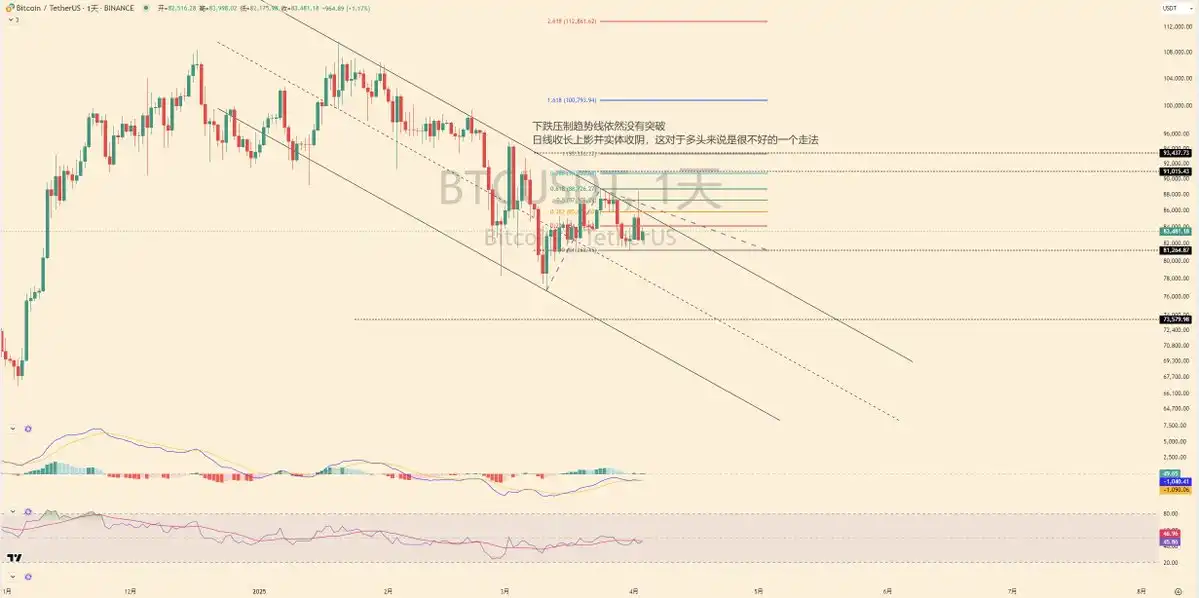
3. The current rebound has two potential scenarios:
1) 76,606 ➡️ 88,765 is the first part of the rebound, 88,765 ➡️ 81,279 is the second part of the rebound, and the uptrend from 81,279 marks the third part of the rebound;
2) 76,606 ➡️ 88,765 has already completed the entire rebound, and at this point, it is continuing to establish a continuation of the downtrend.
4. Looking at a smaller timeframe, it was mentioned yesterday that during the uptrend rebound process, the trendline resistance was temporarily breached, but the horizontal resistance was not yet surpassed. As a result, at the horizontal resistance level, the price was promptly rejected back;
1) Only a breakthrough around 88,700 will strengthen the rebound;
2) Only a breakthrough around 91,000 will allow for a more extended view of the rebound.
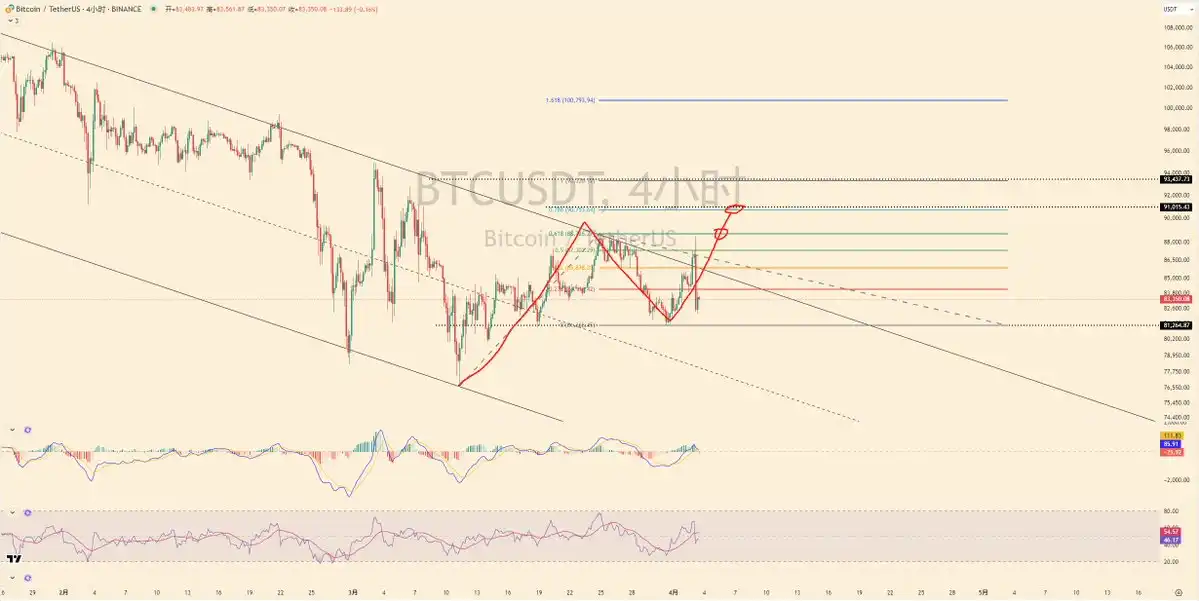
5. Operationally, although there was no loss, the market did not follow the expected path. The expectation was for a news-driven stimulus, a gentle implementation of tariff policies, to promptly boost the market above the 90,000 level, followed by the construction of a strong rebound continuation. However, the market stimulus was a forceful implementation of tariff policies, leading to a direct rejection around the 89,000 level;
6. Anticipation and assumption: as time progresses, the candlestick and downtrend resistance line will inevitably intersect. At that point, two possibilities arise:
1) Passive breakthrough, meaning the trendline has pushed down, but the price has not yet dropped, resulting in a natural breakthrough of the downtrend line. This scenario is not robust. Subsequently, a more extended and volatile continuation will be constructed;
2) As the trendline descends, the candlestick encounters resistance, causing the price to continue downward. This scenario may be relatively swift, with both upper resistance and lower support levels visible in the chart. Please refer to the chart for details:
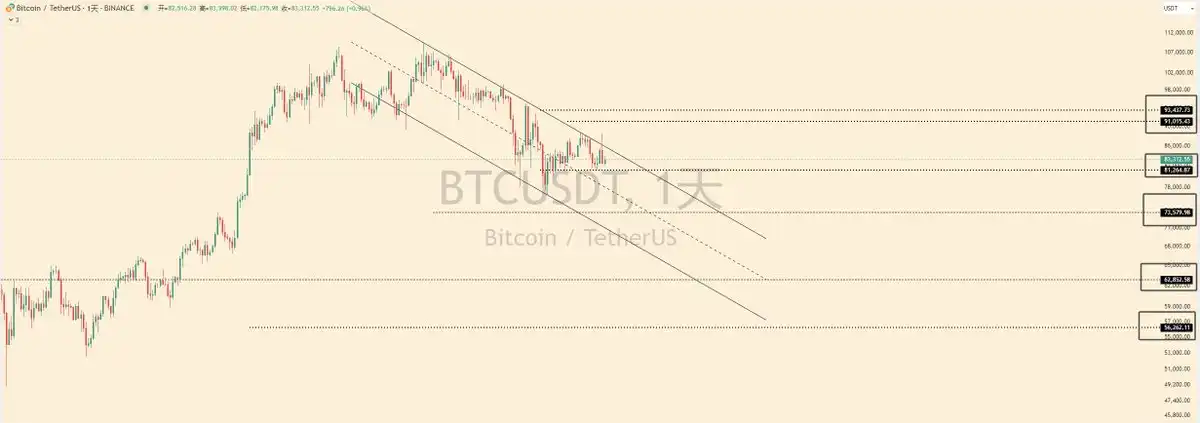
7. Currently, I am back to a cash position. Since the primary market driver is the policy landscape, during this window, it is essential to patiently observe various countries, markets, central banks, especially the U.S. and China, to assess their reactions to the tariff policies before deciding on a position. The overall higher timeframe still maintains a bearish trend, and this rebound's subjectively anticipated favorable factors have been debunked. Thus, we must await the outcome of the game. I believe that other smaller countries will generally benefit from tariffs, with China having the highest level of uncertainty and influence. At this point, I am looking forward to a scenario of "no breakthrough, no progress," as the current back-and-forth is draining.
You may also like

$COIN Joins S&P 500, but Coinbase Isn't Celebrating
On May 13, S&P Dow Jones Indices announced that Coinbase would officially replace Discover Financial Services in the S&P 500 on May 19. While other companies like Block and MicroStrategy, closely tied to Bitcoin, were already part of the S&P 500, Coinbase became the first cryptocurrency exchange whose primary business is in the index. This also signifies that cryptocurrency is gradually moving from the fringes to the mainstream in the U.S.
On the day of the announcement, Coinbase's stock price surged by 23%, surpassing the $250 mark. However, just 3 days later, Coinbase was hit by two consecutive events: a hack where employees were bribed to steal customer data and a demand for a $20 million ransom, and an investigation by the U.S. Securities and Exchange Commission (SEC) into the authenticity of its claim of having over 100 million "verified users" in its securities filings and marketing materials. These two events acted as mini-bombs, and at the time of writing, Coinbase's stock had already dropped by over 7.3%.
Coincidentally, Discover Financial Services, being replaced by Coinbase, can also be considered the "Coinbase" of the previous payment era. Discover is a U.S.-based digital banking and payment services company headquartered in Illinois, founded in 1960. Its payment network, Discover Network, is the fourth largest payment network apart from Visa, Mastercard, and American Express.
In April, after the approval of the acquisition of Discover by the sixth-largest U.S. bank, Capital One, this well-established digital banking company of over 60 years smoothly handed over its S&P 500 "seat" to this emerging cryptocurrency "bank." This unexpected coincidence also portrayed the handover between the new and old eras in Coinbase's entry into the S&P 500, resembling a relay race scene. However, this relay baton also brought Coinbase's accumulated "external troubles and internal strife" to a tipping point.
Over the past decade, cryptocurrency exchanges have been the most stable "profit machines." They play a role in providing liquidity to the entire industry and rely on trading fees to sustain their operations. However, with the comprehensive rollout of ETF products in the U.S. market, this profit model is facing unprecedented challenges. As the leader in the "American stack," with over 80% of its business coming from the U.S., Coinbase is most affected by this.
Starting from the approval of Bitcoin and Ethereum spot ETFs, traditional financial capital has significantly onboarded users and funds that originally belonged to exchanges in a more cost-effective, compliant, and transparent manner. The transaction fee revenue of cryptocurrency exchanges has started to decline, and this trend may further intensify in the coming months.
According to Coinbase's 2024 Q4 financial report, the platform's total trading revenue was $417 million, a 45% year-on-year decrease. The contribution of BTC and ETH's trading revenue dropped from 65% in the same period last year to less than 50%.
This decline is not a result of a decrease in market enthusiasm. In fact, since the approval of the Bitcoin ETF in January 2024, the inflow of BTC into the U.S. market has continued to reach new highs, with asset management giants like BlackRock and Fidelity rapidly expanding their management scale. Data shows that BlackRock's iShares Bitcoin ETF (IBIT) alone has surpassed $17 billion in assets under management. As of mid-May 2025, the cumulative net inflow of 11 major institutional Bitcoin spot ETFs on the market has exceeded $41.5 billion, with a total net asset value of $1214.69 billion, accounting for approximately 5.91% of the total Bitcoin market capitalization.
Institutional investors and some retail investors are shifting towards ETF products, partly due to compliance and tax considerations. On one hand, ETFs have much lower trading costs compared to cryptocurrency exchanges. While Coinbase's spot trading fee rate varies annually in a tiered manner but averages around 1.49%, for example, the management fee for IBIT ETF is only 0.25%, and the majority of ETF institution fees fluctuate around 0.15% to 0.25%.
In other words, the more rational users are, the more likely they are to move from exchanges to ETF products, especially for investors aiming for long-term holdings.
According to multiple sources, several institutions, including VanEck and Grayscale, have submitted applications to the SEC for a Solana (SOL) ETF, with some institutions also planning to submit an XRP ETF proposal. Once approved, this may trigger a new round of fund migration. According to a report submitted by Coinbase to the SEC, as of April, the platform's trading revenue from XRP and Solana accounted for 18% and 10%, nearly one-third of the platform's fee revenue.
However, the Bitcoin and Ethereum ETFs passed in 2024 also reduced the fees for these two tokens on Coinbase from 30% and 15% to 26% and 10%, respectively. If the SOL and XRP ETFs are approved, it will further undermine the core fee revenue of exchanges like Coinbase.
The expansion of ETF products is gradually weakening the financial intermediary status of cryptocurrency exchanges. From their original roles as matchmakers and clearers to now gradually becoming mere "on-ramps and off-ramps" for funds, exchanges are seeing their marginal value squeezed by ETFs.
On May 12, 2025, SEC Chairman Paul S. Atkins gave a keynote speech at the Tokenization and Cryptocurrency Working Group roundtable. The theme of his speech revolved around "It is a new day at the SEC," where he indicated that the SEC would not approach enforcement and regulation the same way as before but would instead pave the way for cryptocurrency assets in the U.S. market.
With signs of cryptocurrency compliance such as the SEC's "NEW DAY" declaration, an increasing number of traditional brokerages are attempting to enter the cryptocurrency industry. One of the most representative cases is the well-known U.S. brokerage Robinhood, which began expanding its crypto business in 2018. By the time of its IPO in 2021, Robinhood's crypto business revenue accounted for over 50% of the company, with a significant boost from the Dogecoin "moonshot" promoted by Musk.
In Q1 2025 earnings report, Robinhood showcased strong growth, especially in revenue from cryptocurrency and options trading. Fueled by Trump's Memecoin, cryptocurrency-related revenue reached $250 million, nearly doubling year-over-year. Consequently, Robinhood Gold subscription users reached 3.5 million, a 90% increase from the previous year, with the rapid growth of Robinhood Gold providing the company with a stable source of income.
Meanwhile, RobinHood is actively pursuing acquisitions in the cryptocurrency space. In 2024, it announced a $2 billion acquisition of the long-standing European cryptocurrency exchange Bitstamp. Additionally, Canada's largest cryptocurrency CEX, WonderFi, which recently went public on the Toronto Stock Exchange, also announced its integration with RobinHood Crypto. After obtaining virtual asset licenses in the UK, Canada, Singapore, and other markets, RobinHood has taken a proactive approach in the compliant cryptocurrency trading market.
Furthermore, an increasing number of brokerage firms are exploring the same path. Futu Securities, Tiger Brokers, and others are also dipping their toes into cryptocurrency trading, with some having applied for or obtained the VA license from the Hong Kong SFC. Although their user bases are currently small, traditional brokerages have a natural advantage in user trust, regulatory licenses, and low fee structures. This could pose a threat to native cryptocurrency platforms in the future.
In April 2025, security researchers discovered that some Coinbase user data was leaked on the dark web. While the platform initially responded by attributing it to a "technical misinformation," it still raised concerns among users regarding its security and privacy protection. Just two days before Dow Jones Indexes announced Coinbase's addition to the S&P 500 Index, on May 11, 2025, Coinbase received an email from an unknown threat actor claiming to have obtained customer account information and internal documents, demanding a $20 million ransom to keep the data private. Subsequent investigations confirmed the data breach.
Cybercriminals obtained the data by bribing overseas customer service agents and support staff, mainly in "non-U.S. regions such as India." These agents abused their access to Coinbase's internal customer support system and stole customer data. As early as February this year, blockchain detective ZachXBT revealed on X platform that between December 2024 and January 2025, Coinbase users lost over $65 million to social engineering scams, with the actual amount potentially higher.
Among the victims was a well-known figure, 67-year-old Ed Suman, an established artist in the art world for nearly two decades, having been involved in the creation of artworks such as Jeff Koons' "Balloon Dog" sculpture. Earlier this year, he fell victim to an impersonation scam involving fake Coinbase customer support, resulting in a loss of over $2 million in cryptocurrency. ZachXBT critiqued Coinbase for its inadequate handling of such scams, noting that other major exchanges have not faced similar issues and recommending Coinbase to enhance its security measures.
Amidst a series of ongoing social engineering incidents, although there has not been any impact on user assets at the technical level so far, it has raised concerns among many retail and institutional investors. Especially institutions holding massive assets on Coinbase. Just considering the U.S. BTC ETF institutions, as of mid-May 2025, they collectively hold nearly 840,000 BTC, and 75% of these are custodied by Coinbase. If we price BTC at $100,000, this amount reaches a staggering $63 billion, which is equivalent to the nominal GDP of two Iceland in the year 2024.
In addition, Coinbase Custody also serves over 300 institutional clients, including hedge funds, family offices, pension funds, and endowments. As of the Q1 2025 financial report, Coinbase's total assets under management (including institutional and retail clients) reached $404 billion. The specific amount of institutional custodied assets was not explicitly disclosed in the latest report, but it should still be over 50% based on the Q4 2024 report.
Once this security barrier is breached, not only could the rate of user attrition far exceed expectations, but more importantly, institutional trust in it would undermine the foundation of its business. Therefore, after a hacking event, Coinbase's stock price plummeted significantly.
Facing a decline in spot trading fee revenue, Coinbase is also accelerating its transformation, attempting to find growth opportunities in derivatives and emerging assets. Coinbase acquired a stake in the options platform Deribit at the end of 2024 and announced the official launch of perpetual contract products in 2025. This acquisition fills in Coinbase's gap in options trading and its relatively small global market share.
Deribit has a strong presence in non-U.S. markets, especially in Asia and Europe. The acquisition has enabled Coinbase to gain a dominant position in bitcoin and ethereum options trading on Deribit, accounting for approximately 80% of the global options trading volume, with daily trading volume remaining above $2 billion.
Meanwhile, 80-90% of Deribit's customer base consists of institutional investors, with their professionalism and liquidity in the Bitcoin and Ethereum options market highly favored by institutions. Coinbase's compliance advantage, coupled with its already robust institutional ecosystem, makes it even more suitable. By using institutions as an entry point, it can face the squeeze from giants like Binance and OKX in the derivatives market.
Facing a similar dilemma is Kraken, which is attempting to replicate Binance Futures' model in non-U.S. markets. Since the derivatives market relies more on professional users, fee rates are relatively higher and stickiness is stronger, making it a significant source of revenue for exchanges. In the first half of 2025, Kraken completed the acquisition of TradeStation Crypto and a futures exchange, aiming to build a complete derivatives trading ecosystem to hedge the risk of declining spot transaction fee income.
With the surge of Memecoin in 2024, Binance, OKX, and various CEX platforms began massively listing small-market-cap, highly volatile tokens to activate active trading users. Due to the wealth effect and trading activity of Memecoins, Coinbase was also forced to join the battle, successively listing popular tokens from the Solana ecosystem such as BOOK OF MEME and Dogwifhat. Although these coins are controversial, they are frequently traded, with fee rates several times higher than mainstream coins, serving as a "blood-boosting" method for spot trading.
However, due to its status as a publicly traded company, this practice is a riskier endeavor for Coinbase. Even in the current crypto-friendly environment, the SEC is still investigating whether tokens like SOL, ADA, and SAND constitute securities.
In addition to the forced transformation strategies carried out by the aforementioned CEXs, they are also starting to lay out RWAs and the most talked-about stablecoin payment fields, such as the PYUSD launched through a collaboration between Coinbase and Paypal, Coinbase's support for the Euro stablecoin EURC by Circle that complies with EU MiCA regulatory requirements, or the USD1 launched through a collaboration between Binance and WIFL. In the increasingly crowded trading field, many CEXs have shifted their focus from just the trading market to the application field.
The golden age of transaction fees has quietly ended, and the second half of the crypto exchange platform game has silently begun.
Arthur Hayes: Why I'm Betting on ETH While the Market Is Obsessed with SOL
May 16 Key Market Information Gap, A Must-Read! | Alpha Morning Report
Key Market Intelligence on May 14th, how much did you miss out on?
1.Binance Alpha Launches HIPPO, BLUE, and Other Tokens
2.Believe Ecosystem Tokens See General Rise, LAUNCHCOIN Surges Over 250% in 24 Hours
3.Tiger Securities Introduces Cryptocurrency Deposit and Withdrawal Service, Supports Mainstream Cryptocurrencies such as BTC and ETH
4.Current Bitcoin Rally Possibly Driven by Institutions, Retail Traders Yet to Join
5.Binance Wallet's New TGE Privasea AI Participation Requires a 198 Point Threshold, with a Point Consumption of 15
Source: Overheard on CT (tg: @overheardonct), Kaito
PUMP: Today's discussions about PUMP focus on its new creator revenue-sharing model: the platform will allocate 50% of PumpSwap revenue to token creators, sparking varied reactions from users. Some criticize the move as insufficient or even misleading, while others view it as a positive step the platform is taking to reward creators. Meanwhile, PUMP faces market pressure from emerging competitors like LetsBONKfun and Raydium, which are rapidly gaining market share. Users also express concerns about PUMP's sustainability and potential regulatory risks in the U.S., with discussions extending to the platform's impact on the entire memecoin ecosystem.
COINBASE: Today, Coinbase became the first crypto company to join the S&P 500 Index, replacing Discover Financial Services, sparking widespread industry attention. The entire crypto community views this milestone as a significant development, signaling that crypto assets are further integrating into the mainstream financial system. The news has sparked lively discussions on Twitter, with many users pointing out that this may attract more institutional investors to enter the Bitcoin and other cryptocurrency markets.
XRP: XRP became the focal point of today's crypto discussion, with its significant market movements and strategic advances drawing attention. XRP has surpassed USDT to become the third-largest cryptocurrency by market capitalization, sparking market excitement and discussions about its future potential. The surge in market capitalization and price is believed to be related to increasing institutional interest, deepening strategic partnerships, and its role in the crypto ecosystem. Additionally, XRP's integration into multiple financial systems and its potential as a macro asset class are also seen as key factors driving the current market sentiment.
DYDX: Today's discussions about DYDX mainly focused on the dYdX Yapper Leaderboard launched by KaitoAI. The leaderboard aims to identify the most active community participants, with a total of $150,000 in rewards to be distributed over the first three seasons. This initiative has sparked broad community participation, with many users discussing the potential rewards and the incentive effect on the DYDX ecosystem. Meanwhile, progress on the ethDYDX to dYdX native chain migration and historical airdrop events have also been topics of discussion.
1. "What Is 'ICM'? Holding Up the $4 Billion Market Cap Solana's New Narrative"
Overnight, the hottest narrative in the crypto space has become "Internet Capital Markets," with a host of crypto projects and founders, led by the Solana ecosystem's new Launchpad platform Believe, releasing this phrase. Together with "Believe in something," it has become the new slogan heralding the onset of a bull market. What exactly is the so-called "Internet Capital Market," will it become a short-lived hype phrase like the Base ecosystem's previous Content Coin, and what related targets are available for selection?2.《LaunchCoin Surges 20x in One Day, How Did Believe Create a $200M Market Cap Shiba Inu After Going to Zero?|100x Retrospective》
LAUNCHCOIN broke through a $200 million market cap today, with the long-lost liquidity and such a high market cap "Memecoin" almost bringing half of the on-chain crypto community CT into the fray. The community is crazily discussing this token, with half of it being FOMO and the other half being FUD. This token, originally issued by Believe founder Ben Pasternak under his personal identity, transformed into a new platform token after a renaming. From once going to zero to a $200 million market cap, what happened in between?May 14 On-chain Fund Flow
RWA Evergreen Product Crisis: Why is the GLP Model Doomed to Collapse Under RWA Evergreen?
Week 16 On-Chain Data: Intensifying Structural Supply-Demand Imbalance, Data Reveals Solid Blueprint for Next Bull Run?
Sui Q1 Advanced Report: The Rise of BTCfi Infrastructure, the Boom of Lending Protocols, and the Future of Rollup-Based Scalability
Crypto Developer: The Trump Family's Coin Minting Real Estate Business
SignalPlus Macro Analysis: The Tariff-Torn M2 Narrative and the Return of TradFi-Style FOMO
After El Salvador's President Nayib Bukele signed it, which U.S. states have been **"good, good"** in advancing Bitcoin strategic reserve legislation?
PENGU Experiences Strong Rebound from Bottom with 360% Surge, How Will the Fat Penguin Leverage IP Marketing for a Comeback?
Arthur Hayes Interview: Bitcoin Has Bottomed, Which Tokens Can Outperform Bitcoin?
Ika Receives Strategic Investment from Sui Foundation, Total Funding Exceeds $21 Million
Switzerland Zug, April 28, 2025, Chainwire
The world's fastest parallel MPC network, Ika, is set to launch on the Sui blockchain, announces a strategic investment from the Sui Foundation. Previously, Ika successfully completed a record-breaking 1.4 million SUI NFT art event on Sui. Ika is the world's first sub-second MPC network, capable of achieving zero-trust interoperability among hundreds of signing nodes, unprecedented in scale and rock-solid security.
Ika's core values of performance, speed, and high decentralization align perfectly with Sui. With its upcoming launch on the Sui blockchain, Ika will bring its unparalleled MPC technology into the Sui ecosystem, providing Sui Move smart contract developers with secure cross-Web3 interoperability. This further solidifies Sui's position as the preferred solution in cross-chain DeFi, decentralized custody, chain abstraction, AI-agent defense, native Bitcoin programmability, leveraging the first truly scalable and secure MPC signature scheme.
Ika addresses key bottlenecks of existing MPC networks and delivers unparalleled performance through innovative 2PC-MPC encryption scheme and Sui's Mysticeti consensus protocol:
1. Record Throughput: Ika's transaction processing capability is up to 10,000 times higher than current MPC networks, supporting unprecedented transaction volumes.
2. Ultra-Low Latency: While traditional network signatures may experience delays of 30 seconds or more, Ika can generate signatures in sub-seconds, supporting cross-chain real-time applications.
3. Tremendous Scalability: Ika breaks the conventional limit of 4-8 nodes, and the 2PC-MPC can scale to hundreds or even thousands of signers, enhancing decentralization without sacrificing performance.
4. Zero-Trust Security: Ika's architecture ensures that even in the most extreme scenarios, user assets remain secure, setting a new standard for decentralized security.
Ika's ultra-fast MPC network supports various applications on the Sui blockchain, and several Sui developers have utilized Ika to build tech, including:
· DeFi Interoperability: Ika's sub-second speed and scalability enable instant secure operations within the Web3 ecosystem, bringing liquidity from chains like Bitcoin and Ethereum into Sui. Sui developers Full Sail and Rhei have announced upcoming tech launches based on Ika.
· Decentralized Custody: Ika provides a secure, decentralized custody solution for digital assets on Sui, delivering unparalleled security for both institutional and individual users. Sui developers Aeon and Human Tech have announced the integration of Ika into their technology.
· Chain Abstraction: Ika helps Sui developers abstract away multi-chain complexity for users, combining with Sui's zkLogin feature to deliver a seamless user experience. Sui developers Covault and Lucky Kat have announced the integration of Ika into their technology.
· Programmable Bitcoin: Ika unlocks new possibilities for native BTC on Sui, enabling programmable and secure DeFi and custody. Sui developers Native and Nativerse have announced the upcoming launch of Ika-based technology.
· AI Agent Protection: Ika enhances AI applications on Sui by providing secure MPC protection, ensuring AI agents do not possess unrestricted power and safeguarding user asset security. Sui developers Atoma and Ekko have announced the upcoming launch of Ika-based technology.
The strategic investment in Ika by the Sui Foundation underscores Sui's commitment to driving cutting-edge technology for high performance and decentralization. This amplifies the technical synergy within the Sui ecosystem, propelling Sui and Ika to the forefront of the Web3 revolution, jointly advancing the future of secure, scalable, decentralized infrastructure.
Ika has raised over $21 million in funding, with a peak private valuation of $6 billion FDV, backed by support from Sui Foundation, DCG, Big Brain Holdings, Blockchange, Node Capital, Amplify Partners, Liquid2 Ventures, FalconX, Tykhe Block Ventures, Lightshift, Token Bay Capital, Collider, Zero Knowledge Ventures, NoLimit Holdings, Rubik Ventures, Dispersion Capital, Insignius Capital, Impatient Ventures, Cerulean Ventures, Earl Grey Capital, HDI Ventures, Flowdesk, TPC Ventures, Purechain Capital, Solr DAO, Heroic Ventures, Naval Ravikant, NotVCs, G-20 Group, Artifact Capital, DSRV, Encapsulate, and many other key players in the Web3 space.
Ika also demonstrated the strong support of Sui users by launching the "MF Squid Market" NFT art event, which became the largest and most successful NFT event in Sui's history, raising over 1.4 million SUI and establishing an active grassroots community.
The IKA token is set to native launch on the Sui blockchain, unlocking new decentralized security features and utilities. As the native token of the Ika MPC Network, IKA will play a key role in its ultra-fast, scalable infrastructure, used for paying MPC signature services, enabling seamless transactions within the Web3 ecosystem. Leveraging Sui's unparalleled speed and performance, Ika enhances the security and scalability of the entire ecosystem, introducing the most promising MPC technology in blockchain to the fastest-growing L1 of Web3.
Ika is the world's fastest parallel MPC network, offering sub-second latency, unprecedented scale and decentralization, and zero-trust security. As the preferred choice for interoperability, decentralized custody, and chain abstraction, Ika will fundamentally transform digital asset security and multi-chain DeFi.
Sui is the first Layer 1 blockchain and smart contract platform designed from the ground up to provide fast, private, secure, and inclusive digital assets. Built on the Move programming language, its object-centric model supports parallel execution, sub-second finality, and rich on-chain assets. Through horizontally scalable processing and storage capacity, Sui supports widespread applications at low cost with unparalleled speed. Sui represents a significant advancement in blockchain technology, offering creators and developers a platform to build exceptional user experiences.
Contact:
Ika PR
pr@ika.xyz (mailto:pr@ika.xyz)
Exclusive Interview with AllianceDAO Partner qw: Crypto Entrepreneurs Are Fleeing to AI, 90% of Crypto+AI Projects Are Misleading
Stablecoin Showdown: Six Rising Stars Enter the Fray, Will the Market Structure Shift?
Deep Dive into Dubai's Crypto Dream: Illusion, Capital, and Decentralized Empire
Large companies buying Bitcoin has become a trend, but Asian companies hold less than 1% of the total supply
The "Yearn Finance" Effect: Cryptocurrency Funds Experience the Calm Before the Dawn
$COIN Joins S&P 500, but Coinbase Isn't Celebrating
On May 13, S&P Dow Jones Indices announced that Coinbase would officially replace Discover Financial Services in the S&P 500 on May 19. While other companies like Block and MicroStrategy, closely tied to Bitcoin, were already part of the S&P 500, Coinbase became the first cryptocurrency exchange whose primary business is in the index. This also signifies that cryptocurrency is gradually moving from the fringes to the mainstream in the U.S.
On the day of the announcement, Coinbase's stock price surged by 23%, surpassing the $250 mark. However, just 3 days later, Coinbase was hit by two consecutive events: a hack where employees were bribed to steal customer data and a demand for a $20 million ransom, and an investigation by the U.S. Securities and Exchange Commission (SEC) into the authenticity of its claim of having over 100 million "verified users" in its securities filings and marketing materials. These two events acted as mini-bombs, and at the time of writing, Coinbase's stock had already dropped by over 7.3%.
Coincidentally, Discover Financial Services, being replaced by Coinbase, can also be considered the "Coinbase" of the previous payment era. Discover is a U.S.-based digital banking and payment services company headquartered in Illinois, founded in 1960. Its payment network, Discover Network, is the fourth largest payment network apart from Visa, Mastercard, and American Express.
In April, after the approval of the acquisition of Discover by the sixth-largest U.S. bank, Capital One, this well-established digital banking company of over 60 years smoothly handed over its S&P 500 "seat" to this emerging cryptocurrency "bank." This unexpected coincidence also portrayed the handover between the new and old eras in Coinbase's entry into the S&P 500, resembling a relay race scene. However, this relay baton also brought Coinbase's accumulated "external troubles and internal strife" to a tipping point.
Over the past decade, cryptocurrency exchanges have been the most stable "profit machines." They play a role in providing liquidity to the entire industry and rely on trading fees to sustain their operations. However, with the comprehensive rollout of ETF products in the U.S. market, this profit model is facing unprecedented challenges. As the leader in the "American stack," with over 80% of its business coming from the U.S., Coinbase is most affected by this.
Starting from the approval of Bitcoin and Ethereum spot ETFs, traditional financial capital has significantly onboarded users and funds that originally belonged to exchanges in a more cost-effective, compliant, and transparent manner. The transaction fee revenue of cryptocurrency exchanges has started to decline, and this trend may further intensify in the coming months.
According to Coinbase's 2024 Q4 financial report, the platform's total trading revenue was $417 million, a 45% year-on-year decrease. The contribution of BTC and ETH's trading revenue dropped from 65% in the same period last year to less than 50%.
This decline is not a result of a decrease in market enthusiasm. In fact, since the approval of the Bitcoin ETF in January 2024, the inflow of BTC into the U.S. market has continued to reach new highs, with asset management giants like BlackRock and Fidelity rapidly expanding their management scale. Data shows that BlackRock's iShares Bitcoin ETF (IBIT) alone has surpassed $17 billion in assets under management. As of mid-May 2025, the cumulative net inflow of 11 major institutional Bitcoin spot ETFs on the market has exceeded $41.5 billion, with a total net asset value of $1214.69 billion, accounting for approximately 5.91% of the total Bitcoin market capitalization.
Institutional investors and some retail investors are shifting towards ETF products, partly due to compliance and tax considerations. On one hand, ETFs have much lower trading costs compared to cryptocurrency exchanges. While Coinbase's spot trading fee rate varies annually in a tiered manner but averages around 1.49%, for example, the management fee for IBIT ETF is only 0.25%, and the majority of ETF institution fees fluctuate around 0.15% to 0.25%.
In other words, the more rational users are, the more likely they are to move from exchanges to ETF products, especially for investors aiming for long-term holdings.
According to multiple sources, several institutions, including VanEck and Grayscale, have submitted applications to the SEC for a Solana (SOL) ETF, with some institutions also planning to submit an XRP ETF proposal. Once approved, this may trigger a new round of fund migration. According to a report submitted by Coinbase to the SEC, as of April, the platform's trading revenue from XRP and Solana accounted for 18% and 10%, nearly one-third of the platform's fee revenue.
However, the Bitcoin and Ethereum ETFs passed in 2024 also reduced the fees for these two tokens on Coinbase from 30% and 15% to 26% and 10%, respectively. If the SOL and XRP ETFs are approved, it will further undermine the core fee revenue of exchanges like Coinbase.
The expansion of ETF products is gradually weakening the financial intermediary status of cryptocurrency exchanges. From their original roles as matchmakers and clearers to now gradually becoming mere "on-ramps and off-ramps" for funds, exchanges are seeing their marginal value squeezed by ETFs.
On May 12, 2025, SEC Chairman Paul S. Atkins gave a keynote speech at the Tokenization and Cryptocurrency Working Group roundtable. The theme of his speech revolved around "It is a new day at the SEC," where he indicated that the SEC would not approach enforcement and regulation the same way as before but would instead pave the way for cryptocurrency assets in the U.S. market.
With signs of cryptocurrency compliance such as the SEC's "NEW DAY" declaration, an increasing number of traditional brokerages are attempting to enter the cryptocurrency industry. One of the most representative cases is the well-known U.S. brokerage Robinhood, which began expanding its crypto business in 2018. By the time of its IPO in 2021, Robinhood's crypto business revenue accounted for over 50% of the company, with a significant boost from the Dogecoin "moonshot" promoted by Musk.
In Q1 2025 earnings report, Robinhood showcased strong growth, especially in revenue from cryptocurrency and options trading. Fueled by Trump's Memecoin, cryptocurrency-related revenue reached $250 million, nearly doubling year-over-year. Consequently, Robinhood Gold subscription users reached 3.5 million, a 90% increase from the previous year, with the rapid growth of Robinhood Gold providing the company with a stable source of income.
Meanwhile, RobinHood is actively pursuing acquisitions in the cryptocurrency space. In 2024, it announced a $2 billion acquisition of the long-standing European cryptocurrency exchange Bitstamp. Additionally, Canada's largest cryptocurrency CEX, WonderFi, which recently went public on the Toronto Stock Exchange, also announced its integration with RobinHood Crypto. After obtaining virtual asset licenses in the UK, Canada, Singapore, and other markets, RobinHood has taken a proactive approach in the compliant cryptocurrency trading market.
Furthermore, an increasing number of brokerage firms are exploring the same path. Futu Securities, Tiger Brokers, and others are also dipping their toes into cryptocurrency trading, with some having applied for or obtained the VA license from the Hong Kong SFC. Although their user bases are currently small, traditional brokerages have a natural advantage in user trust, regulatory licenses, and low fee structures. This could pose a threat to native cryptocurrency platforms in the future.
In April 2025, security researchers discovered that some Coinbase user data was leaked on the dark web. While the platform initially responded by attributing it to a "technical misinformation," it still raised concerns among users regarding its security and privacy protection. Just two days before Dow Jones Indexes announced Coinbase's addition to the S&P 500 Index, on May 11, 2025, Coinbase received an email from an unknown threat actor claiming to have obtained customer account information and internal documents, demanding a $20 million ransom to keep the data private. Subsequent investigations confirmed the data breach.
Cybercriminals obtained the data by bribing overseas customer service agents and support staff, mainly in "non-U.S. regions such as India." These agents abused their access to Coinbase's internal customer support system and stole customer data. As early as February this year, blockchain detective ZachXBT revealed on X platform that between December 2024 and January 2025, Coinbase users lost over $65 million to social engineering scams, with the actual amount potentially higher.
Among the victims was a well-known figure, 67-year-old Ed Suman, an established artist in the art world for nearly two decades, having been involved in the creation of artworks such as Jeff Koons' "Balloon Dog" sculpture. Earlier this year, he fell victim to an impersonation scam involving fake Coinbase customer support, resulting in a loss of over $2 million in cryptocurrency. ZachXBT critiqued Coinbase for its inadequate handling of such scams, noting that other major exchanges have not faced similar issues and recommending Coinbase to enhance its security measures.
Amidst a series of ongoing social engineering incidents, although there has not been any impact on user assets at the technical level so far, it has raised concerns among many retail and institutional investors. Especially institutions holding massive assets on Coinbase. Just considering the U.S. BTC ETF institutions, as of mid-May 2025, they collectively hold nearly 840,000 BTC, and 75% of these are custodied by Coinbase. If we price BTC at $100,000, this amount reaches a staggering $63 billion, which is equivalent to the nominal GDP of two Iceland in the year 2024.
In addition, Coinbase Custody also serves over 300 institutional clients, including hedge funds, family offices, pension funds, and endowments. As of the Q1 2025 financial report, Coinbase's total assets under management (including institutional and retail clients) reached $404 billion. The specific amount of institutional custodied assets was not explicitly disclosed in the latest report, but it should still be over 50% based on the Q4 2024 report.
Once this security barrier is breached, not only could the rate of user attrition far exceed expectations, but more importantly, institutional trust in it would undermine the foundation of its business. Therefore, after a hacking event, Coinbase's stock price plummeted significantly.
Facing a decline in spot trading fee revenue, Coinbase is also accelerating its transformation, attempting to find growth opportunities in derivatives and emerging assets. Coinbase acquired a stake in the options platform Deribit at the end of 2024 and announced the official launch of perpetual contract products in 2025. This acquisition fills in Coinbase's gap in options trading and its relatively small global market share.
Deribit has a strong presence in non-U.S. markets, especially in Asia and Europe. The acquisition has enabled Coinbase to gain a dominant position in bitcoin and ethereum options trading on Deribit, accounting for approximately 80% of the global options trading volume, with daily trading volume remaining above $2 billion.
Meanwhile, 80-90% of Deribit's customer base consists of institutional investors, with their professionalism and liquidity in the Bitcoin and Ethereum options market highly favored by institutions. Coinbase's compliance advantage, coupled with its already robust institutional ecosystem, makes it even more suitable. By using institutions as an entry point, it can face the squeeze from giants like Binance and OKX in the derivatives market.
Facing a similar dilemma is Kraken, which is attempting to replicate Binance Futures' model in non-U.S. markets. Since the derivatives market relies more on professional users, fee rates are relatively higher and stickiness is stronger, making it a significant source of revenue for exchanges. In the first half of 2025, Kraken completed the acquisition of TradeStation Crypto and a futures exchange, aiming to build a complete derivatives trading ecosystem to hedge the risk of declining spot transaction fee income.
With the surge of Memecoin in 2024, Binance, OKX, and various CEX platforms began massively listing small-market-cap, highly volatile tokens to activate active trading users. Due to the wealth effect and trading activity of Memecoins, Coinbase was also forced to join the battle, successively listing popular tokens from the Solana ecosystem such as BOOK OF MEME and Dogwifhat. Although these coins are controversial, they are frequently traded, with fee rates several times higher than mainstream coins, serving as a "blood-boosting" method for spot trading.
However, due to its status as a publicly traded company, this practice is a riskier endeavor for Coinbase. Even in the current crypto-friendly environment, the SEC is still investigating whether tokens like SOL, ADA, and SAND constitute securities.
In addition to the forced transformation strategies carried out by the aforementioned CEXs, they are also starting to lay out RWAs and the most talked-about stablecoin payment fields, such as the PYUSD launched through a collaboration between Coinbase and Paypal, Coinbase's support for the Euro stablecoin EURC by Circle that complies with EU MiCA regulatory requirements, or the USD1 launched through a collaboration between Binance and WIFL. In the increasingly crowded trading field, many CEXs have shifted their focus from just the trading market to the application field.
The golden age of transaction fees has quietly ended, and the second half of the crypto exchange platform game has silently begun.
Arthur Hayes: Why I'm Betting on ETH While the Market Is Obsessed with SOL
May 16 Key Market Information Gap, A Must-Read! | Alpha Morning Report
Key Market Intelligence on May 14th, how much did you miss out on?
1.Binance Alpha Launches HIPPO, BLUE, and Other Tokens
2.Believe Ecosystem Tokens See General Rise, LAUNCHCOIN Surges Over 250% in 24 Hours
3.Tiger Securities Introduces Cryptocurrency Deposit and Withdrawal Service, Supports Mainstream Cryptocurrencies such as BTC and ETH
4.Current Bitcoin Rally Possibly Driven by Institutions, Retail Traders Yet to Join
5.Binance Wallet's New TGE Privasea AI Participation Requires a 198 Point Threshold, with a Point Consumption of 15
Source: Overheard on CT (tg: @overheardonct), Kaito
PUMP: Today's discussions about PUMP focus on its new creator revenue-sharing model: the platform will allocate 50% of PumpSwap revenue to token creators, sparking varied reactions from users. Some criticize the move as insufficient or even misleading, while others view it as a positive step the platform is taking to reward creators. Meanwhile, PUMP faces market pressure from emerging competitors like LetsBONKfun and Raydium, which are rapidly gaining market share. Users also express concerns about PUMP's sustainability and potential regulatory risks in the U.S., with discussions extending to the platform's impact on the entire memecoin ecosystem.
COINBASE: Today, Coinbase became the first crypto company to join the S&P 500 Index, replacing Discover Financial Services, sparking widespread industry attention. The entire crypto community views this milestone as a significant development, signaling that crypto assets are further integrating into the mainstream financial system. The news has sparked lively discussions on Twitter, with many users pointing out that this may attract more institutional investors to enter the Bitcoin and other cryptocurrency markets.
XRP: XRP became the focal point of today's crypto discussion, with its significant market movements and strategic advances drawing attention. XRP has surpassed USDT to become the third-largest cryptocurrency by market capitalization, sparking market excitement and discussions about its future potential. The surge in market capitalization and price is believed to be related to increasing institutional interest, deepening strategic partnerships, and its role in the crypto ecosystem. Additionally, XRP's integration into multiple financial systems and its potential as a macro asset class are also seen as key factors driving the current market sentiment.
DYDX: Today's discussions about DYDX mainly focused on the dYdX Yapper Leaderboard launched by KaitoAI. The leaderboard aims to identify the most active community participants, with a total of $150,000 in rewards to be distributed over the first three seasons. This initiative has sparked broad community participation, with many users discussing the potential rewards and the incentive effect on the DYDX ecosystem. Meanwhile, progress on the ethDYDX to dYdX native chain migration and historical airdrop events have also been topics of discussion.
1. "What Is 'ICM'? Holding Up the $4 Billion Market Cap Solana's New Narrative"
Overnight, the hottest narrative in the crypto space has become "Internet Capital Markets," with a host of crypto projects and founders, led by the Solana ecosystem's new Launchpad platform Believe, releasing this phrase. Together with "Believe in something," it has become the new slogan heralding the onset of a bull market. What exactly is the so-called "Internet Capital Market," will it become a short-lived hype phrase like the Base ecosystem's previous Content Coin, and what related targets are available for selection?2.《LaunchCoin Surges 20x in One Day, How Did Believe Create a $200M Market Cap Shiba Inu After Going to Zero?|100x Retrospective》
LAUNCHCOIN broke through a $200 million market cap today, with the long-lost liquidity and such a high market cap "Memecoin" almost bringing half of the on-chain crypto community CT into the fray. The community is crazily discussing this token, with half of it being FOMO and the other half being FUD. This token, originally issued by Believe founder Ben Pasternak under his personal identity, transformed into a new platform token after a renaming. From once going to zero to a $200 million market cap, what happened in between?May 14 On-chain Fund Flow
RWA Evergreen Product Crisis: Why is the GLP Model Doomed to Collapse Under RWA Evergreen?
Week 16 On-Chain Data: Intensifying Structural Supply-Demand Imbalance, Data Reveals Solid Blueprint for Next Bull Run?
Popular coins
Latest Crypto News


Customer Support:@weikecs
Business Cooperation:@weikecs
Quant Trading & MM:bd@weex.com
VIP Services:support@weex.com
 App
App