
- Buy Crypto
- Markets
- Futures
- Spot
- Copy Trade
 WE-Launch
Perp DEX Showdown: Who Is the Winner?

Original Article Title: The Perp DEX Wars of 2025: Hyperliquid, Aster, Lighter, and EdgeX
Original Article Author: @stacy_muur
Translation: Peggy, BlockBeats
Editor's Note: The decentralized perpetual contract exchange (Perp DEX) track has undergone drastic changes in the past year: from Hyperliquid's absolute dominance to the rise of Aster, Lighter, and EdgeX, the market landscape is being reshaped.
This article provides an in-depth analysis of the four major platforms from the perspectives of technical architecture, key metrics, risk events, and long-term viability, aiming to help readers see the "truth behind the data" rather than relying solely on trading volume rankings.
The following is the original article:
In 2025, the decentralized perpetual contract (perp DEX) market experienced explosive growth. In October 2025, the monthly trading volume of perpetual contract DEX surpassed $12 trillion for the first time, quickly attracting high attention from retail traders, institutional investors, and venture capital funds.
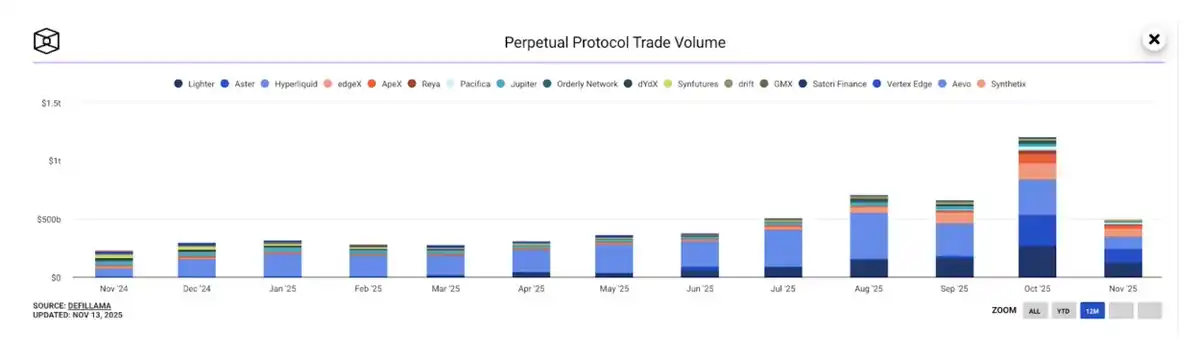
Over the past year, Hyperliquid almost monopolized the lead, reaching its peak in May this year, occupying 71% of on-chain perpetual contract trading volume. However, by November, its market share had plummeted to only 20%, with emerging competitors quickly seizing territory:
- Lighter: 27.7%
- Aster: 19.3%
- EdgeX: 14.6%
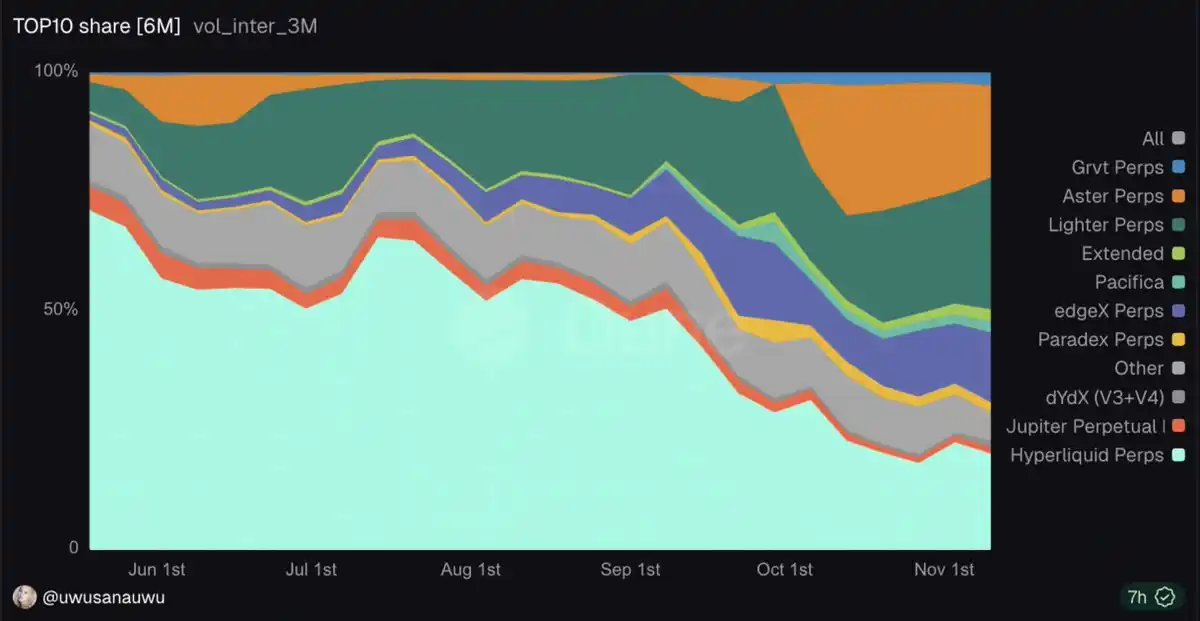
In this rapidly evolving ecosystem, the four dominant players have already emerged, engaging in fierce competition for industry dominance:
@HyperliquidX – The veteran champion of on-chain perpetual contracts
@Aster_DEX – The massive trading volume, controversy-ridden "rocket"
@Lighter_xyz – The disruptor with zero fees and native zk
@edgeX_exchange – The "dark horse" quietly aligned with institutions
This in-depth investigation aims to dispel the fog, dissecting the technical strength, key metrics, controversial focus, and long-term viability of each platform.
Part 1: Hyperliquid, the Undisputed Champion
Why Hyperliquid Reigns Supreme
Hyperliquid has solidified its position as the industry-leading decentralized perpetual contract trading platform, with a peak market share exceeding 71%. Despite competitors grabbing headlines with explosive trading volume growth, Hyperliquid remains a foundational pillar of the entire perpetual contract DEX ecosystem.
Technological Foundation
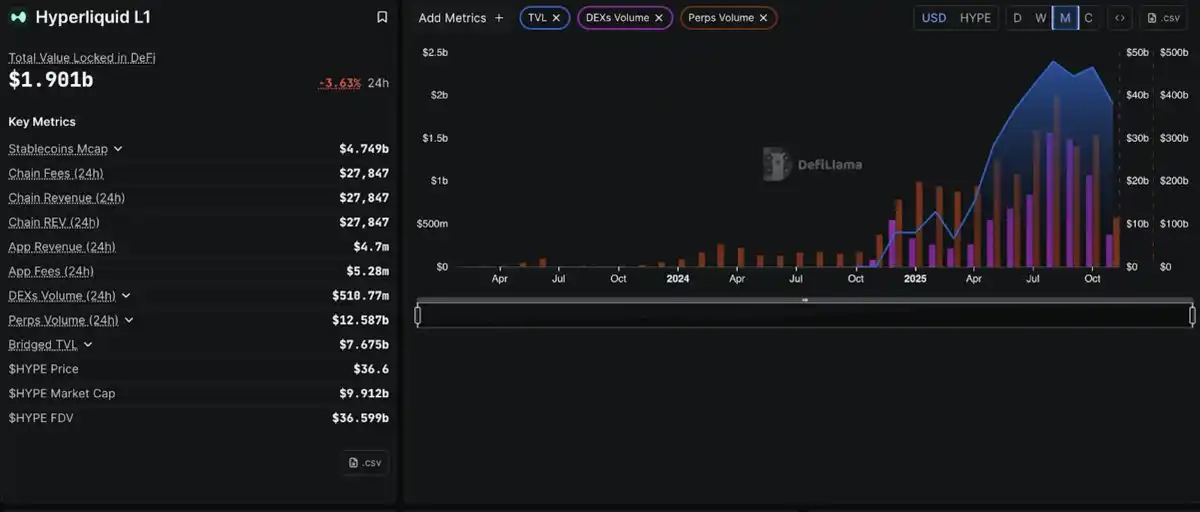
Hyperliquid's advantage stems from a revolutionary architectural decision: creating a custom Layer 1 blockchain designed specifically for derivative trading. Its HyperBFT consensus mechanism achieves sub-second order confirmation and supports 200,000 transactions per second, performance comparable to or even surpassing centralized exchanges.
The Truth About Open Interest
Competitors often attract attention with astounding 24-hour trading volumes, but the true indicator of capital deployment is Open Interest (OI), which represents the total value of all perpetual contracts still held.
Trading volume indicates activity, while Open Interest indicates capital commitment.
According to 21Shares data, as of September 2025: Aster occupies approximately 70% of total trading volume; Hyperliquid temporarily dropped to around 10%
However, this is only a volume advantage, and trading volume is the most easily manipulated metric through incentives, rebates, market maker frequent trading, or even "wash trading" behavior.
The latest 24-hour Open Interest data shows:
-Hyperliquid: $8.014B
-Aster: $2.329B
-Lighter: $1.591B
-edgeX: $780.41M
Total OI for the top four platforms: $12.714B
Hyperliquid's share: approximately 63%
This means that Hyperliquid holds nearly two-thirds of the entire market's Open Interest, surpassing the combined total of Aster, Lighter, and edgeX.
Open Interest Market Share (24h)
- Hyperliquid: 63.0%
- Aster: 18.3%
- Lighter: 12.5%
- edgeX: 6.1%
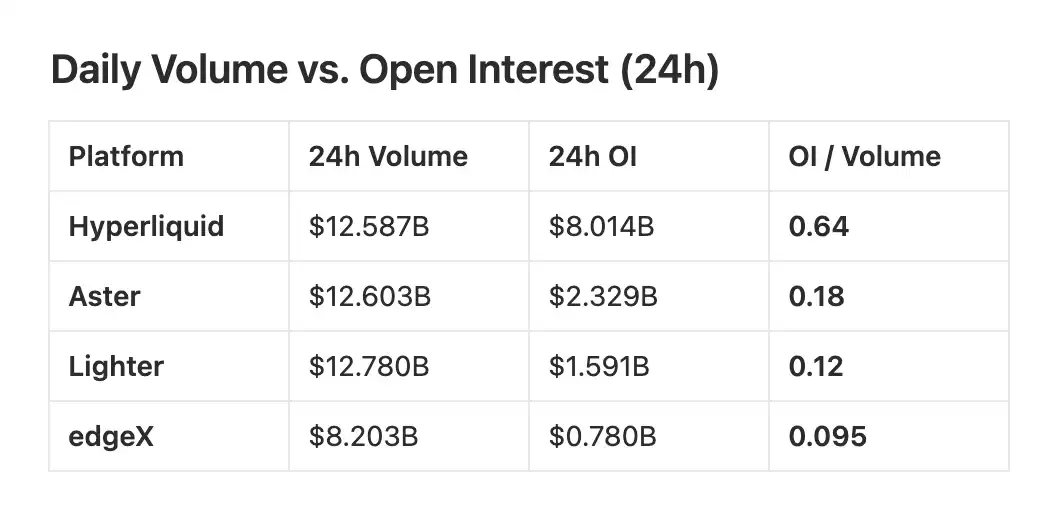
This metric reflects traders' willingness to hold funds overnight rather than purely for incentive mining or high-frequency trading.
Hyperliquid: High OI/Volume ratio (around 0.64), indicating a significant amount of trading volume translating into sustained open positions.
Aster & Lighter: Low ratios (around 0.18 and 0.12), suggesting frequent trading but minimal fund retention, typical of incentive-driven behavior rather than stable liquidity provision.
Full Picture
Trading Volume (24h): Indicates short-term activity
Open Interest (24h): Indicates retained risk capital
OI/Volume Ratio (24h): Reveals genuine trading vs incentive-driven trading
Across all OI-related metrics, Hyperliquid emerges as the structural leader: highest open interest; largest share of committed funds; strongest OI/Volume ratio; total OI exceeding the sum of the latter three platforms
While trading volume rankings may fluctuate, open interest unveils the true market frontrunner, which is Hyperliquid.
Real-World Validation
During the liquidation event in October 2025, $190 billion in positions were liquidated, and Hyperliquid maintained zero downtime during the peak trading volume.
Institutional Recognition
21Shares has submitted the Hyperliquid (HYPE) product application to the U.S. SEC and listed a regulated HYPE ETP on the Swiss stock exchange. These developments (including coverage on platforms like CoinMarketCap) indicate increasing institutional access to HYPE. The HyperEVM ecosystem is also expanding, although public data has not yet validated claims of "180+ projects" or "$4.1B TVL."
Conclusion
Based on the current record-keeping, exchange listings, and ecosystem growth, Hyperliquid demonstrates a strong momentum and increasing institutional recognition, further solidifying its position as a leading DeFi derivatives platform.
Part 2: Aster, Explosive Growth Amid Controversy
Aster's Positioning
Aster is a multi-chain perpetual contract trading platform that launched in early 2025 with a clear goal: to provide users with high-speed, high-leverage derivative trading on networks such as BNB Chain, Arbitrum, Ethereum, and Solana without the need for cross-chain asset transfers.
The project did not start from scratch but rather originated from the merger of Asterus and APX Finance at the end of 2024, combining APX's mature perpetual contract engine with Asterus's liquidity technology.
Explosive Rise
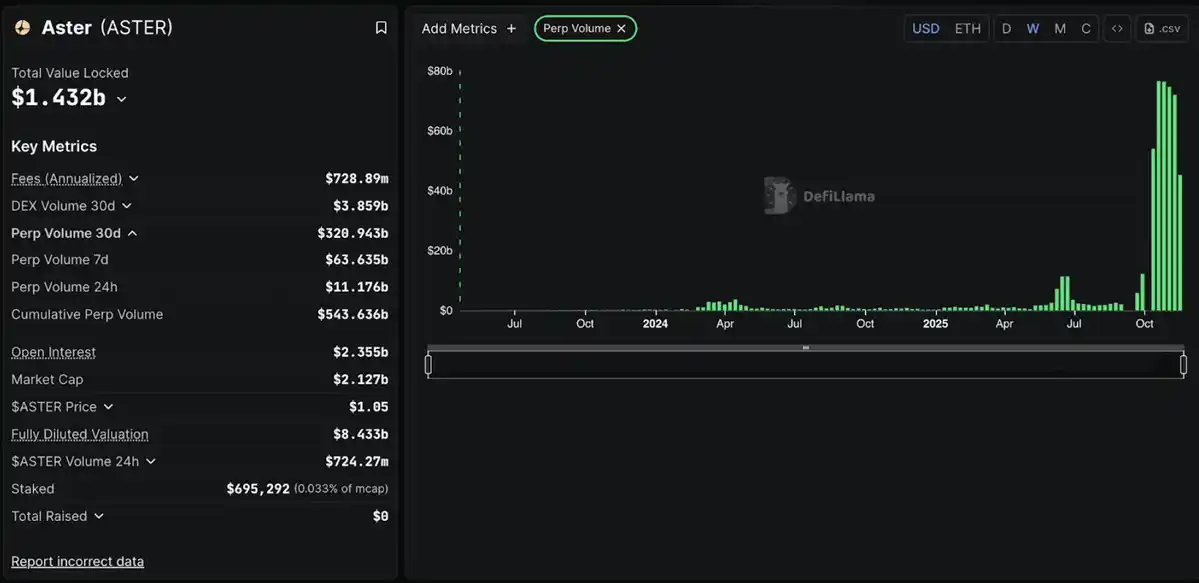
Aster launched on September 17, 2025, at $0.08 and skyrocketed to $2.42 in just one week, a staggering 2800% increase. The daily trading volume surged past $700 billion at its peak, temporarily dominating the entire perpetual contract DEX market.
The fuel for this "rocket"? CZ. The founder of Binance supported Aster through YZi Labs and personally tweeted to boost it, causing the token's price to soar. In the first 30 days of trading, Aster's cumulative trading volume exceeded $320 billion, briefly capturing over 50% market share.
DefiLlama Delisting Incident
On October 5, 2025, as the most trusted data source in the crypto industry, DefiLlama delisted Aster's data due to its trading volume being nearly identical to Binance's trading volume (1:1 correlation).
Real trading platforms exhibit natural fluctuations, and perfect correlation only means one thing: data manipulation.
Evidence includes:
- Trading volume patterns perfectly synchronized with Binance (across all pairs like XRP, ETH, etc.)
- Aster's refusal to provide trading data, making it impossible to verify the authenticity of trades
- 96% of ASTER tokens concentrated in 6 wallets
- Transaction Volume/OI Ratio as high as 58+ (Healthy level should be below 3)
ASTER token immediately dropped by 10%, from $2.42 to approximately $1.05
Aster's Defense
CEO Leonard claimed that this correlation was only due to "airdrop users" hedging on Binance. But if true, why refuse to provide public data as proof?
Weeks later, Aster relisted, but DefiLlama warned: "It's still a black box, we can't verify the data."
Its Actual Offerings
To be fair, Aster does have some technical highlights: 1001x leverage; hidden orders; multi-chain support (BNB, Ethereum, Solana); stakable collateral
Furthermore, Aster is building the Aster Chain based on zero-knowledge proofs for privacy protection. However, even great technology cannot cover up fake metrics.
Conclusion
Concrete evidence:
- Perfect correlation with Binance = Wash trading
- Lack of transparency = Concealment of facts
- 96% token concentration = High centralization
- DefiLlama delisting = Reputation collapse
Aster captured significant value through CZ's hype and fake trading volume but failed to establish a real infrastructure. Perhaps surviving due to Binance support, its reputation has been permanently damaged.
To Traders: High risk, you are betting on CZ's narrative, not real growth. Please set strict stop losses.
To Investors: Avoid, too many red flags, there are better options in the market (e.g., Hyperliquid).
Part Three: Lighter, Impressive Tech, Doubtful Metrics
Technological Advantages
Lighter is unique. Founded by a former Citadel engineer and backed by Peter Thiel, a16z, and Lightspeed (raised $68 million, $15 billion valuation), its core technology involves encrypting every transaction using Zero-Knowledge Proofs (ZK).
As an Ethereum Layer 2 (L2), Lighter inherits Ethereum's security through an "escape hatch" mechanism—even if the platform fails, users can still retrieve funds via smart contract. Application chains on L1 do not have this security feature.
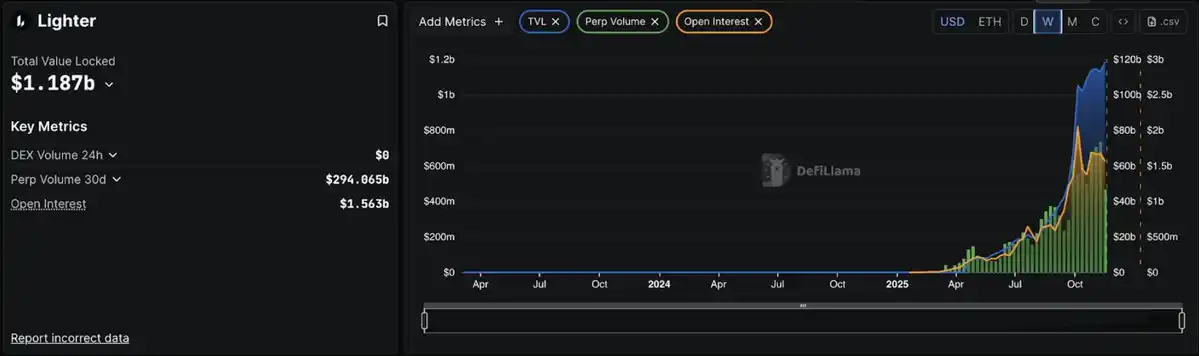
Lighter launched on October 2, 2025, and within weeks, its TVL surpassed $11 billion, with a daily trading volume of $70-80 billion and over 56,000 users.
Zero Fees = Aggressive Strategy
Lighter charges 0 fees for both Maker and Taker transactions, completely disrupting the decision-making of fee-sensitive traders.
The strategy is simple: to capture market share through an unsustainable economic model, build user loyalty, and subsequently achieve profitability.
October 11 Stress Test
10 days after the mainnet launch, the crypto market experienced its largest liquidation event in history, with $190 billion in positions liquidated.
Good news: The system remained operational during a 5-hour turmoil, with LLP providing liquidity as competitors retreated.
Bad news: The database crashed after 5 hours, leading to a 4-hour platform outage.
Worse news: LLP incurred losses, while Hyperliquid's HLP and EdgeX's eLP were profitable.
Founder Vlad Novakovski explained: The original plan was to upgrade the database on Sunday, but the intense Friday fluctuations prematurely crippled the old system.
Volume Manipulation
Data strongly suggests wash trading behavior:
- 24-hour trading volume: $127.8 billion
- Open interest (OI): $15.91 billion
- Volume/OI ratio: 8.03
- Healthy range = below 3, suspicious above 5, 8.03 is extremely abnormal.
Comparison:
Hyperliquid: 1.57 (Natural)
EdgeX: 2.7 (Moderate)
Aster: 5.4 (Concerning)
Lighter: 8.03 (Severe wash trading)
For every $1 deployed by traders, $8 in trading volume is generated—indicative of frequent flipping for wash trading, not actual positions held.
30-day data validation: $2.94 trillion trading volume vs. $470 billion cumulative OI = 6.25 ratio, still significantly above a reasonable level.
Airdrop Question
The Lighter loyalty program is highly aggressive. Loyalty points will be converted to LITER tokens at TGE (expected in Q4 2025/Q1 2026). The OTC market values points at $5-100+, with a potential airdrop value of tens of thousands of dollars, explaining the explosive trading volume.
Key question: What will happen after TGE? Will users stay or will trading volume collapse?
Conclusion
Advantages:
Cutting-edge technology (ZK verification in place)
Zero fees = a true competitive advantage
Inherited Ethereum security
Top-tier team with capital backing
Concerns:
8.03 transaction volume/OI ratio = severe wash trading
LLP incurred losses in stress testing
4-hour downtime raised questions
Post-airdrop user retention not validated
Key difference from Aster: No wash trading accusations, no DeFiLlama delisting. The high ratio reflects aggressive but temporary incentives, not systematic fraud.
Bottom Line Assessment: Lighter boasts world-class technology but is shrouded in suspicious metrics. Can they convert wash traders into real users? Tech says "can," history says "maybe not."
To wash traders: Good opportunity before TGE.
To investors: Wait 2-3 months after TGE, observe if trading volume sustains.
Probability assessment: 40% become a top-three platform, 60% devolve into another "wash farm," just with better underlying technology.
Part Four: EdgeX, Institutional-Grade Pro Player
Amber Group's Advantages
EdgeX operates differently. It originates from Amber Group's incubator (managing $50 billion AUM), with team members from Morgan Stanley, Barclays, Goldman Sachs, Bybit. This isn't "crypto-native" learning finance but traditional finance (TradFi) experts bringing institutional experience into DeFi.
Amber's market-making DNA directly empowers EdgeX: deep liquidity, tight spreads, and execution quality rivaling centralized exchanges. The platform launched in September 2024 with a clear goal: achieve CEX-level performance without sacrificing self-custody.
Built on StarkEx (StarkWare's mature ZK engine), EdgeX can process 200,000 orders per second, with latencies below 10 milliseconds, on par with Binance's speed.
Lower Fees Than Hyperliquid
EdgeX excels in fees compared to Hyperliquid:
Taker Fee: EdgeX 0.038% vs Hyperliquid 0.045%
Maker Fee: EdgeX 0.012% vs Hyperliquid 0.015%
For a trader with a monthly volume of $10 million, savings can amount to $7,000-$10,000 per year, and at the retail order level (<$6 million), EdgeX offers better liquidity, tighter spreads, and lower slippage.
Real Revenue, Healthy Metrics
Unlike Lighter's zero-fee model or Aster's questionable data, EdgeX has created real, sustainable revenue:
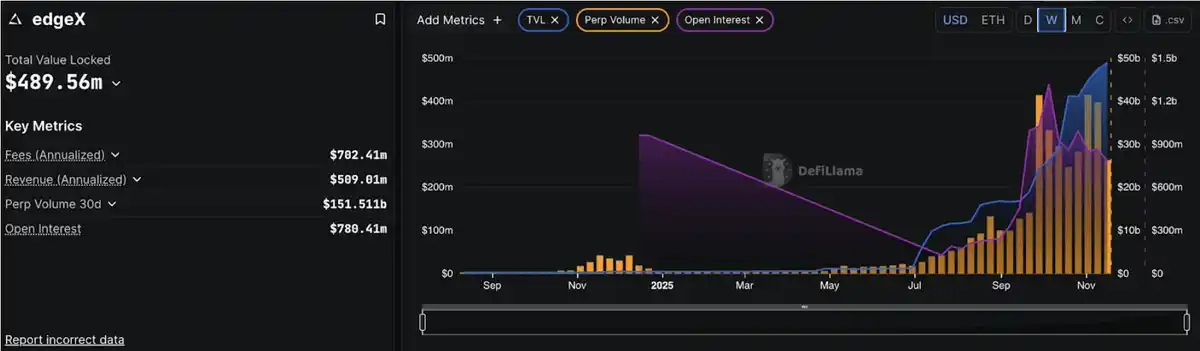
TVL: $4.897 billion
24-Hour Trading Volume: $82 billion
Open Interest (OI): $7.8 billion
30-Day Revenue: $41.72 million (147% QoQ growth)
Annualized Revenue: $5.09 billion (second only to Hyperliquid)
Trading Volume/OI Ratio: 10.51 (seemingly high, but requires in-depth analysis)
At first glance, 10.51 may seem high, but context is crucial: EdgeX initially employed an aggressive incentive program to drive liquidity at launch, and as the platform matures, this ratio is steadily improving. More importantly, EdgeX has maintained healthy revenue during this period, proving the presence of real traders rather than pure wash traders.
October Stress Test
During the market crash on October 11th ($190 billion liquidated), EdgeX performed exceptionally:
No downtime (Lighter had 4 hours of downtime)
eLP Treasury remained profitable (Lighter's LLP suffered losses)
Liquidity Provider Annualized Return Rate 57% (industry-leading)
The eLP (EdgeX Liquidity Pool) demonstrated outstanding risk management capabilities during extreme volatility, remaining profitable while competitors faced difficulties.
EdgeX Differentiation Advantages
Multi-Chain Flexibility: Supports Ethereum L1, Arbitrum, BNB Chain; Collateral supports USDT and USDC; Cross-chain deposits and withdrawals (Hyperliquid limited to Arbitrum).
Best Mobile Experience: Official iOS and Android apps (not available on Hyperliquid), simple interface for easy position management anytime.
Asian Market Strategy: Actively positioning in the Asian market through localized support and participation in Korea Blockchain Week, seizing the region overlooked by Western competitors.
Transparent Incentive Program: 60% Trading Volume, 20% Referrals, 10% TVL/Treasury, 10% Liquidation/OI
Clear Statement: "No volume mining rewards," and the metrics validate this—trading volume/OI ratio is improving, not deteriorating.
Challenges
Market Share: Only accounts for 5.5% of perpetual contract DEX open interest, to grow, more aggressive incentives (risk of score manipulation) or major partnerships are required.
Lack of "Killer Feature": EdgeX performs well in all aspects but lacks disruptive innovation, presenting itself as a "business-class" option, professional but not dazzling.
Unable to Compete with Lighter on Fees: Zero fees make EdgeX's "lower than Hyperliquid" advantage less attractive.
Late TGE Timing: Expected in Q4 2025, missing out on the initial airdrop frenzy.
Conclusion
EdgeX is the choice for professional users—reliability triumphs over flashiness.
Advantages:
Amber Group institutional support
$5.09 billion annual revenue
Treasury profitability in stress tests, APY up to 57%
Fees lower than Hyperliquid
No volume mining scandals, clean metrics
Multi-chain support + Best mobile experience
Concerns:
Small market share (5.5% OI)
Trading volume/OI ratio still high (but improving)
Lack of unique selling points
Pressure from zero fee competition
Target Audience:
Asian traders needing localized support
Institutional User, Emphasizing Amber Liquidity
Conservative Trader, Prioritizing Risk Management
Mobile-First User
LP Investor Seeking Stable Returns
Bottom Line Assessment: EdgeX is poised to capture a 10-15% market share in the Asian market, among institutions and conservative traders. It will not threaten Hyperliquid's dominant position, but it doesn't need to—it is building a sustainable, profitable niche market.
Think of it as the "Kraken of Perpetual Contract DEX": Not the largest, not the flashiest, but sturdy, professional, and highly valued by mature users who prioritize execution quality.
For Yield Farmers: Moderate opportunity, less intense competition compared to other platforms.
For Investors: Suitable for small position diversified investments, low risk, low return.
Comparative Analysis: Perp DEX Wars
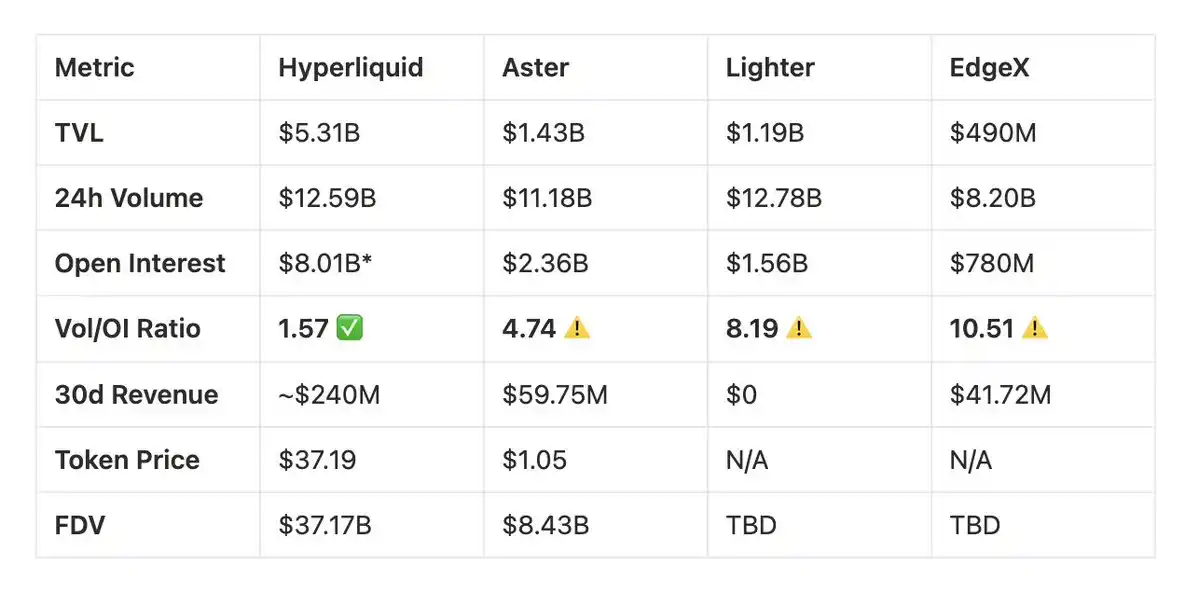
Trading Volume/Open Interest (OI) Analysis
Industry Standard: Healthy Ratio ≤ 3
Hyperliquid: 1.57 ✅ Indicates a strong organic trading pattern
Aster: 4.74 ⚠️ Slightly high, reflecting significant incentive activities
Lighter: 8.19 ⚠️ High ratio implies incentive-driven trading
EdgeX: 10.51 ⚠️ Points plan impact is evident, but showing improvement
Market Share: Open Interest Distribution
Total Market: Approximately $13B OI
Hyperliquid: 62% - Market Leader
Aster: 18% - Strong Second Tier
Lighter: 12% - Continued Growth
EdgeX: 6% - Focused on a niche market
Platform Overview
Hyperliquid - Seasoned Leader
Controls 62% market share, stable metrics
Annual Revenue $2.9B, active buyback program
Community Ownership Model, Reliable Performance
Advantages: Market Leadership, Sustainable Economic Model
Rating: A+
Aster - High Growth, High Uncertainty
Strong Integration with BNB Ecosystem, CZ Endorsement
Faced DefiLlama Data Scrutiny in October 2025
Multi-chain Strategy Driving Adoption
Advantages: Ecosystem Support, Retail User Coverage
Concerns: Need to Monitor Data Transparency Issues
Rating: C+
Lighter - Technology Vanguard
Zero Fee Model, Advanced ZK Verification
Top-tier Investors (Thiel, a16z, Lightspeed)
Prior to TGE Stage (2026 Q1), Limited Performance Data
Advantages: Technological Innovation, Ethereum L2 Security
Concerns: Business Model Sustainability, User Retention Post Airdrop
Rating: Not Completed (Awaiting TGE Performance)
EdgeX - Institution-driven
Endorsed by Amber Group, Professional-grade Execution
$509M Annualized Revenue, Stable Treasury Performance
Asia Market Strategy, Mobile-first
Advantages: Institutional Reputation, Steady Growth
Concerns: Small Market Share, Competitive Positioning
Rating: B
Investment Considerations
Exchange Selection:
Hyperliquid: Deepest Liquidity, Reliability Validation
Lighter: Zero Fees, Suitable for High-frequency Traders
EdgeX: Lower Fees than Hyperliquid, Excellent Mobile Experience
Aster: Multi-chain Flexibility, BNB Ecosystem Integration
Token Investment Timeline:
HYPE: Now Available, $37.19
ASTER: Trading at $1.05, watch for future developments
LITER: TGE 2026 Q1, metrics to be evaluated post-launch
EGX: TGE 2025 Q4, observe initial performance
Key Takeaways
Market Maturity: Clear differentiation in the Perp DEX space, with Hyperliquid establishing dominance through sustainable metrics and community collaboration.
Growth Strategies: Each platform targets different user demographics—Hyperliquid (Professional), Aster (Retail/Asia), Lighter (Tech), EdgeX (Institutional).
Metrics Focus: Metrics such as Trading Volume/OI ratio and Revenue Generation Ratio can better reflect performance than mere trading volume.
Future Outlook: Post-TGE performance of Lighter and EdgeX will determine long-term competitiveness; Aster's future hinges on addressing transparency issues and maintaining ecosystem support.
You may also like

Uniswap Token Burn Proposal Approved, What Is the Overseas Crypto Community Talking About Today?

December 24th Market Key Intelligence, How Much Did You Miss?

Aave Community Governance Drama Escalates, What's the Overseas Crypto Community Talking About Today?

Where Did $362 Million Go? Hyperliquid Counters FUD in Decentralization Showdown

2025 Whale Saga: Mansion Kidnapping, Supply Chain Poisoning, and Billions Liquidated

Coinbase Joins Prediction Market, AAVE Governance Dispute - What's the Overseas Crypto Community Talking About Today?
Over the past 24 hours, the crypto market has shown strong momentum across multiple dimensions. The mainstream discussion has focused on Coinbase's official entry into the prediction market through the acquisition of The Clearing Company, as well as the intense controversy within the AAVE community regarding token incentives and governance rights.
In terms of ecosystem development, Solana has introduced the innovative Kora fee layer aimed at reducing user transaction costs; meanwhile, the Perp DEX competition has intensified, with the showdown between Hyperliquid and Lighter sparking widespread community discussion on the future of decentralized derivatives.
This week, Coinbase announced the acquisition of The Clearing Company, marking another significant move to deepen its presence in this field after last week's announcement of launching a prediction market on its platform.
The Clearing Company's founder, Toni Gemayel, and the team will join Coinbase to jointly drive the development of the prediction market business.
Coinbase's Product Lead, Shan Aggarwal, stated that the growth of the prediction market is still in its early stages and predicts that 2026 will be the breakout year for this field.
The community has reacted positively to this, generally believing that Coinbase's entry will bring significant traffic and compliance advantages to the prediction market. However, this has also sparked discussions about the industry's competitive landscape.
Jai Bhavnani, Founder of Rivalry, commented that for startups, if their product model proves to be successful, industry giants like Coinbase have ample reason to replicate it.
This serves as a reminder to all entrepreneurs in the crypto space that they must build significant moats to withstand competition pressure from these giants.
Regulated prediction market platform Kalshi launched its research arm, Kalshi Research, this week, aimed at opening its internal data to the academic community and researchers to facilitate exploration of prediction market-related topics.
Its inaugural research report highlights Kalshi's outperformance in predicting inflation compared to Wall Street's traditional models. Kalshi co-founder Luana Lopes Lara commented that the power of prediction markets lies in the valuable data they generate, and it is now time to better utilize this data.
Meanwhile, Kalshi announced its support for the BNB Chain (BSC), allowing users to deposit and withdraw BNB and USDT via the BSC network.
This move is seen as a significant step for Kalshi to open its platform to a broader crypto user base, aiming to unlock access to the world's largest prediction market. Furthermore, Kalshi also revealed plans to host the first Prediction Market Summit in 2026 to further drive industry engagement and development.
The AAVE community recently engaged in heated debates around an Aave Improvement Proposal (AIP) titled "AAVE Tokenomics Alignment Phase One - Ownership Governance," aiming to transfer ownership and control of the Aave brand from Aave Labs to Aave DAO.
Aave founder Stani Kulechov publicly stated his intention to vote against the proposal, believing it oversimplifies the complex legal and operational structure, potentially slowing down the development process of core products like Aave V4.
The community's reaction was polarized. Some criticized Stani for adopting a "double standard" in governance and questioned whether his team had siphoned off protocol revenue, while others supported his cautious stance, arguing that significant governance changes require more thorough discussion.
This controversy highlights the tension between the ideal of DAO governance in DeFi projects and the actual power held by core development teams.
Despite governance disputes putting pressure on the AAVE token price, on-chain data shows that Stani Kulechov himself has purchased millions of dollars' worth of AAVE in the past few hours.
Simultaneously, a whale address, 0xDDC4, which had been quiet for 6 months, once again spent 500 ETH (approximately $1.53 million) to purchase 9,629 AAVE tokens. Data indicates that this whale has accumulated nearly 40,000 AAVE over the past year but is currently in an unrealized loss position.
The founder and whale's increased holdings during market volatility were interpreted by some investors as a confidence signal in AAVE's long-term value.
In this week's top article, Morpho Labs' "Curator Explained" detailed the role of "curators" in DeFi.
The article likened curators to asset managers in traditional finance, who design, deploy, and manage on-chain vaults, providing users with a one-click diversified investment portfolio.
Unlike traditional fund managers, DeFi curators execute strategies automatically through non-custodial smart contracts, allowing users to maintain full control of their assets. The article offered a new perspective on the specialization and risk management in the DeFi space.
Another widely circulated article, "Ethereum 2025: From Experiment to Global Infrastructure," provided a comprehensive summary of Ethereum's development over the past year. The article noted that 2025 is a crucial year for Ethereum's transition from an experimental project to global financial infrastructure. Through the Pectra and Fusaka hard forks, Ethereum achieved significant reductions in account abstraction and transaction costs.
Furthermore, the SEC's clarification of Ethereum's "non-securities" nature and the launch of tokenized funds on the Ethereum mainnet by traditional financial giants like JPMorgan marked Ethereum's gaining recognition from mainstream institutions. The article suggested that whether it is the continued growth of DeFi, the thriving L2 ecosystem, or the integration with the AI field, Ethereum's vision as the "world computer" is gradually becoming a reality.
The Solana Foundation engineering team released a fee layer solution called Kora this week.
Kora is a fee relayer and signatory node designed to provide the Solana ecosystem with a more flexible transaction fee payment method. Through Kora, users will be able to achieve gas-free transactions or choose to pay network fees using any stablecoin or SPL token. This innovation is seen as an important step in lowering the barrier of entry for new users and improving Solana network's availability.
Additionally, a deep research report on propAMM (proactive market maker) sparked community interest. The report's data analysis of propAMMs on Solana like HumidiFi indicated that Solana has achieved, or even surpassed, the level of transaction execution quality in traditional finance (TradFi) markets.
For example, on the SOL-USDC trading pair, HumidiFi is able to provide a highly competitive spread for large trades (0.4-1.6 bps), which is already better than the trading slippage of some mid-cap stocks in traditional markets.
Research suggests that propAMM is making the vision of the "Internet Capital Market" a reality, with Solana emerging as the prime venue for all of this to happen.
The competition in the perpetual contract DEX (Perp DEX) space is becoming increasingly heated.
In its latest official article, Hyperliquid has positioned its emerging competitor, Lighter, alongside centralized exchanges like Binance, referring to it as a platform utilizing a centralized sequencer. Hyperliquid emphasizes its transparency advantage of being "fully on-chain, operated by a validator network, and with no hidden state."
The community widely interprets this as Hyperliquid declaring "war" on Lighter. The technical differences between the two platforms have also become a focal point of discussion: Hyperliquid focuses on ultimate on-chain transparency, while Lighter emphasizes achieving "verifiable execution" through zero-knowledge proofs to provide users with a Central Limit Order Book (CLOB)-like trading experience.
This battle over the future direction of decentralized derivatives exchanges is expected to peak in 2026.
Meanwhile, discussions about Lighter's trading fees have surfaced. Some users have pointed out that Lighter charged as much as 81 basis points (0.81%) for a $2 million USD/JPY forex trade, far exceeding the near-zero spreads of traditional forex brokers.
Some argue that Lighter does not follow a B-book model that bets against market makers, instead anchoring its prices to the TradFi market, and the high fees may be related to the current liquidity or market maker balance incentives. Providing a more competitive spread for real-world assets (RWA) in the highly volatile crypto market is a key issue Lighter will need to address in the future.

Why Did Market Sentiment Completely Collapse in 2025? Decoding Messari's Ten-Thousand-Word Annual Report

Open Source Achilles' Heel: Nofx and Its 9,000-Star Drama, Forking Fiasco, and Open Source Controversy
Upcoming Lighter TGE: What Is a Reasonable Valuation? As a finance and blockchain translation expert, you are familiar with the field's slang and terminology.

Security Tokenization and Prediction Markets: 7 Major Crypto Boons to Watch in 2026

Aave Yield Distribution Dispute, Solana Surpasses Ethereum in Revenue, What's the Overseas Crypto Community Talking About Today?
Messari 2026 Research Report: Insights into Seven Key Crypto Trends

Key Market Insights from December 19th, How Much Did You Miss Out?
UNI Burn Proposal Vote, Lighter TGE Outlook, What's the Topic of Conversation in the Global Crypto Community Today?
Hyperliquid Price Projection: Anticipated Decline to $19.46 by December 22, 2025
Hyperliquid’s market sentiment remains overwhelmingly bearish, with a projected price drop of -22.76% in the next five days.…
Fartcoin Falls Below Critical Price Point Amidst Market Uncertainty
Key Takeaways Fartcoin’s value briefly dipped below $0.29, registering an approximate 8.4% decline to reach $0.28 before stabilizing.…

Hyperliquid User Experiences $21 Million Loss Due to Key Leak
Key Takeaways A Hyperliquid user experienced a $21 million loss as a result of a private key leak,…

Why does Hyperliquid earn less than Coinbase?
Uniswap Token Burn Proposal Approved, What Is the Overseas Crypto Community Talking About Today?
December 24th Market Key Intelligence, How Much Did You Miss?
Aave Community Governance Drama Escalates, What's the Overseas Crypto Community Talking About Today?
Where Did $362 Million Go? Hyperliquid Counters FUD in Decentralization Showdown
2025 Whale Saga: Mansion Kidnapping, Supply Chain Poisoning, and Billions Liquidated
Coinbase Joins Prediction Market, AAVE Governance Dispute - What's the Overseas Crypto Community Talking About Today?
Over the past 24 hours, the crypto market has shown strong momentum across multiple dimensions. The mainstream discussion has focused on Coinbase's official entry into the prediction market through the acquisition of The Clearing Company, as well as the intense controversy within the AAVE community regarding token incentives and governance rights.
In terms of ecosystem development, Solana has introduced the innovative Kora fee layer aimed at reducing user transaction costs; meanwhile, the Perp DEX competition has intensified, with the showdown between Hyperliquid and Lighter sparking widespread community discussion on the future of decentralized derivatives.
This week, Coinbase announced the acquisition of The Clearing Company, marking another significant move to deepen its presence in this field after last week's announcement of launching a prediction market on its platform.
The Clearing Company's founder, Toni Gemayel, and the team will join Coinbase to jointly drive the development of the prediction market business.
Coinbase's Product Lead, Shan Aggarwal, stated that the growth of the prediction market is still in its early stages and predicts that 2026 will be the breakout year for this field.
The community has reacted positively to this, generally believing that Coinbase's entry will bring significant traffic and compliance advantages to the prediction market. However, this has also sparked discussions about the industry's competitive landscape.
Jai Bhavnani, Founder of Rivalry, commented that for startups, if their product model proves to be successful, industry giants like Coinbase have ample reason to replicate it.
This serves as a reminder to all entrepreneurs in the crypto space that they must build significant moats to withstand competition pressure from these giants.
Regulated prediction market platform Kalshi launched its research arm, Kalshi Research, this week, aimed at opening its internal data to the academic community and researchers to facilitate exploration of prediction market-related topics.
Its inaugural research report highlights Kalshi's outperformance in predicting inflation compared to Wall Street's traditional models. Kalshi co-founder Luana Lopes Lara commented that the power of prediction markets lies in the valuable data they generate, and it is now time to better utilize this data.
Meanwhile, Kalshi announced its support for the BNB Chain (BSC), allowing users to deposit and withdraw BNB and USDT via the BSC network.
This move is seen as a significant step for Kalshi to open its platform to a broader crypto user base, aiming to unlock access to the world's largest prediction market. Furthermore, Kalshi also revealed plans to host the first Prediction Market Summit in 2026 to further drive industry engagement and development.
The AAVE community recently engaged in heated debates around an Aave Improvement Proposal (AIP) titled "AAVE Tokenomics Alignment Phase One - Ownership Governance," aiming to transfer ownership and control of the Aave brand from Aave Labs to Aave DAO.
Aave founder Stani Kulechov publicly stated his intention to vote against the proposal, believing it oversimplifies the complex legal and operational structure, potentially slowing down the development process of core products like Aave V4.
The community's reaction was polarized. Some criticized Stani for adopting a "double standard" in governance and questioned whether his team had siphoned off protocol revenue, while others supported his cautious stance, arguing that significant governance changes require more thorough discussion.
This controversy highlights the tension between the ideal of DAO governance in DeFi projects and the actual power held by core development teams.
Despite governance disputes putting pressure on the AAVE token price, on-chain data shows that Stani Kulechov himself has purchased millions of dollars' worth of AAVE in the past few hours.
Simultaneously, a whale address, 0xDDC4, which had been quiet for 6 months, once again spent 500 ETH (approximately $1.53 million) to purchase 9,629 AAVE tokens. Data indicates that this whale has accumulated nearly 40,000 AAVE over the past year but is currently in an unrealized loss position.
The founder and whale's increased holdings during market volatility were interpreted by some investors as a confidence signal in AAVE's long-term value.
In this week's top article, Morpho Labs' "Curator Explained" detailed the role of "curators" in DeFi.
The article likened curators to asset managers in traditional finance, who design, deploy, and manage on-chain vaults, providing users with a one-click diversified investment portfolio.
Unlike traditional fund managers, DeFi curators execute strategies automatically through non-custodial smart contracts, allowing users to maintain full control of their assets. The article offered a new perspective on the specialization and risk management in the DeFi space.
Another widely circulated article, "Ethereum 2025: From Experiment to Global Infrastructure," provided a comprehensive summary of Ethereum's development over the past year. The article noted that 2025 is a crucial year for Ethereum's transition from an experimental project to global financial infrastructure. Through the Pectra and Fusaka hard forks, Ethereum achieved significant reductions in account abstraction and transaction costs.
Furthermore, the SEC's clarification of Ethereum's "non-securities" nature and the launch of tokenized funds on the Ethereum mainnet by traditional financial giants like JPMorgan marked Ethereum's gaining recognition from mainstream institutions. The article suggested that whether it is the continued growth of DeFi, the thriving L2 ecosystem, or the integration with the AI field, Ethereum's vision as the "world computer" is gradually becoming a reality.
The Solana Foundation engineering team released a fee layer solution called Kora this week.
Kora is a fee relayer and signatory node designed to provide the Solana ecosystem with a more flexible transaction fee payment method. Through Kora, users will be able to achieve gas-free transactions or choose to pay network fees using any stablecoin or SPL token. This innovation is seen as an important step in lowering the barrier of entry for new users and improving Solana network's availability.
Additionally, a deep research report on propAMM (proactive market maker) sparked community interest. The report's data analysis of propAMMs on Solana like HumidiFi indicated that Solana has achieved, or even surpassed, the level of transaction execution quality in traditional finance (TradFi) markets.
For example, on the SOL-USDC trading pair, HumidiFi is able to provide a highly competitive spread for large trades (0.4-1.6 bps), which is already better than the trading slippage of some mid-cap stocks in traditional markets.
Research suggests that propAMM is making the vision of the "Internet Capital Market" a reality, with Solana emerging as the prime venue for all of this to happen.
The competition in the perpetual contract DEX (Perp DEX) space is becoming increasingly heated.
In its latest official article, Hyperliquid has positioned its emerging competitor, Lighter, alongside centralized exchanges like Binance, referring to it as a platform utilizing a centralized sequencer. Hyperliquid emphasizes its transparency advantage of being "fully on-chain, operated by a validator network, and with no hidden state."
The community widely interprets this as Hyperliquid declaring "war" on Lighter. The technical differences between the two platforms have also become a focal point of discussion: Hyperliquid focuses on ultimate on-chain transparency, while Lighter emphasizes achieving "verifiable execution" through zero-knowledge proofs to provide users with a Central Limit Order Book (CLOB)-like trading experience.
This battle over the future direction of decentralized derivatives exchanges is expected to peak in 2026.
Meanwhile, discussions about Lighter's trading fees have surfaced. Some users have pointed out that Lighter charged as much as 81 basis points (0.81%) for a $2 million USD/JPY forex trade, far exceeding the near-zero spreads of traditional forex brokers.
Some argue that Lighter does not follow a B-book model that bets against market makers, instead anchoring its prices to the TradFi market, and the high fees may be related to the current liquidity or market maker balance incentives. Providing a more competitive spread for real-world assets (RWA) in the highly volatile crypto market is a key issue Lighter will need to address in the future.
Popular coins
Latest Crypto News


Customer Support:@weikecs
Business Cooperation:@weikecs
Quant Trading & MM:bd@weex.com
VIP Services:support@weex.com
 App
App