
- Buy Crypto
- Markets
- Futures
- Spot
- Copy Trade
 WE-Launch
A man named threadguy disappeared

Author: Kaori, BlockBeats
Editor: Jack, BlockBeats
Today marks the 20th day of threadguy's "disappearance," and almost every day someone on X is discussing when he will return.
threadguy's most recent social media interaction was when he liked a post that said, "Business leaders are willing to pay up to $5 million to have a one-on-one meeting with President Trump at his Florida estate, while others pay $1 million to attend a group dinner with him. Gotta admire threadguy, spending $25,000 to meet Trump really is a steal."
This like is like a time capsule, sealing the moment of intersection between this 23-year-old crypto youth and the center of power at close range.
Let's rewind to September 22, 2024, at the Mar-a-Lago estate during this Trump dinner. threadguy, dressed in a dark pinstripe suit with a carefully selected eagle-shaped tie clip, sporting his freshly dyed iconic golden hair, raised his hand and asked Trump a question, "As someone who is interested in NFTs, I'm curious, if (hopefully not) you do not win this election, what do you think the future of cryptocurrency will be like?"

As usual, Trump shrugged and said, "I think it is the future." Facing threadguy, Trump took 30 seconds to answer the question, "I think the future of cryptocurrency is very bright, really. Maybe we can use it to pay off the $35 trillion debt, right? I just scribbled a little note, $35 trillion in cryptocurrency, so we have no debt, right?"
Before taking the stage, Trump was preparing behind the curtain, with threadguy just two steps away from him. The girl filming threadguy kept urging him to do something.
threadguy raised his hand to gesture to Trump, and when Trump turned to him, he asked, "Will there be more Trump Cards in the future?" Trump said he didn't know, to which threadguy quickly added, "I'm a top holder, I love them," and Trump immediately reached out and tightly shook hands with threadguy.
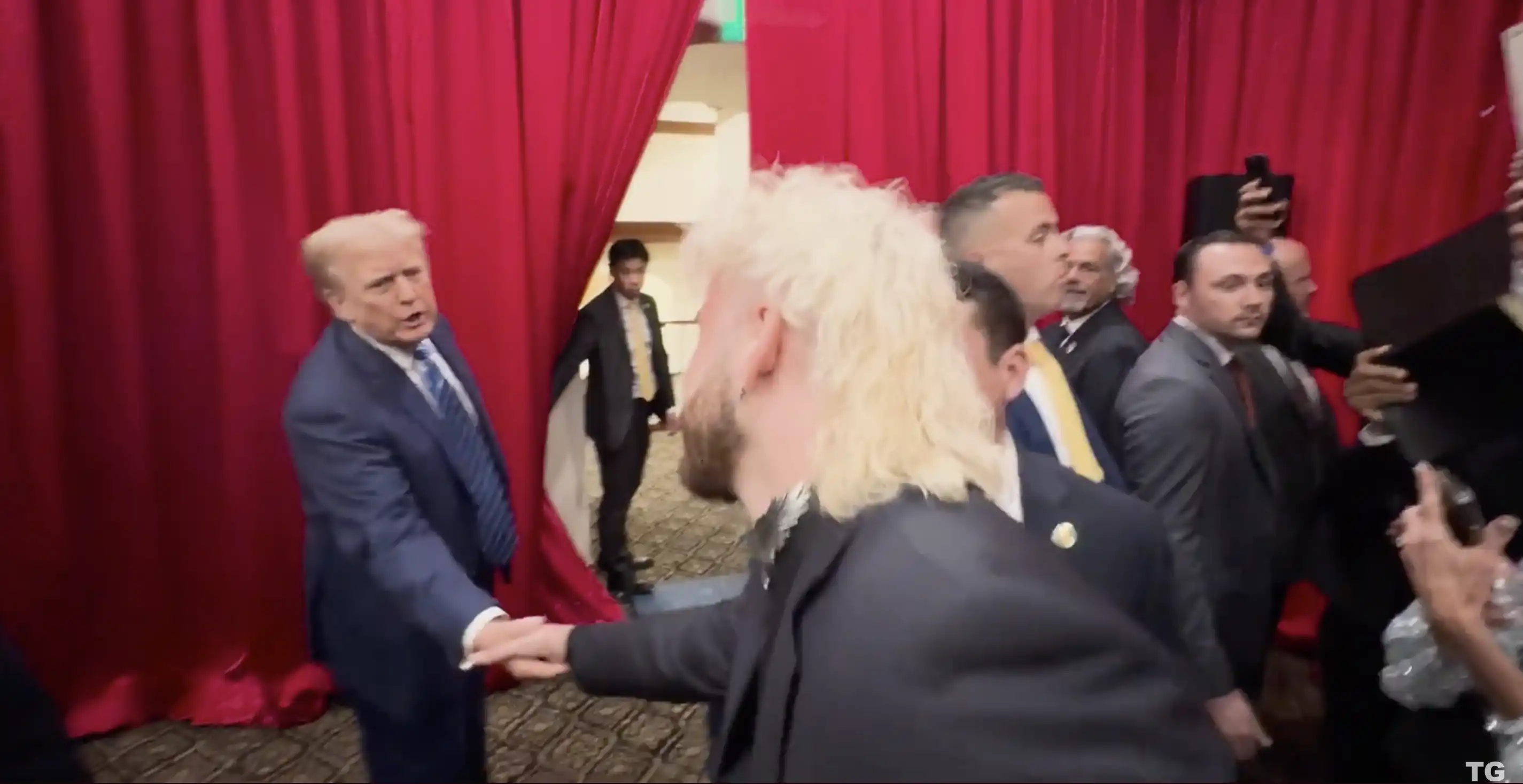
As for this dinner, there was a side story where threadguy asked five different people in a row, none of whom knew they needed to buy an NFT to get in. Just because they knew someone, threadguy repeated to the camera several times, "Am I the only one who bought an NFT?"
And 5 months later, threadguy found himself embroiled in another presidential-related controversy. The Argentine coin LIBRA subjected this young man and his crypto business to a capital meat grinder. This time, without the dashing suit and golden hair, threadguy appeared on camera looking dismayed, saying, "Most people in this market will eventually be 'rekt' [wiped out]. The number of people who can truly make money is very small, and the outcome usually isn't great. No one is willing to actively promote this casino, yet I inadvertently played that role."
The Dropout Teen's Rule of Breaking the Circle
In 2021, Michael Jerome, a sophomore at the Virginia Business School, stayed in the first Zoom accounting class for less than 10 minutes before decisively leaving the meeting. The next day, he made a bold decision—to drop out and go all-in on the crypto field.
Having dabbled in trading card and sneaker flipping during his youth, Michael found himself naturally drawn to the NFT world, where he rediscovered a familiar feeling—an enthusiastic community, the possibility of making money, and the joy of collecting, all reminiscent of his past hobbies.

Michael at a basketball game
2021 was hailed as the year of NFTs. Globally, the transaction volume surrounding NFTs exceeded $19.6 billion, a 228-fold increase over 2020. NFT digital collectibles generated a total transaction volume of over 8.16 million and a total transaction value of over $6.5 billion. According to reports in the domestic media, the majority of potential NFT collectors are post-2000s and post-1990s generations, with post-1990s accounting for about 37% of NFT potential collectors, ranking first, and post-2000s accounting for about 27%, ranking second.
Michael was not a big player, nor a seasoned trader, and certainly not a project founder, so he began searching for gaps in the market. At that time, if someone wanted to learn about a particular NFT project, reliable sources of information were nearly impossible to find. Perhaps a few sporadic tweets could be found on Twitter or an outdated article. It was for this reason that Michael decided to start writing in-depth threads about projects he was genuinely interested in.
In August 2021, Michael named his newly created Twitter account DiscoverxNFT and continued to post analytical threads about NFT projects for three consecutive months. These posts had no personal style, no memes, no nonsense—just straightforward project information. As a result, DiscoverxNFT grew from zero followers to around 5,000.
Michael Mint's first NFT project was Jenkins The Valet in October 2021, for which Michael wrote a long tweet thread. At that time, the DiscoverxNFT account was still relatively unknown, and Jenkins was just getting started. In November of the same year, Michael acquired a Mutant Ape Yacht Club (MAYC), and it was during this period that his social media accounts and personal brand really took off.
Due to the strong brand impression created by Michael's tweet thread, in 2022, he changed his Twitter handle from DiscoverxNFT to threadguy.
As both DiscoverxNFT and Jenkins' influence grew, in April 2022, the Jenkins team approached Michael, hoping to bring him on board. Initially unsure of what role to offer Michael, the Jenkins team jokingly suggested the position of "Director of Vibes," to which Michael playfully agreed.
“Age Discrimination Is a Myth”
In February 2021, amid the global lockdown due to COVID, Musk and a host of Silicon Valley bigwigs gathered on Clubhouse, sparking worldwide craze for the voice-based social app. Two months later, Twitter launched its Space feature. As the features improved, hosting Spaces became a key way for the crypto community and individuals to promote themselves.
At that time, someone invited threadguy to co-host a podcast, which ultimately did not materialize but planted a seed in his mind. In the summer of 2022, threadguy began co-hosting daily Spaces with crypto OG Alex, inviting individuals from the NFT or crypto space for conversations, all from his basement home studio.
Alex highly appreciated threadguy's character, often stepping in to support this young man in many instances.
“I only co-host Twitter Spaces with threadguy because he is the top influencer in the Ethereum space. He is insanely intelligent, achieving industry-leading status not by luck but by hard work. This guy's work ethic is unparalleled, not just in the Web3 space, but even compared to ordinary folks. I truly appreciate learning from him. Yes, he's over a decade younger than me, but I learn something from him every day. Age discrimination is simply a myth.”
In November 2022, threadguy decided to independently host a show. Initially, progress was slow as individual hosting was completely different from co-hosting, and the atmosphere was quite different.
"I've made up my mind, so I thought—screw it. Even without experience, I want to do it," threadguy said. "I will think about how inviting this guest will spark discussions and what new opportunities it may bring. This is a chess game that requires careful planning."
This dropout who joined the crypto field full-time as a post-00s once expressed his understanding of what he was doing: "In the social and content field, the most important principle is to maintain a steady output. Even if you are not at the top of the industry right now or have not brought disruptive change, as long as you consistently produce high-quality content, you will eventually find yourself ahead of most people.
Many people come in all guns blazing, fully firing in just two to three months, but this approach is hard to sustain and often ends in a crash. A more stable and planned rhythm can allow you to persist for a longer time. Being able to last longer than others is often a severely underestimated competitive advantage."
Threadguy once said he "spent several months finding his voice." Since then, he has been hosting the show six days a week without interruption. This almost obsessive steady output precisely confirms his stated philosophy of survival—in the battlefield of fragmented attention, endurance itself is a moat.

In this era where traffic is paramount, attracting attention and winning audience love has become the goal of many. However, facing a market where attention is easily scattered, threadguy is clear that to survive in such an environment and maintain his influence, not only solid capabilities are required but also a forward-looking vision and adaptability to market changes.
The Cost of Chasing Traffic
In April 2023, threadguy and his Space partner Leap moved to Los Angeles. Their goal was not limited to Twitter Space, and the broader community also showed them more new opportunities and possibilities.

Left: Leap; Right: threadguy
In September of that year, threadguy officially launched his first video podcast interview with fashion brand founder Jeff Staple. In October, he released the second video, interviewing digital artist Beeple.
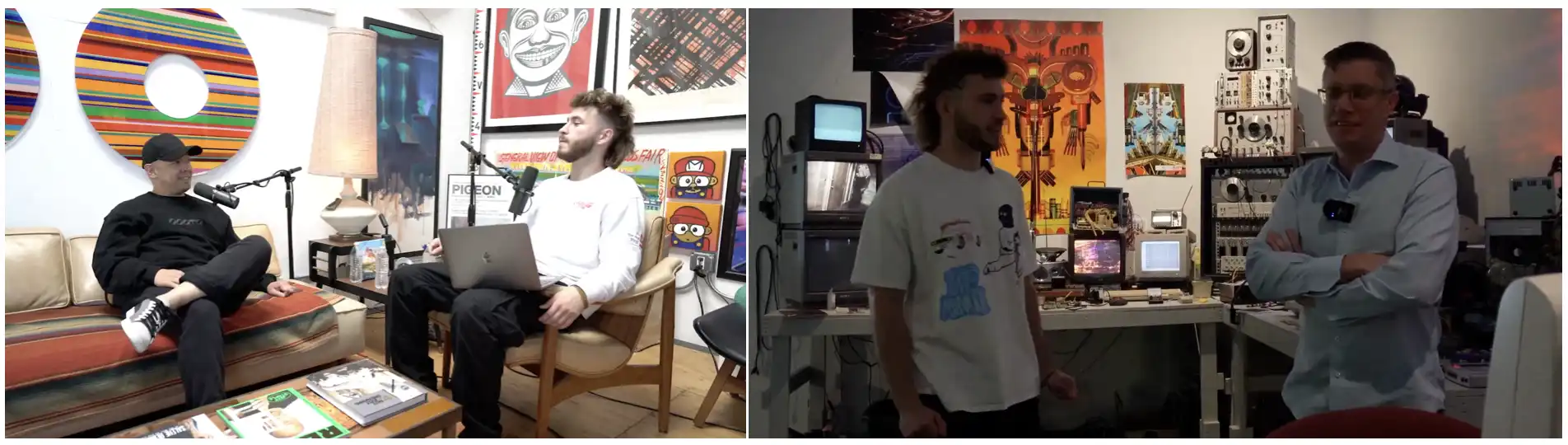
No doubt these guests are all deeply involved in NFT culture. threadguy will run to where the guests are for interviews, whether it's a studio or an exhibition hall. The young man's demeanor in the videos is always positive and upbeat.
As the NFT and overall crypto market landscape evolves, threadguy's interviewees are also becoming more diverse.
In June 2024, renowned Rapper Iggy Azalea and her released meme coin MOTHER caused quite a stir. Seizing this wave of celebrity coin frenzy, threadguy invited Iggy to do a video podcast together titled "Understanding Attention, Cryptocurrency, and Internet Culture."

In July, threadguy flew to Romania for the twelfth podcast interview. This time, the guest was another internet sensation, Andrew Tate. This guest, who is highly controversial and topical across the web with many fans and detractors, brought threadguy over 10 million views. On YouTube, this video's views were 15 times that of the second-ranked video.
Prior to the interview with Andrew Tate, threadguy's most successful podcast on X accumulated millions of views, while the YouTube views numbered around 1000. This interview multiplied those numbers significantly, with the X views nearly nine times the previous, reaching 8.8 million, and YouTube seeing hundreds of times growth, reaching 1.24 million. This episode allowed threadguy to reach a completely new audience, and he clearly felt the influx of new traffic.
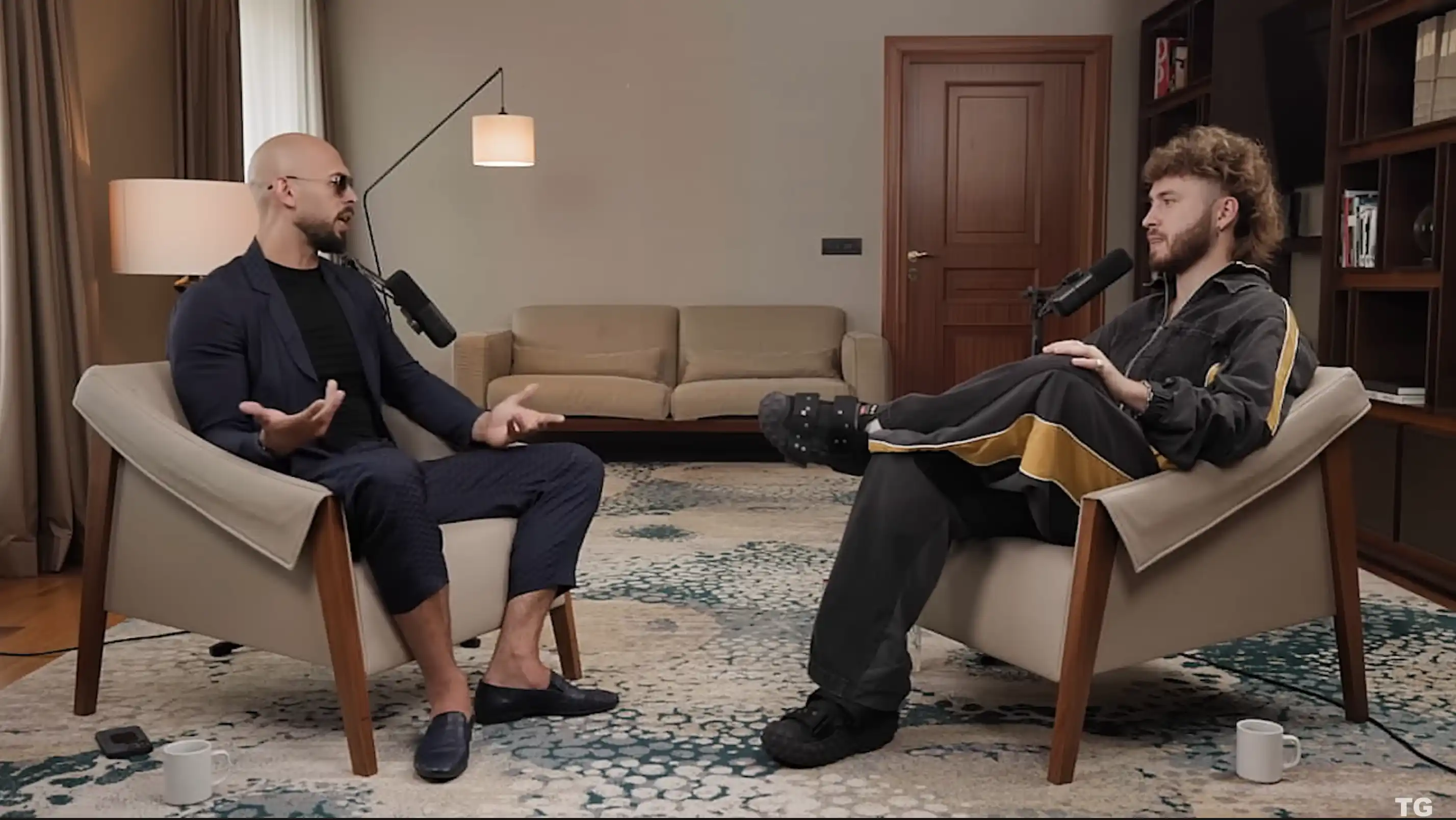
However, this unexpected traffic peak left threadguy in distress. In the period following the interview release, threadguy's mental state deteriorated rapidly. On one hand, Andrew Tate's reputation was less than stellar. Aside from his attention-seeking antics, most of the meme coins associated with him were manipulated to experience extreme volatility, making threadguy realize the dark side of this individual.
On the other hand, the post-interview podcast traffic data decline was excessively severe, creating a sense of disconnect that threadguy found hard to accept. Reflecting on X, he said:
"I initially started doing Spaces, then moved on to podcasts, just because I enjoy chatting with interesting people and hearing them share intriguing things. But recording podcasts in reality really drained me. Due to cost and travel constraints, I can only interview the top-tier guests. Moreover, I've always refused to take on ad sponsorships (not sure why, just a bit resistant), which has made 99% of the guests I really want to chat with seem unreachable. As a result, every episode bears immense pressure to perform well, and that has completely destroyed my enthusiasm for this."
「So I decided to return to my original intention — to interact with interesting people through live streaming anytime, anywhere, without worrying about their influence or the size of their platform anymore」, a Twitch live stream link was provided below the tweet. Since then, threadguy has stopped producing traditional on-site interview video podcasts and has mostly conducted interviews through online call-ins.
The Twitch, Twitter, YouTube, and threadguy Crypto Lifestyle Matrix
However, this suspicion of the side effects of influence did not last long. The controversy brought by Andrew Tate may have been a triggering factor for threadguy's shift to using the lower-cost Twitch for content distribution. On a deeper level, he realized that the meme coin supercycle was attacking the cryptocurrency space in an unprecedented way.
Concurrent with the interview with Andrew Tate was an interview with the founder of Punm.Fun, the most thrilling crypto app of this cycle, giving his first public interview. It was this podcast episode that led threadguy to embark on a journey he later described as gradually transitioning into full-time promotion, even into promoting a meme coin casino.
Starting from a Card Game
On January 16, it was threadguy's 23rd birthday. He excitedly introduced his new recording studio during the live stream, even rolling on the floor in the empty room. A friend knocked on the door and gave threadguy a basketball, planning to take him to watch the Lakers game that evening, sitting courtside. threadguy happily spun the basketball in his hand, clearly stepping out of Andrew Tate's shadow.
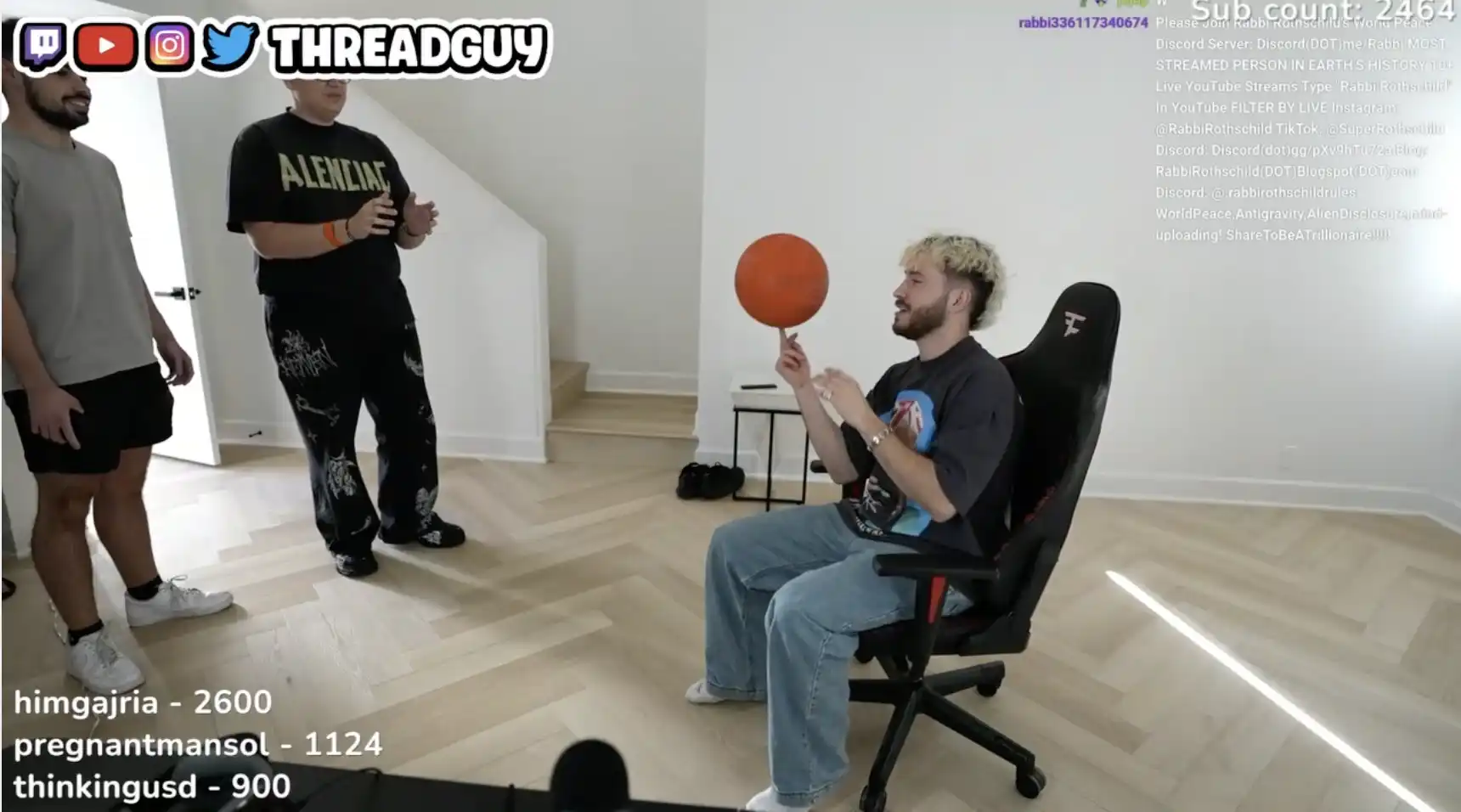
Before moving into this new room, threadguy's live streaming background was an open-plan living room, and he often used a whiteboard as a backdrop. Since moving away from offline in-person interviews, threadguy's interview videos have become more personalized, with the entire live stream process interspersed with chat questions and banter.
With live streams often lasting two to three hours, the first half is spent chatting informally with the audience in the chat room, then inviting guests to discuss issues. After the live stream ends, the conversation with the guest is edited and uploaded to YouTube.
Thus, Twitch is threadguy's primary channel for conveying values, Twitter is his traffic pool, and YouTube is his content garden.
During this time, he interviewed a series of AI concept meme coin founders, including GOAT, ai16z, PIPPIN, ZEREBRO, GRIFFAIN, and others. He also interviewed Base Protocol's leader Jesse, Pudgy Penguins CEO Luca Netz, Opensea CEO Devin Finzer, as well as internet personalities like Raoul Pal and Ansem.
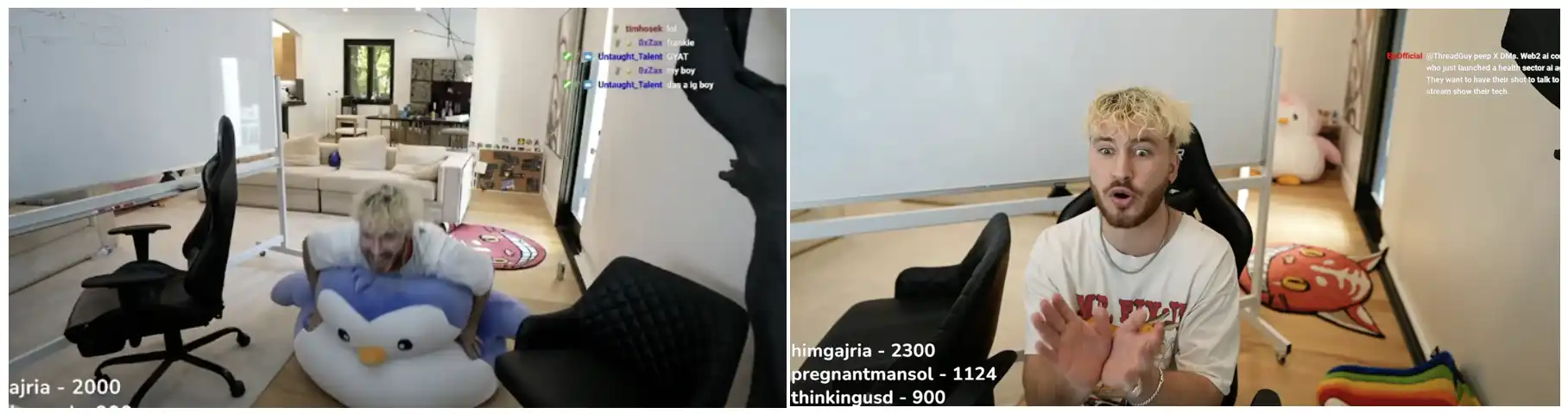
And this house is not only used by threadguy for live streaming. It is also the residence of him and several other KOLs who also live stream cryptocurrency content on Twitch.
Let's go back three months to the end of October when Polymarket sponsored a poker night event hosted by threadguy at this house. The dedicated poker table was set up by threadguy and his team in this house over 26 hours. Complex live streaming equipment could be seen in one corner of the room, along with the table and computer used in threadguy's previous streams.
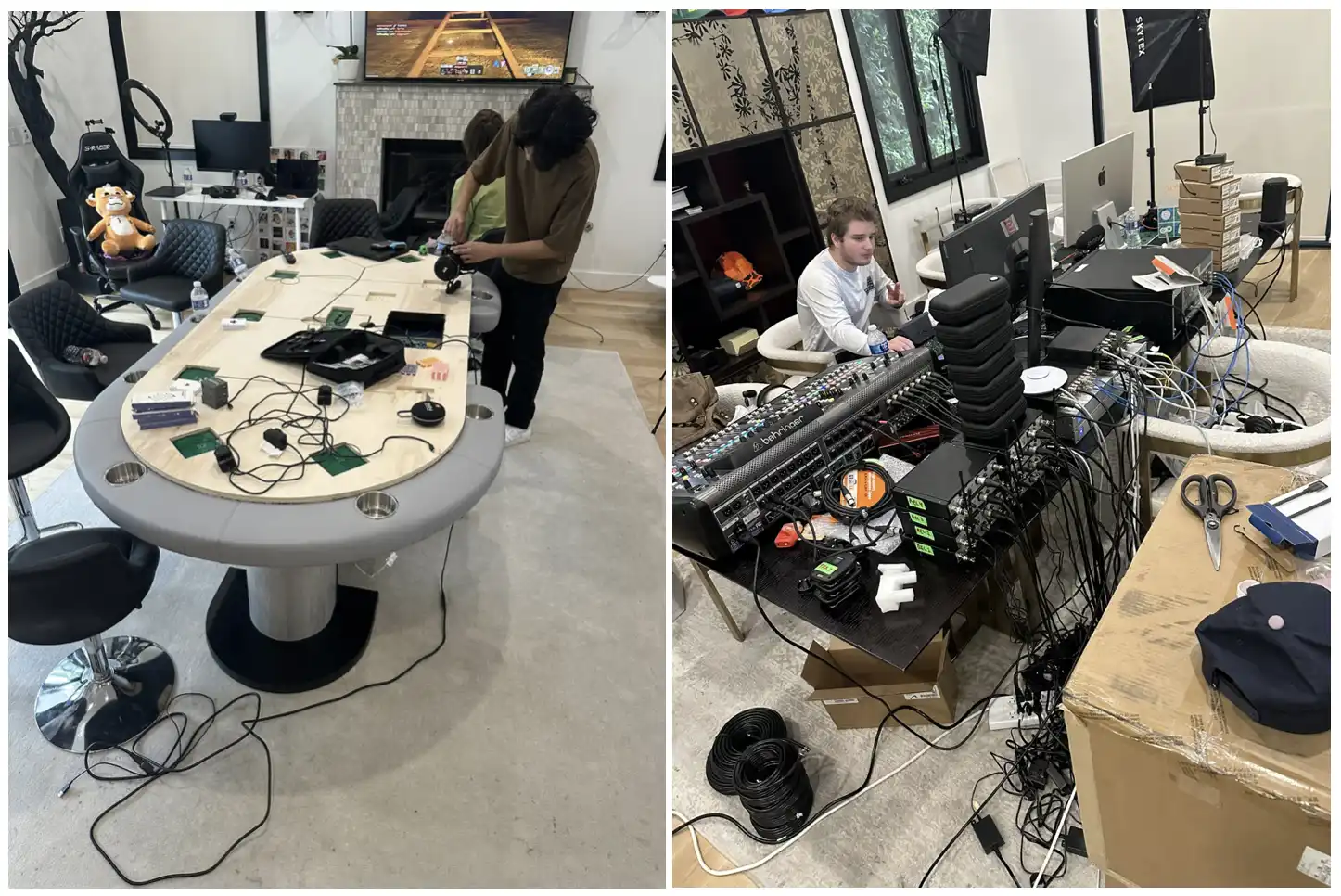
Throughout October, threadguy prepared for this poker live stream. Besides practicing poker skills at the casino, he announced the lineup, conducted event warm-ups, and promoted Polymarket.
This event invited many crypto KOLs, including Ansem, Macdegods, Frankdegods, Based16z, Rasmr, Bitboy, and Minh. The poker game lasted for 7 hours and involved viewers placing bets on Polymarket during the game, along with Twitter interactions.
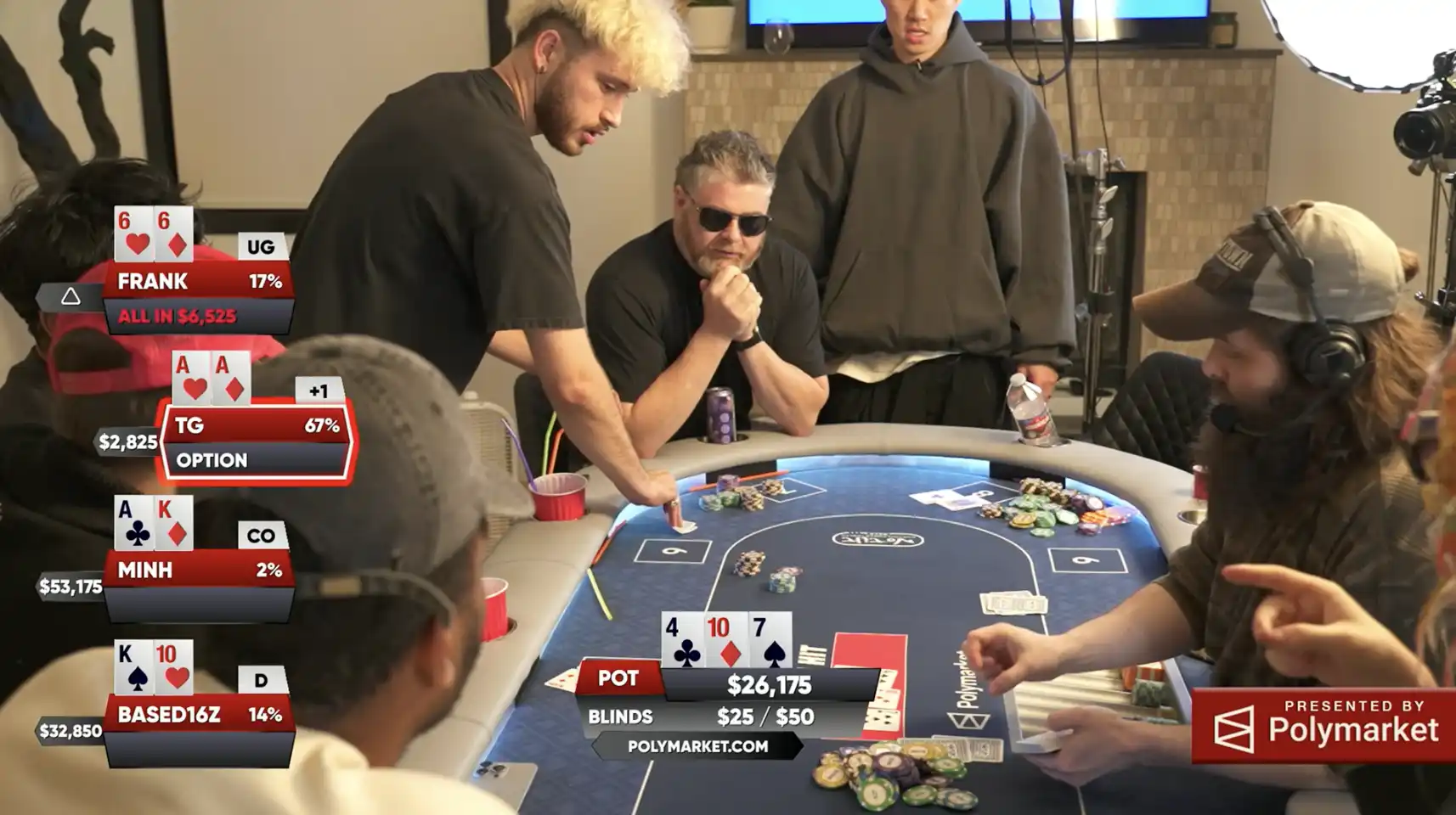
After the live stream, there were over 20,000 views on Twitch, and 800 new followers were gained. It was after this poker game live stream that threadguy officially began his Twitch streaming career. After the stream, threadguy posted on X:
"Honestly, I was so touched that I almost cried. You guys have no idea how important this is to me. This is just the beginning, the journey of streaming has just begun!"
Most of the people involved in this game were also dubbed by the community as the Los Angeles Vape Cabal.
Of course, it was not just a card game that connected them; they organized an account named "Probably Nothing" in March 2024. The members included FaZe Clan co-founder FaZe Banks, NFT project DeGods founder Frank, de Labs (DeGods' parent company) member Malcolm, and crypto Key Opinion Leaders including threadguy, rasmr, OGshoots.
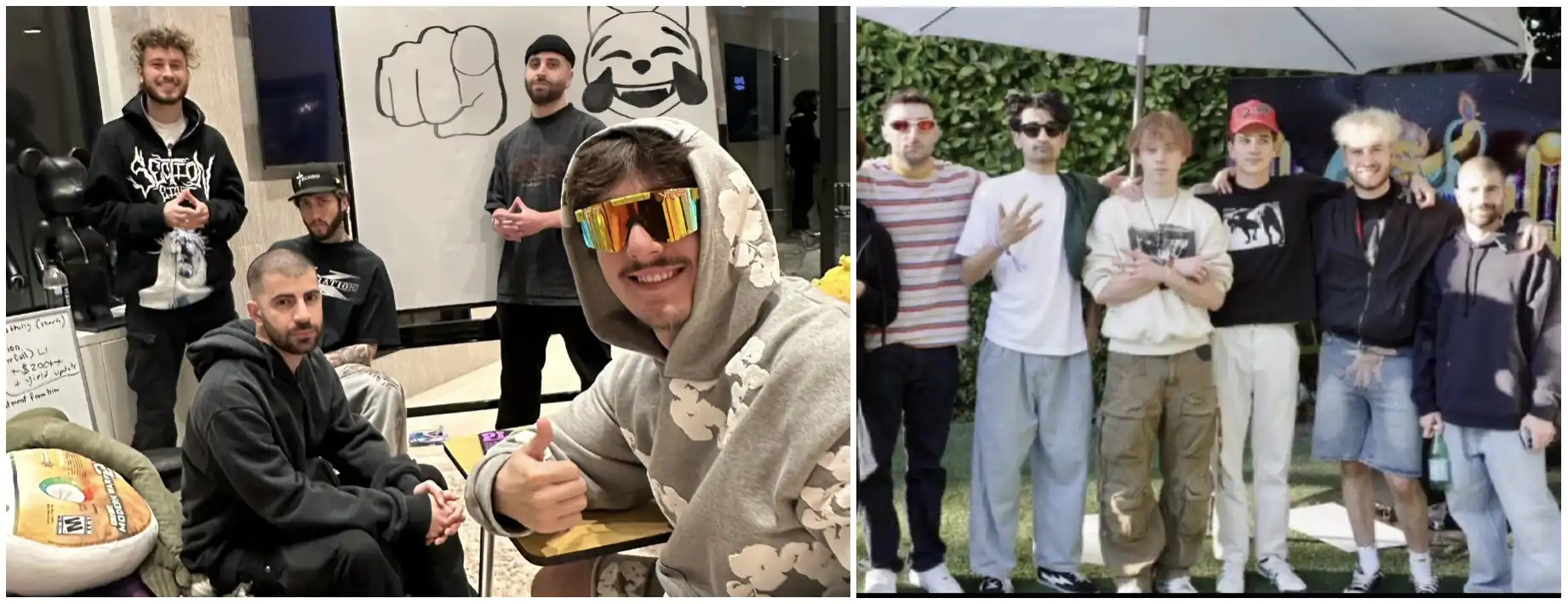
This group of Los Angeles crypto enthusiasts gathered around NFT culture live-stream cryptocurrency-related content on Twitch. In addition to interviews, during live streams, threadguy, Frank, and others also analyze meme coin opportunities, review trades, and discuss market trends.
Outside of the live streams, these individuals have their own small group named the "LA Vape Cabal." A community member named Mikasa was once pulled into this group chat by a friend, and upon joining, the first opportunity seized was a meme coin called JELLYJELLY launched by former Facebook VP of Product lessin. When initially spotted, the coin had a market value of only $2 million, but within six hours, it skyrocketed to $250 million.
People in the group frantically searched through lessin's Twitter and social media to confirm if the account was compromised, then communicated within the group as if it were a matter of life and death, making sure to clarify the situation. Once they determined it was not a rug pull project, they would go all-in, of course, due to their Degen mindset; some would even go all-in from the start. Mikasa said the core that unites the people in this group chat is a phrase from Frank: "Know what you're holding." Mikasa wrote on their own social media:
Any random person pulled from this group can retire now; they basically won't have to worry about making a living for the next 5 to 10 years. Yet, they are still aggressively monitoring the market, searching for coins, and digging for insider information, as if they are barely getting by on a salary. He has not seen any signs of insider trading or dumping, which surprised him greatly, but it is also because of this that he finally understands why so many people have always stuck with Frank.
For threadguy, the first three Twitch live streams had very good performance, surpassing 2,000 subscriptions. According to the data at the time, the top 100 subscriptions on Twitch were at 7,000, and the top 25 were at 17,000. In just three days, threadguy achieved 35% progress in the top 100 subscriptions on Twitch.
The founder of Probably Nothing, Banks, once explained why he established such an organization, stating that documenting the lifestyle of the new generation of day traders and young Web3 builders is crucial, and that the Probably Nothing platform—especially this team—is the best way to achieve this goal. Evidently, threadguy's live streaming career has brought him closer to his crypto ideals.
LA Vape Stream Cabal
threadguy's last livestream was on Valentine's Day.
At 7 p.m., he was wearing a T-shirt with Snoopy on it, sharing with his audience in the livestream room a meme coin called LIBRA that was retweeted by the President of Argentina, Milei, two hours prior. In the livestream, threadguy mentioned that he bought into LIBRA when it had a $2.5 billion market cap, watched sports videos, followed the market out of FOMO, and eventually noticed whales dumping and pulling liquidity, realizing something was wrong and exited with a loss when the market cap hit around $1.2 billion.
The livestream video has been deleted on Twitch. The most widely circulated clip online from that day is one where threadguy muted the livestream and covered his mouth while taking a phone call, an action that made him the target of criticism in the "Libragate" event involving the President of Argentina.

During the initial phase of his livestreaming career, threadguy often shared live account data, believing that the market severely lacked high-quality crypto content and hoping to create more industry-relevant content.
「Just talk directly to the camera, someday you'll accidentally hit Adin Ross-level traffic.」
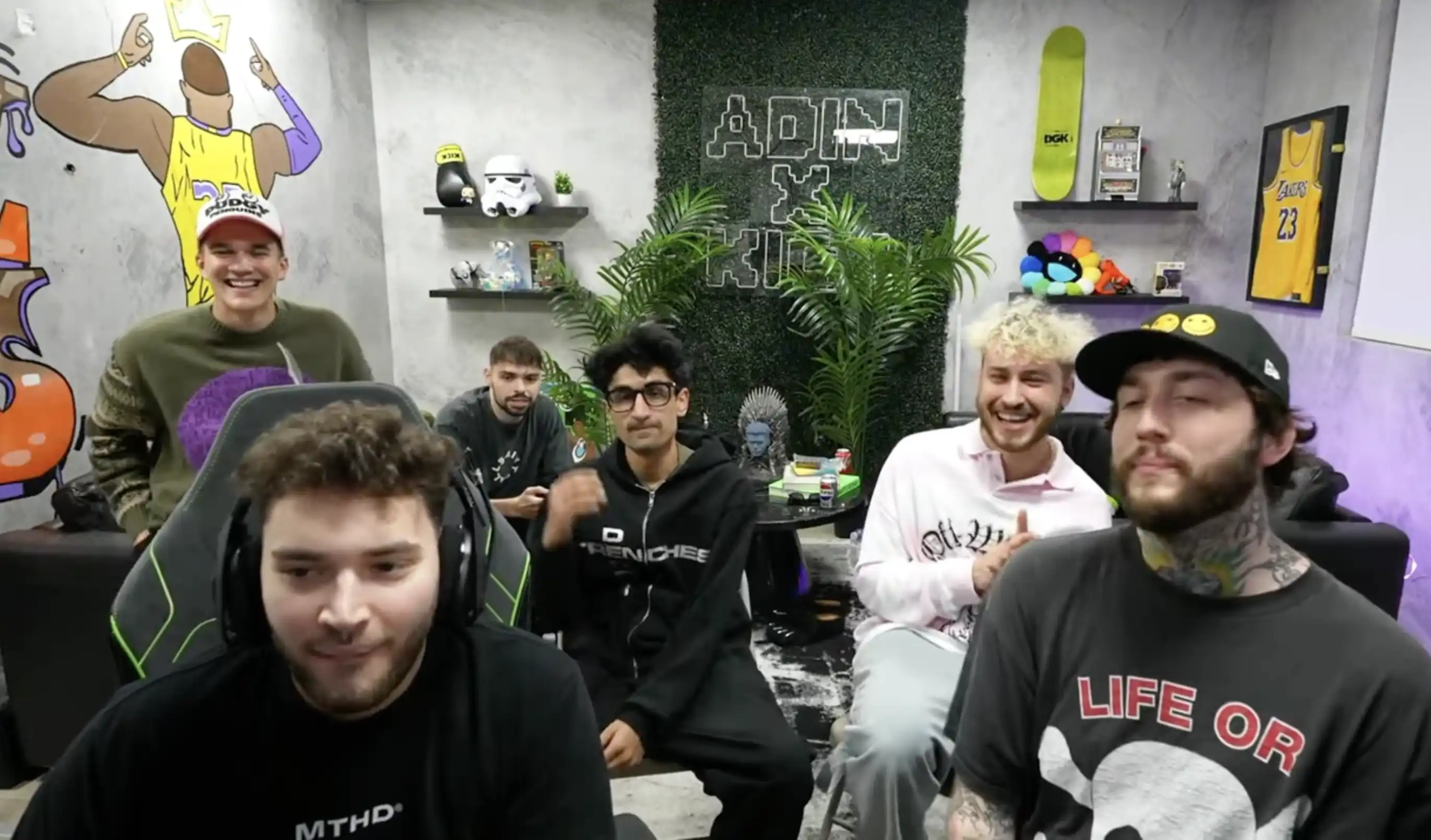
In February 2025, threadguy, Banks, Frank, Rasmr, and others actually went to Adin Ross's livestream room, which became their second-ranked interview video in terms of views, titled "Teaching Adin Ross How to Trade Memecoins."
Adin Ross is a top-tier streamer in today's streaming era, with over 20 million followers on platforms like YouTube, TikTok, and Instagram. The "00s" Ross, two years older than threadguy, interviewed Trump in August last year. Two years earlier, Adin Ross had also done a livestream with Andrew Tate.
In addition to Adin Ross, threadguy and others also did a video interview with internet personality Haliey Welch. Haliey, who was once the popular Hawk Tuah Girl, unexpectedly went viral in June 2024 due to a street interview video. She mimicked Hawk Tuah's (spitting sound) with a playful southern accent and gave suggestive responses, quickly spreading on social media. Like Ross, she is also a focal point of Gen Z social media.
However, this all turned into a farce. In threadguy's eyes, the release process of this episode was full of mistakes and chaos, from content leaks to the mistakenly published episode that was supposed to be canceled, to the final decision to go live. The whole team encountered severe issues at every stage, and $HAWK suffered the same fate as many celebrity meme coins.
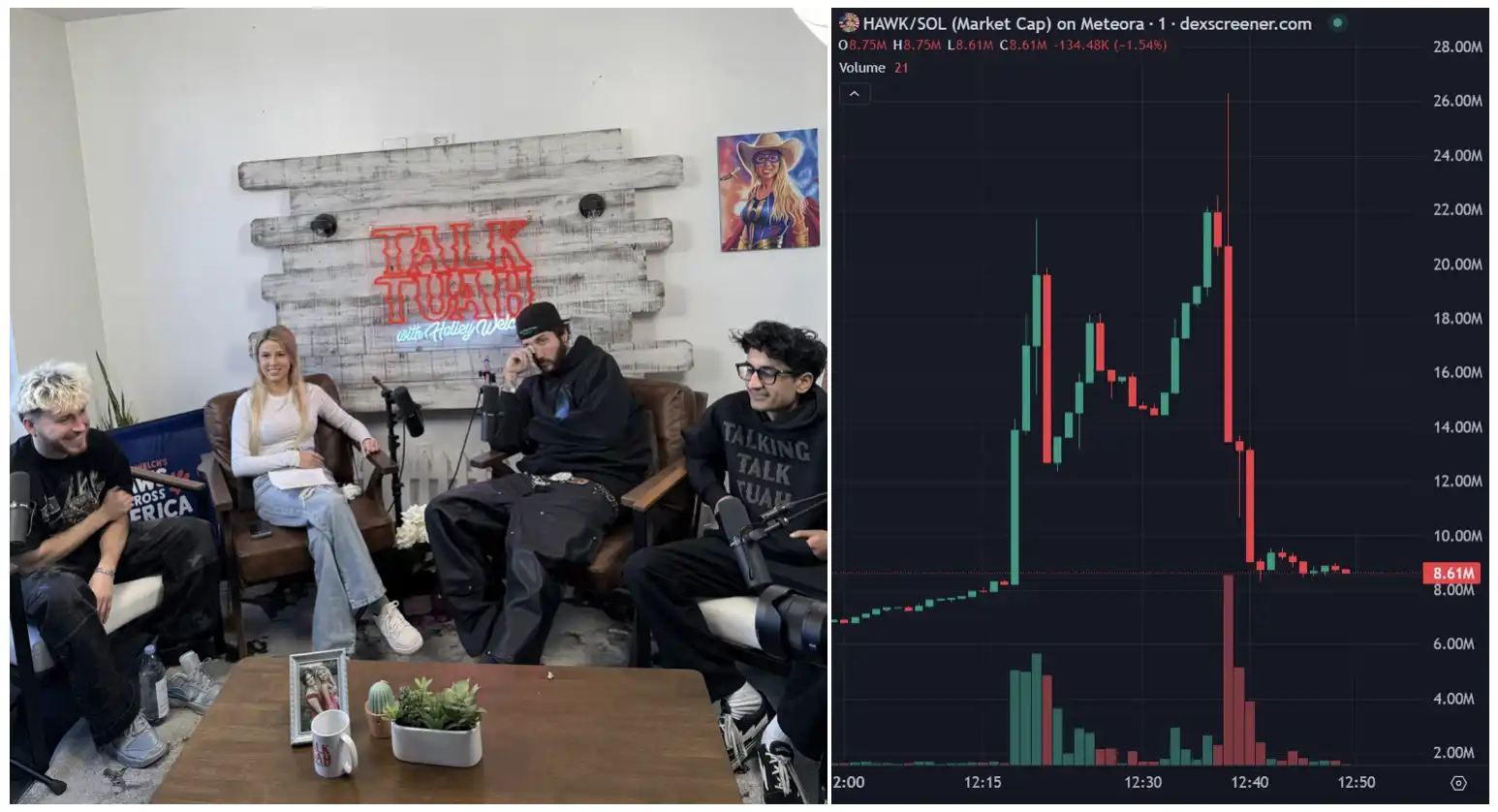
The selection of these guests, rather than being seen as a consideration of content depth, should be viewed as a precise capture of Gen Z social media attention or, more bluntly, a naked pursuit of traffic.
The moniker "LA Vape Cabal" has evolved from a mere joke to the community's "accusation" against them. They have been accused of using their fans to rug-pull liquidity and manipulate the meme coin market. This community outrage finally erupted on LIBRA, where the video of threadguy covering his mouth and Banks making a call was seen as the "ironclad evidence" that the "LA Vape Cabal" had insider information about the Argentinian coin.
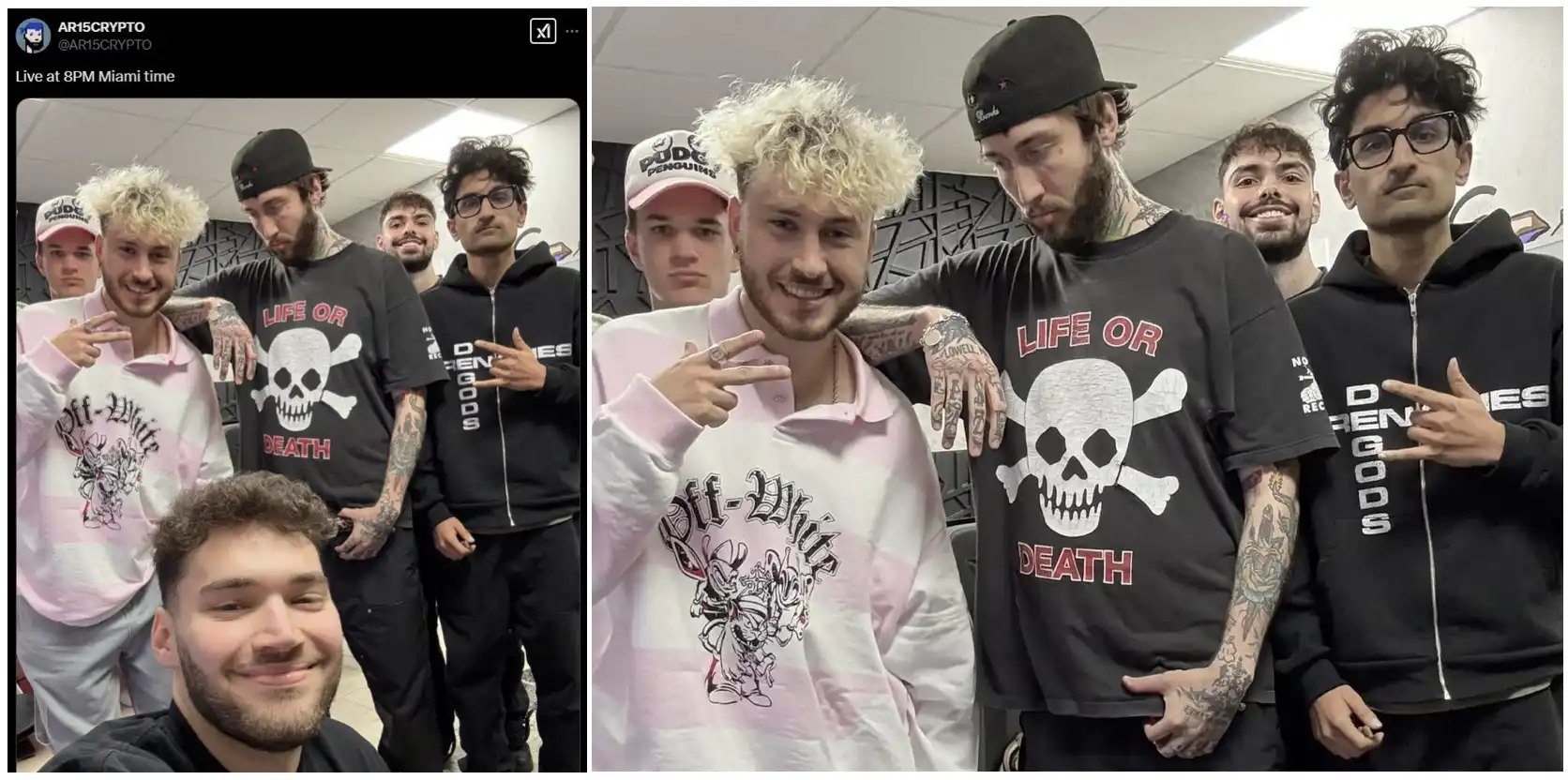
The insults poured in, with some even suggesting that the "LA Vape Cabal" was associated with the North Korean hacker group Lazarus Group. Even the group photo taken by threadguy, Adin Ross, and others during the interview, which was circulated in the community after Ross was removed, depicted them as a conspiracy group that only relied on insider trading to manipulate the meme market.
The Solana Wiki also removed the "LA Vape Cabal" entry during this controversy. The entry originally stated, "The group is known for its 'insider circle' and its controversial personalities."
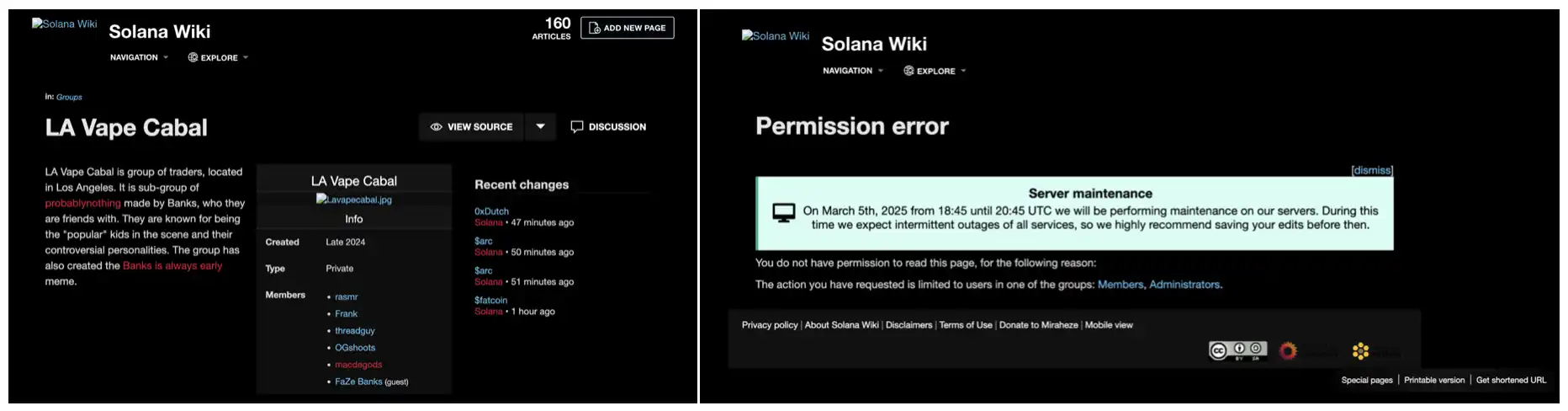
Left: Restored Solana Wiki page; Right: Deleted Solana Wiki page;
On the fourth day after LIBRA's "exit scam," threadguy posted a ten-minute clarification video on X. In addition to clarifying that he had no insider information on the Argentinian coin and there was no factual evidence suggesting he engaged in insider trading, threadguy also made an unexpected statement:
At some point, the direction of my content changed. I originally focused on interviewing project teams, founders, and developers, but it gradually shifted to fully embracing, and even promoting, this "meme coin casino." This matter is now very clear, even more so than ever before—most people in this market will eventually be "rekt," very few will actually make money, and the outcome is usually not great. No one willingly promotes this casino, yet I unintentionally played that role.
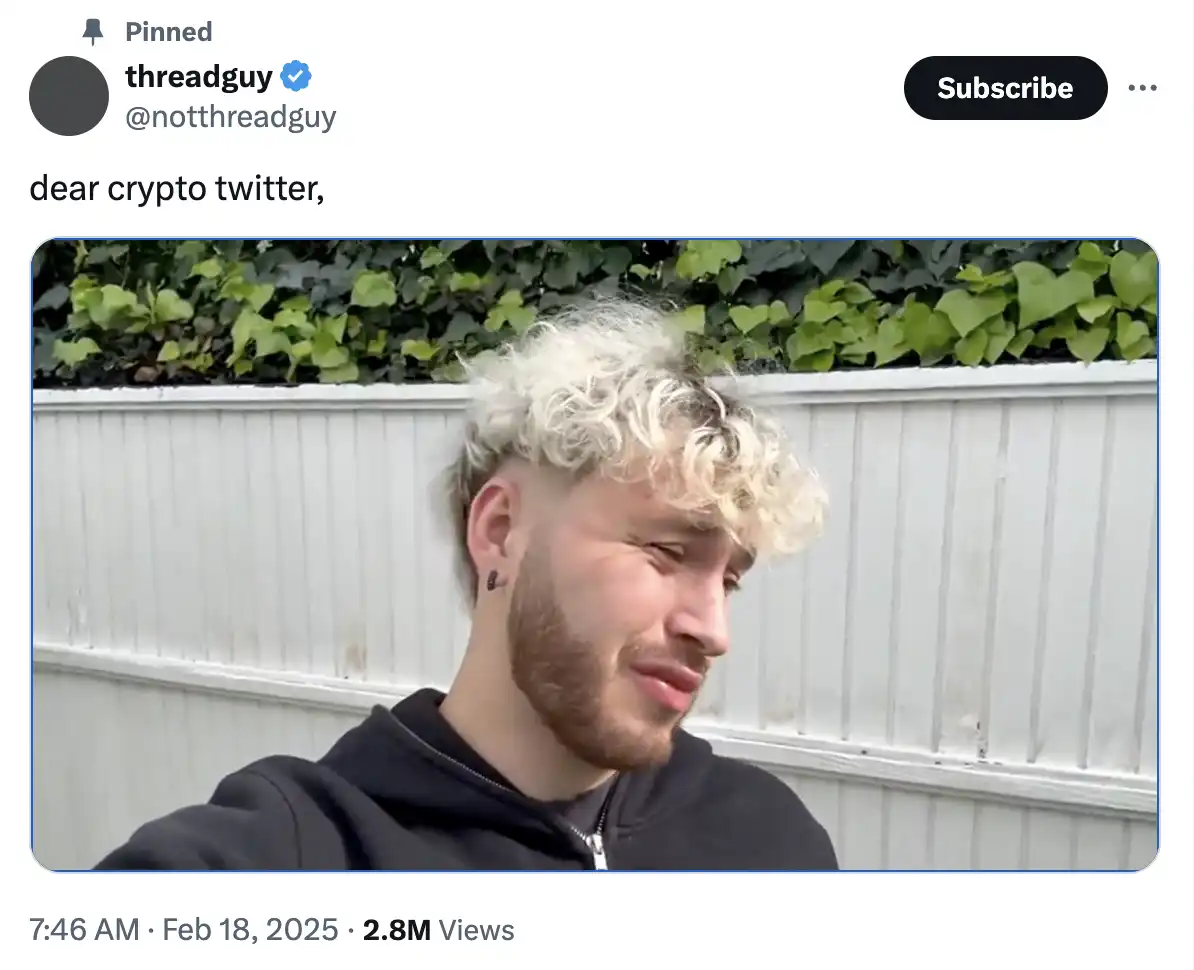
Beyond the Post-00s Generation: Even Presidents Need to Have Internet Sensibility
When threadguy released the first in-depth NFT project analysis from his basement, this post-00s individual may not have realized they were tapping into the pulse of the times. The crypto world acts like a giant magnet, continuously attracting the Z generation—there are no suit-and-tie investment banking barriers, no seniority-based promotion systems, only Twitter followers, meme virality, and a beastly instinct for trends.
CoinGecko's 2025 GenZ research data shows that 18-25-year-old crypto professionals increased from 17% in 2021 to 43% in 2025. While traditional industries still require young people to "start as interns," the crypto sector has long been witnessing a more naked wealth myth: a funny NFT meme created at 3 AM may earn more than a decade-long fund manager; a live stream on Twitch discussing tokenomics while gaming may unlock millions in liquidity.
From the "Pawns" who rose to fame in a single battle with TRUMP to the billionaire founder executing millisecond business deals, age has never been a bottleneck to one's development. From Elizabeth's group dues to Ehhhh's short essays, these post-00s, like threadguy, are leaving their mark on this market in their own unique way.
This industry provides opportunities for many young people, but due to the lack of rules and barriers, it has both fueled the wildest grassroots success stories and nurtured disorder and speculation under the law of the jungle. When traditional society's educational credentials, career ladders, and resource monopolies have all failed, the Z generation, holding the keys to meme propagation, is reconstructing the value system through emojis, live stream clips, and internet slang.
Despite facing a lot of hate, the LA Vape Cabal and other publicly identified content creators play a very important role in the crypto space. Retail investors need engaging content to be drawn in, and the most effective way in 2025 is through vlogs and live streaming; anonymous culture cannot scale.
Just as people are now complaining about infrastructure oversaturation, geeky podcasts also seem to be too widespread. In some eyes, threadguy and his livestream are representative of the crypto lifestyle media, discussing the latest game they watched with fans and chatting about what they did over the weekend. Some say, "We need avant-garde to turn the industry threshold into a trend symbol—when Gen Z begins to see becoming a crypto field anchor-level KOL as a life goal, then this field has truly mainstreamed." Crypto lifestyle media may be the real ace up the sleeve of this cycle.
On the day this article was completed, threadguy made his first post after the storm and replied to a tweet from November last year, "Cryptocurrency is the most exciting and rapidly developing industry in the world today, with no other field coming close. Everyone wants to get in, but no one truly understands. In any other field, KOLs cannot directly create wealth for community members as they do in the cryptocurrency domain."
You may also like

a16z Leads $18M Seed Round for Catena Labs, Crypto Industry Bets on Stablecoin AI Payment
Pharos, deeply integrated with AntChain, is about to launch. How can we get involved?
$COIN Joins S&P 500, but Coinbase Isn't Celebrating
On May 13, S&P Dow Jones Indices announced that Coinbase would officially replace Discover Financial Services in the S&P 500 on May 19. While other companies like Block and MicroStrategy, closely tied to Bitcoin, were already part of the S&P 500, Coinbase became the first cryptocurrency exchange whose primary business is in the index. This also signifies that cryptocurrency is gradually moving from the fringes to the mainstream in the U.S.
On the day of the announcement, Coinbase's stock price surged by 23%, surpassing the $250 mark. However, just 3 days later, Coinbase was hit by two consecutive events: a hack where employees were bribed to steal customer data and a demand for a $20 million ransom, and an investigation by the U.S. Securities and Exchange Commission (SEC) into the authenticity of its claim of having over 100 million "verified users" in its securities filings and marketing materials. These two events acted as mini-bombs, and at the time of writing, Coinbase's stock had already dropped by over 7.3%.
Coincidentally, Discover Financial Services, being replaced by Coinbase, can also be considered the "Coinbase" of the previous payment era. Discover is a U.S.-based digital banking and payment services company headquartered in Illinois, founded in 1960. Its payment network, Discover Network, is the fourth largest payment network apart from Visa, Mastercard, and American Express.
In April, after the approval of the acquisition of Discover by the sixth-largest U.S. bank, Capital One, this well-established digital banking company of over 60 years smoothly handed over its S&P 500 "seat" to this emerging cryptocurrency "bank." This unexpected coincidence also portrayed the handover between the new and old eras in Coinbase's entry into the S&P 500, resembling a relay race scene. However, this relay baton also brought Coinbase's accumulated "external troubles and internal strife" to a tipping point.
Over the past decade, cryptocurrency exchanges have been the most stable "profit machines." They play a role in providing liquidity to the entire industry and rely on trading fees to sustain their operations. However, with the comprehensive rollout of ETF products in the U.S. market, this profit model is facing unprecedented challenges. As the leader in the "American stack," with over 80% of its business coming from the U.S., Coinbase is most affected by this.
Starting from the approval of Bitcoin and Ethereum spot ETFs, traditional financial capital has significantly onboarded users and funds that originally belonged to exchanges in a more cost-effective, compliant, and transparent manner. The transaction fee revenue of cryptocurrency exchanges has started to decline, and this trend may further intensify in the coming months.
According to Coinbase's 2024 Q4 financial report, the platform's total trading revenue was $417 million, a 45% year-on-year decrease. The contribution of BTC and ETH's trading revenue dropped from 65% in the same period last year to less than 50%.
This decline is not a result of a decrease in market enthusiasm. In fact, since the approval of the Bitcoin ETF in January 2024, the inflow of BTC into the U.S. market has continued to reach new highs, with asset management giants like BlackRock and Fidelity rapidly expanding their management scale. Data shows that BlackRock's iShares Bitcoin ETF (IBIT) alone has surpassed $17 billion in assets under management. As of mid-May 2025, the cumulative net inflow of 11 major institutional Bitcoin spot ETFs on the market has exceeded $41.5 billion, with a total net asset value of $1214.69 billion, accounting for approximately 5.91% of the total Bitcoin market capitalization.
Institutional investors and some retail investors are shifting towards ETF products, partly due to compliance and tax considerations. On one hand, ETFs have much lower trading costs compared to cryptocurrency exchanges. While Coinbase's spot trading fee rate varies annually in a tiered manner but averages around 1.49%, for example, the management fee for IBIT ETF is only 0.25%, and the majority of ETF institution fees fluctuate around 0.15% to 0.25%.
In other words, the more rational users are, the more likely they are to move from exchanges to ETF products, especially for investors aiming for long-term holdings.
According to multiple sources, several institutions, including VanEck and Grayscale, have submitted applications to the SEC for a Solana (SOL) ETF, with some institutions also planning to submit an XRP ETF proposal. Once approved, this may trigger a new round of fund migration. According to a report submitted by Coinbase to the SEC, as of April, the platform's trading revenue from XRP and Solana accounted for 18% and 10%, nearly one-third of the platform's fee revenue.
However, the Bitcoin and Ethereum ETFs passed in 2024 also reduced the fees for these two tokens on Coinbase from 30% and 15% to 26% and 10%, respectively. If the SOL and XRP ETFs are approved, it will further undermine the core fee revenue of exchanges like Coinbase.
The expansion of ETF products is gradually weakening the financial intermediary status of cryptocurrency exchanges. From their original roles as matchmakers and clearers to now gradually becoming mere "on-ramps and off-ramps" for funds, exchanges are seeing their marginal value squeezed by ETFs.
On May 12, 2025, SEC Chairman Paul S. Atkins gave a keynote speech at the Tokenization and Cryptocurrency Working Group roundtable. The theme of his speech revolved around "It is a new day at the SEC," where he indicated that the SEC would not approach enforcement and regulation the same way as before but would instead pave the way for cryptocurrency assets in the U.S. market.
With signs of cryptocurrency compliance such as the SEC's "NEW DAY" declaration, an increasing number of traditional brokerages are attempting to enter the cryptocurrency industry. One of the most representative cases is the well-known U.S. brokerage Robinhood, which began expanding its crypto business in 2018. By the time of its IPO in 2021, Robinhood's crypto business revenue accounted for over 50% of the company, with a significant boost from the Dogecoin "moonshot" promoted by Musk.
In Q1 2025 earnings report, Robinhood showcased strong growth, especially in revenue from cryptocurrency and options trading. Fueled by Trump's Memecoin, cryptocurrency-related revenue reached $250 million, nearly doubling year-over-year. Consequently, Robinhood Gold subscription users reached 3.5 million, a 90% increase from the previous year, with the rapid growth of Robinhood Gold providing the company with a stable source of income.
Meanwhile, RobinHood is actively pursuing acquisitions in the cryptocurrency space. In 2024, it announced a $2 billion acquisition of the long-standing European cryptocurrency exchange Bitstamp. Additionally, Canada's largest cryptocurrency CEX, WonderFi, which recently went public on the Toronto Stock Exchange, also announced its integration with RobinHood Crypto. After obtaining virtual asset licenses in the UK, Canada, Singapore, and other markets, RobinHood has taken a proactive approach in the compliant cryptocurrency trading market.
Furthermore, an increasing number of brokerage firms are exploring the same path. Futu Securities, Tiger Brokers, and others are also dipping their toes into cryptocurrency trading, with some having applied for or obtained the VA license from the Hong Kong SFC. Although their user bases are currently small, traditional brokerages have a natural advantage in user trust, regulatory licenses, and low fee structures. This could pose a threat to native cryptocurrency platforms in the future.
In April 2025, security researchers discovered that some Coinbase user data was leaked on the dark web. While the platform initially responded by attributing it to a "technical misinformation," it still raised concerns among users regarding its security and privacy protection. Just two days before Dow Jones Indexes announced Coinbase's addition to the S&P 500 Index, on May 11, 2025, Coinbase received an email from an unknown threat actor claiming to have obtained customer account information and internal documents, demanding a $20 million ransom to keep the data private. Subsequent investigations confirmed the data breach.
Cybercriminals obtained the data by bribing overseas customer service agents and support staff, mainly in "non-U.S. regions such as India." These agents abused their access to Coinbase's internal customer support system and stole customer data. As early as February this year, blockchain detective ZachXBT revealed on X platform that between December 2024 and January 2025, Coinbase users lost over $65 million to social engineering scams, with the actual amount potentially higher.
Among the victims was a well-known figure, 67-year-old Ed Suman, an established artist in the art world for nearly two decades, having been involved in the creation of artworks such as Jeff Koons' "Balloon Dog" sculpture. Earlier this year, he fell victim to an impersonation scam involving fake Coinbase customer support, resulting in a loss of over $2 million in cryptocurrency. ZachXBT critiqued Coinbase for its inadequate handling of such scams, noting that other major exchanges have not faced similar issues and recommending Coinbase to enhance its security measures.
Amidst a series of ongoing social engineering incidents, although there has not been any impact on user assets at the technical level so far, it has raised concerns among many retail and institutional investors. Especially institutions holding massive assets on Coinbase. Just considering the U.S. BTC ETF institutions, as of mid-May 2025, they collectively hold nearly 840,000 BTC, and 75% of these are custodied by Coinbase. If we price BTC at $100,000, this amount reaches a staggering $63 billion, which is equivalent to the nominal GDP of two Iceland in the year 2024.
In addition, Coinbase Custody also serves over 300 institutional clients, including hedge funds, family offices, pension funds, and endowments. As of the Q1 2025 financial report, Coinbase's total assets under management (including institutional and retail clients) reached $404 billion. The specific amount of institutional custodied assets was not explicitly disclosed in the latest report, but it should still be over 50% based on the Q4 2024 report.
Once this security barrier is breached, not only could the rate of user attrition far exceed expectations, but more importantly, institutional trust in it would undermine the foundation of its business. Therefore, after a hacking event, Coinbase's stock price plummeted significantly.
Facing a decline in spot trading fee revenue, Coinbase is also accelerating its transformation, attempting to find growth opportunities in derivatives and emerging assets. Coinbase acquired a stake in the options platform Deribit at the end of 2024 and announced the official launch of perpetual contract products in 2025. This acquisition fills in Coinbase's gap in options trading and its relatively small global market share.
Deribit has a strong presence in non-U.S. markets, especially in Asia and Europe. The acquisition has enabled Coinbase to gain a dominant position in bitcoin and ethereum options trading on Deribit, accounting for approximately 80% of the global options trading volume, with daily trading volume remaining above $2 billion.
Meanwhile, 80-90% of Deribit's customer base consists of institutional investors, with their professionalism and liquidity in the Bitcoin and Ethereum options market highly favored by institutions. Coinbase's compliance advantage, coupled with its already robust institutional ecosystem, makes it even more suitable. By using institutions as an entry point, it can face the squeeze from giants like Binance and OKX in the derivatives market.
Facing a similar dilemma is Kraken, which is attempting to replicate Binance Futures' model in non-U.S. markets. Since the derivatives market relies more on professional users, fee rates are relatively higher and stickiness is stronger, making it a significant source of revenue for exchanges. In the first half of 2025, Kraken completed the acquisition of TradeStation Crypto and a futures exchange, aiming to build a complete derivatives trading ecosystem to hedge the risk of declining spot transaction fee income.
With the surge of Memecoin in 2024, Binance, OKX, and various CEX platforms began massively listing small-market-cap, highly volatile tokens to activate active trading users. Due to the wealth effect and trading activity of Memecoins, Coinbase was also forced to join the battle, successively listing popular tokens from the Solana ecosystem such as BOOK OF MEME and Dogwifhat. Although these coins are controversial, they are frequently traded, with fee rates several times higher than mainstream coins, serving as a "blood-boosting" method for spot trading.
However, due to its status as a publicly traded company, this practice is a riskier endeavor for Coinbase. Even in the current crypto-friendly environment, the SEC is still investigating whether tokens like SOL, ADA, and SAND constitute securities.
In addition to the forced transformation strategies carried out by the aforementioned CEXs, they are also starting to lay out RWAs and the most talked-about stablecoin payment fields, such as the PYUSD launched through a collaboration between Coinbase and Paypal, Coinbase's support for the Euro stablecoin EURC by Circle that complies with EU MiCA regulatory requirements, or the USD1 launched through a collaboration between Binance and WIFL. In the increasingly crowded trading field, many CEXs have shifted their focus from just the trading market to the application field.
The golden age of transaction fees has quietly ended, and the second half of the crypto exchange platform game has silently begun.
Arthur Hayes: Why I'm Betting on ETH While the Market Is Obsessed with SOL
Key Market Insights for May 16th, how much did you miss out on?
CryptoPunks Changes Hands Twice, Did the Originator of NFTs Finally Find Its "Forever Home" This Time?
May 16 Key Market Information Gap, A Must-Read! | Alpha Morning Report
MOG Coin Skyrockets as Elon Musk and Garry Tan Embrace "mog/acc" Identity
The End and Rebirth of NFTs: How the Meme Coin Craze Ended the PFP Era?
STARTUP's Price Surges 40x in 30 Minutes: How did he become the Emotion King of Believe?
Key Market Intelligence on May 14th, how much did you miss out on?
1.Binance Alpha Launches HIPPO, BLUE, and Other Tokens
2.Believe Ecosystem Tokens See General Rise, LAUNCHCOIN Surges Over 250% in 24 Hours
3.Tiger Securities Introduces Cryptocurrency Deposit and Withdrawal Service, Supports Mainstream Cryptocurrencies such as BTC and ETH
4.Current Bitcoin Rally Possibly Driven by Institutions, Retail Traders Yet to Join
5.Binance Wallet's New TGE Privasea AI Participation Requires a 198 Point Threshold, with a Point Consumption of 15
Source: Overheard on CT (tg: @overheardonct), Kaito
PUMP: Today's discussions about PUMP focus on its new creator revenue-sharing model: the platform will allocate 50% of PumpSwap revenue to token creators, sparking varied reactions from users. Some criticize the move as insufficient or even misleading, while others view it as a positive step the platform is taking to reward creators. Meanwhile, PUMP faces market pressure from emerging competitors like LetsBONKfun and Raydium, which are rapidly gaining market share. Users also express concerns about PUMP's sustainability and potential regulatory risks in the U.S., with discussions extending to the platform's impact on the entire memecoin ecosystem.
COINBASE: Today, Coinbase became the first crypto company to join the S&P 500 Index, replacing Discover Financial Services, sparking widespread industry attention. The entire crypto community views this milestone as a significant development, signaling that crypto assets are further integrating into the mainstream financial system. The news has sparked lively discussions on Twitter, with many users pointing out that this may attract more institutional investors to enter the Bitcoin and other cryptocurrency markets.
XRP: XRP became the focal point of today's crypto discussion, with its significant market movements and strategic advances drawing attention. XRP has surpassed USDT to become the third-largest cryptocurrency by market capitalization, sparking market excitement and discussions about its future potential. The surge in market capitalization and price is believed to be related to increasing institutional interest, deepening strategic partnerships, and its role in the crypto ecosystem. Additionally, XRP's integration into multiple financial systems and its potential as a macro asset class are also seen as key factors driving the current market sentiment.
DYDX: Today's discussions about DYDX mainly focused on the dYdX Yapper Leaderboard launched by KaitoAI. The leaderboard aims to identify the most active community participants, with a total of $150,000 in rewards to be distributed over the first three seasons. This initiative has sparked broad community participation, with many users discussing the potential rewards and the incentive effect on the DYDX ecosystem. Meanwhile, progress on the ethDYDX to dYdX native chain migration and historical airdrop events have also been topics of discussion.
1. "What Is 'ICM'? Holding Up the $4 Billion Market Cap Solana's New Narrative"
Overnight, the hottest narrative in the crypto space has become "Internet Capital Markets," with a host of crypto projects and founders, led by the Solana ecosystem's new Launchpad platform Believe, releasing this phrase. Together with "Believe in something," it has become the new slogan heralding the onset of a bull market. What exactly is the so-called "Internet Capital Market," will it become a short-lived hype phrase like the Base ecosystem's previous Content Coin, and what related targets are available for selection?2.《LaunchCoin Surges 20x in One Day, How Did Believe Create a $200M Market Cap Shiba Inu After Going to Zero?|100x Retrospective》
LAUNCHCOIN broke through a $200 million market cap today, with the long-lost liquidity and such a high market cap "Memecoin" almost bringing half of the on-chain crypto community CT into the fray. The community is crazily discussing this token, with half of it being FOMO and the other half being FUD. This token, originally issued by Believe founder Ben Pasternak under his personal identity, transformed into a new platform token after a renaming. From once going to zero to a $200 million market cap, what happened in between?May 14 On-chain Fund Flow
Within 24 hours, GOONC's market cap soared to 70 million, could GOONC be the next billion-dollar dog on the Believe platform?
Bitcoin has broken $100,000, Ethereum has surpassed 2500, and is Solana's hot streak about to make a comeback?
The current market is in a state of macro euphoria, with GOONC riding the wave today, skyrocketing 10x in just a few hours, reaching a market cap of tens of millions of dollars, trading volume soaring past 50 million, and rumors swirling that the developer may be from OpenAI (unconfirmed but intriguing enough).
A ludicrous and absurd Solana meme that some actually buy into.
GOONC is a meme coin that has sprouted from the "gooning" subculture, offering no technological innovation or practical use, its sole function being speculation.
It takes inspiration from an NSFW term "gooning," which refers to a person being deeply immersed in certain content (you know what), eventually entering a nearly religious-like trance.
In Reddit (such as r/GOONED, r/GoonCaves) and some counterculture media outlets (such as MEL Magazine in 2020), "gooning" has gradually transitioned from an adult label to a meme-addicted, digital content and virtual self-indulgence synonym, arguably the epitome of Degen spirit.
GOONC is playing around with this concept, packaging the addictive nature, uselessness, and irony of gooning into a tradable financial product. The project team has made it clear: "We do not solve blockchain problems, we only trade absurdity." Blunt but oddly genuine.
GOONC launched on May 13, 2025, using the meme coin launch platform Believe App's LaunchCoin module on Solana. This tool is highly Degen: zero technical barriers, a few clicks to create a coin, perfect for projects like GOONC that can come up with ideas out of the blue.
The mastermind behind GOONC is also quite something and is the most talked-about, with KOL @basedalexandoor on X platform (alias "Pata van Goon") personally involved. His profile even caught the attention of Marc Andreessen, co-founder of a16z, making onlookers unable to resist speculating if GOONC has a hint of OpenAI lineage.
While this 'OpenAI Endorsement' is currently just community speculation, it is definitely a good card to play to fuel hype. Saying "we are pure speculation" on one hand, while tagging a few "AI + a16z" on the other.
GOONC took off as soon as it launched. After its launch on May 13, 2025, its market capitalization skyrocketed to $22 million within 4 hours, with a trading volume exceeding $25.6 million in 24 hours. According to platform data, the first day of trading saw an astonishing +41,100% surge, soaring from $0.0000001 to $0.02, becoming a "missed-the-boat" situation.
GOONC quickly formed an active trading community post-launch, with a lot of discussion and trading signals appearing on X platform (such as the 292x return signal provided by DeBot). Liquidity pools on exchanges like Raydium and Meteora grew rapidly, supporting high trading volumes and price increases.
The real climax occurred between May 13 and May 14, with the market cap rising to $5.5 million in the morning and directly surpassing $55 million in the afternoon. By the 14th, it briefly approached a $70 million market cap, with the trading volume soaring to $59 million. Some community members even posted screenshots claiming an increase of +85,000%, creating a new myth out of the ruins.
As of 1:30 pm on May 14, the price stabilized around $0.039, with a total market cap and FDV both around $39.6 million, and a 24-hour trading volume of $5.43 million. Active platforms include XT.COM, LBank, Meteora, and others.
Although there was a slight pullback from the peak ($0.07), the coin's popularity remains strong. For a coin that relies purely on "irony + community + X post" to thrive, this performance is already at a stellar level.
Currently, the background of the token's development team is not transparent, increasing the potential risk of a rug pull. Rugcheck.xyz warns that the creator of the GOONC contract may have permission to modify the contract (e.g., change fees or mint additional tokens), posing certain security risks.
Community members speculate that the meteoric rise of GOONC may be the "last hurrah".
After Surging 40%, Has Ethereum Price Peaked Upon Exiting the Craze?
Whether you are an insider or an outsider, these days you must be familiar with the news about Ethereum. The reason is simple, causing Ethereum enthusiasts to sigh with emotion and almost throwing off-guard those who defend Ethereum, Ethereum, with a "3-day surge of 40%," climbed to the top of the Douyin Hot List.
As we all know, Ethereum launched the Pectra upgrade on May 7th. This most significant network upgrade since early 2024 integrates the Prague execution layer hard fork and the Electra consensus layer upgrade, significantly improving Ethereum's performance through 11 improvement proposals. The account abstraction feature (EIP-7702) allows users to flexibly manage wallets through social media accounts or multi-signature schemes, reducing the user threshold, attracting more users and developers. The staking mechanism optimization increases the validator ETH cap from 32ETH to 2048ETH and introduces a flexible withdrawal method, making it easier for institutions and individuals to participate in network security, enhancing the market's confidence in Ethereum's long-term value.
At the same time, Pectra optimized the interaction efficiency of Layer 2 networks such as Arbitrum and Optimism, making transactions faster and cheaper, leading to a surge in on-chain activity. As a crucial step for Ethereum's transition from "2G" to "5G," the Pectra upgrade not only enhances network vitality but also "recharges confidence" in the market, directly driving the price increase.
Related Reading: "Ethereum Skyrockets 22% in One Day, E Enthusiasts Rejoice"
It's not just Ethereum itself, as Wall Street also brought important bullish news.
The world's largest asset management company, BlackRock, proposed to the SEC allowing Ethereum ETFs for staking. This proposal is expected to elevate Ethereum ETFs from a mere investment tool to a bond-like "interest-bearing asset," bringing investors both capital appreciation and passive income, igniting market optimism about Ethereum's future potential.
Specifically, BlackRock has proposed to amend its S-1 filing to allow investors to create and redeem ETF shares directly with Ethereum instead of the U.S. dollar (i.e., in-kind redemption). This move, combined with its $2.9 billion BUIDL Fund launched in March 2024, aims to deepen the integration of traditional finance with blockchain. The BUIDL Fund is a tokenized fund operating on the Ethereum network, investing in traditional assets such as U.S. Treasury bonds. This setup is highly attractive to institutional investors, as they can not only benefit from Ethereum's price appreciation but also earn stable cash flow through staking.
Robert Mitchnick, BlackRock's Head of Digital Assets, stated in a CNBC interview in March 2025 that the addition of staking functionality will significantly enhance the appeal of the Ethereum ETF. He admitted that when the Ethereum spot ETF was launched in July 2024 without staking functionality, the market demand was lackluster, and staking could be the key to reversing this trend.
Meanwhile, the SEC's shifting stance on cryptocurrency regulation has also fueled this upward trend. During the tenure of the previous SEC chairman, the regulatory approach was tough, and staking was strictly viewed through the Howey test as a potential unregistered security. Therefore, when approving the Ethereum spot ETF in May 2024, staking functionality was explicitly prohibited.
However, with Trump back in the White House and Paul Atkins taking over the SEC, there has been a noticeable relaxation in crypto regulation. Apart from BlackRock, ETF issuers such as Invesco Galaxy, VanEck, WisdomTree, and 21Shares have also submitted applications for similar staking and in-kind redemption.
Related reading: "New Chairman Takes Office, SEC Transforms into 'Crypto Daddy' Within 48 Hours"
If staking ETFs are approved, the benefits are likely to go beyond price appreciation. The introduction of staking functionality could redefine the role of crypto assets, making them more similar to traditional financial products that provide returns and value appreciation, thereby driving Ethereum closer to mainstream finance.
Currently, the SEC still needs to address several decisions related to crypto ETFs, including whether to approve ETFs for Solana, XRP, Litecoin, and even Dogecoin. With the calls for an "altcoin season" growing louder, Ethereum's strong performance may just be the beginning of a larger crypto market frenzy.
In addition, the Trump family-related DeFi project WLFI is also bullish on this wave of rise, with frequent on-chain activities. According to on-chain data analyst @ai_9684xtpa's monitoring, a WLFI-related address is currently borrowing coins to go long on ETH, borrowing 4 million U from Aave to buy 1590 ETH at an average price of $2515 per ETH.
For this epic surge of Ethereum after half a year of silence, the community has indeed gained more confidence and hope, which has also led to a revival of the entire altcoin market. However, amidst the joy, there are also voices of pessimism. Below is a summary conducted by BlockBeats based on community discussions.
The optimists point out that the current market structure is similar to the eve of the bull markets in 2016 and 2020, predicting a life-changing surge in the next 3-6 months, where some altcoins may even achieve astonishing single-day gains of up to 40%.
@liuwei16602825 stated that this surge signifies the return of the bull market as a sure thing. There is no need to worry about a pullback. The driving force behind the surge uses a high-cost isolated operation, fearing a drop more than any retail investor and will definitely do everything to support the price.
Related Reading: "Ethereum Leads the Surge Triggering the 'Altcoin Season' Speculation, How Do Traders View the Future Market?"
The bears mainly believe that this surge is different from the bull market of 2021, as the current market lacks the confidence of large-scale retail investors entering and holding positions for the long term, with funds rotating too quickly.
@market_beggar observed that a Bitfinex E/B whale has started to close positions and believes that if this whale maintains its high-speed position-closing operation for the next few days, it can be inferred that the whale no longer sees the upside potential of ETH, preparing to take profits and exit. The closing time will be a key focus going forward.
@FLS_OTC stated that there are still many uncertainties at the macro level, and the liquidity cannot support a major bull market. At this stage, it is a "last hurrah," not a complete reversal, and will continue to remain in a short position.
@off_thetarget believes that after ETH transitioned from POW to POS, it lost the "gold standard" of mining machine power cost support. The staking economic model led to a breakdown in value anchoring. Additionally, the L2 ecosystem (such as Starknet, zkSync, etc.) suffered from liquidity fragmentation, failing to establish an effective capital inflow mechanism, causing the collapse of the split disc pattern. Furthermore, the ETH community's excessive pursuit of technical narratives divorced from real-world needs resulted in a weak ecosystem growth. Therefore, he believes that ETH's intrinsic value system has crumbled, and the price is bound to plummet to the 800-1200 range, with a decisive short position at 1800.
@Airdrop_Guard, based on the core logic of the "High Probability Trading Strategy," where three sets of underlying logic different trading systems (such as volume depletion, price supply-demand, long/short position funding rate, etc.) simultaneously issue a short signal at the same point (2580), creating a high-probability trading opportunity. He emphasizes that these systems must be based on different algorithms and logics (rather than mere technical indicator overlays). The current ETH trend aligns with the short conditions in multiple independent dimensions of his trading system, hence the decision to short.
Overall, Bitcoin still maintains over 54% market dominance, and institutional funds' continued preference for it may limit the altcoin's upward potential. The market's future direction will depend on multiple factors, such as Bitcoin's price trend, global macroeconomic conditions, and whether funds can effectively rotate from Bitcoin to the altcoin sector.
Although Ethereum's recent leadership in the market has brought about optimistic sentiment, investors still need to remain rational as different sectors of altcoins are likely to show divergence in trends. Whether this round of Ethereum's rise will usher in a true altcoin frenzy may require more time and conducive conditions.
How to Get Rich in Crypto Without Relying on Luck? Financial Veteran Raoul Pal's Macro Insights and Investment Path
Stablecoins Driving Global B2B Payment Innovation: How to Break Through Workflow Bottlenecks and Unlock Trillion-Dollar Market Potential?
Which City Will Be the Crypto Capital? A Look at the 2025 Crypto-Friendly City Index
These startups are building cutting-edge AI models without the need for a data center
After CEX and Wallet, OKX enters the payment game
a16z Leads $18M Seed Round for Catena Labs, Crypto Industry Bets on Stablecoin AI Payment
Pharos, deeply integrated with AntChain, is about to launch. How can we get involved?
$COIN Joins S&P 500, but Coinbase Isn't Celebrating
On May 13, S&P Dow Jones Indices announced that Coinbase would officially replace Discover Financial Services in the S&P 500 on May 19. While other companies like Block and MicroStrategy, closely tied to Bitcoin, were already part of the S&P 500, Coinbase became the first cryptocurrency exchange whose primary business is in the index. This also signifies that cryptocurrency is gradually moving from the fringes to the mainstream in the U.S.
On the day of the announcement, Coinbase's stock price surged by 23%, surpassing the $250 mark. However, just 3 days later, Coinbase was hit by two consecutive events: a hack where employees were bribed to steal customer data and a demand for a $20 million ransom, and an investigation by the U.S. Securities and Exchange Commission (SEC) into the authenticity of its claim of having over 100 million "verified users" in its securities filings and marketing materials. These two events acted as mini-bombs, and at the time of writing, Coinbase's stock had already dropped by over 7.3%.
Coincidentally, Discover Financial Services, being replaced by Coinbase, can also be considered the "Coinbase" of the previous payment era. Discover is a U.S.-based digital banking and payment services company headquartered in Illinois, founded in 1960. Its payment network, Discover Network, is the fourth largest payment network apart from Visa, Mastercard, and American Express.
In April, after the approval of the acquisition of Discover by the sixth-largest U.S. bank, Capital One, this well-established digital banking company of over 60 years smoothly handed over its S&P 500 "seat" to this emerging cryptocurrency "bank." This unexpected coincidence also portrayed the handover between the new and old eras in Coinbase's entry into the S&P 500, resembling a relay race scene. However, this relay baton also brought Coinbase's accumulated "external troubles and internal strife" to a tipping point.
Over the past decade, cryptocurrency exchanges have been the most stable "profit machines." They play a role in providing liquidity to the entire industry and rely on trading fees to sustain their operations. However, with the comprehensive rollout of ETF products in the U.S. market, this profit model is facing unprecedented challenges. As the leader in the "American stack," with over 80% of its business coming from the U.S., Coinbase is most affected by this.
Starting from the approval of Bitcoin and Ethereum spot ETFs, traditional financial capital has significantly onboarded users and funds that originally belonged to exchanges in a more cost-effective, compliant, and transparent manner. The transaction fee revenue of cryptocurrency exchanges has started to decline, and this trend may further intensify in the coming months.
According to Coinbase's 2024 Q4 financial report, the platform's total trading revenue was $417 million, a 45% year-on-year decrease. The contribution of BTC and ETH's trading revenue dropped from 65% in the same period last year to less than 50%.
This decline is not a result of a decrease in market enthusiasm. In fact, since the approval of the Bitcoin ETF in January 2024, the inflow of BTC into the U.S. market has continued to reach new highs, with asset management giants like BlackRock and Fidelity rapidly expanding their management scale. Data shows that BlackRock's iShares Bitcoin ETF (IBIT) alone has surpassed $17 billion in assets under management. As of mid-May 2025, the cumulative net inflow of 11 major institutional Bitcoin spot ETFs on the market has exceeded $41.5 billion, with a total net asset value of $1214.69 billion, accounting for approximately 5.91% of the total Bitcoin market capitalization.
Institutional investors and some retail investors are shifting towards ETF products, partly due to compliance and tax considerations. On one hand, ETFs have much lower trading costs compared to cryptocurrency exchanges. While Coinbase's spot trading fee rate varies annually in a tiered manner but averages around 1.49%, for example, the management fee for IBIT ETF is only 0.25%, and the majority of ETF institution fees fluctuate around 0.15% to 0.25%.
In other words, the more rational users are, the more likely they are to move from exchanges to ETF products, especially for investors aiming for long-term holdings.
According to multiple sources, several institutions, including VanEck and Grayscale, have submitted applications to the SEC for a Solana (SOL) ETF, with some institutions also planning to submit an XRP ETF proposal. Once approved, this may trigger a new round of fund migration. According to a report submitted by Coinbase to the SEC, as of April, the platform's trading revenue from XRP and Solana accounted for 18% and 10%, nearly one-third of the platform's fee revenue.
However, the Bitcoin and Ethereum ETFs passed in 2024 also reduced the fees for these two tokens on Coinbase from 30% and 15% to 26% and 10%, respectively. If the SOL and XRP ETFs are approved, it will further undermine the core fee revenue of exchanges like Coinbase.
The expansion of ETF products is gradually weakening the financial intermediary status of cryptocurrency exchanges. From their original roles as matchmakers and clearers to now gradually becoming mere "on-ramps and off-ramps" for funds, exchanges are seeing their marginal value squeezed by ETFs.
On May 12, 2025, SEC Chairman Paul S. Atkins gave a keynote speech at the Tokenization and Cryptocurrency Working Group roundtable. The theme of his speech revolved around "It is a new day at the SEC," where he indicated that the SEC would not approach enforcement and regulation the same way as before but would instead pave the way for cryptocurrency assets in the U.S. market.
With signs of cryptocurrency compliance such as the SEC's "NEW DAY" declaration, an increasing number of traditional brokerages are attempting to enter the cryptocurrency industry. One of the most representative cases is the well-known U.S. brokerage Robinhood, which began expanding its crypto business in 2018. By the time of its IPO in 2021, Robinhood's crypto business revenue accounted for over 50% of the company, with a significant boost from the Dogecoin "moonshot" promoted by Musk.
In Q1 2025 earnings report, Robinhood showcased strong growth, especially in revenue from cryptocurrency and options trading. Fueled by Trump's Memecoin, cryptocurrency-related revenue reached $250 million, nearly doubling year-over-year. Consequently, Robinhood Gold subscription users reached 3.5 million, a 90% increase from the previous year, with the rapid growth of Robinhood Gold providing the company with a stable source of income.
Meanwhile, RobinHood is actively pursuing acquisitions in the cryptocurrency space. In 2024, it announced a $2 billion acquisition of the long-standing European cryptocurrency exchange Bitstamp. Additionally, Canada's largest cryptocurrency CEX, WonderFi, which recently went public on the Toronto Stock Exchange, also announced its integration with RobinHood Crypto. After obtaining virtual asset licenses in the UK, Canada, Singapore, and other markets, RobinHood has taken a proactive approach in the compliant cryptocurrency trading market.
Furthermore, an increasing number of brokerage firms are exploring the same path. Futu Securities, Tiger Brokers, and others are also dipping their toes into cryptocurrency trading, with some having applied for or obtained the VA license from the Hong Kong SFC. Although their user bases are currently small, traditional brokerages have a natural advantage in user trust, regulatory licenses, and low fee structures. This could pose a threat to native cryptocurrency platforms in the future.
In April 2025, security researchers discovered that some Coinbase user data was leaked on the dark web. While the platform initially responded by attributing it to a "technical misinformation," it still raised concerns among users regarding its security and privacy protection. Just two days before Dow Jones Indexes announced Coinbase's addition to the S&P 500 Index, on May 11, 2025, Coinbase received an email from an unknown threat actor claiming to have obtained customer account information and internal documents, demanding a $20 million ransom to keep the data private. Subsequent investigations confirmed the data breach.
Cybercriminals obtained the data by bribing overseas customer service agents and support staff, mainly in "non-U.S. regions such as India." These agents abused their access to Coinbase's internal customer support system and stole customer data. As early as February this year, blockchain detective ZachXBT revealed on X platform that between December 2024 and January 2025, Coinbase users lost over $65 million to social engineering scams, with the actual amount potentially higher.
Among the victims was a well-known figure, 67-year-old Ed Suman, an established artist in the art world for nearly two decades, having been involved in the creation of artworks such as Jeff Koons' "Balloon Dog" sculpture. Earlier this year, he fell victim to an impersonation scam involving fake Coinbase customer support, resulting in a loss of over $2 million in cryptocurrency. ZachXBT critiqued Coinbase for its inadequate handling of such scams, noting that other major exchanges have not faced similar issues and recommending Coinbase to enhance its security measures.
Amidst a series of ongoing social engineering incidents, although there has not been any impact on user assets at the technical level so far, it has raised concerns among many retail and institutional investors. Especially institutions holding massive assets on Coinbase. Just considering the U.S. BTC ETF institutions, as of mid-May 2025, they collectively hold nearly 840,000 BTC, and 75% of these are custodied by Coinbase. If we price BTC at $100,000, this amount reaches a staggering $63 billion, which is equivalent to the nominal GDP of two Iceland in the year 2024.
In addition, Coinbase Custody also serves over 300 institutional clients, including hedge funds, family offices, pension funds, and endowments. As of the Q1 2025 financial report, Coinbase's total assets under management (including institutional and retail clients) reached $404 billion. The specific amount of institutional custodied assets was not explicitly disclosed in the latest report, but it should still be over 50% based on the Q4 2024 report.
Once this security barrier is breached, not only could the rate of user attrition far exceed expectations, but more importantly, institutional trust in it would undermine the foundation of its business. Therefore, after a hacking event, Coinbase's stock price plummeted significantly.
Facing a decline in spot trading fee revenue, Coinbase is also accelerating its transformation, attempting to find growth opportunities in derivatives and emerging assets. Coinbase acquired a stake in the options platform Deribit at the end of 2024 and announced the official launch of perpetual contract products in 2025. This acquisition fills in Coinbase's gap in options trading and its relatively small global market share.
Deribit has a strong presence in non-U.S. markets, especially in Asia and Europe. The acquisition has enabled Coinbase to gain a dominant position in bitcoin and ethereum options trading on Deribit, accounting for approximately 80% of the global options trading volume, with daily trading volume remaining above $2 billion.
Meanwhile, 80-90% of Deribit's customer base consists of institutional investors, with their professionalism and liquidity in the Bitcoin and Ethereum options market highly favored by institutions. Coinbase's compliance advantage, coupled with its already robust institutional ecosystem, makes it even more suitable. By using institutions as an entry point, it can face the squeeze from giants like Binance and OKX in the derivatives market.
Facing a similar dilemma is Kraken, which is attempting to replicate Binance Futures' model in non-U.S. markets. Since the derivatives market relies more on professional users, fee rates are relatively higher and stickiness is stronger, making it a significant source of revenue for exchanges. In the first half of 2025, Kraken completed the acquisition of TradeStation Crypto and a futures exchange, aiming to build a complete derivatives trading ecosystem to hedge the risk of declining spot transaction fee income.
With the surge of Memecoin in 2024, Binance, OKX, and various CEX platforms began massively listing small-market-cap, highly volatile tokens to activate active trading users. Due to the wealth effect and trading activity of Memecoins, Coinbase was also forced to join the battle, successively listing popular tokens from the Solana ecosystem such as BOOK OF MEME and Dogwifhat. Although these coins are controversial, they are frequently traded, with fee rates several times higher than mainstream coins, serving as a "blood-boosting" method for spot trading.
However, due to its status as a publicly traded company, this practice is a riskier endeavor for Coinbase. Even in the current crypto-friendly environment, the SEC is still investigating whether tokens like SOL, ADA, and SAND constitute securities.
In addition to the forced transformation strategies carried out by the aforementioned CEXs, they are also starting to lay out RWAs and the most talked-about stablecoin payment fields, such as the PYUSD launched through a collaboration between Coinbase and Paypal, Coinbase's support for the Euro stablecoin EURC by Circle that complies with EU MiCA regulatory requirements, or the USD1 launched through a collaboration between Binance and WIFL. In the increasingly crowded trading field, many CEXs have shifted their focus from just the trading market to the application field.
The golden age of transaction fees has quietly ended, and the second half of the crypto exchange platform game has silently begun.
Arthur Hayes: Why I'm Betting on ETH While the Market Is Obsessed with SOL
Key Market Insights for May 16th, how much did you miss out on?
CryptoPunks Changes Hands Twice, Did the Originator of NFTs Finally Find Its "Forever Home" This Time?
Popular coins
Latest Crypto News


Customer Support:@weikecs
Business Cooperation:@weikecs
Quant Trading & MM:bd@weex.com
VIP Services:support@weex.com
 App
App