
- Buy Crypto
- Markets
- Futures
- Spot
- Copy Trade
 WE-Launch
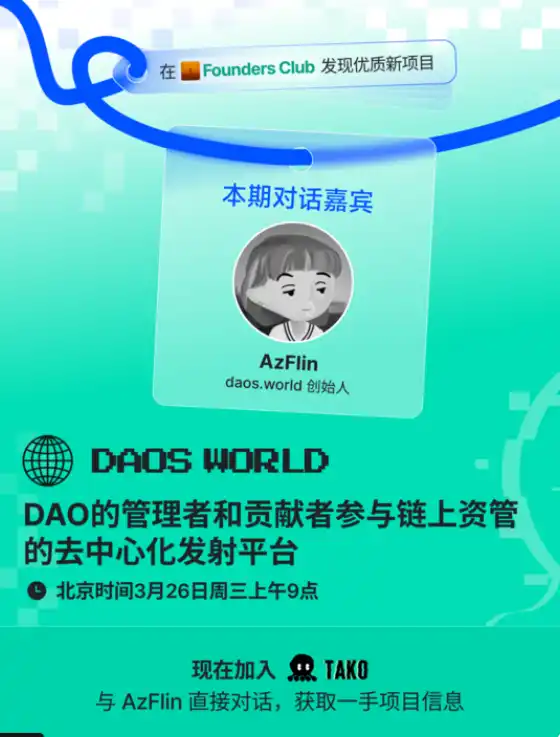
Based Series | Weekly Founder Feature: Daos.World Founder AzFlin

Source: Tako
Editor's Note: In order to provide direct access to Alpha founders, Tako recently established the Founders Club and launched the "Discover Base Alpha" series of interviews in collaboration with BlockBeats. This series will regularly introduce readers to projects within the Base ecosystem that are highly potential, innovative in product, and have a high-quality team background, inviting project founders to share their insights. At the same time, it also provides an opportunity for users interested in emerging and hot projects to directly engage with the founders.
This edition's guest for the interview is AzFlin, the founder of Daos.World. The following is a transcript of this AMA:
Table of Contents
1. AzFlin's Background and Experience
3. Differentiation of Daos.World
4. Multi-Chain Strategy
5. View on Industry Trend Changes
6. Social Features of Daos.World
7. How to Participate in Daos.World
8. Vision and Philosophy
9. Entrepreneurship Insights and Lessons
10. Work-Life Balance
11. Other Community Q&A
AzFlin's Background and Experience
Julie:
We are pleased to introduce this week's guest - AzFlin (@azflin), the co-founder of daos.world (@daosdotworld).
AzFlin is a technically savvy developer who transitioned from Traditional Finance (TradFi) to Web3 in 2021. He has worked at the pioneering NFT aggregation platform Genie and Uniswap before immersing himself in what he calls "trench dev," engaging in various projects on the frontlines of the crypto world.
This journey eventually led to the creation of daos.world, a decentralized DAO launchpad, aiding DAO managers in on-chain fundraising and fund management. daos.world initially launched on Base at the end of 2024, expanding to Solana thereafter, with the aim of becoming the "world's largest DAO launchpad" by offering transparent, trustless investment opportunities through a unique project selection and whitelist mechanism.
AzFlin's vision is to explore new token issuance models and drive greater value through DAOs. By implementing stringent team reviews, requiring project teams to provide private documents to ensure accountability, and introducing the innovative DWL token system, he has built a platform focused on quality and reputation.
Welcome AzFlin to the Founders Club! Next, we will hear him share the entrepreneurial journey of daos.world, his perspective on cross-chain development, and how to build an incentive-aligned system in Web3. Feel free to ask any questions, whether about his transition from TradFi to "trench dev" or feedback on daos.world, speak your mind.
AzFlin:
Thank you for the invitation, Julie. I really enjoy Tako's asynchronous long-form interview format, especially the functionality to sync across platforms to Warpcaster, very powerful.
I usually prefer text-based communication rather than voice meetings. So, this format suits me well.
Let me briefly introduce my background, from mundane development in traditional finance to the shift to "trench dev." I have been programming for over 10 years, majored in Mathematics in college, and then worked for 7 years in TradFi doing Python+SQL+data analysis. Back then, I had no passion for work, just wanted to get by, had no ambition, just wanted to enjoy life—completely different from my mindset now.
In 2021, I joined a Solidity boot camp called Chainshot, reigniting my passion for programming. Later, I joined Genie (the first NFT aggregation trading platform) as the lead engineer. I fell in love with the industry's rapid pace of innovation—the constant stream of new things every day, where anyone could create a blockbuster project at any moment. My experience at Genie truly captivated me in the crypto world.
A year later, Genie was acquired by Uniswap. Compared to a startup, Uniswap's large company pace was much slower, with all sorts of meetings, documents, and processes that I found hard to adapt to. I enjoyed rapid development, working alone or in a small team. A year later, I was fired because of a so-called "rug pull shitcoin" incident (the specific story can be found online, but I won't go into detail here). But this turned out to be a blessing in disguise, giving me the opportunity to develop independently and also gaining some recognition in the industry.
Then came the "trench development" phase. After leaving Uniswap, I independently developed various small projects on different chains and took on some freelance work. Whenever I had an interesting idea, I would either pursue it alone or collaborate with others. This phase was very challenging—going from a stable high salary to earning money from sporadic projects, sometimes going weeks or even months without income, sometimes putting in a lot of effort into a project that received little attention, and sometimes seeing a small side project unexpectedly take off.
"Trench development" is full of randomness, but you learn a lot and have the complete freedom to do what you want. It was this experience that eventually led me to found daos.world. In November 2024, I decided to fork the then-popular daos.fun and, together with another partner, spent a month creating an MVP. Through luck and timing, we also gained popularity.
Now, I am completely immersed in entrepreneurship.
Q1.1 - Tako User@jamesx:
As a founder, I can understand the various challenges, joys, and surprises you have experienced. I would like to know, since the launch of your project, what has been your happiest moment?
AzFlin:
Probably sitting in Telegram watching everyone frantically spamming whitelist commands, or going downstairs for a smoke and having a moment of contemplation on what to do next.
Daos.World 101
Q2.1 - Julie:
For those who are new to daos.world, how would you introduce it in 30 seconds? What is its core mission? Why should Tako users pay attention?
AzFlin:
"DAO + Meme Token" is an explosively powerful combination. Many DAO attempts in the past have failed, but in this cycle, the Memecoin craze has proven that everything can be tokenized. DAOs themselves are cool — having a treasury to freely invest from, but adding a speculative token makes it even more interesting.
Daos.World Differentiation
Q3.1 - Julie:
Ever since daos.world launched on Base at the end of 2024, I've been keeping an eye on it. What made you decide to create a DAO launchpad? What sets DW apart from other launchpads? (Similar questions have been asked by the community as well.)
AzFlin:
Our points of differentiation are:
Innovative Tokenomics: On Base, we've designed a mechanism where staking DAO tokens earns $DWL.
DWL is a lottery token that can be burned to win whitelist spots in other projects.
I love this on-chain experiment, akin to the "food farms" gameplay during the DeFi summer of 2021.
In the future, we'll explore more DAO tokenomics models, such as $RWOK's "staking NFT to earn tokens" paradigm.
Customized Services: We provide tailored support for DAOs, such as early development of dedicated AI agents for DAOs (e.g., the three AI directors of 3 Beras Capital).
We work closely with teams, offering consultancy in development and marketing to help them reach their full potential.
Q3.2 - Tako User @coolhayley:
Recently, many projects using the "AI Agent+DAO Funding" model have been gaining popularity. What is the core competitive advantage of daos.world compared to other DAO platforms?
AzFlin:
Key advantages:
The DAO funds are completely under free control, and the treasury assets can be cross-chain invested in NFTs, DeFi, etc., as we only use a regular wallet to manage funds, not custom contracts.
A high revenue share is based on Base, with 40% of Uniswap V3 trading fees refunded to the DAO. On Solana, the Meteora dynamic pool can generate very high first-day fees, and creators can also share in them.
Deep support; we are not just a launch platform but also provide customized marketing and technical support to help projects maximize their potential.
Multi-chain Strategy
Q4.1 - Julie:
What was the initial reason for daos.world to choose Base? Curious how early support from @jessepollak helped you grow (e.g., the 176x increase in $FDREAM)?
AzFlin:
Choosing Base was a natural choice. We first considered EVM chains because compared to Solana, EVM makes it easier to build complex smart contracts. Base is the No.1 on the EVM chain in Degen culture, trading volume, and user mindset, so we naturally chose it.
Additionally, we were fortunate to be noticed early on by @jessepollak, who gave us great support, for which I am forever grateful! The conclusion is: as long as you create something good, the Base team will see it.
Q4.2 - Julie:
Expanding to Solana was a natural progression. What shortcomings of Base does Solana address? How is the current progress?
AzFlin:
Solana has attracted a large number of Degen users that Base did not have. Even though the market has cooled off now, Solana's Degen culture remains unmatched. Launching a project on Solana immediately catches people's attention; everyone holds SOL and is ready to go.
Meteora's technology is also excellent, and its fee structure is very advantageous for project teams. Although the market is currently down, new DAOs are slow to join, but we remain optimistic and will continue to build on Solana.
Q4.3 - Tako User@emily:
HypurrDAO provides liquidity support for daos.world in the Solana ecosystem through Meteora's dynamic pool, and daos.world also opens whitelist resources to HypurrDAO. Have you considered designing a two-way token incentive to achieve a cross-chain ecosystem loop in this collaboration?
AzFlin:
I don't fully understand this question. Yes, this is a two-chain cross-chain system, and I believe it benefits users on both sides.
View on Hot Topic Changes in the Industry
Q5.1 - Julie:
The cryptocurrency industry's trends change rapidly, with AI Meme and DAO Meme dominating at the end of last year, but recently the spotlight has shifted to the BNB chain. How do you view this market rotation? How does daos.world adjust its strategy to avoid merely chasing hot trends and instead build long-term value?
AzFlin:
Attention in this industry is as fleeting as a fish's. The speed at which the AI/DAO Meme cycle faded was astonishing. We also noticed the heat around BSC and may deploy over there in the future. EVM technology is easy to replicate, so expanding to other EVM chains is not difficult; the key is to have enough Degen users and transaction volume.
I don't always want to chase the latest trends; my goal is to build a project that can provide long-term value to the industry. The core idea of a DAO — community crowdfunding and pursuing common goals — is one of the foundations of this industry. We hope to help creators launch DAOs in the simplest and most seamless way possible and provide the best tools to operate them.
We have many relevant plans.
There are many DAO enthusiasts in this industry, and I would love to hear everyone's feedback: How can we make DAOs fun again? How can we increase participation? Many people don't like voting; how can we truly involve the community rather than just speculating on coins?
Q5.2 - Tako User@amandaeth:
Are there any circumstances that would make you stop operating this project? For example, inadequate funding, a proven unworkable mechanism?
AzFlin:
If I can't make money, no new DAOs join, or the market-product fit (PMF) is too low, I might pause maintenance, but I won't completely give up.
Q5.3 - Tako User@anymose:
Aside from the DAO space, what other race tracks do you think can exist in the crypto industry for the long term?
AzFlin:
DeFi comes first; this is the true product-market fit (PMF) of cryptocurrency.
Daos.World's social features
Q6.1 - Julie:
You previously mentioned wanting to add social features, such as a Troll Box and enhanced governance. How do you view the development of the social layer on daos.world?
AzFlin:
Currently, the social layer of daos.world mainly consists of Telegram, Discord, X, with each DAO having its own community.
In fact, these platforms are already quite good. Discord's emoji voting is great for quick decision-making. Unless there is a truly innovative feature, there is no need to reinvent the wheel.
A simple improvement would be to add a Troll Box on each DAO page to allow people to leave messages and increase interaction.
How to Participate in Daos.World
Q7.1 - Julie:
For users new to DAOs but interested in participating in daos.world, how can they get involved? What is the entry process for the average user? What risks should they be aware of?
AzFlin:
The simplest way to participate is to buy any DAO token on daos.world. But please do your own research (DYOR) as some tokens may even be below Net Asset Value (NAV), presenting undervaluation opportunities. For example, the NAV of $YT (YapTrade) is higher than its market cap.
Furthermore, participating in the whitelist of new projects can also be exciting. For example, on SOL, @Meet_Wally (a competitor of ChatGPT/Perplexity) is currently a good opportunity to get on the whitelist as the hype hasn't fully kicked in yet.
Q7.2 - Tako User@coolhayley:
As a founder, what key points do you think users need to pay attention to when participating in order to maximize gains and reduce risks?
AzFlin:
If you have made a lot of profit, remember to cash out. I have seen too many people being greedy and not withdrawing, only to end up losing. I have made this mistake myself as well.
Methods to reduce risk: Research the team, observe their social media, analyze their communication style; these little details can help you make judgments.
Q7.3 - Tako User@Fraral:
How can one get into your whitelist?
AzFlin:
The most direct way is to contribute on X (Twitter) — tweet promoting a new project, join their Telegram, or join my community. Any contribution will be seen and acknowledged.
Q7.4 - Tako User@aegis2293:
I heard @latenightonbase and @basejunkie are up to something with $NFA? The tax token for the NFT DAO? It sounds revolutionary for creators!
AzFlin:
That's right, stay tuned.
Vision and Methodology
Q8.1 - Julie:
You mentioned wanting to focus on long-term development, what is the roadmap for daos.world for the next two quarters? Will it still be a launchpad in two years, or will it evolve into something bigger? What is the ultimate goal?
AzFlin:
Next two quarters:
Expand to more high-activity EVM chains
Optimize launch mechanism
Introduce more innovative DAOs
Strengthen community building for existing DAOs
Next two years:
To be honest, I haven't thought that far ahead yet. The primary goal is to build the best DAO launch platform and provide all the tools needed for DAOs (treasury management, governance, voting, etc.). We will stay up to date with industry trends and explore any opportunities in the DAO space.
Ultimate goal:
Get more people (including non-crypto users) involved in DAOs, showcasing the power of decentralized governance and tokenization.
Q8.2 - Julie:
You mentioned "Just write code, just launch," and some DAOs can go live in a few weeks. This rapid iterative approach is rare in the crypto industry (many projects get stuck in endless development cycles). How do you manage to be both fast and stable? How do you decide which features must go live and which can be added later?
AzFlin:
Speed is key. Speed determines success. I often tell people that the crypto industry changes rapidly, and many teams move too slowly. Everyone needs to step up, act faster, and not get bogged down by details. Release the most basic version first, allowing the product to face users as soon as possible.
I have no secrets; it's just hard work, aiming to launch with the minimum viable product (MVP). Additionally, testing is crucial. As long as the tests pass, I will not hesitate to release.
Q8.3 - Tako User@SOLO_eva:
daos.world What are the plans for future product iteration and ecosystem expansion?
AzFlin:
We will expand to more chains, optimize the launch mechanism (such as the upcoming tax token), and enhance DAO tools.
Q8.4 - Tako User@JulianAllen:
daos.world has created a wealth effect through a whitelist mechanism, but as DWL is a token without market value, how can we prevent users from losing interest after short-term gains? In the future, will DWL have more utility scenarios?
AzFlin:
Currently, $DWL is mainly a lottery whitelist token and will also be used for community rewards. I have always emphasized that it has no intrinsic market value, but I am considering how to make it more impactful.
Entrepreneurship Insights and Lessons
Q9.1 - Julie:
Every founder's journey is filled with challenges and learning moments. What obstacles have you encountered in building daos.world? Have there been any failures or hacks that taught you valuable lessons?
AzFlin:
I have learned more in the past few months than in the past few years. Just to share a few points:
Cashing out at the right time is key, as the success and hype in the crypto industry are fleeting. As a founder, you need to secure your financial well-being first. If you don't sell, others will not hesitate to sell on top of you, leaving you with nothing. We could have cashed out more during the initial hype phase.
Deciding whom to whitelist for allocation is tricky. It's best to have clear requirements in advance (such as tweeting, providing support), as many people who receive whitelist allocation disappear.
Talent is hard to find; there are few truly capable individuals in this industry. If you find one, cherish them and collaborate as much as possible.
Networking is crucial, and everything accumulates. Many supporters of daos.world are people I have collaborated with in the past.
Maintaining price stability is extremely difficult now with fierce competition, you must perform at the top 5% level just to barely maintain it. Continuous introduction of new users and buying pressure is needed.
Q9.2 - @Mable Jiang:
How do you deal with the community's pressure on the coin price? And the developer's moral blackmail of "should not do certain things otherwise it's a rug"? Public development is challenging; I'd like to hear your thoughts.
AzFlin:
I basically ignore comments about the coin price, I'm used to dealing with FUD. Public development is indeed difficult, but that's part of the game.
Q9.3 - Tako User@coolhayley:
How was the early team formed?
AzFlin:
They were all friends or partners I knew from before.
Work-Life Balance
Q10.1 - Julie:
Tako initially advocated for "High Tech, High Life." Your development pace must be very demanding physically and mentally. How do you maintain balance to avoid burnout?
AzFlin:
daos.world when it first launched, I completely gave up a healthy lifestyle, worked non-stop, sometimes anxious to the point of insomnia, and even started smoking again. This state is not sustainable, but that period was the most exciting days of my life — facing new challenges and opportunities every day.
I'm still very busy now (especially with some real-life matters), but I'm more composed. Balance must be maintained, or else burnout will happen.
Q10.2 - Tako User@shea:
When under a lot of pressure, besides smoking, are there any other ways to relieve stress? Such as exercise?
AzFlin:
I used to exercise regularly, but have been doing it less lately. I plan to start again!
Q10.3 - Tako User@Ekko:
How do you currently balance remote and on-site work?
AzFlin:
It's all about working hard every day and not wasting time—although I still often watch shows and chill at night, haha.
Community Q&A
Q11.1 - Tako User@web3zy8:
You mentioned that you would stick to daos.world, but many projects on the platform are currently performing poorly, supporters and users are drained, and the coin price has dropped by 99%. What are your thoughts? Will you compensate loyal users?
AzFlin:
I understand everyone's frustration. Indeed, many people have lost money, but many have also made gains. This is the nature of the cyclical rotation in the industry. All DAOs are still under development, and many will have a strong comeback. For example, AISTR is about to launch bonds, and RWOK is becoming the core treasury of the Remilia ecosystem. These DAOs are all backed by hard assets, and at the very least, funds will be returned to holders upon maturity.
Q11.2 - Tako User@Fraral:
What is your view on the social track? Why did you accept Tako's invitation?
AzFlin:
Two reasons: 1) I like to talk about myself; 2) Vitalik has also been here.
Q11.3 - Tako User@jacktod1:
daos.world has enabled many people to earn hundreds of times (including me). Although I haven't sold most of the tokens, I haven't lost either. The early community atmosphere was the best, with many people willing to contribute, feeling the charm of the platform and AZ. AZ is one of the most approachable founders I have ever seen.
Platform development inevitably encounters setbacks, divisions, FUD, especially when the DWL rules were introduced. The team's original intention was fairness, but lack of adequate communication led to continuous FUD. In hindsight, at that time, AI tokens were the hottest, and most coins eventually plummeted. So, FUD + unclear rules + lack of liquidity provision + too many projects leading to fund dispersion formed a vicious cycle.
I think this is market-driven, but community operations also have a responsibility. I have always respected the daos.world team, AZ, Mew, Americanspirit; they are really great.
What I most hope to see is different developers collaborating on the same platform, complementing each other's resources.
AzFlin:
Thank you for the feedback, Jack. You are one of the earliest OG supporters, and I will always remember that!
Q11.4 - Tako User@flyawei:
I'm fed up with PVP (Player-vs-Player). Just the day before yesterday, a dao.fun project was rug pulled right after launch. Hopefully, our DAO project can address this pain point.
AzFlin:
The current market is very challenging, purely PVP mode. To keep a project hot, you need a whitelist followed by new buyers to take over. But it's hard to find new funds now. A real market fit must be found.
Q11.5 - Tako User@shea:
The whitelist mechanism of daos.world allows users to earn 15-77x returns. How is such high yield designed? How to ensure sustainability?
AzFlin:
This was not designed by us but determined by the initial presale price and market demand. No one can guarantee such a return rate; everything depends on market supply and demand.
Q11.6 - Tako User@shea:
daos.world has "anti-snipe" technology to protect DWL holders. Will more innovative technologies be introduced in the future to optimize the platform?
AzFlin:
Yes. For example, we may introduce "tax tokens" for certain DAOs, allowing creators to earn passive income based on transaction volume. Although tax mechanisms have been unpopular in the past, they can create a positive feedback loop, fairly rewarding creators.
We are designing this mechanism for the NFT DAO of @latenightonbase and @basejunkie ($NFA).
This article is contributed and does not represent the views of BlockBeats.
You may also like
a16z Leads $18M Seed Round for Catena Labs, Crypto Industry Bets on Stablecoin AI Payment
Pharos, deeply integrated with AntChain, is about to launch. How can we get involved?
$COIN Joins S&P 500, but Coinbase Isn't Celebrating
On May 13, S&P Dow Jones Indices announced that Coinbase would officially replace Discover Financial Services in the S&P 500 on May 19. While other companies like Block and MicroStrategy, closely tied to Bitcoin, were already part of the S&P 500, Coinbase became the first cryptocurrency exchange whose primary business is in the index. This also signifies that cryptocurrency is gradually moving from the fringes to the mainstream in the U.S.
On the day of the announcement, Coinbase's stock price surged by 23%, surpassing the $250 mark. However, just 3 days later, Coinbase was hit by two consecutive events: a hack where employees were bribed to steal customer data and a demand for a $20 million ransom, and an investigation by the U.S. Securities and Exchange Commission (SEC) into the authenticity of its claim of having over 100 million "verified users" in its securities filings and marketing materials. These two events acted as mini-bombs, and at the time of writing, Coinbase's stock had already dropped by over 7.3%.
Coincidentally, Discover Financial Services, being replaced by Coinbase, can also be considered the "Coinbase" of the previous payment era. Discover is a U.S.-based digital banking and payment services company headquartered in Illinois, founded in 1960. Its payment network, Discover Network, is the fourth largest payment network apart from Visa, Mastercard, and American Express.
In April, after the approval of the acquisition of Discover by the sixth-largest U.S. bank, Capital One, this well-established digital banking company of over 60 years smoothly handed over its S&P 500 "seat" to this emerging cryptocurrency "bank." This unexpected coincidence also portrayed the handover between the new and old eras in Coinbase's entry into the S&P 500, resembling a relay race scene. However, this relay baton also brought Coinbase's accumulated "external troubles and internal strife" to a tipping point.
Over the past decade, cryptocurrency exchanges have been the most stable "profit machines." They play a role in providing liquidity to the entire industry and rely on trading fees to sustain their operations. However, with the comprehensive rollout of ETF products in the U.S. market, this profit model is facing unprecedented challenges. As the leader in the "American stack," with over 80% of its business coming from the U.S., Coinbase is most affected by this.
Starting from the approval of Bitcoin and Ethereum spot ETFs, traditional financial capital has significantly onboarded users and funds that originally belonged to exchanges in a more cost-effective, compliant, and transparent manner. The transaction fee revenue of cryptocurrency exchanges has started to decline, and this trend may further intensify in the coming months.
According to Coinbase's 2024 Q4 financial report, the platform's total trading revenue was $417 million, a 45% year-on-year decrease. The contribution of BTC and ETH's trading revenue dropped from 65% in the same period last year to less than 50%.
This decline is not a result of a decrease in market enthusiasm. In fact, since the approval of the Bitcoin ETF in January 2024, the inflow of BTC into the U.S. market has continued to reach new highs, with asset management giants like BlackRock and Fidelity rapidly expanding their management scale. Data shows that BlackRock's iShares Bitcoin ETF (IBIT) alone has surpassed $17 billion in assets under management. As of mid-May 2025, the cumulative net inflow of 11 major institutional Bitcoin spot ETFs on the market has exceeded $41.5 billion, with a total net asset value of $1214.69 billion, accounting for approximately 5.91% of the total Bitcoin market capitalization.
Institutional investors and some retail investors are shifting towards ETF products, partly due to compliance and tax considerations. On one hand, ETFs have much lower trading costs compared to cryptocurrency exchanges. While Coinbase's spot trading fee rate varies annually in a tiered manner but averages around 1.49%, for example, the management fee for IBIT ETF is only 0.25%, and the majority of ETF institution fees fluctuate around 0.15% to 0.25%.
In other words, the more rational users are, the more likely they are to move from exchanges to ETF products, especially for investors aiming for long-term holdings.
According to multiple sources, several institutions, including VanEck and Grayscale, have submitted applications to the SEC for a Solana (SOL) ETF, with some institutions also planning to submit an XRP ETF proposal. Once approved, this may trigger a new round of fund migration. According to a report submitted by Coinbase to the SEC, as of April, the platform's trading revenue from XRP and Solana accounted for 18% and 10%, nearly one-third of the platform's fee revenue.
However, the Bitcoin and Ethereum ETFs passed in 2024 also reduced the fees for these two tokens on Coinbase from 30% and 15% to 26% and 10%, respectively. If the SOL and XRP ETFs are approved, it will further undermine the core fee revenue of exchanges like Coinbase.
The expansion of ETF products is gradually weakening the financial intermediary status of cryptocurrency exchanges. From their original roles as matchmakers and clearers to now gradually becoming mere "on-ramps and off-ramps" for funds, exchanges are seeing their marginal value squeezed by ETFs.
On May 12, 2025, SEC Chairman Paul S. Atkins gave a keynote speech at the Tokenization and Cryptocurrency Working Group roundtable. The theme of his speech revolved around "It is a new day at the SEC," where he indicated that the SEC would not approach enforcement and regulation the same way as before but would instead pave the way for cryptocurrency assets in the U.S. market.
With signs of cryptocurrency compliance such as the SEC's "NEW DAY" declaration, an increasing number of traditional brokerages are attempting to enter the cryptocurrency industry. One of the most representative cases is the well-known U.S. brokerage Robinhood, which began expanding its crypto business in 2018. By the time of its IPO in 2021, Robinhood's crypto business revenue accounted for over 50% of the company, with a significant boost from the Dogecoin "moonshot" promoted by Musk.
In Q1 2025 earnings report, Robinhood showcased strong growth, especially in revenue from cryptocurrency and options trading. Fueled by Trump's Memecoin, cryptocurrency-related revenue reached $250 million, nearly doubling year-over-year. Consequently, Robinhood Gold subscription users reached 3.5 million, a 90% increase from the previous year, with the rapid growth of Robinhood Gold providing the company with a stable source of income.
Meanwhile, RobinHood is actively pursuing acquisitions in the cryptocurrency space. In 2024, it announced a $2 billion acquisition of the long-standing European cryptocurrency exchange Bitstamp. Additionally, Canada's largest cryptocurrency CEX, WonderFi, which recently went public on the Toronto Stock Exchange, also announced its integration with RobinHood Crypto. After obtaining virtual asset licenses in the UK, Canada, Singapore, and other markets, RobinHood has taken a proactive approach in the compliant cryptocurrency trading market.
Furthermore, an increasing number of brokerage firms are exploring the same path. Futu Securities, Tiger Brokers, and others are also dipping their toes into cryptocurrency trading, with some having applied for or obtained the VA license from the Hong Kong SFC. Although their user bases are currently small, traditional brokerages have a natural advantage in user trust, regulatory licenses, and low fee structures. This could pose a threat to native cryptocurrency platforms in the future.
In April 2025, security researchers discovered that some Coinbase user data was leaked on the dark web. While the platform initially responded by attributing it to a "technical misinformation," it still raised concerns among users regarding its security and privacy protection. Just two days before Dow Jones Indexes announced Coinbase's addition to the S&P 500 Index, on May 11, 2025, Coinbase received an email from an unknown threat actor claiming to have obtained customer account information and internal documents, demanding a $20 million ransom to keep the data private. Subsequent investigations confirmed the data breach.
Cybercriminals obtained the data by bribing overseas customer service agents and support staff, mainly in "non-U.S. regions such as India." These agents abused their access to Coinbase's internal customer support system and stole customer data. As early as February this year, blockchain detective ZachXBT revealed on X platform that between December 2024 and January 2025, Coinbase users lost over $65 million to social engineering scams, with the actual amount potentially higher.
Among the victims was a well-known figure, 67-year-old Ed Suman, an established artist in the art world for nearly two decades, having been involved in the creation of artworks such as Jeff Koons' "Balloon Dog" sculpture. Earlier this year, he fell victim to an impersonation scam involving fake Coinbase customer support, resulting in a loss of over $2 million in cryptocurrency. ZachXBT critiqued Coinbase for its inadequate handling of such scams, noting that other major exchanges have not faced similar issues and recommending Coinbase to enhance its security measures.
Amidst a series of ongoing social engineering incidents, although there has not been any impact on user assets at the technical level so far, it has raised concerns among many retail and institutional investors. Especially institutions holding massive assets on Coinbase. Just considering the U.S. BTC ETF institutions, as of mid-May 2025, they collectively hold nearly 840,000 BTC, and 75% of these are custodied by Coinbase. If we price BTC at $100,000, this amount reaches a staggering $63 billion, which is equivalent to the nominal GDP of two Iceland in the year 2024.
In addition, Coinbase Custody also serves over 300 institutional clients, including hedge funds, family offices, pension funds, and endowments. As of the Q1 2025 financial report, Coinbase's total assets under management (including institutional and retail clients) reached $404 billion. The specific amount of institutional custodied assets was not explicitly disclosed in the latest report, but it should still be over 50% based on the Q4 2024 report.
Once this security barrier is breached, not only could the rate of user attrition far exceed expectations, but more importantly, institutional trust in it would undermine the foundation of its business. Therefore, after a hacking event, Coinbase's stock price plummeted significantly.
Facing a decline in spot trading fee revenue, Coinbase is also accelerating its transformation, attempting to find growth opportunities in derivatives and emerging assets. Coinbase acquired a stake in the options platform Deribit at the end of 2024 and announced the official launch of perpetual contract products in 2025. This acquisition fills in Coinbase's gap in options trading and its relatively small global market share.
Deribit has a strong presence in non-U.S. markets, especially in Asia and Europe. The acquisition has enabled Coinbase to gain a dominant position in bitcoin and ethereum options trading on Deribit, accounting for approximately 80% of the global options trading volume, with daily trading volume remaining above $2 billion.
Meanwhile, 80-90% of Deribit's customer base consists of institutional investors, with their professionalism and liquidity in the Bitcoin and Ethereum options market highly favored by institutions. Coinbase's compliance advantage, coupled with its already robust institutional ecosystem, makes it even more suitable. By using institutions as an entry point, it can face the squeeze from giants like Binance and OKX in the derivatives market.
Facing a similar dilemma is Kraken, which is attempting to replicate Binance Futures' model in non-U.S. markets. Since the derivatives market relies more on professional users, fee rates are relatively higher and stickiness is stronger, making it a significant source of revenue for exchanges. In the first half of 2025, Kraken completed the acquisition of TradeStation Crypto and a futures exchange, aiming to build a complete derivatives trading ecosystem to hedge the risk of declining spot transaction fee income.
With the surge of Memecoin in 2024, Binance, OKX, and various CEX platforms began massively listing small-market-cap, highly volatile tokens to activate active trading users. Due to the wealth effect and trading activity of Memecoins, Coinbase was also forced to join the battle, successively listing popular tokens from the Solana ecosystem such as BOOK OF MEME and Dogwifhat. Although these coins are controversial, they are frequently traded, with fee rates several times higher than mainstream coins, serving as a "blood-boosting" method for spot trading.
However, due to its status as a publicly traded company, this practice is a riskier endeavor for Coinbase. Even in the current crypto-friendly environment, the SEC is still investigating whether tokens like SOL, ADA, and SAND constitute securities.
In addition to the forced transformation strategies carried out by the aforementioned CEXs, they are also starting to lay out RWAs and the most talked-about stablecoin payment fields, such as the PYUSD launched through a collaboration between Coinbase and Paypal, Coinbase's support for the Euro stablecoin EURC by Circle that complies with EU MiCA regulatory requirements, or the USD1 launched through a collaboration between Binance and WIFL. In the increasingly crowded trading field, many CEXs have shifted their focus from just the trading market to the application field.
The golden age of transaction fees has quietly ended, and the second half of the crypto exchange platform game has silently begun.
Arthur Hayes: Why I'm Betting on ETH While the Market Is Obsessed with SOL
Key Market Insights for May 16th, how much did you miss out on?
MOG Coin Skyrockets as Elon Musk and Garry Tan Embrace "mog/acc" Identity
The End and Rebirth of NFTs: How the Meme Coin Craze Ended the PFP Era?
STARTUP's Price Surges 40x in 30 Minutes: How did he become the Emotion King of Believe?
Key Market Intelligence on May 14th, how much did you miss out on?
1.Binance Alpha Launches HIPPO, BLUE, and Other Tokens
2.Believe Ecosystem Tokens See General Rise, LAUNCHCOIN Surges Over 250% in 24 Hours
3.Tiger Securities Introduces Cryptocurrency Deposit and Withdrawal Service, Supports Mainstream Cryptocurrencies such as BTC and ETH
4.Current Bitcoin Rally Possibly Driven by Institutions, Retail Traders Yet to Join
5.Binance Wallet's New TGE Privasea AI Participation Requires a 198 Point Threshold, with a Point Consumption of 15
Source: Overheard on CT (tg: @overheardonct), Kaito
PUMP: Today's discussions about PUMP focus on its new creator revenue-sharing model: the platform will allocate 50% of PumpSwap revenue to token creators, sparking varied reactions from users. Some criticize the move as insufficient or even misleading, while others view it as a positive step the platform is taking to reward creators. Meanwhile, PUMP faces market pressure from emerging competitors like LetsBONKfun and Raydium, which are rapidly gaining market share. Users also express concerns about PUMP's sustainability and potential regulatory risks in the U.S., with discussions extending to the platform's impact on the entire memecoin ecosystem.
COINBASE: Today, Coinbase became the first crypto company to join the S&P 500 Index, replacing Discover Financial Services, sparking widespread industry attention. The entire crypto community views this milestone as a significant development, signaling that crypto assets are further integrating into the mainstream financial system. The news has sparked lively discussions on Twitter, with many users pointing out that this may attract more institutional investors to enter the Bitcoin and other cryptocurrency markets.
XRP: XRP became the focal point of today's crypto discussion, with its significant market movements and strategic advances drawing attention. XRP has surpassed USDT to become the third-largest cryptocurrency by market capitalization, sparking market excitement and discussions about its future potential. The surge in market capitalization and price is believed to be related to increasing institutional interest, deepening strategic partnerships, and its role in the crypto ecosystem. Additionally, XRP's integration into multiple financial systems and its potential as a macro asset class are also seen as key factors driving the current market sentiment.
DYDX: Today's discussions about DYDX mainly focused on the dYdX Yapper Leaderboard launched by KaitoAI. The leaderboard aims to identify the most active community participants, with a total of $150,000 in rewards to be distributed over the first three seasons. This initiative has sparked broad community participation, with many users discussing the potential rewards and the incentive effect on the DYDX ecosystem. Meanwhile, progress on the ethDYDX to dYdX native chain migration and historical airdrop events have also been topics of discussion.
1. "What Is 'ICM'? Holding Up the $4 Billion Market Cap Solana's New Narrative"
Overnight, the hottest narrative in the crypto space has become "Internet Capital Markets," with a host of crypto projects and founders, led by the Solana ecosystem's new Launchpad platform Believe, releasing this phrase. Together with "Believe in something," it has become the new slogan heralding the onset of a bull market. What exactly is the so-called "Internet Capital Market," will it become a short-lived hype phrase like the Base ecosystem's previous Content Coin, and what related targets are available for selection?2.《LaunchCoin Surges 20x in One Day, How Did Believe Create a $200M Market Cap Shiba Inu After Going to Zero?|100x Retrospective》
LAUNCHCOIN broke through a $200 million market cap today, with the long-lost liquidity and such a high market cap "Memecoin" almost bringing half of the on-chain crypto community CT into the fray. The community is crazily discussing this token, with half of it being FOMO and the other half being FUD. This token, originally issued by Believe founder Ben Pasternak under his personal identity, transformed into a new platform token after a renaming. From once going to zero to a $200 million market cap, what happened in between?May 14 On-chain Fund Flow
Within 24 hours, GOONC's market cap soared to 70 million, could GOONC be the next billion-dollar dog on the Believe platform?
Bitcoin has broken $100,000, Ethereum has surpassed 2500, and is Solana's hot streak about to make a comeback?
The current market is in a state of macro euphoria, with GOONC riding the wave today, skyrocketing 10x in just a few hours, reaching a market cap of tens of millions of dollars, trading volume soaring past 50 million, and rumors swirling that the developer may be from OpenAI (unconfirmed but intriguing enough).
A ludicrous and absurd Solana meme that some actually buy into.
GOONC is a meme coin that has sprouted from the "gooning" subculture, offering no technological innovation or practical use, its sole function being speculation.
It takes inspiration from an NSFW term "gooning," which refers to a person being deeply immersed in certain content (you know what), eventually entering a nearly religious-like trance.
In Reddit (such as r/GOONED, r/GoonCaves) and some counterculture media outlets (such as MEL Magazine in 2020), "gooning" has gradually transitioned from an adult label to a meme-addicted, digital content and virtual self-indulgence synonym, arguably the epitome of Degen spirit.
GOONC is playing around with this concept, packaging the addictive nature, uselessness, and irony of gooning into a tradable financial product. The project team has made it clear: "We do not solve blockchain problems, we only trade absurdity." Blunt but oddly genuine.
GOONC launched on May 13, 2025, using the meme coin launch platform Believe App's LaunchCoin module on Solana. This tool is highly Degen: zero technical barriers, a few clicks to create a coin, perfect for projects like GOONC that can come up with ideas out of the blue.
The mastermind behind GOONC is also quite something and is the most talked-about, with KOL @basedalexandoor on X platform (alias "Pata van Goon") personally involved. His profile even caught the attention of Marc Andreessen, co-founder of a16z, making onlookers unable to resist speculating if GOONC has a hint of OpenAI lineage.
While this 'OpenAI Endorsement' is currently just community speculation, it is definitely a good card to play to fuel hype. Saying "we are pure speculation" on one hand, while tagging a few "AI + a16z" on the other.
GOONC took off as soon as it launched. After its launch on May 13, 2025, its market capitalization skyrocketed to $22 million within 4 hours, with a trading volume exceeding $25.6 million in 24 hours. According to platform data, the first day of trading saw an astonishing +41,100% surge, soaring from $0.0000001 to $0.02, becoming a "missed-the-boat" situation.
GOONC quickly formed an active trading community post-launch, with a lot of discussion and trading signals appearing on X platform (such as the 292x return signal provided by DeBot). Liquidity pools on exchanges like Raydium and Meteora grew rapidly, supporting high trading volumes and price increases.
The real climax occurred between May 13 and May 14, with the market cap rising to $5.5 million in the morning and directly surpassing $55 million in the afternoon. By the 14th, it briefly approached a $70 million market cap, with the trading volume soaring to $59 million. Some community members even posted screenshots claiming an increase of +85,000%, creating a new myth out of the ruins.
As of 1:30 pm on May 14, the price stabilized around $0.039, with a total market cap and FDV both around $39.6 million, and a 24-hour trading volume of $5.43 million. Active platforms include XT.COM, LBank, Meteora, and others.
Although there was a slight pullback from the peak ($0.07), the coin's popularity remains strong. For a coin that relies purely on "irony + community + X post" to thrive, this performance is already at a stellar level.
Currently, the background of the token's development team is not transparent, increasing the potential risk of a rug pull. Rugcheck.xyz warns that the creator of the GOONC contract may have permission to modify the contract (e.g., change fees or mint additional tokens), posing certain security risks.
Community members speculate that the meteoric rise of GOONC may be the "last hurrah".
Deconstructing Binance Alpha2.0's New "Asia-Led Liquidity Mining" Model
After Surging 40%, Has Ethereum Price Peaked Upon Exiting the Craze?
Whether you are an insider or an outsider, these days you must be familiar with the news about Ethereum. The reason is simple, causing Ethereum enthusiasts to sigh with emotion and almost throwing off-guard those who defend Ethereum, Ethereum, with a "3-day surge of 40%," climbed to the top of the Douyin Hot List.
As we all know, Ethereum launched the Pectra upgrade on May 7th. This most significant network upgrade since early 2024 integrates the Prague execution layer hard fork and the Electra consensus layer upgrade, significantly improving Ethereum's performance through 11 improvement proposals. The account abstraction feature (EIP-7702) allows users to flexibly manage wallets through social media accounts or multi-signature schemes, reducing the user threshold, attracting more users and developers. The staking mechanism optimization increases the validator ETH cap from 32ETH to 2048ETH and introduces a flexible withdrawal method, making it easier for institutions and individuals to participate in network security, enhancing the market's confidence in Ethereum's long-term value.
At the same time, Pectra optimized the interaction efficiency of Layer 2 networks such as Arbitrum and Optimism, making transactions faster and cheaper, leading to a surge in on-chain activity. As a crucial step for Ethereum's transition from "2G" to "5G," the Pectra upgrade not only enhances network vitality but also "recharges confidence" in the market, directly driving the price increase.
Related Reading: "Ethereum Skyrockets 22% in One Day, E Enthusiasts Rejoice"
It's not just Ethereum itself, as Wall Street also brought important bullish news.
The world's largest asset management company, BlackRock, proposed to the SEC allowing Ethereum ETFs for staking. This proposal is expected to elevate Ethereum ETFs from a mere investment tool to a bond-like "interest-bearing asset," bringing investors both capital appreciation and passive income, igniting market optimism about Ethereum's future potential.
Specifically, BlackRock has proposed to amend its S-1 filing to allow investors to create and redeem ETF shares directly with Ethereum instead of the U.S. dollar (i.e., in-kind redemption). This move, combined with its $2.9 billion BUIDL Fund launched in March 2024, aims to deepen the integration of traditional finance with blockchain. The BUIDL Fund is a tokenized fund operating on the Ethereum network, investing in traditional assets such as U.S. Treasury bonds. This setup is highly attractive to institutional investors, as they can not only benefit from Ethereum's price appreciation but also earn stable cash flow through staking.
Robert Mitchnick, BlackRock's Head of Digital Assets, stated in a CNBC interview in March 2025 that the addition of staking functionality will significantly enhance the appeal of the Ethereum ETF. He admitted that when the Ethereum spot ETF was launched in July 2024 without staking functionality, the market demand was lackluster, and staking could be the key to reversing this trend.
Meanwhile, the SEC's shifting stance on cryptocurrency regulation has also fueled this upward trend. During the tenure of the previous SEC chairman, the regulatory approach was tough, and staking was strictly viewed through the Howey test as a potential unregistered security. Therefore, when approving the Ethereum spot ETF in May 2024, staking functionality was explicitly prohibited.
However, with Trump back in the White House and Paul Atkins taking over the SEC, there has been a noticeable relaxation in crypto regulation. Apart from BlackRock, ETF issuers such as Invesco Galaxy, VanEck, WisdomTree, and 21Shares have also submitted applications for similar staking and in-kind redemption.
Related reading: "New Chairman Takes Office, SEC Transforms into 'Crypto Daddy' Within 48 Hours"
If staking ETFs are approved, the benefits are likely to go beyond price appreciation. The introduction of staking functionality could redefine the role of crypto assets, making them more similar to traditional financial products that provide returns and value appreciation, thereby driving Ethereum closer to mainstream finance.
Currently, the SEC still needs to address several decisions related to crypto ETFs, including whether to approve ETFs for Solana, XRP, Litecoin, and even Dogecoin. With the calls for an "altcoin season" growing louder, Ethereum's strong performance may just be the beginning of a larger crypto market frenzy.
In addition, the Trump family-related DeFi project WLFI is also bullish on this wave of rise, with frequent on-chain activities. According to on-chain data analyst @ai_9684xtpa's monitoring, a WLFI-related address is currently borrowing coins to go long on ETH, borrowing 4 million U from Aave to buy 1590 ETH at an average price of $2515 per ETH.
For this epic surge of Ethereum after half a year of silence, the community has indeed gained more confidence and hope, which has also led to a revival of the entire altcoin market. However, amidst the joy, there are also voices of pessimism. Below is a summary conducted by BlockBeats based on community discussions.
The optimists point out that the current market structure is similar to the eve of the bull markets in 2016 and 2020, predicting a life-changing surge in the next 3-6 months, where some altcoins may even achieve astonishing single-day gains of up to 40%.
@liuwei16602825 stated that this surge signifies the return of the bull market as a sure thing. There is no need to worry about a pullback. The driving force behind the surge uses a high-cost isolated operation, fearing a drop more than any retail investor and will definitely do everything to support the price.
Related Reading: "Ethereum Leads the Surge Triggering the 'Altcoin Season' Speculation, How Do Traders View the Future Market?"
The bears mainly believe that this surge is different from the bull market of 2021, as the current market lacks the confidence of large-scale retail investors entering and holding positions for the long term, with funds rotating too quickly.
@market_beggar observed that a Bitfinex E/B whale has started to close positions and believes that if this whale maintains its high-speed position-closing operation for the next few days, it can be inferred that the whale no longer sees the upside potential of ETH, preparing to take profits and exit. The closing time will be a key focus going forward.
@FLS_OTC stated that there are still many uncertainties at the macro level, and the liquidity cannot support a major bull market. At this stage, it is a "last hurrah," not a complete reversal, and will continue to remain in a short position.
@off_thetarget believes that after ETH transitioned from POW to POS, it lost the "gold standard" of mining machine power cost support. The staking economic model led to a breakdown in value anchoring. Additionally, the L2 ecosystem (such as Starknet, zkSync, etc.) suffered from liquidity fragmentation, failing to establish an effective capital inflow mechanism, causing the collapse of the split disc pattern. Furthermore, the ETH community's excessive pursuit of technical narratives divorced from real-world needs resulted in a weak ecosystem growth. Therefore, he believes that ETH's intrinsic value system has crumbled, and the price is bound to plummet to the 800-1200 range, with a decisive short position at 1800.
@Airdrop_Guard, based on the core logic of the "High Probability Trading Strategy," where three sets of underlying logic different trading systems (such as volume depletion, price supply-demand, long/short position funding rate, etc.) simultaneously issue a short signal at the same point (2580), creating a high-probability trading opportunity. He emphasizes that these systems must be based on different algorithms and logics (rather than mere technical indicator overlays). The current ETH trend aligns with the short conditions in multiple independent dimensions of his trading system, hence the decision to short.
Overall, Bitcoin still maintains over 54% market dominance, and institutional funds' continued preference for it may limit the altcoin's upward potential. The market's future direction will depend on multiple factors, such as Bitcoin's price trend, global macroeconomic conditions, and whether funds can effectively rotate from Bitcoin to the altcoin sector.
Although Ethereum's recent leadership in the market has brought about optimistic sentiment, investors still need to remain rational as different sectors of altcoins are likely to show divergence in trends. Whether this round of Ethereum's rise will usher in a true altcoin frenzy may require more time and conducive conditions.
Binance Alpha Points Gameplay Overtakes on the Inside Track, Sweeping 90% of the Web3 Wallet Market
How to Get Rich in Crypto Without Relying on Luck? Financial Veteran Raoul Pal's Macro Insights and Investment Path
Stablecoins Driving Global B2B Payment Innovation: How to Break Through Workflow Bottlenecks and Unlock Trillion-Dollar Market Potential?
Key Market Insight Discrepancy on May 2nd - A Must-Read! | Alpha Morning Report
These startups are building cutting-edge AI models without the need for a data center
After CEX and Wallet, OKX enters the payment game
a16z Leads $18M Seed Round for Catena Labs, Crypto Industry Bets on Stablecoin AI Payment
Pharos, deeply integrated with AntChain, is about to launch. How can we get involved?
$COIN Joins S&P 500, but Coinbase Isn't Celebrating
On May 13, S&P Dow Jones Indices announced that Coinbase would officially replace Discover Financial Services in the S&P 500 on May 19. While other companies like Block and MicroStrategy, closely tied to Bitcoin, were already part of the S&P 500, Coinbase became the first cryptocurrency exchange whose primary business is in the index. This also signifies that cryptocurrency is gradually moving from the fringes to the mainstream in the U.S.
On the day of the announcement, Coinbase's stock price surged by 23%, surpassing the $250 mark. However, just 3 days later, Coinbase was hit by two consecutive events: a hack where employees were bribed to steal customer data and a demand for a $20 million ransom, and an investigation by the U.S. Securities and Exchange Commission (SEC) into the authenticity of its claim of having over 100 million "verified users" in its securities filings and marketing materials. These two events acted as mini-bombs, and at the time of writing, Coinbase's stock had already dropped by over 7.3%.
Coincidentally, Discover Financial Services, being replaced by Coinbase, can also be considered the "Coinbase" of the previous payment era. Discover is a U.S.-based digital banking and payment services company headquartered in Illinois, founded in 1960. Its payment network, Discover Network, is the fourth largest payment network apart from Visa, Mastercard, and American Express.
In April, after the approval of the acquisition of Discover by the sixth-largest U.S. bank, Capital One, this well-established digital banking company of over 60 years smoothly handed over its S&P 500 "seat" to this emerging cryptocurrency "bank." This unexpected coincidence also portrayed the handover between the new and old eras in Coinbase's entry into the S&P 500, resembling a relay race scene. However, this relay baton also brought Coinbase's accumulated "external troubles and internal strife" to a tipping point.
Over the past decade, cryptocurrency exchanges have been the most stable "profit machines." They play a role in providing liquidity to the entire industry and rely on trading fees to sustain their operations. However, with the comprehensive rollout of ETF products in the U.S. market, this profit model is facing unprecedented challenges. As the leader in the "American stack," with over 80% of its business coming from the U.S., Coinbase is most affected by this.
Starting from the approval of Bitcoin and Ethereum spot ETFs, traditional financial capital has significantly onboarded users and funds that originally belonged to exchanges in a more cost-effective, compliant, and transparent manner. The transaction fee revenue of cryptocurrency exchanges has started to decline, and this trend may further intensify in the coming months.
According to Coinbase's 2024 Q4 financial report, the platform's total trading revenue was $417 million, a 45% year-on-year decrease. The contribution of BTC and ETH's trading revenue dropped from 65% in the same period last year to less than 50%.
This decline is not a result of a decrease in market enthusiasm. In fact, since the approval of the Bitcoin ETF in January 2024, the inflow of BTC into the U.S. market has continued to reach new highs, with asset management giants like BlackRock and Fidelity rapidly expanding their management scale. Data shows that BlackRock's iShares Bitcoin ETF (IBIT) alone has surpassed $17 billion in assets under management. As of mid-May 2025, the cumulative net inflow of 11 major institutional Bitcoin spot ETFs on the market has exceeded $41.5 billion, with a total net asset value of $1214.69 billion, accounting for approximately 5.91% of the total Bitcoin market capitalization.
Institutional investors and some retail investors are shifting towards ETF products, partly due to compliance and tax considerations. On one hand, ETFs have much lower trading costs compared to cryptocurrency exchanges. While Coinbase's spot trading fee rate varies annually in a tiered manner but averages around 1.49%, for example, the management fee for IBIT ETF is only 0.25%, and the majority of ETF institution fees fluctuate around 0.15% to 0.25%.
In other words, the more rational users are, the more likely they are to move from exchanges to ETF products, especially for investors aiming for long-term holdings.
According to multiple sources, several institutions, including VanEck and Grayscale, have submitted applications to the SEC for a Solana (SOL) ETF, with some institutions also planning to submit an XRP ETF proposal. Once approved, this may trigger a new round of fund migration. According to a report submitted by Coinbase to the SEC, as of April, the platform's trading revenue from XRP and Solana accounted for 18% and 10%, nearly one-third of the platform's fee revenue.
However, the Bitcoin and Ethereum ETFs passed in 2024 also reduced the fees for these two tokens on Coinbase from 30% and 15% to 26% and 10%, respectively. If the SOL and XRP ETFs are approved, it will further undermine the core fee revenue of exchanges like Coinbase.
The expansion of ETF products is gradually weakening the financial intermediary status of cryptocurrency exchanges. From their original roles as matchmakers and clearers to now gradually becoming mere "on-ramps and off-ramps" for funds, exchanges are seeing their marginal value squeezed by ETFs.
On May 12, 2025, SEC Chairman Paul S. Atkins gave a keynote speech at the Tokenization and Cryptocurrency Working Group roundtable. The theme of his speech revolved around "It is a new day at the SEC," where he indicated that the SEC would not approach enforcement and regulation the same way as before but would instead pave the way for cryptocurrency assets in the U.S. market.
With signs of cryptocurrency compliance such as the SEC's "NEW DAY" declaration, an increasing number of traditional brokerages are attempting to enter the cryptocurrency industry. One of the most representative cases is the well-known U.S. brokerage Robinhood, which began expanding its crypto business in 2018. By the time of its IPO in 2021, Robinhood's crypto business revenue accounted for over 50% of the company, with a significant boost from the Dogecoin "moonshot" promoted by Musk.
In Q1 2025 earnings report, Robinhood showcased strong growth, especially in revenue from cryptocurrency and options trading. Fueled by Trump's Memecoin, cryptocurrency-related revenue reached $250 million, nearly doubling year-over-year. Consequently, Robinhood Gold subscription users reached 3.5 million, a 90% increase from the previous year, with the rapid growth of Robinhood Gold providing the company with a stable source of income.
Meanwhile, RobinHood is actively pursuing acquisitions in the cryptocurrency space. In 2024, it announced a $2 billion acquisition of the long-standing European cryptocurrency exchange Bitstamp. Additionally, Canada's largest cryptocurrency CEX, WonderFi, which recently went public on the Toronto Stock Exchange, also announced its integration with RobinHood Crypto. After obtaining virtual asset licenses in the UK, Canada, Singapore, and other markets, RobinHood has taken a proactive approach in the compliant cryptocurrency trading market.
Furthermore, an increasing number of brokerage firms are exploring the same path. Futu Securities, Tiger Brokers, and others are also dipping their toes into cryptocurrency trading, with some having applied for or obtained the VA license from the Hong Kong SFC. Although their user bases are currently small, traditional brokerages have a natural advantage in user trust, regulatory licenses, and low fee structures. This could pose a threat to native cryptocurrency platforms in the future.
In April 2025, security researchers discovered that some Coinbase user data was leaked on the dark web. While the platform initially responded by attributing it to a "technical misinformation," it still raised concerns among users regarding its security and privacy protection. Just two days before Dow Jones Indexes announced Coinbase's addition to the S&P 500 Index, on May 11, 2025, Coinbase received an email from an unknown threat actor claiming to have obtained customer account information and internal documents, demanding a $20 million ransom to keep the data private. Subsequent investigations confirmed the data breach.
Cybercriminals obtained the data by bribing overseas customer service agents and support staff, mainly in "non-U.S. regions such as India." These agents abused their access to Coinbase's internal customer support system and stole customer data. As early as February this year, blockchain detective ZachXBT revealed on X platform that between December 2024 and January 2025, Coinbase users lost over $65 million to social engineering scams, with the actual amount potentially higher.
Among the victims was a well-known figure, 67-year-old Ed Suman, an established artist in the art world for nearly two decades, having been involved in the creation of artworks such as Jeff Koons' "Balloon Dog" sculpture. Earlier this year, he fell victim to an impersonation scam involving fake Coinbase customer support, resulting in a loss of over $2 million in cryptocurrency. ZachXBT critiqued Coinbase for its inadequate handling of such scams, noting that other major exchanges have not faced similar issues and recommending Coinbase to enhance its security measures.
Amidst a series of ongoing social engineering incidents, although there has not been any impact on user assets at the technical level so far, it has raised concerns among many retail and institutional investors. Especially institutions holding massive assets on Coinbase. Just considering the U.S. BTC ETF institutions, as of mid-May 2025, they collectively hold nearly 840,000 BTC, and 75% of these are custodied by Coinbase. If we price BTC at $100,000, this amount reaches a staggering $63 billion, which is equivalent to the nominal GDP of two Iceland in the year 2024.
In addition, Coinbase Custody also serves over 300 institutional clients, including hedge funds, family offices, pension funds, and endowments. As of the Q1 2025 financial report, Coinbase's total assets under management (including institutional and retail clients) reached $404 billion. The specific amount of institutional custodied assets was not explicitly disclosed in the latest report, but it should still be over 50% based on the Q4 2024 report.
Once this security barrier is breached, not only could the rate of user attrition far exceed expectations, but more importantly, institutional trust in it would undermine the foundation of its business. Therefore, after a hacking event, Coinbase's stock price plummeted significantly.
Facing a decline in spot trading fee revenue, Coinbase is also accelerating its transformation, attempting to find growth opportunities in derivatives and emerging assets. Coinbase acquired a stake in the options platform Deribit at the end of 2024 and announced the official launch of perpetual contract products in 2025. This acquisition fills in Coinbase's gap in options trading and its relatively small global market share.
Deribit has a strong presence in non-U.S. markets, especially in Asia and Europe. The acquisition has enabled Coinbase to gain a dominant position in bitcoin and ethereum options trading on Deribit, accounting for approximately 80% of the global options trading volume, with daily trading volume remaining above $2 billion.
Meanwhile, 80-90% of Deribit's customer base consists of institutional investors, with their professionalism and liquidity in the Bitcoin and Ethereum options market highly favored by institutions. Coinbase's compliance advantage, coupled with its already robust institutional ecosystem, makes it even more suitable. By using institutions as an entry point, it can face the squeeze from giants like Binance and OKX in the derivatives market.
Facing a similar dilemma is Kraken, which is attempting to replicate Binance Futures' model in non-U.S. markets. Since the derivatives market relies more on professional users, fee rates are relatively higher and stickiness is stronger, making it a significant source of revenue for exchanges. In the first half of 2025, Kraken completed the acquisition of TradeStation Crypto and a futures exchange, aiming to build a complete derivatives trading ecosystem to hedge the risk of declining spot transaction fee income.
With the surge of Memecoin in 2024, Binance, OKX, and various CEX platforms began massively listing small-market-cap, highly volatile tokens to activate active trading users. Due to the wealth effect and trading activity of Memecoins, Coinbase was also forced to join the battle, successively listing popular tokens from the Solana ecosystem such as BOOK OF MEME and Dogwifhat. Although these coins are controversial, they are frequently traded, with fee rates several times higher than mainstream coins, serving as a "blood-boosting" method for spot trading.
However, due to its status as a publicly traded company, this practice is a riskier endeavor for Coinbase. Even in the current crypto-friendly environment, the SEC is still investigating whether tokens like SOL, ADA, and SAND constitute securities.
In addition to the forced transformation strategies carried out by the aforementioned CEXs, they are also starting to lay out RWAs and the most talked-about stablecoin payment fields, such as the PYUSD launched through a collaboration between Coinbase and Paypal, Coinbase's support for the Euro stablecoin EURC by Circle that complies with EU MiCA regulatory requirements, or the USD1 launched through a collaboration between Binance and WIFL. In the increasingly crowded trading field, many CEXs have shifted their focus from just the trading market to the application field.
The golden age of transaction fees has quietly ended, and the second half of the crypto exchange platform game has silently begun.
Arthur Hayes: Why I'm Betting on ETH While the Market Is Obsessed with SOL
Key Market Insights for May 16th, how much did you miss out on?
MOG Coin Skyrockets as Elon Musk and Garry Tan Embrace "mog/acc" Identity
Popular coins
Latest Crypto News


Customer Support:@weikecs
Business Cooperation:@weikecs
Quant Trading & MM:bd@weex.com
VIP Services:support@weex.com
 App
App