
- Buy Crypto
- Markets
- Futures
- Spot
- Copy Trade
 WE-Launch
Coinbase Monthly Outlook: Bitcoin and COIN50 Both Break Key Support, How Far is the Market from a Rebound?

Original Article Title: Monthly Outlook: How Do You Define a Crypto Bear Market?
Original Article Author: David Duong, CFA - Global Head of Research
Original Article Translation: Daisy, ChainCatcher
Key Points Summary:
As of mid-April, the total cryptocurrency market capitalization excluding Bitcoin has dropped from its December 2024 peak of $1.6 trillion to $950 billion, a 41% decline. Additionally, venture capital funding has also decreased by 50% to 60% compared to the levels seen in 2021-2022.
We believe that a conservative risk management approach should be taken at this stage. However, we expect the cryptocurrency market prices to stabilize in the latter half of the second quarter of 2025, setting the stage for a rebound in the third quarter.
Overview
Multiple factors are converging, potentially signaling the onset of a new phase of the "crypto winter." With global tariff policies being implemented and possibly escalated, market sentiment has significantly deteriorated. As of mid-April, the total cryptocurrency market capitalization excluding Bitcoin has dropped to $950 billion, a 41% decline from the peak of $1.6 trillion in December 2024, representing a 17% year-over-year decrease. It is worth noting that this level is even lower than the market cap performance for almost the entire period from August 2021 to April 2022.
In the first quarter of 2025, venture capital investment in the crypto industry saw a slight recovery compared to the previous quarter, but it remains 50% to 60% lower than the peak levels seen in 2021 to 2022. This has significantly restricted new capital inflows into the ecosystem, with a more pronounced impact on the altcoin sector. The structural pressure mentioned above is mainly derived from the current macroeconomic uncertainty. Fiscal tightening and tariff policies continue to suppress traditional risk assets, leading to a stagnation in investment decisions. Despite some support from the regulatory environment, the road to recovery for the crypto market remains challenging against the backdrop of overall stock market weakness.
A combination of factors has put the digital asset market in a challenging cyclical outlook, requiring caution in the short term (expected for the next 4 to 6 weeks). However, we believe that investors should adopt flexible tactics to navigate market fluctuations. Once market sentiment undergoes a full recovery, a rebound could quickly ensue. We remain optimistic about the market performance in the latter half of 2025.
Bull Market and Bear Market Classification
In the stock market, a common rule of thumb for determining a bull market or bear market is a 20% rise from a recent low or a 20% decline from a peak. However, this rule is inherently subjective and may not apply to the high volatility of the crypto market. Cryptocurrency assets often experience price swings of over 20% in a short period, but this does not necessarily indicate a fundamental shift in market trend. Historical data shows that, for example, Bitcoin can drop 20% in a week but still be in a long-term uptrend, and vice versa.
Furthermore, the crypto market operates 24/7, serving as a global sentiment indicator during traditional financial market closures (such as nights or weekends). As a result, cryptocurrency asset prices often exhibit stronger reactions to global events. For example, from January to November 2022, during the period of the Federal Reserve's aggressive interest rate hikes, the U.S. stock market (represented by the S&P 500 Index) experienced a cumulative 22% decline. In contrast, Bitcoin started declining earlier in November 2021 and saw a 76% decline over a similar period, approximately 3.5 times the decline in the stock market during the same period.
The Truth in Contradiction
It should be noted that the traditional "20% rule" used to define bull and bear markets is essentially a rule of thumb and has not yet been standardized. As U.S. Supreme Court Justice Potter Stewart famously said regarding defining obscenity, "I know it when I see it." Similarly, identifying market trends often relies more on experience and intuition rather than strict calculation models.
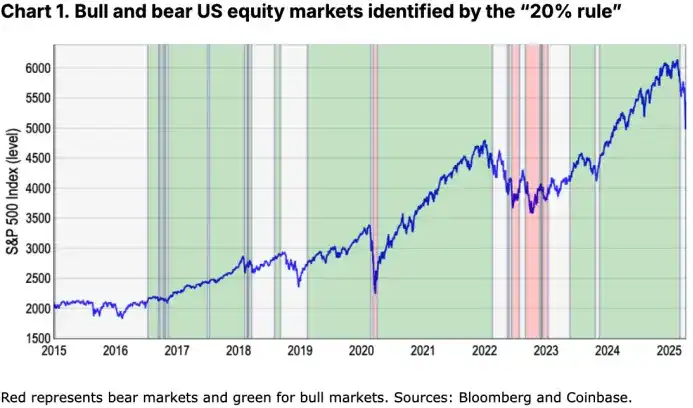
Nevertheless, to make judgments more systematic, we refer to the S&P 500 Index's high and low closing prices over a rolling one-year period to identify key market reversals. According to this method, over the past decade, the U.S. stock market has roughly experienced four bull markets and two bear markets—excluding the most recent downturn in late March to early April (our model has started signaling a bear market). Refer to Chart 1 for details.
However, the "20% threshold" also overlooks at least two significant pullback events that had a major impact on market sentiment but saw declines between 10% and 20%. For example, the increased volatility due to the late 2015 turmoil in the Chinese stock market and the market turbulence caused by the escalation of global trade tensions in 2018 (evidenced by the Fed's global trade policy uncertainty index). Refer to Chart 2 for details.
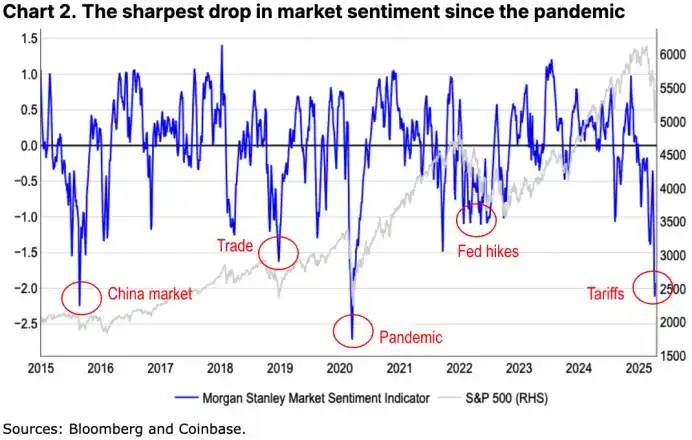
Historically, we have seen that emotion-driven market declines often trigger defensive portfolio adjustments even if the decline does not reach the artificially set 20% threshold. In other words, we believe that a bear market fundamentally reflects a structural shift in the market, characterized by deteriorating fundamentals and liquidity tightening, rather than just the magnitude of price declines. Additionally, the "20% rule" carries a paralysis risk as it overlooks some early warning signs, such as waning market depth and defensive sector rotation, which have often been harbingers of significant downturns in history.
Alternative Metrics
Therefore, we are trying to find alternative metrics that can more accurately reflect the relationship between price trends and investor psychology, applicable to both stocks and crypto assets. The definition of a bear market not only involves asset returns but is also closely related to market sentiment—which often determines whether investors believe the downtrend will continue and adjust their strategies accordingly. This concept is rather complex because what we are observing is not just a simple continuous uptrend or downtrend, but rather turning points in long-term trends. For example, the period during the COVID-19 pandemic is a typical case where the market experienced a rapid and intense decline followed by a quick rebound. Of course, the reason why this bear market was short-lived is largely due to the massive fiscal and monetary stimulus policies subsequently implemented by governments around the world, preventing investors from experiencing a prolonged drawdown.
Instead of relying on rules of thumb like the "20% rule," we prefer to use two types of risk-adjusted metrics: (1) risk-adjusted return performance measured by standard deviation; and (2) the 200-day moving average (200DMA). For example, from November 2021 to November 2022, Bitcoin's performance compared to the previous 365 days' average declined by 1.4 standard deviations; during the same period, the decline in the US stock market also reached 1.3 standard deviations. From a risk-adjusted perspective, Bitcoin's 76% decline and the S&P 500 Index's 22% decline can be considered relatively similar.
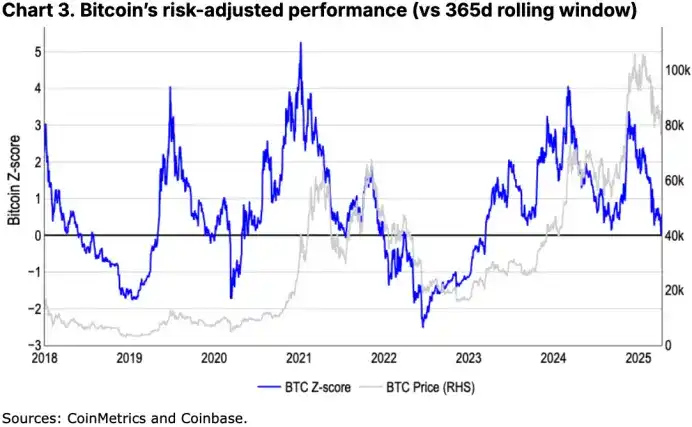
Since the standard deviation metric can naturally reflect the high volatility of the crypto market, the z-score (standard score) is very suitable for crypto asset analysis. However, it also has certain limitations: on the one hand, the calculation is relatively complex; on the other hand, there are fewer signals when the market trend is relatively stable, and the response to trend changes may not be sufficiently sensitive. For example, our model indicates that the recent bull market cycle ended in late February, and since then, the market status has been classified as "neutral," reflecting a potential lag in the model during periods of market volatility.
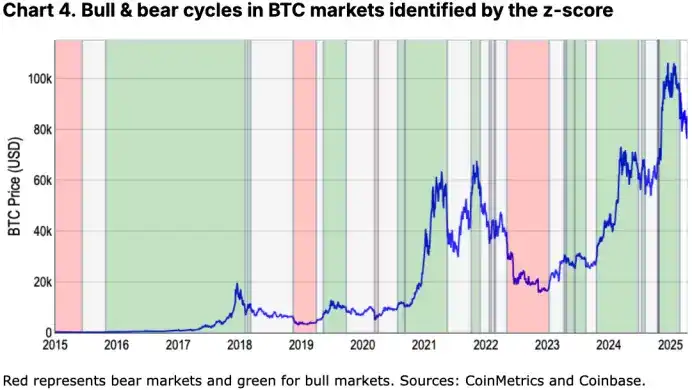
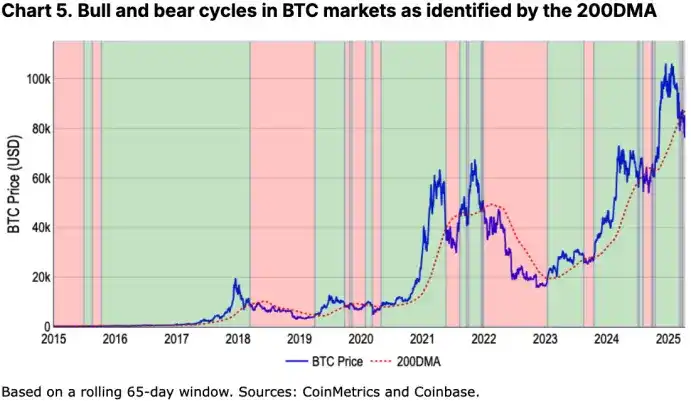
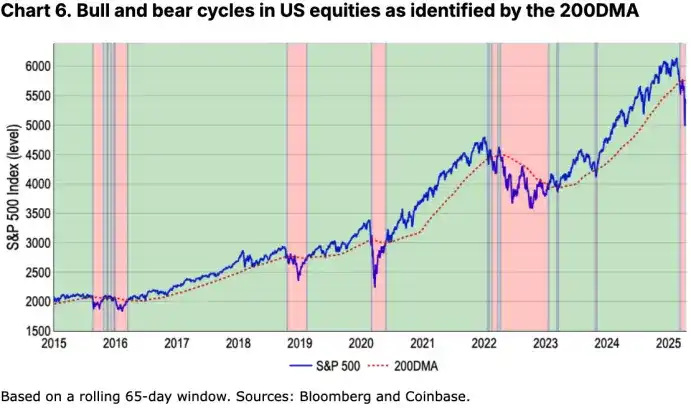
In contrast, the 200-day moving average (200DMA) provides a more concise and robust method for identifying sustained market trends. As it is calculated based on long-term data, it can effectively smooth out short-term fluctuations and adjust promptly based on the latest price trends, thereby providing clearer momentum signals.
The judgment method is also relatively intuitive:
· When the price remains consistently above the 200DMA and is accompanied by upward momentum, it is usually considered a bull market;
· When the price remains significantly below the 200DMA for an extended period and is accompanied by downward momentum, it often signifies the formation of a bear market.
This method not only aligns with the "20% Rule" and the z-score model's reflection of general trend signals but also enhances the practicality and forward-looking nature of insights in a dynamic market environment. For example, it successfully captured key downward cycles such as the early days of the 2020 pandemic, the 2022-2023 Fed rate hike cycle, reflected the 2018-2019 crypto winter, and the 2021 pullback due to China's mining ban.
In our view, this method not only aligns with the "20% Rule" and z-score model's reflection of general trend signals but also enhances the accuracy of extracting actionable insights in a dynamic market environment.
Furthermore, we have also found that the 200DMA better reflects the sharp fluctuations in investor sentiment during different periods. Refer to Charts 5 and 6 for details.
Crypto Winter?
So, have we entered a crypto bear market? Previous analyses have mainly focused on Bitcoin due to its sufficient historical data for comparison with traditional markets like the US stock market. However, as the crypto asset class continues to expand into emerging areas (such as Meme coins, DeFi, DePIN, AI agents, etc.), Bitcoin gradually no longer fully represents the overall market trend.
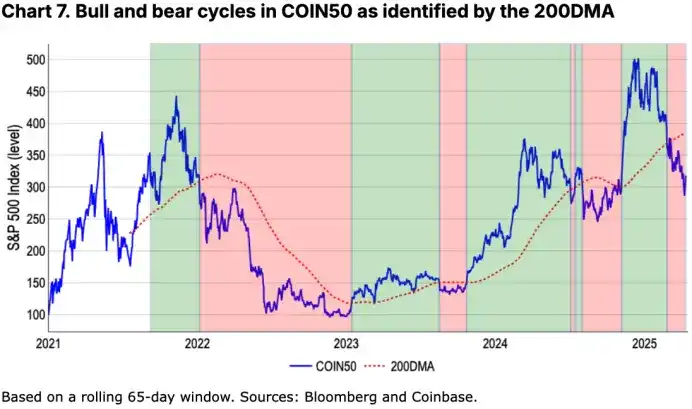
For example, Bitcoin's 200DMA model shows that since late March, its sharp pullback has entered a bear market phase. Analyzing the COIN50 Index (covering the top 50 tokens by market cap) using the same model reveals that since late February, this asset class has been significantly in a bear market state overall. This is consistent with the total crypto market capitalization excluding Bitcoin dropping 41% from the December 2024 peak to $950 billion; in contrast, Bitcoin's decline during the same period is less than 20%. This gap reflects that altcoins at the risk curve's tail end have higher volatility and risk premium.
Conclusion
As Bitcoin's "store of value" attribute continues to strengthen, we believe that the future requires a more systematic and comprehensive way to evaluate the overall performance of the crypto market to more accurately define its bull or bear market status, especially in an increasingly diverse asset category context. Nevertheless, both Bitcoin and the COIN50 Index have fallen below their respective 200-day moving averages, a signal indicating that the market may be in the early stages of a long-term downtrend. This aligns with the trends of total market value decline and venture capital contraction, both key characteristics indicating the potential onset of a "Crypto Winter."
Therefore, we recommend that a defensive risk management strategy be maintained in the current phase. Although we still expect cryptocurrency prices to stabilize in the latter part of the second quarter of 2025 and set the stage for improvement in the third quarter. At present, the complex macroeconomic environment still requires investors to remain highly cautious.
You may also like

a16z Leads $18M Seed Round for Catena Labs, Crypto Industry Bets on Stablecoin AI Payment
Pharos, deeply integrated with AntChain, is about to launch. How can we get involved?
The End and Rebirth of NFTs: How the Meme Coin Craze Ended the PFP Era?
Key Market Intelligence on May 14th, how much did you miss out on?
1.Binance Alpha Launches HIPPO, BLUE, and Other Tokens
2.Believe Ecosystem Tokens See General Rise, LAUNCHCOIN Surges Over 250% in 24 Hours
3.Tiger Securities Introduces Cryptocurrency Deposit and Withdrawal Service, Supports Mainstream Cryptocurrencies such as BTC and ETH
4.Current Bitcoin Rally Possibly Driven by Institutions, Retail Traders Yet to Join
5.Binance Wallet's New TGE Privasea AI Participation Requires a 198 Point Threshold, with a Point Consumption of 15
Source: Overheard on CT (tg: @overheardonct), Kaito
PUMP: Today's discussions about PUMP focus on its new creator revenue-sharing model: the platform will allocate 50% of PumpSwap revenue to token creators, sparking varied reactions from users. Some criticize the move as insufficient or even misleading, while others view it as a positive step the platform is taking to reward creators. Meanwhile, PUMP faces market pressure from emerging competitors like LetsBONKfun and Raydium, which are rapidly gaining market share. Users also express concerns about PUMP's sustainability and potential regulatory risks in the U.S., with discussions extending to the platform's impact on the entire memecoin ecosystem.
COINBASE: Today, Coinbase became the first crypto company to join the S&P 500 Index, replacing Discover Financial Services, sparking widespread industry attention. The entire crypto community views this milestone as a significant development, signaling that crypto assets are further integrating into the mainstream financial system. The news has sparked lively discussions on Twitter, with many users pointing out that this may attract more institutional investors to enter the Bitcoin and other cryptocurrency markets.
XRP: XRP became the focal point of today's crypto discussion, with its significant market movements and strategic advances drawing attention. XRP has surpassed USDT to become the third-largest cryptocurrency by market capitalization, sparking market excitement and discussions about its future potential. The surge in market capitalization and price is believed to be related to increasing institutional interest, deepening strategic partnerships, and its role in the crypto ecosystem. Additionally, XRP's integration into multiple financial systems and its potential as a macro asset class are also seen as key factors driving the current market sentiment.
DYDX: Today's discussions about DYDX mainly focused on the dYdX Yapper Leaderboard launched by KaitoAI. The leaderboard aims to identify the most active community participants, with a total of $150,000 in rewards to be distributed over the first three seasons. This initiative has sparked broad community participation, with many users discussing the potential rewards and the incentive effect on the DYDX ecosystem. Meanwhile, progress on the ethDYDX to dYdX native chain migration and historical airdrop events have also been topics of discussion.
1. "What Is 'ICM'? Holding Up the $4 Billion Market Cap Solana's New Narrative"
Overnight, the hottest narrative in the crypto space has become "Internet Capital Markets," with a host of crypto projects and founders, led by the Solana ecosystem's new Launchpad platform Believe, releasing this phrase. Together with "Believe in something," it has become the new slogan heralding the onset of a bull market. What exactly is the so-called "Internet Capital Market," will it become a short-lived hype phrase like the Base ecosystem's previous Content Coin, and what related targets are available for selection?2.《LaunchCoin Surges 20x in One Day, How Did Believe Create a $200M Market Cap Shiba Inu After Going to Zero?|100x Retrospective》
LAUNCHCOIN broke through a $200 million market cap today, with the long-lost liquidity and such a high market cap "Memecoin" almost bringing half of the on-chain crypto community CT into the fray. The community is crazily discussing this token, with half of it being FOMO and the other half being FUD. This token, originally issued by Believe founder Ben Pasternak under his personal identity, transformed into a new platform token after a renaming. From once going to zero to a $200 million market cap, what happened in between?May 14 On-chain Fund Flow
Within 24 hours, GOONC's market cap soared to 70 million, could GOONC be the next billion-dollar dog on the Believe platform?
Bitcoin has broken $100,000, Ethereum has surpassed 2500, and is Solana's hot streak about to make a comeback?
The current market is in a state of macro euphoria, with GOONC riding the wave today, skyrocketing 10x in just a few hours, reaching a market cap of tens of millions of dollars, trading volume soaring past 50 million, and rumors swirling that the developer may be from OpenAI (unconfirmed but intriguing enough).
A ludicrous and absurd Solana meme that some actually buy into.
GOONC is a meme coin that has sprouted from the "gooning" subculture, offering no technological innovation or practical use, its sole function being speculation.
It takes inspiration from an NSFW term "gooning," which refers to a person being deeply immersed in certain content (you know what), eventually entering a nearly religious-like trance.
In Reddit (such as r/GOONED, r/GoonCaves) and some counterculture media outlets (such as MEL Magazine in 2020), "gooning" has gradually transitioned from an adult label to a meme-addicted, digital content and virtual self-indulgence synonym, arguably the epitome of Degen spirit.
GOONC is playing around with this concept, packaging the addictive nature, uselessness, and irony of gooning into a tradable financial product. The project team has made it clear: "We do not solve blockchain problems, we only trade absurdity." Blunt but oddly genuine.
GOONC launched on May 13, 2025, using the meme coin launch platform Believe App's LaunchCoin module on Solana. This tool is highly Degen: zero technical barriers, a few clicks to create a coin, perfect for projects like GOONC that can come up with ideas out of the blue.
The mastermind behind GOONC is also quite something and is the most talked-about, with KOL @basedalexandoor on X platform (alias "Pata van Goon") personally involved. His profile even caught the attention of Marc Andreessen, co-founder of a16z, making onlookers unable to resist speculating if GOONC has a hint of OpenAI lineage.
While this 'OpenAI Endorsement' is currently just community speculation, it is definitely a good card to play to fuel hype. Saying "we are pure speculation" on one hand, while tagging a few "AI + a16z" on the other.
GOONC took off as soon as it launched. After its launch on May 13, 2025, its market capitalization skyrocketed to $22 million within 4 hours, with a trading volume exceeding $25.6 million in 24 hours. According to platform data, the first day of trading saw an astonishing +41,100% surge, soaring from $0.0000001 to $0.02, becoming a "missed-the-boat" situation.
GOONC quickly formed an active trading community post-launch, with a lot of discussion and trading signals appearing on X platform (such as the 292x return signal provided by DeBot). Liquidity pools on exchanges like Raydium and Meteora grew rapidly, supporting high trading volumes and price increases.
The real climax occurred between May 13 and May 14, with the market cap rising to $5.5 million in the morning and directly surpassing $55 million in the afternoon. By the 14th, it briefly approached a $70 million market cap, with the trading volume soaring to $59 million. Some community members even posted screenshots claiming an increase of +85,000%, creating a new myth out of the ruins.
As of 1:30 pm on May 14, the price stabilized around $0.039, with a total market cap and FDV both around $39.6 million, and a 24-hour trading volume of $5.43 million. Active platforms include XT.COM, LBank, Meteora, and others.
Although there was a slight pullback from the peak ($0.07), the coin's popularity remains strong. For a coin that relies purely on "irony + community + X post" to thrive, this performance is already at a stellar level.
Currently, the background of the token's development team is not transparent, increasing the potential risk of a rug pull. Rugcheck.xyz warns that the creator of the GOONC contract may have permission to modify the contract (e.g., change fees or mint additional tokens), posing certain security risks.
Community members speculate that the meteoric rise of GOONC may be the "last hurrah".
How to Get Rich in Crypto Without Relying on Luck? Financial Veteran Raoul Pal's Macro Insights and Investment Path
Stablecoins Driving Global B2B Payment Innovation: How to Break Through Workflow Bottlenecks and Unlock Trillion-Dollar Market Potential?
These startups are building cutting-edge AI models without the need for a data center
Science Equity Movement: DeSci's Trillion-Dollar Knowledge Economy Reconstruction Revolution
Sentient In-Depth Research Report: Secures $85 Million in Funding to Build a Decentralized AGI New Paradigm
April 30th Market Key Intelligence, How Much Did You Miss?
Interview with Virtuals Co-Founder empty: AI Startups Don't Need a Lot of Funding, Crypto is One of the Answers
a16z Leads $25M Investment, 0xMiden to Run a Privacy Chain on Your Phone
Sui Q1 Advanced Report: The Rise of BTCfi Infrastructure, the Boom of Lending Protocols, and the Future of Rollup-Based Scalability
Gate.io MemeBox has officially integrated with the Solana ecosystem, providing lightning-fast on-chain asset trading.
Key Market Information Discrepancy on April 30th - A Must-Read! | Alpha Morning Report
Taking Stock of the Top 10 Emerging Launchpad Platforms: Who Will Succeed in Disrupting Pump.fun?
April 29th Market Key Insights, How Much Did You Miss?
a16z Leads $18M Seed Round for Catena Labs, Crypto Industry Bets on Stablecoin AI Payment
Pharos, deeply integrated with AntChain, is about to launch. How can we get involved?
The End and Rebirth of NFTs: How the Meme Coin Craze Ended the PFP Era?
Key Market Intelligence on May 14th, how much did you miss out on?
1.Binance Alpha Launches HIPPO, BLUE, and Other Tokens
2.Believe Ecosystem Tokens See General Rise, LAUNCHCOIN Surges Over 250% in 24 Hours
3.Tiger Securities Introduces Cryptocurrency Deposit and Withdrawal Service, Supports Mainstream Cryptocurrencies such as BTC and ETH
4.Current Bitcoin Rally Possibly Driven by Institutions, Retail Traders Yet to Join
5.Binance Wallet's New TGE Privasea AI Participation Requires a 198 Point Threshold, with a Point Consumption of 15
Source: Overheard on CT (tg: @overheardonct), Kaito
PUMP: Today's discussions about PUMP focus on its new creator revenue-sharing model: the platform will allocate 50% of PumpSwap revenue to token creators, sparking varied reactions from users. Some criticize the move as insufficient or even misleading, while others view it as a positive step the platform is taking to reward creators. Meanwhile, PUMP faces market pressure from emerging competitors like LetsBONKfun and Raydium, which are rapidly gaining market share. Users also express concerns about PUMP's sustainability and potential regulatory risks in the U.S., with discussions extending to the platform's impact on the entire memecoin ecosystem.
COINBASE: Today, Coinbase became the first crypto company to join the S&P 500 Index, replacing Discover Financial Services, sparking widespread industry attention. The entire crypto community views this milestone as a significant development, signaling that crypto assets are further integrating into the mainstream financial system. The news has sparked lively discussions on Twitter, with many users pointing out that this may attract more institutional investors to enter the Bitcoin and other cryptocurrency markets.
XRP: XRP became the focal point of today's crypto discussion, with its significant market movements and strategic advances drawing attention. XRP has surpassed USDT to become the third-largest cryptocurrency by market capitalization, sparking market excitement and discussions about its future potential. The surge in market capitalization and price is believed to be related to increasing institutional interest, deepening strategic partnerships, and its role in the crypto ecosystem. Additionally, XRP's integration into multiple financial systems and its potential as a macro asset class are also seen as key factors driving the current market sentiment.
DYDX: Today's discussions about DYDX mainly focused on the dYdX Yapper Leaderboard launched by KaitoAI. The leaderboard aims to identify the most active community participants, with a total of $150,000 in rewards to be distributed over the first three seasons. This initiative has sparked broad community participation, with many users discussing the potential rewards and the incentive effect on the DYDX ecosystem. Meanwhile, progress on the ethDYDX to dYdX native chain migration and historical airdrop events have also been topics of discussion.
1. "What Is 'ICM'? Holding Up the $4 Billion Market Cap Solana's New Narrative"
Overnight, the hottest narrative in the crypto space has become "Internet Capital Markets," with a host of crypto projects and founders, led by the Solana ecosystem's new Launchpad platform Believe, releasing this phrase. Together with "Believe in something," it has become the new slogan heralding the onset of a bull market. What exactly is the so-called "Internet Capital Market," will it become a short-lived hype phrase like the Base ecosystem's previous Content Coin, and what related targets are available for selection?2.《LaunchCoin Surges 20x in One Day, How Did Believe Create a $200M Market Cap Shiba Inu After Going to Zero?|100x Retrospective》
LAUNCHCOIN broke through a $200 million market cap today, with the long-lost liquidity and such a high market cap "Memecoin" almost bringing half of the on-chain crypto community CT into the fray. The community is crazily discussing this token, with half of it being FOMO and the other half being FUD. This token, originally issued by Believe founder Ben Pasternak under his personal identity, transformed into a new platform token after a renaming. From once going to zero to a $200 million market cap, what happened in between?May 14 On-chain Fund Flow
Within 24 hours, GOONC's market cap soared to 70 million, could GOONC be the next billion-dollar dog on the Believe platform?
Bitcoin has broken $100,000, Ethereum has surpassed 2500, and is Solana's hot streak about to make a comeback?
The current market is in a state of macro euphoria, with GOONC riding the wave today, skyrocketing 10x in just a few hours, reaching a market cap of tens of millions of dollars, trading volume soaring past 50 million, and rumors swirling that the developer may be from OpenAI (unconfirmed but intriguing enough).
A ludicrous and absurd Solana meme that some actually buy into.
GOONC is a meme coin that has sprouted from the "gooning" subculture, offering no technological innovation or practical use, its sole function being speculation.
It takes inspiration from an NSFW term "gooning," which refers to a person being deeply immersed in certain content (you know what), eventually entering a nearly religious-like trance.
In Reddit (such as r/GOONED, r/GoonCaves) and some counterculture media outlets (such as MEL Magazine in 2020), "gooning" has gradually transitioned from an adult label to a meme-addicted, digital content and virtual self-indulgence synonym, arguably the epitome of Degen spirit.
GOONC is playing around with this concept, packaging the addictive nature, uselessness, and irony of gooning into a tradable financial product. The project team has made it clear: "We do not solve blockchain problems, we only trade absurdity." Blunt but oddly genuine.
GOONC launched on May 13, 2025, using the meme coin launch platform Believe App's LaunchCoin module on Solana. This tool is highly Degen: zero technical barriers, a few clicks to create a coin, perfect for projects like GOONC that can come up with ideas out of the blue.
The mastermind behind GOONC is also quite something and is the most talked-about, with KOL @basedalexandoor on X platform (alias "Pata van Goon") personally involved. His profile even caught the attention of Marc Andreessen, co-founder of a16z, making onlookers unable to resist speculating if GOONC has a hint of OpenAI lineage.
While this 'OpenAI Endorsement' is currently just community speculation, it is definitely a good card to play to fuel hype. Saying "we are pure speculation" on one hand, while tagging a few "AI + a16z" on the other.
GOONC took off as soon as it launched. After its launch on May 13, 2025, its market capitalization skyrocketed to $22 million within 4 hours, with a trading volume exceeding $25.6 million in 24 hours. According to platform data, the first day of trading saw an astonishing +41,100% surge, soaring from $0.0000001 to $0.02, becoming a "missed-the-boat" situation.
GOONC quickly formed an active trading community post-launch, with a lot of discussion and trading signals appearing on X platform (such as the 292x return signal provided by DeBot). Liquidity pools on exchanges like Raydium and Meteora grew rapidly, supporting high trading volumes and price increases.
The real climax occurred between May 13 and May 14, with the market cap rising to $5.5 million in the morning and directly surpassing $55 million in the afternoon. By the 14th, it briefly approached a $70 million market cap, with the trading volume soaring to $59 million. Some community members even posted screenshots claiming an increase of +85,000%, creating a new myth out of the ruins.
As of 1:30 pm on May 14, the price stabilized around $0.039, with a total market cap and FDV both around $39.6 million, and a 24-hour trading volume of $5.43 million. Active platforms include XT.COM, LBank, Meteora, and others.
Although there was a slight pullback from the peak ($0.07), the coin's popularity remains strong. For a coin that relies purely on "irony + community + X post" to thrive, this performance is already at a stellar level.
Currently, the background of the token's development team is not transparent, increasing the potential risk of a rug pull. Rugcheck.xyz warns that the creator of the GOONC contract may have permission to modify the contract (e.g., change fees or mint additional tokens), posing certain security risks.
Community members speculate that the meteoric rise of GOONC may be the "last hurrah".
How to Get Rich in Crypto Without Relying on Luck? Financial Veteran Raoul Pal's Macro Insights and Investment Path
Popular coins
Latest Crypto News


Customer Support:@weikecs
Business Cooperation:@weikecs
Quant Trading & MM:bd@weex.com
VIP Services:support@weex.com
 App
App