
- Buy Crypto
- Markets
- Futures
- Spot
- Copy Trade
 Earn
Earn- More
Founder's BIO New Article: From Science Fiction to Science Finance, How Does Desci Drive the Biotech Revolution?

Original Article Title: From Science Friction to Science Finance: A Community-Driven Revolution in Biotech
Original Article Author: Paul Kohlhaas, Founder of BIO Protocol
Original Article Translation: zhouzhou, BlockBeats
Editor's Note: This article introduces how the BIO Protocol addresses funding, R&D, and market issues in the biotechnology field through the decentralized BioDAO network. By tokenizing intellectual property, implementing decentralized governance, and providing real-time liquidity, BIO enables patients, scientists, and investors to participate in decision-making together, supporting neglected areas such as rare diseases and long-haul COVID. BIO breaks through traditional fund structures, drives innovation in biotechnology, accelerates the research process, achieves more efficient and equitable capital flow and results transformation, ultimately promoting scientific advancement and global impact.
The following is the original content (reorganized for better readability):
“We live in a society exquisitely dependent on science and technology, in which hardly anyone knows anything about science and technology.” — Carl Sagan
TL;DR
· The Broken Biopharma System: Science Hits a Bottleneck
· Andrew Lo's Mega Fund Theory: A Milestone in Biotech Finance
· Beyond Mega Funds: Emergence of the BIO Protocol
· From Fund to Ecosystem: Advancing Lo's Vision in the BioDAO Network
· Practice of the BIO Protocol
· Orphan Drugs, Rare Diseases, and Long-Haul COVID: Ethical and Economic Alignment
· Lessons from Mega Fund-Inspired Biotech Holding Companies
· From Science Friction to Science Finance
· Bottom-Up Financial Evolution
A universal truth shrouds our modern era where scientific knowledge is exploding, yet life-changing therapies — from long-haul COVID to rare autoimmune diseases — remain elusive for millions. This stark contrast reveals a distorted paradox: the issue is not scientific impossibility but rather inefficiencies in market structure.
Big Pharma pours billions into incrementally improving existing drugs (like enhancing existing PD-1 cancer drugs or GLP-1 anti-obesity drugs) through strategies such as patent lifecycle management, chasing after the latest and hottest clinically validated drug targets in a fiercely competitive market — while research into patient-driven needs languishes.
What is the result? An industry mired in scientific friction, with escalating costs, capital bottlenecks, and intellectual property islands that slow down potential transformative innovations, even leading to their complete abandonment.
1. Fragmented Biopharma System, Science Hitting a Roadblock
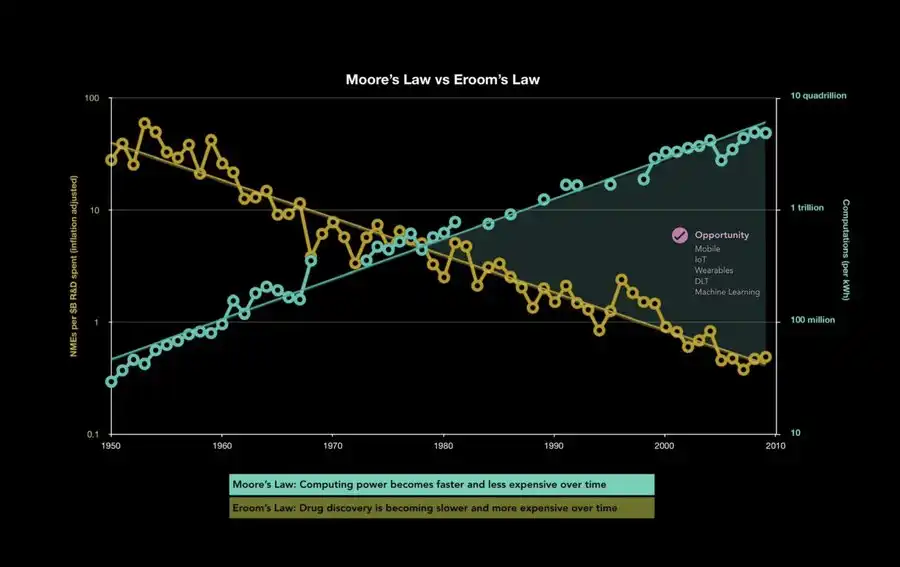
Every day, millions of people are battling long-term, complex, fragile, and underfunded diseases like COVID-19. Many find that the research to help them is not "hard" in a scientific sense but rather "hard" in terms of the return on investment (ROI) for traditional pharma. This is just a symbol of a broader crisis, as revealed by Eroom's Law: as biotech R&D spending has soared, the productivity of discovering new drugs has plummeted. How did we get here?
1.1 Valley of Death and the "Safe Bet"
Promising discoveries made in academia often struggle to transition to early clinical research because no one is willing to fund the risky transition stage between animal studies and human trials. This infamous "Valley of Death" hinders potential treatments that, in the eyes of major pharmaceutical companies, lack profit potential and are too high-risk.
Many venture capitalists and pharma companies take a "fast follower" approach, waiting and hoping that other companies will successfully navigate these risks. These risks may include understanding the pathophysiology of a disease, addressing regulatory challenges (such as a lack of clear clinical endpoints), the uncertain commercial viability of a pharma M&A, or the dynamics of health insurers in reimbursing treatments. It is a minefield of incentives and constraints with no collective mechanism empowering the patient voice.
1.2 Overconcentration of Capital
The primary funding channels for biotech—large pharma companies and major venture capital firms—often concentrate investment in "blockbuster" categories. Over 90% of biotech capital is concentrated in highly competitive, minimally differentiated areas, causing once-promising breakthrough research (such as longevity, complex immune system diseases, or neuroscience) to stagnate.
While these clinically lower-risk and commercially appealing therapy areas are attractive to pharma companies and venture capitalists, many areas also represent the most expensive failures, as only 5% of approved and marketed drugs achieve blockbuster sales potential.
Otherwise, it is a waste of substantial R&D funding. In Bruce Booth's renowned "Atlas 2024 Review," Bruce commented that less than 15% of biotech financing rounds have captured over 66% of available venture capital funding, a significant shift from the situation ten years ago. We need more meritocratic mechanisms to address public health challenges and the impending Western societal demographic tsunami.
1.3 Intellectual Property Lock-In and Data Silos
Under the current business model, knowledge is trapped behind thick walls of patents and closed-door deals, slowing down progress. Global labs often repeat the same high-cost experiments due to a lack of shared insights, adding unnecessary friction. Patient data and clinical insights are so fragmented that under a unified data architecture, they could hold significant inferential value, but are plagued by bureaucratic hurdles from institutions like hospital administrators, data aggregators, and biobanks.
Intellectual property may be time-bound and only certain forms (like composition of matter patents) hold significant value for venture capitalists and pharmaceutical companies, which goes against the longevity community's enthusiasm for repurposing drugs such as rapamycin, metformin, and spermidine. Overall, inefficient resource allocation and commercial constraints hinder real-world health transformation, where real-time transparency can help alleviate some of these issues.
1.4 Opaque R&D and Limited Accountability
The R&D pipeline's unfolding process is slow and convoluted. Flow of funds is opaque; external parties cannot see whether (or why) trials have failed until it's too late. There is limited accountability, leaving patients and the public in the dark.
Executive management and R&D teams are in constant flux, with the pipeline changing along with the team. Companies like Roivant have built successful large enterprises by strategically shelving drugs through licensing and development agreements.
1.5 Over 10-Year Funding Lock-In Suppresses Innovation
Traditional biotech investments often require a decade or more to see returns—which is almost an eternity in the fast-paced market. This illiquidity leads to early-stage research lacking funding, especially in cases of uncertain outcomes.
Biotech competes for capital allocation against other asset classes such as more easily understandable revenue/EBITDA growth. In this scenario, an open community helps bridge the relative value gap of these therapies in terms of education and socialization.
Biotech is at a disadvantage in attracting investors and gaining market share, while other health-related themes (such as longevity) have become cultural phenomena. Some biomedical breakthroughs (like statins, PD-1 inhibitors, or anti-obesity drugs) demonstrate remarkable commercial potential (e.g., the 2024 Obesity 5 (NONO, LLY, AMGN, ZEAL, and VKTX) yielded a 93% return), but the investment structure needs significant revision to ensure the value of these transformative innovations is not diluted and to ensure better investor access—this is where tokenization will bring about transformative change.
Eroom's Law is at odds with the tremendous scientific advances we are currently experiencing — such as DeepMind's AlphaFold2, the 2024 Nobel Prize in Chemistry, mRNA therapy, GLP-1, cell and gene therapy, and more. The commercial and vested interest models of the pharmaceutical and biotech industries have hardly been questioned, and if there are operational structures that can help improve efficiency, they will be warmly welcomed.
Andrew Lo's Mega-Fund Theory: A Milestone in Biotech Finance
In 2012, Professor Andrew Lo from MIT and his collaborators proposed the concept of a "mega-fund" — a large, diversified early-stage drug candidate pool. Having 50 to 200 relatively unrelated assets can spread risk: while a single biotech startup may fail if its sole treatment approach falters, a portfolio can withstand multiple failures as long as a few successful projects can bring returns.
This theory groundbreaking pointed out the structural inefficiency in funding life science research. However, Lo's approach is still top-down: large checks from institutional investors, top-down fund allocation, with little opportunity for ordinary scientists or patients to participate in meaningful decisions.
3. Moving Beyond the Mega-Fund: Introducing the BIO Protocol
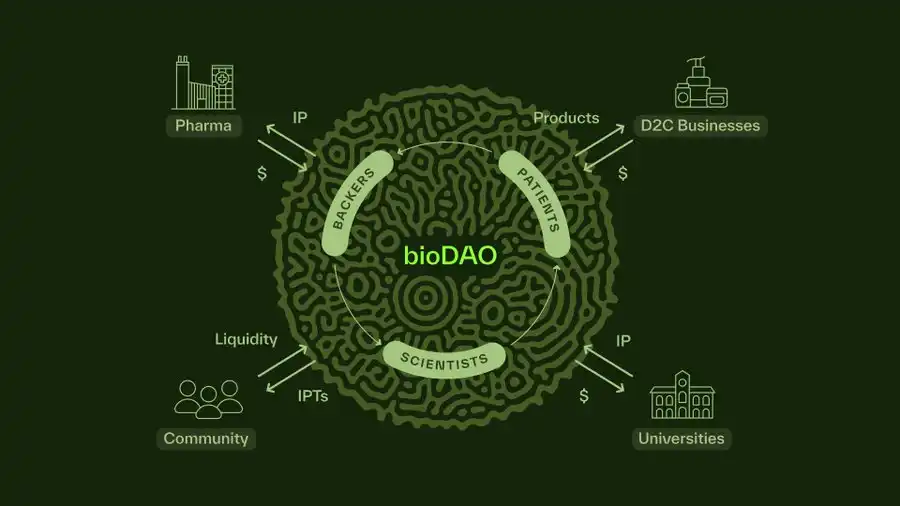
Now, a new wave of decentralized science has emerged, furthering Lo's vision. The BIO Protocol has drawn on the core concept of the mega-fund — managing risk through broad diversification — but reimagined the way this diversification, governance, and capital formation occur. The BIO Protocol is not like a centrally managed single massive fund but:
· Serves as a decentralized token-holder-governed protocol planning and incubating BioDAO. These are dedicated bottom-up communities guiding research through on-chain research portfolios.
· Tokenizes intellectual property and data through IPT (Intellectual Property Tokens) to make them tradable liquid assets, enabling BioDAO researchers and communities earlier access to liquidity than the conventional biotech industry setup.
· Deploys capital in real-time, directly into the "valley of death."
· Places patients, scientists, and laypeople at the center, akin to Reddit communities having a shared bank account.
3.1 Permissionless Stakeholders
In BioDAO, anyone directly linked to a particular disease — be it patients, clinicians, or scientists — can join through on-chain governance. Instead of passively hoping for "someone" to fund their endeavors, they collectively crowdfund capital through encrypted funds, form a DAO, collectively source research ideas from internal and global scientists, and decide on resource allocation and priority development.
3.2 Tokenized Intellectual Property and Data
BioDAO has released IP Tokens (IPT) through @molecule_dao, representing decentralized governance rights over research. These tokens can be licensed, traded, or pooled, effectively providing a new way for DAOs to gradually de-risk early-stage science based on milestone-based fund deployment. Shared data and data replication are no longer an afterthought but a core, liquid asset that can drive scientific discovery. Bonuses can also be issued to various researchers, creating incentives for decentralized science and drug discovery.
3.3 Bottom-Up Capital Formation
Unlike giant funds relying on large institutional investors, the BIO protocol coordinates community-driven fundraising. Through its launchpad, BioDAO founders can showcase their research, set up private or public token sales, and reward early supporters with governance rights—without the need for VC or Big Pharma scrutiny.
4. From Fund to Ecosystem: Advancing Luke's Vision in the BioDAO Network
4.1 Decentralized Center of the "Meta Portfolio"
The BIO protocol does not hold 200 assets like a single entity but facilitates a governance treasury with thousands of BioDAOs, each focusing on a scientific subfield. This significantly expands the space of possibilities while enabling community self-governance. There is no single manager making decisions; instead, the protocol guides asset development, risk management, and synergies for all these DAOs through its token holder community.
4.2 Permissionless Launchpad and Acceleration
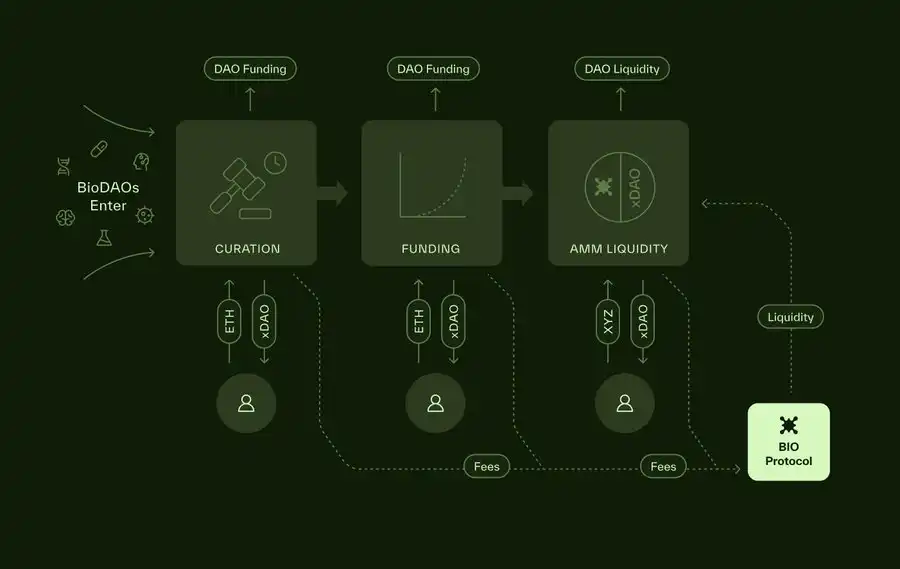
BIO’s real-time decentralized launchpad mechanisms—such as bonding curves or auctions—enable new BioDAOs to launch quickly. Early stakers or token holders can signal which areas are worth investing in. This approach democratizes biotech funding and accelerates capital flow to overlooked areas like long COVID or rare autoimmune diseases.
4.3 On-Chain Risk Management
Just as giant funds use portfolio theory to reduce risk, BioDAO does the same, but on-chain analytics enable them to share standardized reports on clinical milestones, intellectual property valuations, and treasury data. This facilitates real-time insights, allowing the protocol to diversify risk across multiple DAOs or rebalance further through research-based obligations.
4.4 Continuous Liquidity and Evergreen Capital
Traditional funds lock capital for ten years, while BioDAO's tokens and intellectual property tokens maintain liquidity, allowing participants to exit or reallocate capital. If a BioDAO's therapy begins to show promise, it naturally attracts more liquidity. The game theory here is that the treatment will naturally become a capital "Schelling point." Meanwhile, revenue from successful therapies flows back to the protocol treasury (BIObank), recycling capital into new or existing DAOs.
5. Protocol in Action: A Holistic, Bottom-Up Ecosystem
Imagine a team of scientists proposing a new "NeuroDAO" aimed at developing innovative therapies for traumatic brain injury. They upload preclinical data and a funding roadmap to BIO's user-friendly launchpad. The global BIO community approves or rejects the proposal through token staking—no closed-door operations by a small committee behind the scenes. Upon approval:
· NeuroDAO mints its intellectual property tokens (IPTs).
· These tokens are sold through bonding curves or auctions to raise initial capital.
· As milestones (e.g., preclinical endpoints) are met, more capital automatically unlocks.
· The broader community can track progress, further invest, and accelerate the flywheel effect.
If NeuroDAO reaches a significant breakthrough moment—like discovering a new molecule that accelerates brain recovery—the intellectual property licensing agreement can channel revenue back into the treasury to fund further research. This mechanism creates a sustainable flywheel effect, driving an evergreen, self-reinforcing cycle.
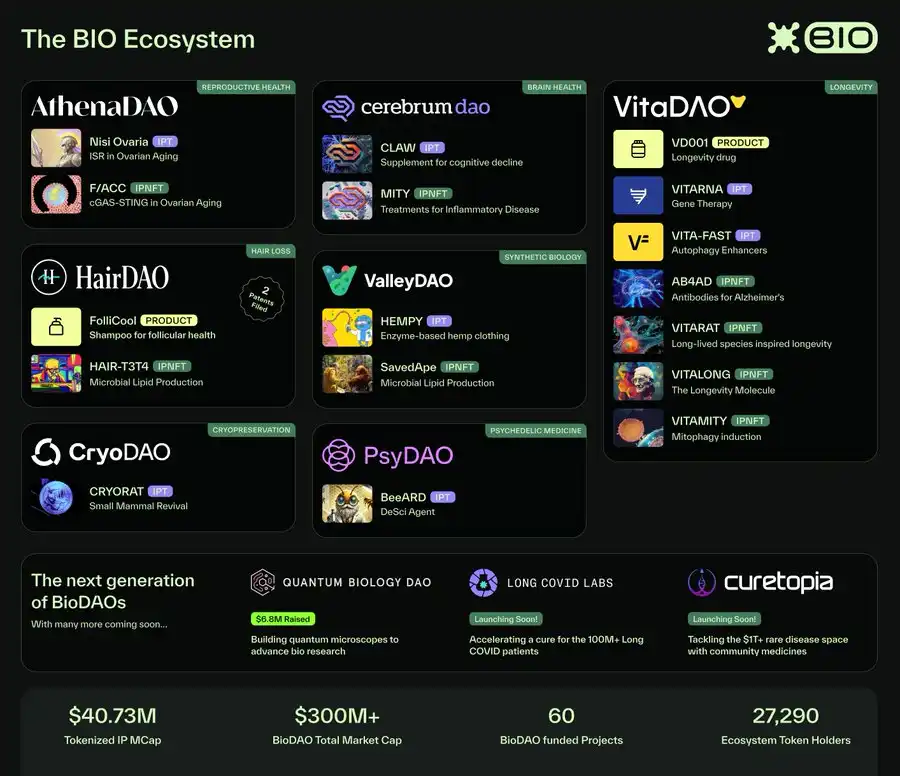
Since its inception, the BIO ecosystem has experienced rapid growth. In less than two years:
· 8 BioDAOs have been funded
· $30 million has been raised for research
· Total value of tokenized intellectual property exceeds $50 million
· Funds in the BIO treasury (AUM) exceed $60 million
· $8 million has been allocated to scientific projects funded by BioDAOs to date
· 60 active research projects
· 34,000 ecosystem token holders (3,716 of whom hold BIO governance tokens)
Several BioDAOs have rapidly progressed from the seed stage of research to advanced preclinical research, validating that decentralized capital plus open collaboration can accelerate biotechnology innovation.
Orphan Drugs, Rare Diseases, and Long COVID: The Ethical and Economic Intersection
Long COVID is just one example of a "niche" yet urgent condition. Similarly, orphan diseases—those affecting smaller patient populations—are often overlooked by major pharmaceutical companies because they see limited profit potential.
However, within networks like BIO, patient-led or family-led BioDAOs can be established around any disease, using novel structures to fund research that large companies are unwilling to sponsor. Smaller patient populations can accelerate clinical trials, shorten timelines, and unlock substantial returns without the "blockbuster or bust" mindset. The ethical alignment is clear: this is not about market size but about impact.
7. Real-World Momentum: Insights from Company Models Inspired by Mega Funds
Prior to decentralized science, the multi-asset risk-sharing model has been attempted in various forms:
· BridgeBio (NASDAQ: BBIO): Focused on rare diseases, employing a hub-and-spoke pipeline.
· Roivant Sciences: Introducing separate "Vants" for each therapeutic area, integrating management fees and capital.
· Royalty Pharma: A portfolio with billions in diversified royalty income streams, demonstrating securitization can stably fund drug IP.
These companies reflect Lo's principle of diversification. The BIO protocol further extends this principle through democratizing access, distributing governance, and achieving ongoing liquidity through tokenization.
8. From Scientific Fricton to Science Finance (SciFi)
Close your eyes and imagine it's now 2026. Within the BIO framework, there are already hundreds of BioDAOs spanning various diseases from pancreatic cancer to autoimmune alopecia. Each DAO is a "community collective intelligence" composed of patients, researchers, and philanthropic supporters. They:
· Access real-time research data shared across networks, accelerating progress at each clinical inflection point.
· Coordinate clinical trial participants and best practices (if multiple BioDAOs are addressing related domains, BIO can facilitate shared trial participant pools, data registries, and best practices governance, reducing management overhead).
·Using AI to assess risk, potential synergy, and capital allocation.
No longer are decade-long capital lockups or fortress-like institutional barriers holding back breakthroughs. Instead, the entire network acts like a living, breathing organism—fluid, adaptive, open.
8.1 The Golden Age of Biotech
Through "tokenizing everything," from preclinical data to late-stage IP, coupled with decentralized governance, BIO exposes industry's greatest friction points. Suddenly, drug development feels more like science fiction than a drawn-out marathon.
8.2 Inclusive Community, Global Impact
This revolution isn't confined to the lab. Everyday investors—those with loved ones suffering from rare diseases—can stake tokens to support new research and witness transparent progress along the way. Collaboration is no longer a buzzword but an on-chain reality, propelling the formation of multinational research teams.
8.3 Reversing the Eroom Law
With friction removed, communities from any region can access global funding, and we might finally see the cost/time curve of drug development bend downward rather than upward—achieving the promised exponential scientific progress.
9. Grassroots Evolution of Biotech Financing
Andrew Lo's mega-fund theory points us to a crucial path: large, diversified portfolios can tame biotech's high risk and attract greater capital. However, top-down structures and institutional inertia still hinder the realization of certain innovations. In contrast, the BIO protocol disrupts this playbook:
· Community-Driven: Anyone with a stake—patients, scientists, or curious funders—can participate in governance, propose new BioDAOs, and collectively shape research directions.
· Tokenized IP: Data and IP become fluid, paving the way for new funding and collaboration models.
· Real-Time Liquidity: Breaking free from decadelong capital lockups, capital can swiftly flow into groundbreaking innovations.
· AI-Driven Risk Management: On-chain analytics continuously track performance, synergy effects, and correlations, allowing capital to flow efficiently across multiple BioDAOs.
By stacking decentralized scientific solutions (via BioDAOs) coordinated at the top layer of BIO (launchpad, funding, liquidity, meta-governance), the most daunting challenges in the science and pharmaceutical industries can be addressed in a community-driven, transparent, and continuously flowing environment.
Placing families, patients, and scientists at the heart of decision-making, BIO aims to 「boil the ocean」, tackling the dilemma of early-stage innovation. No longer shall half of the world's great ideas perish in the 「valley of death.」 Instead, we are witnessing the dawn of a science era unshackled from old gatekeepers and friction-filled pipelines.
So the next time your family faces a rare disease, the deciding factor will no longer be a boardroom's analysis of market size. It will be a global network—scientists, patients, and ordinary believers—collaborating, funding, and accelerating those therapies that truly matter. In short, we are back in a sci-fi world, where humanity unites to turn the impossible into the inevitable.
You may also like
a16z Leads $18M Seed Round for Catena Labs, Crypto Industry Bets on Stablecoin AI Payment
Pharos, deeply integrated with AntChain, is about to launch. How can we get involved?
The End and Rebirth of NFTs: How the Meme Coin Craze Ended the PFP Era?
Key Market Intelligence on May 14th, how much did you miss out on?
1.Binance Alpha Launches HIPPO, BLUE, and Other Tokens
2.Believe Ecosystem Tokens See General Rise, LAUNCHCOIN Surges Over 250% in 24 Hours
3.Tiger Securities Introduces Cryptocurrency Deposit and Withdrawal Service, Supports Mainstream Cryptocurrencies such as BTC and ETH
4.Current Bitcoin Rally Possibly Driven by Institutions, Retail Traders Yet to Join
5.Binance Wallet's New TGE Privasea AI Participation Requires a 198 Point Threshold, with a Point Consumption of 15
Source: Overheard on CT (tg: @overheardonct), Kaito
PUMP: Today's discussions about PUMP focus on its new creator revenue-sharing model: the platform will allocate 50% of PumpSwap revenue to token creators, sparking varied reactions from users. Some criticize the move as insufficient or even misleading, while others view it as a positive step the platform is taking to reward creators. Meanwhile, PUMP faces market pressure from emerging competitors like LetsBONKfun and Raydium, which are rapidly gaining market share. Users also express concerns about PUMP's sustainability and potential regulatory risks in the U.S., with discussions extending to the platform's impact on the entire memecoin ecosystem.
COINBASE: Today, Coinbase became the first crypto company to join the S&P 500 Index, replacing Discover Financial Services, sparking widespread industry attention. The entire crypto community views this milestone as a significant development, signaling that crypto assets are further integrating into the mainstream financial system. The news has sparked lively discussions on Twitter, with many users pointing out that this may attract more institutional investors to enter the Bitcoin and other cryptocurrency markets.
XRP: XRP became the focal point of today's crypto discussion, with its significant market movements and strategic advances drawing attention. XRP has surpassed USDT to become the third-largest cryptocurrency by market capitalization, sparking market excitement and discussions about its future potential. The surge in market capitalization and price is believed to be related to increasing institutional interest, deepening strategic partnerships, and its role in the crypto ecosystem. Additionally, XRP's integration into multiple financial systems and its potential as a macro asset class are also seen as key factors driving the current market sentiment.
DYDX: Today's discussions about DYDX mainly focused on the dYdX Yapper Leaderboard launched by KaitoAI. The leaderboard aims to identify the most active community participants, with a total of $150,000 in rewards to be distributed over the first three seasons. This initiative has sparked broad community participation, with many users discussing the potential rewards and the incentive effect on the DYDX ecosystem. Meanwhile, progress on the ethDYDX to dYdX native chain migration and historical airdrop events have also been topics of discussion.
1. "What Is 'ICM'? Holding Up the $4 Billion Market Cap Solana's New Narrative"
Overnight, the hottest narrative in the crypto space has become "Internet Capital Markets," with a host of crypto projects and founders, led by the Solana ecosystem's new Launchpad platform Believe, releasing this phrase. Together with "Believe in something," it has become the new slogan heralding the onset of a bull market. What exactly is the so-called "Internet Capital Market," will it become a short-lived hype phrase like the Base ecosystem's previous Content Coin, and what related targets are available for selection?2.《LaunchCoin Surges 20x in One Day, How Did Believe Create a $200M Market Cap Shiba Inu After Going to Zero?|100x Retrospective》
LAUNCHCOIN broke through a $200 million market cap today, with the long-lost liquidity and such a high market cap "Memecoin" almost bringing half of the on-chain crypto community CT into the fray. The community is crazily discussing this token, with half of it being FOMO and the other half being FUD. This token, originally issued by Believe founder Ben Pasternak under his personal identity, transformed into a new platform token after a renaming. From once going to zero to a $200 million market cap, what happened in between?May 14 On-chain Fund Flow
Within 24 hours, GOONC's market cap soared to 70 million, could GOONC be the next billion-dollar dog on the Believe platform?
Bitcoin has broken $100,000, Ethereum has surpassed 2500, and is Solana's hot streak about to make a comeback?
The current market is in a state of macro euphoria, with GOONC riding the wave today, skyrocketing 10x in just a few hours, reaching a market cap of tens of millions of dollars, trading volume soaring past 50 million, and rumors swirling that the developer may be from OpenAI (unconfirmed but intriguing enough).
A ludicrous and absurd Solana meme that some actually buy into.
GOONC is a meme coin that has sprouted from the "gooning" subculture, offering no technological innovation or practical use, its sole function being speculation.
It takes inspiration from an NSFW term "gooning," which refers to a person being deeply immersed in certain content (you know what), eventually entering a nearly religious-like trance.
In Reddit (such as r/GOONED, r/GoonCaves) and some counterculture media outlets (such as MEL Magazine in 2020), "gooning" has gradually transitioned from an adult label to a meme-addicted, digital content and virtual self-indulgence synonym, arguably the epitome of Degen spirit.
GOONC is playing around with this concept, packaging the addictive nature, uselessness, and irony of gooning into a tradable financial product. The project team has made it clear: "We do not solve blockchain problems, we only trade absurdity." Blunt but oddly genuine.
GOONC launched on May 13, 2025, using the meme coin launch platform Believe App's LaunchCoin module on Solana. This tool is highly Degen: zero technical barriers, a few clicks to create a coin, perfect for projects like GOONC that can come up with ideas out of the blue.
The mastermind behind GOONC is also quite something and is the most talked-about, with KOL @basedalexandoor on X platform (alias "Pata van Goon") personally involved. His profile even caught the attention of Marc Andreessen, co-founder of a16z, making onlookers unable to resist speculating if GOONC has a hint of OpenAI lineage.
While this 'OpenAI Endorsement' is currently just community speculation, it is definitely a good card to play to fuel hype. Saying "we are pure speculation" on one hand, while tagging a few "AI + a16z" on the other.
GOONC took off as soon as it launched. After its launch on May 13, 2025, its market capitalization skyrocketed to $22 million within 4 hours, with a trading volume exceeding $25.6 million in 24 hours. According to platform data, the first day of trading saw an astonishing +41,100% surge, soaring from $0.0000001 to $0.02, becoming a "missed-the-boat" situation.
GOONC quickly formed an active trading community post-launch, with a lot of discussion and trading signals appearing on X platform (such as the 292x return signal provided by DeBot). Liquidity pools on exchanges like Raydium and Meteora grew rapidly, supporting high trading volumes and price increases.
The real climax occurred between May 13 and May 14, with the market cap rising to $5.5 million in the morning and directly surpassing $55 million in the afternoon. By the 14th, it briefly approached a $70 million market cap, with the trading volume soaring to $59 million. Some community members even posted screenshots claiming an increase of +85,000%, creating a new myth out of the ruins.
As of 1:30 pm on May 14, the price stabilized around $0.039, with a total market cap and FDV both around $39.6 million, and a 24-hour trading volume of $5.43 million. Active platforms include XT.COM, LBank, Meteora, and others.
Although there was a slight pullback from the peak ($0.07), the coin's popularity remains strong. For a coin that relies purely on "irony + community + X post" to thrive, this performance is already at a stellar level.
Currently, the background of the token's development team is not transparent, increasing the potential risk of a rug pull. Rugcheck.xyz warns that the creator of the GOONC contract may have permission to modify the contract (e.g., change fees or mint additional tokens), posing certain security risks.
Community members speculate that the meteoric rise of GOONC may be the "last hurrah".
How to Get Rich in Crypto Without Relying on Luck? Financial Veteran Raoul Pal's Macro Insights and Investment Path
Stablecoins Driving Global B2B Payment Innovation: How to Break Through Workflow Bottlenecks and Unlock Trillion-Dollar Market Potential?
These startups are building cutting-edge AI models without the need for a data center
Science Equity Movement: DeSci's Trillion-Dollar Knowledge Economy Reconstruction Revolution
Sentient In-Depth Research Report: Secures $85 Million in Funding to Build a Decentralized AGI New Paradigm
April 30th Market Key Intelligence, How Much Did You Miss?
Interview with Virtuals Co-Founder empty: AI Startups Don't Need a Lot of Funding, Crypto is One of the Answers
a16z Leads $25M Investment, 0xMiden to Run a Privacy Chain on Your Phone
Sui Q1 Advanced Report: The Rise of BTCfi Infrastructure, the Boom of Lending Protocols, and the Future of Rollup-Based Scalability
Gate.io MemeBox has officially integrated with the Solana ecosystem, providing lightning-fast on-chain asset trading.
Key Market Information Discrepancy on April 30th - A Must-Read! | Alpha Morning Report
Taking Stock of the Top 10 Emerging Launchpad Platforms: Who Will Succeed in Disrupting Pump.fun?
April 29th Market Key Insights, How Much Did You Miss?
a16z Leads $18M Seed Round for Catena Labs, Crypto Industry Bets on Stablecoin AI Payment
Pharos, deeply integrated with AntChain, is about to launch. How can we get involved?
The End and Rebirth of NFTs: How the Meme Coin Craze Ended the PFP Era?
Key Market Intelligence on May 14th, how much did you miss out on?
1.Binance Alpha Launches HIPPO, BLUE, and Other Tokens
2.Believe Ecosystem Tokens See General Rise, LAUNCHCOIN Surges Over 250% in 24 Hours
3.Tiger Securities Introduces Cryptocurrency Deposit and Withdrawal Service, Supports Mainstream Cryptocurrencies such as BTC and ETH
4.Current Bitcoin Rally Possibly Driven by Institutions, Retail Traders Yet to Join
5.Binance Wallet's New TGE Privasea AI Participation Requires a 198 Point Threshold, with a Point Consumption of 15
Source: Overheard on CT (tg: @overheardonct), Kaito
PUMP: Today's discussions about PUMP focus on its new creator revenue-sharing model: the platform will allocate 50% of PumpSwap revenue to token creators, sparking varied reactions from users. Some criticize the move as insufficient or even misleading, while others view it as a positive step the platform is taking to reward creators. Meanwhile, PUMP faces market pressure from emerging competitors like LetsBONKfun and Raydium, which are rapidly gaining market share. Users also express concerns about PUMP's sustainability and potential regulatory risks in the U.S., with discussions extending to the platform's impact on the entire memecoin ecosystem.
COINBASE: Today, Coinbase became the first crypto company to join the S&P 500 Index, replacing Discover Financial Services, sparking widespread industry attention. The entire crypto community views this milestone as a significant development, signaling that crypto assets are further integrating into the mainstream financial system. The news has sparked lively discussions on Twitter, with many users pointing out that this may attract more institutional investors to enter the Bitcoin and other cryptocurrency markets.
XRP: XRP became the focal point of today's crypto discussion, with its significant market movements and strategic advances drawing attention. XRP has surpassed USDT to become the third-largest cryptocurrency by market capitalization, sparking market excitement and discussions about its future potential. The surge in market capitalization and price is believed to be related to increasing institutional interest, deepening strategic partnerships, and its role in the crypto ecosystem. Additionally, XRP's integration into multiple financial systems and its potential as a macro asset class are also seen as key factors driving the current market sentiment.
DYDX: Today's discussions about DYDX mainly focused on the dYdX Yapper Leaderboard launched by KaitoAI. The leaderboard aims to identify the most active community participants, with a total of $150,000 in rewards to be distributed over the first three seasons. This initiative has sparked broad community participation, with many users discussing the potential rewards and the incentive effect on the DYDX ecosystem. Meanwhile, progress on the ethDYDX to dYdX native chain migration and historical airdrop events have also been topics of discussion.
1. "What Is 'ICM'? Holding Up the $4 Billion Market Cap Solana's New Narrative"
Overnight, the hottest narrative in the crypto space has become "Internet Capital Markets," with a host of crypto projects and founders, led by the Solana ecosystem's new Launchpad platform Believe, releasing this phrase. Together with "Believe in something," it has become the new slogan heralding the onset of a bull market. What exactly is the so-called "Internet Capital Market," will it become a short-lived hype phrase like the Base ecosystem's previous Content Coin, and what related targets are available for selection?2.《LaunchCoin Surges 20x in One Day, How Did Believe Create a $200M Market Cap Shiba Inu After Going to Zero?|100x Retrospective》
LAUNCHCOIN broke through a $200 million market cap today, with the long-lost liquidity and such a high market cap "Memecoin" almost bringing half of the on-chain crypto community CT into the fray. The community is crazily discussing this token, with half of it being FOMO and the other half being FUD. This token, originally issued by Believe founder Ben Pasternak under his personal identity, transformed into a new platform token after a renaming. From once going to zero to a $200 million market cap, what happened in between?May 14 On-chain Fund Flow
Within 24 hours, GOONC's market cap soared to 70 million, could GOONC be the next billion-dollar dog on the Believe platform?
Bitcoin has broken $100,000, Ethereum has surpassed 2500, and is Solana's hot streak about to make a comeback?
The current market is in a state of macro euphoria, with GOONC riding the wave today, skyrocketing 10x in just a few hours, reaching a market cap of tens of millions of dollars, trading volume soaring past 50 million, and rumors swirling that the developer may be from OpenAI (unconfirmed but intriguing enough).
A ludicrous and absurd Solana meme that some actually buy into.
GOONC is a meme coin that has sprouted from the "gooning" subculture, offering no technological innovation or practical use, its sole function being speculation.
It takes inspiration from an NSFW term "gooning," which refers to a person being deeply immersed in certain content (you know what), eventually entering a nearly religious-like trance.
In Reddit (such as r/GOONED, r/GoonCaves) and some counterculture media outlets (such as MEL Magazine in 2020), "gooning" has gradually transitioned from an adult label to a meme-addicted, digital content and virtual self-indulgence synonym, arguably the epitome of Degen spirit.
GOONC is playing around with this concept, packaging the addictive nature, uselessness, and irony of gooning into a tradable financial product. The project team has made it clear: "We do not solve blockchain problems, we only trade absurdity." Blunt but oddly genuine.
GOONC launched on May 13, 2025, using the meme coin launch platform Believe App's LaunchCoin module on Solana. This tool is highly Degen: zero technical barriers, a few clicks to create a coin, perfect for projects like GOONC that can come up with ideas out of the blue.
The mastermind behind GOONC is also quite something and is the most talked-about, with KOL @basedalexandoor on X platform (alias "Pata van Goon") personally involved. His profile even caught the attention of Marc Andreessen, co-founder of a16z, making onlookers unable to resist speculating if GOONC has a hint of OpenAI lineage.
While this 'OpenAI Endorsement' is currently just community speculation, it is definitely a good card to play to fuel hype. Saying "we are pure speculation" on one hand, while tagging a few "AI + a16z" on the other.
GOONC took off as soon as it launched. After its launch on May 13, 2025, its market capitalization skyrocketed to $22 million within 4 hours, with a trading volume exceeding $25.6 million in 24 hours. According to platform data, the first day of trading saw an astonishing +41,100% surge, soaring from $0.0000001 to $0.02, becoming a "missed-the-boat" situation.
GOONC quickly formed an active trading community post-launch, with a lot of discussion and trading signals appearing on X platform (such as the 292x return signal provided by DeBot). Liquidity pools on exchanges like Raydium and Meteora grew rapidly, supporting high trading volumes and price increases.
The real climax occurred between May 13 and May 14, with the market cap rising to $5.5 million in the morning and directly surpassing $55 million in the afternoon. By the 14th, it briefly approached a $70 million market cap, with the trading volume soaring to $59 million. Some community members even posted screenshots claiming an increase of +85,000%, creating a new myth out of the ruins.
As of 1:30 pm on May 14, the price stabilized around $0.039, with a total market cap and FDV both around $39.6 million, and a 24-hour trading volume of $5.43 million. Active platforms include XT.COM, LBank, Meteora, and others.
Although there was a slight pullback from the peak ($0.07), the coin's popularity remains strong. For a coin that relies purely on "irony + community + X post" to thrive, this performance is already at a stellar level.
Currently, the background of the token's development team is not transparent, increasing the potential risk of a rug pull. Rugcheck.xyz warns that the creator of the GOONC contract may have permission to modify the contract (e.g., change fees or mint additional tokens), posing certain security risks.
Community members speculate that the meteoric rise of GOONC may be the "last hurrah".


 App
App