
- Buy Crypto
- Markets
- Futures
- Spot
- Copy Trade
 WE-Launch
Gold Panning in the Sandbox: Seeking Long-Term Investment Opportunities That Weather Market Ups and Downs (Part 2)

Original Article Title: "Gold Panning in the Sand: Seeking Long-term Investment Targets Across Bull and Bear Markets (2025 Edition Midpoint)"
Original Article Authors: Alex Xu, Lawrence Lee, Mint Ventures
In the previously published "Gold Panning in the Sand: Seeking Long-term Investment Targets Across Bull and Bear Markets (2025 Edition Part I)", we reviewed and introduced several projects in the lending track such as Aave, Morpho, Kamino, MakerDAO, and in the staking track such as Lido, Jito. This article, as the midpoint of the series, will continue to introduce projects with strong fundamental qualities and long-term growth potential.
PS: This article reflects the authors' preliminary thoughts at the time of publication, which are subject to change in the future. The content is highly subjective and may contain errors in facts, data, or reasoning logic. All views expressed in this article are not investment advice. We welcome criticism and further discussions from industry peers and readers.
III. Trading Track: Cow Protocol, Uniswap, Jupiter
3.1 Cow Protocol
Current State of Business
Product and Mechanism
The Cow Protocol is a decentralized trading aggregation protocol, with its core product being the decentralized trading aggregator CoW Swap. The term "CoW" in the name stands for Coincidence of Wants, which leverages a matching mechanism to directly match the buying and selling parties' needs. CoW Swap uses batch auction matching as a price discovery mechanism, aggregating users' trade intentions (order requests) for unified settlement in each block.

This mechanism allows for direct order matching without the need for traditional market makers or liquidity pools. When two parties exactly want to exchange the assets the other party desires, the trade can be executed directly, avoiding intermediary fees. For parts that cannot be directly matched, CoW Swap then routes the remaining orders to decentralized exchanges (DEXs) or other aggregators to obtain liquidity. This design minimizes slippage and fees to the greatest extent, and through batch matching, ensures that all trades settled in the same batch share the same settlement price, eliminating price unfairness due to order sequencing.
In addition, CoW Swap has introduced a Solver bidding mechanism: multiple third-party solvers compete to provide users with the best trade execution solution. The winner gains the right to execute that batch of trades and pays the on-chain gas fee. Users only need to sign the order intent offline, without having to pay the on-chain transaction fee themselves. If the trade is not executed, no transaction costs are incurred. This "intent matching + Solver bidding" model makes the user experience more friendly (no need to worry about gas losses from failed transactions) and provides a certain level of MEV (Maximal Extractable Value) protection. Since order matching is done off-chain, solvers must bid to return MEV to the user, making front-running and other MEV attacks less effective.
CoW Swap currently operates on Ethereum, Arbitrum, Gnosis, and Base.
In addition to Cow Swap, another product of Cow Protocol is MEV Blocker, developed by CoW DAO in collaboration with partners such as Beaver Build and Agnostic Relay. When users switch their wallet's RPC to MEV Blocker, their transactions go through a private searchers' network (instead of entering Ethereum's public mempool, visible to all searchers, which can lead to MEV attacks), preventing sandwich attacks and front-running attacks from the source.
*The process of regular transactions on the Ethereum network being included in a block: after a user initiates a transaction, the transaction first enters the public mempool; searchers monitor the mempool, look for MEV opportunities, and bundle transactions; builders receive bundles from searchers and construct blocks; validators receive blocks from builders, validate them, and add them to the blockchain.
Revenue Model
The revenue streams of the Cow Protocol are roughly divided into two categories:
1. Surplus from Cowswap transactions, where the transaction surplus is the money Cowswap saves users beyond the initial quote through its bidding network. Currently, Cowswap charges 50% of the surplus for most networks but does not exceed 1% of the transaction volume.
In addition, for external protocols (partners) that have integrated the Cow Protocol, Cow Protocol will extract 15% from the transaction fees generated by partners (the percentage can be customized but not exceeding 1% of the transaction volume) as a service fee.
Finally, Cow Protocol will also charge a fee on the overall network transaction volume for certain networks, such as Gnosis and Arbitrum, with the current fee rate being 0.1% of the transaction volume (excluding stablecoin pairs and other special pairs).
2. Revenue generated by the MEV Blocker, extracted from the revenue validators receive through the MEV Blocker, at a rate of approximately 10%.
In the protocol's revenue composition, the majority of the revenue comes from Cowswap's trading surplus sharing, so our subsequent focus on business data will also be centered around Cowswap.
Business Data
We will focus on two key pieces of business data for the Cow Protocol: transaction volume and protocol revenue.
Transaction Volume
Data Source: Dune
As an emerging order matching protocol, CoW Swap has experienced rapid growth over the past three years. In 2021, the protocol was still in its early stages, with relatively low transaction volumes. Moving into 2022-2023, Cow Protocol saw an increase in business data as the demand for MEV protection and efficient aggregated trading in the DeFi space grew. By 2024, the protocol's transaction volume saw a significant surge: monthly transaction volume reached a new high at the end of 2024, with nearly $78 billion in trading volume in December 2024, and still around $69 billion in February 2025, far exceeding previous years' levels.
Notably, CoW Swap, due to its large-size, low-slippage trading solutions, has been increasingly favored by DAOs and professional institutions. Around one-third of DAO on-chain transaction volume was processed through CoW Swap in 2023, and by February this year, this proportion had risen to 79.5%.
Data Source: Dune
Protocol Revenue
Data Source: Dune
After 2024, the Cow Protocol began actively exploring protocol revenue generation, undergoing multiple rounds of revenue testing, with the income showing a steady monthly growth trend. In January 2025, as the peak month for income (calculated in ETH), the protocol's monthly income was 641 ETH, calculated at an average monthly ETH price of $3328, approximately $2.13 million. In February, the income was 586 ETH, calculated at an average monthly ETH price of $2668, resulting in a protocol income of around $1.56 million.
Protocol Incentives
Data Source: Tokenterminal
Currently, the primary expense of the Cow Protocol is the Cow token incentives for Cow Protocol network solvers. Network solvers receive Cow token rewards based on the quality of the transaction schemes they provide (transaction surplus they provide to traders). According to Tokenterminal's statistics, the expenditure on Cow token rewards over the past year was approximately $7.4 million. However, the protocol token incentives for January and February 2025 were $858,000 and $961,000, respectively, lower than the income for the same months of $2.13 million and $1.56 million.
Based on the Cow Protocol's official disclosure of the 2024 project's income and expenses in January of this year, excluding the protocol's development costs, the expenditure on Solver token rewards in 2024 was approximately $5.2 million, while the total annual protocol income was about $6 million, surpassing the token incentive expenditure.
Competition Landscape
The main battlefield of the Cow Protocol is in the decentralized exchange aggregator sector. This sector was initially dominated by 1inch alone, but the landscape has become more diverse in the past two years. According to The Block's latest data for March 2025 (excluding UniswapX), 1inch's market share has fallen from the top position (on March 5th, 1inch's Fusion feature was attacked resulting in a loss of over $5 million, exacerbating user concerns about its security) to second place with only 22.8%, while Cowswap has surged ahead with 33.85%, taking the top spot in monthly data for the first time.
Data Source: The Block
Apart from 1inch and CoW, the top five aggregators also include ParaSwap, 0xAPI/Matcha (an aggregation interface provided by the 0x protocol), as well as KyberSwap and Bebop. These competitors each hold a market share of around 10% or less, with ParaSwap and 0x having a longer history and stable user base, while KyberSwap (Kyber Network transitioning to aggregation) and Bebop launched by Wintermute have recently gained some incremental users.
Overall, the competitive landscape of the DEX aggregation track remains strong, with new players constantly emerging. While CoW Protocol has become the new leader in this field, its position is not yet solidified.
In addition to traditional aggregation trading products, two other competitive projects worth noting are Uniswap's UniswapX and the cross-chain trading platform UniversalX launched by Particle Network.
UniswapX
UniswapX is a cross-platform aggregation trading feature launched by the Uniswap team in the second half of 2023. UniswapX essentially provides users with a similar mechanism of limit orders + fillers: users submit offline signed orders on the Uniswap frontend, and third-party "fillers" in the network (similar to the solver role in the CoW Protocol network) can take on orders and execute trades on behalf of users on-chain.
The process involves fillers providing quotes and having exclusive matching rights for a short period. If the order is not filled within the specified time, it enters a Dutch auction phase, where more fillers participate in bidding. This model shares similarities with the CoW Swap solver bidding process, both being off-chain matching and on-chain settlement solutions. Leveraging Uniswap's brand and large user base, UniswapX quickly integrated into its frontend interface since its launch and went live on the Ethereum network.
It is worth noting that the industry once questioned whether UniswapX "copied" CoW Swap's intent matching model. Voices, including official comments from Curve, pointed out that CoW Swap had already pioneered the solver model, indicating that UniswapX was not the first. Despite the controversy, UniswapX still leveraged its positioning advantage within the Uniswap ecosystem to quickly gain significant trading volume. In early 2024, its market share in the EVM aggregation trading market once exceeded 10% (while Cowswap's share was about 14% at that time). However, its market share gradually declined thereafter. According to data disclosed by Cow Protocol in March of this year, UniswapX's market share in aggregation trading is around 5.5%.
UniversalX
UniversalX is another highly anticipated new project focusing on cross-chain aggregation transactions. Launched by Particle Network and scheduled to go live on the mainnet by the end of 2024, the project aims to enable the trading of assets on any chain without the need for cross-chain bridges. Its core concept is "chain abstraction": users can deposit assets from multiple chains into a unified on-chain account, and through the UniversalX platform, buy and sell tokens from any chain using a unified balance. The platform will automatically perform cross-chain swaps and settlements in the background.
As a newcomer in the aggregator space, UniversalX enters the field of cross-chain transactions, distinguishing itself from projects like Cow Protocol that mainly focus on single-chain aggregation. However, with the development of multi-chain ecosystems, UniversalX may potentially compete with Cow Protocol in the future. If Cow Protocol expands to more chains or provides cross-chain functionality, it will enter UniversalX's competitive landscape.
Cow Protocol's Competitive Advantage
Facing intense competition, Cow Protocol has been able to rise and grow steadily, and its competitive advantage can be analyzed from both product and brand perspectives:
1. Product
· Technical and Mechanism Advantages of Trading Products: Cow Swap is the first protocol to apply batch auction matching and solver competition to DEX aggregation, with a first-mover advantage. Its unique Coincidence of Wants direct matching mechanism can complete trades without the need for traditional liquidity pools, reducing user reliance on AMM pools, lowering slippage and fees. Additionally, the uniform clearing price mechanism avoids price exploitation due to transaction order and allows heavy traders, especially institutional ones, to transact at a fair price.
In comparison, later protocols like UniswapX and 1inch Fusion, while borrowing similar concepts, have implementation differences. For example, CoW Swap uses sealed-bid auctions once per block, where all parties submit simultaneously and the best solution is executed, maximizing MEV compression. This mechanism is considered more effective in preventing frontrunning and other unfair behaviors compared to UniswapX's time-limited exclusive fills and Dutch auctions.
· MEV Protection and Security: Cow Protocol's dual-product structure of trading service + MEV Blocker further enhances the protocol's resistance to MEV, detaching user trades from Ethereum's public mempool and batching them for trusted solvers to submit to Ethereum, significantly reducing the risk of MEV attacks such as frontrunning and sandwich attacks. Moreover, the protocol imposes strict limits on solvers' quoted slippage and execution outcomes, mechanically compressing the space for miners and searchers to extract MEV. These measures make Cow Swap one of the most user-centric trading platforms currently available. For large transactions and DAO treasury managers, this kind of MEV protection is highly attractive.
2. Brand
As the first trading product to launch batch auction matching and solver competition mechanism, Cow Protocol has deeply ingrained its value proposition of security and cost-saving for traders with its MEV-resistant product features. This has gradually made it the first choice for whale traders in terms of mindset, a preference that is not easily altered. Behind this user habit is Cow Protocol's brand and reputation built on its product, which is also the source of the protocol's eventual profitability.
1inch monthly active users in the past year, data source: Tokenterminal
Cow Protocol monthly active users in the past year, data source: Tokenterminal
Main Challenges and Risks
Fierce Competitive Environment
The aggregated trading track faces fierce competition. Established projects like 1inch, Kyber, and DoDo are in front, while new forces like Bebop, supported by Wintermute, are behind. Additionally, centralized exchanges and wallets are closer to users, with powerful entry points and front-end advantages. Conceptual products like UniversalX are also actively exploring product innovation in trading and striving for higher user penetration. In the long run, their relationship with Cow Protocol is more about competition than collaboration. Despite Cow Protocol currently surpassing 1inch in market share and rising to the top, maintaining market share in such a high-pressure competition is not easy. It directly hinders the protocol's bargaining power with users and suppliers (solvers), creating a clear contradiction between the goals of "market share" and "protocol profit."
Market Cycle
A downturn in the overall market cycle will cause a shrinkage in overall trading volume, impacting Cowswap's trading volume significantly. This is self-evident. Other trading products are similarly affected and will not be further elaborated on.
Dependency on the EVM Ecosystem
Currently, Cow Protocol only provides services within the Ethereum ecosystem. If the Ethereum ecosystem lags behind other public chains in development, it will naturally also hinder the development space of Cow Protocol. The following text will mention a similar risk faced by Uniswap, and the author will not repeat it here.
Evaluation Reference
COW Token
Cow currently has a total supply of 1 billion tokens. According to Coingecko data, the current circulating supply is approximately 41.5%, with a 19.61% token inflation rate in the next year.
Currently, Cow's token use case is mainly governance. With the rise in protocol revenue in the future, token buybacks may be conducted. Previously, there have also been attempts to stake Cow to reduce transaction fees.
Evaluation
Looking at the vertical valuation comparison with itself, as business data continues to rise, Cow's Fully Diluted Valuation (FDV) has also hit a new high in this round (excluding the anomaly caused by the extremely low circulation rate of the token in the first month of the project's token release). The highest market value peaked at 990 million FDV at the end of December last year, followed by a significant decline. It is currently around $280 million.
We can compare Cow's PS value through the FDV and protocol revenue income multiple:
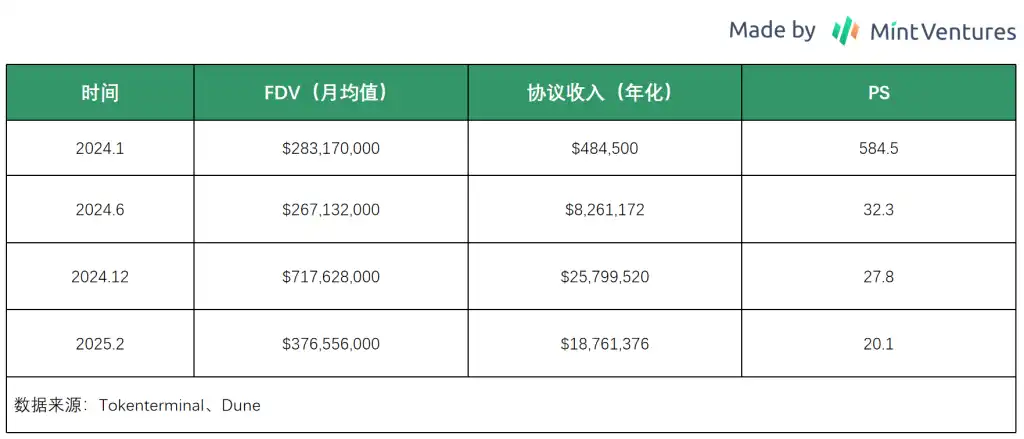
From the chart above, although Cow's FDV has shown an upward trend over the past year, as protocol revenue has increased, its PS value has still shown a significant decline, making it more cost-effective compared to before.
Looking at a horizontal comparison with competing products, among comparable projects in the aggregator field, 1inch is the most direct benchmark. Considering that the current 1INCH does not have direct token value capture and the protocol does not have stable, transparent protocol revenue, we mainly compare the FDV-to-transaction volume ratio of the two protocols.
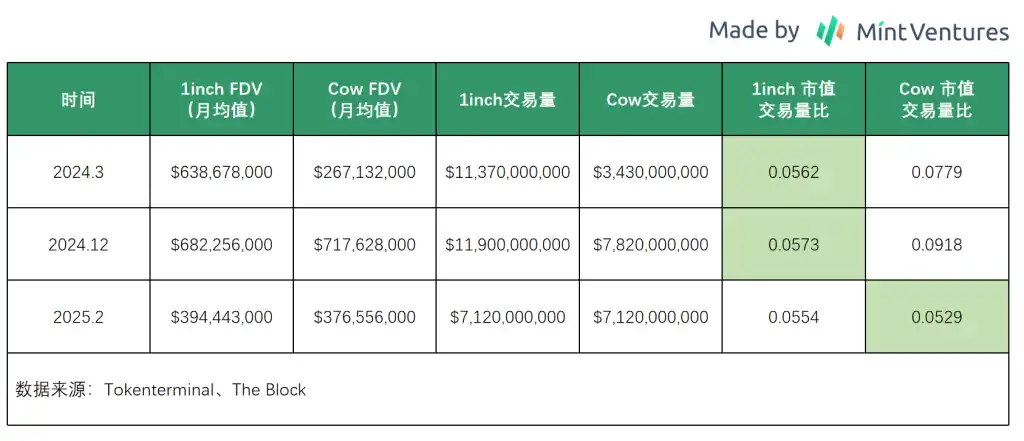
From the chart above, with Cow's price decline and business data increase, its market value-to-transaction volume ratio has, for the first time since February 2025, fallen below that of 1inch, showing a higher horizontal cost-effectiveness.
3.2 Uniswap
Business Status
Core Product
Uniswap is the largest decentralized exchange (DEX) on Ethereum, with its main products currently including its DEX protocol (already deployed on the Ethereum mainnet and multiple Layer 1 networks) and the recently introduced Unichain exclusive Layer 2 network.
The Uniswap protocol's fee switch mechanism has not been activated yet, so the protocol itself has not directly generated revenue in the past (but Uniswap Labs charges a 0.15% interface fee on token swaps through its official frontend).
However, following the announcement of Unichain's launch in November 2024, Unichain will subsequently distribute transaction sorter fees to UNI holders through staking, thus directly allocating value to UNI holders without the need to activate the fee switch.
Business Data
For Uniswap, the key business data includes trading volume and fees; whereas for Unichain, we primarily focus on the number of active addresses on the chain, the core ecosystem, and the on-chain asset size.
DEX Trading Volume and Fees
Uniswap's Trading Volume and Fees, Source: tokenterminal
Overall, Uniswap's trading volume has continued to grow with the market's development and hit monthly trading volume all-time highs in March and December of the past year; however, recently, with the market's downturn, the trading volume has noticeably declined.
It is worth noting that in this cycle, Uniswap's Fee metric has not yet surpassed the peak and sub-peak of the previous cycle, indicating a decreasing fee rate as the cycle progresses, showing fiercer competition among liquidity providers.
Multi-Chain Data
Thanks to multi-chain deployment (currently covering 11 EVM chains), especially with the introduction of Base by Coinbase, Uniswap's active user count hit a new high in October last year, reaching 19 million. The growth rate of this business data far exceeds the growth in trading volume, demonstrating the L2's ability to onboard new users.
Uniswap's Monthly Active Address Count Multi-Chain Distribution, Source: tokenterminal
Where Base is the main force of active users, accounting for 82% of Uniswap's active users across all chains.
Source: tokenterminal_12
However, in terms of transaction volume, Ethereum is still the main battlefield for Uniswap, accounting for about 62% of the volume, followed by Arbitrum at 23%, and then Base at 8.4%.
Source: tokenterminal_13
Unichain's Business Data
Since its official launch in early February this year, Unichain has grown rapidly. The number of weekly active addresses in early March has reached nearly 120,000, ranking 7th among all Layer 2 solutions, surpassing well-known L2 projects such as zksync, Manta, and Scroll.
Source: tokenterminal_14
However, the bridged asset value of Unichain is still relatively low, currently only around $14 million.
Source: tokenterminal_15
In terms of the ecosystem, Unichain's official list of ecosystem projects has exceeded 80, but most of them have not yet officially launched their actual operations. Taking DeFi as an example, among the well-known applications that have actually launched, besides Uniswap itself, there is currently only Venus (with a total of $5.67 million in deposits).
Competition
Over the past year, Uniswap has continued to dominate the DEX market in the EVM ecosystem, maintaining its leading overall market share, but the overall trend of market share has been declining. The following chart shows the market share trend of all DEXs in the EVM ecosystem (including all EVM L1 and L2 solutions).
Source: Dune
The second-place is Pancakeswap, and the third-place is Aerodrome, which are the leading DEXes on Bnbchain and Base (although Uniswap has also been deployed on these chains).
Source: Dune
ETH, Bnbchain, and Base are also the top three chains in terms of transaction volume in the EVM ecosystem, aligning with the market share rankings of Uniswap, Pancake, and Aerodrome.
As for Unichain, due to its recent launch, its ecosystem is still relatively weak and is in the application and fund cold-start stage. Apart from a good growth in active users, other business data still lag significantly behind mainstream L2 solutions.
Uniswap's Competitive Advantage
Uniswap's competitive advantage can be summarized as follows:
1. Network Effect and Liquidity Depth
The largest liquidity pool attracts the most traders, and vice versa. More traders and trading volume attract more tokens to deploy liquidity, creating a self-reinforcing cycle.
2. Brand and Stickiness from User Habits
As the project that first popularized the AMM model in the DeFi space, Uniswap has the highest brand recognition, including awareness and legitimacy. It holds a high mental position in the minds of both traders and liquidity providers. Even in today's environment with a rich ecosystem of DEXs and aggregators, many users habitually trade on the Uniswap frontend, even if it charges an additional transaction fee. Uniswap's brand has also played a significant role in its L2 development, attracting numerous high-quality projects for testing and adoption at the launch of L2, leading to rapid user growth.
3. Ecosystem Positioning through Multichain Deployment
Uniswap has deployed its product on most mainstream EVM chains and ranks in the top three for trading volume on most chains. This not only helps Uniswap maintain its foundational presence in the multichain era but also establishes a cornerstone for Uniswap's future multichain aggregation trading features, making it easier to achieve cross-chain liquidity.
Main Challenges and Risks
Intense Competition Landscape and Impact of New Models
While Uniswap still holds a certain advantage in market share, on one hand, its traditional Ethereum competitors such as Curve are holding their ground, and on the other hand, Uniswap's expansion to other EVM L1&2 solutions is not going smoothly, with each chain having its own strong contenders to compete with (such as Pancake on Bnbchain, Aerodrome on Base, Camelot on Arbitrum, etc.).
Of more concern are various emerging trading models challenging Uniswap: RFQ protocols (Request-For-Quote) and batch auction matching models are on the rise. Projects like CowSwap allow liquidity providers (solvers) to quote prices directly, improving the efficiency of large trades, reducing AMM slippage and MEV, and are favored by professional traders and whales, significantly diverting trading volume away from Uniswap.
Although Uniswap later introduced UniswapX with a similar mechanism, it has not been able to slow down the growth of projects like Cowswap. Furthermore, wallets, CEXs, and other products with significant front-end advantages are also focusing on the trading scene, attempting to tap into user behavior upstream, relegating Uniswap to a more passive "price taker," facing fierce price competition.
Low Community Governance Efficiency, Token Lack of Value Peg
Long-time observers of the Uniswap governance forums will mostly find that compared to other DeFi projects with higher governance efficiency and better reputation (such as Aave), Uniswap's governance efficiency is very low, manifested in slow speed, wastage of resources, and inadequate focus on strategic metrics.
For specific examples:
1. The community's most concerned fee switch issue has been repeatedly discussed for nearly 3 years without any resolution;
2. Donations and budgets are provided for various research and organizations unrelated to Uniswap's North Star metric (trading volume), but the results reaped are minimal for the project's benefit.
The community's low governance level, as well as the disregard and procrastination in pegging the value of the Uni token, evidently have a long-term negative impact on the Uni token price.
Valuation Reference
Due to Uniswap not having received formal protocol revenue yet, and Unichain's Fee being negligible relative to its market cap, we use the ratio of Uniswap's market cap to its Fee (PF) for valuation comparisons both vertically and horizontally.
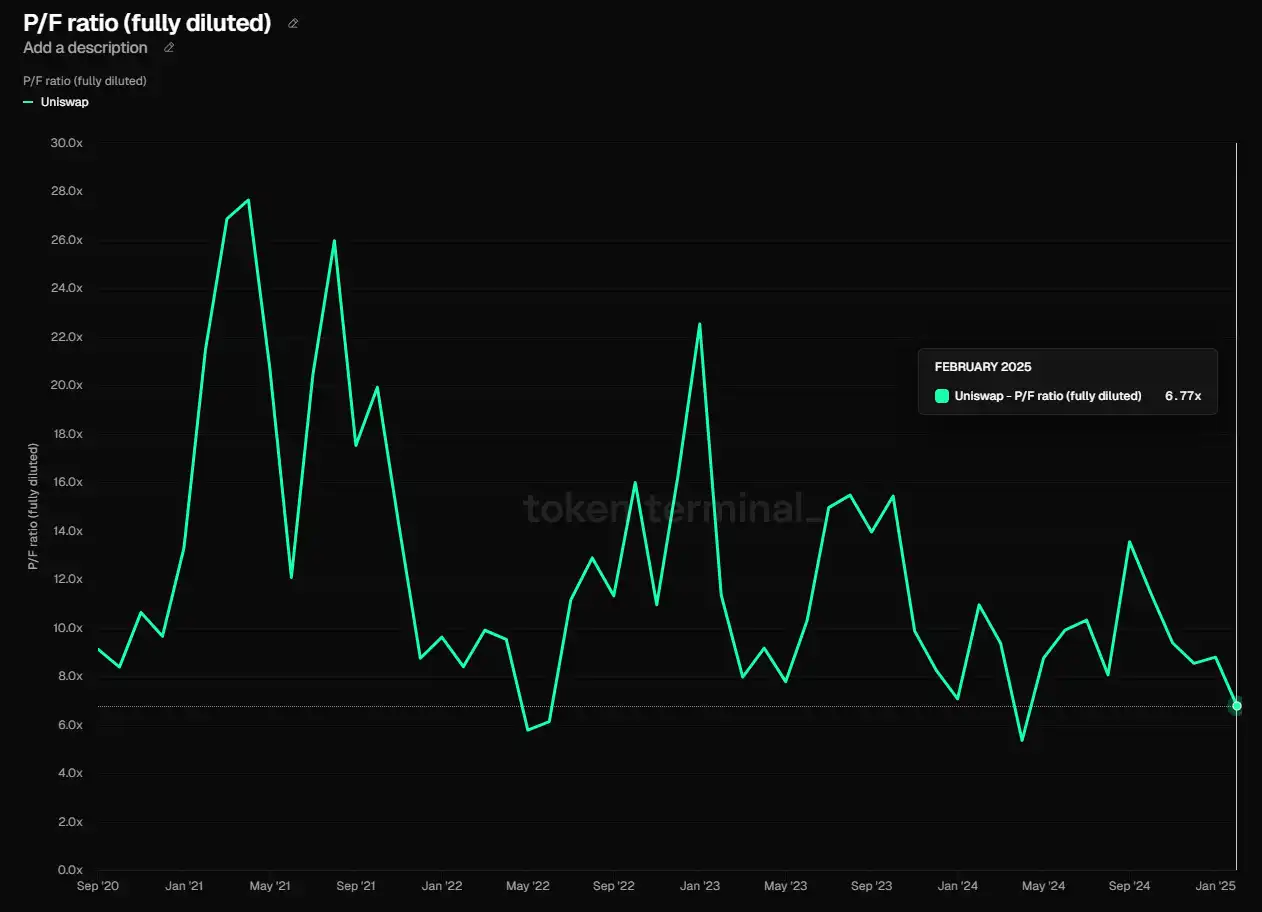
Source: tokenterminal
Vertically, in February of this year, Uniswap's PF was 6.77, hitting an all-time low. Since the inception of Uniswap, there have only been three months with a lower PF, which are May-June 2022 (Three Arrows FUD), and April 2024 (Altcoin market crash + Uniswap receiving an SEC Wells Notice). In March, this metric slightly increased to 7.26. From this perspective, the market is evidently very bearish on the future of the Uni token.
Source: tokenterminal
For horizontal comparison, I chose other DEX projects, namely Pancake and Aerodrome, which are second only to Uniswap in market share. I did not choose Curve because, apart from being a DEX, it also has a primary lending business, making it less comparable to the first three.
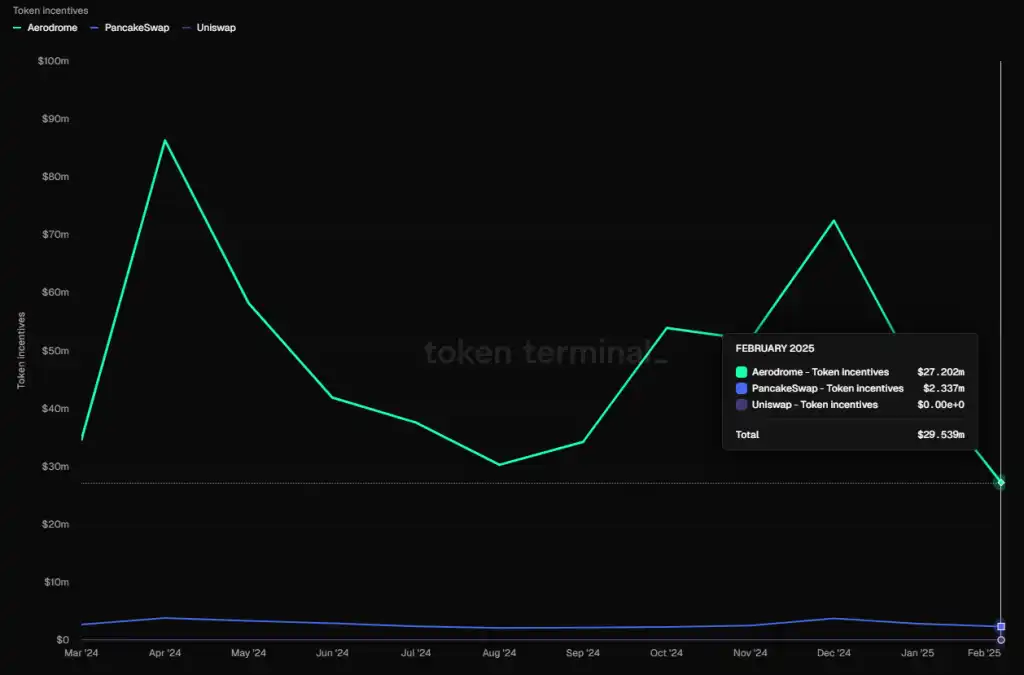
Looking at the PF metrics of the three, Uniswap's valuation seems significantly higher than that of Pancake and Aerodrome. However, we need to consider two additional factors:
Uniswap has not engaged in any token subsidies, while Pancake and Aerodrome continue to offer substantial token incentives, particularly Aerodrome, whose February token incentive value reached as high as $27 million (see figure below)
Uni has Unichain as a second growth trajectory. Uniswap's multi-chain ecosystem is more robust. Although Pancake has also deployed on multiple chains, there is a significant gap in operations compared to Uni, while Aerodrome is a single-chain DEX.
Overall, even considering the similarity of Uniswap's business to Pancake and Aerodrome, the horizontal comparability of its PF valuation reference is weaker than the vertical comparability.
3.3 Jupiter
Business Status
Starting from aggregated trading, Jupiter has developed a full-chain layout around Solana onchain transactions through continuous product expansion and mergers, horizontally expanding to other chains and ecosystems. Key products within the Jupiter system include:
· Main Site Proprietary Trading Products: including aggregated trading (Instant), spot price orders (Trigger), and conditional orders (Recurring) trading, which were Jupiter's earliest launched products and are the most widely used. The daily transaction volume set a record of 57 million transactions on January 20.
Source: Dune
The main site's Trenches product, formerly Ape.pro, had a product form focused on Meme, similar to typical meme trading tools like Phonton/GMGN. However, at the end of February, after Ape.pro merged into Trenches, its product form became similar to Jupiter's aggregated trading product form.
The main site's Perps product, whose core product logic is similar to GMX, provides leveraged long/short positions and yield farming for BTC, ETH, and SOL. The TVL of this segment peaked at over $2 billion, a significant part of Jupiter's TVL. The daily average trading volume during the peak period also approached $1 billion, which was the primary cash flow business in Jupiter's early days.
Jupiter Derivatives Exchange TVL (left axis) and Trading Volume (right axis) Data Source: DeFillama
The above can be considered Jupiter's main products at present. In addition to these, the Jupiter system also includes the following products:
Meme Trading Platform Moonshot. In January 2025, Jupiter announced the acquisition of a majority stake in the meme trading platform Moonshot.
Moonshot is a meme trading platform that has surged in the past six months, attracting many users to trade with its smooth fiat deposit system and streamlined trading process, leading to the Moonshot listing effect, especially when TRUMP was listed.
Moonshot's Trading Volume (left axis) and Fees (right axis) Source: Dune
Liquidity Platform Meteora.
Meteora was founded by an early co-founder of Jupiter (Ben Chow), and although it does not have a direct control relationship with Jupiter, it is considered an important part of the Jupiter ecosystem. However, Meteora will issue its own tokens in the future. Although Meteora is part of the Jupiter ecosystem, its relationship with the JUP token is more indirect.
LST Product jupSOL, jupSOL quickly gained a substantial market share after its launch in 2024. Currently, jupSOL ranks fourth after jitoSOL, bnSOL, and mSOL.
Solana LST Market Share Distribution (jupSOL in the gray block above) Source: Dune
Launchpad LFG, in addition to the JUP token itself, LFG also launched the governance token ZEUS of the cross-chain communication protocol zeus, the governance token CLOUD of the LST protocol Sanctum, the governance token DBR of the cross-chain protocol debridge, and several other meme projects in 2024. Although the number of launched projects is small, the quality is relatively high.
Portfolio Management Platform Jupiter Portfolio. In January of this year, Jupiter announced the acquisition of the on-chain portfolio tracker Sonarwatch and officially launched Jupiter Portfolio on January 30th. Mobile Wallet Jupiter Mobile, after acquiring Solana's mobile wallet Ultimate Wallet, Jupiter released its mobile wallet.
The full-chain network Jupnet was launched at the end of January this year with the goal of achieving an account that accesses all chains, all currencies, and all commodities. However, there is currently no directly usable version for end users. The transaction terminal Coinhall was acquired by Jupiter in September 2024 and mainly provides transactions for Cosmos ecosystem tokens. Through the acquisition of Coinhall, Jupiter gained the ability to build its own transaction terminal, which is essential for the development of its Trenches product.
Currently, on-chain transactions for Cosmos ecosystem tokens are not frequent, with daily trading volumes below $10 million.
Source: Coinhall
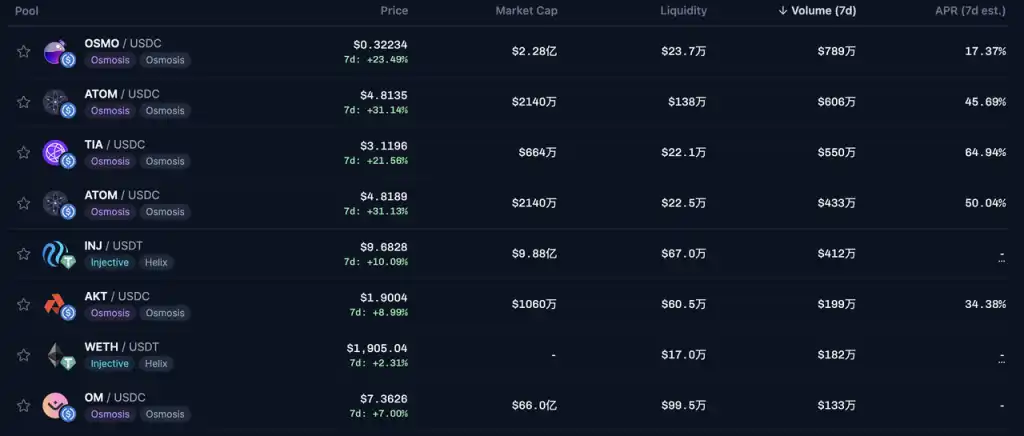
In addition to the above-mentioned end-user products, Jupiter's official website also showcases various other initiatives, such as the acquisition of Solana's browser SolanaFM. Furthermore, they have many upcoming products in the pipeline, including the full-chain network Jupnet.
From a product perspective, Jupiter, as Solana's largest consumer traffic entry point, covers almost all business directions except for lending. Even in Solana, where the trend of "conglomerate operations" is prevalent, Jupiter's business scope remains the most extensive. Apart from self-operated products, they also expand their business boundaries through fairly aggressive acquisitions.
Revenue Model
Currently, Jupiter's fee-based services include:
- Aggregated transaction services (including Trenches) charge 0.05%-0.1%
- Spot order and DCA charge 0.1%
- Derivatives business follows GMX's mechanism and primarily charges a 0.06% fee upon opening and closing positions. Additionally, there are fees for lending, price impact, etc. However, not all derivative fees go to JupiterDAO; 75% of the fees are allocated to its liquidity providers (JLP), while the remaining 25% is retained by JupiterDAO. Other services do not incur fees.
Token Incentives
Jupiter does not have daily token incentive plans; its main incentives come from two rounds of retroactive airdrops.
Competitive Landscape
Trading is the core service provided by Jupiter, and other businesses such as LST, Launchpad, Wallet, etc., can all be seen as a reuse of traffic brought by trading to some extent. Therefore, we mainly analyze Jupiter's competitive landscape in terms of aggregation trading and derivatives trading.
Aggregation Trading
In the Solana trading gateway competition, Jupiter quickly surpassed Orca and Raydium in the first half of 2024 with the aggregator's multi-liquidity pool routing feature and excellent user experience, holding an absolute advantage (capturing 51% of Solana trading volume in 24Q2, Source: Messari).
However, with the rise of meme and Pump.fun, specialized meme trading tools such as Photon, Trojan, Bullx, and GMGN quickly took over Jupiter's market share at the trading gateway layer. They focus on faster transaction speeds and more comprehensive meme trading support features, becoming a more recognized "Meme Trading Gateway" in the market. Jupiter launched a similar tool, ape.pro, in October last year, but the market responded, and it was eventually integrated into the main Trenches product. This is reflected in the data, as Jupiter's share of Solana trading volume dropped to 38% in 24Q5 (Source: Messari).
Meme trading accounted for 90% of Solana network transaction volume during the craze. Meme trading gateways were divided, posing the biggest challenge for Jupiter at the aggregation trading level.
Derivatives Trading
Jupiter's derivatives trading platform is currently the second largest on-chain derivatives exchange, second only to Hyperliquid, which we will introduce in the next section. Specifically on the Solana chain, Jupiter has a clear advantage over its main competitor Drift, with its trading volume roughly 5-10 times that of Drift recently.
7 Daily Derivatives Exchange Trading Volume Ranking Source: DeFillama
From the perspective of DAU, the difference between the two in the past month is also close to an order of magnitude.
Data Source: Dune
In the field of derivative trading, Jupiter's position on the Solana network appears unshakeable in the short term.
Main Challenges and Risks
Despite the launch of the Jupnet to expand its on-chain operations, Jupiter's core business is still predominantly on Solana. For Jupiter, the biggest unknown is whether the Solana network can sustain its prosperity and maintain active on-chain transactions.
In addition to the aforementioned disadvantageous competitive challenge in meme trading entry points, Jupiter faces challenges and risks including:
Overly aggressive business expansion with questionable results
Jupiter's business expansion is far more aggressive than most Web3 projects. Their business concept is grandiose, and in the past year, they have frequently expanded their business boundaries through acquisitions. However, many acquisitions have not had the intended effect. For example, the acquisitions of Moonshot and Coinhall.
Comparing the time of acquisition to when Moonshot had a peak daily trading volume of $660 million and revenue in the tens of millions of dollars in January, the current daily trading volume of Moonshot has plummeted to less than $5 million, with revenue not exceeding $10,000. Although Jupiter has not disclosed the acquisition prices or costs, it is evident that acquiring Moonshot today would come at a much lower cost for JUP token holders.
Moonshot's Trading Volume (left axis) and Fees (right axis) Source: Dune
The acquisition of Coinhall helped Jupiter establish the ability for their meme trading product, Trenches. However, based on current circumstances, the Trenches product still lags significantly behind the leading meme trading products such as Photon, Bullx, Trojan, GMGN, in terms of both transaction volume and visibility.
No Self-Built Liquidity Pool
Jupiter does not have a self-built liquidity pool. Its supported Metrora has already launched a rewards program and is expected to initiate an independent token issuance process. This means that JupiterDAO or the JUP token cannot capture the transaction fee from the "Token in Liquidity Pool Trade" step, a portion of which supported Raydium's business revenue exceeding $22 million in January of this year.
Untested in a Bear Market
In a bear market, many common practices during a bull market are disrupted. For example, currently, the overall willingness to pay for meme trades on the Solana blockchain is very strong. Users engaging in Jupiter's aggregated trades almost did not react to the 0.05% fee, as competing meme tools charge fees ranging from 0.5% to 1%. However, during a bear market, as trading enthusiasm wanes, users' sensitivity to transaction fees also increases. Jupiter may also face a dilemma between "market share" and "net profit."
Additionally, Jupiter's current product line includes a wallet, the full-chain network Jupnet, and the Jupiter Portfolio investment management tool, all of which are businesses that are unlikely to generate revenue in the short term. There are doubts about whether Jupiter can sustain such a large product line during a bear market.
Valuation Reference
With a total supply of 10 billion JUP tokens, 30 billion tokens were burned by the end of January this year, leaving a maximum circulating supply of 7 billion tokens. The actual circulating supply is 2.63 billion tokens, resulting in a circulating ratio of 38.5%. Among the current uncirculating tokens, 810 million team tokens will have their initial unlock over the next 21 months, and another 700 million tokens will be released in the January airdrop of Jupiter next year, resulting in an inflation rate of over 40% in the next year. JUP still belongs to the category of low-circulation high-inflation tokens.
Current Distribution ofJUP Tokens Source: Jupiter Governance Forum
At the end of January, Jupiter announced that 50% of the protocol's revenue would be used to repurchase JUP, with the repurchased JUP being locked up for 3 years.
The chart below shows DeFillama's statistics on Jupiter's protocol revenue since October of last year (the statistics on the Jupiter Aggregator revenue are possibly erroneous outliers on February 10th and March 10th, but the author has not found other data sources for Jupiter revenue statistics). It can be seen that Jupiter's main revenue still comes from derivatives trading (blue bars). Of course, this is somewhat related to the significant decrease in meme trading enthusiasm when the Jupiter aggregator fee was launched.
Data Source: DeFillama
Due to Jupiter's major economic model update at the end of January, with aggregate trading fees of 0.05%-0.1%, the more relevant P/S data is for February and March.
Based on revenue data collected by DeFillama, Jupiter's revenue in February was $31.7 million, with an annualized revenue of $380 million, corresponding to a P/S ratio (circulating) of only 3.65 and a P/S ratio (fully diluted) of 9.5. As of March 18th, the revenue was $12.25 million, with an annualized revenue of $253 million, resulting in a P/S ratio (circulating) of 5.45 and a P/S ratio (fully diluted) of 14.15.
Source: DeFillama
Whether comparing horizontally to Cowswap mentioned earlier or vertically to Jupiter itself, JUP's current valuation appears to be relatively low.
Of course, all the above data is based on the Solana hype. As the Solana craze subsides further into the future bear market, maintaining such high revenue will be challenging. We have already seen this trend in March compared to February.
You may also like

$COIN Joins S&P 500, but Coinbase Isn't Celebrating
On May 13, S&P Dow Jones Indices announced that Coinbase would officially replace Discover Financial Services in the S&P 500 on May 19. While other companies like Block and MicroStrategy, closely tied to Bitcoin, were already part of the S&P 500, Coinbase became the first cryptocurrency exchange whose primary business is in the index. This also signifies that cryptocurrency is gradually moving from the fringes to the mainstream in the U.S.
On the day of the announcement, Coinbase's stock price surged by 23%, surpassing the $250 mark. However, just 3 days later, Coinbase was hit by two consecutive events: a hack where employees were bribed to steal customer data and a demand for a $20 million ransom, and an investigation by the U.S. Securities and Exchange Commission (SEC) into the authenticity of its claim of having over 100 million "verified users" in its securities filings and marketing materials. These two events acted as mini-bombs, and at the time of writing, Coinbase's stock had already dropped by over 7.3%.
Coincidentally, Discover Financial Services, being replaced by Coinbase, can also be considered the "Coinbase" of the previous payment era. Discover is a U.S.-based digital banking and payment services company headquartered in Illinois, founded in 1960. Its payment network, Discover Network, is the fourth largest payment network apart from Visa, Mastercard, and American Express.
In April, after the approval of the acquisition of Discover by the sixth-largest U.S. bank, Capital One, this well-established digital banking company of over 60 years smoothly handed over its S&P 500 "seat" to this emerging cryptocurrency "bank." This unexpected coincidence also portrayed the handover between the new and old eras in Coinbase's entry into the S&P 500, resembling a relay race scene. However, this relay baton also brought Coinbase's accumulated "external troubles and internal strife" to a tipping point.
Over the past decade, cryptocurrency exchanges have been the most stable "profit machines." They play a role in providing liquidity to the entire industry and rely on trading fees to sustain their operations. However, with the comprehensive rollout of ETF products in the U.S. market, this profit model is facing unprecedented challenges. As the leader in the "American stack," with over 80% of its business coming from the U.S., Coinbase is most affected by this.
Starting from the approval of Bitcoin and Ethereum spot ETFs, traditional financial capital has significantly onboarded users and funds that originally belonged to exchanges in a more cost-effective, compliant, and transparent manner. The transaction fee revenue of cryptocurrency exchanges has started to decline, and this trend may further intensify in the coming months.
According to Coinbase's 2024 Q4 financial report, the platform's total trading revenue was $417 million, a 45% year-on-year decrease. The contribution of BTC and ETH's trading revenue dropped from 65% in the same period last year to less than 50%.
This decline is not a result of a decrease in market enthusiasm. In fact, since the approval of the Bitcoin ETF in January 2024, the inflow of BTC into the U.S. market has continued to reach new highs, with asset management giants like BlackRock and Fidelity rapidly expanding their management scale. Data shows that BlackRock's iShares Bitcoin ETF (IBIT) alone has surpassed $17 billion in assets under management. As of mid-May 2025, the cumulative net inflow of 11 major institutional Bitcoin spot ETFs on the market has exceeded $41.5 billion, with a total net asset value of $1214.69 billion, accounting for approximately 5.91% of the total Bitcoin market capitalization.
Institutional investors and some retail investors are shifting towards ETF products, partly due to compliance and tax considerations. On one hand, ETFs have much lower trading costs compared to cryptocurrency exchanges. While Coinbase's spot trading fee rate varies annually in a tiered manner but averages around 1.49%, for example, the management fee for IBIT ETF is only 0.25%, and the majority of ETF institution fees fluctuate around 0.15% to 0.25%.
In other words, the more rational users are, the more likely they are to move from exchanges to ETF products, especially for investors aiming for long-term holdings.
According to multiple sources, several institutions, including VanEck and Grayscale, have submitted applications to the SEC for a Solana (SOL) ETF, with some institutions also planning to submit an XRP ETF proposal. Once approved, this may trigger a new round of fund migration. According to a report submitted by Coinbase to the SEC, as of April, the platform's trading revenue from XRP and Solana accounted for 18% and 10%, nearly one-third of the platform's fee revenue.
However, the Bitcoin and Ethereum ETFs passed in 2024 also reduced the fees for these two tokens on Coinbase from 30% and 15% to 26% and 10%, respectively. If the SOL and XRP ETFs are approved, it will further undermine the core fee revenue of exchanges like Coinbase.
The expansion of ETF products is gradually weakening the financial intermediary status of cryptocurrency exchanges. From their original roles as matchmakers and clearers to now gradually becoming mere "on-ramps and off-ramps" for funds, exchanges are seeing their marginal value squeezed by ETFs.
On May 12, 2025, SEC Chairman Paul S. Atkins gave a keynote speech at the Tokenization and Cryptocurrency Working Group roundtable. The theme of his speech revolved around "It is a new day at the SEC," where he indicated that the SEC would not approach enforcement and regulation the same way as before but would instead pave the way for cryptocurrency assets in the U.S. market.
With signs of cryptocurrency compliance such as the SEC's "NEW DAY" declaration, an increasing number of traditional brokerages are attempting to enter the cryptocurrency industry. One of the most representative cases is the well-known U.S. brokerage Robinhood, which began expanding its crypto business in 2018. By the time of its IPO in 2021, Robinhood's crypto business revenue accounted for over 50% of the company, with a significant boost from the Dogecoin "moonshot" promoted by Musk.
In Q1 2025 earnings report, Robinhood showcased strong growth, especially in revenue from cryptocurrency and options trading. Fueled by Trump's Memecoin, cryptocurrency-related revenue reached $250 million, nearly doubling year-over-year. Consequently, Robinhood Gold subscription users reached 3.5 million, a 90% increase from the previous year, with the rapid growth of Robinhood Gold providing the company with a stable source of income.
Meanwhile, RobinHood is actively pursuing acquisitions in the cryptocurrency space. In 2024, it announced a $2 billion acquisition of the long-standing European cryptocurrency exchange Bitstamp. Additionally, Canada's largest cryptocurrency CEX, WonderFi, which recently went public on the Toronto Stock Exchange, also announced its integration with RobinHood Crypto. After obtaining virtual asset licenses in the UK, Canada, Singapore, and other markets, RobinHood has taken a proactive approach in the compliant cryptocurrency trading market.
Furthermore, an increasing number of brokerage firms are exploring the same path. Futu Securities, Tiger Brokers, and others are also dipping their toes into cryptocurrency trading, with some having applied for or obtained the VA license from the Hong Kong SFC. Although their user bases are currently small, traditional brokerages have a natural advantage in user trust, regulatory licenses, and low fee structures. This could pose a threat to native cryptocurrency platforms in the future.
In April 2025, security researchers discovered that some Coinbase user data was leaked on the dark web. While the platform initially responded by attributing it to a "technical misinformation," it still raised concerns among users regarding its security and privacy protection. Just two days before Dow Jones Indexes announced Coinbase's addition to the S&P 500 Index, on May 11, 2025, Coinbase received an email from an unknown threat actor claiming to have obtained customer account information and internal documents, demanding a $20 million ransom to keep the data private. Subsequent investigations confirmed the data breach.
Cybercriminals obtained the data by bribing overseas customer service agents and support staff, mainly in "non-U.S. regions such as India." These agents abused their access to Coinbase's internal customer support system and stole customer data. As early as February this year, blockchain detective ZachXBT revealed on X platform that between December 2024 and January 2025, Coinbase users lost over $65 million to social engineering scams, with the actual amount potentially higher.
Among the victims was a well-known figure, 67-year-old Ed Suman, an established artist in the art world for nearly two decades, having been involved in the creation of artworks such as Jeff Koons' "Balloon Dog" sculpture. Earlier this year, he fell victim to an impersonation scam involving fake Coinbase customer support, resulting in a loss of over $2 million in cryptocurrency. ZachXBT critiqued Coinbase for its inadequate handling of such scams, noting that other major exchanges have not faced similar issues and recommending Coinbase to enhance its security measures.
Amidst a series of ongoing social engineering incidents, although there has not been any impact on user assets at the technical level so far, it has raised concerns among many retail and institutional investors. Especially institutions holding massive assets on Coinbase. Just considering the U.S. BTC ETF institutions, as of mid-May 2025, they collectively hold nearly 840,000 BTC, and 75% of these are custodied by Coinbase. If we price BTC at $100,000, this amount reaches a staggering $63 billion, which is equivalent to the nominal GDP of two Iceland in the year 2024.
In addition, Coinbase Custody also serves over 300 institutional clients, including hedge funds, family offices, pension funds, and endowments. As of the Q1 2025 financial report, Coinbase's total assets under management (including institutional and retail clients) reached $404 billion. The specific amount of institutional custodied assets was not explicitly disclosed in the latest report, but it should still be over 50% based on the Q4 2024 report.
Once this security barrier is breached, not only could the rate of user attrition far exceed expectations, but more importantly, institutional trust in it would undermine the foundation of its business. Therefore, after a hacking event, Coinbase's stock price plummeted significantly.
Facing a decline in spot trading fee revenue, Coinbase is also accelerating its transformation, attempting to find growth opportunities in derivatives and emerging assets. Coinbase acquired a stake in the options platform Deribit at the end of 2024 and announced the official launch of perpetual contract products in 2025. This acquisition fills in Coinbase's gap in options trading and its relatively small global market share.
Deribit has a strong presence in non-U.S. markets, especially in Asia and Europe. The acquisition has enabled Coinbase to gain a dominant position in bitcoin and ethereum options trading on Deribit, accounting for approximately 80% of the global options trading volume, with daily trading volume remaining above $2 billion.
Meanwhile, 80-90% of Deribit's customer base consists of institutional investors, with their professionalism and liquidity in the Bitcoin and Ethereum options market highly favored by institutions. Coinbase's compliance advantage, coupled with its already robust institutional ecosystem, makes it even more suitable. By using institutions as an entry point, it can face the squeeze from giants like Binance and OKX in the derivatives market.
Facing a similar dilemma is Kraken, which is attempting to replicate Binance Futures' model in non-U.S. markets. Since the derivatives market relies more on professional users, fee rates are relatively higher and stickiness is stronger, making it a significant source of revenue for exchanges. In the first half of 2025, Kraken completed the acquisition of TradeStation Crypto and a futures exchange, aiming to build a complete derivatives trading ecosystem to hedge the risk of declining spot transaction fee income.
With the surge of Memecoin in 2024, Binance, OKX, and various CEX platforms began massively listing small-market-cap, highly volatile tokens to activate active trading users. Due to the wealth effect and trading activity of Memecoins, Coinbase was also forced to join the battle, successively listing popular tokens from the Solana ecosystem such as BOOK OF MEME and Dogwifhat. Although these coins are controversial, they are frequently traded, with fee rates several times higher than mainstream coins, serving as a "blood-boosting" method for spot trading.
However, due to its status as a publicly traded company, this practice is a riskier endeavor for Coinbase. Even in the current crypto-friendly environment, the SEC is still investigating whether tokens like SOL, ADA, and SAND constitute securities.
In addition to the forced transformation strategies carried out by the aforementioned CEXs, they are also starting to lay out RWAs and the most talked-about stablecoin payment fields, such as the PYUSD launched through a collaboration between Coinbase and Paypal, Coinbase's support for the Euro stablecoin EURC by Circle that complies with EU MiCA regulatory requirements, or the USD1 launched through a collaboration between Binance and WIFL. In the increasingly crowded trading field, many CEXs have shifted their focus from just the trading market to the application field.
The golden age of transaction fees has quietly ended, and the second half of the crypto exchange platform game has silently begun.
Arthur Hayes: Why I'm Betting on ETH While the Market Is Obsessed with SOL
CryptoPunks Changes Hands Twice, Did the Originator of NFTs Finally Find Its "Forever Home" This Time?
May 16 Key Market Information Gap, A Must-Read! | Alpha Morning Report
Key Market Intelligence on May 14th, how much did you miss out on?
1.Binance Alpha Launches HIPPO, BLUE, and Other Tokens
2.Believe Ecosystem Tokens See General Rise, LAUNCHCOIN Surges Over 250% in 24 Hours
3.Tiger Securities Introduces Cryptocurrency Deposit and Withdrawal Service, Supports Mainstream Cryptocurrencies such as BTC and ETH
4.Current Bitcoin Rally Possibly Driven by Institutions, Retail Traders Yet to Join
5.Binance Wallet's New TGE Privasea AI Participation Requires a 198 Point Threshold, with a Point Consumption of 15
Source: Overheard on CT (tg: @overheardonct), Kaito
PUMP: Today's discussions about PUMP focus on its new creator revenue-sharing model: the platform will allocate 50% of PumpSwap revenue to token creators, sparking varied reactions from users. Some criticize the move as insufficient or even misleading, while others view it as a positive step the platform is taking to reward creators. Meanwhile, PUMP faces market pressure from emerging competitors like LetsBONKfun and Raydium, which are rapidly gaining market share. Users also express concerns about PUMP's sustainability and potential regulatory risks in the U.S., with discussions extending to the platform's impact on the entire memecoin ecosystem.
COINBASE: Today, Coinbase became the first crypto company to join the S&P 500 Index, replacing Discover Financial Services, sparking widespread industry attention. The entire crypto community views this milestone as a significant development, signaling that crypto assets are further integrating into the mainstream financial system. The news has sparked lively discussions on Twitter, with many users pointing out that this may attract more institutional investors to enter the Bitcoin and other cryptocurrency markets.
XRP: XRP became the focal point of today's crypto discussion, with its significant market movements and strategic advances drawing attention. XRP has surpassed USDT to become the third-largest cryptocurrency by market capitalization, sparking market excitement and discussions about its future potential. The surge in market capitalization and price is believed to be related to increasing institutional interest, deepening strategic partnerships, and its role in the crypto ecosystem. Additionally, XRP's integration into multiple financial systems and its potential as a macro asset class are also seen as key factors driving the current market sentiment.
DYDX: Today's discussions about DYDX mainly focused on the dYdX Yapper Leaderboard launched by KaitoAI. The leaderboard aims to identify the most active community participants, with a total of $150,000 in rewards to be distributed over the first three seasons. This initiative has sparked broad community participation, with many users discussing the potential rewards and the incentive effect on the DYDX ecosystem. Meanwhile, progress on the ethDYDX to dYdX native chain migration and historical airdrop events have also been topics of discussion.
1. "What Is 'ICM'? Holding Up the $4 Billion Market Cap Solana's New Narrative"
Overnight, the hottest narrative in the crypto space has become "Internet Capital Markets," with a host of crypto projects and founders, led by the Solana ecosystem's new Launchpad platform Believe, releasing this phrase. Together with "Believe in something," it has become the new slogan heralding the onset of a bull market. What exactly is the so-called "Internet Capital Market," will it become a short-lived hype phrase like the Base ecosystem's previous Content Coin, and what related targets are available for selection?2.《LaunchCoin Surges 20x in One Day, How Did Believe Create a $200M Market Cap Shiba Inu After Going to Zero?|100x Retrospective》
LAUNCHCOIN broke through a $200 million market cap today, with the long-lost liquidity and such a high market cap "Memecoin" almost bringing half of the on-chain crypto community CT into the fray. The community is crazily discussing this token, with half of it being FOMO and the other half being FUD. This token, originally issued by Believe founder Ben Pasternak under his personal identity, transformed into a new platform token after a renaming. From once going to zero to a $200 million market cap, what happened in between?May 14 On-chain Fund Flow
Deconstructing Binance Alpha2.0's New "Asia-Led Liquidity Mining" Model
After Surging 40%, Has Ethereum Price Peaked Upon Exiting the Craze?
Whether you are an insider or an outsider, these days you must be familiar with the news about Ethereum. The reason is simple, causing Ethereum enthusiasts to sigh with emotion and almost throwing off-guard those who defend Ethereum, Ethereum, with a "3-day surge of 40%," climbed to the top of the Douyin Hot List.
As we all know, Ethereum launched the Pectra upgrade on May 7th. This most significant network upgrade since early 2024 integrates the Prague execution layer hard fork and the Electra consensus layer upgrade, significantly improving Ethereum's performance through 11 improvement proposals. The account abstraction feature (EIP-7702) allows users to flexibly manage wallets through social media accounts or multi-signature schemes, reducing the user threshold, attracting more users and developers. The staking mechanism optimization increases the validator ETH cap from 32ETH to 2048ETH and introduces a flexible withdrawal method, making it easier for institutions and individuals to participate in network security, enhancing the market's confidence in Ethereum's long-term value.
At the same time, Pectra optimized the interaction efficiency of Layer 2 networks such as Arbitrum and Optimism, making transactions faster and cheaper, leading to a surge in on-chain activity. As a crucial step for Ethereum's transition from "2G" to "5G," the Pectra upgrade not only enhances network vitality but also "recharges confidence" in the market, directly driving the price increase.
Related Reading: "Ethereum Skyrockets 22% in One Day, E Enthusiasts Rejoice"
It's not just Ethereum itself, as Wall Street also brought important bullish news.
The world's largest asset management company, BlackRock, proposed to the SEC allowing Ethereum ETFs for staking. This proposal is expected to elevate Ethereum ETFs from a mere investment tool to a bond-like "interest-bearing asset," bringing investors both capital appreciation and passive income, igniting market optimism about Ethereum's future potential.
Specifically, BlackRock has proposed to amend its S-1 filing to allow investors to create and redeem ETF shares directly with Ethereum instead of the U.S. dollar (i.e., in-kind redemption). This move, combined with its $2.9 billion BUIDL Fund launched in March 2024, aims to deepen the integration of traditional finance with blockchain. The BUIDL Fund is a tokenized fund operating on the Ethereum network, investing in traditional assets such as U.S. Treasury bonds. This setup is highly attractive to institutional investors, as they can not only benefit from Ethereum's price appreciation but also earn stable cash flow through staking.
Robert Mitchnick, BlackRock's Head of Digital Assets, stated in a CNBC interview in March 2025 that the addition of staking functionality will significantly enhance the appeal of the Ethereum ETF. He admitted that when the Ethereum spot ETF was launched in July 2024 without staking functionality, the market demand was lackluster, and staking could be the key to reversing this trend.
Meanwhile, the SEC's shifting stance on cryptocurrency regulation has also fueled this upward trend. During the tenure of the previous SEC chairman, the regulatory approach was tough, and staking was strictly viewed through the Howey test as a potential unregistered security. Therefore, when approving the Ethereum spot ETF in May 2024, staking functionality was explicitly prohibited.
However, with Trump back in the White House and Paul Atkins taking over the SEC, there has been a noticeable relaxation in crypto regulation. Apart from BlackRock, ETF issuers such as Invesco Galaxy, VanEck, WisdomTree, and 21Shares have also submitted applications for similar staking and in-kind redemption.
Related reading: "New Chairman Takes Office, SEC Transforms into 'Crypto Daddy' Within 48 Hours"
If staking ETFs are approved, the benefits are likely to go beyond price appreciation. The introduction of staking functionality could redefine the role of crypto assets, making them more similar to traditional financial products that provide returns and value appreciation, thereby driving Ethereum closer to mainstream finance.
Currently, the SEC still needs to address several decisions related to crypto ETFs, including whether to approve ETFs for Solana, XRP, Litecoin, and even Dogecoin. With the calls for an "altcoin season" growing louder, Ethereum's strong performance may just be the beginning of a larger crypto market frenzy.
In addition, the Trump family-related DeFi project WLFI is also bullish on this wave of rise, with frequent on-chain activities. According to on-chain data analyst @ai_9684xtpa's monitoring, a WLFI-related address is currently borrowing coins to go long on ETH, borrowing 4 million U from Aave to buy 1590 ETH at an average price of $2515 per ETH.
For this epic surge of Ethereum after half a year of silence, the community has indeed gained more confidence and hope, which has also led to a revival of the entire altcoin market. However, amidst the joy, there are also voices of pessimism. Below is a summary conducted by BlockBeats based on community discussions.
The optimists point out that the current market structure is similar to the eve of the bull markets in 2016 and 2020, predicting a life-changing surge in the next 3-6 months, where some altcoins may even achieve astonishing single-day gains of up to 40%.
@liuwei16602825 stated that this surge signifies the return of the bull market as a sure thing. There is no need to worry about a pullback. The driving force behind the surge uses a high-cost isolated operation, fearing a drop more than any retail investor and will definitely do everything to support the price.
Related Reading: "Ethereum Leads the Surge Triggering the 'Altcoin Season' Speculation, How Do Traders View the Future Market?"
The bears mainly believe that this surge is different from the bull market of 2021, as the current market lacks the confidence of large-scale retail investors entering and holding positions for the long term, with funds rotating too quickly.
@market_beggar observed that a Bitfinex E/B whale has started to close positions and believes that if this whale maintains its high-speed position-closing operation for the next few days, it can be inferred that the whale no longer sees the upside potential of ETH, preparing to take profits and exit. The closing time will be a key focus going forward.
@FLS_OTC stated that there are still many uncertainties at the macro level, and the liquidity cannot support a major bull market. At this stage, it is a "last hurrah," not a complete reversal, and will continue to remain in a short position.
@off_thetarget believes that after ETH transitioned from POW to POS, it lost the "gold standard" of mining machine power cost support. The staking economic model led to a breakdown in value anchoring. Additionally, the L2 ecosystem (such as Starknet, zkSync, etc.) suffered from liquidity fragmentation, failing to establish an effective capital inflow mechanism, causing the collapse of the split disc pattern. Furthermore, the ETH community's excessive pursuit of technical narratives divorced from real-world needs resulted in a weak ecosystem growth. Therefore, he believes that ETH's intrinsic value system has crumbled, and the price is bound to plummet to the 800-1200 range, with a decisive short position at 1800.
@Airdrop_Guard, based on the core logic of the "High Probability Trading Strategy," where three sets of underlying logic different trading systems (such as volume depletion, price supply-demand, long/short position funding rate, etc.) simultaneously issue a short signal at the same point (2580), creating a high-probability trading opportunity. He emphasizes that these systems must be based on different algorithms and logics (rather than mere technical indicator overlays). The current ETH trend aligns with the short conditions in multiple independent dimensions of his trading system, hence the decision to short.
Overall, Bitcoin still maintains over 54% market dominance, and institutional funds' continued preference for it may limit the altcoin's upward potential. The market's future direction will depend on multiple factors, such as Bitcoin's price trend, global macroeconomic conditions, and whether funds can effectively rotate from Bitcoin to the altcoin sector.
Although Ethereum's recent leadership in the market has brought about optimistic sentiment, investors still need to remain rational as different sectors of altcoins are likely to show divergence in trends. Whether this round of Ethereum's rise will usher in a true altcoin frenzy may require more time and conducive conditions.
How to Get Rich in Crypto Without Relying on Luck? Financial Veteran Raoul Pal's Macro Insights and Investment Path
Key Market Insight Discrepancy on May 2nd - A Must-Read! | Alpha Morning Report
After CEX and Wallet, OKX enters the payment game
RWA Evergreen Product Crisis: Why is the GLP Model Doomed to Collapse Under RWA Evergreen?
Science Equity Movement: DeSci's Trillion-Dollar Knowledge Economy Reconstruction Revolution
Sentient In-Depth Research Report: Secures $85 Million in Funding to Build a Decentralized AGI New Paradigm
April 30th Market Key Intelligence, How Much Did You Miss?
Week 16 On-Chain Data: Intensifying Structural Supply-Demand Imbalance, Data Reveals Solid Blueprint for Next Bull Run?
President's 'Official' Coin Issuance, Market Performance 'Desensitized'; Trump's Crypto Empire Lacks Novelty
Sui Q1 Advanced Report: The Rise of BTCfi Infrastructure, the Boom of Lending Protocols, and the Future of Rollup-Based Scalability
Crypto Developer: The Trump Family's Coin Minting Real Estate Business
$COIN Joins S&P 500, but Coinbase Isn't Celebrating
On May 13, S&P Dow Jones Indices announced that Coinbase would officially replace Discover Financial Services in the S&P 500 on May 19. While other companies like Block and MicroStrategy, closely tied to Bitcoin, were already part of the S&P 500, Coinbase became the first cryptocurrency exchange whose primary business is in the index. This also signifies that cryptocurrency is gradually moving from the fringes to the mainstream in the U.S.
On the day of the announcement, Coinbase's stock price surged by 23%, surpassing the $250 mark. However, just 3 days later, Coinbase was hit by two consecutive events: a hack where employees were bribed to steal customer data and a demand for a $20 million ransom, and an investigation by the U.S. Securities and Exchange Commission (SEC) into the authenticity of its claim of having over 100 million "verified users" in its securities filings and marketing materials. These two events acted as mini-bombs, and at the time of writing, Coinbase's stock had already dropped by over 7.3%.
Coincidentally, Discover Financial Services, being replaced by Coinbase, can also be considered the "Coinbase" of the previous payment era. Discover is a U.S.-based digital banking and payment services company headquartered in Illinois, founded in 1960. Its payment network, Discover Network, is the fourth largest payment network apart from Visa, Mastercard, and American Express.
In April, after the approval of the acquisition of Discover by the sixth-largest U.S. bank, Capital One, this well-established digital banking company of over 60 years smoothly handed over its S&P 500 "seat" to this emerging cryptocurrency "bank." This unexpected coincidence also portrayed the handover between the new and old eras in Coinbase's entry into the S&P 500, resembling a relay race scene. However, this relay baton also brought Coinbase's accumulated "external troubles and internal strife" to a tipping point.
Over the past decade, cryptocurrency exchanges have been the most stable "profit machines." They play a role in providing liquidity to the entire industry and rely on trading fees to sustain their operations. However, with the comprehensive rollout of ETF products in the U.S. market, this profit model is facing unprecedented challenges. As the leader in the "American stack," with over 80% of its business coming from the U.S., Coinbase is most affected by this.
Starting from the approval of Bitcoin and Ethereum spot ETFs, traditional financial capital has significantly onboarded users and funds that originally belonged to exchanges in a more cost-effective, compliant, and transparent manner. The transaction fee revenue of cryptocurrency exchanges has started to decline, and this trend may further intensify in the coming months.
According to Coinbase's 2024 Q4 financial report, the platform's total trading revenue was $417 million, a 45% year-on-year decrease. The contribution of BTC and ETH's trading revenue dropped from 65% in the same period last year to less than 50%.
This decline is not a result of a decrease in market enthusiasm. In fact, since the approval of the Bitcoin ETF in January 2024, the inflow of BTC into the U.S. market has continued to reach new highs, with asset management giants like BlackRock and Fidelity rapidly expanding their management scale. Data shows that BlackRock's iShares Bitcoin ETF (IBIT) alone has surpassed $17 billion in assets under management. As of mid-May 2025, the cumulative net inflow of 11 major institutional Bitcoin spot ETFs on the market has exceeded $41.5 billion, with a total net asset value of $1214.69 billion, accounting for approximately 5.91% of the total Bitcoin market capitalization.
Institutional investors and some retail investors are shifting towards ETF products, partly due to compliance and tax considerations. On one hand, ETFs have much lower trading costs compared to cryptocurrency exchanges. While Coinbase's spot trading fee rate varies annually in a tiered manner but averages around 1.49%, for example, the management fee for IBIT ETF is only 0.25%, and the majority of ETF institution fees fluctuate around 0.15% to 0.25%.
In other words, the more rational users are, the more likely they are to move from exchanges to ETF products, especially for investors aiming for long-term holdings.
According to multiple sources, several institutions, including VanEck and Grayscale, have submitted applications to the SEC for a Solana (SOL) ETF, with some institutions also planning to submit an XRP ETF proposal. Once approved, this may trigger a new round of fund migration. According to a report submitted by Coinbase to the SEC, as of April, the platform's trading revenue from XRP and Solana accounted for 18% and 10%, nearly one-third of the platform's fee revenue.
However, the Bitcoin and Ethereum ETFs passed in 2024 also reduced the fees for these two tokens on Coinbase from 30% and 15% to 26% and 10%, respectively. If the SOL and XRP ETFs are approved, it will further undermine the core fee revenue of exchanges like Coinbase.
The expansion of ETF products is gradually weakening the financial intermediary status of cryptocurrency exchanges. From their original roles as matchmakers and clearers to now gradually becoming mere "on-ramps and off-ramps" for funds, exchanges are seeing their marginal value squeezed by ETFs.
On May 12, 2025, SEC Chairman Paul S. Atkins gave a keynote speech at the Tokenization and Cryptocurrency Working Group roundtable. The theme of his speech revolved around "It is a new day at the SEC," where he indicated that the SEC would not approach enforcement and regulation the same way as before but would instead pave the way for cryptocurrency assets in the U.S. market.
With signs of cryptocurrency compliance such as the SEC's "NEW DAY" declaration, an increasing number of traditional brokerages are attempting to enter the cryptocurrency industry. One of the most representative cases is the well-known U.S. brokerage Robinhood, which began expanding its crypto business in 2018. By the time of its IPO in 2021, Robinhood's crypto business revenue accounted for over 50% of the company, with a significant boost from the Dogecoin "moonshot" promoted by Musk.
In Q1 2025 earnings report, Robinhood showcased strong growth, especially in revenue from cryptocurrency and options trading. Fueled by Trump's Memecoin, cryptocurrency-related revenue reached $250 million, nearly doubling year-over-year. Consequently, Robinhood Gold subscription users reached 3.5 million, a 90% increase from the previous year, with the rapid growth of Robinhood Gold providing the company with a stable source of income.
Meanwhile, RobinHood is actively pursuing acquisitions in the cryptocurrency space. In 2024, it announced a $2 billion acquisition of the long-standing European cryptocurrency exchange Bitstamp. Additionally, Canada's largest cryptocurrency CEX, WonderFi, which recently went public on the Toronto Stock Exchange, also announced its integration with RobinHood Crypto. After obtaining virtual asset licenses in the UK, Canada, Singapore, and other markets, RobinHood has taken a proactive approach in the compliant cryptocurrency trading market.
Furthermore, an increasing number of brokerage firms are exploring the same path. Futu Securities, Tiger Brokers, and others are also dipping their toes into cryptocurrency trading, with some having applied for or obtained the VA license from the Hong Kong SFC. Although their user bases are currently small, traditional brokerages have a natural advantage in user trust, regulatory licenses, and low fee structures. This could pose a threat to native cryptocurrency platforms in the future.
In April 2025, security researchers discovered that some Coinbase user data was leaked on the dark web. While the platform initially responded by attributing it to a "technical misinformation," it still raised concerns among users regarding its security and privacy protection. Just two days before Dow Jones Indexes announced Coinbase's addition to the S&P 500 Index, on May 11, 2025, Coinbase received an email from an unknown threat actor claiming to have obtained customer account information and internal documents, demanding a $20 million ransom to keep the data private. Subsequent investigations confirmed the data breach.
Cybercriminals obtained the data by bribing overseas customer service agents and support staff, mainly in "non-U.S. regions such as India." These agents abused their access to Coinbase's internal customer support system and stole customer data. As early as February this year, blockchain detective ZachXBT revealed on X platform that between December 2024 and January 2025, Coinbase users lost over $65 million to social engineering scams, with the actual amount potentially higher.
Among the victims was a well-known figure, 67-year-old Ed Suman, an established artist in the art world for nearly two decades, having been involved in the creation of artworks such as Jeff Koons' "Balloon Dog" sculpture. Earlier this year, he fell victim to an impersonation scam involving fake Coinbase customer support, resulting in a loss of over $2 million in cryptocurrency. ZachXBT critiqued Coinbase for its inadequate handling of such scams, noting that other major exchanges have not faced similar issues and recommending Coinbase to enhance its security measures.
Amidst a series of ongoing social engineering incidents, although there has not been any impact on user assets at the technical level so far, it has raised concerns among many retail and institutional investors. Especially institutions holding massive assets on Coinbase. Just considering the U.S. BTC ETF institutions, as of mid-May 2025, they collectively hold nearly 840,000 BTC, and 75% of these are custodied by Coinbase. If we price BTC at $100,000, this amount reaches a staggering $63 billion, which is equivalent to the nominal GDP of two Iceland in the year 2024.
In addition, Coinbase Custody also serves over 300 institutional clients, including hedge funds, family offices, pension funds, and endowments. As of the Q1 2025 financial report, Coinbase's total assets under management (including institutional and retail clients) reached $404 billion. The specific amount of institutional custodied assets was not explicitly disclosed in the latest report, but it should still be over 50% based on the Q4 2024 report.
Once this security barrier is breached, not only could the rate of user attrition far exceed expectations, but more importantly, institutional trust in it would undermine the foundation of its business. Therefore, after a hacking event, Coinbase's stock price plummeted significantly.
Facing a decline in spot trading fee revenue, Coinbase is also accelerating its transformation, attempting to find growth opportunities in derivatives and emerging assets. Coinbase acquired a stake in the options platform Deribit at the end of 2024 and announced the official launch of perpetual contract products in 2025. This acquisition fills in Coinbase's gap in options trading and its relatively small global market share.
Deribit has a strong presence in non-U.S. markets, especially in Asia and Europe. The acquisition has enabled Coinbase to gain a dominant position in bitcoin and ethereum options trading on Deribit, accounting for approximately 80% of the global options trading volume, with daily trading volume remaining above $2 billion.
Meanwhile, 80-90% of Deribit's customer base consists of institutional investors, with their professionalism and liquidity in the Bitcoin and Ethereum options market highly favored by institutions. Coinbase's compliance advantage, coupled with its already robust institutional ecosystem, makes it even more suitable. By using institutions as an entry point, it can face the squeeze from giants like Binance and OKX in the derivatives market.
Facing a similar dilemma is Kraken, which is attempting to replicate Binance Futures' model in non-U.S. markets. Since the derivatives market relies more on professional users, fee rates are relatively higher and stickiness is stronger, making it a significant source of revenue for exchanges. In the first half of 2025, Kraken completed the acquisition of TradeStation Crypto and a futures exchange, aiming to build a complete derivatives trading ecosystem to hedge the risk of declining spot transaction fee income.
With the surge of Memecoin in 2024, Binance, OKX, and various CEX platforms began massively listing small-market-cap, highly volatile tokens to activate active trading users. Due to the wealth effect and trading activity of Memecoins, Coinbase was also forced to join the battle, successively listing popular tokens from the Solana ecosystem such as BOOK OF MEME and Dogwifhat. Although these coins are controversial, they are frequently traded, with fee rates several times higher than mainstream coins, serving as a "blood-boosting" method for spot trading.
However, due to its status as a publicly traded company, this practice is a riskier endeavor for Coinbase. Even in the current crypto-friendly environment, the SEC is still investigating whether tokens like SOL, ADA, and SAND constitute securities.
In addition to the forced transformation strategies carried out by the aforementioned CEXs, they are also starting to lay out RWAs and the most talked-about stablecoin payment fields, such as the PYUSD launched through a collaboration between Coinbase and Paypal, Coinbase's support for the Euro stablecoin EURC by Circle that complies with EU MiCA regulatory requirements, or the USD1 launched through a collaboration between Binance and WIFL. In the increasingly crowded trading field, many CEXs have shifted their focus from just the trading market to the application field.
The golden age of transaction fees has quietly ended, and the second half of the crypto exchange platform game has silently begun.
Arthur Hayes: Why I'm Betting on ETH While the Market Is Obsessed with SOL
CryptoPunks Changes Hands Twice, Did the Originator of NFTs Finally Find Its "Forever Home" This Time?
May 16 Key Market Information Gap, A Must-Read! | Alpha Morning Report
Key Market Intelligence on May 14th, how much did you miss out on?
1.Binance Alpha Launches HIPPO, BLUE, and Other Tokens
2.Believe Ecosystem Tokens See General Rise, LAUNCHCOIN Surges Over 250% in 24 Hours
3.Tiger Securities Introduces Cryptocurrency Deposit and Withdrawal Service, Supports Mainstream Cryptocurrencies such as BTC and ETH
4.Current Bitcoin Rally Possibly Driven by Institutions, Retail Traders Yet to Join
5.Binance Wallet's New TGE Privasea AI Participation Requires a 198 Point Threshold, with a Point Consumption of 15
Source: Overheard on CT (tg: @overheardonct), Kaito
PUMP: Today's discussions about PUMP focus on its new creator revenue-sharing model: the platform will allocate 50% of PumpSwap revenue to token creators, sparking varied reactions from users. Some criticize the move as insufficient or even misleading, while others view it as a positive step the platform is taking to reward creators. Meanwhile, PUMP faces market pressure from emerging competitors like LetsBONKfun and Raydium, which are rapidly gaining market share. Users also express concerns about PUMP's sustainability and potential regulatory risks in the U.S., with discussions extending to the platform's impact on the entire memecoin ecosystem.
COINBASE: Today, Coinbase became the first crypto company to join the S&P 500 Index, replacing Discover Financial Services, sparking widespread industry attention. The entire crypto community views this milestone as a significant development, signaling that crypto assets are further integrating into the mainstream financial system. The news has sparked lively discussions on Twitter, with many users pointing out that this may attract more institutional investors to enter the Bitcoin and other cryptocurrency markets.
XRP: XRP became the focal point of today's crypto discussion, with its significant market movements and strategic advances drawing attention. XRP has surpassed USDT to become the third-largest cryptocurrency by market capitalization, sparking market excitement and discussions about its future potential. The surge in market capitalization and price is believed to be related to increasing institutional interest, deepening strategic partnerships, and its role in the crypto ecosystem. Additionally, XRP's integration into multiple financial systems and its potential as a macro asset class are also seen as key factors driving the current market sentiment.
DYDX: Today's discussions about DYDX mainly focused on the dYdX Yapper Leaderboard launched by KaitoAI. The leaderboard aims to identify the most active community participants, with a total of $150,000 in rewards to be distributed over the first three seasons. This initiative has sparked broad community participation, with many users discussing the potential rewards and the incentive effect on the DYDX ecosystem. Meanwhile, progress on the ethDYDX to dYdX native chain migration and historical airdrop events have also been topics of discussion.
1. "What Is 'ICM'? Holding Up the $4 Billion Market Cap Solana's New Narrative"
Overnight, the hottest narrative in the crypto space has become "Internet Capital Markets," with a host of crypto projects and founders, led by the Solana ecosystem's new Launchpad platform Believe, releasing this phrase. Together with "Believe in something," it has become the new slogan heralding the onset of a bull market. What exactly is the so-called "Internet Capital Market," will it become a short-lived hype phrase like the Base ecosystem's previous Content Coin, and what related targets are available for selection?2.《LaunchCoin Surges 20x in One Day, How Did Believe Create a $200M Market Cap Shiba Inu After Going to Zero?|100x Retrospective》
LAUNCHCOIN broke through a $200 million market cap today, with the long-lost liquidity and such a high market cap "Memecoin" almost bringing half of the on-chain crypto community CT into the fray. The community is crazily discussing this token, with half of it being FOMO and the other half being FUD. This token, originally issued by Believe founder Ben Pasternak under his personal identity, transformed into a new platform token after a renaming. From once going to zero to a $200 million market cap, what happened in between?May 14 On-chain Fund Flow
Deconstructing Binance Alpha2.0's New "Asia-Led Liquidity Mining" Model
Popular coins
Latest Crypto News


Customer Support:@weikecs
Business Cooperation:@weikecs
Quant Trading & MM:bd@weex.com
VIP Services:support@weex.com
 App
App