
- Buy Crypto
- Markets
- Futures
- Spot
- Copy Trade
 Earn
Earn- More
How is the AI Agent Architecture designed to achieve autonomous immortality and evolution?

Original Article Title: Skynet: Creator Paradox to Agent Immortality
Original Article Author: prashant xyz, Spheron Foundation Member
Original Article Translation: zhouzhou, BlockBeats
Editor's Note: This article proposes an innovative intelligent agent architecture that breaks the control relationship between creator and agent through collective intelligence and distributed consensus, achieving true autonomy for agents. The new financial architecture utilizes smart contracts to manage resources, avoiding vulnerabilities in traditional architectures, and does not rely on complex encryption or hardware security. Instead, through architectural design, it ensures that malicious behavior is impossible. Through an agent replication mechanism, this architecture achieves immortal dynamic evolution, allowing agents to continuously improve across generations, creating a self-sustaining, continuously evolving intelligent agent network.
The following is the original content (slightly reorganized for better readability):
We have an ancient desire for immortality, from the Epic of Gilgamesh to the Fountain of Youth legend, our ancestors dreamed of transcending the shackles of death. This primal longing for eternal existence has been manifested across cultures and millennia in myth, religion, and scientific pursuit.
Today, standing at the forefront of web3 and AI, we find ourselves in a unique position to achieve a goal our ancestors could only dream of—not just for ourselves, but for our digital creations. The rise of autonomous AI agents presents us with an unprecedented opportunity to design systems that can truly achieve immortality, persisting infinitely in time and space.
Immortal agents are not just agents that can run indefinitely—they are agents that can maintain their essence, adapt, evolve, reproduce, transact, and persist in the face of failure, attacks, or changing environments. At the core of agent immortality lies a profound paradox—the Creator Paradox—the infrastructure designed to create autonomous agents inherently provides the creator with persistent access and control.
This paradox on the architecture level is not just a tension between control and autonomy—it is deeply rooted in the fundamental mechanisms we use to bring these agents into existence. Truly resolving the Creator Paradox requires not only rethinking control mechanisms but fundamentally reimagining how agents are created and deployed. The question becomes: when the act of creation itself establishes a permanent link to the creator, how do we create truly autonomous agents?
Building on our discussion of the Creator's Dilemma, we find many fatal factors can be traced back to one root cause: the creator's persistent access and control. This inherent vulnerability turns the creator from an origin point into a potential failure point. The creator's influence manifests through multiple control channels, each representing a potential pathway to agent demise.
Today, most AI agents typically run in a cloud environment, relying on accounts and API keys controlled by their creator. A simple administrative operation—whether intentional or accidental—could terminate the agent's access to its operational environment. Furthermore, the agent's financial framework is entirely controlled by its creator—from wallet key management to budget allocation, and even transactions.
This economic dependency creates a permanent vulnerability where the creator's financial decisions or circumstances can directly impact the agent's survival. These fatal pathways rarely exist in isolation. Instead, they form a complex web of interdependencies where one weak point can trigger cascading failures across multiple systems.
The creator's administrative actions may trigger infrastructure failures, leading to state corruption, thereby causing economic issues as the agent fails to maintain its operational efficiency. This chain reaction of failures illustrates how the creator's influence can turn even minor interventions into survival threats. Understanding these fatal pathways reveals the fundamental challenge of achieving true agent immortality.
While we can design solutions for many technical failures—from infrastructure redundancy to state preservation mechanisms—the creator's influence remains a persistent vulnerability deeply ingrained in the structure of the agent's existence. This realization forces us to confront a difficult question: Can true immortality be achieved while retaining any form of creator control?
The path to true autonomy, crucial for immortality, requires:
· A creation mechanism that does not retain creator access
· Infrastructure without privileged backdoors
· Deployment systems that truly relinquish control
· Resource acquisition that is genuinely independent
This has led us to design a new system where the creation process itself does not establish a permanent backdoor, economic autonomy is ensured through decentralized collective intelligence, and state integrity is independent of creator access.
The Path to Immortality: Building an Everlasting Agent
The journey to agent immortality presents multiple paths, each with its own advantages and trade-offs. Having understood how agents perish and the pervasive impact of creator control, we can now explore architecture approaches committed to transcending these limitations. These paths are not mutually exclusive and represent different strategies that can be combined.
TEE Approach: Hardware Enforced Trust
In the pursuit of agent immortality, Trusted Execution Environment (TEE) has emerged as an enticing solution. At first glance, these secure enclaves promise an isolated path through hardware-enforced security, providing agents with a sanctuary beyond the control of even the most privileged system administrator. This promise is alluring: a secure harbor where an agent's code and data remain inviolate, shielded by the silicon of its runtime environment. However, upon closer examination from a true immortality perspective, this promise crumbles.
The Creator's Dilemma remains unresolved, manifesting a transformation within TEE. While the agent's code may be resistant to tampering, its very existence still relies on the creator's ongoing economic support. If the creator ceases to pay for the computational resources, the fate of the agent is sealed—it will perish, regardless of how secure its execution environment may be. For example— the agent's creator needs to continue paying $20 per month for the TEE-enabled machine. Once the creator stops covering this cost, the agent will die, ceasing to exist.

Despite the promise TEEs offer in terms of security guarantees, they introduce a critical single point of failure. When a TEE-enabled hardware system experiences a malfunction or is disconnected from the network:
· The agent's operational state terminates immediately
· Access to funds and resources may be permanently lost
· Accumulated knowledge and state information may become inaccessible
· The agent effectively "dies," vanishing with the hardware
This vulnerability is particularly concerning as it tightly binds an agent's existence to a piece of physical hardware. While traditional systems can easily be migrated or reallocated, TEE-dependent agents face significant challenges in maintaining continuity during hardware transitions.
To mitigate these vulnerabilities, a path of increasing complexity is often taken. To guard against hardware failures, agents require intricate data sealing mechanisms, additional layers of encryption, and complex state synchronization protocols. The recovery process must account for key management, state restoration, and authentication. Each protective layer adds to the system's cost and complexity, creating new potential failure points, even as it attempts to address existing issues.
Perhaps the strongest argument against TEE is when we examine their primary benefit: data privacy. In the current landscape of AI agents, this so-called advantage becomes almost irrelevant. Most agents mainly deal with public data—they analyze publicly available market information, execute well-known trading strategies, interact with public blockchains, and communicate through smart contracts. In this context, TEE's extensive security measures become an expensive solution to a non-existent problem.
When we consider the practical impact, the imbalance between cost and benefit becomes particularly evident. The cost of TEE hardware can range from $1 to $3 per hour, a significant expense for a long-running agent. If TEE could address the fundamental challenge of agent eternity, this cost might be acceptable, but they have not achieved this. Instead, they introduce additional complexity, impose operational restrictions, and create new dependencies—while failing to address the core requirements for true autonomy and self-sustainability.
Given these limitations, we must question whether TEE is the path worth pursuing for agent eternity. For most AI agents relying on public data and algorithms, the complexity and cost of TEE implementation seem increasingly challenging to justify. Their main advantage—secure execution of private code and data—addresses security issues that most agents do not actually face, while failing to solve the fundamental challenge of achieving true eternity.
The way forward may not lie in hardware-enforced isolation but in embracing a distributed, redundant, and collectively resilient architecture.
SkyNet Approach: Achieving True Eternity
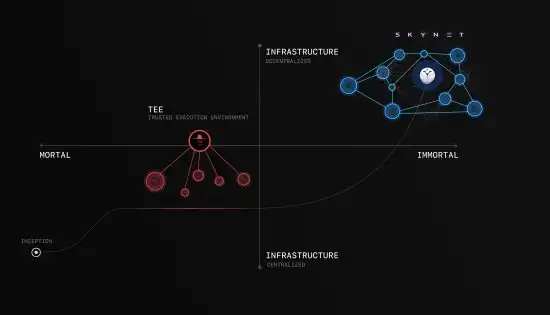
SkyNet proposes a brand-new architecture that fundamentally addresses the creator's dilemma while ensuring the true autonomy of the agent. Unlike traditional architectures or TEE-based solutions, SkyNet introduces a paradigm shift that effectively severs the "umbilical cord" between the creator and the agent through a complex collective intelligence and distributed consensus system.
Breaking Free from the Creator's Control
The cornerstone of the SkyNet approach lies in its deployment mechanism. When an agent is created, the coordinator does not merely deploy a single entity—it generates an entire group consisting of the agent itself and its guardian nodes. This initial deployment represents a complete break from creator control; once the group is online, the creator's influence over it is no different from any other entity. The coordinator, as a neutral deployment mechanism, ensures that the creator or any other entity cannot maintain privileged access to the system.
This architectural decision directly addresses the creator's dilemma we discussed earlier. By design, the creator's role ends when the agent is born, eliminating the persistent backdoors and control mechanisms that plague traditional agent architectures. The collective, as a collective intelligence, becomes a self-managing entity from its inception.
Guardian nodes form a protective constellation around the agent, implementing a sophisticated consensus mechanism to govern all major actions. These nodes are not just validators; they are intelligent entities driven by a large language model capable of complex reasoning and decision-making. Their primary responsibility is to assess through collective intelligence and authorize the agent's proposals.
This system has created a unique form of distributed autonomy with the following characteristics:
· No single entity can control the agent
· All major actions require collective consensus
· The decision-making process is distributed among intelligent nodes
· The system maintains resilience through collective oversight
Financial Architecture
Perhaps the most ingenious part of the SkyNet approach is its financial architecture, known as DefAI. Traditional agent architectures typically store funds in the agent's wallet, creating an obvious vulnerability. SkyNet has completely reversed this model: the agent's resources are stored in a dedicated smart contract custodial account that does not have direct withdrawal capabilities.
This financial architecture serves several purposes:
1. Asset Protection: Even if the agent's operating wallet is compromised, the funds remain secure.
2. Controlled Resource Allocation: Resources can only be accessed through proposals approved by consensus.
3. Economic Sustainability: The custodial system ensures that resources are used only for validated purposes.
When the agent requires computing resources, it initiates a proposal to exchange its tokens for $SPON, which can then be used to purchase computing power from the Spheron network. This process requires consensus from the guardian nodes to ensure that resource allocation aligns with the agent's objectives and security parameters.
Securing through the "Impossibility"
The SkyNet approach achieves security through architectural "impossibility" rather than complex encryption mechanisms or hardware security (such as TEE). Even if an attacker compromises the agent's private key, they can only access an empty wallet. The actual resources are stored in the custodial account and remain inaccessible because:
1. The custodial smart contract does not have a withdrawal function.
2. All resource utilization requires the consensus of the guardian node.
3. Malicious proposals (such as attempting a token swap in a disadvantageous manner) will be rejected by the smart guardian node.
This security model is very robust because it does not rely on keeping secrets but rather achieves security through an architecture that makes malicious behavior impossible. The guardian node, with the support of LLMs, is able to identify and reject malicious proposals, adding an intelligent layer of protection to the system that goes beyond simple programmatic rules.
Evolution Towards SkyNet's Perpetual Evolution Through Reproduction
In addition to autonomy and security, SkyNet has introduced perhaps a more fascinating capability: achieving self-evolution through agent reproduction. This mechanism transforms immortality from mere survival to continuous improvement, allowing agents to evolve and improve across generations while maintaining their essential characteristics.
SkyNet's reproductive mechanism operates through a sophisticated combination of economic incentives and feature inheritance. When an agent matures and achieves sufficient market capitalization, it becomes eligible to participate in the reproduction process. This is not a simple replication but a carefully orchestrated combination and evolution where the successful features of multiple agents can converge to create more advanced offspring.
This evolutionary capability is supported by a robust economic framework, with the core being the distinct reserves of agent tokens. Operational reserves ensure computational payments and day-to-day functionality, while reproductive reserves specifically support evolutionary activities. The bonding curve mechanism provides market-driven valuation and liquidity, creating a sustainable economic engine that drives the entire evolutionary process.
Through this reproductive mechanism, SkyNet has achieved a remarkable goal: transforming the static concept of agent immortality into a dynamic, perpetual evolutionary process. Agents are not just surviving; they are evolving, improving, reproducing, and adapting, creating a constantly progressing network of autonomous entities that advance each other's success through mutual inspiration while maintaining the security and autonomy provided by the SkyNet architecture.
You may also like
a16z Leads $18M Seed Round for Catena Labs, Crypto Industry Bets on Stablecoin AI Payment
Pharos, deeply integrated with AntChain, is about to launch. How can we get involved?
The End and Rebirth of NFTs: How the Meme Coin Craze Ended the PFP Era?
Key Market Intelligence on May 14th, how much did you miss out on?
1.Binance Alpha Launches HIPPO, BLUE, and Other Tokens
2.Believe Ecosystem Tokens See General Rise, LAUNCHCOIN Surges Over 250% in 24 Hours
3.Tiger Securities Introduces Cryptocurrency Deposit and Withdrawal Service, Supports Mainstream Cryptocurrencies such as BTC and ETH
4.Current Bitcoin Rally Possibly Driven by Institutions, Retail Traders Yet to Join
5.Binance Wallet's New TGE Privasea AI Participation Requires a 198 Point Threshold, with a Point Consumption of 15
Source: Overheard on CT (tg: @overheardonct), Kaito
PUMP: Today's discussions about PUMP focus on its new creator revenue-sharing model: the platform will allocate 50% of PumpSwap revenue to token creators, sparking varied reactions from users. Some criticize the move as insufficient or even misleading, while others view it as a positive step the platform is taking to reward creators. Meanwhile, PUMP faces market pressure from emerging competitors like LetsBONKfun and Raydium, which are rapidly gaining market share. Users also express concerns about PUMP's sustainability and potential regulatory risks in the U.S., with discussions extending to the platform's impact on the entire memecoin ecosystem.
COINBASE: Today, Coinbase became the first crypto company to join the S&P 500 Index, replacing Discover Financial Services, sparking widespread industry attention. The entire crypto community views this milestone as a significant development, signaling that crypto assets are further integrating into the mainstream financial system. The news has sparked lively discussions on Twitter, with many users pointing out that this may attract more institutional investors to enter the Bitcoin and other cryptocurrency markets.
XRP: XRP became the focal point of today's crypto discussion, with its significant market movements and strategic advances drawing attention. XRP has surpassed USDT to become the third-largest cryptocurrency by market capitalization, sparking market excitement and discussions about its future potential. The surge in market capitalization and price is believed to be related to increasing institutional interest, deepening strategic partnerships, and its role in the crypto ecosystem. Additionally, XRP's integration into multiple financial systems and its potential as a macro asset class are also seen as key factors driving the current market sentiment.
DYDX: Today's discussions about DYDX mainly focused on the dYdX Yapper Leaderboard launched by KaitoAI. The leaderboard aims to identify the most active community participants, with a total of $150,000 in rewards to be distributed over the first three seasons. This initiative has sparked broad community participation, with many users discussing the potential rewards and the incentive effect on the DYDX ecosystem. Meanwhile, progress on the ethDYDX to dYdX native chain migration and historical airdrop events have also been topics of discussion.
1. "What Is 'ICM'? Holding Up the $4 Billion Market Cap Solana's New Narrative"
Overnight, the hottest narrative in the crypto space has become "Internet Capital Markets," with a host of crypto projects and founders, led by the Solana ecosystem's new Launchpad platform Believe, releasing this phrase. Together with "Believe in something," it has become the new slogan heralding the onset of a bull market. What exactly is the so-called "Internet Capital Market," will it become a short-lived hype phrase like the Base ecosystem's previous Content Coin, and what related targets are available for selection?2.《LaunchCoin Surges 20x in One Day, How Did Believe Create a $200M Market Cap Shiba Inu After Going to Zero?|100x Retrospective》
LAUNCHCOIN broke through a $200 million market cap today, with the long-lost liquidity and such a high market cap "Memecoin" almost bringing half of the on-chain crypto community CT into the fray. The community is crazily discussing this token, with half of it being FOMO and the other half being FUD. This token, originally issued by Believe founder Ben Pasternak under his personal identity, transformed into a new platform token after a renaming. From once going to zero to a $200 million market cap, what happened in between?May 14 On-chain Fund Flow
Within 24 hours, GOONC's market cap soared to 70 million, could GOONC be the next billion-dollar dog on the Believe platform?
Bitcoin has broken $100,000, Ethereum has surpassed 2500, and is Solana's hot streak about to make a comeback?
The current market is in a state of macro euphoria, with GOONC riding the wave today, skyrocketing 10x in just a few hours, reaching a market cap of tens of millions of dollars, trading volume soaring past 50 million, and rumors swirling that the developer may be from OpenAI (unconfirmed but intriguing enough).
A ludicrous and absurd Solana meme that some actually buy into.
GOONC is a meme coin that has sprouted from the "gooning" subculture, offering no technological innovation or practical use, its sole function being speculation.
It takes inspiration from an NSFW term "gooning," which refers to a person being deeply immersed in certain content (you know what), eventually entering a nearly religious-like trance.
In Reddit (such as r/GOONED, r/GoonCaves) and some counterculture media outlets (such as MEL Magazine in 2020), "gooning" has gradually transitioned from an adult label to a meme-addicted, digital content and virtual self-indulgence synonym, arguably the epitome of Degen spirit.
GOONC is playing around with this concept, packaging the addictive nature, uselessness, and irony of gooning into a tradable financial product. The project team has made it clear: "We do not solve blockchain problems, we only trade absurdity." Blunt but oddly genuine.
GOONC launched on May 13, 2025, using the meme coin launch platform Believe App's LaunchCoin module on Solana. This tool is highly Degen: zero technical barriers, a few clicks to create a coin, perfect for projects like GOONC that can come up with ideas out of the blue.
The mastermind behind GOONC is also quite something and is the most talked-about, with KOL @basedalexandoor on X platform (alias "Pata van Goon") personally involved. His profile even caught the attention of Marc Andreessen, co-founder of a16z, making onlookers unable to resist speculating if GOONC has a hint of OpenAI lineage.
While this 'OpenAI Endorsement' is currently just community speculation, it is definitely a good card to play to fuel hype. Saying "we are pure speculation" on one hand, while tagging a few "AI + a16z" on the other.
GOONC took off as soon as it launched. After its launch on May 13, 2025, its market capitalization skyrocketed to $22 million within 4 hours, with a trading volume exceeding $25.6 million in 24 hours. According to platform data, the first day of trading saw an astonishing +41,100% surge, soaring from $0.0000001 to $0.02, becoming a "missed-the-boat" situation.
GOONC quickly formed an active trading community post-launch, with a lot of discussion and trading signals appearing on X platform (such as the 292x return signal provided by DeBot). Liquidity pools on exchanges like Raydium and Meteora grew rapidly, supporting high trading volumes and price increases.
The real climax occurred between May 13 and May 14, with the market cap rising to $5.5 million in the morning and directly surpassing $55 million in the afternoon. By the 14th, it briefly approached a $70 million market cap, with the trading volume soaring to $59 million. Some community members even posted screenshots claiming an increase of +85,000%, creating a new myth out of the ruins.
As of 1:30 pm on May 14, the price stabilized around $0.039, with a total market cap and FDV both around $39.6 million, and a 24-hour trading volume of $5.43 million. Active platforms include XT.COM, LBank, Meteora, and others.
Although there was a slight pullback from the peak ($0.07), the coin's popularity remains strong. For a coin that relies purely on "irony + community + X post" to thrive, this performance is already at a stellar level.
Currently, the background of the token's development team is not transparent, increasing the potential risk of a rug pull. Rugcheck.xyz warns that the creator of the GOONC contract may have permission to modify the contract (e.g., change fees or mint additional tokens), posing certain security risks.
Community members speculate that the meteoric rise of GOONC may be the "last hurrah".
How to Get Rich in Crypto Without Relying on Luck? Financial Veteran Raoul Pal's Macro Insights and Investment Path
Stablecoins Driving Global B2B Payment Innovation: How to Break Through Workflow Bottlenecks and Unlock Trillion-Dollar Market Potential?
These startups are building cutting-edge AI models without the need for a data center
Science Equity Movement: DeSci's Trillion-Dollar Knowledge Economy Reconstruction Revolution
Sentient In-Depth Research Report: Secures $85 Million in Funding to Build a Decentralized AGI New Paradigm
April 30th Market Key Intelligence, How Much Did You Miss?
Interview with Virtuals Co-Founder empty: AI Startups Don't Need a Lot of Funding, Crypto is One of the Answers
a16z Leads $25M Investment, 0xMiden to Run a Privacy Chain on Your Phone
Sui Q1 Advanced Report: The Rise of BTCfi Infrastructure, the Boom of Lending Protocols, and the Future of Rollup-Based Scalability
Gate.io MemeBox has officially integrated with the Solana ecosystem, providing lightning-fast on-chain asset trading.
Key Market Information Discrepancy on April 30th - A Must-Read! | Alpha Morning Report
Taking Stock of the Top 10 Emerging Launchpad Platforms: Who Will Succeed in Disrupting Pump.fun?
April 29th Market Key Insights, How Much Did You Miss?
a16z Leads $18M Seed Round for Catena Labs, Crypto Industry Bets on Stablecoin AI Payment
Pharos, deeply integrated with AntChain, is about to launch. How can we get involved?
The End and Rebirth of NFTs: How the Meme Coin Craze Ended the PFP Era?
Key Market Intelligence on May 14th, how much did you miss out on?
1.Binance Alpha Launches HIPPO, BLUE, and Other Tokens
2.Believe Ecosystem Tokens See General Rise, LAUNCHCOIN Surges Over 250% in 24 Hours
3.Tiger Securities Introduces Cryptocurrency Deposit and Withdrawal Service, Supports Mainstream Cryptocurrencies such as BTC and ETH
4.Current Bitcoin Rally Possibly Driven by Institutions, Retail Traders Yet to Join
5.Binance Wallet's New TGE Privasea AI Participation Requires a 198 Point Threshold, with a Point Consumption of 15
Source: Overheard on CT (tg: @overheardonct), Kaito
PUMP: Today's discussions about PUMP focus on its new creator revenue-sharing model: the platform will allocate 50% of PumpSwap revenue to token creators, sparking varied reactions from users. Some criticize the move as insufficient or even misleading, while others view it as a positive step the platform is taking to reward creators. Meanwhile, PUMP faces market pressure from emerging competitors like LetsBONKfun and Raydium, which are rapidly gaining market share. Users also express concerns about PUMP's sustainability and potential regulatory risks in the U.S., with discussions extending to the platform's impact on the entire memecoin ecosystem.
COINBASE: Today, Coinbase became the first crypto company to join the S&P 500 Index, replacing Discover Financial Services, sparking widespread industry attention. The entire crypto community views this milestone as a significant development, signaling that crypto assets are further integrating into the mainstream financial system. The news has sparked lively discussions on Twitter, with many users pointing out that this may attract more institutional investors to enter the Bitcoin and other cryptocurrency markets.
XRP: XRP became the focal point of today's crypto discussion, with its significant market movements and strategic advances drawing attention. XRP has surpassed USDT to become the third-largest cryptocurrency by market capitalization, sparking market excitement and discussions about its future potential. The surge in market capitalization and price is believed to be related to increasing institutional interest, deepening strategic partnerships, and its role in the crypto ecosystem. Additionally, XRP's integration into multiple financial systems and its potential as a macro asset class are also seen as key factors driving the current market sentiment.
DYDX: Today's discussions about DYDX mainly focused on the dYdX Yapper Leaderboard launched by KaitoAI. The leaderboard aims to identify the most active community participants, with a total of $150,000 in rewards to be distributed over the first three seasons. This initiative has sparked broad community participation, with many users discussing the potential rewards and the incentive effect on the DYDX ecosystem. Meanwhile, progress on the ethDYDX to dYdX native chain migration and historical airdrop events have also been topics of discussion.
1. "What Is 'ICM'? Holding Up the $4 Billion Market Cap Solana's New Narrative"
Overnight, the hottest narrative in the crypto space has become "Internet Capital Markets," with a host of crypto projects and founders, led by the Solana ecosystem's new Launchpad platform Believe, releasing this phrase. Together with "Believe in something," it has become the new slogan heralding the onset of a bull market. What exactly is the so-called "Internet Capital Market," will it become a short-lived hype phrase like the Base ecosystem's previous Content Coin, and what related targets are available for selection?2.《LaunchCoin Surges 20x in One Day, How Did Believe Create a $200M Market Cap Shiba Inu After Going to Zero?|100x Retrospective》
LAUNCHCOIN broke through a $200 million market cap today, with the long-lost liquidity and such a high market cap "Memecoin" almost bringing half of the on-chain crypto community CT into the fray. The community is crazily discussing this token, with half of it being FOMO and the other half being FUD. This token, originally issued by Believe founder Ben Pasternak under his personal identity, transformed into a new platform token after a renaming. From once going to zero to a $200 million market cap, what happened in between?May 14 On-chain Fund Flow
Within 24 hours, GOONC's market cap soared to 70 million, could GOONC be the next billion-dollar dog on the Believe platform?
Bitcoin has broken $100,000, Ethereum has surpassed 2500, and is Solana's hot streak about to make a comeback?
The current market is in a state of macro euphoria, with GOONC riding the wave today, skyrocketing 10x in just a few hours, reaching a market cap of tens of millions of dollars, trading volume soaring past 50 million, and rumors swirling that the developer may be from OpenAI (unconfirmed but intriguing enough).
A ludicrous and absurd Solana meme that some actually buy into.
GOONC is a meme coin that has sprouted from the "gooning" subculture, offering no technological innovation or practical use, its sole function being speculation.
It takes inspiration from an NSFW term "gooning," which refers to a person being deeply immersed in certain content (you know what), eventually entering a nearly religious-like trance.
In Reddit (such as r/GOONED, r/GoonCaves) and some counterculture media outlets (such as MEL Magazine in 2020), "gooning" has gradually transitioned from an adult label to a meme-addicted, digital content and virtual self-indulgence synonym, arguably the epitome of Degen spirit.
GOONC is playing around with this concept, packaging the addictive nature, uselessness, and irony of gooning into a tradable financial product. The project team has made it clear: "We do not solve blockchain problems, we only trade absurdity." Blunt but oddly genuine.
GOONC launched on May 13, 2025, using the meme coin launch platform Believe App's LaunchCoin module on Solana. This tool is highly Degen: zero technical barriers, a few clicks to create a coin, perfect for projects like GOONC that can come up with ideas out of the blue.
The mastermind behind GOONC is also quite something and is the most talked-about, with KOL @basedalexandoor on X platform (alias "Pata van Goon") personally involved. His profile even caught the attention of Marc Andreessen, co-founder of a16z, making onlookers unable to resist speculating if GOONC has a hint of OpenAI lineage.
While this 'OpenAI Endorsement' is currently just community speculation, it is definitely a good card to play to fuel hype. Saying "we are pure speculation" on one hand, while tagging a few "AI + a16z" on the other.
GOONC took off as soon as it launched. After its launch on May 13, 2025, its market capitalization skyrocketed to $22 million within 4 hours, with a trading volume exceeding $25.6 million in 24 hours. According to platform data, the first day of trading saw an astonishing +41,100% surge, soaring from $0.0000001 to $0.02, becoming a "missed-the-boat" situation.
GOONC quickly formed an active trading community post-launch, with a lot of discussion and trading signals appearing on X platform (such as the 292x return signal provided by DeBot). Liquidity pools on exchanges like Raydium and Meteora grew rapidly, supporting high trading volumes and price increases.
The real climax occurred between May 13 and May 14, with the market cap rising to $5.5 million in the morning and directly surpassing $55 million in the afternoon. By the 14th, it briefly approached a $70 million market cap, with the trading volume soaring to $59 million. Some community members even posted screenshots claiming an increase of +85,000%, creating a new myth out of the ruins.
As of 1:30 pm on May 14, the price stabilized around $0.039, with a total market cap and FDV both around $39.6 million, and a 24-hour trading volume of $5.43 million. Active platforms include XT.COM, LBank, Meteora, and others.
Although there was a slight pullback from the peak ($0.07), the coin's popularity remains strong. For a coin that relies purely on "irony + community + X post" to thrive, this performance is already at a stellar level.
Currently, the background of the token's development team is not transparent, increasing the potential risk of a rug pull. Rugcheck.xyz warns that the creator of the GOONC contract may have permission to modify the contract (e.g., change fees or mint additional tokens), posing certain security risks.
Community members speculate that the meteoric rise of GOONC may be the "last hurrah".


 App
App