
- Buy Crypto
- Markets
- Futures
- Spot
- Copy Trade
 WE-Launch
How to Build a High-Performance Blockchain

Source: Aptos Labs
Since the advent of computing technology, engineers and researchers have been continuously exploring how to push computing resources to the performance limit, aiming to maximize efficiency while minimizing the latency of computing tasks. The two pillars of high performance and low latency have always shaped the development of computer science, influencing a wide range of fields from CPUs, FPGAs, and database systems to more recent artificial intelligence infrastructure and blockchain systems. In the pursuit of high performance, pipeline technology has become an indispensable tool. Since the introduction of pipeline technology in the IBM System/360 in 1964 [1], it has been a core of high-performance system design, driving key discussions and innovations in the field.
Pipeline technology is not only applied to hardware but also widely used in the database field. For example, Jim Gray introduced the pipeline parallelism approach in his work "High-Performance Database Systems" [2]. This method breaks down complex database queries into multiple stages and runs them simultaneously, thus improving efficiency and performance. Pipeline technology is equally vital in the field of artificial intelligence, especially in widely used deep learning frameworks like TensorFlow. It utilizes data pipeline parallelism to process data preprocessing and loading, ensuring a smooth flow of data for training and inference, making AI workflows faster and more efficient [3].
Blockchain is no exception. Its core function is similar to a database, handling transactions and updating the state, but it adds the challenge of Byzantine fault-tolerant consensus. The key to improving blockchain throughput (transactions per second) and reducing latency (time to finality) lies in optimizing the different stages—ordering, execution, submission, and transaction synchronization—during interactions under high loads. This challenge is particularly crucial in high-throughput scenarios where traditional designs struggle to maintain low latency.
To explore these concepts, let's consider a familiar analogy: the automobile factory. Understanding how the assembly line has revolutionized manufacturing can help us grasp the evolution of the blockchain pipeline—and why next-generation designs like Zaptos [8] are pushing blockchain performance to new heights.
From Automobile Factory to Blockchain
Imagine you are the owner of an automobile factory with two main goals:
· Maximize throughput: Assemble as many cars as possible every day.
· Minimize latency: Reduce the build time of each car.
Now, consider three types of factories:
Simple Factory
In a simple factory, a group of versatile workers systematically assembles a car. One worker assembles the engine, the next worker installs the wheels, and so on—producing only one car at a time.
The issue? Some workers often wait idle, leading to an overall low production efficiency because no one is working on different parts of the same car simultaneously.
Ford Factory
Enter the Ford assembly line[4]! Here, each worker focuses on a single task. The car moves along a conveyor belt, and as each car passes through, a dedicated worker adds their part.
The result? Multiple cars are at different assembly stages simultaneously, and all workers are busy. Throughput increases significantly—but each car still needs to go through each worker sequentially, meaning the delay per car remains the same.
Magic Factory
Imagine a magic factory where all workers can work on a single car simultaneously! No longer needing to move the car from one station to the next, each part of the car is built simultaneously.
The outcome? The car is assembled at a record speed, with every step happening in sync. This is the ideal scenario to address throughput and latency issues.
Alright, enough about car factories—what about blockchain? As it turns out, designing a high-performance blockchain is not so different from optimizing an assembly line.
Blockchain as a Car Factory
In blockchain, processing a block is akin to assembling a car. The analogy goes as follows:
· Worker = Validator Resource
· Car = One Block
· Assembly Task = Consensus, Execution, and Submission stages
Just as in a simple factory where only one car is processed at a time, if a blockchain were to handle only one block at a time, it would result in underutilization of resources. In contrast, modern blockchain designs aim to emulate the Ford assembly line—processing multiple blocks in different stages simultaneously. This is where pipeline technology shines.
Evolution of Blockchain Pipelines
Traditional Architecture: Sequential Blockchain
Imagine a blockchain that processes blocks sequentially. Validators need to:
1. Receive block proposals.
2. Execute blocks to update the blockchain state.
3. Proceed with achieving consensus on that state.
4. Persist the state to the database.
5. Initiate the consensus for the next block.
Where is the problem?
· Execution and submission are in the critical path of the consensus process.
· Each consensus instance needs to wait for the previous one to complete before starting.
This setup is akin to factories of the pre-Ford era: workers (resources) often idle as they focus on only one block (car) at a time. Unfortunately, many existing blockchains still fall into this category, leading to low throughput and high latency.
Aptos: Parallelizing Performance
Diem introduced a pipeline architecture that decouples execution and submission from the consensus phase, with the consensus phase itself also adopting a pipeline design.
· Asynchronous Execution and Submission [5]: Validators first agree on a block, then execute the block based on the parent block's state. Once validated by a quorum of validators, the state is persisted to storage.
· Pipeline Consensus (Jolteon[6]): New consensus instances can start before the previous one completes, akin to a moving assembly line.
This enhancement allows different blocks to be in different stages simultaneously, increasing throughput and significantly reducing block times to just 2 message delays. However, Jolteon's leader-based design may lead to bottlenecks as the leader can become overloaded during transaction dissemination.
Aptos further optimizes the pipeline through Quorum Store[7], a mechanism that decouples data distribution from consensus. Quorum Store no longer relies on a single leader to broadcast large data blocks in the consensus protocol but separates data distribution from metadata ordering, allowing validators to asynchronously and concurrently distribute data. This design leverages the total bandwidth of all validators, effectively eliminating leader bottlenecks in consensus.
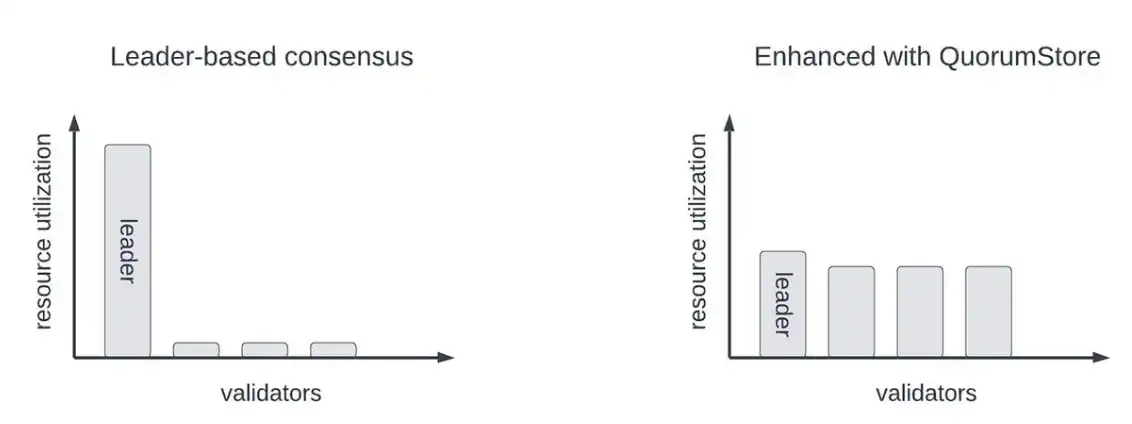
Visualization: How Quorum Store balances resource utilization in leader-based consensus protocols.
Thus far, the Aptos blockchain has built the "Ford Factory" of blockchains. Just as Ford's assembly line revolutionized car manufacturing—different cars in different stages simultaneously—Aptos processes different blocks in different stages concurrently. Each validator's resources are fully utilized, ensuring no part of the process remains idle. This clever arrangement has led to a high-throughput system, making Aptos a robust platform for efficiently and scalably handling blockchain transactions.
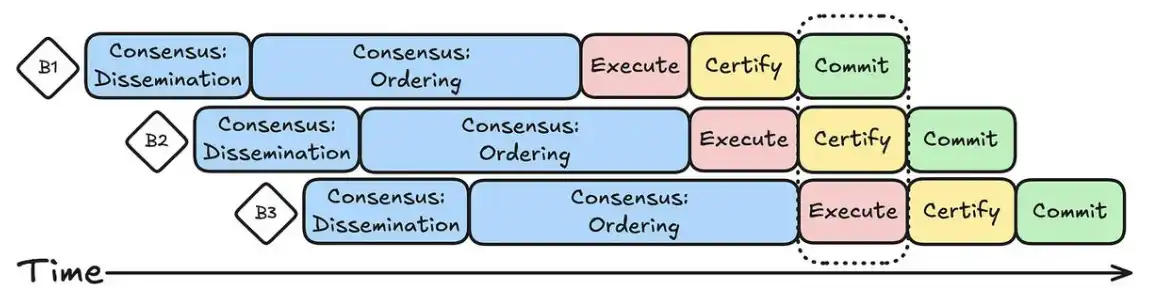
Illustration: Pipelined Processing of Sequential Blocks in the Aptos Blockchain. Validators can pipeline process different stages of sequential blocks to maximize resource utilization and increase throughput.
While throughput is crucial, end-to-end latency—the time from transaction submission to final confirmation—is equally important. For applications such as payments, decentralized finance (DeFi), and gaming, every millisecond counts. Many users have experienced delays during high-traffic events because each transaction must sequentially pass through a series of stages: client-full node-validator communication, consensus, execution, state validation, submission, and full node synchronization. Under high load, stages like execution and full node synchronization introduce additional latency.
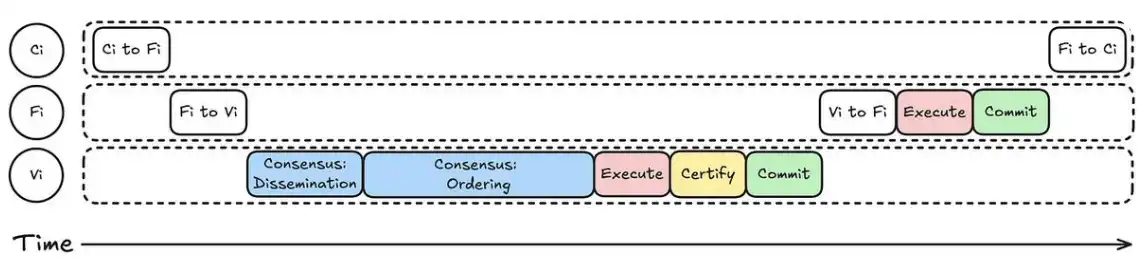
Illustration: Pipeline Architecture of the Aptos Blockchain. The diagram shows client Ci, full node Fi, and validator Vi. Each box represents a stage a transaction block in the blockchain must go through from left to right. The pipeline consists of five stages: consensus (including dissemination and ordering), execution, validation, submission, and full node synchronization.
It's like a Ford factory: while the assembly line maximizes overall throughput, each car still needs to pass through each worker sequentially, resulting in longer completion times. To truly push blockchain performance to the limit, we need to build a "magic factory" where these stages run in parallel.
Zaptos: Towards Optimal Blockchain Latency
Zaptos[8] further reduces latency through three key optimizations without sacrificing throughput.
· Optimistic Execution: Reducing pipeline latency by starting execution immediately upon receiving a block proposal. Validators promptly add the block to the pipeline and speculatively execute after the parent block completes. Full nodes, upon receiving the proposal from the validator, also perform optimistic execution to validate the state proof.
· Optimistic Submission: Writing state to storage immediately after block execution—even before state validation. When validators eventually validate the state, only minimal updates are needed to complete the submission. If a block ultimately remains unsorted, its optimistically submitted state is rolled back for consistency.
· Fast Verification: Validators expedite verification by concurrently sending validation messages at the final consensus round, starting early verification of the executed block's state without waiting for consensus completion. This optimization significantly reduces pipeline latency by one round in common scenarios.
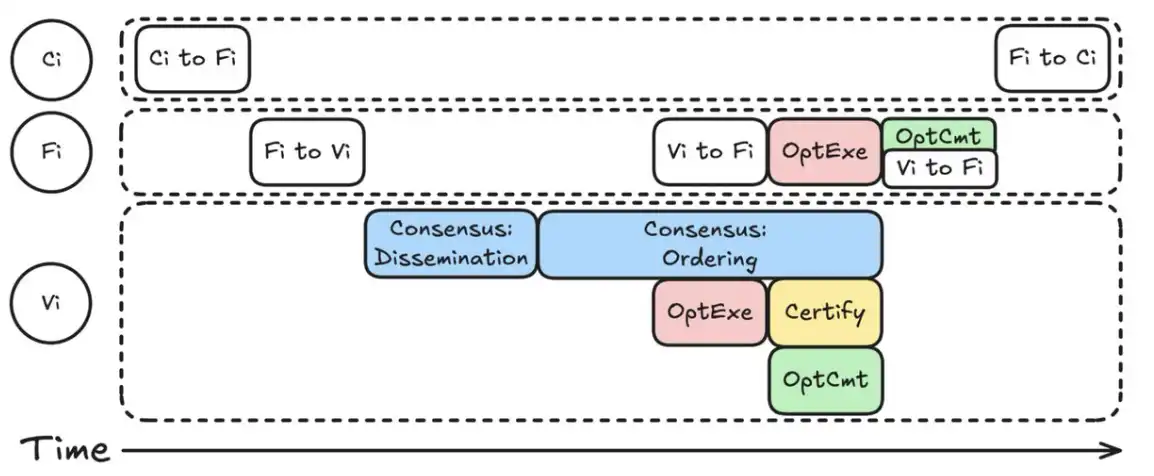
Illustration: Parallel Pipeline Architecture of Zaptos. Stages other than consensus are effectively hidden within the consensus stage, reducing end-to-end latency.
Through these optimizations, Zaptos effectively hides the latency of other pipeline stages within the consensus stage. Thus, if a blockchain adopts an optimal latency consensus protocol, the overall blockchain latency can also reach an optimum!
Talk is Cheap, Show Me the Data
We evaluated Zaptos' end-to-end performance through geographically distributed experiments, with Aptos as the high-performance baseline. For more details, refer to the paper [8].
On Google Cloud, we simulated a globally decentralized network consisting of 100 validators and 30 full nodes distributed across 10 regions, using commercial-grade machines similar to Aptos deployment.
Throughput-Latency
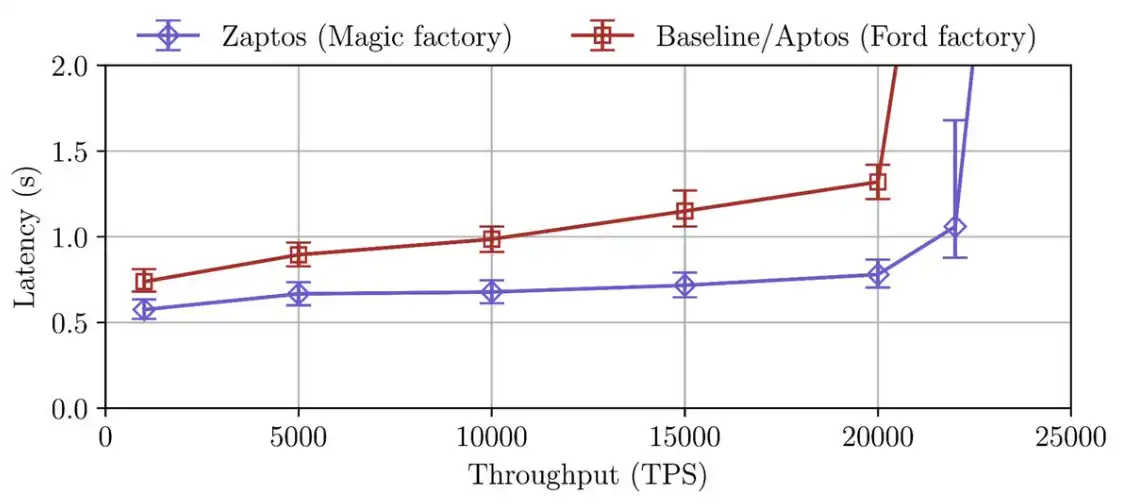
Figure: Common performance characteristics of Zaptos and Aptos blockchains.
The above figure compares the relationship between end-to-end latency and throughput of the two systems. Both exhibit a gradual latency increase as the load increases, with sharp spikes at maximum capacity, but Zaptos consistently demonstrates more stable latency before reaching peak throughput, reducing latency by 160 milliseconds under low load and over 500 milliseconds under high load.
Impressively, Zaptos achieves sub-second latency at 20k TPS in a production-level mainnet environment—this breakthrough makes real-world applications requiring speed and scalability a possibility.
Latency Breakdown
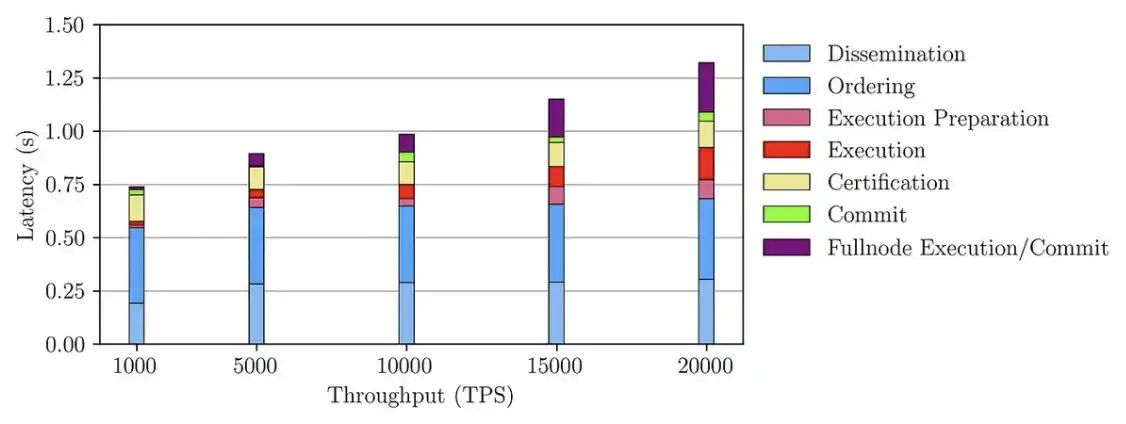
Figure: Latency breakdown of the Aptos blockchain.
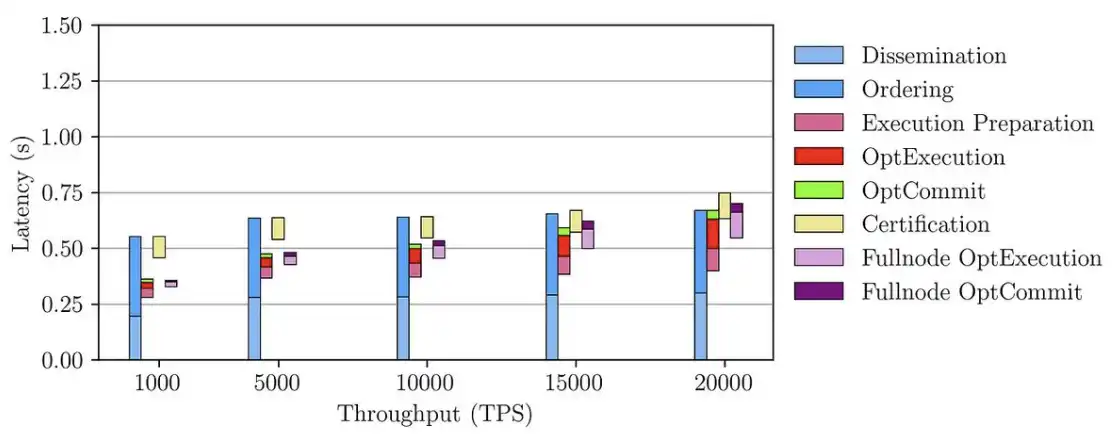
Figure: Latency breakdown of Zaptos.
The latency breakdown charts detail the duration of each stage for validators and full nodes in the pipeline. Key insights include:
· Up to 10k TPS: Zaptos' overall latency is nearly equivalent to its consensus latency, as optimistic execution, authentication, and optimistic commit stages are effectively "hidden" within the consensus stage.
· Above 10k TPS: Due to increased optimistic execution and full node synchronization time, non-consensus stages become more significant. Nevertheless, Zaptos significantly reduces overall latency by overlapping most stages. For example, at 20k TPS, the baseline total latency is 1.32 seconds (consensus 0.68 seconds, other stages 0.64 seconds), while Zaptos is 0.78 seconds (consensus 0.67 seconds, other stages 0.11 seconds).
Conclusion
The evolution of blockchain architecture parallels the transformation in manufacturing—from simple sequential workflows to highly parallelized assembly lines. Aptos's assembly line approach has significantly increased throughput, while Zaptos goes further, reducing latency to sub-second levels, all while maintaining high TPS. Just as modern computing architectures leverage parallelism to maximize efficiency, blockchain must continuously optimize its design to eliminate unnecessary delays. By comprehensively optimizing the blockchain pipeline to achieve minimal latency, Zaptos paves the way for real-world blockchain applications that require speed and scalability.
References
[1] Gene M. Amdahl, Gerrit A. Blaauw, and Frederick P. Brooks. 1964. "Architecture of the IBM System/360." IBM Journal of Research and Development. https://doi.org/10.1147/rd.82.0087
[2] David DeWitt, and Jim Gray. 1992. "Parallel Database Systems: The Future of High Performance Database Systems." Communications of the ACM. https://doi.org/10.1145/129888.129894
[3] Martín Abadi, Paul Barham, Jianmin Chen, Zhifeng Chen, Andy Davis, Jeffrey Dean, Matthieu Devin et al. 2016. "TensorFlow: a System for Large-Scale Machine Learning." In 12th USENIX symposium on operating systems design and implementation (OSDI). https://arxiv.org/abs/1605.08695
[4] The Moving Assembly Line and the Five-Dollar Workday. https://corporate.ford.com/articles/history/moving-assembly-line.html
[5] Zekun Li, and Yu Xia. 2021. DIP-213 - Decoupled Execution. https://github.com/diem/dip/blob/7dc44ee57bb7efe76559f05dcc6851d97e2d3149/dips/dip-213.md
[6] Rati Gelashvili, Lefteris Kokoris-Kogias, Alberto Sonnino, Alexander Spiegelman, and Zhuolun Xiang. 2022. "Jolteon and Ditto: Network-Adaptive Efficient Consensus with Asynchronous Fallback." In International conference on financial cryptography and data security (FC). https://arxiv.org/abs/2106.10362
[7] Quorum Store: How Consensus Horizontally Scales on the Aptos Blockchain. https://medium.com/aptoslabs/quorum-store-how-consensus-horizontally-scales-on-the-aptos-blockchain-988866f6d5b0
[8] Zhuolun Xiang, Zekun Li, Balaji Arun, Teng Zhang, and Alexander Spiegelman. 202 2025. "Zaptos: Towards Optimal Blockchain Latency." arXiv preprint arXiv:2501.10612. https://arxiv.org/abs/2501.10612
This article is from a submission and does not represent the views of BlockBeats.
You may also like
a16z Leads $18M Seed Round for Catena Labs, Crypto Industry Bets on Stablecoin AI Payment
Pharos, deeply integrated with AntChain, is about to launch. How can we get involved?
The End and Rebirth of NFTs: How the Meme Coin Craze Ended the PFP Era?
Key Market Intelligence on May 14th, how much did you miss out on?
1.Binance Alpha Launches HIPPO, BLUE, and Other Tokens
2.Believe Ecosystem Tokens See General Rise, LAUNCHCOIN Surges Over 250% in 24 Hours
3.Tiger Securities Introduces Cryptocurrency Deposit and Withdrawal Service, Supports Mainstream Cryptocurrencies such as BTC and ETH
4.Current Bitcoin Rally Possibly Driven by Institutions, Retail Traders Yet to Join
5.Binance Wallet's New TGE Privasea AI Participation Requires a 198 Point Threshold, with a Point Consumption of 15
Source: Overheard on CT (tg: @overheardonct), Kaito
PUMP: Today's discussions about PUMP focus on its new creator revenue-sharing model: the platform will allocate 50% of PumpSwap revenue to token creators, sparking varied reactions from users. Some criticize the move as insufficient or even misleading, while others view it as a positive step the platform is taking to reward creators. Meanwhile, PUMP faces market pressure from emerging competitors like LetsBONKfun and Raydium, which are rapidly gaining market share. Users also express concerns about PUMP's sustainability and potential regulatory risks in the U.S., with discussions extending to the platform's impact on the entire memecoin ecosystem.
COINBASE: Today, Coinbase became the first crypto company to join the S&P 500 Index, replacing Discover Financial Services, sparking widespread industry attention. The entire crypto community views this milestone as a significant development, signaling that crypto assets are further integrating into the mainstream financial system. The news has sparked lively discussions on Twitter, with many users pointing out that this may attract more institutional investors to enter the Bitcoin and other cryptocurrency markets.
XRP: XRP became the focal point of today's crypto discussion, with its significant market movements and strategic advances drawing attention. XRP has surpassed USDT to become the third-largest cryptocurrency by market capitalization, sparking market excitement and discussions about its future potential. The surge in market capitalization and price is believed to be related to increasing institutional interest, deepening strategic partnerships, and its role in the crypto ecosystem. Additionally, XRP's integration into multiple financial systems and its potential as a macro asset class are also seen as key factors driving the current market sentiment.
DYDX: Today's discussions about DYDX mainly focused on the dYdX Yapper Leaderboard launched by KaitoAI. The leaderboard aims to identify the most active community participants, with a total of $150,000 in rewards to be distributed over the first three seasons. This initiative has sparked broad community participation, with many users discussing the potential rewards and the incentive effect on the DYDX ecosystem. Meanwhile, progress on the ethDYDX to dYdX native chain migration and historical airdrop events have also been topics of discussion.
1. "What Is 'ICM'? Holding Up the $4 Billion Market Cap Solana's New Narrative"
Overnight, the hottest narrative in the crypto space has become "Internet Capital Markets," with a host of crypto projects and founders, led by the Solana ecosystem's new Launchpad platform Believe, releasing this phrase. Together with "Believe in something," it has become the new slogan heralding the onset of a bull market. What exactly is the so-called "Internet Capital Market," will it become a short-lived hype phrase like the Base ecosystem's previous Content Coin, and what related targets are available for selection?2.《LaunchCoin Surges 20x in One Day, How Did Believe Create a $200M Market Cap Shiba Inu After Going to Zero?|100x Retrospective》
LAUNCHCOIN broke through a $200 million market cap today, with the long-lost liquidity and such a high market cap "Memecoin" almost bringing half of the on-chain crypto community CT into the fray. The community is crazily discussing this token, with half of it being FOMO and the other half being FUD. This token, originally issued by Believe founder Ben Pasternak under his personal identity, transformed into a new platform token after a renaming. From once going to zero to a $200 million market cap, what happened in between?May 14 On-chain Fund Flow
Within 24 hours, GOONC's market cap soared to 70 million, could GOONC be the next billion-dollar dog on the Believe platform?
Bitcoin has broken $100,000, Ethereum has surpassed 2500, and is Solana's hot streak about to make a comeback?
The current market is in a state of macro euphoria, with GOONC riding the wave today, skyrocketing 10x in just a few hours, reaching a market cap of tens of millions of dollars, trading volume soaring past 50 million, and rumors swirling that the developer may be from OpenAI (unconfirmed but intriguing enough).
A ludicrous and absurd Solana meme that some actually buy into.
GOONC is a meme coin that has sprouted from the "gooning" subculture, offering no technological innovation or practical use, its sole function being speculation.
It takes inspiration from an NSFW term "gooning," which refers to a person being deeply immersed in certain content (you know what), eventually entering a nearly religious-like trance.
In Reddit (such as r/GOONED, r/GoonCaves) and some counterculture media outlets (such as MEL Magazine in 2020), "gooning" has gradually transitioned from an adult label to a meme-addicted, digital content and virtual self-indulgence synonym, arguably the epitome of Degen spirit.
GOONC is playing around with this concept, packaging the addictive nature, uselessness, and irony of gooning into a tradable financial product. The project team has made it clear: "We do not solve blockchain problems, we only trade absurdity." Blunt but oddly genuine.
GOONC launched on May 13, 2025, using the meme coin launch platform Believe App's LaunchCoin module on Solana. This tool is highly Degen: zero technical barriers, a few clicks to create a coin, perfect for projects like GOONC that can come up with ideas out of the blue.
The mastermind behind GOONC is also quite something and is the most talked-about, with KOL @basedalexandoor on X platform (alias "Pata van Goon") personally involved. His profile even caught the attention of Marc Andreessen, co-founder of a16z, making onlookers unable to resist speculating if GOONC has a hint of OpenAI lineage.
While this 'OpenAI Endorsement' is currently just community speculation, it is definitely a good card to play to fuel hype. Saying "we are pure speculation" on one hand, while tagging a few "AI + a16z" on the other.
GOONC took off as soon as it launched. After its launch on May 13, 2025, its market capitalization skyrocketed to $22 million within 4 hours, with a trading volume exceeding $25.6 million in 24 hours. According to platform data, the first day of trading saw an astonishing +41,100% surge, soaring from $0.0000001 to $0.02, becoming a "missed-the-boat" situation.
GOONC quickly formed an active trading community post-launch, with a lot of discussion and trading signals appearing on X platform (such as the 292x return signal provided by DeBot). Liquidity pools on exchanges like Raydium and Meteora grew rapidly, supporting high trading volumes and price increases.
The real climax occurred between May 13 and May 14, with the market cap rising to $5.5 million in the morning and directly surpassing $55 million in the afternoon. By the 14th, it briefly approached a $70 million market cap, with the trading volume soaring to $59 million. Some community members even posted screenshots claiming an increase of +85,000%, creating a new myth out of the ruins.
As of 1:30 pm on May 14, the price stabilized around $0.039, with a total market cap and FDV both around $39.6 million, and a 24-hour trading volume of $5.43 million. Active platforms include XT.COM, LBank, Meteora, and others.
Although there was a slight pullback from the peak ($0.07), the coin's popularity remains strong. For a coin that relies purely on "irony + community + X post" to thrive, this performance is already at a stellar level.
Currently, the background of the token's development team is not transparent, increasing the potential risk of a rug pull. Rugcheck.xyz warns that the creator of the GOONC contract may have permission to modify the contract (e.g., change fees or mint additional tokens), posing certain security risks.
Community members speculate that the meteoric rise of GOONC may be the "last hurrah".
How to Get Rich in Crypto Without Relying on Luck? Financial Veteran Raoul Pal's Macro Insights and Investment Path
Stablecoins Driving Global B2B Payment Innovation: How to Break Through Workflow Bottlenecks and Unlock Trillion-Dollar Market Potential?
These startups are building cutting-edge AI models without the need for a data center
Science Equity Movement: DeSci's Trillion-Dollar Knowledge Economy Reconstruction Revolution
Sentient In-Depth Research Report: Secures $85 Million in Funding to Build a Decentralized AGI New Paradigm
April 30th Market Key Intelligence, How Much Did You Miss?
Interview with Virtuals Co-Founder empty: AI Startups Don't Need a Lot of Funding, Crypto is One of the Answers
a16z Leads $25M Investment, 0xMiden to Run a Privacy Chain on Your Phone
Sui Q1 Advanced Report: The Rise of BTCfi Infrastructure, the Boom of Lending Protocols, and the Future of Rollup-Based Scalability
Gate.io MemeBox has officially integrated with the Solana ecosystem, providing lightning-fast on-chain asset trading.
Key Market Information Discrepancy on April 30th - A Must-Read! | Alpha Morning Report
Taking Stock of the Top 10 Emerging Launchpad Platforms: Who Will Succeed in Disrupting Pump.fun?
April 29th Market Key Insights, How Much Did You Miss?
a16z Leads $18M Seed Round for Catena Labs, Crypto Industry Bets on Stablecoin AI Payment
Pharos, deeply integrated with AntChain, is about to launch. How can we get involved?
The End and Rebirth of NFTs: How the Meme Coin Craze Ended the PFP Era?
Key Market Intelligence on May 14th, how much did you miss out on?
1.Binance Alpha Launches HIPPO, BLUE, and Other Tokens
2.Believe Ecosystem Tokens See General Rise, LAUNCHCOIN Surges Over 250% in 24 Hours
3.Tiger Securities Introduces Cryptocurrency Deposit and Withdrawal Service, Supports Mainstream Cryptocurrencies such as BTC and ETH
4.Current Bitcoin Rally Possibly Driven by Institutions, Retail Traders Yet to Join
5.Binance Wallet's New TGE Privasea AI Participation Requires a 198 Point Threshold, with a Point Consumption of 15
Source: Overheard on CT (tg: @overheardonct), Kaito
PUMP: Today's discussions about PUMP focus on its new creator revenue-sharing model: the platform will allocate 50% of PumpSwap revenue to token creators, sparking varied reactions from users. Some criticize the move as insufficient or even misleading, while others view it as a positive step the platform is taking to reward creators. Meanwhile, PUMP faces market pressure from emerging competitors like LetsBONKfun and Raydium, which are rapidly gaining market share. Users also express concerns about PUMP's sustainability and potential regulatory risks in the U.S., with discussions extending to the platform's impact on the entire memecoin ecosystem.
COINBASE: Today, Coinbase became the first crypto company to join the S&P 500 Index, replacing Discover Financial Services, sparking widespread industry attention. The entire crypto community views this milestone as a significant development, signaling that crypto assets are further integrating into the mainstream financial system. The news has sparked lively discussions on Twitter, with many users pointing out that this may attract more institutional investors to enter the Bitcoin and other cryptocurrency markets.
XRP: XRP became the focal point of today's crypto discussion, with its significant market movements and strategic advances drawing attention. XRP has surpassed USDT to become the third-largest cryptocurrency by market capitalization, sparking market excitement and discussions about its future potential. The surge in market capitalization and price is believed to be related to increasing institutional interest, deepening strategic partnerships, and its role in the crypto ecosystem. Additionally, XRP's integration into multiple financial systems and its potential as a macro asset class are also seen as key factors driving the current market sentiment.
DYDX: Today's discussions about DYDX mainly focused on the dYdX Yapper Leaderboard launched by KaitoAI. The leaderboard aims to identify the most active community participants, with a total of $150,000 in rewards to be distributed over the first three seasons. This initiative has sparked broad community participation, with many users discussing the potential rewards and the incentive effect on the DYDX ecosystem. Meanwhile, progress on the ethDYDX to dYdX native chain migration and historical airdrop events have also been topics of discussion.
1. "What Is 'ICM'? Holding Up the $4 Billion Market Cap Solana's New Narrative"
Overnight, the hottest narrative in the crypto space has become "Internet Capital Markets," with a host of crypto projects and founders, led by the Solana ecosystem's new Launchpad platform Believe, releasing this phrase. Together with "Believe in something," it has become the new slogan heralding the onset of a bull market. What exactly is the so-called "Internet Capital Market," will it become a short-lived hype phrase like the Base ecosystem's previous Content Coin, and what related targets are available for selection?2.《LaunchCoin Surges 20x in One Day, How Did Believe Create a $200M Market Cap Shiba Inu After Going to Zero?|100x Retrospective》
LAUNCHCOIN broke through a $200 million market cap today, with the long-lost liquidity and such a high market cap "Memecoin" almost bringing half of the on-chain crypto community CT into the fray. The community is crazily discussing this token, with half of it being FOMO and the other half being FUD. This token, originally issued by Believe founder Ben Pasternak under his personal identity, transformed into a new platform token after a renaming. From once going to zero to a $200 million market cap, what happened in between?May 14 On-chain Fund Flow
Within 24 hours, GOONC's market cap soared to 70 million, could GOONC be the next billion-dollar dog on the Believe platform?
Bitcoin has broken $100,000, Ethereum has surpassed 2500, and is Solana's hot streak about to make a comeback?
The current market is in a state of macro euphoria, with GOONC riding the wave today, skyrocketing 10x in just a few hours, reaching a market cap of tens of millions of dollars, trading volume soaring past 50 million, and rumors swirling that the developer may be from OpenAI (unconfirmed but intriguing enough).
A ludicrous and absurd Solana meme that some actually buy into.
GOONC is a meme coin that has sprouted from the "gooning" subculture, offering no technological innovation or practical use, its sole function being speculation.
It takes inspiration from an NSFW term "gooning," which refers to a person being deeply immersed in certain content (you know what), eventually entering a nearly religious-like trance.
In Reddit (such as r/GOONED, r/GoonCaves) and some counterculture media outlets (such as MEL Magazine in 2020), "gooning" has gradually transitioned from an adult label to a meme-addicted, digital content and virtual self-indulgence synonym, arguably the epitome of Degen spirit.
GOONC is playing around with this concept, packaging the addictive nature, uselessness, and irony of gooning into a tradable financial product. The project team has made it clear: "We do not solve blockchain problems, we only trade absurdity." Blunt but oddly genuine.
GOONC launched on May 13, 2025, using the meme coin launch platform Believe App's LaunchCoin module on Solana. This tool is highly Degen: zero technical barriers, a few clicks to create a coin, perfect for projects like GOONC that can come up with ideas out of the blue.
The mastermind behind GOONC is also quite something and is the most talked-about, with KOL @basedalexandoor on X platform (alias "Pata van Goon") personally involved. His profile even caught the attention of Marc Andreessen, co-founder of a16z, making onlookers unable to resist speculating if GOONC has a hint of OpenAI lineage.
While this 'OpenAI Endorsement' is currently just community speculation, it is definitely a good card to play to fuel hype. Saying "we are pure speculation" on one hand, while tagging a few "AI + a16z" on the other.
GOONC took off as soon as it launched. After its launch on May 13, 2025, its market capitalization skyrocketed to $22 million within 4 hours, with a trading volume exceeding $25.6 million in 24 hours. According to platform data, the first day of trading saw an astonishing +41,100% surge, soaring from $0.0000001 to $0.02, becoming a "missed-the-boat" situation.
GOONC quickly formed an active trading community post-launch, with a lot of discussion and trading signals appearing on X platform (such as the 292x return signal provided by DeBot). Liquidity pools on exchanges like Raydium and Meteora grew rapidly, supporting high trading volumes and price increases.
The real climax occurred between May 13 and May 14, with the market cap rising to $5.5 million in the morning and directly surpassing $55 million in the afternoon. By the 14th, it briefly approached a $70 million market cap, with the trading volume soaring to $59 million. Some community members even posted screenshots claiming an increase of +85,000%, creating a new myth out of the ruins.
As of 1:30 pm on May 14, the price stabilized around $0.039, with a total market cap and FDV both around $39.6 million, and a 24-hour trading volume of $5.43 million. Active platforms include XT.COM, LBank, Meteora, and others.
Although there was a slight pullback from the peak ($0.07), the coin's popularity remains strong. For a coin that relies purely on "irony + community + X post" to thrive, this performance is already at a stellar level.
Currently, the background of the token's development team is not transparent, increasing the potential risk of a rug pull. Rugcheck.xyz warns that the creator of the GOONC contract may have permission to modify the contract (e.g., change fees or mint additional tokens), posing certain security risks.
Community members speculate that the meteoric rise of GOONC may be the "last hurrah".
How to Get Rich in Crypto Without Relying on Luck? Financial Veteran Raoul Pal's Macro Insights and Investment Path
Popular coins
Latest Crypto News


Customer Support:@weikecs
Business Cooperation:@weikecs
Quant Trading & MM:bd@weex.com
VIP Services:support@weex.com
 App
App