
- Buy Crypto
- Markets
- Futures
- Spot
- Copy Trade
 WE-Launch
After Losing $5.5 Billion in 15 Minutes, Why Did "Meme Coin" OM Experience a 4x Surge?

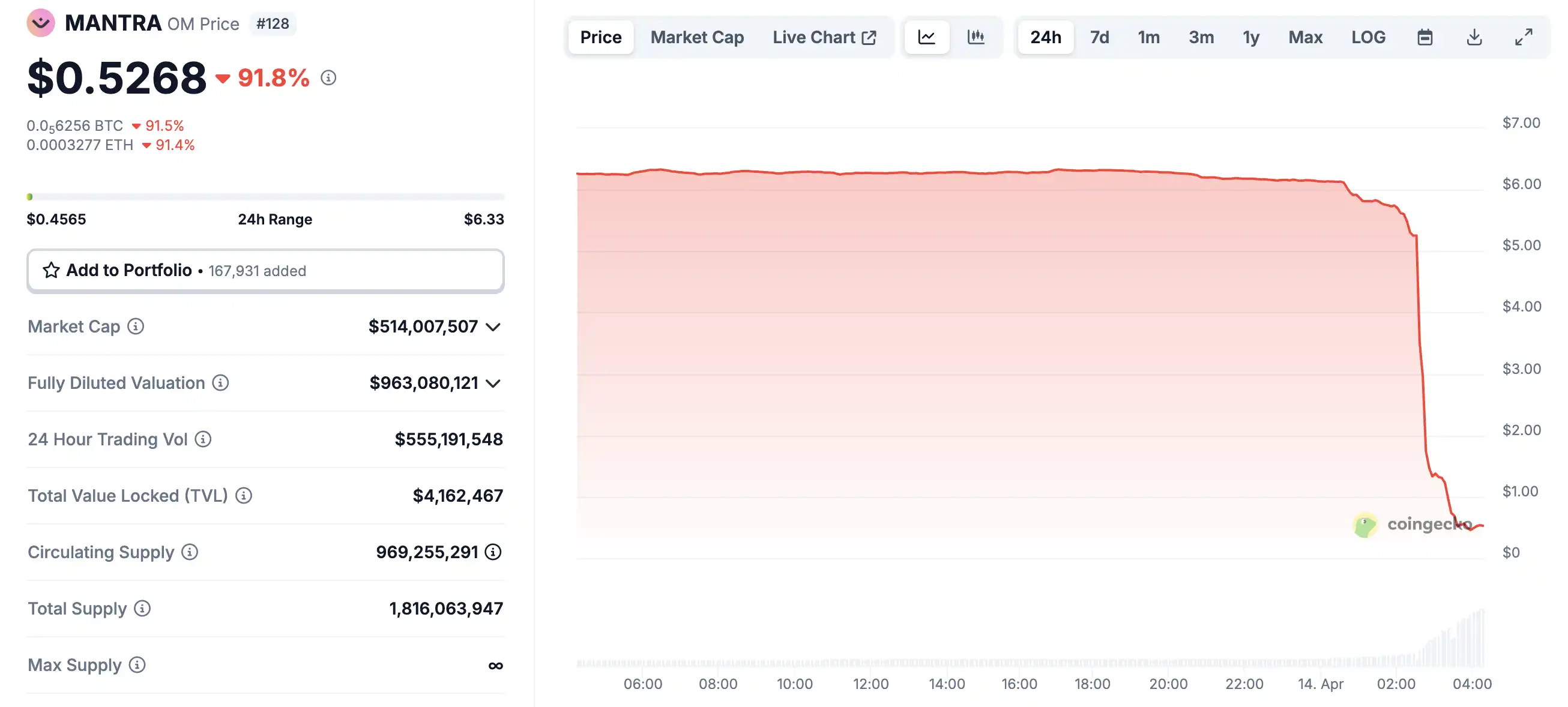
In the early hours, the RWA sector project MANTRA (OM) experienced a rapid 90% drop, plummeting from $6 to $0.5, causing its market capitalization to shrink by over $5.5 billion.
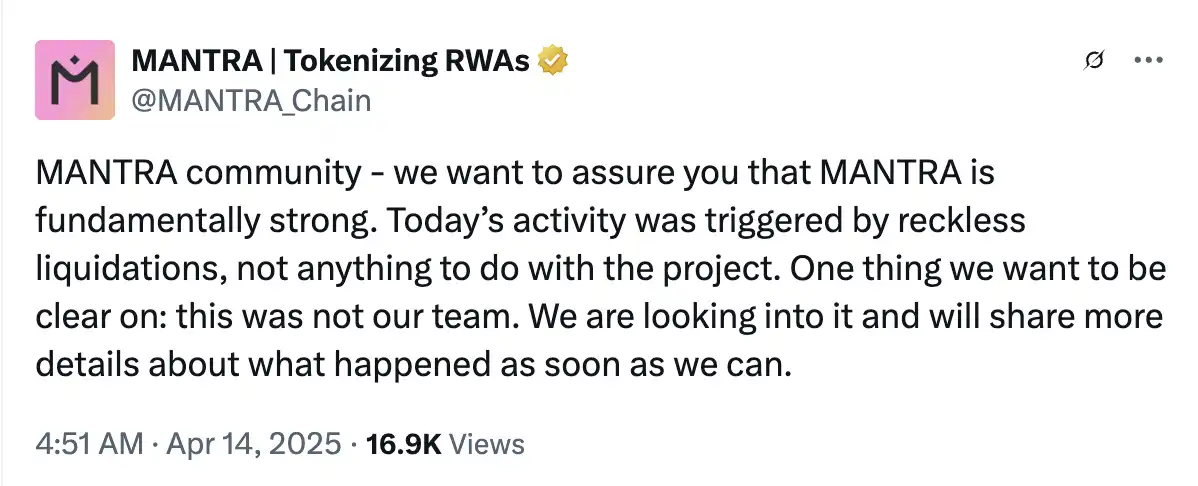
Three hours later, the MANTRA team released a statement attributing the sharp decline to an irrational liquidation event unrelated to the project itself, affirming that it was not initiated by the team.
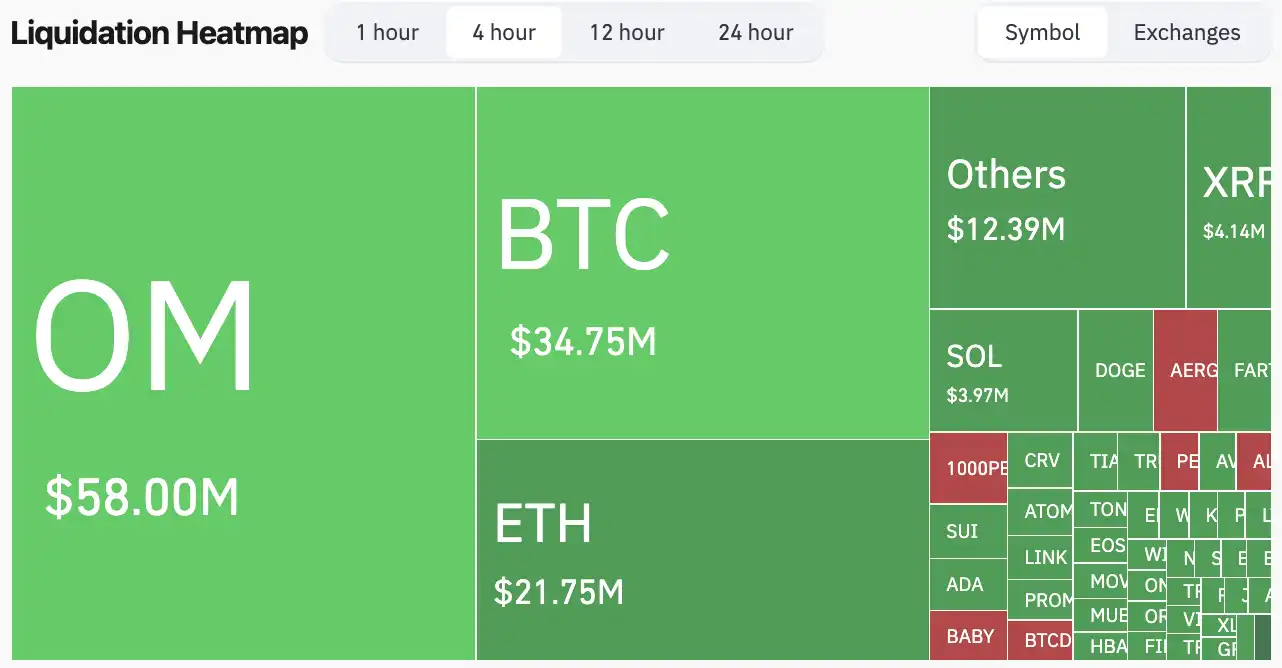
Subsequently, OM surged from around $0.5 to $1.2, experiencing a brief pump. According to Coinglass data, within just four hours, the OM contract saw liquidations totaling $58 million.
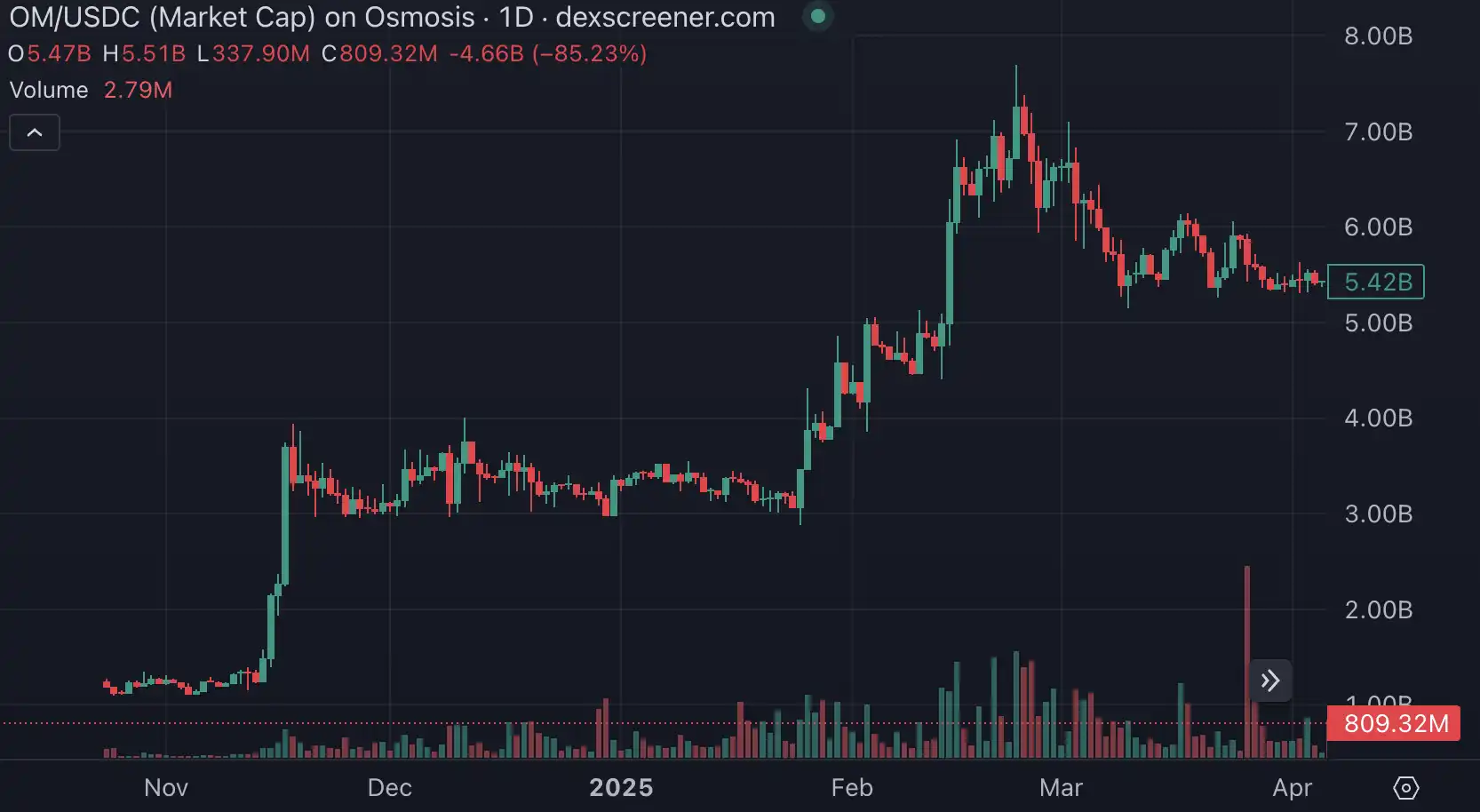
Prior to this crash, OM had gone through multiple violent upswing phases since November last year, earning the nickname "Strong Pump Shitcoin" from the community.
OTC Trading or Team Dump? The Turbulent Life of OM's Whale-Dominated Supply
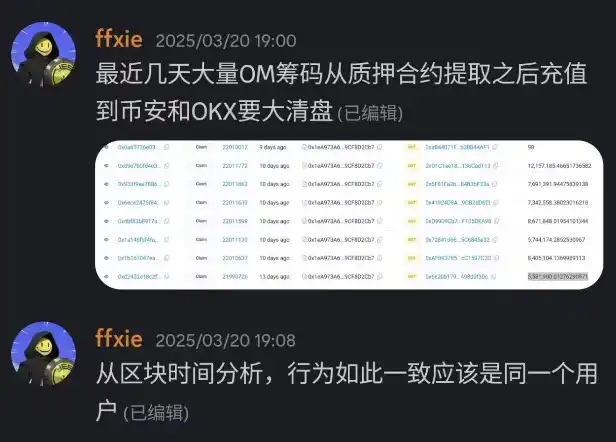
Recently, the community and various data tracking tools reported that whale addresses of OM had been withdrawing and sending funds to exchanges, with rumors suggesting that several off-exchange trades at a 50% discount or higher had been completed. When large holders start dumping, off-exchange buyers also panic sell.
On March 25, according to TheDataNerd's monitoring, the investment firm Laser Digital's address of MANTRA deposited 1.7 million OM to Binance, worth $11.49 million. The wallet had accumulated a total of 27 million OM last year and still holds 6.756 million OM, valued at $45.67 million.
Yesterday, as per Arkham's tracking, the address 0xA8...A84f withdrew 776,000 OM from Polygon's StakedOM contract, approximately worth $5.84 million.
Additionally, as observed by Genç Trader, the wallet address 0x9a…1a28 transferred around $20 million worth of OM to OKX 23 hours ago. Looking at past records, this address had withdrawn about $40 million worth of OM from Binance just a month ago and was one of the whales that had previously pumped the coin's price.
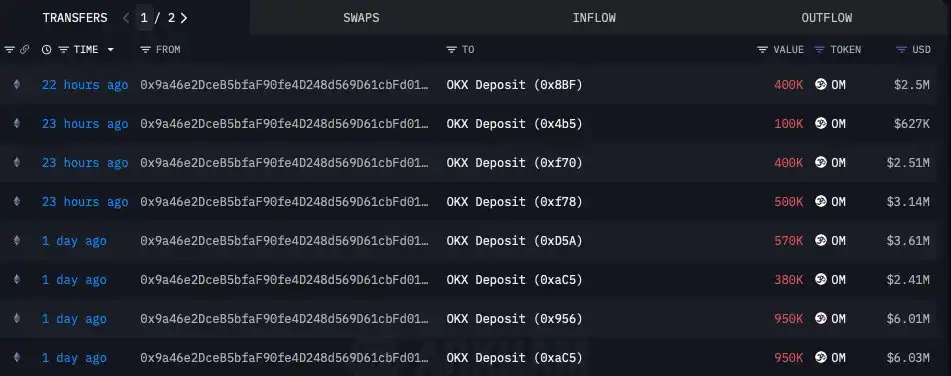
The dumping of OM by several whales is believed to be the direct cause of this recent crash, but some in the community speculate that it may have been premeditated.
PUA Airdrop
Last November, MANTRA announced a change to its airdrop rules, shifting from the previous "3-month cliff period followed by initial liquidity distribution and 9-month linear unlock" to "shortening the cliff period to 1 month, followed by an 11-month linear unlock," triggering strong community dissatisfaction.
Initially, MANTRA used high-profile expectation management to spark user participation, claiming to distribute 50 million OM tokens and promising a 20% immediate unlock on listing, with the airdrop to be completed within a month.
However, in actual implementation, MANTRA successively amended the airdrop rules, first changing the "immediate unlock on listing" to "start of linear release after one month," further delaying it to "10% initial release, with the rest vesting over three years." Simultaneously, with several mechanism changes such as roadmap adjustments and token distribution structures, MANTRA effectively transformed community traffic into a long-term lock-up tool by continually extending the vesting period.
When user sentiment rebounded, the project team introduced a governance voting mechanism to shift responsibility under the guise of "community consensus." However, in practice, the voting rights were concentrated in the hands of the project team or affiliated parties, resulting in high controllability. Finally, some early participants were excluded from the airdrop list, with the project team freezing their stakes citing a "Sybil attack" without disclosing detailed justifications.
High Token Control
The reason OM has been continuously pumped over the past six months is due to its team's significant token control. According to KOL @nihaovand, it usually involves coordinating three waves of community buy-ins at different price ranges to collectively drive up the token price. At the same time, the project team arranges an off-chain exit path for holders. The funds obtained from these exits are then used to boost the coin's price, laying the groundwork for the next wave of off-chain capital influx.
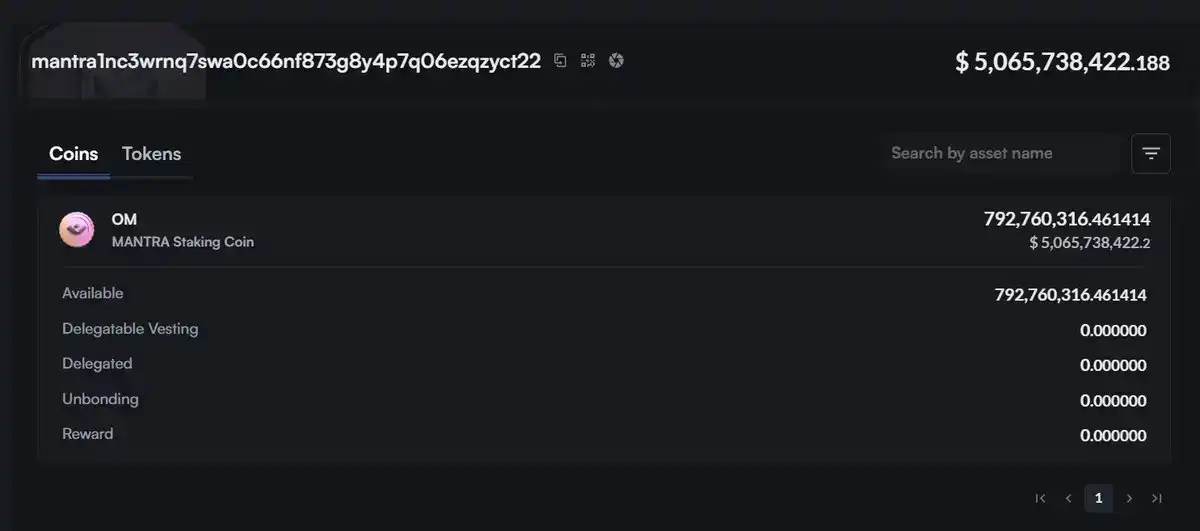
Previously, there were multiple reports alleging that the MANTRA team held 90% of the OM token's supply. Crypto analyst Mosi once wrote an article analyzing how a project with only a $4 million TVL could have over a $10 billion FDV, with the answer being that the team controlled most of the OM circulating supply. The MANTRA team holds 792M OM in a single wallet (90% of the supply), with the team even being too lazy to spread this supply across multiple wallets.
Related reading: "False Circulating Supply, High-profile Pump and Dump: Exposing the Manipulation of High FDV Tokens"
What Is the Actual Circulating Supply of OM?
According to Mosi's analysis, the actual circulating supply of OM = 980 million OM (circulating supply) - 792 million OM (team-controlled portion) = 188 million OM
However, this number may not be accurate either. The team still controls a significant portion of OM, using these tokens to perform a rug pull on their own airdrop, further draining liquidity, and continuing to control the circulating supply. They deployed around 100 million OM for a rug pull on their own airdrop, so this portion of tokens also needs to be deducted from the actual circulating supply.
Ultimately, the actual circulating supply of OM may be only 88 million OM, and the lower actual circulating supply makes it easy to manipulate the price of OM and easily liquidate any short positions. Traders should be wary of shorting OM as the team holds a large portion of the circulating supply, allowing them to easily pump or dump the price.
Mosi believes that Tritaurian Capital may be involved behind OM—this company borrowed $1.5 million from @SOMA_finance (@jp_mullin888 is a co-founder of SOMA, while Tritaurian is owned by Jim Preissler, former CEO of JP Morgan at Trade.io)—as well as some funds and market makers from the Middle East. These operations further compress the actual circulating supply, making its calculation more challenging.
This may also explain why they are unwilling to release the airdrop and have decided to implement a lock-up period. If they did carry out the airdrop, the actual circulating supply would significantly increase, potentially leading to a sharp price drop.
This is not some complex financial engineering, but it seems to be a deliberate plan aimed at reducing the token's actual circulating supply and easily pumping or dumping the price of OM.
You may also like

Binance Sparks "Delist Concept": Can CEX Still Produce the Next ALPACA?
On April 24, Binance announced that it would delist four tokens, including Alpaca Finance ($ALPACA), on May 2, and cease trading of these pairs' perpetual futures contracts at 00:00 on May 1, 2025, Beijing time. Fast forward to the last day of perpetual futures trading delisting, ALPACA surged on the liquidation heat map. Over the past 24 hours, a total of $52.21 million evaporated in ALPACA's contract trading, exceeding the sum of the token's liquidation volume over the past two years.
Historically, when a token is listed on Binance, many traders would buy the news instantly ("Buy the News"). As the Binance listing effect gradually waned, traders found another path, which is to short sell the tokens set to be delisted from Binance ("Sell the News"). This strategy often has a very high success rate. However, as traders followed this path, they encountered the Alpaca on their short-selling journey.
Every thrilling market manipulation game requires careful preparation. Before Binance's official announcement, on April 10, $ALPACA was ranked 7th in the preliminary list of the second batch of "Vote for Delisting" on Binance, causing its price to plummet almost by half. However, in the five days leading up to Binance's official announcement, from April 19 to April 23, trading volume suddenly surged.
The story traces back to the start of Binance's second round of "Vote for Delisting," where ALPACA was included in the delisting candidates list, ranked 7th among 17 projects. After the completion of Binance's delisting vote count, $ALPACA was included in the projects to be delisted. The market did not react significantly, price fluctuations were not substantial, but trading volumes expanded abnormally, suggesting the entry of "manipulative funds" into the community.
On April 24, Binance officially announced the delisting of the $ALPACA spot trading pair on May 2 and the settlement of the futures contracts on April 30. Following the announcement, the spot price of $ALPACA dropped from $0.0329 to $0.029, with a market cap of only about $5 million. However, what followed were two price "rollercoaster" moments; within an hour, the price surged from $0.029 to $0.0857, an increase of about 195%, only to rapidly drop back to $0.04 within 3 hours. Shorts were caught off guard, and the open interest of contracts surged rapidly, initiating the "long and short grinder" mode.
On April 25, Alpaca Finance officially announced that the trading volume in the past 24 hours had exceeded 1 billion tokens. The liquidity provider had suggested a "minting for stability" to be returned to the treasury after a decrease in trading volume. However, as public opinion began to ferment, opposition filled the community. Alpaca Finance deleted the previous tweet and posted a new one at 9 p.m. on the same night, announcing the cancellation of the minting due to community opposition.
On April 26, Binance amended the contract funding rate rules, shortening the maximum rate cap settlement period to hourly and setting it at up to ±2%. Some high-leverage accounts continued to hold short positions against the high rate and were liquidated. Millions of dollars disappeared within a few hours, with $13 million in short positions vanishing on a token with a market cap of less than $30 million.
With the establishment of this short-selling trend, the price skyrocketed nearly 12 times from a low of $0.029 to $0.3477 within 3 days. The contract's open interest surged significantly, especially with a notable increase in short positions, resembling a microcosm of the Wall Street battle of GME's retail investors. However, this time, the retail investors' opponents could continue to mint additional chips.
From April 26 to April 29, these days were relatively calm, with the price fluctuating around $0.2 to $0.34. On April 29, Binance announced another increase in the rate cap to ±4%. Theoretically, such a high rate would severely impact short positions. If the rate remains at -4%, the bears will face a 96% "cost of ruin" after holding a short position for 24 hours. However, miraculously, the price plummeted from $0.27 to $0.067.
On April 30, with the contract delisting and liquidation scheduled in the final 24 hours, the price continued to experience intense fluctuations. ALPACA's attention peaked, with its highest price reaching $1.2 at one point. From a week before the delisting announcement to the eve of the contract delisting, ALPACA's price surged 40 times, creating an independent market for the token delisted by Binance. The total liquidation volume across the network also reached $50 million, with $42 million in "bearish fuel" beneath the price surge.
After the first surge of ALPACA, Heyi, the co-founder of Binance, replied to a netizen asking, "Can the teacher who buys the shell guarantee breakeven?" This has also triggered endless speculation among community members.
KOL Tunbtc believes that Heyi's reply to this matter was the starting point of ALPACA's surge. "The large holders of Alpaca's native token, by transferring spot chips, operating rights, and distribution rights, have pledged allegiance to Binance's deep-water core interest circle, allowing it to fully harvest market liquidity before delisting, slaughtering opposing positions." Through a triple path of fees, contract liquidations, and spot volatility, they converted user attention into profits.
He also called on Binance to thoroughly investigate this matter, clarify which market maker is manipulating the candlestick patterns, as ALPACA saw an 18x surge within 24 hours with users liquidated of tens of millions of dollars, while previously GPS's 500% surge was promptly halted, and expressed his sentiment: "All of this is thought-provoking."
Wenze, the founder of Beta Capital, believes that bypassing the regular listing process, buying shells, renaming, and restarting has crossed Binance's bottom line of maintaining listing credibility and brand compliance. Binance sometimes has a high tolerance for market fluctuations, and the OM issuance only adjusts the collateralization ratio, with many projects only allowed for leveraged trading. However, once the project, such as these "shell projects," is identified, it is easily labeled for observation, triggering a vote for delisting, ultimately leading to delisting rather than using mild measures.
Renowned KOL Rui, "YeruiZhang," likened the ALPACA incident to "crazy revenge on an ex" and shared a piece of insider information, claiming that the original whale behind ALPACA was a team that controlled BSC's MEV for a period of time and expressed dissatisfaction with Binance's current management for some reason. The comments section is rampant with speculation that it is BSC's whale 48CLUB, and 48CLUB's Ian even personally appeared to eat "his own melon."
With the recent buzz around VOXEL's surge and the wealth effect and discussion surrounding ALPACA, more and more "delisting concepts" have emerged. This concept does not necessarily refer to tokens that have already been delisted but rather shares some common characteristics of delisted tokens.
Famous KOL Chuanmo recently shared on Twitter his logic for choosing concept tokens and listed several tokens, all of which experienced varying degrees of price increase after his recommendation.
His "Concept Delisting" strategy involves selecting low-cap tokens from Bybit and Binance, arranging them by market cap from lowest to highest, with almost 100% price increase for the tokens with the highest holdings/circulating market cap. He buys three tokens daily following this order with a fixed amount, and based on the holdings/circulating supply ratio, he removes tokens that no longer meet the criteria daily and continues to buy the new top three tokens.
Many community members have tested this strategy, with some creating helpful tools. The dreamer Disney "discountifu" has created a dashboard, and Vivek10 early bird "vivekw_eth" has developed a monitoring and alert system that can be directly pushed to WeChat with a copyable link, although it is currently deployed locally and not yet entirely stable.
However, when using tools created for free by community members, please be cautious. While there are many enthusiastic contributors in the community, there are also many uncertain factors in this dark forest.
In an increasingly insular market, retail investors not only have to contend with whales and other retail investors but also must bear many unstable elements. The recent ALPACA incident serves as a warning to us. Whether it's a primary or secondary listing on a top-tier exchange or the "Concept Delisting" approach, we need to make rational asset allocations amidst FOMO to protect our principal and reach the other shore.
The mention of all tokens above does not constitute financial investment advice "NFA".
Gate.io MemeBox has officially integrated with the Solana ecosystem, providing lightning-fast on-chain asset trading.
Cryptocurrency Market Sentiment Warms Up, MCP Emerges as New AI Frontier
Weekly Recap | MANTRA (OM) Plunges Sparking Controversy; Powell Emphasizes No Immediate Market Intervention
Opinion: Why Bittensor is a Scam, and TAO is Heading Towards Zero?
Key Market Information Discrepancy on April 17th - A Must-See! | Alpha Morning Report
Mantra Co-Founder Reveals: $5 Billion OM Token Crash, Truly Becoming "Luna 2.0"?
Splurging $80 Million in Growth "Subsidies," Uniswap is Taking Big Steps
The 2000% Surge of RFC Token: The Crypto Capital Game Amid Whale Manipulation and Musk Narrative
April 14th Market Key Insights, How Much Did You Miss?
Timeline | OM plunges over 80% – Whose "Fault" Is It: Team, Liquidity Provider, or Investor?
Key Market Information Discrepancy on April 14th - A Must-Read! | Alpha Morning Report
X Space Review | The Future of Memes, Exploring the Development Trends of the Meme Space Post-Hype
Key Market Intelligence on April 1st, how much did you miss out on?
1.Analysis: Binance Wallet's Next New Coin IDO Suspected to be a PUMP
2.Matrixport: Retail Speculative Sentiment Still Depressed, Bitcoin ETF Inflows Difficult to See a Recovery
3.Compound Founder Suspected of Selling 50,000 COMP, Worth $3.19 Million
4.Backpack Completes Acquisition of FTX EU, Initiates User Fund Return Process Today
5.Binance Announces Adjustment to T+1 Withdrawal Plan
1.《When ETH Dropped Below $1800, What Was Vitalik Thinking?》
As ETH continued to plummet, with many users shouting "Fix your eth" under Vitalik's tweets, people were curious about what Ethereum's founder, Vitalik, was thinking. On March 29, 2025, Vitalik posted two blog posts in a row, revealing his current thoughts. Apparently, Vitalik is not particularly concerned about the ETH price.2.《In-Depth Comparison of GMX, Jupiter, and Drift, Who Is Solana's Perpetual King?》
This article analyzes the key on-chain derivative protocols on Solana, including GMX-Solana, Jupiter Perps, and Drift, comparing their liquidity, trading volume, capital efficiency, and risk management. Jupiter and Drift have shown continued growth but lower capital efficiency, while GMX-Solana has higher capital efficiency but less liquidity. As the protocols introduce better features and incentives, market competition will intensify, and the DEX to CEX derivative trading volume ratio has reached a record high, benefiting Solana.On-chain fund flows for the week of April 1st
Fake Volume, Pump and Dump: Exposing High FDV Token Manipulation
AI Agent Craze Strikes Again, BNB Ecosystem AI Projects Overview
This Week in Review | Binance Initiates Listing and Delisting Voting; Identity of '50x Leverage' Whale Revealed
Binance Launches "Coin Voting," 9 Memes Make the Cut, How Can Users Participate?
Binance Sparks "Delist Concept": Can CEX Still Produce the Next ALPACA?
On April 24, Binance announced that it would delist four tokens, including Alpaca Finance ($ALPACA), on May 2, and cease trading of these pairs' perpetual futures contracts at 00:00 on May 1, 2025, Beijing time. Fast forward to the last day of perpetual futures trading delisting, ALPACA surged on the liquidation heat map. Over the past 24 hours, a total of $52.21 million evaporated in ALPACA's contract trading, exceeding the sum of the token's liquidation volume over the past two years.
Historically, when a token is listed on Binance, many traders would buy the news instantly ("Buy the News"). As the Binance listing effect gradually waned, traders found another path, which is to short sell the tokens set to be delisted from Binance ("Sell the News"). This strategy often has a very high success rate. However, as traders followed this path, they encountered the Alpaca on their short-selling journey.
Every thrilling market manipulation game requires careful preparation. Before Binance's official announcement, on April 10, $ALPACA was ranked 7th in the preliminary list of the second batch of "Vote for Delisting" on Binance, causing its price to plummet almost by half. However, in the five days leading up to Binance's official announcement, from April 19 to April 23, trading volume suddenly surged.
The story traces back to the start of Binance's second round of "Vote for Delisting," where ALPACA was included in the delisting candidates list, ranked 7th among 17 projects. After the completion of Binance's delisting vote count, $ALPACA was included in the projects to be delisted. The market did not react significantly, price fluctuations were not substantial, but trading volumes expanded abnormally, suggesting the entry of "manipulative funds" into the community.
On April 24, Binance officially announced the delisting of the $ALPACA spot trading pair on May 2 and the settlement of the futures contracts on April 30. Following the announcement, the spot price of $ALPACA dropped from $0.0329 to $0.029, with a market cap of only about $5 million. However, what followed were two price "rollercoaster" moments; within an hour, the price surged from $0.029 to $0.0857, an increase of about 195%, only to rapidly drop back to $0.04 within 3 hours. Shorts were caught off guard, and the open interest of contracts surged rapidly, initiating the "long and short grinder" mode.
On April 25, Alpaca Finance officially announced that the trading volume in the past 24 hours had exceeded 1 billion tokens. The liquidity provider had suggested a "minting for stability" to be returned to the treasury after a decrease in trading volume. However, as public opinion began to ferment, opposition filled the community. Alpaca Finance deleted the previous tweet and posted a new one at 9 p.m. on the same night, announcing the cancellation of the minting due to community opposition.
On April 26, Binance amended the contract funding rate rules, shortening the maximum rate cap settlement period to hourly and setting it at up to ±2%. Some high-leverage accounts continued to hold short positions against the high rate and were liquidated. Millions of dollars disappeared within a few hours, with $13 million in short positions vanishing on a token with a market cap of less than $30 million.
With the establishment of this short-selling trend, the price skyrocketed nearly 12 times from a low of $0.029 to $0.3477 within 3 days. The contract's open interest surged significantly, especially with a notable increase in short positions, resembling a microcosm of the Wall Street battle of GME's retail investors. However, this time, the retail investors' opponents could continue to mint additional chips.
From April 26 to April 29, these days were relatively calm, with the price fluctuating around $0.2 to $0.34. On April 29, Binance announced another increase in the rate cap to ±4%. Theoretically, such a high rate would severely impact short positions. If the rate remains at -4%, the bears will face a 96% "cost of ruin" after holding a short position for 24 hours. However, miraculously, the price plummeted from $0.27 to $0.067.
On April 30, with the contract delisting and liquidation scheduled in the final 24 hours, the price continued to experience intense fluctuations. ALPACA's attention peaked, with its highest price reaching $1.2 at one point. From a week before the delisting announcement to the eve of the contract delisting, ALPACA's price surged 40 times, creating an independent market for the token delisted by Binance. The total liquidation volume across the network also reached $50 million, with $42 million in "bearish fuel" beneath the price surge.
After the first surge of ALPACA, Heyi, the co-founder of Binance, replied to a netizen asking, "Can the teacher who buys the shell guarantee breakeven?" This has also triggered endless speculation among community members.
KOL Tunbtc believes that Heyi's reply to this matter was the starting point of ALPACA's surge. "The large holders of Alpaca's native token, by transferring spot chips, operating rights, and distribution rights, have pledged allegiance to Binance's deep-water core interest circle, allowing it to fully harvest market liquidity before delisting, slaughtering opposing positions." Through a triple path of fees, contract liquidations, and spot volatility, they converted user attention into profits.
He also called on Binance to thoroughly investigate this matter, clarify which market maker is manipulating the candlestick patterns, as ALPACA saw an 18x surge within 24 hours with users liquidated of tens of millions of dollars, while previously GPS's 500% surge was promptly halted, and expressed his sentiment: "All of this is thought-provoking."
Wenze, the founder of Beta Capital, believes that bypassing the regular listing process, buying shells, renaming, and restarting has crossed Binance's bottom line of maintaining listing credibility and brand compliance. Binance sometimes has a high tolerance for market fluctuations, and the OM issuance only adjusts the collateralization ratio, with many projects only allowed for leveraged trading. However, once the project, such as these "shell projects," is identified, it is easily labeled for observation, triggering a vote for delisting, ultimately leading to delisting rather than using mild measures.
Renowned KOL Rui, "YeruiZhang," likened the ALPACA incident to "crazy revenge on an ex" and shared a piece of insider information, claiming that the original whale behind ALPACA was a team that controlled BSC's MEV for a period of time and expressed dissatisfaction with Binance's current management for some reason. The comments section is rampant with speculation that it is BSC's whale 48CLUB, and 48CLUB's Ian even personally appeared to eat "his own melon."
With the recent buzz around VOXEL's surge and the wealth effect and discussion surrounding ALPACA, more and more "delisting concepts" have emerged. This concept does not necessarily refer to tokens that have already been delisted but rather shares some common characteristics of delisted tokens.
Famous KOL Chuanmo recently shared on Twitter his logic for choosing concept tokens and listed several tokens, all of which experienced varying degrees of price increase after his recommendation.
His "Concept Delisting" strategy involves selecting low-cap tokens from Bybit and Binance, arranging them by market cap from lowest to highest, with almost 100% price increase for the tokens with the highest holdings/circulating market cap. He buys three tokens daily following this order with a fixed amount, and based on the holdings/circulating supply ratio, he removes tokens that no longer meet the criteria daily and continues to buy the new top three tokens.
Many community members have tested this strategy, with some creating helpful tools. The dreamer Disney "discountifu" has created a dashboard, and Vivek10 early bird "vivekw_eth" has developed a monitoring and alert system that can be directly pushed to WeChat with a copyable link, although it is currently deployed locally and not yet entirely stable.
However, when using tools created for free by community members, please be cautious. While there are many enthusiastic contributors in the community, there are also many uncertain factors in this dark forest.
In an increasingly insular market, retail investors not only have to contend with whales and other retail investors but also must bear many unstable elements. The recent ALPACA incident serves as a warning to us. Whether it's a primary or secondary listing on a top-tier exchange or the "Concept Delisting" approach, we need to make rational asset allocations amidst FOMO to protect our principal and reach the other shore.
The mention of all tokens above does not constitute financial investment advice "NFA".
Gate.io MemeBox has officially integrated with the Solana ecosystem, providing lightning-fast on-chain asset trading.
Cryptocurrency Market Sentiment Warms Up, MCP Emerges as New AI Frontier
Weekly Recap | MANTRA (OM) Plunges Sparking Controversy; Powell Emphasizes No Immediate Market Intervention
Opinion: Why Bittensor is a Scam, and TAO is Heading Towards Zero?
Key Market Information Discrepancy on April 17th - A Must-See! | Alpha Morning Report
Popular coins
Latest Crypto News


Customer Support:@weikecs
Business Cooperation:@weikecs
Quant Trading & MM:bd@weex.com
VIP Services:support@weex.com
 App
App