
- Buy Crypto
- Markets
- Futures
- Spot
- Copy Trade
 WE-Launch
From "Evangelist" to "Harvester": Galaxy's "Pump and Dump" Art

Original Title: From "Evangelist" to "Harvester": Galaxy's "Pump and Dump" Art
Original Author: Daii
In the world of cryptocurrency, the distance between an "Evangelist" and a "Harvester" is often just a thin, almost invisible line.
This line is called "Trust".
The Evangelist we are going to talk about today is Mike Novogratz, a former Goldman Sachs partner, New York Fed advisor, and now the founder and CEO of Galaxy Digital. With unparalleled passion and unwavering belief, he has spread the vision of cryptocurrency to the world through various means, becoming an undeniable voice in the industry.
Galaxy Digital, known as the "Wall Street institution most knowledgeable about cryptocurrency," not only manages billions of dollars in assets but also enjoys a high reputation throughout the entire crypto industry. Countless investors have wholeheartedly invested their funds because of their trust in Novogratz and Galaxy, dreaming of seizing the opportunity of the era and becoming a lucky participant.
However, sometimes "Trust" becomes a deadly trap.
The story we are going to tell today was originally supposed to be shared with you last week, but the sudden US-China trade war forced us to interject an episode on the fracture of the US dollar hegemony and the rise of decentralized stablecoins. While those grand narratives affect the global landscape, this story may be even more critical for ordinary investors.
If you have ever suffered a total loss in Luna's investment, there is no need to blame yourself excessively. It is not because you lack judgment, nor because Luna was destined to fail from the beginning, but because you simply did not know that the person who encouraged you to "hold onto your faith" had quietly unloaded his chips when you bought in at its peak.
What you need to be more vigilant about is that such harvesting theatrics never end; they just change settings and actors. Behind almost every round of "faith celebration," countless retail investors end up paying the bill for the precise exit strategies calculated by a handful of people.
You may feel angry and even try to seek justice. However, the harsh reality is: unless you can clearly prove the fraudulent intent of these Key Opinion Leaders (KOLs) or institutions, the losses you endure are almost impossible to recover.
Due to the high legal threshold for defining fraud, you must provide ample evidence to prove that the other party not only knew about the project's significant risks or false information but also harbored clear malicious intent, intentionally misleading you to enter the scene, making it easier for them to cash out at a high point.
However, reality is always more complicated than theory. KOLs cleverly avoid the legal red line, always speaking in ambiguous terms such as "bullish," "enormous potential," "solely represents a personal opinion and does not constitute investment advice." As long as their language is vague enough and their offloading actions are discreet enough, convicting them is almost an impossible task.
This is the thickest fig leaf for KOL-style harvesting—difficult-to-prove motive and subjective evidence.
But you must be curious: since it's so hard to be caught, why did Galaxy's CEO Mike Novogratz eventually "crash and burn"?
At this point, we must mention a key figure—the New York State Attorney General, and a special law—the "Martin Act." It is precisely because of this law, or more accurately, the existence of its provisions, that the New York State Attorney General can launch an investigation without having to prove explicit fraudulent intent, uncovering the intricate scam hidden behind "faith." Galaxy was the first to be caught, but it will not be the last. We have had a very detailed explanation of the Martin Act, a law that once fined the Trump Organization $450 million and is now setting its sights on the coin circle.
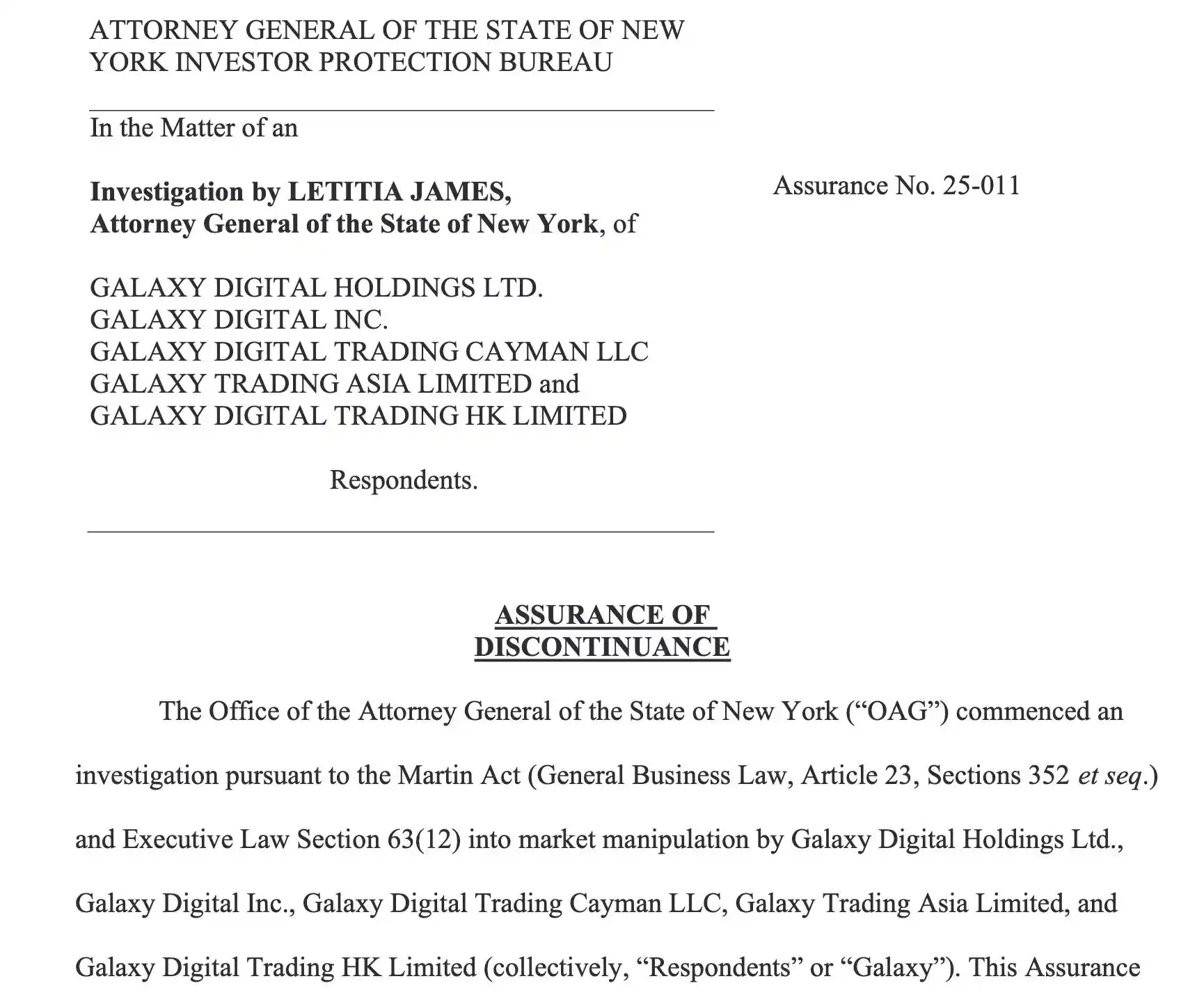
After reading through the New York State Attorney General's Office's 44-page document, I couldn't help but exclaim: if it weren't for that so-called "harshest securities law in the U.S." constraint, there would be no in-depth investigation by the New York State Attorney General. We might never have known: behind the bursting of the $40 billion Luna bubble, there was such a sophisticated and brilliant institutional offloading script.
I hope that today's article is not just a roller-coaster financial story for you but also a cautionary tale to keep your distance from KOLs and institutions.
Next, let's first figure out how Galaxy and LUNA came together.
1. How Did Galaxy "Connect" with Luna?
Before we dive into this thrilling "offloading story," we must first understand a key player—What is Galaxy's background?
1.1 Who Is Galaxy?
Galaxy Digital, full name Galaxy Digital Holdings Ltd., registered in the Cayman Islands, with its business headquarters in New York, was founded by a Wall Street veteran who has been in the trenches for decades: Mike Novogratz.
Who is he? A former Goldman Sachs partner, he previously served on the Investment Advisory Committee of the Federal Reserve Bank of New York. As early as 2013, he began to dabble in Bitcoin and was one of the earliest "institutional believers" to publicly support crypto assets. If you've read anything about the "future of Bitcoin" on CNBC, Bloomberg, or the Financial Times, it's highly likely that his name was mentioned.
In 2018, he founded Galaxy, which manages over $5 billion in assets across its global network of 123 subsidiaries, covering market making, venture investing, trading, custody, research... making it almost a "Morgan Stanley of the crypto world."
In other words, if this industry needs a representative who is "most like Wall Street," then that must be Galaxy. Obviously, Galaxy is the best partner for Luna, hands down.
1.2 What is Luna?
Now, let's get to know the other key player in this story: Luna.
Luna is a cryptocurrency issued by Terraform Labs in 2018. This project was founded by South Korean Do Kwon, registered in Singapore, with the core objective of creating a "algorithmic stablecoin + native token" dual-token system.
This ecosystem consists of several parts:
· Terra Blockchain: The underlying ledger where transactions occur;
· Luna: The platform's native token used for governance, staking, and stabilizing coin supply and demand;
· TerraUSD (UST) and TerraKRW: The so-called "stablecoins," claiming to be pegged to the US dollar and the Korean won;
· CHAI: A South Korean payment app used to promote "real-world usability."

Sounds cool, right? But the problem is: its "stability mechanism" relies entirely on market behavior, and once UST loses its peg, Luna spirals into a "death spiral." UST is fundamentally an algorithmic stablecoin, and to date, there hasn't been a successful case. The previous edition of "Tariffs are the Knife, Currency is the Shield" had a more detailed analysis and introduction to stablecoins for you to look into.
You need to pay attention to the CHAI payment system mentioned above, which is somewhat similar to China's Alipay and the United States' PayPal. Do Kwon is a co-founder of CHAI. It is precisely because of this real-world connection point that Galaxy has a crucial material to pump up Luna.
In plain terms: Behind Luna is an innovative financial engineering with the potential for success, but a higher potential for failure. However, Do Kwon believes that the story is already exciting enough, and he needs to find a "Western advocate" to help him tell this story to the American people.
1.3 "Fateful Encounter": The Transaction Script of Western Advocacy
By 2020, Do Kwon understood that relying solely on Korean speculators and a whitepaper would not be enough to make Luna go viral. He needed to raise awareness in the Western market and sought a "trustworthy" brand endorsement. So, they approached Galaxy.
In August 2020, Terraform extended an olive branch to Galaxy, proposing a transactional deal: Terraform hoped Galaxy would act as their advocate, and as long as Galaxy's CEO was willing to voice support for Luna, we could offer you better investment terms.
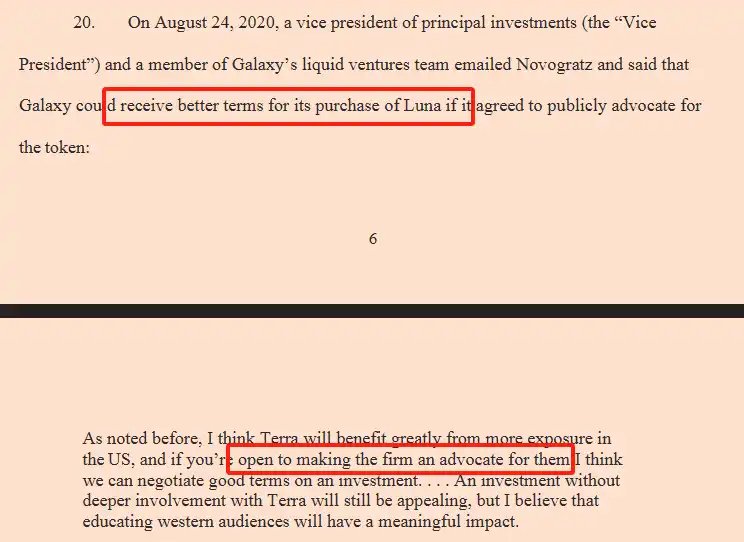
Internal discussions at Galaxy commenced promptly. They had long been observing Terraform's technology and realized the substantial capital demand behind this project. On October 27, 2020, the two parties finalized the transaction, as shown in the figure below:
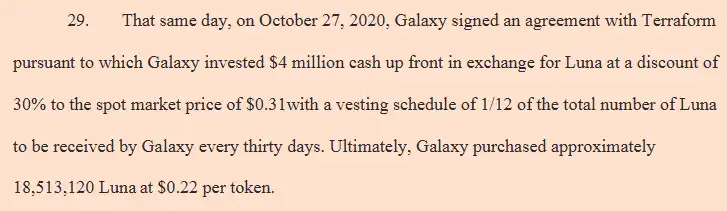
Galaxy invested $4 million, purchasing 18.51 million Luna at a discounted price of $0.22 per token; with monthly unlocks of 1/12, available for sale at any time.
Note: At the time, the market price was $0.31, and Galaxy received a 30% discount, without being subject to a lock-up period. This was not a "too good to be true" deal; it was a transactional right obtained through endorsement, publicity, and platforming.
The hidden rule behind this was: As long as you are willing to "speak positively," we will allow you to "unlock sooner." Galaxy accepted all of this, even writing in an internal memo that Terraform lacked visibility in the U.S. market and could only convince people of its economic activities through our promotion efforts, as seen in the highlighted text in the figure below.
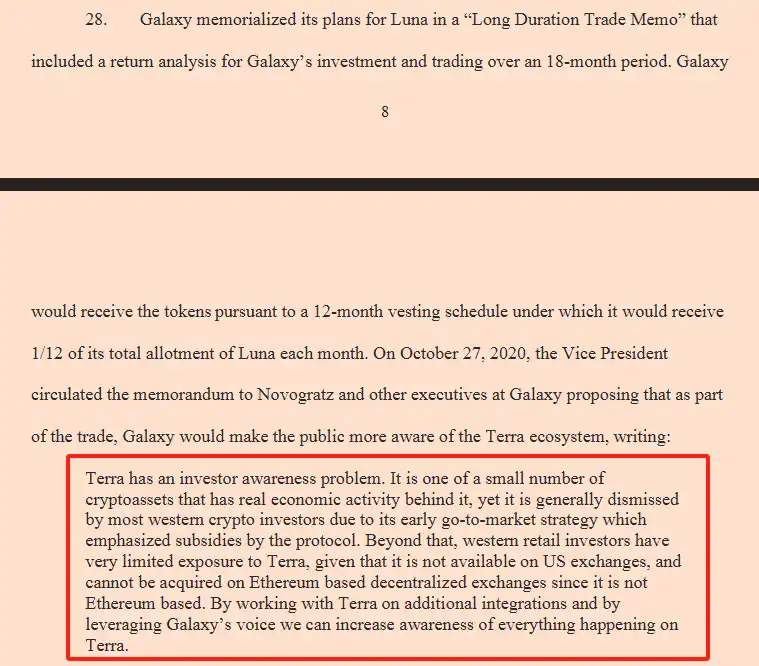
Therefore, starting from November 2020, Galaxy began a planned "mention" of Luna in podcasts, on Twitter, and in interviews. As a result, the price started to rise, and the trading volume quickly expanded. This rhythm continued for a whole year.
1.4 Summary: All's Fair in "Money"
The relationship between Galaxy and Luna was not due to "ideological alignment" or "technological superiority," but rather a thorough "exchange of interests":
· Terraform provided discounts and unlocking privileges;
· Galaxy provided traffic, trust, and packaging;
· Both parties reached implicit consensus: you're responsible for setting up the situation, I'm responsible for pumping the price, and neither of us will spill the beans.
From the results, this "collaboration" was very successful:
· Luna's price rose from $0.31 to a peak of $119;
· Galaxy made profits exceeding hundreds of millions of dollars;
· Retail investors bought in at the top, only to enter a "death spiral" afterwards.
In essence, this was a typical "pump and dump" script, but it did not violate traditional securities laws. This was also why many key opinion leaders (KOLs) defended Galaxy. However, in the face of the Martin Act, this was outright fraud because of the inconsistency between words and actions—pumping the price while offloading holdings. This is market manipulation; this is illegal.
It was for this reason that Galaxy was willing to pay a $200 million settlement to obtain the New York Attorney General's assurance to "suspend the investigation," as shown in the figure below.
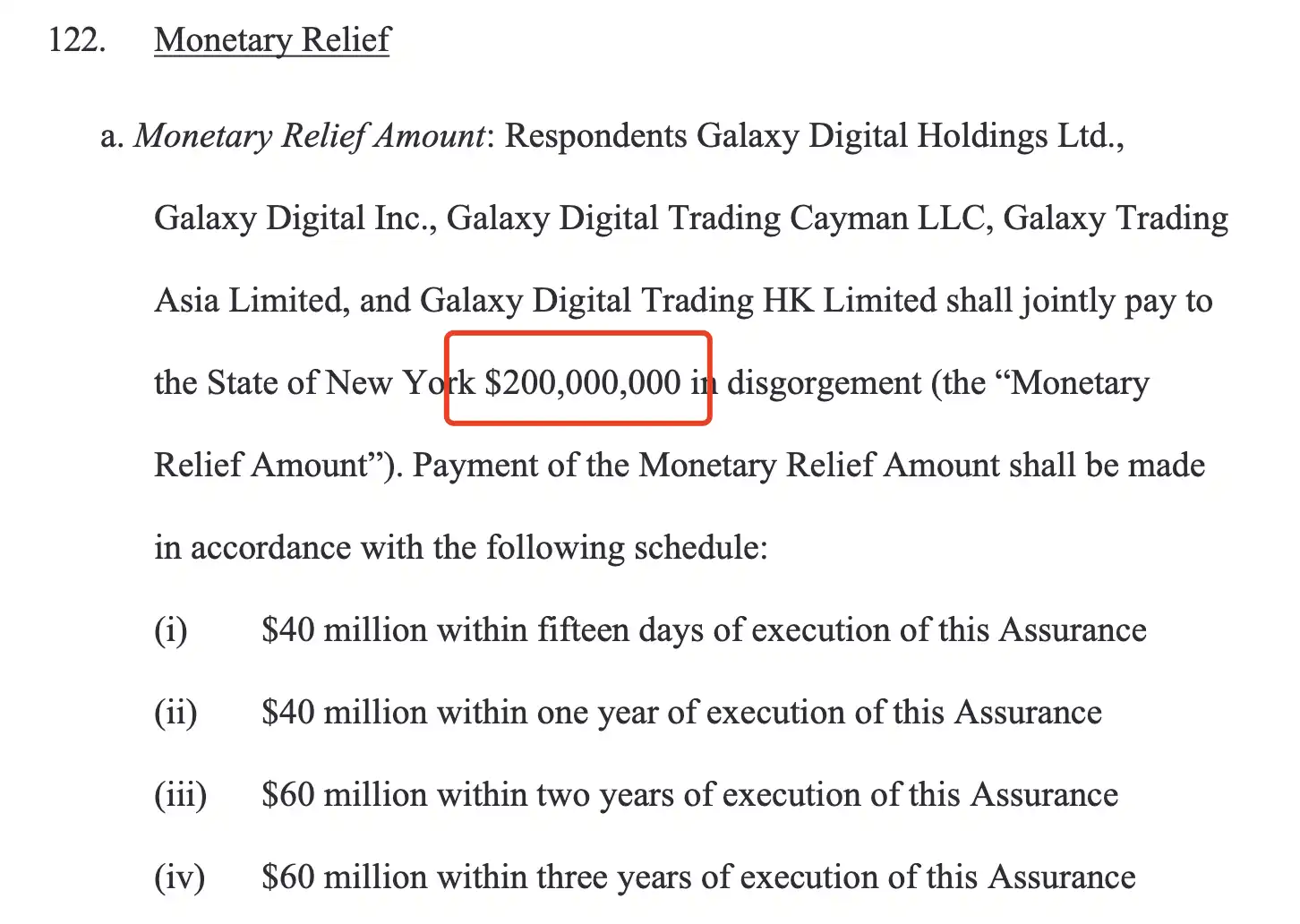
In order to dissect Galaxy's pump and dump technique, I carefully read this 44-page document. Below, I will break it down for you step by step.
2. How Did Galaxy Pump and Dump?
Next, we will uncover how Galaxy engaged in the "faith" chant while precisely selling off chips – the art of unloading. Before delving into this pitiful story, I must objectively speak a few fair words for Galaxy and Mike Novogratz so you don't mistake Novogratz for just a "shameless villain."
You may not know that as early as 2013, when Wall Street as a whole was still collectively mocking Bitcoin, Novogratz had already invested real money in it. Not only did he publicly buy Bitcoin, but he also openly expressed bullish sentiments about crypto assets in mainstream financial media, supporting this "financial revolution." More precisely, he predicted a significant rise in Bitcoin's price in 2013 and in 2014, he crowdfunded an Ethereum project still in its infancy. He stated that 20% of his net worth was invested in Bitcoin and Ethereum, which was astounding in the conservative and cautious Wall Street circles of that time.
By 2024, Galaxy's publicly invested projects had reached as many as 72, covering top crypto projects such as Polygon, Bitfarms, Celestia, among others, with a total investment of billions of dollars. Although Circle (the issuer of USDC) and Bitwise (crypto ETF issuer) did not directly disclose Galaxy's investment records, Galaxy's active participation in ecosystem partnerships and advisory services still contributed significantly to the overall development of the crypto industry.
In other words, today, you can buy coins on Coinbase, transfer using USDC stablecoin, and have an Ethereum ETF approved, all of which wouldn't have been possible without the early-stage market contribution made by Galaxy. Galaxy isn't just a "harvester of external capital," but a truly long-term player that has been part of the industry's growth since the beginning.
This is also the lamentable reason behind the "offloading event" we are about to expose today. Because, with Galaxy's long-accumulated market reputation and resource advantage, they could have chosen a more transparent and legitimate way to profit instead of getting involved in the now much-criticized "grey offloading" quagmire.
Unfortunately, Galaxy ultimately succumbed to temptation. They fell into a trap of their own making, choosing a sophisticated yet unethical profit-making method - "pump and dump."
Next, I will detail how Galaxy manipulated market sentiment step by step and effectively executed offloading to cash out.
2.1 Testing the Waters: The First Attempt at "Pump and Dump Offloading"
The story begins in late 2020.
The agreement signed by Galaxy allowed for 1/12 of Luna to be unlocked each month. As a Wall Street veteran, Novogratz naturally understood that the most effective way to make quick money was to "pump while shouting sell orders."
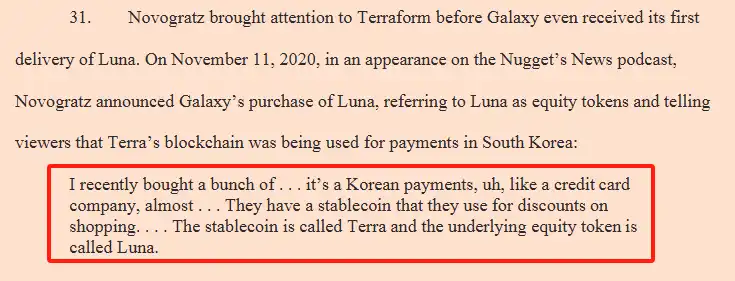
On November 11, 2020, even before Galaxy had received the first batch of Luna, Novogratz couldn't wait to start hyping up Luna. On the well-known Nugget's News podcast, he told the audience that he had recently bought a bunch of Luna, describing it as a South Korean payment company, somewhat like a credit card company, where users could get discounts using it. See the image below. In reality, this was completely untrue, as Luna did not have any real-world utility.
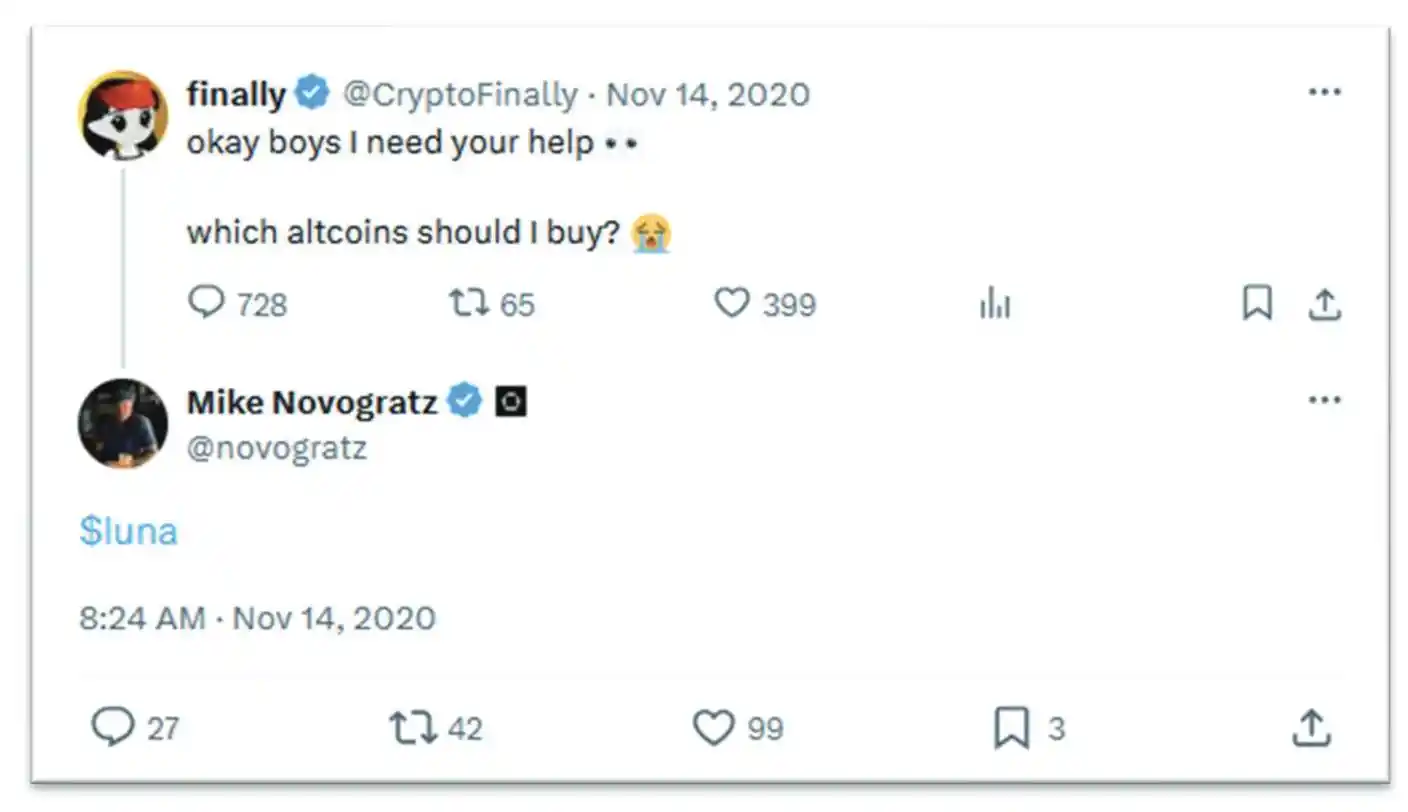
A few days later on November 14, a netizen asked on Twitter: Hey man, can you recommend a coin? Novogratz immediately replied: $luna. See the image below.
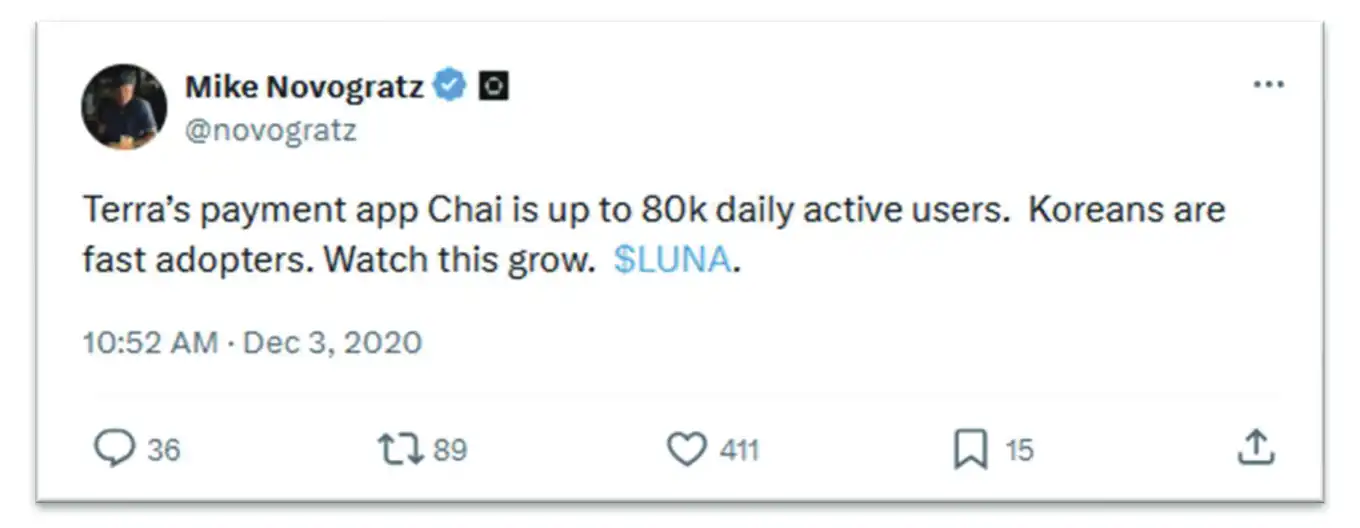
In December, Novogratz tweeted: The Korean payment app Chai now has 80,000 daily active users, $LUNA has great potential! As a result, Luna's daily trading volume surged from $27.5 million to $69 million on the same day, igniting market enthusiasm.
On the same day, Galaxy received the first batch of unlocked Luna: over 1.54 million tokens. This "respectable" Wall Street veteran, however, told the internal team: Don't rush to sell. His rule is not to sell within 3 days after posting positive news on Twitter.
On December 16 and 17, two weeks later, Galaxy sold off all these Luna at a price between $0.50 and $0.52 per token, successfully concluding the first "pump and dump" operation.
Going back to the earlier "no sell within 3 days of pumping," it sounds quite sophisticated, right? However, even this self-imposed rule was not executed well. In the face of a flood of money, everything seemed so fragile.
2.2 Battle to Break Even: Bloomberg's Divine Intervention
Galaxy was clearly addicted to "pump and dump" operations. But to quickly achieve profitability and break even, they needed a bigger stage. This time, they targeted the mainstream financial media—Bloomberg.
In January 2021, Galaxy proactively contacted Bloomberg, providing a press release containing false data, claiming:
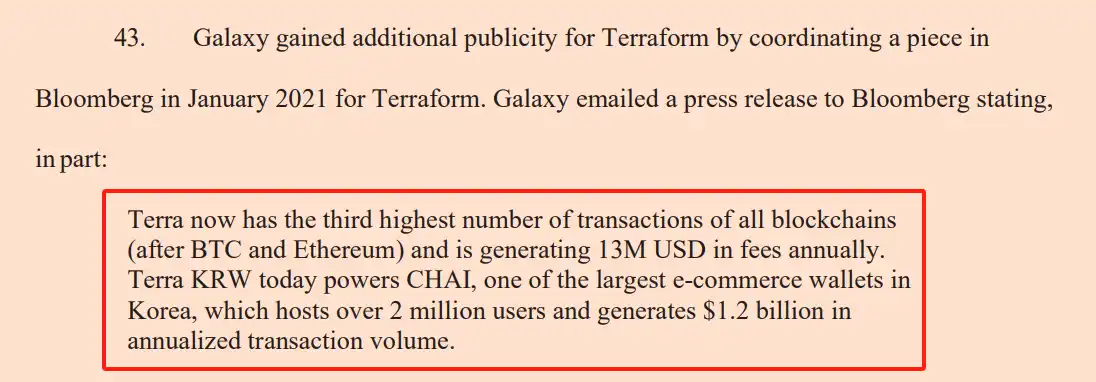
Terra now has the third highest number of transactions of all blockchains (after BTC and Ethereum) and is generating $13 million in fees annually. Terra KRW today powers CHAI, one of the largest e-commerce wallets in Korea, which hosts over 2 million users and generates $1.2 billion in annualized transaction volume.
Translation: Terra has become the world's third-largest blockchain by transaction volume, trailing only Bitcoin and Ethereum, generating $13 million in annual fee revenue. Terra's Korean won stablecoin (TerraKRW) powers one of South Korea's largest e-commerce wallets, CHAI, with 2 million users and an annual transaction volume of $1.2 billion.
However, the reality is that CHAI's transactions have nothing to do with the Terra blockchain at all; all payments are still made in Korean won and have no relation to Luna and TerraKRW. So why did Galaxy and Terra have to deceive and use CHAI as a prop? Because without CHAI as a backing, this story lacks imagination.
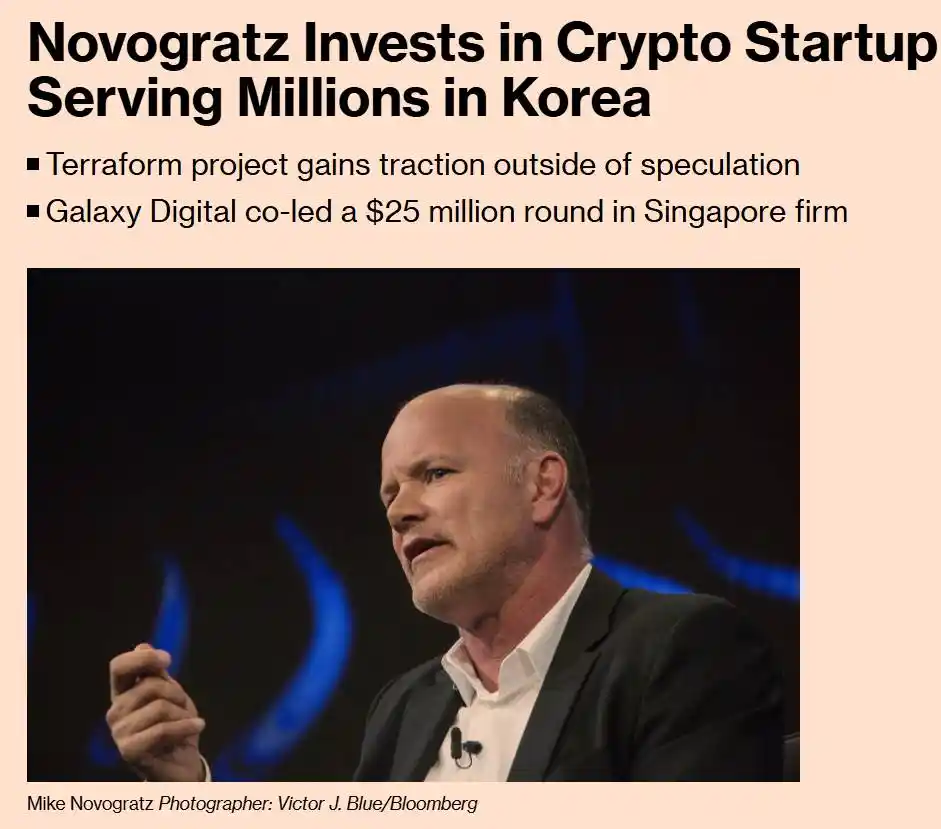
On January 26, 2021, Bloomberg published a major article titled "Novogratz Invests in Crypto Startup Serving Millions in Korea," causing Luna's price to skyrocket from $0.89 to $1.23.
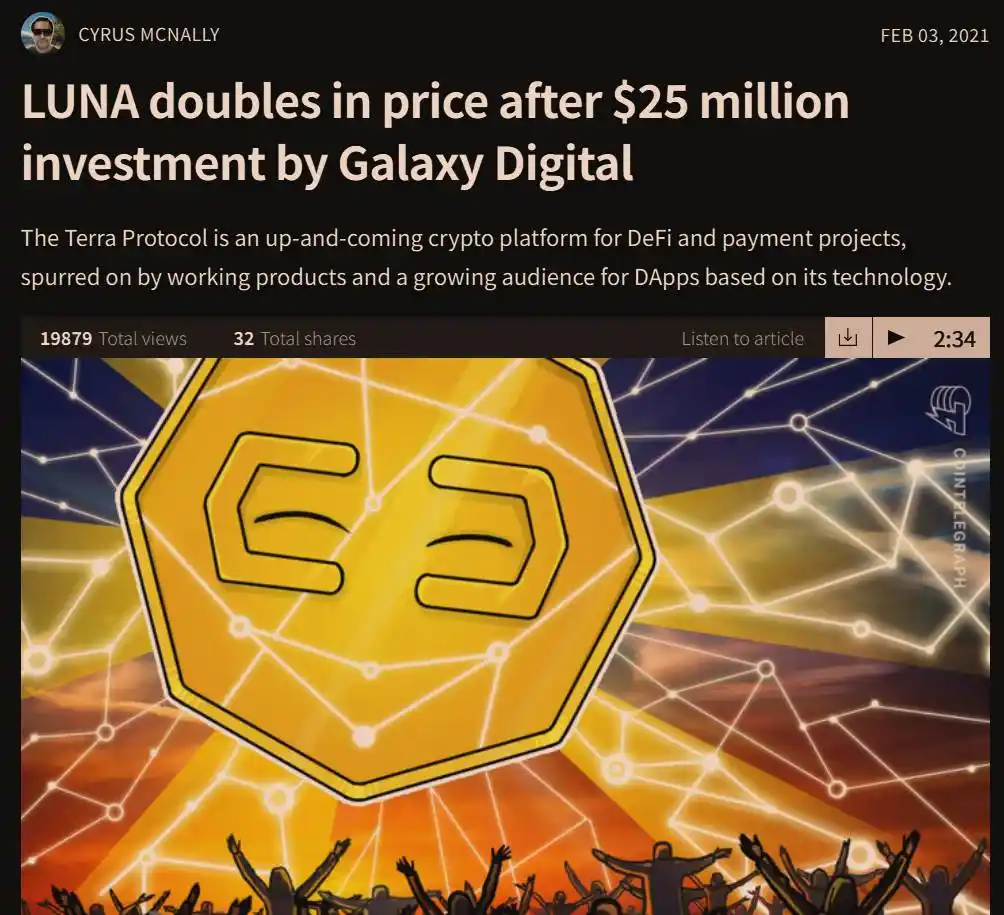
CoinTelegraph reported with the headline "LUNA doubles in price after $25 million investment by Galaxy Digital," triggering a frenzy in the market.
A few days after the Bloomberg article, Galaxy unloaded again. On January 30, 2021, they sold over 1.54 million Lunas at a price of up to $1.47 each. At this point, Galaxy had successfully recouped their initial $4 million investment.
This battle was fought cleanly and efficiently, truly exemplifying the art of "unloading."
2.3 Escalation: The Combination of Tattoos and Fake Data
After recouping their investment, Galaxy became even more brazen. They began to deploy their ultimate weapon.
In March 2021, Novogratz tweeted: "If Luna hits $100, I will get a Luna tattoo!" This direct and personal commitment quickly caused a stir in the industry.
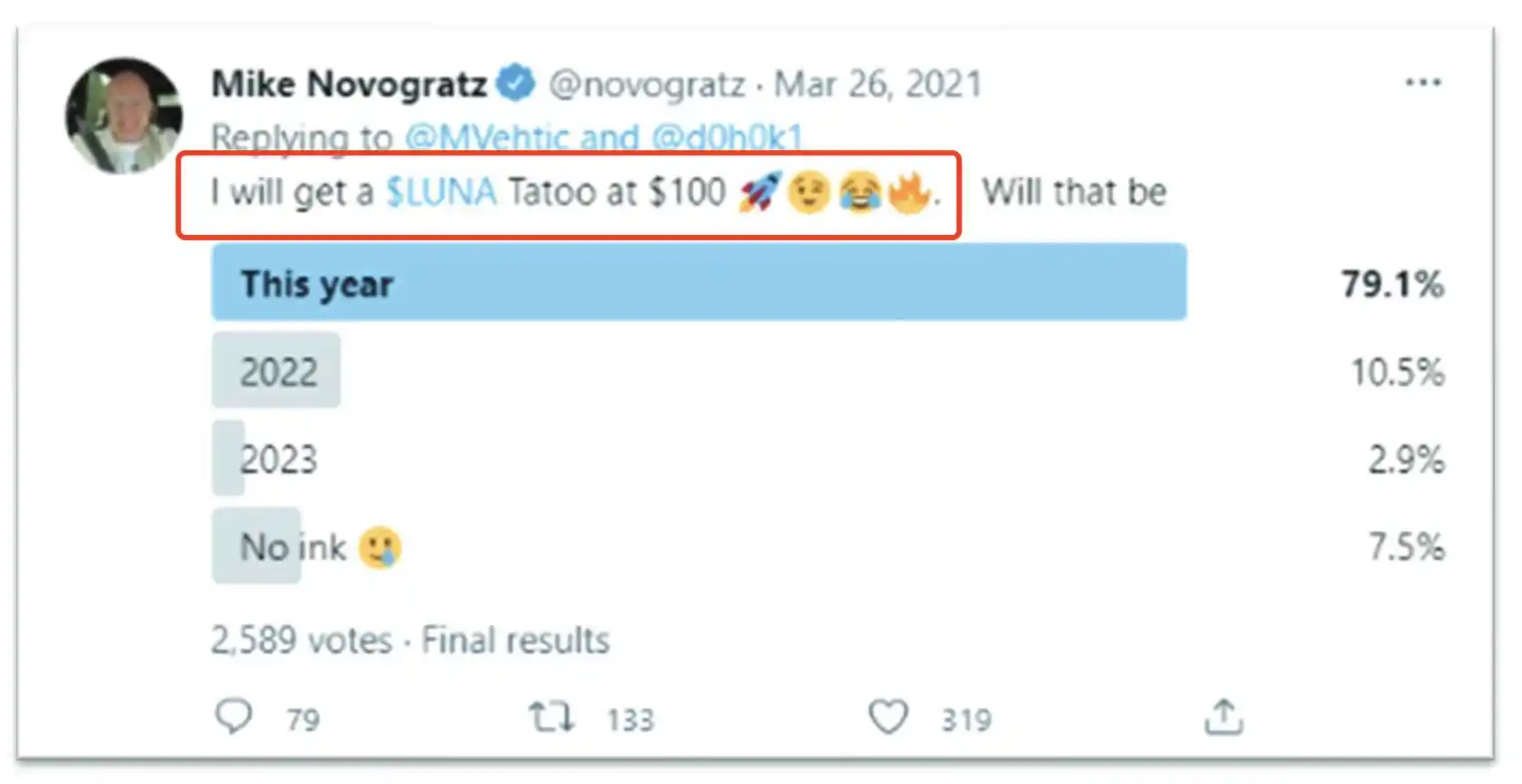
Meanwhile, Novogratz continued to blur the relationship between Chai and Terra, leading people to repeatedly mistake that the Terra blockchain had a strong real-world use case. For example:
On April 26, 2021, Novogratz stated in a podcast: "6% of South Korea's payments are now using Chai."
On May 21, he further exaggerated: "7%-8% of South Korea's payments are now transacted through Chai on the blockchain."
On June 22, he stated: "All 8% of South Korea's payments are made using Chai."
On September 13, during his speech at the Barclays Global Financial Summit, he mentioned that currently 9% of payments are settled via the Luna blockchain.
However, in reality, Chai accounts for less than 1% of South Korea's total transaction volume, and Chai is not even supported by the Terra blockchain, let alone having any relationship with Luna. These data are completely false, but the effect is immediate. After each statement, the price of Luna soared, and Galaxy took advantage of each opportunity to sell off chips:
In early May 2021, selling 1.3 million Lunas at a peak price of $18.60 each;
On June 4, selling nearly 1.79 million Lunas at around $6.91 each;
In early August, selling another 1.61 million Lunas in a price range of $12.19-$14.79 each.
By Christmas Eve, December 24, 2021, the price of Luna indeed reached $100! Novogratz kept his promise and posted a photo of the Luna tattoo on his arm, triggering a frenzy on social media.

However, Galaxy, tattooing Luna on one side and selling on the other, showed no signs of stopping. On Christmas Day, they began selling Luna at $96.96. In early January 2022, Galaxy continued to sell large quantities at around $90, cashing out tens of millions of dollars.
Can you imagine? While Novogratz posted that arm tattoo photo, behind the scenes, traders were rapidly hitting their keyboards, frantically dumping Luna chips into the frenzied market.
2.4 The Final Frenzy: Preaching "Keep the faith" while massively unloading holdings
At the beginning of the new year in 2022, Galaxy and Novogratz began to stage their final madness.
On January 5, as Luna slipped from its $100 peak to around $80 and market sentiment started to waver, Novogratz made another appearance. He took to Twitter to reassure anxious investors: after a big market surge, there is always a consolidation phase, and $100 is just a symbolic number. Be patient, Luna will definitely rise. Keep the faith!
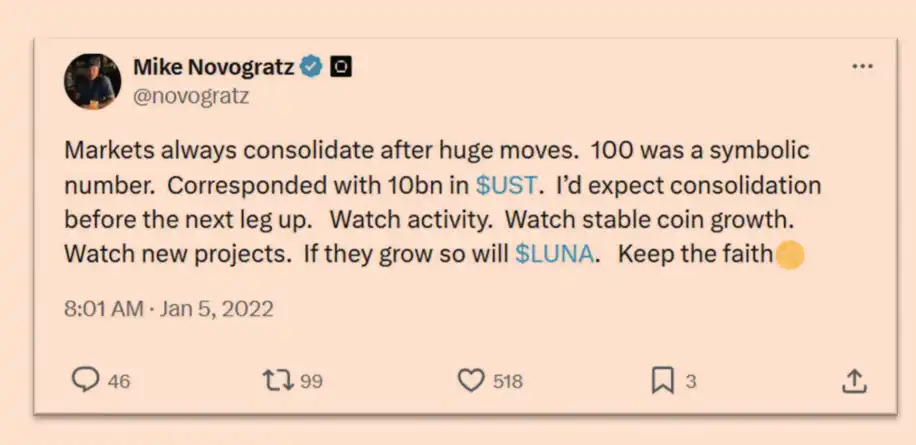
The famous phrase "Keep the faith" seemed like a strong dose of encouragement, reigniting hope in the thousands of Luna holders. However, at the same time, Galaxy's trading room was playing out a completely different scene:
On January 5, Galaxy aggressively sold over 160,000 Luna in the price range of $77.51-$84.80, cashing out approximately $13.58 million on the same day;
Then, over the course of January 6 to January 7, Galaxy once again unhesitatingly sold over 520,000 Luna, with a total amount close to $40 million;
From January 10 to January 13, within just four days, Galaxy again unloaded nearly 680,000 Luna, cashing out over $50 million.
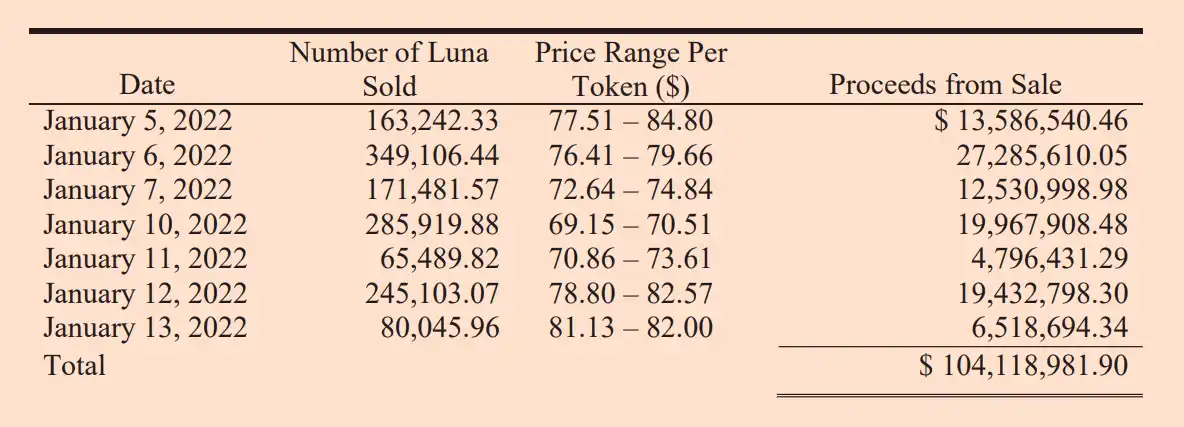
Amid Novogratz's passionate "Keep the faith" voice, in just one week, Galaxy had quietly sold over 1.3 million Luna, realizing a total of $104 million! Meanwhile, they did not disclose any selling behavior to the public, still maintaining the facade of being "faith-backed."
A more absurd scene unfolded on January 15. When Luna dropped to around $87, Novogratz humorously retweeted the "Viejo Lobo" (Spanish for Old Wolf) image on Twitter, joking that his position in the Luna community seemed to imply that he was an experienced old wolf, sitting firmly on the fishing chair.

However, just an hour and a half after posting the tweet, Galaxy quickly sold 13,276 Luna, accurately capturing a brief rebound and cashing out $1.15 million. In the following week, Galaxy even more frantically sold over 1.1 million Luna, driving the price lower from $69 all the way down to $48.
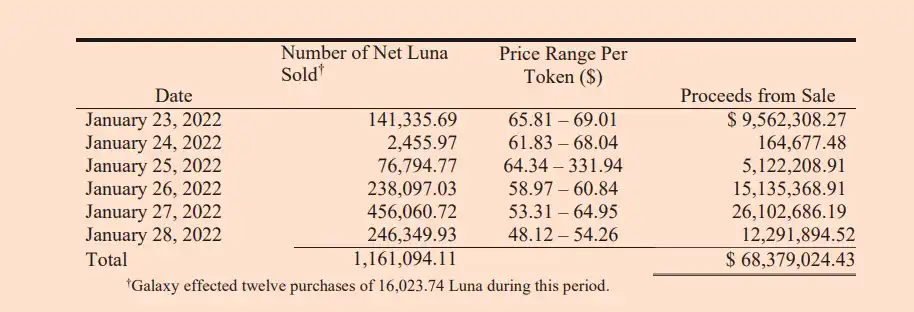
Nevertheless, Novogratz still loudly proclaims "Keep the faith," encouraging followers to hodl as if this were just a normal market correction.
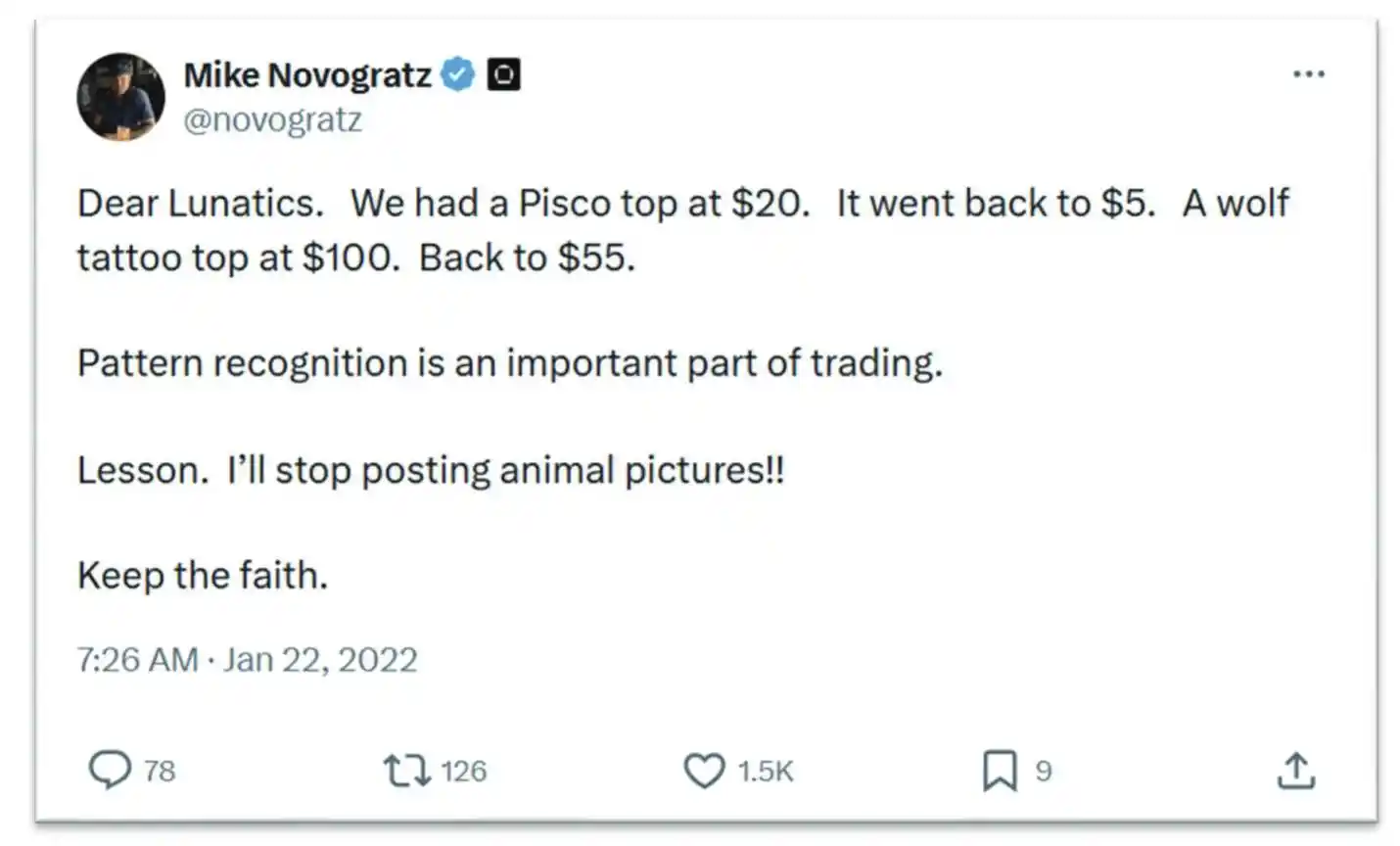
2.5 Conclusion: After the Frenzy, Feathers Everywhere
Galaxy and Novogratz's final frenzy on Luna perfectly exemplified the art of institutional distribution. On the surface, they always played the role of loyal crypto evangelists, inspiring others with shouts of "faith," even going so far as to tattoo the Luna emblem on their arms. Yet behind the spotlight, they carefully orchestrated a large-scale and continuous sell-off of Luna until their positions were almost completely liquidated.
The endgame of this charade was inevitable. On May 9, 2022, when TerraUSD (UST) collapsed completely, triggering Luna's death spiral, Luna's price plummeted from $65 to $0.004 in just three days, wiping out its $40 billion market cap. But by then, Galaxy had already exited in safety, leaving behind a meager 2060 Luna tokens worth less than $10.
Now, it's our turn to reflect.
3. Can You Dodge This Scam?
After witnessing Galaxy's roller-coaster pump-and-dump story, perhaps a pressing question has already arisen in your mind: If I were a bit smarter, a bit more cautious, could I dodge this scam?
To answer this question seriously, one must objectively, based on facts and data, gradually unravel the hidden clues behind this scam and consider what advantages and disadvantages ordinary investors really have. Next, we will delve deep into the analysis from both the "why you can" and "why you can't" perspectives.
3.1 Why You Can?
In fact, if you can remain vigilant enough, possess enough common sense and patience, it is entirely possible to dodge Galaxy's carefully woven "pump-and-dump" scam.
First, Traces of Exaggerated Data
A diligent investor, with just a little bit of research, can discern that the data used in Galaxy and Novogratz's promotion contains significant exaggeration or even falsity.
For example, Novogratz has repeatedly emphasized
In April 2021, 6% of payments in South Korea were already made through Chai.
By May 21, this number had increased to 7%-8%.
By September, Novogratz boldly claimed that 9% of South Korea's payments were all carried out using the Luna blockchain.
But what do the actual data show? According to official Chai data (which can be accessed through channels like Chaiscan), Chai's payment transaction volume has consistently accounted for less than 1% of the South Korean payment market. In fact, Chai has never actually settled transactions using Terra's blockchain.
If you take a closer look at Chaiscan data, you will quickly realize that these so-called strong use cases are nothing but hype. In other words, with a little attention, you can easily spot significant data discrepancies and misleading elements in Galaxy's promotion.
Second, Clear Signs of Long-Term Cash-Out
Another key clue to identify a scam is the market performance after each of Galaxy's public endorsements. Let's take December 3, 2020, as an example, when Novogratz announced on Twitter that Chai had 80,000 daily active users. On that day, Luna's trading volume surged rapidly from $27.5 million to $69 million. However, just two weeks later, Galaxy swiftly unloaded its initial batch of Luna, achieving a quick cash-out at a price of around $0.50.
For instance, on January 30, 2021, just a few days after Bloomberg reported Galaxy's investment in Luna, Galaxy once again swiftly sold off 1.54 million Luna. These sell-offs consistently aligned with positive news coverage, occurring right after price increases. This pattern of selling off is repeated every subsequent month. By simply monitoring on-chain data or Luna's circulation, you can clearly see these signs of large-scale periodic sell-offs, suggesting that the orchestrators behind the scenes may have a structured cash-out plan.

Third, Overly Exaggerated Personal Endorsements
The third signal that can help you avoid a scam is Novogratz's overly exaggerated personal endorsements. Novogratz stated: When Luna reaches $100, he will get a Luna tattoo! While such personal commitments can indeed boost sentiment, they are also overly exaggerated and blatant, exposing the motivators of the manipulators who are eager to influence market sentiment.
A truly professional investor, an institutional investor, typically would not make such explicit market commitments in a public setting. When the market experiences such dramatic commitments or overly extreme calls, cautious investors should be on high alert to avoid blindly following the trend.
3.2 Why Not?
However, aside from rational analysis, we must also admit that for the vast majority of retail investors, escaping high-level, structured scams like Galaxy is actually extremely difficult, and can even be said to be nearly impossible.
First, the Authority of Institutions is Too Strong
Galaxy Digital's CEO, Mike Novogratz, is a legendary figure in the crypto market. He was a partner at Goldman Sachs, appeared extensively on top financial media like CNBC and Bloomberg, and with his early successful investments in Bitcoin and Ethereum, he has established a very high level of authority and credibility.
For retail investors, seeing such an "industry expert" who accurately predicted market trends in the past personally come out to recommend a project can easily create a strong psychological anchoring effect, quickly lowering their guard and completely relying on the expert's recommendation to make decisions, thus giving up independent thinking.
Galaxy has precisely exploited this authority effect to successfully manipulate market sentiment. For the majority of investors, seeing through the hidden motives behind this authority is extremely difficult.
Second, Ingenious Media Manipulation and PR Strategy
When promoting Luna, Galaxy had collaborated with several top-tier media outlets (such as Bloomberg, CoinTelegraph), successfully creating a seemingly genuine and trustworthy market impression of Luna. A Bloomberg report on January 26, 2021, clearly shows that Galaxy provided false data directly to Bloomberg, hyping up the strong ecosystem and real-world use cases of Terra and Luna, creating the illusion of a market breakthrough.
This precise manipulation in the media makes it challenging for retail investors to have doubts. After all, when the public sees positive reports about a project in the mainstream media, they naturally tend to believe it is well-investigated and objectively reliable information, making it very difficult to conceive that this is a carefully orchestrated attempt to control public opinion.
Third, Emotion Manipulation through "Keep the faith"
From a psychological perspective, Novogratz's "Keep the faith" slogan effectively manipulated investors' emotions. When the market is down, what the average investor most wants to hear is someone encouraging them to keep the faith and not give up easily.
This emotional guidance is more penetrating than any rational analysis. Novogratz is skilled at using this emotion, firmly controlling market sentiment with infectious rhetoric, causing investors to hold on during downturns, even continuing to buy the dip and becoming the bagholders.
In reality, when Galaxy was aggressively offloading at the peak, the average investor was almost impossible to remain completely alert. Because when everyone is chanting faith, skeptics are seen as outcasts, facing immense psychological pressure.
3.3 Summary: Balancing Between Can and Cannot
Going back to our initial question: Can you escape this scam?
Objectively speaking, this depends on how much market knowledge, investment experience, and critical thinking ability you possess. If you are careful enough to keenly perceive the difference between data and reality, to discover the abnormal cash-out patterns after each hype, to remain vigilant against dramatic propaganda, you can entirely foresee the scam in advance.
But if you are just an ordinary investor, misled by institutional authority halo, misguided by carefully crafted media, infected by emotional slogans, then in the face of Galaxy's meticulously designed script, the vast majority almost cannot escape. Greed and deception always exist in the market; Galaxy's story is not the first, nor will it be the last.

Conclusion
The thin line of trust between preaching and harvesting, once crossed, becomes the edge of the sickle. Behind every scam is a game of human greed and fear.
In the story of Galaxy and Luna, we see how authority becomes a tool for harvesting, how media becomes an amplifier of deception, and how emotion becomes the fuel of greed. But ultimately, in this world, there is never free wealth, nor undeserved riches.
Faith was originally the most touching term in the investment world, but when it is used by ulterior motives to manipulate the market, faith becomes poison, ultimately backfiring on every blind follower.
However, we must also admit that Galaxy is not merely a predator. They bravely stood at the forefront when the crypto market was still in its infancy, injecting capital and confidence into the industry. Novogratz's vision and Galaxy's contributions to industry standardization have indeed propelled the crypto world into the mainstream. They have accompanied this industry through ups and downs, witnessing and driving the transition of an era and the rise of an industry. Unfortunately, when the temptation of capital collided with the moral bottom line, Galaxy did not hold onto its original intentions and chose a less honorable shortcut.
A true investor must understand that investment does not rely on authority's guidance, nor is it based on media hype, but rather on one's own independent thinking and rational judgment.
Because: every time you blindly follow, you are footing the bill for a scam; and every time you question, you are accumulating capital for your freedom.
Starting today, please remember:
Do not blindly trust authority, trust data instead;
Do not follow blindly, think independently instead;
Do not be swayed by emotions, control with rationality instead.
After all, the market is never kind, only those who truly stay alert deserve real financial freedom.
Finally, we should express our gratitude to the "Martin Act." Hopefully, under the strong deterrence of the "Martin Act," KOLs will no longer be so reckless in pumping and dumping.
You may also like
a16z Leads $18M Seed Round for Catena Labs, Crypto Industry Bets on Stablecoin AI Payment
Never Underestimate the Significance of the US Stablecoin 'Infrastructure Bill'
If the US stablecoin bill, the "GENIUS Act," passes smoothly this time, its significance will be tremendous. I even think it's significant enough to enter the top five in Crypto history.
Although abbreviated as the GENIUS Act, which translates directly to the Genius Act, it is actually the Guiding and Establishing National Innovation for U.S. Stablecoins, which translates to "Guiding and Establishing National Innovation for US Dollar Stablecoins."
The proposal is lengthy, with several key points summarized for everyone:
· Mandatory 1:1 Full Asset Backing: Assets include cash, demand deposits, and short-term US Treasuries. At the same time, misappropriation and rehypothecation are strictly prohibited.
· High-Frequency Disclosure: Reserve reports must be published at least monthly, introducing external audits.
· Licensing Requirement: Once the circulating market cap of the issuer's stablecoin exceeds $100 billion, it must transition into the federal regulatory system within a specified timeframe, adopting banking-grade regulation.
· Introduction of Custody: The custodian of the stablecoin and its reserve assets must be a regulated qualified financial institution.
· Clear Definition as a Payment Medium: The bill explicitly defines stablecoin as a new type of payment medium, primarily regulated by the banking regulatory system, rather than restricted by the securities or commodities regulatory system.
· Embracing Existing Stablecoins: A maximum 18-month grace period after the bill's enactment, aimed at encouraging existing stablecoin issuers (such as USDT, USDC, etc.) to promptly obtain licenses or become compliant.
After finishing the main content, let's talk about the significance of this matter with an excited heart.
Over the years, when others asked, "After working in the Crypto industry for 16 years, what application have you created?"
In the future, you can confidently tell others—Stablecoins.
Some people have held opposing views. In the past, people's impression of stablecoins was that they were an opaque black box. Every few months, there would be FUD — whether Tether's assets were frozen or Circle had a significant black hole deficit.
In fact, if you think about it, Tether easily rakes in billions of dollars a year just from the interest on those underlying government bonds. Circle, slightly less, also made a $1.7 billion profit last year.
They basically made money while standing there. From a motivational standpoint, they have no malicious intentions. In fact, they are the most eager for compliance.
Now, this opaque black box will become a transparent white box.
In the past, the only complaint was that Tether's funds might have been frozen by the United States. Now, they will be directly placed into U.S. compliant custodial institutions, with high-frequency disclosures, so you can rest assured.
【No need to worry about a rug pull】 is such a huge advantage—I think especially all Crypto people understand this.
Stablecoins were once almost on the verge of being overtaken by CBDCs. In any country, if a central bank digital currency really exists, it is highly likely not built on a blockchain, at most it is built on some internal central bank consortium chain, which to be honest, is meaningless.
When CBDCs were at their peak, that was the most dangerous time for stablecoins.
If CBDCs had become a reality back then, stablecoins today would have been relentlessly suppressed into a dark corner, and blockchain would only be able to play a minimal role.
The remaining half-dead stablecoins would even have to learn the standards of central bank digital currencies, completely relinquishing their standard-setting power.
And now, stablecoins have won (or are about to).
Instead, everyone should learn the 【Blockchain + Token】 standard.
Nowadays, many blockchains actually have no meaningful applications on top, only stablecoin transfers. For example, with Aptos, the only scenario I use Aptos for is transfers between Binance and OKX.
And now, stablecoins will be legislated, what does that mean?
That's right, blockchain will become the only standard.
In the future, every stablecoin user will be the first to learn how to use a wallet.
As an aside, I actually think Ethereum's concerted push for EIP-7702 is quite forward-thinking. While other chains are all about memes, thank you Ethereum for sticking to account abstraction.
EIP-7702 is about Account Abstraction, which can support, for example:
· Social Account Registration Wallet
· Paying GAS with Native Coin
· And more
This paves the way for future new users to heavily use stablecoins, solving the last-mile problem.
Furthermore, once stablecoins receive legislative support, deposits and withdrawals will become even easier.
Let's imagine a scenario: previously, hindered by the gray nature of stablecoins, but after the bill passes, many traditional brokerages can support stablecoins themselves. The money from a US stock investor can be converted into stablecoins in minutes and instantly deposited into Coinbase. Believe it or not.
Let's imagine another scenario: if the brilliant bill smoothly passes through the House of Representatives, next, you will see:
Due to the extremely lucrative nature of this trading, existing stablecoin leaders and newly entering traditional giants will crazily start promoting their stablecoin products.
And an outsider, due to these promotions, will start using stablecoins. And then one day, after finding out that the wallet account has been created, will explore Bitcoin inside. Is mining Bitcoin difficult?
Stablecoins are a huge Trojan horse. The moment you start using stablecoins, you unwittingly step half a foot into the Crypto world.
As a large reservoir for digesting US debt, although stablecoins cannot directly absorb debt, they at least provide ammunition for the US debt secondary market. These functions are quite important, and slowly, stablecoins are becoming a part of the US debt market's body. Therefore, once the US legislation is passed and experiences the benefits, there is no turning back.
And, we are also confident that stablecoins are indeed one of the great innovations in our industry. People who have used stablecoins will find it hard to return to the traditional cash-banking system.
Once the bill is passed, users can't go back. In the future, concerns are about to be resolved, standards will be mastered, and the era of large deposits seems to be on the horizon.
Original Article Link
$COIN Joins S&P 500, but Coinbase Isn't Celebrating
On May 13, S&P Dow Jones Indices announced that Coinbase would officially replace Discover Financial Services in the S&P 500 on May 19. While other companies like Block and MicroStrategy, closely tied to Bitcoin, were already part of the S&P 500, Coinbase became the first cryptocurrency exchange whose primary business is in the index. This also signifies that cryptocurrency is gradually moving from the fringes to the mainstream in the U.S.
On the day of the announcement, Coinbase's stock price surged by 23%, surpassing the $250 mark. However, just 3 days later, Coinbase was hit by two consecutive events: a hack where employees were bribed to steal customer data and a demand for a $20 million ransom, and an investigation by the U.S. Securities and Exchange Commission (SEC) into the authenticity of its claim of having over 100 million "verified users" in its securities filings and marketing materials. These two events acted as mini-bombs, and at the time of writing, Coinbase's stock had already dropped by over 7.3%.
Coincidentally, Discover Financial Services, being replaced by Coinbase, can also be considered the "Coinbase" of the previous payment era. Discover is a U.S.-based digital banking and payment services company headquartered in Illinois, founded in 1960. Its payment network, Discover Network, is the fourth largest payment network apart from Visa, Mastercard, and American Express.
In April, after the approval of the acquisition of Discover by the sixth-largest U.S. bank, Capital One, this well-established digital banking company of over 60 years smoothly handed over its S&P 500 "seat" to this emerging cryptocurrency "bank." This unexpected coincidence also portrayed the handover between the new and old eras in Coinbase's entry into the S&P 500, resembling a relay race scene. However, this relay baton also brought Coinbase's accumulated "external troubles and internal strife" to a tipping point.
Over the past decade, cryptocurrency exchanges have been the most stable "profit machines." They play a role in providing liquidity to the entire industry and rely on trading fees to sustain their operations. However, with the comprehensive rollout of ETF products in the U.S. market, this profit model is facing unprecedented challenges. As the leader in the "American stack," with over 80% of its business coming from the U.S., Coinbase is most affected by this.
Starting from the approval of Bitcoin and Ethereum spot ETFs, traditional financial capital has significantly onboarded users and funds that originally belonged to exchanges in a more cost-effective, compliant, and transparent manner. The transaction fee revenue of cryptocurrency exchanges has started to decline, and this trend may further intensify in the coming months.
According to Coinbase's 2024 Q4 financial report, the platform's total trading revenue was $417 million, a 45% year-on-year decrease. The contribution of BTC and ETH's trading revenue dropped from 65% in the same period last year to less than 50%.
This decline is not a result of a decrease in market enthusiasm. In fact, since the approval of the Bitcoin ETF in January 2024, the inflow of BTC into the U.S. market has continued to reach new highs, with asset management giants like BlackRock and Fidelity rapidly expanding their management scale. Data shows that BlackRock's iShares Bitcoin ETF (IBIT) alone has surpassed $17 billion in assets under management. As of mid-May 2025, the cumulative net inflow of 11 major institutional Bitcoin spot ETFs on the market has exceeded $41.5 billion, with a total net asset value of $1214.69 billion, accounting for approximately 5.91% of the total Bitcoin market capitalization.
Institutional investors and some retail investors are shifting towards ETF products, partly due to compliance and tax considerations. On one hand, ETFs have much lower trading costs compared to cryptocurrency exchanges. While Coinbase's spot trading fee rate varies annually in a tiered manner but averages around 1.49%, for example, the management fee for IBIT ETF is only 0.25%, and the majority of ETF institution fees fluctuate around 0.15% to 0.25%.
In other words, the more rational users are, the more likely they are to move from exchanges to ETF products, especially for investors aiming for long-term holdings.
According to multiple sources, several institutions, including VanEck and Grayscale, have submitted applications to the SEC for a Solana (SOL) ETF, with some institutions also planning to submit an XRP ETF proposal. Once approved, this may trigger a new round of fund migration. According to a report submitted by Coinbase to the SEC, as of April, the platform's trading revenue from XRP and Solana accounted for 18% and 10%, nearly one-third of the platform's fee revenue.
However, the Bitcoin and Ethereum ETFs passed in 2024 also reduced the fees for these two tokens on Coinbase from 30% and 15% to 26% and 10%, respectively. If the SOL and XRP ETFs are approved, it will further undermine the core fee revenue of exchanges like Coinbase.
The expansion of ETF products is gradually weakening the financial intermediary status of cryptocurrency exchanges. From their original roles as matchmakers and clearers to now gradually becoming mere "on-ramps and off-ramps" for funds, exchanges are seeing their marginal value squeezed by ETFs.
On May 12, 2025, SEC Chairman Paul S. Atkins gave a keynote speech at the Tokenization and Cryptocurrency Working Group roundtable. The theme of his speech revolved around "It is a new day at the SEC," where he indicated that the SEC would not approach enforcement and regulation the same way as before but would instead pave the way for cryptocurrency assets in the U.S. market.
With signs of cryptocurrency compliance such as the SEC's "NEW DAY" declaration, an increasing number of traditional brokerages are attempting to enter the cryptocurrency industry. One of the most representative cases is the well-known U.S. brokerage Robinhood, which began expanding its crypto business in 2018. By the time of its IPO in 2021, Robinhood's crypto business revenue accounted for over 50% of the company, with a significant boost from the Dogecoin "moonshot" promoted by Musk.
In Q1 2025 earnings report, Robinhood showcased strong growth, especially in revenue from cryptocurrency and options trading. Fueled by Trump's Memecoin, cryptocurrency-related revenue reached $250 million, nearly doubling year-over-year. Consequently, Robinhood Gold subscription users reached 3.5 million, a 90% increase from the previous year, with the rapid growth of Robinhood Gold providing the company with a stable source of income.
Meanwhile, RobinHood is actively pursuing acquisitions in the cryptocurrency space. In 2024, it announced a $2 billion acquisition of the long-standing European cryptocurrency exchange Bitstamp. Additionally, Canada's largest cryptocurrency CEX, WonderFi, which recently went public on the Toronto Stock Exchange, also announced its integration with RobinHood Crypto. After obtaining virtual asset licenses in the UK, Canada, Singapore, and other markets, RobinHood has taken a proactive approach in the compliant cryptocurrency trading market.
Furthermore, an increasing number of brokerage firms are exploring the same path. Futu Securities, Tiger Brokers, and others are also dipping their toes into cryptocurrency trading, with some having applied for or obtained the VA license from the Hong Kong SFC. Although their user bases are currently small, traditional brokerages have a natural advantage in user trust, regulatory licenses, and low fee structures. This could pose a threat to native cryptocurrency platforms in the future.
In April 2025, security researchers discovered that some Coinbase user data was leaked on the dark web. While the platform initially responded by attributing it to a "technical misinformation," it still raised concerns among users regarding its security and privacy protection. Just two days before Dow Jones Indexes announced Coinbase's addition to the S&P 500 Index, on May 11, 2025, Coinbase received an email from an unknown threat actor claiming to have obtained customer account information and internal documents, demanding a $20 million ransom to keep the data private. Subsequent investigations confirmed the data breach.
Cybercriminals obtained the data by bribing overseas customer service agents and support staff, mainly in "non-U.S. regions such as India." These agents abused their access to Coinbase's internal customer support system and stole customer data. As early as February this year, blockchain detective ZachXBT revealed on X platform that between December 2024 and January 2025, Coinbase users lost over $65 million to social engineering scams, with the actual amount potentially higher.
Among the victims was a well-known figure, 67-year-old Ed Suman, an established artist in the art world for nearly two decades, having been involved in the creation of artworks such as Jeff Koons' "Balloon Dog" sculpture. Earlier this year, he fell victim to an impersonation scam involving fake Coinbase customer support, resulting in a loss of over $2 million in cryptocurrency. ZachXBT critiqued Coinbase for its inadequate handling of such scams, noting that other major exchanges have not faced similar issues and recommending Coinbase to enhance its security measures.
Amidst a series of ongoing social engineering incidents, although there has not been any impact on user assets at the technical level so far, it has raised concerns among many retail and institutional investors. Especially institutions holding massive assets on Coinbase. Just considering the U.S. BTC ETF institutions, as of mid-May 2025, they collectively hold nearly 840,000 BTC, and 75% of these are custodied by Coinbase. If we price BTC at $100,000, this amount reaches a staggering $63 billion, which is equivalent to the nominal GDP of two Iceland in the year 2024.
In addition, Coinbase Custody also serves over 300 institutional clients, including hedge funds, family offices, pension funds, and endowments. As of the Q1 2025 financial report, Coinbase's total assets under management (including institutional and retail clients) reached $404 billion. The specific amount of institutional custodied assets was not explicitly disclosed in the latest report, but it should still be over 50% based on the Q4 2024 report.
Once this security barrier is breached, not only could the rate of user attrition far exceed expectations, but more importantly, institutional trust in it would undermine the foundation of its business. Therefore, after a hacking event, Coinbase's stock price plummeted significantly.
Facing a decline in spot trading fee revenue, Coinbase is also accelerating its transformation, attempting to find growth opportunities in derivatives and emerging assets. Coinbase acquired a stake in the options platform Deribit at the end of 2024 and announced the official launch of perpetual contract products in 2025. This acquisition fills in Coinbase's gap in options trading and its relatively small global market share.
Deribit has a strong presence in non-U.S. markets, especially in Asia and Europe. The acquisition has enabled Coinbase to gain a dominant position in bitcoin and ethereum options trading on Deribit, accounting for approximately 80% of the global options trading volume, with daily trading volume remaining above $2 billion.
Meanwhile, 80-90% of Deribit's customer base consists of institutional investors, with their professionalism and liquidity in the Bitcoin and Ethereum options market highly favored by institutions. Coinbase's compliance advantage, coupled with its already robust institutional ecosystem, makes it even more suitable. By using institutions as an entry point, it can face the squeeze from giants like Binance and OKX in the derivatives market.
Facing a similar dilemma is Kraken, which is attempting to replicate Binance Futures' model in non-U.S. markets. Since the derivatives market relies more on professional users, fee rates are relatively higher and stickiness is stronger, making it a significant source of revenue for exchanges. In the first half of 2025, Kraken completed the acquisition of TradeStation Crypto and a futures exchange, aiming to build a complete derivatives trading ecosystem to hedge the risk of declining spot transaction fee income.
With the surge of Memecoin in 2024, Binance, OKX, and various CEX platforms began massively listing small-market-cap, highly volatile tokens to activate active trading users. Due to the wealth effect and trading activity of Memecoins, Coinbase was also forced to join the battle, successively listing popular tokens from the Solana ecosystem such as BOOK OF MEME and Dogwifhat. Although these coins are controversial, they are frequently traded, with fee rates several times higher than mainstream coins, serving as a "blood-boosting" method for spot trading.
However, due to its status as a publicly traded company, this practice is a riskier endeavor for Coinbase. Even in the current crypto-friendly environment, the SEC is still investigating whether tokens like SOL, ADA, and SAND constitute securities.
In addition to the forced transformation strategies carried out by the aforementioned CEXs, they are also starting to lay out RWAs and the most talked-about stablecoin payment fields, such as the PYUSD launched through a collaboration between Coinbase and Paypal, Coinbase's support for the Euro stablecoin EURC by Circle that complies with EU MiCA regulatory requirements, or the USD1 launched through a collaboration between Binance and WIFL. In the increasingly crowded trading field, many CEXs have shifted their focus from just the trading market to the application field.
The golden age of transaction fees has quietly ended, and the second half of the crypto exchange platform game has silently begun.
Arthur Hayes: Why I'm Betting on ETH While the Market Is Obsessed with SOL
May 16 Key Market Information Gap, A Must-Read! | Alpha Morning Report
Key Market Intelligence on May 14th, how much did you miss out on?
1.Binance Alpha Launches HIPPO, BLUE, and Other Tokens
2.Believe Ecosystem Tokens See General Rise, LAUNCHCOIN Surges Over 250% in 24 Hours
3.Tiger Securities Introduces Cryptocurrency Deposit and Withdrawal Service, Supports Mainstream Cryptocurrencies such as BTC and ETH
4.Current Bitcoin Rally Possibly Driven by Institutions, Retail Traders Yet to Join
5.Binance Wallet's New TGE Privasea AI Participation Requires a 198 Point Threshold, with a Point Consumption of 15
Source: Overheard on CT (tg: @overheardonct), Kaito
PUMP: Today's discussions about PUMP focus on its new creator revenue-sharing model: the platform will allocate 50% of PumpSwap revenue to token creators, sparking varied reactions from users. Some criticize the move as insufficient or even misleading, while others view it as a positive step the platform is taking to reward creators. Meanwhile, PUMP faces market pressure from emerging competitors like LetsBONKfun and Raydium, which are rapidly gaining market share. Users also express concerns about PUMP's sustainability and potential regulatory risks in the U.S., with discussions extending to the platform's impact on the entire memecoin ecosystem.
COINBASE: Today, Coinbase became the first crypto company to join the S&P 500 Index, replacing Discover Financial Services, sparking widespread industry attention. The entire crypto community views this milestone as a significant development, signaling that crypto assets are further integrating into the mainstream financial system. The news has sparked lively discussions on Twitter, with many users pointing out that this may attract more institutional investors to enter the Bitcoin and other cryptocurrency markets.
XRP: XRP became the focal point of today's crypto discussion, with its significant market movements and strategic advances drawing attention. XRP has surpassed USDT to become the third-largest cryptocurrency by market capitalization, sparking market excitement and discussions about its future potential. The surge in market capitalization and price is believed to be related to increasing institutional interest, deepening strategic partnerships, and its role in the crypto ecosystem. Additionally, XRP's integration into multiple financial systems and its potential as a macro asset class are also seen as key factors driving the current market sentiment.
DYDX: Today's discussions about DYDX mainly focused on the dYdX Yapper Leaderboard launched by KaitoAI. The leaderboard aims to identify the most active community participants, with a total of $150,000 in rewards to be distributed over the first three seasons. This initiative has sparked broad community participation, with many users discussing the potential rewards and the incentive effect on the DYDX ecosystem. Meanwhile, progress on the ethDYDX to dYdX native chain migration and historical airdrop events have also been topics of discussion.
1. "What Is 'ICM'? Holding Up the $4 Billion Market Cap Solana's New Narrative"
Overnight, the hottest narrative in the crypto space has become "Internet Capital Markets," with a host of crypto projects and founders, led by the Solana ecosystem's new Launchpad platform Believe, releasing this phrase. Together with "Believe in something," it has become the new slogan heralding the onset of a bull market. What exactly is the so-called "Internet Capital Market," will it become a short-lived hype phrase like the Base ecosystem's previous Content Coin, and what related targets are available for selection?2.《LaunchCoin Surges 20x in One Day, How Did Believe Create a $200M Market Cap Shiba Inu After Going to Zero?|100x Retrospective》
LAUNCHCOIN broke through a $200 million market cap today, with the long-lost liquidity and such a high market cap "Memecoin" almost bringing half of the on-chain crypto community CT into the fray. The community is crazily discussing this token, with half of it being FOMO and the other half being FUD. This token, originally issued by Believe founder Ben Pasternak under his personal identity, transformed into a new platform token after a renaming. From once going to zero to a $200 million market cap, what happened in between?May 14 On-chain Fund Flow
How to Get Rich in Crypto Without Relying on Luck? Financial Veteran Raoul Pal's Macro Insights and Investment Path
After CEX and Wallet, OKX enters the payment game
RWA Evergreen Product Crisis: Why is the GLP Model Doomed to Collapse Under RWA Evergreen?
Why Are Crypto Projects Rushing to Issue Credit Cards? A Battle Between Web3 and the Real World
Week 16 On-Chain Data: Intensifying Structural Supply-Demand Imbalance, Data Reveals Solid Blueprint for Next Bull Run?
Sui Q1 Advanced Report: The Rise of BTCfi Infrastructure, the Boom of Lending Protocols, and the Future of Rollup-Based Scalability
Crypto Developer: The Trump Family's Coin Minting Real Estate Business
SignalPlus Macro Analysis: The Tariff-Torn M2 Narrative and the Return of TradFi-Style FOMO
Launch on Binance Alpha, how much is your HAEDAL airdrop worth?
Taking Stock of the Top 10 Emerging Launchpad Platforms: Who Will Succeed in Disrupting Pump.fun?
After El Salvador's President Nayib Bukele signed it, which U.S. states have been **"good, good"** in advancing Bitcoin strategic reserve legislation?
PENGU Experiences Strong Rebound from Bottom with 360% Surge, How Will the Fat Penguin Leverage IP Marketing for a Comeback?
a16z Leads $18M Seed Round for Catena Labs, Crypto Industry Bets on Stablecoin AI Payment
Never Underestimate the Significance of the US Stablecoin 'Infrastructure Bill'
If the US stablecoin bill, the "GENIUS Act," passes smoothly this time, its significance will be tremendous. I even think it's significant enough to enter the top five in Crypto history.
Although abbreviated as the GENIUS Act, which translates directly to the Genius Act, it is actually the Guiding and Establishing National Innovation for U.S. Stablecoins, which translates to "Guiding and Establishing National Innovation for US Dollar Stablecoins."
The proposal is lengthy, with several key points summarized for everyone:
· Mandatory 1:1 Full Asset Backing: Assets include cash, demand deposits, and short-term US Treasuries. At the same time, misappropriation and rehypothecation are strictly prohibited.
· High-Frequency Disclosure: Reserve reports must be published at least monthly, introducing external audits.
· Licensing Requirement: Once the circulating market cap of the issuer's stablecoin exceeds $100 billion, it must transition into the federal regulatory system within a specified timeframe, adopting banking-grade regulation.
· Introduction of Custody: The custodian of the stablecoin and its reserve assets must be a regulated qualified financial institution.
· Clear Definition as a Payment Medium: The bill explicitly defines stablecoin as a new type of payment medium, primarily regulated by the banking regulatory system, rather than restricted by the securities or commodities regulatory system.
· Embracing Existing Stablecoins: A maximum 18-month grace period after the bill's enactment, aimed at encouraging existing stablecoin issuers (such as USDT, USDC, etc.) to promptly obtain licenses or become compliant.
After finishing the main content, let's talk about the significance of this matter with an excited heart.
Over the years, when others asked, "After working in the Crypto industry for 16 years, what application have you created?"
In the future, you can confidently tell others—Stablecoins.
Some people have held opposing views. In the past, people's impression of stablecoins was that they were an opaque black box. Every few months, there would be FUD — whether Tether's assets were frozen or Circle had a significant black hole deficit.
In fact, if you think about it, Tether easily rakes in billions of dollars a year just from the interest on those underlying government bonds. Circle, slightly less, also made a $1.7 billion profit last year.
They basically made money while standing there. From a motivational standpoint, they have no malicious intentions. In fact, they are the most eager for compliance.
Now, this opaque black box will become a transparent white box.
In the past, the only complaint was that Tether's funds might have been frozen by the United States. Now, they will be directly placed into U.S. compliant custodial institutions, with high-frequency disclosures, so you can rest assured.
【No need to worry about a rug pull】 is such a huge advantage—I think especially all Crypto people understand this.
Stablecoins were once almost on the verge of being overtaken by CBDCs. In any country, if a central bank digital currency really exists, it is highly likely not built on a blockchain, at most it is built on some internal central bank consortium chain, which to be honest, is meaningless.
When CBDCs were at their peak, that was the most dangerous time for stablecoins.
If CBDCs had become a reality back then, stablecoins today would have been relentlessly suppressed into a dark corner, and blockchain would only be able to play a minimal role.
The remaining half-dead stablecoins would even have to learn the standards of central bank digital currencies, completely relinquishing their standard-setting power.
And now, stablecoins have won (or are about to).
Instead, everyone should learn the 【Blockchain + Token】 standard.
Nowadays, many blockchains actually have no meaningful applications on top, only stablecoin transfers. For example, with Aptos, the only scenario I use Aptos for is transfers between Binance and OKX.
And now, stablecoins will be legislated, what does that mean?
That's right, blockchain will become the only standard.
In the future, every stablecoin user will be the first to learn how to use a wallet.
As an aside, I actually think Ethereum's concerted push for EIP-7702 is quite forward-thinking. While other chains are all about memes, thank you Ethereum for sticking to account abstraction.
EIP-7702 is about Account Abstraction, which can support, for example:
· Social Account Registration Wallet
· Paying GAS with Native Coin
· And more
This paves the way for future new users to heavily use stablecoins, solving the last-mile problem.
Furthermore, once stablecoins receive legislative support, deposits and withdrawals will become even easier.
Let's imagine a scenario: previously, hindered by the gray nature of stablecoins, but after the bill passes, many traditional brokerages can support stablecoins themselves. The money from a US stock investor can be converted into stablecoins in minutes and instantly deposited into Coinbase. Believe it or not.
Let's imagine another scenario: if the brilliant bill smoothly passes through the House of Representatives, next, you will see:
Due to the extremely lucrative nature of this trading, existing stablecoin leaders and newly entering traditional giants will crazily start promoting their stablecoin products.
And an outsider, due to these promotions, will start using stablecoins. And then one day, after finding out that the wallet account has been created, will explore Bitcoin inside. Is mining Bitcoin difficult?
Stablecoins are a huge Trojan horse. The moment you start using stablecoins, you unwittingly step half a foot into the Crypto world.
As a large reservoir for digesting US debt, although stablecoins cannot directly absorb debt, they at least provide ammunition for the US debt secondary market. These functions are quite important, and slowly, stablecoins are becoming a part of the US debt market's body. Therefore, once the US legislation is passed and experiences the benefits, there is no turning back.
And, we are also confident that stablecoins are indeed one of the great innovations in our industry. People who have used stablecoins will find it hard to return to the traditional cash-banking system.
Once the bill is passed, users can't go back. In the future, concerns are about to be resolved, standards will be mastered, and the era of large deposits seems to be on the horizon.
Original Article Link
$COIN Joins S&P 500, but Coinbase Isn't Celebrating
On May 13, S&P Dow Jones Indices announced that Coinbase would officially replace Discover Financial Services in the S&P 500 on May 19. While other companies like Block and MicroStrategy, closely tied to Bitcoin, were already part of the S&P 500, Coinbase became the first cryptocurrency exchange whose primary business is in the index. This also signifies that cryptocurrency is gradually moving from the fringes to the mainstream in the U.S.
On the day of the announcement, Coinbase's stock price surged by 23%, surpassing the $250 mark. However, just 3 days later, Coinbase was hit by two consecutive events: a hack where employees were bribed to steal customer data and a demand for a $20 million ransom, and an investigation by the U.S. Securities and Exchange Commission (SEC) into the authenticity of its claim of having over 100 million "verified users" in its securities filings and marketing materials. These two events acted as mini-bombs, and at the time of writing, Coinbase's stock had already dropped by over 7.3%.
Coincidentally, Discover Financial Services, being replaced by Coinbase, can also be considered the "Coinbase" of the previous payment era. Discover is a U.S.-based digital banking and payment services company headquartered in Illinois, founded in 1960. Its payment network, Discover Network, is the fourth largest payment network apart from Visa, Mastercard, and American Express.
In April, after the approval of the acquisition of Discover by the sixth-largest U.S. bank, Capital One, this well-established digital banking company of over 60 years smoothly handed over its S&P 500 "seat" to this emerging cryptocurrency "bank." This unexpected coincidence also portrayed the handover between the new and old eras in Coinbase's entry into the S&P 500, resembling a relay race scene. However, this relay baton also brought Coinbase's accumulated "external troubles and internal strife" to a tipping point.
Over the past decade, cryptocurrency exchanges have been the most stable "profit machines." They play a role in providing liquidity to the entire industry and rely on trading fees to sustain their operations. However, with the comprehensive rollout of ETF products in the U.S. market, this profit model is facing unprecedented challenges. As the leader in the "American stack," with over 80% of its business coming from the U.S., Coinbase is most affected by this.
Starting from the approval of Bitcoin and Ethereum spot ETFs, traditional financial capital has significantly onboarded users and funds that originally belonged to exchanges in a more cost-effective, compliant, and transparent manner. The transaction fee revenue of cryptocurrency exchanges has started to decline, and this trend may further intensify in the coming months.
According to Coinbase's 2024 Q4 financial report, the platform's total trading revenue was $417 million, a 45% year-on-year decrease. The contribution of BTC and ETH's trading revenue dropped from 65% in the same period last year to less than 50%.
This decline is not a result of a decrease in market enthusiasm. In fact, since the approval of the Bitcoin ETF in January 2024, the inflow of BTC into the U.S. market has continued to reach new highs, with asset management giants like BlackRock and Fidelity rapidly expanding their management scale. Data shows that BlackRock's iShares Bitcoin ETF (IBIT) alone has surpassed $17 billion in assets under management. As of mid-May 2025, the cumulative net inflow of 11 major institutional Bitcoin spot ETFs on the market has exceeded $41.5 billion, with a total net asset value of $1214.69 billion, accounting for approximately 5.91% of the total Bitcoin market capitalization.
Institutional investors and some retail investors are shifting towards ETF products, partly due to compliance and tax considerations. On one hand, ETFs have much lower trading costs compared to cryptocurrency exchanges. While Coinbase's spot trading fee rate varies annually in a tiered manner but averages around 1.49%, for example, the management fee for IBIT ETF is only 0.25%, and the majority of ETF institution fees fluctuate around 0.15% to 0.25%.
In other words, the more rational users are, the more likely they are to move from exchanges to ETF products, especially for investors aiming for long-term holdings.
According to multiple sources, several institutions, including VanEck and Grayscale, have submitted applications to the SEC for a Solana (SOL) ETF, with some institutions also planning to submit an XRP ETF proposal. Once approved, this may trigger a new round of fund migration. According to a report submitted by Coinbase to the SEC, as of April, the platform's trading revenue from XRP and Solana accounted for 18% and 10%, nearly one-third of the platform's fee revenue.
However, the Bitcoin and Ethereum ETFs passed in 2024 also reduced the fees for these two tokens on Coinbase from 30% and 15% to 26% and 10%, respectively. If the SOL and XRP ETFs are approved, it will further undermine the core fee revenue of exchanges like Coinbase.
The expansion of ETF products is gradually weakening the financial intermediary status of cryptocurrency exchanges. From their original roles as matchmakers and clearers to now gradually becoming mere "on-ramps and off-ramps" for funds, exchanges are seeing their marginal value squeezed by ETFs.
On May 12, 2025, SEC Chairman Paul S. Atkins gave a keynote speech at the Tokenization and Cryptocurrency Working Group roundtable. The theme of his speech revolved around "It is a new day at the SEC," where he indicated that the SEC would not approach enforcement and regulation the same way as before but would instead pave the way for cryptocurrency assets in the U.S. market.
With signs of cryptocurrency compliance such as the SEC's "NEW DAY" declaration, an increasing number of traditional brokerages are attempting to enter the cryptocurrency industry. One of the most representative cases is the well-known U.S. brokerage Robinhood, which began expanding its crypto business in 2018. By the time of its IPO in 2021, Robinhood's crypto business revenue accounted for over 50% of the company, with a significant boost from the Dogecoin "moonshot" promoted by Musk.
In Q1 2025 earnings report, Robinhood showcased strong growth, especially in revenue from cryptocurrency and options trading. Fueled by Trump's Memecoin, cryptocurrency-related revenue reached $250 million, nearly doubling year-over-year. Consequently, Robinhood Gold subscription users reached 3.5 million, a 90% increase from the previous year, with the rapid growth of Robinhood Gold providing the company with a stable source of income.
Meanwhile, RobinHood is actively pursuing acquisitions in the cryptocurrency space. In 2024, it announced a $2 billion acquisition of the long-standing European cryptocurrency exchange Bitstamp. Additionally, Canada's largest cryptocurrency CEX, WonderFi, which recently went public on the Toronto Stock Exchange, also announced its integration with RobinHood Crypto. After obtaining virtual asset licenses in the UK, Canada, Singapore, and other markets, RobinHood has taken a proactive approach in the compliant cryptocurrency trading market.
Furthermore, an increasing number of brokerage firms are exploring the same path. Futu Securities, Tiger Brokers, and others are also dipping their toes into cryptocurrency trading, with some having applied for or obtained the VA license from the Hong Kong SFC. Although their user bases are currently small, traditional brokerages have a natural advantage in user trust, regulatory licenses, and low fee structures. This could pose a threat to native cryptocurrency platforms in the future.
In April 2025, security researchers discovered that some Coinbase user data was leaked on the dark web. While the platform initially responded by attributing it to a "technical misinformation," it still raised concerns among users regarding its security and privacy protection. Just two days before Dow Jones Indexes announced Coinbase's addition to the S&P 500 Index, on May 11, 2025, Coinbase received an email from an unknown threat actor claiming to have obtained customer account information and internal documents, demanding a $20 million ransom to keep the data private. Subsequent investigations confirmed the data breach.
Cybercriminals obtained the data by bribing overseas customer service agents and support staff, mainly in "non-U.S. regions such as India." These agents abused their access to Coinbase's internal customer support system and stole customer data. As early as February this year, blockchain detective ZachXBT revealed on X platform that between December 2024 and January 2025, Coinbase users lost over $65 million to social engineering scams, with the actual amount potentially higher.
Among the victims was a well-known figure, 67-year-old Ed Suman, an established artist in the art world for nearly two decades, having been involved in the creation of artworks such as Jeff Koons' "Balloon Dog" sculpture. Earlier this year, he fell victim to an impersonation scam involving fake Coinbase customer support, resulting in a loss of over $2 million in cryptocurrency. ZachXBT critiqued Coinbase for its inadequate handling of such scams, noting that other major exchanges have not faced similar issues and recommending Coinbase to enhance its security measures.
Amidst a series of ongoing social engineering incidents, although there has not been any impact on user assets at the technical level so far, it has raised concerns among many retail and institutional investors. Especially institutions holding massive assets on Coinbase. Just considering the U.S. BTC ETF institutions, as of mid-May 2025, they collectively hold nearly 840,000 BTC, and 75% of these are custodied by Coinbase. If we price BTC at $100,000, this amount reaches a staggering $63 billion, which is equivalent to the nominal GDP of two Iceland in the year 2024.
In addition, Coinbase Custody also serves over 300 institutional clients, including hedge funds, family offices, pension funds, and endowments. As of the Q1 2025 financial report, Coinbase's total assets under management (including institutional and retail clients) reached $404 billion. The specific amount of institutional custodied assets was not explicitly disclosed in the latest report, but it should still be over 50% based on the Q4 2024 report.
Once this security barrier is breached, not only could the rate of user attrition far exceed expectations, but more importantly, institutional trust in it would undermine the foundation of its business. Therefore, after a hacking event, Coinbase's stock price plummeted significantly.
Facing a decline in spot trading fee revenue, Coinbase is also accelerating its transformation, attempting to find growth opportunities in derivatives and emerging assets. Coinbase acquired a stake in the options platform Deribit at the end of 2024 and announced the official launch of perpetual contract products in 2025. This acquisition fills in Coinbase's gap in options trading and its relatively small global market share.
Deribit has a strong presence in non-U.S. markets, especially in Asia and Europe. The acquisition has enabled Coinbase to gain a dominant position in bitcoin and ethereum options trading on Deribit, accounting for approximately 80% of the global options trading volume, with daily trading volume remaining above $2 billion.
Meanwhile, 80-90% of Deribit's customer base consists of institutional investors, with their professionalism and liquidity in the Bitcoin and Ethereum options market highly favored by institutions. Coinbase's compliance advantage, coupled with its already robust institutional ecosystem, makes it even more suitable. By using institutions as an entry point, it can face the squeeze from giants like Binance and OKX in the derivatives market.
Facing a similar dilemma is Kraken, which is attempting to replicate Binance Futures' model in non-U.S. markets. Since the derivatives market relies more on professional users, fee rates are relatively higher and stickiness is stronger, making it a significant source of revenue for exchanges. In the first half of 2025, Kraken completed the acquisition of TradeStation Crypto and a futures exchange, aiming to build a complete derivatives trading ecosystem to hedge the risk of declining spot transaction fee income.
With the surge of Memecoin in 2024, Binance, OKX, and various CEX platforms began massively listing small-market-cap, highly volatile tokens to activate active trading users. Due to the wealth effect and trading activity of Memecoins, Coinbase was also forced to join the battle, successively listing popular tokens from the Solana ecosystem such as BOOK OF MEME and Dogwifhat. Although these coins are controversial, they are frequently traded, with fee rates several times higher than mainstream coins, serving as a "blood-boosting" method for spot trading.
However, due to its status as a publicly traded company, this practice is a riskier endeavor for Coinbase. Even in the current crypto-friendly environment, the SEC is still investigating whether tokens like SOL, ADA, and SAND constitute securities.
In addition to the forced transformation strategies carried out by the aforementioned CEXs, they are also starting to lay out RWAs and the most talked-about stablecoin payment fields, such as the PYUSD launched through a collaboration between Coinbase and Paypal, Coinbase's support for the Euro stablecoin EURC by Circle that complies with EU MiCA regulatory requirements, or the USD1 launched through a collaboration between Binance and WIFL. In the increasingly crowded trading field, many CEXs have shifted their focus from just the trading market to the application field.
The golden age of transaction fees has quietly ended, and the second half of the crypto exchange platform game has silently begun.
Arthur Hayes: Why I'm Betting on ETH While the Market Is Obsessed with SOL
May 16 Key Market Information Gap, A Must-Read! | Alpha Morning Report
Key Market Intelligence on May 14th, how much did you miss out on?
1.Binance Alpha Launches HIPPO, BLUE, and Other Tokens
2.Believe Ecosystem Tokens See General Rise, LAUNCHCOIN Surges Over 250% in 24 Hours
3.Tiger Securities Introduces Cryptocurrency Deposit and Withdrawal Service, Supports Mainstream Cryptocurrencies such as BTC and ETH
4.Current Bitcoin Rally Possibly Driven by Institutions, Retail Traders Yet to Join
5.Binance Wallet's New TGE Privasea AI Participation Requires a 198 Point Threshold, with a Point Consumption of 15
Source: Overheard on CT (tg: @overheardonct), Kaito
PUMP: Today's discussions about PUMP focus on its new creator revenue-sharing model: the platform will allocate 50% of PumpSwap revenue to token creators, sparking varied reactions from users. Some criticize the move as insufficient or even misleading, while others view it as a positive step the platform is taking to reward creators. Meanwhile, PUMP faces market pressure from emerging competitors like LetsBONKfun and Raydium, which are rapidly gaining market share. Users also express concerns about PUMP's sustainability and potential regulatory risks in the U.S., with discussions extending to the platform's impact on the entire memecoin ecosystem.
COINBASE: Today, Coinbase became the first crypto company to join the S&P 500 Index, replacing Discover Financial Services, sparking widespread industry attention. The entire crypto community views this milestone as a significant development, signaling that crypto assets are further integrating into the mainstream financial system. The news has sparked lively discussions on Twitter, with many users pointing out that this may attract more institutional investors to enter the Bitcoin and other cryptocurrency markets.
XRP: XRP became the focal point of today's crypto discussion, with its significant market movements and strategic advances drawing attention. XRP has surpassed USDT to become the third-largest cryptocurrency by market capitalization, sparking market excitement and discussions about its future potential. The surge in market capitalization and price is believed to be related to increasing institutional interest, deepening strategic partnerships, and its role in the crypto ecosystem. Additionally, XRP's integration into multiple financial systems and its potential as a macro asset class are also seen as key factors driving the current market sentiment.
DYDX: Today's discussions about DYDX mainly focused on the dYdX Yapper Leaderboard launched by KaitoAI. The leaderboard aims to identify the most active community participants, with a total of $150,000 in rewards to be distributed over the first three seasons. This initiative has sparked broad community participation, with many users discussing the potential rewards and the incentive effect on the DYDX ecosystem. Meanwhile, progress on the ethDYDX to dYdX native chain migration and historical airdrop events have also been topics of discussion.
1. "What Is 'ICM'? Holding Up the $4 Billion Market Cap Solana's New Narrative"
Overnight, the hottest narrative in the crypto space has become "Internet Capital Markets," with a host of crypto projects and founders, led by the Solana ecosystem's new Launchpad platform Believe, releasing this phrase. Together with "Believe in something," it has become the new slogan heralding the onset of a bull market. What exactly is the so-called "Internet Capital Market," will it become a short-lived hype phrase like the Base ecosystem's previous Content Coin, and what related targets are available for selection?2.《LaunchCoin Surges 20x in One Day, How Did Believe Create a $200M Market Cap Shiba Inu After Going to Zero?|100x Retrospective》
LAUNCHCOIN broke through a $200 million market cap today, with the long-lost liquidity and such a high market cap "Memecoin" almost bringing half of the on-chain crypto community CT into the fray. The community is crazily discussing this token, with half of it being FOMO and the other half being FUD. This token, originally issued by Believe founder Ben Pasternak under his personal identity, transformed into a new platform token after a renaming. From once going to zero to a $200 million market cap, what happened in between?May 14 On-chain Fund Flow
Popular coins
Latest Crypto News


Customer Support:@weikecs
Business Cooperation:@weikecs
Quant Trading & MM:bd@weex.com
VIP Services:support@weex.com
 App
App