
- Buy Crypto
- Markets
- Futures
- Spot
- Copy Trade
 WE-Launch
Still using traditional DeFi lending? Wake up, 3Jane has already flipped the script

Recently, the market has been quite volatile, with trading volume low. Just when everyone thought "lying flat in a bear market" was the only way out, traditional financial giant BlackRock quietly accelerated its DeFi layout, attempting to mine on-chain.
Currently, DeFi's Total Value Locked (TVL) is around $100 billion, which may seem like a large number, but the industry's development is limited—protocols like Aave and Compound have the same old issue, with outrageously high collateral ratios! You have to first put up a bunch of assets as collateral to borrow some money, and the result is often borrowing your way into poverty, getting liquidated as soon as leverage is applied, with capital efficiency far below traditional finance.
In other words, what everyone is playing is the "game of the rich," where ordinary users find it difficult to borrow efficiently. The growth ceiling of DeFi is becoming increasingly apparent. 3Jane has taken an unconventional approach by directly introducing a new form of credit lending, with the project receiving strategic support from Coinbase and backed by well-known fintech companies such as Plaid and Credit Karma to help integrate off-chain data and ensure compliance. Technical partners like Lagrange, Reclaim, CRED, and EigenLayer have also joined in, making 3Jane's position in the DeFi field more solidified, with considerable development potential.

DeFi Credit Lending: No Longer "Crushing" Your Wallet
3Jane does not follow the traditional DeFi platform's old path of "collateralize 100, borrow 50." Instead, it lends based on your credit data, and loan approval is carried out by off-chain algorithms. How is your credit verified? On-chain assets, bank deposits, future income, credit score... all of these can be utilized. As long as the verification is sound, you can directly borrow USDC, without collateral, and borrow as you go.

3Jane's Technical Architecture Keeps You From "Running Away"
But some may ask: Isn't this a "no-collateral loan and run" competition? Rest assured, 3Jane is no fool. It uses zero-knowledge technology (zkTLS) to connect on-chain and off-chain credit data, ensuring that every borrower undergoes precise credit assessment and only those who qualify receive the loans. The fund providers are depositors who deposit USDC to mint 3Jane's native stablecoins USD3 or sUSD3, assuming a specific credit risk level.
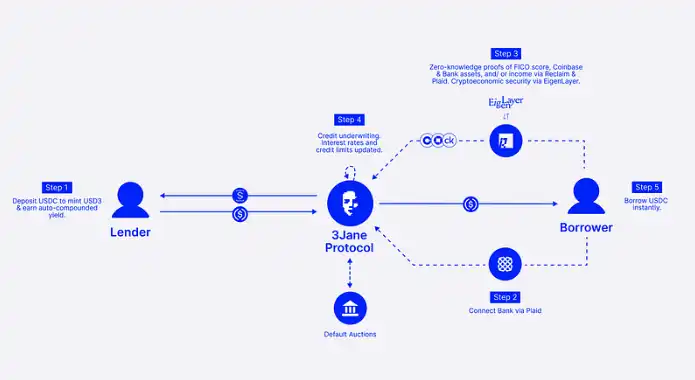
3Jane evaluates your on-chain credit through CredProtocol and BlockchainBureau, analyzing activities such as borrowing, liquidation, holding, and exchange interactions on the EVM chain to determine whether you are a prime user or a high-risk player. These scoring systems have been widely used in the DeFi space, and their risk identification capabilities are relatively reliable.
In addition to on-chain records, 3Jane can also access your Transunion, Equifax credit scores, and CreditKarma records through ReclaimProtocol and EigenLayer (such as credit card usage and delinquency history), without affecting your credit inquiry records and without the need for providing an SSN. This allows for a more comprehensive view of your borrowing credit, beyond just looking at on-chain data.
Through a dual on-chain and off-chain credit system, 3Jane ensures that loans are provided to truly trustworthy users, rather than "borrow and run" players.
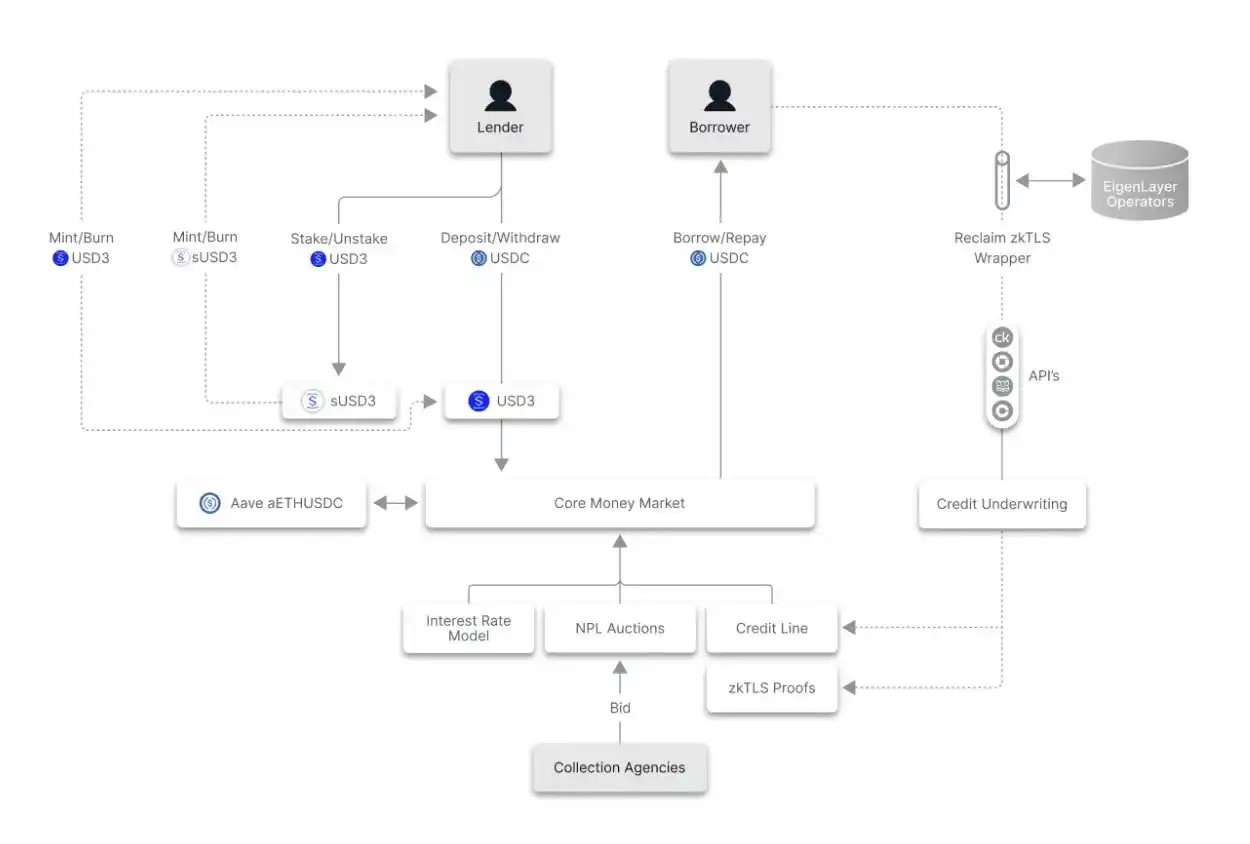
In case someone defaults on their loan, 3Jane binds users' bank account data to their Ethereum address through Plaid, providing minimal personal information, encrypting bank data end-to-end, and allowing for its deletion after repayment. Alternatively, if you default, 3Jane will directly auction off the non-performing loan on-chain, allowing U.S. debt collection agencies to take over. Ethereum smart contracts ensure a permanent and trustworthy commitment to off-chain collections, leaving an immutable default record. This mechanism increases the success rate of recovery.
How to Repay?
3Jane's repayment rules are much more flexible than traditional loans. You only need to pay the minimum amount each month, and the calculation method is quite unique—it will choose the lower of two options: if your on-chain and off-chain assets plus cash flow have increased since borrowing, you will repay based on this appreciation amount. If your assets have not performed well, you will repay based on the principal repayment ratio + interest set by 3Jane. As long as your financial situation is stable, market fluctuations will not make you unable to repay your debt.
If your assets have depreciated, 3Jane may have considered this risk when lending. However, if you have not made repayment by the grace period, you will enter the default period, during which additional late fees will be charged.
In summary: the repayment method is flexible, but there's no escape for defaulters!
Founder's Future Insights
3Jane was founded by @_yakovsky, who previously worked at RibbonFinance (later merged into Aevo) for three years. He initially joined as a smart contract engineer and later transitioned to growth strategy, departing in April 2024 to start 3Jane. There is currently limited information available about the rest of the team's background.

Initially, the 3Jane project was planned to be built on the Base Network, but the latest whitepaper only mentions Ethereum, perhaps due to considerations of liquidity and ecosystem maturity. @_yakovsky tweeted that uncollateralized loans are key to DeFi's mainstream adoption. If Ethereum aims to become a true "internet-native financial system," it must break free from reliance on bank liquidity and support the lending market with future value rather than existing assets. This concept has also been endorsed by Circle co-founder Jeremy Allaire, bringing more attention to 3Jane in the DeFi space.
Although 3Jane is still in its early stages with limited team information, its combination of credit lending, on-chain stablecoin, and off-chain recovery model demonstrates significant potential to reshape the DeFi ecosystem. Whether it's the vision of its founder @_yakovsky or the endorsement from Circle co-founder Jeremy Allaire, it indicates the market's anticipation for uncollateralized DeFi lending.
However, the ultimate question remains: Can 3Jane truly operationalize this model? Will the credit system of DeFi lending withstand market tests? Or is this just another highlight reel in the crypto market? All of these questions can only be answered with time.
You may also like

a16z Leads $18M Seed Round for Catena Labs, Crypto Industry Bets on Stablecoin AI Payment
Never Underestimate the Significance of the US Stablecoin 'Infrastructure Bill'
If the US stablecoin bill, the "GENIUS Act," passes smoothly this time, its significance will be tremendous. I even think it's significant enough to enter the top five in Crypto history.
Although abbreviated as the GENIUS Act, which translates directly to the Genius Act, it is actually the Guiding and Establishing National Innovation for U.S. Stablecoins, which translates to "Guiding and Establishing National Innovation for US Dollar Stablecoins."
The proposal is lengthy, with several key points summarized for everyone:
· Mandatory 1:1 Full Asset Backing: Assets include cash, demand deposits, and short-term US Treasuries. At the same time, misappropriation and rehypothecation are strictly prohibited.
· High-Frequency Disclosure: Reserve reports must be published at least monthly, introducing external audits.
· Licensing Requirement: Once the circulating market cap of the issuer's stablecoin exceeds $100 billion, it must transition into the federal regulatory system within a specified timeframe, adopting banking-grade regulation.
· Introduction of Custody: The custodian of the stablecoin and its reserve assets must be a regulated qualified financial institution.
· Clear Definition as a Payment Medium: The bill explicitly defines stablecoin as a new type of payment medium, primarily regulated by the banking regulatory system, rather than restricted by the securities or commodities regulatory system.
· Embracing Existing Stablecoins: A maximum 18-month grace period after the bill's enactment, aimed at encouraging existing stablecoin issuers (such as USDT, USDC, etc.) to promptly obtain licenses or become compliant.
After finishing the main content, let's talk about the significance of this matter with an excited heart.
Over the years, when others asked, "After working in the Crypto industry for 16 years, what application have you created?"
In the future, you can confidently tell others—Stablecoins.
Some people have held opposing views. In the past, people's impression of stablecoins was that they were an opaque black box. Every few months, there would be FUD — whether Tether's assets were frozen or Circle had a significant black hole deficit.
In fact, if you think about it, Tether easily rakes in billions of dollars a year just from the interest on those underlying government bonds. Circle, slightly less, also made a $1.7 billion profit last year.
They basically made money while standing there. From a motivational standpoint, they have no malicious intentions. In fact, they are the most eager for compliance.
Now, this opaque black box will become a transparent white box.
In the past, the only complaint was that Tether's funds might have been frozen by the United States. Now, they will be directly placed into U.S. compliant custodial institutions, with high-frequency disclosures, so you can rest assured.
【No need to worry about a rug pull】 is such a huge advantage—I think especially all Crypto people understand this.
Stablecoins were once almost on the verge of being overtaken by CBDCs. In any country, if a central bank digital currency really exists, it is highly likely not built on a blockchain, at most it is built on some internal central bank consortium chain, which to be honest, is meaningless.
When CBDCs were at their peak, that was the most dangerous time for stablecoins.
If CBDCs had become a reality back then, stablecoins today would have been relentlessly suppressed into a dark corner, and blockchain would only be able to play a minimal role.
The remaining half-dead stablecoins would even have to learn the standards of central bank digital currencies, completely relinquishing their standard-setting power.
And now, stablecoins have won (or are about to).
Instead, everyone should learn the 【Blockchain + Token】 standard.
Nowadays, many blockchains actually have no meaningful applications on top, only stablecoin transfers. For example, with Aptos, the only scenario I use Aptos for is transfers between Binance and OKX.
And now, stablecoins will be legislated, what does that mean?
That's right, blockchain will become the only standard.
In the future, every stablecoin user will be the first to learn how to use a wallet.
As an aside, I actually think Ethereum's concerted push for EIP-7702 is quite forward-thinking. While other chains are all about memes, thank you Ethereum for sticking to account abstraction.
EIP-7702 is about Account Abstraction, which can support, for example:
· Social Account Registration Wallet
· Paying GAS with Native Coin
· And more
This paves the way for future new users to heavily use stablecoins, solving the last-mile problem.
Furthermore, once stablecoins receive legislative support, deposits and withdrawals will become even easier.
Let's imagine a scenario: previously, hindered by the gray nature of stablecoins, but after the bill passes, many traditional brokerages can support stablecoins themselves. The money from a US stock investor can be converted into stablecoins in minutes and instantly deposited into Coinbase. Believe it or not.
Let's imagine another scenario: if the brilliant bill smoothly passes through the House of Representatives, next, you will see:
Due to the extremely lucrative nature of this trading, existing stablecoin leaders and newly entering traditional giants will crazily start promoting their stablecoin products.
And an outsider, due to these promotions, will start using stablecoins. And then one day, after finding out that the wallet account has been created, will explore Bitcoin inside. Is mining Bitcoin difficult?
Stablecoins are a huge Trojan horse. The moment you start using stablecoins, you unwittingly step half a foot into the Crypto world.
As a large reservoir for digesting US debt, although stablecoins cannot directly absorb debt, they at least provide ammunition for the US debt secondary market. These functions are quite important, and slowly, stablecoins are becoming a part of the US debt market's body. Therefore, once the US legislation is passed and experiences the benefits, there is no turning back.
And, we are also confident that stablecoins are indeed one of the great innovations in our industry. People who have used stablecoins will find it hard to return to the traditional cash-banking system.
Once the bill is passed, users can't go back. In the future, concerns are about to be resolved, standards will be mastered, and the era of large deposits seems to be on the horizon.
Original Article Link
After CEX and Wallet, OKX enters the payment game
Why Are Crypto Projects Rushing to Issue Credit Cards? A Battle Between Web3 and the Real World
Launch on Binance Alpha, how much is your HAEDAL airdrop worth?
Taking Stock of the Top 10 Emerging Launchpad Platforms: Who Will Succeed in Disrupting Pump.fun?
Parse Haedal Protocol: Sui Liquidity Staking Gem Project, TVL Ratio Exceeds Sum of Competitors
Stablecoin Showdown: Six Rising Stars Enter the Fray, Will the Market Structure Shift?
Deep Dive into Dubai's Crypto Dream: Illusion, Capital, and Decentralized Empire
HTX Research Latest Research Report丨Sonic: A Case Study of the New DeFi Paradigm
While the industry was still embroiled in the Layer 2 scaling debate, Sonic offered a new answer through a "foundational revolution." Recently, HTX Research released its latest research report "Sonic: A Blueprint for the DeFi New Paradigm," detailing the new public chain Sonic. While fully compatible with the EVM, Sonic has achieved a throughput of over 2000 TPS, 0.7-second transaction finality, and a transaction cost of 0.0001 USD, outperforming mainstream Layer 1 solutions and even surpassing most Layer 2 solutions. The performance-boosting Sonic is reshaping public chain infrastructure, officially ushering in the "sub-second era" of public chains.
As a high-performance public chain based on a Directed Acyclic Graph (aDAG), Fantom Opera initially stood out for its high throughput and fast confirmation capabilities. However, as the on-chain ecosystem expanded, the limitations of its traditional EVM architecture became increasingly apparent: state storage expansion, slow node synchronization, and constrained execution efficiency. To address this, Fantom introduced the new upgrade solution Sonic, aimed at achieving performance leaps through fundamental reconstruction without relying on sharding or Layer 2.
Led by the restructured Sonic Labs, Sonic's core development team brought together top industry talents, including CEO Michael Kong, CTO Andre Cronje (founder of Yearn Finance), and Chief Research Officer Bernhard Scholz. Over a period of two and a half years, the team comprehensively optimized from the virtual machine, storage engine to the consensus mechanism, ultimately creating the standalone new chain Sonic. While being EVM-compatible, Sonic has achieved over 2000 TPS, 0.7-second finality, $0.0001 transaction cost, a 90% improvement in storage efficiency, and reduced node synchronization time from weeks to within two days.
· SonicVM: The new virtual machine dynamically compiles EVM bytecode, caches high-frequency operations (such as SHA3 hashing), and pre-analyzes jump instructions, improving execution efficiency several times over to support high-throughput demands.
· SonicDB: Using a layered storage design, it separates real-time state (LiveDB) from historical data (ArchiveDB), compressing storage space by 90%, reducing node maintenance thresholds, and enhancing decentralization.
· Sonic Gateway: A Layer 2-like cross-chain bridge to Ethereum, balancing security and efficiency through a batch processing mechanism, supporting bi-directional asset migration, and seamless integration with the Ethereum ecosystem.
Sonic introduces its native token S, exchanged 1:1 with the old token FTM, undertaking functions such as gas payment and governance staking. Its innovative mechanisms include:
· Gas Fee Monetization (FeeM): Developers can receive up to 90% of transaction fee sharing, incentivizing ecosystem app innovation; non-FeeM apps have 50% of fees burned to deter inflation.
· Point Airdrop System: Users earn points (Passive/Activity Points and Gems) through holding tokens, participating in DeFi, or ecosystem interactions, redeemable for a total of 200 million S tokens, creating a "usage is mining" positive feedback loop.
During the market downturn in 2025, Sonic's on-chain TVL grew over 500% against the trend, with stablecoin volume surpassing $260 million, driven by high-leverage yield strategies:
· Silo v2 Recurring Borrowing: Pledge S tokens to borrow stablecoins, leverage up to 20x, capturing multiple points and spread yields.
· Euler+Rings Combination: Deposit USDC to mint overcollateralized stablecoin scUSD, leverage up to 10x, while receiving Sonic points and protocol airdrops.
· Shadow DEX Liquidity Mining: Provide liquidity for mainstream trading pairs, earning up to 169% APY and receiving a share of trading fees.
The ecosystem's future plans involve introducing Real World Asset (RWA) yields and off-chain payment scenarios, expanding through compliant asset backing and consumer app integration, establishing a sustainable stablecoin utility loop.
Sonic's core DEX, FlyingTulip, designed by Andre Cronje, integrates trading, lending, and leverage functions, with key technological breakthroughs including:
· Adaptive AMM Curve: Combining Curve V2's liquidity aggregation advantage, introducing external oracle monitoring of volatility, dynamically adjusting the curve shape—close to a constant-product curve during low volatility (low slippage), and approaching a constant-product curve during high volatility (preventing liquidity depletion), reducing impermanent loss by 42%, and improving capital efficiency by 85%.
· Dynamic LTV Lending Model: Drawing inspiration from Curve's LLAMA liquidation mechanism but dynamically adjusting the loan-to-value (LTV) ratio based on market volatility. For example, the ETH collateral loan-to-value ratio can plummet from 80% during calm periods to 50% during volatile periods, reducing systemic risk.
With its triple advantage of "high performance + nested yield + low threshold," Sonic is expected to exceed $2 billion in TVL within 12 months, and its token S may impact billions of dollars in market capitalization. Its model has established a new paradigm for the industry: replacing liquidity speculation with on-chain efficiency and real returns, potentially triggering a fundamental shift in the logic of public chain competition.
Potential risks are concentrated at the technical level, including the Adaptive AMM relying on an external oracle, which could result in liquidity pool anomalies if the price feed is attacked. High-leverage strategies face liquidation risks during extreme market conditions and require hedging tools (such as perpetual contract shorts) to manage volatility.
From a macro perspective, Sonic is poised to be the dark horse in the 2025 DeFi revival wave, with the success of its stablecoin ecosystem creating broad upside potential for the ecosystem token S and overall network value. Sonic's rise validates a key proposition: even in a bear market, through mechanism innovation and performance breakthroughs, DeFi can still build a "yield fortress" to attract rational capital for long-term retention. Its nested yield model, developer incentive system, and efficient infrastructure provide the industry with a reusable template. If successfully integrated with RWAs and payment scenarios, Sonic may become a bridge connecting on-chain yield with real economic demand, propelling DeFi into a new stage of mass adoption.
To read the full report, please visit: https://square.htx.com/wp-content/uploads/2025/04/HTX-Research-Latest-Report.pdf
HTX Research is the dedicated research arm of HTX Group, responsible for in-depth analysis of a wide range of areas including cryptocurrency, blockchain technology, and emerging market trends. HTX Research produces comprehensive reports, offers professional evaluations, and is committed to providing data-driven insights and strategic foresight. It plays a key role in shaping industry perspectives and supporting informed decision-making in the digital asset space. With rigorous research methods and cutting-edge data analysis, HTX Research always remains at the forefront of innovation, driving industry thought leadership and facilitating a deep understanding of the evolving market dynamics.
From Cantor to Securitize, Crypto Industry Buys Up Washington
WLFI Holdings Token Analysis: Did the Trump Family's Crypto Investment Pay Off?
This Week in Review | Trump to Host Dinner for TRUMP Holders; Musk and US Treasury Secretary Engage in Heated Argument at the White House
Key Market Information Discrepancy on April 27th - A Must-Read! | Alpha Morning Report
Cryptocurrency Market Sentiment Warms Up, MCP Emerges as New AI Frontier
Dialogue Backpack CEO: Everything is a Meme, Bitcoin is always the ultimate value
Three-Day 54% Surge: Where Does SUI's Growth Momentum Come From?
RWA Track Deep Dive Playbook: 10 RWA Projects to Watch in 2025
a16z Leads $18M Seed Round for Catena Labs, Crypto Industry Bets on Stablecoin AI Payment
Never Underestimate the Significance of the US Stablecoin 'Infrastructure Bill'
If the US stablecoin bill, the "GENIUS Act," passes smoothly this time, its significance will be tremendous. I even think it's significant enough to enter the top five in Crypto history.
Although abbreviated as the GENIUS Act, which translates directly to the Genius Act, it is actually the Guiding and Establishing National Innovation for U.S. Stablecoins, which translates to "Guiding and Establishing National Innovation for US Dollar Stablecoins."
The proposal is lengthy, with several key points summarized for everyone:
· Mandatory 1:1 Full Asset Backing: Assets include cash, demand deposits, and short-term US Treasuries. At the same time, misappropriation and rehypothecation are strictly prohibited.
· High-Frequency Disclosure: Reserve reports must be published at least monthly, introducing external audits.
· Licensing Requirement: Once the circulating market cap of the issuer's stablecoin exceeds $100 billion, it must transition into the federal regulatory system within a specified timeframe, adopting banking-grade regulation.
· Introduction of Custody: The custodian of the stablecoin and its reserve assets must be a regulated qualified financial institution.
· Clear Definition as a Payment Medium: The bill explicitly defines stablecoin as a new type of payment medium, primarily regulated by the banking regulatory system, rather than restricted by the securities or commodities regulatory system.
· Embracing Existing Stablecoins: A maximum 18-month grace period after the bill's enactment, aimed at encouraging existing stablecoin issuers (such as USDT, USDC, etc.) to promptly obtain licenses or become compliant.
After finishing the main content, let's talk about the significance of this matter with an excited heart.
Over the years, when others asked, "After working in the Crypto industry for 16 years, what application have you created?"
In the future, you can confidently tell others—Stablecoins.
Some people have held opposing views. In the past, people's impression of stablecoins was that they were an opaque black box. Every few months, there would be FUD — whether Tether's assets were frozen or Circle had a significant black hole deficit.
In fact, if you think about it, Tether easily rakes in billions of dollars a year just from the interest on those underlying government bonds. Circle, slightly less, also made a $1.7 billion profit last year.
They basically made money while standing there. From a motivational standpoint, they have no malicious intentions. In fact, they are the most eager for compliance.
Now, this opaque black box will become a transparent white box.
In the past, the only complaint was that Tether's funds might have been frozen by the United States. Now, they will be directly placed into U.S. compliant custodial institutions, with high-frequency disclosures, so you can rest assured.
【No need to worry about a rug pull】 is such a huge advantage—I think especially all Crypto people understand this.
Stablecoins were once almost on the verge of being overtaken by CBDCs. In any country, if a central bank digital currency really exists, it is highly likely not built on a blockchain, at most it is built on some internal central bank consortium chain, which to be honest, is meaningless.
When CBDCs were at their peak, that was the most dangerous time for stablecoins.
If CBDCs had become a reality back then, stablecoins today would have been relentlessly suppressed into a dark corner, and blockchain would only be able to play a minimal role.
The remaining half-dead stablecoins would even have to learn the standards of central bank digital currencies, completely relinquishing their standard-setting power.
And now, stablecoins have won (or are about to).
Instead, everyone should learn the 【Blockchain + Token】 standard.
Nowadays, many blockchains actually have no meaningful applications on top, only stablecoin transfers. For example, with Aptos, the only scenario I use Aptos for is transfers between Binance and OKX.
And now, stablecoins will be legislated, what does that mean?
That's right, blockchain will become the only standard.
In the future, every stablecoin user will be the first to learn how to use a wallet.
As an aside, I actually think Ethereum's concerted push for EIP-7702 is quite forward-thinking. While other chains are all about memes, thank you Ethereum for sticking to account abstraction.
EIP-7702 is about Account Abstraction, which can support, for example:
· Social Account Registration Wallet
· Paying GAS with Native Coin
· And more
This paves the way for future new users to heavily use stablecoins, solving the last-mile problem.
Furthermore, once stablecoins receive legislative support, deposits and withdrawals will become even easier.
Let's imagine a scenario: previously, hindered by the gray nature of stablecoins, but after the bill passes, many traditional brokerages can support stablecoins themselves. The money from a US stock investor can be converted into stablecoins in minutes and instantly deposited into Coinbase. Believe it or not.
Let's imagine another scenario: if the brilliant bill smoothly passes through the House of Representatives, next, you will see:
Due to the extremely lucrative nature of this trading, existing stablecoin leaders and newly entering traditional giants will crazily start promoting their stablecoin products.
And an outsider, due to these promotions, will start using stablecoins. And then one day, after finding out that the wallet account has been created, will explore Bitcoin inside. Is mining Bitcoin difficult?
Stablecoins are a huge Trojan horse. The moment you start using stablecoins, you unwittingly step half a foot into the Crypto world.
As a large reservoir for digesting US debt, although stablecoins cannot directly absorb debt, they at least provide ammunition for the US debt secondary market. These functions are quite important, and slowly, stablecoins are becoming a part of the US debt market's body. Therefore, once the US legislation is passed and experiences the benefits, there is no turning back.
And, we are also confident that stablecoins are indeed one of the great innovations in our industry. People who have used stablecoins will find it hard to return to the traditional cash-banking system.
Once the bill is passed, users can't go back. In the future, concerns are about to be resolved, standards will be mastered, and the era of large deposits seems to be on the horizon.
Original Article Link
After CEX and Wallet, OKX enters the payment game
Why Are Crypto Projects Rushing to Issue Credit Cards? A Battle Between Web3 and the Real World
Launch on Binance Alpha, how much is your HAEDAL airdrop worth?
Taking Stock of the Top 10 Emerging Launchpad Platforms: Who Will Succeed in Disrupting Pump.fun?
Popular coins
Latest Crypto News


Customer Support:@weikecs
Business Cooperation:@weikecs
Quant Trading & MM:bd@weex.com
VIP Services:support@weex.com
 App
App