
- Buy Crypto
- Markets
- Futures
- Spot
- Copy Trade
 WE-Launch
Three-Day 54% Surge: Where Does SUI's Growth Momentum Come From?

Original Title: "SUI Surges 54% in Three Days! DeFi Craze + Capital Frenzy, Is $4 Just the Beginning?"
Original Author: Lawrence, Mars Finance
SUI Against the Trend: Value Awakening Driven by Technology, Ecosystem, and Capital Synergy
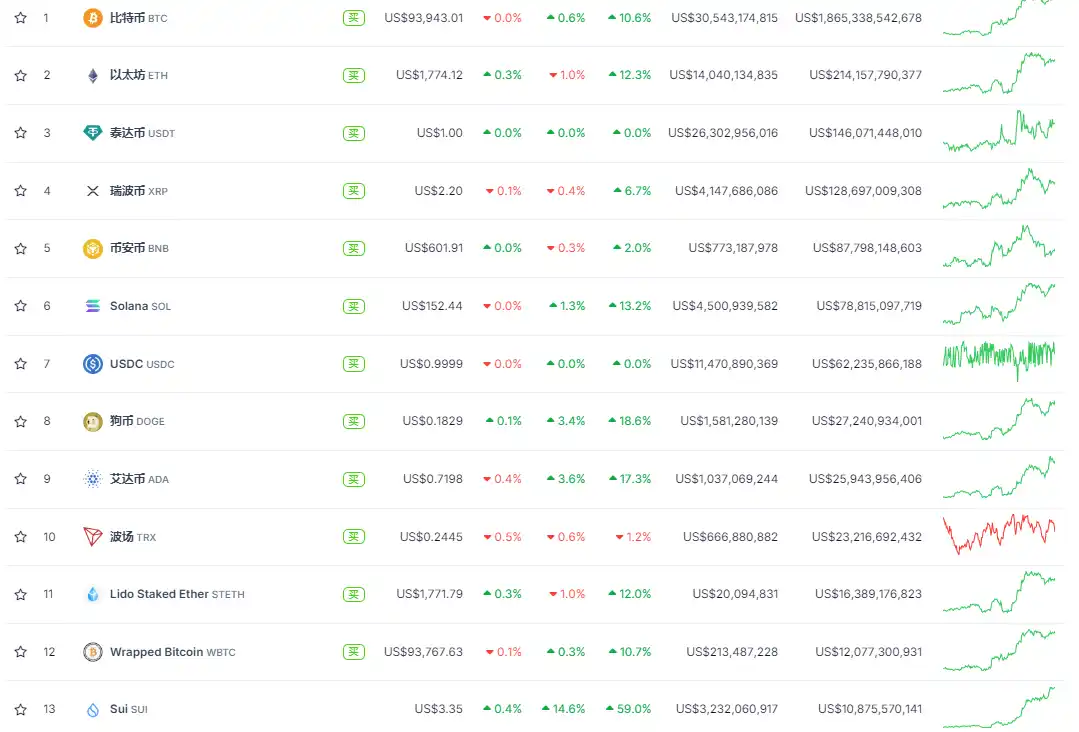
On April 25, 2025, the SUI token surged a staggering 54% over three days to break through $3.39, with the total on-chain value locked reaching $11 billion, making it the only project among the top 20 tokens by market capitalization to break historical resistance levels.
Key Data Comparison (as of April 25):
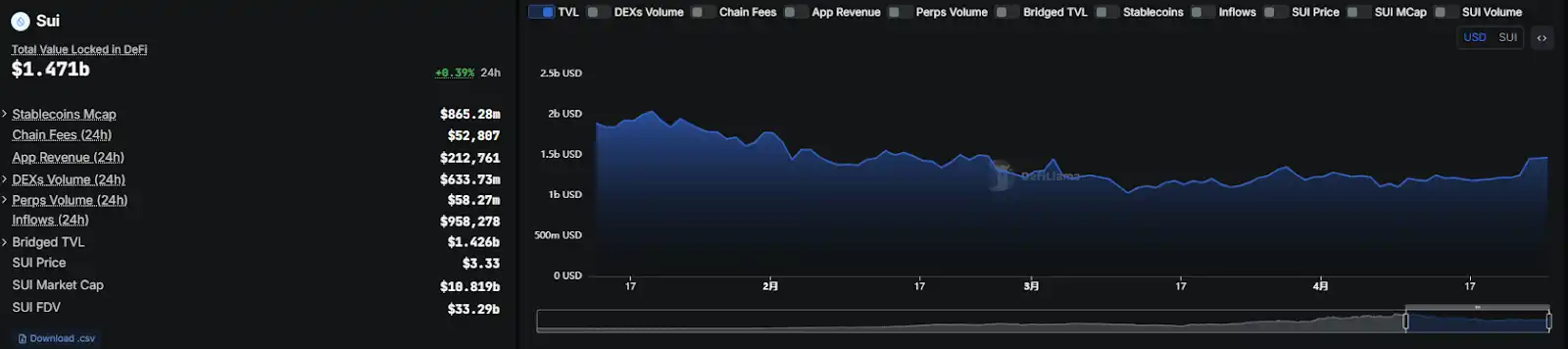
· TVL Growth: The Sui Network's total value locked (TVL) reached $14.6 billion, with a weekly growth rate of 10%, far exceeding Solana (+3.2%) and Avalanche (-1.8%) during the same period.
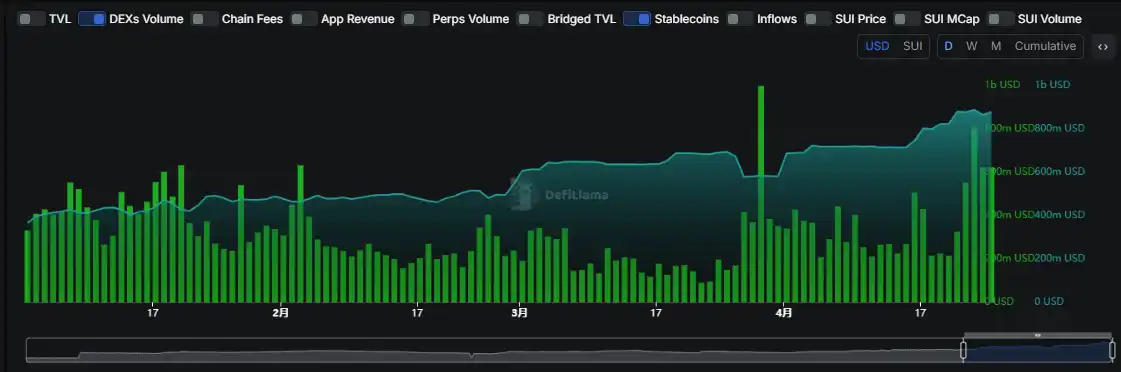
· Stablecoin Ratio: On-chain stablecoin market value surpassed $8.8 billion, with USDC holding a market share of 71%, and liquidity depth increased by 200% compared to three months ago
· DEX Surge: Daily DEX trading volume exceeded $620 million, weekly DEX trading volume reached $2.77 billion, 8 times higher than the market average, with meme coins contributing over 60% of the trading volume.
Behind this "divergent growth" is a new ecological paradigm built by Sui—a triple-engine breakthrough from foundational protocol to application ecosystem through technological stack refactoring, capital synergy, and community fission.
Technological Revolution: Operating System-level Architecture of Public Chain 3.0 Era
Sui's technical architecture is far from a traditional linear upgrade of public chains; it is a restructuring of blockchain architecture based on the concept of a "full-stack operating system":
1. Paradigm Shift of Consensus Mechanism
Mysticeti V2 Engine: Using a DAG (Directed Acyclic Graph) structure, it compresses the confirmation time of shared object transactions to 0.25 seconds, with a tested TPS throughput exceeding 120,000. This makes Sui the first public chain to support high-frequency quantitative trading, with DeepBook order book slippage reduced by 40% compared to Uniswap V4.Remora Sharding Mechanism: By splitting the validation node tasks into computing, storage, and verification modules, linear scalability is achieved. In the testnet environment, adding each group of node clusters increases TPS by 43,000.
2. Disruptive Breakthrough in Storage Layer
Walrus Distributed Network: As the first programmable storage sidechain, it uses erasure coding technology to reduce storage costs to 10% of traditional solutions. In its first month online, the mainnet hosted a 200TB AI training dataset, providing infrastructure for compute-intensive projects like Render Network.SEAL Dynamic Encryption Protocol: Achieving NFT content hierarchical authorization, Warner Music has released dynamic music NFTs based on this technology, with over 120 million plays.
3. Inter-Generational Leap in Developer Experience
· Move Prover Smart Verification: By formal verification, the contract vulnerability rate is reduced to 0.3%, a 5x improvement in security compared to Solidity.· RPC 2.0 Response System: A GraphQL-based query system compresses data call latency to within 50ms. Paired with Bugdar AI audit tools, development efficiency is tripled. This technological architecture has freed Sui from the "performance-decentralization" dichotomy. Artemis data shows that its active validating nodes reach 297, far exceeding Solana's 183, truly achieving both high performance and decentralization.
Ecosystem Eruption: Flywheel Effect of Multi-Track Collaboration
The Sui ecosystem has formed a complete matrix of "Infrastructure-Middleware-Application Layer," with each track showing a synergistic explosive trend:
1. Institutionalization Transformation of DeFi
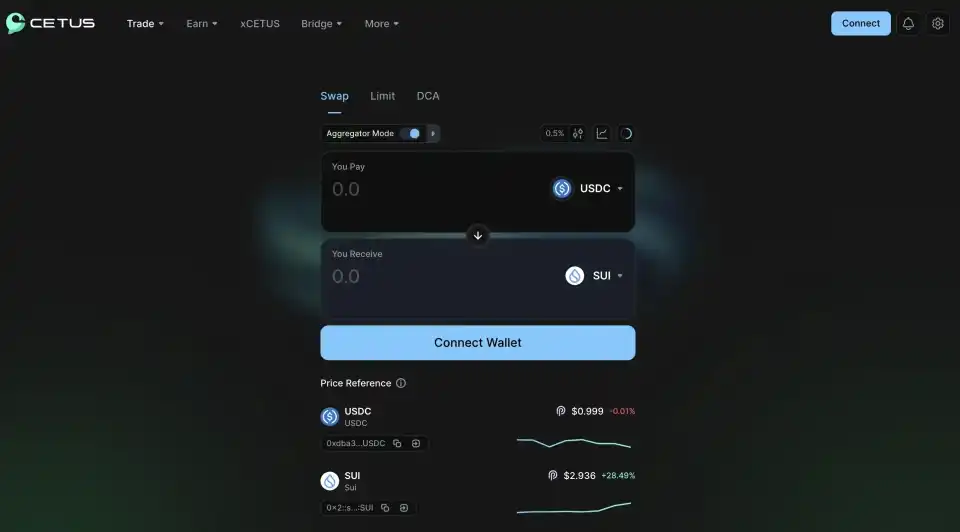
· Cetus Protocol: A liquidity aggregation protocol deeply integrated with DeepBook, stabilizing million-dollar trade slippage to within 0.3%. It has attracted top-tier market makers like Jump Crypto to settle, and the platform's token CETUS has seen a monthly increase of 180%.
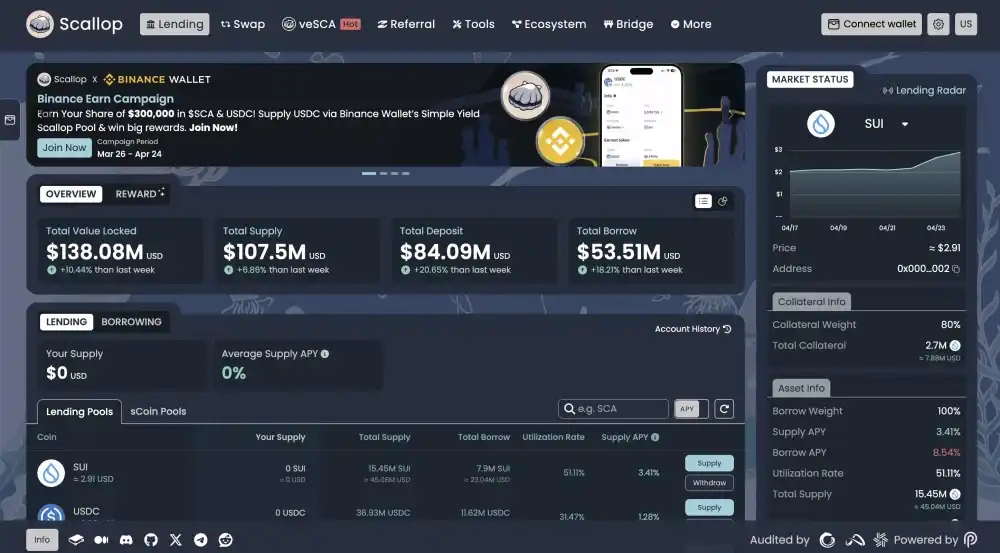
· Scallop Cross-Chain Hub: Through modular design, it supports seamless circulation of assets on 20 chains. Its "yield layering" mechanism has led stablecoin deposit APY to reach 15%, with TVL surpassing $500 million.
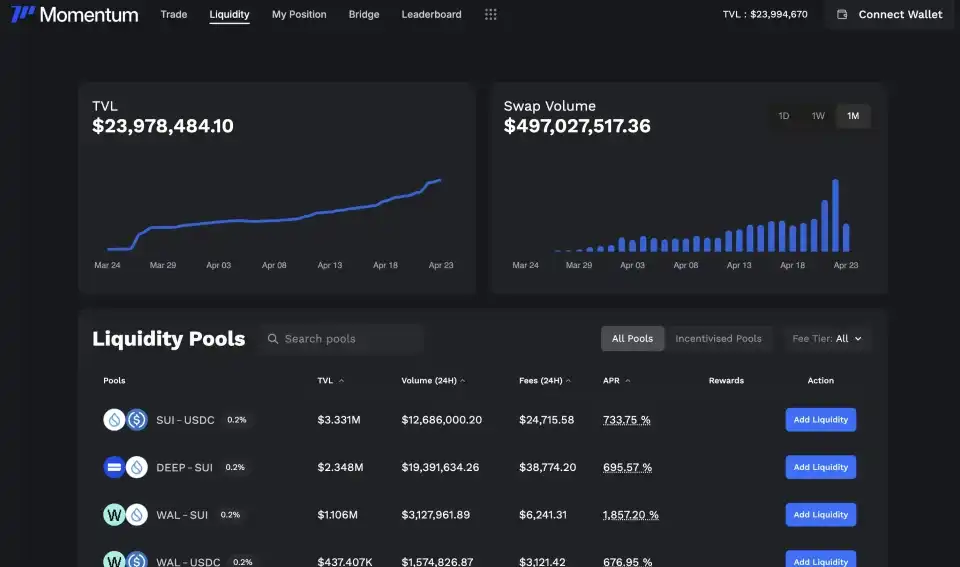
· Momentum Stablecoin Platform: The algorithmic stablecoin and over-collateralization hybrid mechanism achieve a daily average trading volume of $120 million, becoming a cornerstone of liquidity in the Sui DeFi ecosystem.
2. The Traffic Inflection Point of Meme+AI
· LOFI/BLUB Phenomenon: The single-day price surges of two major Meme coins reached 124% and 100% respectively, driving the on-chain active addresses to exceed 1.7 million. Its success stems from Sui's unique Gas Fee Subsidy Mechanism, keeping the cost of small transactions stable at $0.01
· RockeeAI: A DeFi protocol integrating natural language processing, achieving "Voice Command Trading" functionality. The social media sentiment analysis module covers 2000+ communities with a prediction accuracy of 78%
· Zeromorph Perpetual Contract: The AI Agent SDK supports users in training personalized strategies, and the "Risk Hedging Engine" reduces the liquidation rate to one-third of the industry average
3. Ecological Expansion of Hardware Breakthroughs
· SuiPlay0X1 Gaming Handheld: Deep integration of hardware with the blockchain gaming ecosystem, where 62% of the 700,000 pre-orders are from traditional gamers. This device supports seamless acquisition of NFT equipment, leading to a 300% surge in the number of Sui gaming DApps
· Sui Frens Dynamic NFT: Real-time interaction of NFT attributes through a gene mutation algorithm, with the floor price of rare editions surpassing 420 SUI. The minting volume has seen a 470% week-over-week growth
· This multi-dimensional outbreak forms an ecological flywheel: Technological superiority attracts developers → Rich applications enhance user retention → Capital inflow strengthens liquidity → Feedback into technological iteration.
Capital Resonance: Traditional Powers Entering to Reframe Valuation Logic
The essence of Sui's value reassessment is the mainstream capital's repricing of Web3 infrastructure:
1. Three Steps of Institutional Entry
· ETF Breakthrough: Canary Capital submitted the first SUI ETF application, with VanEck predicting a $3.5 billion incremental fund inflow upon approval
· RWA Layout: Collaborating with Franklin D. Roosevelt to build a tokenization platform, managing the on-chainization of $15 trillion in traditional assets
· Compliance Breakthrough: Obtaining the Dubai VARA license, becoming the first compliant public chain in the Middle East, with the Abu Dhabi Sovereign Wealth Fund allocating $230 million
2. Liquidity Structural Transformation
· Stablecoin Leverage: The USDC circulation increased by 7.77% weekly, with institutions conducting cross-chain arbitrage through the CCTP protocol, with a daily average arbitrage scale exceeding $80 million
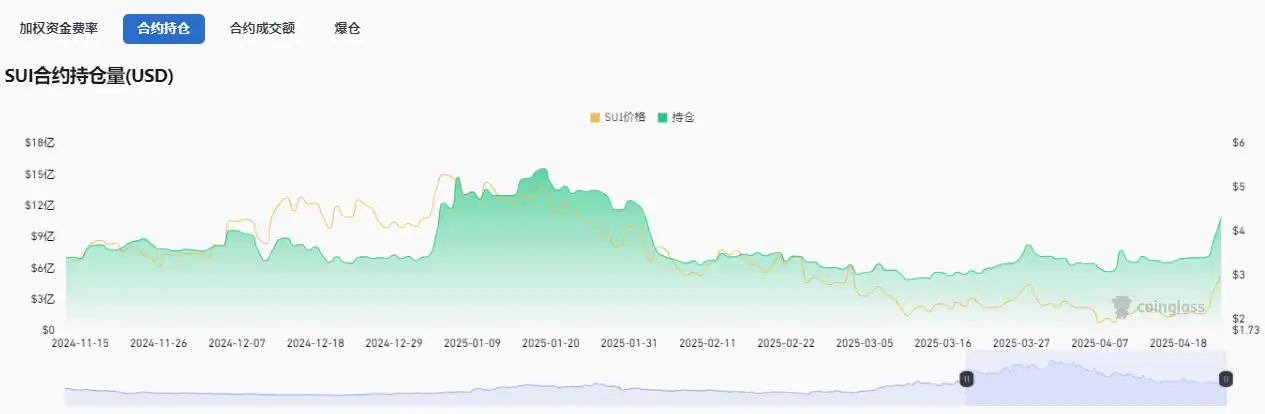
Sui Network-wide Contract Position Surpasses $1.1 Billion
· Contract Position Anomaly: Coinglass data shows a 320% weekly increase in the call option open interest at a $3.5 strike price, with the market betting on a breakout above $4 in May
3. Disruption of Valuation Models
Traditional public chain valuations often adopt Metcalfe's Law (Value∝Number of Users²), while Sui's full-stack capability has spawned the "Metcalfe-Ziff Composite Model":
· Valuation = Number of Developers × (Number of DApps + TVL)^1.5
· According to this model, Sui's current valuation should reach $20 billion, indicating an 80% upside potential from the current price.
· This expectation is supported by on-chain data: the current SUI chain adds 17 new DApps daily, which is 2.3 times that of Solana, signaling an exponential growth stage in network effects.
Conclusion: The Second Half of Public Chain Competition Begins
The rise of SUI marks the entry of blockchain competition into the era of "full-stack capabilities." While other public chains are still grappling with TPS figures, Sui has quietly completed its comprehensive layout from the protocol layer to the application layer, from the online ecosystem to offline hardware. Through the triple resonance of technological depth, capital strength, and ecosystem breadth, Sui is rewriting the fundamental rules of Web3.
The essence of this value reconfiguration is the evolution of blockchain from a "financial experimental field" to a "digital economic operating system." When SUI Play0X1 handheld devices begin to appear in the hands of subway passengers, when Warner Music fans go crazy for dynamic NFTs, we may be witnessing the true "breakout moment" of blockchain technology. Perhaps this feast has just begun.
You may also like

a16z Leads $18M Seed Round for Catena Labs, Crypto Industry Bets on Stablecoin AI Payment
Never Underestimate the Significance of the US Stablecoin 'Infrastructure Bill'
If the US stablecoin bill, the "GENIUS Act," passes smoothly this time, its significance will be tremendous. I even think it's significant enough to enter the top five in Crypto history.
Although abbreviated as the GENIUS Act, which translates directly to the Genius Act, it is actually the Guiding and Establishing National Innovation for U.S. Stablecoins, which translates to "Guiding and Establishing National Innovation for US Dollar Stablecoins."
The proposal is lengthy, with several key points summarized for everyone:
· Mandatory 1:1 Full Asset Backing: Assets include cash, demand deposits, and short-term US Treasuries. At the same time, misappropriation and rehypothecation are strictly prohibited.
· High-Frequency Disclosure: Reserve reports must be published at least monthly, introducing external audits.
· Licensing Requirement: Once the circulating market cap of the issuer's stablecoin exceeds $100 billion, it must transition into the federal regulatory system within a specified timeframe, adopting banking-grade regulation.
· Introduction of Custody: The custodian of the stablecoin and its reserve assets must be a regulated qualified financial institution.
· Clear Definition as a Payment Medium: The bill explicitly defines stablecoin as a new type of payment medium, primarily regulated by the banking regulatory system, rather than restricted by the securities or commodities regulatory system.
· Embracing Existing Stablecoins: A maximum 18-month grace period after the bill's enactment, aimed at encouraging existing stablecoin issuers (such as USDT, USDC, etc.) to promptly obtain licenses or become compliant.
After finishing the main content, let's talk about the significance of this matter with an excited heart.
Over the years, when others asked, "After working in the Crypto industry for 16 years, what application have you created?"
In the future, you can confidently tell others—Stablecoins.
Some people have held opposing views. In the past, people's impression of stablecoins was that they were an opaque black box. Every few months, there would be FUD — whether Tether's assets were frozen or Circle had a significant black hole deficit.
In fact, if you think about it, Tether easily rakes in billions of dollars a year just from the interest on those underlying government bonds. Circle, slightly less, also made a $1.7 billion profit last year.
They basically made money while standing there. From a motivational standpoint, they have no malicious intentions. In fact, they are the most eager for compliance.
Now, this opaque black box will become a transparent white box.
In the past, the only complaint was that Tether's funds might have been frozen by the United States. Now, they will be directly placed into U.S. compliant custodial institutions, with high-frequency disclosures, so you can rest assured.
【No need to worry about a rug pull】 is such a huge advantage—I think especially all Crypto people understand this.
Stablecoins were once almost on the verge of being overtaken by CBDCs. In any country, if a central bank digital currency really exists, it is highly likely not built on a blockchain, at most it is built on some internal central bank consortium chain, which to be honest, is meaningless.
When CBDCs were at their peak, that was the most dangerous time for stablecoins.
If CBDCs had become a reality back then, stablecoins today would have been relentlessly suppressed into a dark corner, and blockchain would only be able to play a minimal role.
The remaining half-dead stablecoins would even have to learn the standards of central bank digital currencies, completely relinquishing their standard-setting power.
And now, stablecoins have won (or are about to).
Instead, everyone should learn the 【Blockchain + Token】 standard.
Nowadays, many blockchains actually have no meaningful applications on top, only stablecoin transfers. For example, with Aptos, the only scenario I use Aptos for is transfers between Binance and OKX.
And now, stablecoins will be legislated, what does that mean?
That's right, blockchain will become the only standard.
In the future, every stablecoin user will be the first to learn how to use a wallet.
As an aside, I actually think Ethereum's concerted push for EIP-7702 is quite forward-thinking. While other chains are all about memes, thank you Ethereum for sticking to account abstraction.
EIP-7702 is about Account Abstraction, which can support, for example:
· Social Account Registration Wallet
· Paying GAS with Native Coin
· And more
This paves the way for future new users to heavily use stablecoins, solving the last-mile problem.
Furthermore, once stablecoins receive legislative support, deposits and withdrawals will become even easier.
Let's imagine a scenario: previously, hindered by the gray nature of stablecoins, but after the bill passes, many traditional brokerages can support stablecoins themselves. The money from a US stock investor can be converted into stablecoins in minutes and instantly deposited into Coinbase. Believe it or not.
Let's imagine another scenario: if the brilliant bill smoothly passes through the House of Representatives, next, you will see:
Due to the extremely lucrative nature of this trading, existing stablecoin leaders and newly entering traditional giants will crazily start promoting their stablecoin products.
And an outsider, due to these promotions, will start using stablecoins. And then one day, after finding out that the wallet account has been created, will explore Bitcoin inside. Is mining Bitcoin difficult?
Stablecoins are a huge Trojan horse. The moment you start using stablecoins, you unwittingly step half a foot into the Crypto world.
As a large reservoir for digesting US debt, although stablecoins cannot directly absorb debt, they at least provide ammunition for the US debt secondary market. These functions are quite important, and slowly, stablecoins are becoming a part of the US debt market's body. Therefore, once the US legislation is passed and experiences the benefits, there is no turning back.
And, we are also confident that stablecoins are indeed one of the great innovations in our industry. People who have used stablecoins will find it hard to return to the traditional cash-banking system.
Once the bill is passed, users can't go back. In the future, concerns are about to be resolved, standards will be mastered, and the era of large deposits seems to be on the horizon.
Original Article Link
Pharos, deeply integrated with AntChain, is about to launch. How can we get involved?
The End and Rebirth of NFTs: How the Meme Coin Craze Ended the PFP Era?
Key Market Intelligence on May 14th, how much did you miss out on?
1.Binance Alpha Launches HIPPO, BLUE, and Other Tokens
2.Believe Ecosystem Tokens See General Rise, LAUNCHCOIN Surges Over 250% in 24 Hours
3.Tiger Securities Introduces Cryptocurrency Deposit and Withdrawal Service, Supports Mainstream Cryptocurrencies such as BTC and ETH
4.Current Bitcoin Rally Possibly Driven by Institutions, Retail Traders Yet to Join
5.Binance Wallet's New TGE Privasea AI Participation Requires a 198 Point Threshold, with a Point Consumption of 15
Source: Overheard on CT (tg: @overheardonct), Kaito
PUMP: Today's discussions about PUMP focus on its new creator revenue-sharing model: the platform will allocate 50% of PumpSwap revenue to token creators, sparking varied reactions from users. Some criticize the move as insufficient or even misleading, while others view it as a positive step the platform is taking to reward creators. Meanwhile, PUMP faces market pressure from emerging competitors like LetsBONKfun and Raydium, which are rapidly gaining market share. Users also express concerns about PUMP's sustainability and potential regulatory risks in the U.S., with discussions extending to the platform's impact on the entire memecoin ecosystem.
COINBASE: Today, Coinbase became the first crypto company to join the S&P 500 Index, replacing Discover Financial Services, sparking widespread industry attention. The entire crypto community views this milestone as a significant development, signaling that crypto assets are further integrating into the mainstream financial system. The news has sparked lively discussions on Twitter, with many users pointing out that this may attract more institutional investors to enter the Bitcoin and other cryptocurrency markets.
XRP: XRP became the focal point of today's crypto discussion, with its significant market movements and strategic advances drawing attention. XRP has surpassed USDT to become the third-largest cryptocurrency by market capitalization, sparking market excitement and discussions about its future potential. The surge in market capitalization and price is believed to be related to increasing institutional interest, deepening strategic partnerships, and its role in the crypto ecosystem. Additionally, XRP's integration into multiple financial systems and its potential as a macro asset class are also seen as key factors driving the current market sentiment.
DYDX: Today's discussions about DYDX mainly focused on the dYdX Yapper Leaderboard launched by KaitoAI. The leaderboard aims to identify the most active community participants, with a total of $150,000 in rewards to be distributed over the first three seasons. This initiative has sparked broad community participation, with many users discussing the potential rewards and the incentive effect on the DYDX ecosystem. Meanwhile, progress on the ethDYDX to dYdX native chain migration and historical airdrop events have also been topics of discussion.
1. "What Is 'ICM'? Holding Up the $4 Billion Market Cap Solana's New Narrative"
Overnight, the hottest narrative in the crypto space has become "Internet Capital Markets," with a host of crypto projects and founders, led by the Solana ecosystem's new Launchpad platform Believe, releasing this phrase. Together with "Believe in something," it has become the new slogan heralding the onset of a bull market. What exactly is the so-called "Internet Capital Market," will it become a short-lived hype phrase like the Base ecosystem's previous Content Coin, and what related targets are available for selection?2.《LaunchCoin Surges 20x in One Day, How Did Believe Create a $200M Market Cap Shiba Inu After Going to Zero?|100x Retrospective》
LAUNCHCOIN broke through a $200 million market cap today, with the long-lost liquidity and such a high market cap "Memecoin" almost bringing half of the on-chain crypto community CT into the fray. The community is crazily discussing this token, with half of it being FOMO and the other half being FUD. This token, originally issued by Believe founder Ben Pasternak under his personal identity, transformed into a new platform token after a renaming. From once going to zero to a $200 million market cap, what happened in between?May 14 On-chain Fund Flow
Within 24 hours, GOONC's market cap soared to 70 million, could GOONC be the next billion-dollar dog on the Believe platform?
Bitcoin has broken $100,000, Ethereum has surpassed 2500, and is Solana's hot streak about to make a comeback?
The current market is in a state of macro euphoria, with GOONC riding the wave today, skyrocketing 10x in just a few hours, reaching a market cap of tens of millions of dollars, trading volume soaring past 50 million, and rumors swirling that the developer may be from OpenAI (unconfirmed but intriguing enough).
A ludicrous and absurd Solana meme that some actually buy into.
GOONC is a meme coin that has sprouted from the "gooning" subculture, offering no technological innovation or practical use, its sole function being speculation.
It takes inspiration from an NSFW term "gooning," which refers to a person being deeply immersed in certain content (you know what), eventually entering a nearly religious-like trance.
In Reddit (such as r/GOONED, r/GoonCaves) and some counterculture media outlets (such as MEL Magazine in 2020), "gooning" has gradually transitioned from an adult label to a meme-addicted, digital content and virtual self-indulgence synonym, arguably the epitome of Degen spirit.
GOONC is playing around with this concept, packaging the addictive nature, uselessness, and irony of gooning into a tradable financial product. The project team has made it clear: "We do not solve blockchain problems, we only trade absurdity." Blunt but oddly genuine.
GOONC launched on May 13, 2025, using the meme coin launch platform Believe App's LaunchCoin module on Solana. This tool is highly Degen: zero technical barriers, a few clicks to create a coin, perfect for projects like GOONC that can come up with ideas out of the blue.
The mastermind behind GOONC is also quite something and is the most talked-about, with KOL @basedalexandoor on X platform (alias "Pata van Goon") personally involved. His profile even caught the attention of Marc Andreessen, co-founder of a16z, making onlookers unable to resist speculating if GOONC has a hint of OpenAI lineage.
While this 'OpenAI Endorsement' is currently just community speculation, it is definitely a good card to play to fuel hype. Saying "we are pure speculation" on one hand, while tagging a few "AI + a16z" on the other.
GOONC took off as soon as it launched. After its launch on May 13, 2025, its market capitalization skyrocketed to $22 million within 4 hours, with a trading volume exceeding $25.6 million in 24 hours. According to platform data, the first day of trading saw an astonishing +41,100% surge, soaring from $0.0000001 to $0.02, becoming a "missed-the-boat" situation.
GOONC quickly formed an active trading community post-launch, with a lot of discussion and trading signals appearing on X platform (such as the 292x return signal provided by DeBot). Liquidity pools on exchanges like Raydium and Meteora grew rapidly, supporting high trading volumes and price increases.
The real climax occurred between May 13 and May 14, with the market cap rising to $5.5 million in the morning and directly surpassing $55 million in the afternoon. By the 14th, it briefly approached a $70 million market cap, with the trading volume soaring to $59 million. Some community members even posted screenshots claiming an increase of +85,000%, creating a new myth out of the ruins.
As of 1:30 pm on May 14, the price stabilized around $0.039, with a total market cap and FDV both around $39.6 million, and a 24-hour trading volume of $5.43 million. Active platforms include XT.COM, LBank, Meteora, and others.
Although there was a slight pullback from the peak ($0.07), the coin's popularity remains strong. For a coin that relies purely on "irony + community + X post" to thrive, this performance is already at a stellar level.
Currently, the background of the token's development team is not transparent, increasing the potential risk of a rug pull. Rugcheck.xyz warns that the creator of the GOONC contract may have permission to modify the contract (e.g., change fees or mint additional tokens), posing certain security risks.
Community members speculate that the meteoric rise of GOONC may be the "last hurrah".
How to Get Rich in Crypto Without Relying on Luck? Financial Veteran Raoul Pal's Macro Insights and Investment Path
Stablecoins Driving Global B2B Payment Innovation: How to Break Through Workflow Bottlenecks and Unlock Trillion-Dollar Market Potential?
These startups are building cutting-edge AI models without the need for a data center
After CEX and Wallet, OKX enters the payment game
Science Equity Movement: DeSci's Trillion-Dollar Knowledge Economy Reconstruction Revolution
Sentient In-Depth Research Report: Secures $85 Million in Funding to Build a Decentralized AGI New Paradigm
April 30th Market Key Intelligence, How Much Did You Miss?
Why Are Crypto Projects Rushing to Issue Credit Cards? A Battle Between Web3 and the Real World
Interview with Virtuals Co-Founder empty: AI Startups Don't Need a Lot of Funding, Crypto is One of the Answers
a16z Leads $25M Investment, 0xMiden to Run a Privacy Chain on Your Phone
Sui Q1 Advanced Report: The Rise of BTCfi Infrastructure, the Boom of Lending Protocols, and the Future of Rollup-Based Scalability
Gate.io MemeBox has officially integrated with the Solana ecosystem, providing lightning-fast on-chain asset trading.
a16z Leads $18M Seed Round for Catena Labs, Crypto Industry Bets on Stablecoin AI Payment
Never Underestimate the Significance of the US Stablecoin 'Infrastructure Bill'
If the US stablecoin bill, the "GENIUS Act," passes smoothly this time, its significance will be tremendous. I even think it's significant enough to enter the top five in Crypto history.
Although abbreviated as the GENIUS Act, which translates directly to the Genius Act, it is actually the Guiding and Establishing National Innovation for U.S. Stablecoins, which translates to "Guiding and Establishing National Innovation for US Dollar Stablecoins."
The proposal is lengthy, with several key points summarized for everyone:
· Mandatory 1:1 Full Asset Backing: Assets include cash, demand deposits, and short-term US Treasuries. At the same time, misappropriation and rehypothecation are strictly prohibited.
· High-Frequency Disclosure: Reserve reports must be published at least monthly, introducing external audits.
· Licensing Requirement: Once the circulating market cap of the issuer's stablecoin exceeds $100 billion, it must transition into the federal regulatory system within a specified timeframe, adopting banking-grade regulation.
· Introduction of Custody: The custodian of the stablecoin and its reserve assets must be a regulated qualified financial institution.
· Clear Definition as a Payment Medium: The bill explicitly defines stablecoin as a new type of payment medium, primarily regulated by the banking regulatory system, rather than restricted by the securities or commodities regulatory system.
· Embracing Existing Stablecoins: A maximum 18-month grace period after the bill's enactment, aimed at encouraging existing stablecoin issuers (such as USDT, USDC, etc.) to promptly obtain licenses or become compliant.
After finishing the main content, let's talk about the significance of this matter with an excited heart.
Over the years, when others asked, "After working in the Crypto industry for 16 years, what application have you created?"
In the future, you can confidently tell others—Stablecoins.
Some people have held opposing views. In the past, people's impression of stablecoins was that they were an opaque black box. Every few months, there would be FUD — whether Tether's assets were frozen or Circle had a significant black hole deficit.
In fact, if you think about it, Tether easily rakes in billions of dollars a year just from the interest on those underlying government bonds. Circle, slightly less, also made a $1.7 billion profit last year.
They basically made money while standing there. From a motivational standpoint, they have no malicious intentions. In fact, they are the most eager for compliance.
Now, this opaque black box will become a transparent white box.
In the past, the only complaint was that Tether's funds might have been frozen by the United States. Now, they will be directly placed into U.S. compliant custodial institutions, with high-frequency disclosures, so you can rest assured.
【No need to worry about a rug pull】 is such a huge advantage—I think especially all Crypto people understand this.
Stablecoins were once almost on the verge of being overtaken by CBDCs. In any country, if a central bank digital currency really exists, it is highly likely not built on a blockchain, at most it is built on some internal central bank consortium chain, which to be honest, is meaningless.
When CBDCs were at their peak, that was the most dangerous time for stablecoins.
If CBDCs had become a reality back then, stablecoins today would have been relentlessly suppressed into a dark corner, and blockchain would only be able to play a minimal role.
The remaining half-dead stablecoins would even have to learn the standards of central bank digital currencies, completely relinquishing their standard-setting power.
And now, stablecoins have won (or are about to).
Instead, everyone should learn the 【Blockchain + Token】 standard.
Nowadays, many blockchains actually have no meaningful applications on top, only stablecoin transfers. For example, with Aptos, the only scenario I use Aptos for is transfers between Binance and OKX.
And now, stablecoins will be legislated, what does that mean?
That's right, blockchain will become the only standard.
In the future, every stablecoin user will be the first to learn how to use a wallet.
As an aside, I actually think Ethereum's concerted push for EIP-7702 is quite forward-thinking. While other chains are all about memes, thank you Ethereum for sticking to account abstraction.
EIP-7702 is about Account Abstraction, which can support, for example:
· Social Account Registration Wallet
· Paying GAS with Native Coin
· And more
This paves the way for future new users to heavily use stablecoins, solving the last-mile problem.
Furthermore, once stablecoins receive legislative support, deposits and withdrawals will become even easier.
Let's imagine a scenario: previously, hindered by the gray nature of stablecoins, but after the bill passes, many traditional brokerages can support stablecoins themselves. The money from a US stock investor can be converted into stablecoins in minutes and instantly deposited into Coinbase. Believe it or not.
Let's imagine another scenario: if the brilliant bill smoothly passes through the House of Representatives, next, you will see:
Due to the extremely lucrative nature of this trading, existing stablecoin leaders and newly entering traditional giants will crazily start promoting their stablecoin products.
And an outsider, due to these promotions, will start using stablecoins. And then one day, after finding out that the wallet account has been created, will explore Bitcoin inside. Is mining Bitcoin difficult?
Stablecoins are a huge Trojan horse. The moment you start using stablecoins, you unwittingly step half a foot into the Crypto world.
As a large reservoir for digesting US debt, although stablecoins cannot directly absorb debt, they at least provide ammunition for the US debt secondary market. These functions are quite important, and slowly, stablecoins are becoming a part of the US debt market's body. Therefore, once the US legislation is passed and experiences the benefits, there is no turning back.
And, we are also confident that stablecoins are indeed one of the great innovations in our industry. People who have used stablecoins will find it hard to return to the traditional cash-banking system.
Once the bill is passed, users can't go back. In the future, concerns are about to be resolved, standards will be mastered, and the era of large deposits seems to be on the horizon.
Original Article Link
Pharos, deeply integrated with AntChain, is about to launch. How can we get involved?
The End and Rebirth of NFTs: How the Meme Coin Craze Ended the PFP Era?
Key Market Intelligence on May 14th, how much did you miss out on?
1.Binance Alpha Launches HIPPO, BLUE, and Other Tokens
2.Believe Ecosystem Tokens See General Rise, LAUNCHCOIN Surges Over 250% in 24 Hours
3.Tiger Securities Introduces Cryptocurrency Deposit and Withdrawal Service, Supports Mainstream Cryptocurrencies such as BTC and ETH
4.Current Bitcoin Rally Possibly Driven by Institutions, Retail Traders Yet to Join
5.Binance Wallet's New TGE Privasea AI Participation Requires a 198 Point Threshold, with a Point Consumption of 15
Source: Overheard on CT (tg: @overheardonct), Kaito
PUMP: Today's discussions about PUMP focus on its new creator revenue-sharing model: the platform will allocate 50% of PumpSwap revenue to token creators, sparking varied reactions from users. Some criticize the move as insufficient or even misleading, while others view it as a positive step the platform is taking to reward creators. Meanwhile, PUMP faces market pressure from emerging competitors like LetsBONKfun and Raydium, which are rapidly gaining market share. Users also express concerns about PUMP's sustainability and potential regulatory risks in the U.S., with discussions extending to the platform's impact on the entire memecoin ecosystem.
COINBASE: Today, Coinbase became the first crypto company to join the S&P 500 Index, replacing Discover Financial Services, sparking widespread industry attention. The entire crypto community views this milestone as a significant development, signaling that crypto assets are further integrating into the mainstream financial system. The news has sparked lively discussions on Twitter, with many users pointing out that this may attract more institutional investors to enter the Bitcoin and other cryptocurrency markets.
XRP: XRP became the focal point of today's crypto discussion, with its significant market movements and strategic advances drawing attention. XRP has surpassed USDT to become the third-largest cryptocurrency by market capitalization, sparking market excitement and discussions about its future potential. The surge in market capitalization and price is believed to be related to increasing institutional interest, deepening strategic partnerships, and its role in the crypto ecosystem. Additionally, XRP's integration into multiple financial systems and its potential as a macro asset class are also seen as key factors driving the current market sentiment.
DYDX: Today's discussions about DYDX mainly focused on the dYdX Yapper Leaderboard launched by KaitoAI. The leaderboard aims to identify the most active community participants, with a total of $150,000 in rewards to be distributed over the first three seasons. This initiative has sparked broad community participation, with many users discussing the potential rewards and the incentive effect on the DYDX ecosystem. Meanwhile, progress on the ethDYDX to dYdX native chain migration and historical airdrop events have also been topics of discussion.
1. "What Is 'ICM'? Holding Up the $4 Billion Market Cap Solana's New Narrative"
Overnight, the hottest narrative in the crypto space has become "Internet Capital Markets," with a host of crypto projects and founders, led by the Solana ecosystem's new Launchpad platform Believe, releasing this phrase. Together with "Believe in something," it has become the new slogan heralding the onset of a bull market. What exactly is the so-called "Internet Capital Market," will it become a short-lived hype phrase like the Base ecosystem's previous Content Coin, and what related targets are available for selection?2.《LaunchCoin Surges 20x in One Day, How Did Believe Create a $200M Market Cap Shiba Inu After Going to Zero?|100x Retrospective》
LAUNCHCOIN broke through a $200 million market cap today, with the long-lost liquidity and such a high market cap "Memecoin" almost bringing half of the on-chain crypto community CT into the fray. The community is crazily discussing this token, with half of it being FOMO and the other half being FUD. This token, originally issued by Believe founder Ben Pasternak under his personal identity, transformed into a new platform token after a renaming. From once going to zero to a $200 million market cap, what happened in between?May 14 On-chain Fund Flow
Within 24 hours, GOONC's market cap soared to 70 million, could GOONC be the next billion-dollar dog on the Believe platform?
Bitcoin has broken $100,000, Ethereum has surpassed 2500, and is Solana's hot streak about to make a comeback?
The current market is in a state of macro euphoria, with GOONC riding the wave today, skyrocketing 10x in just a few hours, reaching a market cap of tens of millions of dollars, trading volume soaring past 50 million, and rumors swirling that the developer may be from OpenAI (unconfirmed but intriguing enough).
A ludicrous and absurd Solana meme that some actually buy into.
GOONC is a meme coin that has sprouted from the "gooning" subculture, offering no technological innovation or practical use, its sole function being speculation.
It takes inspiration from an NSFW term "gooning," which refers to a person being deeply immersed in certain content (you know what), eventually entering a nearly religious-like trance.
In Reddit (such as r/GOONED, r/GoonCaves) and some counterculture media outlets (such as MEL Magazine in 2020), "gooning" has gradually transitioned from an adult label to a meme-addicted, digital content and virtual self-indulgence synonym, arguably the epitome of Degen spirit.
GOONC is playing around with this concept, packaging the addictive nature, uselessness, and irony of gooning into a tradable financial product. The project team has made it clear: "We do not solve blockchain problems, we only trade absurdity." Blunt but oddly genuine.
GOONC launched on May 13, 2025, using the meme coin launch platform Believe App's LaunchCoin module on Solana. This tool is highly Degen: zero technical barriers, a few clicks to create a coin, perfect for projects like GOONC that can come up with ideas out of the blue.
The mastermind behind GOONC is also quite something and is the most talked-about, with KOL @basedalexandoor on X platform (alias "Pata van Goon") personally involved. His profile even caught the attention of Marc Andreessen, co-founder of a16z, making onlookers unable to resist speculating if GOONC has a hint of OpenAI lineage.
While this 'OpenAI Endorsement' is currently just community speculation, it is definitely a good card to play to fuel hype. Saying "we are pure speculation" on one hand, while tagging a few "AI + a16z" on the other.
GOONC took off as soon as it launched. After its launch on May 13, 2025, its market capitalization skyrocketed to $22 million within 4 hours, with a trading volume exceeding $25.6 million in 24 hours. According to platform data, the first day of trading saw an astonishing +41,100% surge, soaring from $0.0000001 to $0.02, becoming a "missed-the-boat" situation.
GOONC quickly formed an active trading community post-launch, with a lot of discussion and trading signals appearing on X platform (such as the 292x return signal provided by DeBot). Liquidity pools on exchanges like Raydium and Meteora grew rapidly, supporting high trading volumes and price increases.
The real climax occurred between May 13 and May 14, with the market cap rising to $5.5 million in the morning and directly surpassing $55 million in the afternoon. By the 14th, it briefly approached a $70 million market cap, with the trading volume soaring to $59 million. Some community members even posted screenshots claiming an increase of +85,000%, creating a new myth out of the ruins.
As of 1:30 pm on May 14, the price stabilized around $0.039, with a total market cap and FDV both around $39.6 million, and a 24-hour trading volume of $5.43 million. Active platforms include XT.COM, LBank, Meteora, and others.
Although there was a slight pullback from the peak ($0.07), the coin's popularity remains strong. For a coin that relies purely on "irony + community + X post" to thrive, this performance is already at a stellar level.
Currently, the background of the token's development team is not transparent, increasing the potential risk of a rug pull. Rugcheck.xyz warns that the creator of the GOONC contract may have permission to modify the contract (e.g., change fees or mint additional tokens), posing certain security risks.
Community members speculate that the meteoric rise of GOONC may be the "last hurrah".
Popular coins
Latest Crypto News


Customer Support:@weikecs
Business Cooperation:@weikecs
Quant Trading & MM:bd@weex.com
VIP Services:support@weex.com
 App
App