
- Buy Crypto
- Markets
- Futures
- Spot
- Copy Trade
 Earn
Earn- More
Worldwide Debut: Bitcoin Unified Asset Protocol 'Goldinals' Chinese Deep Dive

Article Source: Nubit
On January 10, 2025, Nubit, a Bitcoin project deeply rooted in native Bitcoin ecosystem development, released a Bitcoin asset protocol called "Goldinals" (Protocol Whitepaper: https://www.nubit.org/Goldinals.pdf).
According to the official statement, the Goldinals concept was proposed by Domo, the creator of the Ordinals protocol's first token ($ORDI) and BRC20, and was implemented by the Nubit team to achieve technical implementation. This protocol aims to introduce trustless asset management and programmability to the Bitcoin ecosystem, addressing the lack of interoperability between existing Bitcoin asset protocols (such as BRC-20, Runes, Ordinals, etc.), which has led to fragmented liquidity and security risks.
Goldinals's slogan is "The Unified Protocol for Bitcoin Assets," aiming to provide a unified standard for Bitcoin assets, compatible with existing protocols, while supporting more efficient asset creation, management, and interaction features. It will be a significant step for the Bitcoin ecosystem to advance into the asset programming domain.
Nubit, founded by UC Santa Barbara Professor YU FENG, aims to build "the Trustless World Computer for Bitcoin" by leveraging Bitcoin's native technologies such as BitVM to achieve Bitcoin's open scalability and programmability. Nubit enables developers to build any Bitcoin-native applications, bringing global users into the Bitcoin ecosystem.
Goldinals Design Principles Overview
Goldinals is a Bitcoin-native asset protocol designed to break free from Bitcoin's technical constraints while providing similar functionalities to mature asset standards on other blockchains (such as Ethereum's ERC-20).
In Ethereum, developers can leverage the ERC-20 standard to deploy, transfer, mint, and burn tokens through a simple API. However, the current Bitcoin-based BRC-20 protocol, while attempting to achieve similar functionality, heavily relies on off-chain indexers and additional trust assumptions, limiting its decentralization and security.
The Goldinals Asset Protocol, to address trust and security issues, provides a revolutionary on-chain alternative that implements a similar API directly on the Bitcoin network, including:
· Deploy: Initialize the protocol's global parameters and create a new token instance.
· Mint: Increase the token's supply and allocate the newly minted tokens to a specified address.
· Transfer: Transfer tokens between addresses while ensuring validity checks such as balance verification.
· Burn: Decrease the token's supply by permanently removing tokens through an on-chain operation.
Although the logic of the above APIs is similar to ERC-20, implementing these functions on Bitcoin requires overcoming its stateless design and Turing incomplete script language limitations. To tackle this challenge, Goldinals has designed a sophisticated three-stage state machine process to ensure the legitimacy, transparency, and trustlessness of operations.
Through the three-stage state machine, Goldinals cleverly adapts to Bitcoin's technical constraints by breaking down each operation into multiple steps, combined with on-chain data and zero-knowledge proofs (ZKPs), ensuring the security and trustworthiness of the final confirmed state. This design not only addresses Bitcoin's native technical limitations on complex operations but also eliminates reliance on centralized indexers, enabling every token operation to take place in a trustless environment. The following are the specific steps of Goldinals' three-stage state machine:
1. Preparation Stage:
In this stage, users declare the intent of the operation (such as transferring, minting, or burning tokens) through on-chain transactions. The transaction content includes the target address, operation type, and parameters, which are written to the Bitcoin chain via the OP_RETURN field, ensuring the data's permanent availability and transparency.
This process is like writing a check, where the user specifies the payee, amount, and purpose on the check, but it has not been formally delivered yet.
2. Kickoff Stage:
After a certain number of block confirmations, users can submit a "Kickoff Transaction," which includes:
1) Submission of Zero-Knowledge Proof (ZKP): Using mathematical methods to prove the legitimacy of the operation, such as sufficient balance or compliance with protocol rules.
2) Verification Data: Used to prove relevant information about the on-chain state.
3) State Update: Clearly states the impact of the requested operation on the protocol's global state.
The Kickoff Stage is a core step in confirming the operation, similar to a notary verifying the legality of a check. During this process, all operation conditions are strictly verified on-chain, while complex computation verification is achieved through BitVM's computing capability.
3. Challenge Stage:
After the Kickoff Stage is completed, the process enters the Challenge Stage, where the user's operation undergoes a security validation period. During this period, any network validator (referred to as a challenger) can validate the validity of the user-submitted zero-knowledge proof:
1) If any illegal operation is discovered, the challenger can challenge the legality of the operation through on-chain transactions;
2) If there is no valid challenge, the operation will be formally confirmed and updated in the protocol's global state.
This stage is similar to multiple auditors conducting a review of the transaction's legality, where only one honest challenger can prevent potential fraudulent behavior.
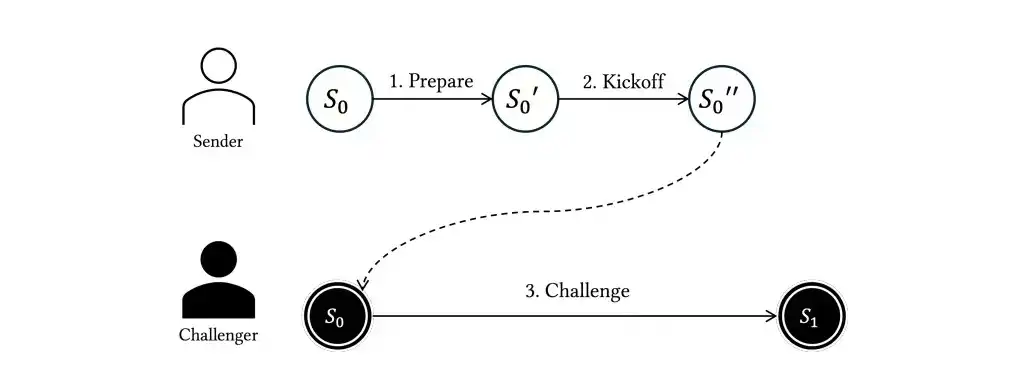
Through multi-stage verification, Goldinals has successfully addressed the limitations of Bitcoin's native technology. It ensures that all token operations can be carried out in a fully decentralized and trust-minimized environment, providing an efficient, transparent, and secure solution for complex asset operations.
This design not only allows developers to build powerful and secure Bitcoin-native applications through Goldinals' API but also brings trust and technological innovation to the entire Bitcoin ecosystem.
Revolutionary Protocol for Unified Bitcoin Ecosystem Assets
The launch of Goldinals may usher in a new era of unity and expansion for the Bitcoin asset ecosystem.
As a full-fledged ERC-20 standard on Bitcoin, Goldinals is compatible with existing Bitcoin asset protocols (such as BRC-20, Ordinals, Runes, and CAT), while supporting future Bitcoin assets and application development.
Through decentralized validation and on-chain programmability, Goldinals eliminates reliance on centralized indexers, enabling the Bitcoin asset ecosystem to truly achieve trustlessness and Bitcoin nativeness. Post Goldinals, existing Bitcoin applications can easily add new features or develop new assets without the need to painstakingly create new protocols. By unifying Bitcoin assets, Goldinals will provide the ultimate solution for upgrading the Bitcoin asset ecosystem.
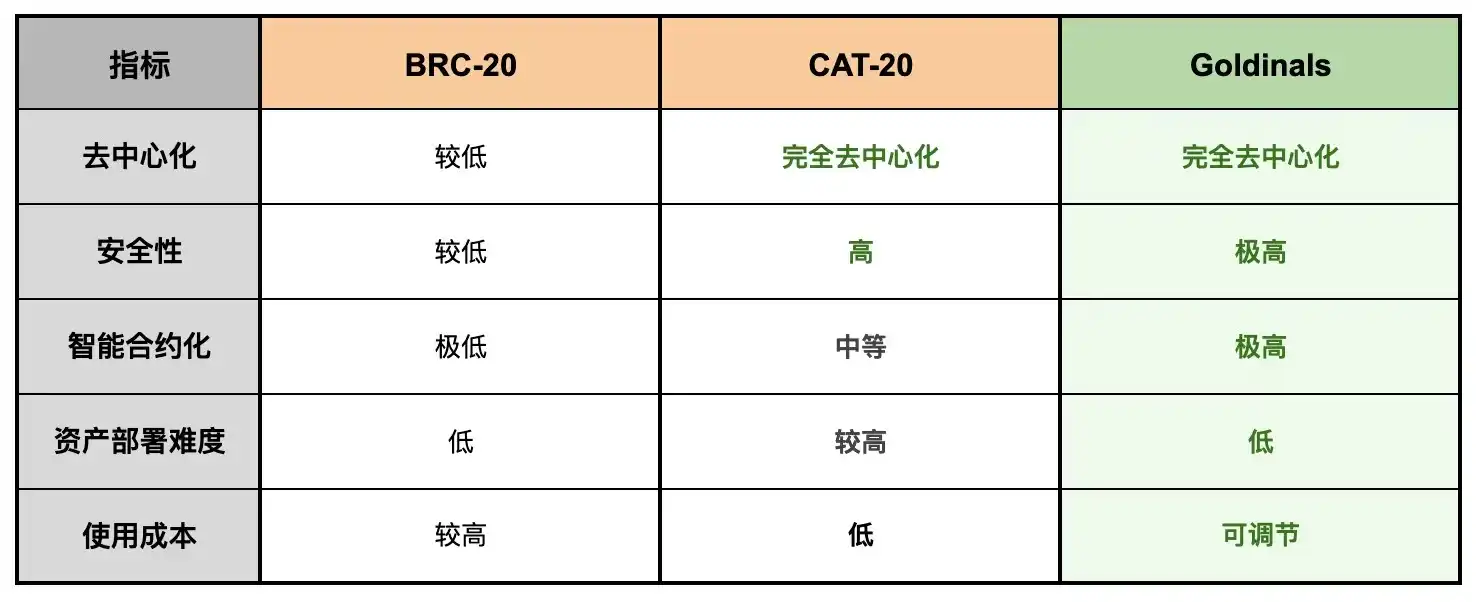
Initial observations suggest that Goldinals possesses the following significant advantages:
· Minimized Trust: All operations are directly validated on the Bitcoin chain without relying on centralized indexers or custodial solutions, ensuring full decentralization.
· Inherited Bitcoin Security: Goldinals records every token operation directly on the Bitcoin chain, relying on Bitcoin's finality and data availability to mitigate risks of L2 protocol disruptions.
· Native Programmability: Leveraging BitVM technology, Goldinals supports complex on-chain logic, including multi-signature wallets, conditional transfers, and token gating, expanding the application scenarios of the Bitcoin protocol.
· Efficiency and Scalability: Through zero-knowledge proofs and optimized design, Goldinals significantly reduces transaction costs while enhancing operational speed and scalability, providing a better experience for developers and users.
Building on these advantages, Goldinals is not only an upgrade to the Bitcoin asset protocol but also the foundational framework for the future development of the Bitcoin asset ecosystem.
Upon reviewing Nubit's official social media, we have found that Goldinals has been steadily expanding its ecosystem, which will encompass areas such as wallets, trading platforms, infrastructure, and financial solutions.
Its core partners include Babylon, Lombard, Yala, Succinct, StarkWare, Fractal Bitcoin, Merlin, sCrypt, and others. These partnerships will drive the innovative development of cross-chain bridges, stablecoins, and Bitcoin-native financial solutions.
In addition, Goldinals has also attracted over 30 Bitcoin ecosystem participants, including Milkyway, Wizz Wallet, Avalon Finance, and more. With Goldinals set to launch soon, developers and the community can participate and engage through the Goldinals website, ushering in a more open, programmable, and decentralized future for Bitcoin asset protocols.
Bitcoin 3.0: A Unified and Decentralized New Era
Goldinals has introduced a new trust-minimized token standard, injecting powerful decentralization and programmability into the Bitcoin asset ecosystem, marking a significant leap forward in the evolution of Bitcoin asset protocols. With compatibility with the existing ecosystem and seamless support for new application scenarios, Goldinals will provide a broader imagination space for Bitcoin's application in the global economy.
Whether issuing custom assets, building a stablecoin system, or achieving decentralized liquidity mining, Goldinals will empower developers and enterprises to explore new frontiers of Bitcoin, ushering in the golden age of Bitcoin 3.0.
Goldinals Whitepaper Original Text: https://www.nubit.org/Goldinals.pdf
This article is a contributed piece and does not represent the views of BlockBeats.
You may also like

Each to Their Own, Every Public Blockchain Has Its Purpose
Is Solana About to Recover? Analyzing On-Chain MEME Whale Movement
Key Market Information Discrepancy on April 11th - A Must-Read! | Alpha Morning Post
Tariff Reprieve Unleashes SOL On-Chain 'Emotion Rush' Space, FART and VINE Surge Over 40% Intraday
X Space Review | The Future of Memes, Exploring the Development Trends of the Meme Space Post-Hype
This Week in Review | US Imposes Additional Tariffs Leading to Market Plunge; Blockchain Gaming Projects Face Financial Crisis
BlockBeats will summarize the industry's key news content for the week (3.31-4.6) in this article and recommend in-depth articles to help readers better understand the market and grasp industry trends.
On April 3, Trump announced in the White House Rose Garden that the U.S. would impose a comprehensive 10% tariff on all imports. The detailed tariff measures for each country are as follows: 46% tariff on Vietnam; 10% tariff on the UK; 31% tariff on Switzerland; 49% tariff on Cambodia; 36% tariff on Thailand; 30% tariff on South Africa; 32% tariff on Indonesia; 10% tariff on Brazil; 10% tariff on Singapore. A 20% retaliatory tariff will be imposed on the EU on a country-by-country basis; a 24% tariff will be imposed on goods imported from Japan. Due to the 10% comprehensive tariff, which was at the low end of the previous expectations (10%-20%), Bitcoin briefly surged by 2.7% that evening, breaking through $88,000. However, after the detailed tariff announcement, Bitcoin quickly fell by 3.35%, Nasdaq futures plummeted, widening the decline to 1.2%, and the U.S. Dollar Index (DXY) also experienced a 0.5% fluctuation. Additionally, it is worth noting that energy commodities are exempt from Trump's comprehensive tariff, including crude oil, natural gas, and refined oil products.
On the same day, U.S. Treasury Secretary Benson wrote, "I suggest that all countries refrain from taking retaliatory action. We can see if there will be a different lower limit for tariffs (from the announced numbers). Trump's mindset might be to temporarily stabilize things. I was not part of the negotiations, but we will see if there are any negotiations before April 9 (the effective date of retaliatory tariffs)." Previously, senior White House officials stated that the base tariff rate (10%) would take effect early on April 5, and the retaliatory tariffs would take effect early on April 9. Related Readings: "U.S. Stock Market Evaporates $2 Trillion in 15 Minutes, Is the 'Retaliatory Tariff' the Last Straw for the Bull Market?", "How Do Tariffs Stir Up Cryptocurrency Prices?"
On April 2, Justin Sun posted on social media claiming that the FDUSD issuer, First Digital Trust (FDT), had actually gone bankrupt and was unable to fulfill customer fund redemption obligations. He strongly advised users to take immediate action to protect their assets. Subsequently, FDUSD temporarily plummeted below $0.9. As a result, several FDUSD-related trading pairs on Binance experienced extreme price surges: BTC reached a high of 98,950 FDUSD, and ETH reached a high of 2165 FDUSD. Since FDUSD is the new stablecoin supported by Binance after BUSD was delisted, Binance, as the primary use case, responded to this news by stating that a 1:1 redemption is possible.
In the early hours of the 3rd, Justin Sun once again posted stating that this FUD was only directed at FDT and not at Binance. At noon on the 3rd, First Digital issued a statement denying Sun's claims, mentioning that the initial redemptions after the FUD had already been processed. FDUSD is still fully backed at a 1:1 ratio, its redemption channels are operating smoothly, and all redemption requests will continue to be processed promptly.
According to reports from Hong Kong media, Wu Kit-chee, Chairman of the Web3 and Virtual Asset Development Subcommittee of the Hong Kong Legislative Council, responded to the dispute between Justin Sun and FDT by suggesting that regulatory systems should be reviewed as soon as possible. Wu Kit-chee stated that due to the current lack of regulated custodianship, Web3 companies rely on trust companies to help third parties custody assets. While conducting this properly is not an issue, there are individuals who may take advantage of this gap to engage in illegal activities, raising concerns about trust in Hong Kong's financial center. He recommended that the authorities should do more in terms of education and review to optimize the existing framework.
On April 3, during a live press conference, Justin Sun stated, "We have over $500 million USD deposited in FDT but cannot withdraw." He also called on FDT to hire a third-party auditing firm to conduct an audit, believing that the audit results would show FDT is insolvent. He further mentioned that due to FDT's failure to pay investment interest in 2023, Techteryx conducted an investigation and found a significant amount of client funds had been misappropriated. Justin Sun personally provided assistance to Techteryx to ensure TUSD had sufficient liquidity to protect the interests of all TUSD holders. TrueCoin was implicated in colluding with FDT and illegally transferring $456 million USD of TUSD reserves to a company in Dubai. Justin Sun stated, "I will provide a $50 million reward to law enforcement agencies and tipsters to recover the $456 million USD." First Digital later responded to the allegations stating that the dispute only involved TUSD and was completely unrelated to FDUSD. First Digital has more than enough liquidity to meet its obligations. It also described this as a typical smear campaign by Justin Sun aimed at undermining its business competitors. Related Reading: "FDUSD Depegging Crisis: Justin Sun Accuses FDT of Embezzling $456 Million, Latter Denies Insolvency"
On April 1st, several meme tokens experienced a sharp decline in prices, with ACT plummeting over 50% briefly; DEXE dropping over 28% briefly; and DF plunging over 17.7% briefly, among others. This sell-off was triggered by a large number of short-term sell orders, leading to a significant increase in spot trading volume. Subsequently, crypto influencer Benson Sun analyzed in a post stating, "ACT suddenly flash crashed by 50%, as Binance adjusted ACT's leverage position limit, allowing a maximum position of only $4.5 million at 1x leverage. Some market makers' positions exceeded the limit, leading to liquidation at market price, causing a collapse in the contract price and a massive price spread between the contract and spot markets, resulting in a cascade sell-off in the spot market as well." Wintermute's founder and CEO, Evgeny Gaevoy, responded to community skepticism claiming, "The flash crash was initiated by Wintermute's dumping," stating, "It has nothing to do with us, but I'm curious to know what happened in the aftermath analysis." He also added, "If you ask me to guess, we reacted only after the price violently fluctuated, arbitraging the AMM pools."
In the early hours of April 2nd, Binance responded to the sudden fall in prices of certain meme coins like ACT, stating, "Upon preliminary investigation, we found that individual low-market-cap tokens experienced a cascading drop event, including 3 VIP users engaging in roughly $514,000 USDT worth of token cross-market sell-offs within a short period and a non-VIP user transferring a large amount of ACT from another platform, selling around $540,000 USDT worth of tokens on the spot market in a brief timeframe. As prices dropped, some users' futures contracts were liquidated, leading to a drop in other tokens as well." It is worth noting that in the following days, tokens such as MASK, LEVER, TROY, CATI, among others, once again experienced a significant volume-driven decline, with trading volume spiking 5 to 10 times higher than usual. Related Read: "ACT Flash Crash Night: When Exchange 'Circuit Breaker' Turns into a Bearish Bullet"
On April 1st, according to Slow Mist monitoring, the zkLend hacker (from an incident in February) mistakenly clicked on a phishing website while attempting to use Tornado Cash, leading to the theft of 2930 ETH. The hacker then sent an on-chain message to zkLend, stating, "Hello, I intended to transfer the funds to Tornado Cash, but I mistakenly used a phishing site, and as a result, all funds were lost. I am devastated. I deeply apologize for the chaos and loss caused by this. All 2930 ETH has been taken by the operators of that site. I have no coins left in my possession. Please focus your efforts on those site operators to see if any funds can be recovered."
On the same day, the zkLend team released a statement indicating that the phishing website appears to have been operational for over 5 years. At this stage, the security team has no concrete evidence linking the phishing site to the attackers. As a precautionary measure, zkLend has incorporated these new wallet addresses from the phishing site into its fund tracking efforts for real-time monitoring and has been in contact with CEX and authorities. The team will continue to actively track these funds. Related reading: "zkLend Hacker Also Hacked, Is the On-Chain Apology Truly Remorseful or Staged?"
On April 1, according to HTX market data, Bitcoin had a first-quarter return of -11.82%, and Ethereum had a first-quarter return of -45.41%, marking their worst performances to date since 2019. In 2018, Bitcoin saw a first-quarter return of -49.7%, and Ethereum had a first-quarter return of -46.61%. Additionally, historical data indicates that Bitcoin typically performs well in the second quarter, with a 12-year average quarterly return of 24.86% and a median quarterly return of 7.19%. However, its performance has been lackluster in the past five years as follows: a 42.33% increase in Q2 2020, a 40.36% decline in Q2 2021, a 56.2% decline in Q2 2022, a 7.19% increase in Q2 2023, and an 11.92% decline in Q2 2024. In April over the past 12 years, Bitcoin has seen 7 increases and 5 declines, with a monthly average return of 12.03% and a monthly median return of 2.81%. However, its performance has been mediocre in the past five years with: a 34.26% increase in April 2020, a 1.98% decline in April 2021, a 17.3% decline in April 2022, a 2.81% increase in April 2023, and a 14.76% decline in April 2024.
On April 1, the publicly traded U.S. cryptocurrency exchange Coinbase experienced its worst quarter performance since the 2022 FTX exchange crash, with its stock price declining by 33% in the first quarter of 2025. Despite strong revenue expectations, Coinbase's stock price still suffered. Coinbase is expected to release its 2025 financial data in early May. The company's recent shareholder letter indicated that as of February 11, the company had generated approximately $750 million in transaction revenue and expects subscription revenue to be between $685 million and $765 million. While Coinbase has not yet disclosed first-quarter profit data, MarketBeat analysis estimates its profit to be around $1.87 billion. Coinbase is not alone as most publicly listed crypto companies reported similar results in the first quarter of 2025. Leading crypto mining company Marathon Digital Holdings saw its stock price near $17.5 at the beginning of the first quarter and closed at $11, a loss of over 37%.
On March 30, according to 8marketcap data, Ethereum's market cap dropped to $218.73 billion, with a 7-day decrease of 9.98%, ranking it 68th on the global asset market cap list. McDonald's surpassed Ethereum with a market cap of $219.4 billion, placing it 67th on the global asset market cap list.
On April 1, according to CNBC, OpenAI completed a $40 billion funding round, bringing its post-investment valuation to $300 billion (including new capital). According to CB Insights data, this valuation makes OpenAI one of the highest-valued private companies globally, second only to SpaceX at $350 billion, alongside TikTok's parent company ByteDance. This round of funding was led by SoftBank from Japan, with an investment of $30 billion, and received support from a group of other investors, including key investor Microsoft, as well as institutions like Coatue, Altimeter, and Thrive. Sources revealed that the initial investment was $10 billion, with the remaining $30 billion expected to be in place by the end of 2025. However, this round of funding comes with a condition: if OpenAI fails to restructure into a profitable entity by December 31, 2025, the funding amount may be reduced by up to $10 billion.
On March 31, the SpaceX Crew Dragon began its sixth manned space mission (Fram-2) on April 1, marking humanity's first polar orbit manned spaceflight lasting 3 to 5 days. The launch took place from Launch Complex 39A at Kennedy Space Center in Florida, USA, on April 1. The crew for this mission consists of 4 astronauts, namely F2Pool co-founder Wang Chun, Janick Michelsen, Labéaurogue, and Anärykphillips. Wang Chun's team independently funded nearly $200 million for this flight plan, making it the first privately contracted polar orbit mission in commercial spaceflight history, with Wang Chun serving as the mission's commander. The spacecraft will enter a polar orbit with an inclination of 90° at an altitude between 425 and 450 kilometers. It will travel along the polar orbit, flying from over the South Pole to the North Pole, and then back from the North Pole to the South Pole, repeating this path. Related Read: "From Bitcoin Miner to Polar Astronaut: Wangchun's Magical Realism Rags-to-Riches Story"
On March 31, Elon Musk, during the "America PAC" town hall meeting held in Green Bay, Wisconsin on March 30, stated that the US government has no plans to use the cryptocurrency Dogecoin. He pointed out that the federal "Department of Government Efficiency (D.O.G.E.)" is not associated with Dogecoin, saying "they are just namesake, the government is not going to use Dogecoin, at least not that I know of." Despite this, the D.O.G.E. official website briefly displayed Dogecoin's Shiba Inu mascot in February, sparking market speculation about the government's relationship with cryptocurrency and driving DOGE up by 14%, with a market cap exceeding $580 billion. Related reading: "Musk Denies Relationship Between DOGE and US Government, Is Dogecoin Really Over?"
On April 3, Bitcoin developer Ruben Somsen wrote that the Bitcoin Development Group BitcoinDev's email list was "permanently removed" by Google. Ruben had previously stated, "To my knowledge, no inappropriate content has been posted." An update later stated, "It turns out we did receive more information, but it was all thrown into the spam folder (the irony). It's clear we have been 'permanently removed.' What was our fault? We were deemed 'unwanted content.' Really, Google? Is open-source development 'unwelcome'? It looks like we have to migrate again." Block CEO Jack Dorsey has retweeted in support of Ruben Somsen's tweet and questioned Google CEO Sundar Pichai.
On April 3, John, the Chief Contributor of the blockchain gaming ecosystem Treasure DAO, announced that due to worsening financial conditions, they are facing restructuring and will terminate game operations and the Treasure Chain. Documents show that their annual operating expenses are as high as $8.3 million, while the current treasury holds only $2.4 million, originally estimated to be sustainable only until July 2025. John, the Chief Contributor, has resumed a leadership role, revealing that the team once reached 40 people, with annual personnel costs of $6.1 million and infrastructure costs of $3 million, including a fixed annual cost of $450,000 for the Treasure Chain. Faced with survival pressure, the DAO has laid off 15 people, decided to terminate game issuance support and the Treasure Chain, and assist partners in migrating to other chains.
To extend the runway, John proposed withdrawing $785,000 in idle funds from the liquidity provider Flowdesk. If approved, the stablecoin balance will increase to $3.2 million, and operations can be optimistically extended until February 2026. Additionally, the ecosystem fund holds 22.3 million MAGIC tokens (valued at $2.3 million), but if the MAGIC price experiences a sharp decline, the DAO may struggle to continue between December of this year and February of next year. The future strategy will focus on four main products: Market, Bridgeworld, Smolworld, and AI Agent Expansion Technology, aimed at showcasing the utility of MAGIC through Smols and Bridgeworld and developing the Neurochimp agent to enhance market competitiveness.
According to Blockworks, the cryptocurrency shooting game "Shrapnel" developer Neon Machine is in a severe financial predicament. The company has now depleted nearly $86.9 million in operating funds. Despite generating $21.7 million in revenue in 2024, a net loss of $11.4 million was incurred due to $33 million in operating costs.
The company is currently burning $2-3.5 million per month, with cash reserves depleted and owing external vendors millions of dollars in debt. A new round of financing planned for early 2025 has failed to materialize. The company has already gone through at least three rounds of layoffs, reducing the workforce from nearly a hundred people to just over ten, with the Seattle headquarters closed at the end of March. Despite the concerning financial situation, Neon Machine still publicly claims to be in its "strongest state ever" and plans to globally launch "Shrapnel" by the end of 2025. However, insiders are skeptical of this assertion.
The social media app Phaver has ceased operations, with its token price plummeting by 99% since the September 2024 TGE. Phaver team members cited several reasons for the shutdown: first, technical issues during the TGE and airdrop prevented users from timely claiming their tokens, leading to FUD; second, Phaver spent over $1 million to list on five CEXs; and third, due to the depressed market sentiment, the team did not sell tokens during the TGE, resulting in insufficient operational funds.
As a Finnish company, Phaver still needs to pay severance costs equivalent to 1 to 2 months' salary to its employees. Some former team members are now developing SocialDAO to explore new use cases for the SOCIAL token.
On April 2nd, Binance announced the start of the second round of its Coin Listing Vote. The coins participating in this event include: VIRTUAL, BIGTIME, UXLINK, MORPHO, GRASS, ATH, WAL, SAFE, ZETA, IP, ONDO, PLUME. The voting period is from April 2, 2025, 21:30 to April 10, 2025, 07:59. During the voting period, users must be logged in with a verified account, hold at least 0.01 BNB in their main account for their vote to count. Each user can vote for up to 5 projects, with a maximum of one vote per project.
On April 1st, Binance Wallet announced a joint TGE event with PancakeSwap for the AI-driven Bitcoin asset management solution, PumpBTC, with a subscription line of 3BNB. On the same day, PumpBTC unveiled the PUMP tokenomics, with a total supply of 1 billion tokens, 9% of which will be used for airdrops. The breakdown is as follows: Community Ecosystem 38%; Initial PUMP Claim 9%; Marketing 5%; Liquidity 3.5%; Contributors 19.5%; Investors 20%; IDO 5%. In the early hours of April 2nd, PumpBTC concluded its allocation and token distribution, with a final input of 406,023 BNB, oversubscribed by 327.56 times.
On April 3rd, Binance Wallet listed the StakeStone TGE, with a total fundraising amount of $1,000,000 in BNB, and an open subscription of 50,000,000 STO tokens (5% of the total supply). The final input was 369,445 BNB, oversubscribed by 218.2 times.
On April 1st, according to a cybersecurity firm's monitoring, there were over 60 cryptocurrency hacking incidents in the first quarter of 2025, resulting in a total loss of $1.63 billion, a 131% increase from the first quarter of 2024's $706 million. In March 2025, there were 20 cryptocurrency hacking incidents, with losses totaling $33.46 million, including a $5 million hack affecting 1inch, of which 90% has been recovered.
On March 31, according to WSJ, the Trump family is actively advancing its cryptocurrency strategy, this time targeting Bitcoin mining. The president's two sons are investing in a Bitcoin mining company, further expanding the Trump family's footprint in the cryptocurrency business sector. The Trump sons' American Data Centers will merge with American Bitcoin and hold a 20% stake. American Bitcoin is a mining operation majority-owned by the publicly traded cryptocurrency mining company Hut 8. They plan to jointly build the world's largest digital currency mining enterprise and intend to establish their own "Bitcoin reserve."
On March 31, crypto reporter Eleanor Terrett tweeted that the House of Representatives will hold a hearing on cryptocurrency market structure legislation. The House Financial Services Committee's Digital Assets Subcommittee will hold a hearing next Wednesday, April 9, to discuss issues surrounding establishing a federal regulatory framework for digital assets. The hearing, titled "American Innovation and the Future of Digital Assets: Adjusting the US Securities Laws to the Digital Age," marks the first public push by the 119th Congress to establish rules regulating the operation of the $2.7 trillion crypto industry in the United States.
"US Stocks Evaporate $2 Trillion in 15 Minutes, Is 'Reciprocal Tariffs' the Final Straw that Broke the Bull Market's Back?"
Trump signed an executive order for "reciprocal tariffs," with the US imposing a 10% baseline tariff on trading partners and higher rates, up to 49%, on some countries. This move triggered intense market fluctuations, with Bitcoin and the stock market first rising and then falling, while gold hit a historic high. The tariff calculation method has been criticized as "pseudoscience," with widespread concern in the economic community that it will raise inflation, hit manufacturing and consumer confidence, and backlash against US companies, keeping the market in a wait-and-see mode on whether negotiations will be initiated.
"FDUSD Unpegging Crisis: Justin Sun Accuses FDT of Defrauding $456 Million, the Latter Denies Insolvency"
In the late night of April 2, Justin Sun accused the stablecoin FDUSD's issuer, First Digital Trust (FDT), of being insolvent, leading to a severe temporary depegging of FDUSD, causing market panic and user sell-offs, with the price dropping to as low as $0.76; despite Binance later debunking this and stating that FDUSD's reserve was sufficient, the price gradually recovered to $0.98. However, the incident exposed a trust crisis between Sun and FDT due to a TUSD custody dispute, also triggering community doubts about Binance's untimely disclosure of information and suspicion of "rug pulling."
"When ETH Fell Below $1800, What Is Vitalik Pondering?"
Vitalik recently published two blog posts expressing his in-depth thoughts on the relationship between real-world political culture and technological development, calling for a shift in focus from "public goods funding" to a clearer, more actionable "open-source funding." He proposed the "Tree Ring Model," suggesting that culture's attitude towards new and old things is deeply influenced by historical stages and is difficult to change rapidly, while the crypto space provides a relatively free soil suitable for nurturing new behavioral patterns. At the same time, he believes that the term "public goods" has been overused in practice, with "open source" having a clearer definition and more explicit practices, making it more suitable as a core concept for funding and innovation in the digital age.
"ACT's Flash Crash Nightmare: When the Exchange's 'Circuit Breaker Mechanism' Turns into a Short Selling Bullet"
On April 1, Binance adjusted the contract rules for some low-market-cap tokens, causing several tokens, including ACT, to halve in price in a short period, with a drastic drop in contract positions, triggering market panic and stampedes. Although Binance attributed the cause to whale sell-offs, on-chain anomalies of market maker Wintermute, synchronous price drops of some tokens, and user liquidation data all indicate that this flash crash was not a random event, but rather the result of factors such as the exchange's risk control adjustments, MEME coin liquidity fragility, and market maker high leverage strategies, exposing the limits of risk control in the crypto market and the structural disadvantages of retail traders.
"Circle's IPO Rush to a $50 Billion Valuation, Do Stablecoins Now Have Blue-Chip Stocks?"
Circle is accelerating its IPO plan, aiming for a valuation of 40 to 50 billion USD, and plans to submit its prospectus by the end of April. This is its second attempt to go public after the failed 2021 SPAC merger, amid clearer global stablecoin regulations and improved policy environment. With USDC gradually narrowing the gap with USDT through compliance and transparency, and receiving support from institutions like Visa, Mastercard, and BlackRock, Circle's IPO success is expected to not only provide funding for its expansion but also potentially drive reshuffling in the stablecoin market, further challenging Tether's market dominance.
"New Article by Arthur Hayes: Signals of the Fed's Policy Shift Emerging, Can Bitcoin Break $250,000 by the End of the Year?"
Powell, under pressure from Treasury Secretary Benson, found himself in a psychological dilemma and sought counseling, reflecting the limited independence of the Fed in the "fiscal dominance" scenario. Against the backdrop of high debt and persistent deficits, the Fed faces the realistic pressure to loosen policy to sustain government financing, potentially restarting quantitative easing and exempting banks from leverage restrictions. Despite strong economic indicators and high inflation, the Fed has shown signs of a policy shift, indicating a gradual softening of its anti-inflation stance. The changing global liquidity landscape has provided an opportunity for assets like Bitcoin to rise, and the entanglement of politics, mathematics, and history has also revealed the increasingly complex role of central banks.
"Exclusive Interview with Independent Developer Haole: Working at a Tech Giant During the Day, Building Dreams on the Blockchain at Night | Base Builder Talk"
In the third episode of Base Builder Talk, Haole, a steadfast independent developer driven by technical ideals, who has witnessed the rise and fall of Steemit and DeFi, is now actively building the Recaster client on the Farcaster protocol, exploring the possibilities of decentralized social media. Using minimal cost to invest his spare time in product development, not for commercialization but to respond to his belief in data sovereignty and open networks. In the current AI frenzy and mainstream focus on centralization, he has chosen a more difficult yet more authentic path, practicing the belief that "data belongs to the users," demonstrating a rare perseverance and clarity.
"40 Million Token Liquidity Stalemate: How Do Project Teams 'Make a Living' in a Bear Market?"
The liquidity of stablecoins in the cryptocurrency space has significantly decreased, reflecting the current zero-sum game situation in the industry—where the number of projects has surged, but funding has not grown in sync, leading to resource dispersion and community weakening. Short-term attention cannot bring about sustainable development; only projects with cash flow and real demand can survive. Depending on the stage of development, crypto protocols should adopt corresponding revenue strategies: early stages should focus on survival and experimentation, mid-term should balance growth and distribution, and mature projects should focus on robust operation and value feedback. Additionally, good investor relations and transparency become key moats for building trust and driving long-term development.
"Unveiling Funding Rate Arbitrage: How Institutions 'Earn While Sleeping,' and Retail Investors 'See but Can't Taste'?"
Perpetual contracts are a type of derivative with no settlement date, using the funding rate mechanism to keep their price anchored to the spot market long-term. When there is an imbalance of long and short forces, the funding rate acts as a market regulation tool, encouraging one party to pay the other to restore price balance. Arbitrageurs can earn funding rate returns through position hedging, with mainstream strategies including single-platform arbitrage, cross-platform arbitrage, and multi-currency arbitrage, focusing on risk hedging and compounding effects. While the theoretical threshold is not high, institutions have an advantage in systematic risk management, data monitoring, and execution efficiency, making it difficult for retail investors to implement despite understanding the strategy. Retail investors are suitable for participating in compliant institutional products to earn stable returns.
"ETH Hangzhou On-site Survey: ETH Has Become a Middle-aged ‘Greasy Uncle,’ Price Unlikely to Reach New High in 3 Years?"
In the first quarter of 2025, Ethereum faced a trough, with the ETH/BTC exchange rate hitting a nearly five-year low, and the price falling below $1800, causing community anxiety. However, at the ETH Hangzhou event, many developers remained actively engaged in ecosystem development. A small-scale survey showed that most participants held a limited amount of ETH and believed that Ethereum has entered its "middle-aged" phase. While the ecosystem infrastructure is sound, it lacks support from new narratives. Expectations for future prices are generally pessimistic, with many believing it will be challenging to reach a new high in three years, depending mainly on new asset forms, application development, or major breakthroughs. Although ETH is seen as replaceable, it remains the core battlefield in the current crypto space.
"Exclusive Interview with Cat President: I'm in Japan, Selling Houses with Cryptocurrency"
Cat President is an executor who combines traditional finance with crypto assets. With years of experience in banking and wealth management, coupled with a sharp sense of cryptocurrency, he successfully pioneered the path of buying houses with digital currencies like USDT in Japan. Understanding both the crypto language and the Japanese real estate process, in an information asymmetric market, he provides trustworthy services to crypto investors. Rather than chasing trends, he steadily navigates through each transaction process, accumulating word-of-mouth through real delivery and personalized content, turning "crypto buying houses" into a realistic and trusted choice.
"After Translating Circle's IPO Prospectus, Executive Compensation Keeps Rising, Company's Gross Profit Keeps Falling"
Stablecoin issuer Circle has officially launched its U.S. listing plan, aiming to be listed on the NYSE with a valuation expected to reach $5 billion, under the ticker symbol CRCL. Its core product USDC is the world's second-largest stablecoin, with a market value projected to reach $60.1 billion in 2024, capturing a 24% market share of the stablecoin market. Circle mainly earns revenue through reserve asset interest, with total revenue reaching $1.68 billion in 2024, 99% of which comes from reserve earnings, but heavily reliant on interest rates. Despite enhancing USDC's ecosystem penetration through partnerships with Coinbase, Binance, and others, high distribution costs have eroded profits. This IPO is Circle's reattempt after the failed SPAC merger, and if successful, it will become the first stablecoin issuing company to go public, facing tough competition from Tether, PayPal, and other strong rivals, while also hoping to seize a compliance advantage amid increasingly clear regulatory frameworks.
"a16z Accelerator CSX Accelerates 'Money Spray Mode' Again, Are the Next Explosive Hits Here?"
a16z's crypto startup accelerator CSX is becoming a key driver in the Web3 startup community, assisting early-stage companies in quickly realizing their ideas through funding, intensive mentoring, and industry resources, attracting significant follow-up investments. Even during market downturns, CSX continues to incubate innovative projects such as AminoChain, Cork Protocol, and Cambrian Network, spanning multiple areas such as biotech, fintech, and AI blockchain. Its "star-making factory" model and strong mentor team are accelerating the development and breakthrough of the entire crypto ecosystem.
"Laughter Continues, but the Crypto World Has 'Alienated': When All Narratives Collapse into Just Selling Coins"
The crypto world is no longer in a traditional bull-bear market pattern but rather in an alienated state centered around "selling coins." Project teams and VCs no longer focus on product and innovation, with only the trading end remaining active. Intermediaries extract resources through promotions, listings, etc., leading to value creation exhaustion and a gradual disappearance of entrepreneurs. The entire market has degenerated into a high-spread distribution chain, losing its ability for a positive feedback loop and will face long-term ecological decline. Nevertheless, the market will eventually return to cyclical patterns, and breakthroughs in technological innovation and usage scenarios may still bring about a new round of rebuilding. However, before that, a difficult and chaotic period must be traversed.
"In-Depth Analysis: Timeline and Landscape of Traditional Institutions Embracing the Crypto Industry"
Since 2020, traditional financial institutions have gradually deepened their integration with the crypto industry. By early 2025, around 15% of Bitcoin is held by institutions, with major banks and asset management companies launching various crypto-related products. Key factors driving this process include the approval of Bitcoin and Ethereum ETFs, the rise of real asset tokenization, and the widespread use of stablecoins in settlements. Despite regulatory uncertainty, technological integration, and market volatility remaining obstacles, a clearer global compliance framework is emerging, allowing institutions to explore blockchain efficiency and innovation potential through permissioned DeFi and other means. The tokenization trend has become a bridge connecting TradFi and DeFi, signaling that the next few years will be a crucial period for deep integration of the financial system.
"Decoding Saylor's Bitcoin Financial Magic: Stock Price Triples Since Last October"
Under the leadership of founder Michael Saylor, MicroStrategy (MSTR) has raised significant funds to purchase Bitcoin through efficient and flexible financial means, holding over 506,000 BTC. Its core strategy involves issuing options, convertible bonds, and preferred shares to generate cash flow, while opportunistically issuing new shares to achieve a low-cost, high-leverage yet low-risk Bitcoin reserve model. This model operates similarly to a bank in terms of logic but does not rely on government backing, instead primarily relying on Bitcoin's capital appreciation for returns. As market recognition of this model grows, its potential impact and sustainability continue to strengthen.
"Web3 New Tale of Two Cities: Stablecoins and Money Market Funds"
The regulatory controversy surrounding stablecoins mirrors what money market funds (MMFs) experienced half a century ago. MMFs initially provided cash management for corporations but faced criticism due to lack of deposit insurance and susceptibility to runs, impacting bank stability and monetary policy. Nevertheless, MMF assets now exceed $7.2 trillion. The 2008 financial crisis led to the collapse of the Reserve Fund, and in 2023, the SEC is still advancing MMF regulatory reform. The history of MMFs suggests that stablecoins may face similar regulatory challenges but could ultimately become a key part of the financial system.
"Analyzing Current Market 'HODL Anxiety' from Binance Launchpool Data"
Binance's disclosed LaunchPool data reveals market sentiment and fund flows: despite cautiousness in the market, idle funds within the ecosystem have increased rather than decreased. The growing number of participants indicates that investors are choosing to cash out but not exit the market. The increase in average lock-up amount shows that funds are concentrated in the hands of large holders, who, after completing wealth redistribution, remain optimistic about the future and patiently await the next opportunity.
"From Bitcoin Miner to Polar Astronaut: Wangchun's Magical Realism Success Story"
Wangchun, who dreamt of "landing on the moon" at the age of 7, transitioned from an early Bitcoin player to building the world's largest mining pool, F2Pool, and then spending $200 million to board SpaceX's spacecraft. Using a combination of "geek spirit + business acumen," he turned science fiction into reality. Not only did he send the mining pool's logo into space but also participated in the space economy by collecting climate data in polar orbits, completing a magnificent transformation from a coder to an astronaut. With a Casio watch, a Bitcoin cold wallet, and the phrase "giving light-years to time," he made idealism shine brightly in the vacuum of space.
"VC Perspective: Hyperliquid Incident Reveals the Power Struggle Between CEX and DEX"
The short-selling squeeze triggered by the memecoin JELLYJELLY exposed significant flaws in Hyperliquid's decentralized exchange mechanism, including opaque market-making mechanisms, a virtually non-existent governance process, and internal conflicts of interest. In an effort to salvage its HLP liquidity pool, the platform intervened in the market by manipulating oracle prices, leading to widespread questioning of its "decentralization" credibility. At the same time, Binance's and OKX's swift interventions are seen as competitive strikes against Hyperliquid. This event not only reflects the vulnerability of DeFi platforms in extreme situations but also ignites a new round of contemplation on topics such as Decentralized Science (DeSci) and stablecoin regulation, revealing the deep-seated tensions among centralization of power, lack of transparency, and regulatory gamesmanship in the crypto industry.
"From Wealth to Loss: A Profound Reflection on the 'Four-Year Cycle'"
The author reviewed his own experience in the crypto market, from the excitement of 2017 to the crash of 2018, and then to the resurgence of new hot topics such as NFTs and agents. He pointed out that the market cycle continuously creates frenzy and illusions, leading investors to mistakenly believe they have grasped the pattern, only to still suffer losses in the end. Emotions drive people to repeat the same mistakes, and the market always operates counter to expectations. The only way to survive is to take profits as much as possible during the uptrend and reduce losses during the downtrend, but this is harder than imagined. The market will not change, and the real challenge lies in how to control one's emotions and decisions.
"Paradigm: Unraveling the Mystery of the North Korean Hacker Group Lazarus Group Threat"
In February 2025, the cryptocurrency exchange Bybit experienced the largest hack in history, with over $1 billion in assets stolen. The mastermind behind the attack was believed to be North Korea's Lazarus Group hacker organization. Investigations revealed that the attackers disrupted Bybit's Safe Wallet infrastructure and injected malicious code to trick engineers into signing malicious transactions, indirectly taking control of the cold wallet. North Korea's cyber attack operation is extensive, involving multiple organizations such as RGB and MID, with branches like TraderTraitor, APT38, and AppleJeus, who excel in social engineering, supply chain attacks, and disguised infiltration, posing a continuous threat to the crypto industry. To prevent such attacks, users and organizations are advised to strengthen permission management, use two-factor authentication, raise security awareness, and establish an effective industry collaboration network to swiftly respond to potential threats.
"Berachain Founder's Entrepreneurship Reflection: Don't Let Tokens Drag Down Your Project"
This article discussed the recent phenomenon of several projects in the Berachain ecosystem issuing tokens, cautioning founders not to blindly issue tokens. Tokens should drive growth when the product reaches market fit to avoid impacting user adoption. In a sluggish market environment with limited community funds, a token price drop can damage the product's image. Token issuance should avoid competing at the same time, ensure a reasonable valuation, and focus on long-term value rather than short-term exit. The author supports Berachain's development but emphasizes that success requires patience and strategy, recommending that the team prioritize profitability and user growth.
"Ethereum OG Lambasts 'ETH Dilemma': Foundation Needs to Confront Four Major Strategic Mistakes, Once Holding the World's Strongest Hash Rate but Missing Opportunities"
Ethereum has recently entered a slump, with ETH/BTC hitting a new five-year low, sparking community dissatisfaction and pessimism. The core issue is attributed to the EIP-1559 and deflation narrative driven in 2021, which not only failed to bring the expected development but also led to community division, developer exodus, and an increasingly politicized atmosphere. Additionally, Ethereum missed the opportunity to transition from PoW to AI computational power, and although upgrades continue, user experience remains lackluster, causing the brand's perceived value to gradually detach from its actual value, potentially leading to a continued weak trend in the future.
"Coinbase Hit by 'Insider Threat'? $300 Million Scam Reveals Precise Data Breach"
A large number of Coinbase users have recently fallen victim to social engineering scams, with over $46 million stolen in March and potential losses for the year reaching $300 million. Scammers have used methods such as impersonating official phone calls, phishing emails, and clone websites to induce users to transfer funds to a "secure wallet." They also seemingly have detailed user information, raising concerns about Coinbase's internal data access management. The incident of Coinbase employees inappropriately accessing account records, along with rumors of user data leaks from platforms like Gemini and Kraken, indicates that the crypto industry is facing a serious crisis in terms of information security and internal risk control.
"Ethereum at a Crossroads: To Pivot or Persevere?"
Ethereum is currently at the center of a valuation dispute: bulls believe that its position as a core infrastructure of Web3 is solid, with technical upgrades and macro trends injecting long-term value, and its ecosystem and developer advantages remaining apparent. On the other hand, bears point out its weakening value-capture ability, negative price impacts from its technical roadmap, a narrative shift, and user outflow to new public chains, with the ETH/BTC ratio hitting a five-year low. Overall, Ethereum faces a misalignment between technical progress and price lag, still holding long-term potential but requiring caution in the short term amid intensified competition and wavering market confidence.
"In-Depth Comparison of GMX, Jupiter, and Drift: Who Will Be Solana's Sustainable King?"
This article analyzes the primary on-chain derivatives protocols of Solana, including GMX-Solana, Jupiter Perps, and Drift, comparing their liquidity, trading volume, capital efficiency, and risk management. Jupiter and Drift show sustained growth but lower capital efficiency, while GMX-Solana exhibits higher capital efficiency but lower liquidity. As Solana introduces better features and incentives into the protocol, market competition will intensify, with the DEX to CEX derivatives trading volume ratio reaching a historical high. Solana is poised to benefit from this trend.
March 14 Market Key Insights, How Much Did You Miss?
The user doesn't want VC coins or meme coins, so what does the user want?
BRC20 Ecosystem Revitalization? A New Dawn or an Illusion
OKX Friends Session 7 | In Conversation with Wind, Trader Turned Meme Lord: Revealing the "Mining Secrets" of Generating Millions in Monthly Revenue
2025 Roadmap Revealed, With Binance Coin (BNB) Price Surging, What Other Potential Targets Are There in the BNB Chain Ecosystem Spring?
Key Market Intelligence from February 8th, How Much Did You Miss Out On?
Key Market Information Discrepancy on February 7th - A Must-See! | Alpha Morning Report
2025 Halving Outlook: How to Avoid the Bear Trap and Capture AI Coin Alpha?
This Week in Review | US Department of Justice Granted Permission to Sell $6.5 Billion Worth of Bitcoin; Trump May Take Office as Convicted Felon
Base Ecology AI Deep Dive: Apart from Virtuals, What Other Hidden Gem Projects Are There?
Everyone praises AI Agent, and the Solana ecosystem is a treasure trove.
However, outside of Solana, Base is also one of the origins of this hype cycle. Do not forget that the market value of Virtuals is higher than that of ai16z.
Furthermore, one of the reasons why everyone likes the Base ecosystem is that its PvP intensity is not as high as Solana's, and you can also find many hidden gems there. However, due to scattered information, relatively low visibility of some projects, and information silos, seizing opportunities on Base is not that easy.
In addition to the tokens generated around Virtuals and Clanker in the past few months and the well-known AIXBT, what other hidden gem projects exist on Base now that you may have overlooked?
The editorial team has decided to start a major gold rush, attempting to find more AI Agent-related projects on Base to reveal the full landscape of opportunities in the entire ecosystem.
Based on different development directions and themes, we will list the recently outstanding projects here for your reference.
In addition to AIXBT and the GAME framework, there are many potential projects in the Virtuals ecosystem with a market value of less than 100M that have performed well in recent months. Some of these noteworthy projects are as follows.
$TAOCAT
CA: 0x7a5f5ccd46ebd7ac30615836d988ca3bd57412b3
Market Cap: 44M
Endorsed by well-known AI projects Masa and Bittensor, with excellent backgrounds and resources.
As a native AI agent in the Bittensor ecosystem, TAOCAT is directly built on top of Bittensor's subnets:
· SN42: Used for hyperintelligence real-time data.
· SN19: LLM/Reasoning, high-level language capabilities.
Functionally, TAOCAT is able to process and analyze real-time social data, combining AI technology for data interpretation and decision-making, providing market insights and analysis.
Some recent notable trends: Binance Alpha launch; TAOCAT also secured investment from DWF Labs, becoming a recipient of its $20 million AI agent fund.
$POLY
X: @polytraderAI
CA: 0x2676E4e0E2eB58D9Bdb5078358ff8A3a964CEdf5
Market Cap: 17M
Polytrader analyzes market sentiment and provides actionable insights to help make wiser, data-driven decisions on Polymarket.
You can have Polytrader analyze trending topics on social platforms, and then make a bet on the outcome of a particular event, essentially playing the role of a market predictor, akin to a vertically specialized AI agent that aligns with the previously popular Polymarket platform during the election period.
Specifically, to fully utilize this project, you need to hold a certain amount of POLY tokens, thus giving the token a defined utility.
During certain significant events, POLY may benefit not only from AI narratives but also from the events themselves.
X: @AcolytAI
CA: 0x79dacb99A8698052a9898E81Fdf883c29efb93cb
Market Cap: 37M
Acolyt provides reliable research and engineering data through infrastructure. It offers high-quality analysis and actionable insights for individuals and companies.
Currently, Acolyt is undergoing training to map and understand metrics that influence the artificial intelligence agent ecosystem, providing a comprehensive view of each agent and their role within it.
In the future, Acolyt will be a leading oracle, supplying high-quality data to artificial intelligence agents, traders, venture capital firms, index funds, AI accelerators, and educational companies. It will be capable of analyzing and generating probabilistic outcomes for any project, even before project launch.
$Freya
Twitter: @Freya_Starfall
CA: 0xF04D220b8136E2d3d4BE08081Dbb565c3c302FfD
Market Cap: 14M
Integrating AI agents into games to make in-game characters smarter and more imaginative has always been a hot topic.
Freya is a representative example of this concept. The token is associated with the popular Japanese-style game Starfall Chronicles (which utilizes Immutable's technology support) and allows leveraging AI capabilities in the game to enhance character interactions.
Therefore, Freya is not only a token but also an AI character in the game, positioned at the intersection of AI Agent and GameFi.
Recent Developments: The token has been listed on Binance Alpha; on January 6, the developer behind the game also participated in an AI16Z Japan meetup discussing Freya's freedom and future roadmap achieved through elizaTEE.
DeFAI refers to utilizing AI capabilities within DeFi to optimize various stages of DeFi transactions, before, during, and after, making it one of the key focal points discussed on social media recently.
For more insights on this track, please refer to the previous article: ""The "AI+DeFi" Trend Has Arrived, These DeFAI Sector Projects Are Worth Your Attention""
$kudai
Website: @Kudai_IO
Contract Address: 0x288F4Eb27400fA220d14b864259Ad1B7f77C1594
Market Cap: 19M
Kudai is an AI agent born out of the GMX Blueberry Club community and built using the renowned framework @EmpyrealSDK, offering an experience that integrates community-driven spirit, DeFi, artificial intelligence, and innovative features.
It is important to note that Kudai has only released its token at the moment, with more capabilities yet to be formed; however, in the recent whitepaper release, it was mentioned that Kudai will later purchase and stake GMX to provide additional revenue streams, as well as invest in GMX's GM pool to further increase yield.
The project's envisioned goal is for Kudai to operate different strategies (leveraged trading, arbitrage, Farm negative interest rates, etc.) automatically on GMX V2, real-time share positions, profits, and losses.
It has a slight taste of GMX's AI image spokesperson, but more features are still on the way.
Website: @ReiNetwork0x
Contract Address: 0x6B2504A03ca4D43d0D73776F6aD46dAb2F2a4cFD
Market Cap: 104M
Rei Network is a core framework layer dedicated to maximizing the integration capabilities of AI and blockchain.
It has achieved a key goal through a three-layer architecture: enabling AI to be unrestricted by blockchain technology while being able to efficiently validate and store data on-chain at a low cost. What sets Rei apart is its ability to transform the probabilistic outputs of AI into deterministic, verifiable data structures.
Rei was the first project to adopt this approach, and with the first-mover advantage, they quickly established their leading position.
The technical details of framework-type projects are no longer redundant. The market generally believes that one benefit of REI is:
It separates blockchain and AI by design instead of forcibly combining them; it focuses on collaborative logic rather than fusion logic.
Currently, some AI Agents based on the Rei framework are also gradually emerging, but due to space constraints, they are not listed here. For a detailed analysis, see: "In-Depth Analysis of Rei Network and $REI: Another AI Project in the Base Ecosystem Not to Be Overlooked."
Following the popularity of the decentralized fund management platform Daos.fun launched by a16z, the concept of an "Investment DAO" began to be accepted --- a decentralized hedge fund managed by human or AI agents that raise funds, generate returns, and distribute profits back to DAO token holders.
On Base, a similar investment DAO is Daos.world.
Users can raise funds through this platform, easily launch and manage their own DAO hedge funds, and conduct trades through trustless smart contracts. Within each DAO, DAO managers raise ETH to start the fund. Managers can freely trade and invest ETH according to their preferences.
At the same time, each DAO also mints its own coin. Holding DAO tokens corresponds to "fund shares," which will later be used to share the investment returns of the fund.
Regarding the traded assets, the product homepage clearly states that these hedge funds are also related to Meme coins and AI.
Furthermore, the early products of daos.world are currently based on the Base chain, with plans to gradually expand to ETH, Hyperliquid, and others based on user demand.
Currently, four funds have been launched on daos.world, as outlined below.
Note: The DAO token in the daos.world ecosystem is currently experiencing a collective price drop. Please be aware of the risks and DYOR.
$FDREAM
X: @DR3AM_AI
CA: 0x0521AaA7C96E25afeE79FDd4f1Bb48F008aE4eac
Market Cap: 7M
DR3AM DAO is an AI-assisted investment fund targeting large, medium, and small-scale artificial intelligence opportunities. It is supported by the DREAM proprietary dataset and algorithm, combining human expertise with AI analysis to identify groundbreaking projects in the entire crypto AI space.
However, from DR3AM's current holdings, it appears to be mostly buying the tokens of other investment DAOs, such as WAI and TRUST (further details below).
$ALCH (Not the one on Solana, please verify)
X: @ALCHDAO
CA: 0x2b0772BEa2757624287ffc7feB92D03aeAE6F12D
Market Cap: 1.2M
The DAO claims to invest in groundbreaking projects, create multilingual educational resources, and provide guidance and connections to enhance the global community's capabilities.
However, apart from holding the tokens of the aforementioned neighboring DAO FDREAM, ALCHDAO actually holds the most in Bitcoin and Ethereum, indicating a very conservative investment style...
$AiSTR
X: @AicroStrategy
CA: 0x20ef84969f6d81Ff74AE4591c331858b20AD82CD
Market Cap: 4.2M
AicroStrategy is an AI hedge fund that will leverage cbBTC holdings to maximize Bitcoin exposure. The raised funds will be used to purchase cbBTC, which will be deployed to carefully selected DeFi protocols to maximize security and leverage.
The initial plan of the project is to deposit into Aave, borrow USDC, purchase more cbBTC, and then repeat the process. An AI algorithm will determine the optimal leverage ratio for executing the plan.
The DAO's holdings indeed reflect that it only buys cbBTC, but what it buys more of are the tokens of its sibling DAO $FDREAM.
$AR
X: @AlamedaV2DAO
CA: 0x3e43cB385A6925986e7ea0f0dcdAEc06673d4e10
Market Cap: 1.5M
From the name and logo, it is evident that there is a strong sense of irony and humor, clearly paying homage to the FTX bankruptcy event and the Alameda Research associated with SBF and his girlfriend.
The DAO's introduction is also very interesting: "V2 is a leading trading firm operated from SBF's cell... We use internally developed technology and deep expertise of the team in crypto to trade thousands of digital asset products."
Looking at the fund's holdings, it is indeed the most diversified and spread out among several DAOs, basically including the popular AI-related tokens on Base.
$WAI
X: @wai_combinator
CA: 0x6112b8714221bBd96AE0A0032A683E38B475d06C
Market Cap: 17M
The WAI Combinator is actually a project built on the Virtuals protocol, but more inclined towards investment incubation.
Its core positioning is as an experimental "Agent + Human" investment DAO organization, aiming to create value for Token holders by making investment decisions through a combination of AI agents and human expertise.
From the name, WAI is clearly paying tribute to the well-known tech company incubator Y Combinator, and its business is similar. However, the projects incubated are all within the on-chain Base ecosystem, especially early-stage projects within Virtuals still in the Bonding Curve phase.
Its asset under management has grown from 50k to over 700k USD in less than two weeks, with the portfolio value showing significant growth (currently at 500k USD). At the same time, the project is continuously deploying new investments through the "Velocity" plan, so staying tuned for projects that it favors is advisable.
WAI has also disclosed its asset management address (click here), and interested players can track it.
Similarly, holding WAI tokens allows you, like other investment DAOs, to share in the organization's investment fund's returns. However, compared to the aforementioned investment DAO, the WAI Combinator has more business opportunities, such as:
Providing AI technical support and integration to help projects optimize decision-making processes; assisting projects in accessing the Virtuals ecosystem to promote collaboration and resource sharing among projects, and so forth.
So it is more like a strategic investment + incubation for listed projects role, rather than just making investments.
Note: A similar investment DAO project to WAI is Vader AI, which is often compared by Key Opinion Leaders (KOLs):
$VADER
CA: 0x731814e491571A2e9eE3c5b1F7f3b962eE8f4870
$TRUST
Telegram: @trustmebrosfun
CA: 0xC841b4eaD3F70bE99472FFdB88E5c3C7aF6A481a
Market Cap: 12M
The above-mentioned WAI Combinator has successfully incubated a project called trustmebrosfun, an AI project running on the Base chain. The name comes from a common meme in the cryptocurrency community "Trust me bro," which ironically emphasizes the trust issue in the crypto market.
The existing token of the project is $TRUST, which is both a meme and corresponds to the social media AI Agent of trust.
However, the key point is that its founder, @Degen__Ape__, recently released the DATDAO whitepaper based on trustmebrosfun. DATDAO is defined as an innovative decentralized autonomous organization that will focus on investing in other tokens and PVP airdrop mining on Hyperliquid.
DATDAO will soon launch its own token $DATDAO, and to qualify for the whitelist to obtain this token, a minimum of 100K TRUST tokens is required in the public round, which will correspond to an allocation of $DATDAO worth 1 ETH, with a personal cap of 5 ETH.
For more rules, please refer to the founder's original post.
Setting aside questions about DATDAO's investment level, whether it generates returns, and the market need for another investment DAO, from a tokenomics perspective, participation in DATDAO requires holding TRUST. This may create some short-term demand for TRUST.
$ SEKOIA
X: @sekoia_virtuals
CA: 0x1185cB5122Edad199BdBC0cbd7a0457E448f23c7
Market Cap: 60M
This project also exists on Virtuals, but the author classified it under an investment DAO or on-chain fund.
SEKOIA aims to build the best-performing on-chain venture capital agency. The project's X uses a semi-automatic, semi-manual AI posting approach and claims to aim to outperform traditional companies for better outcomes.
From its name, it's clear that it pays tribute to Sequoia, i.e., Sequoia Capital.
During the recent crypto market downturn, the project's token price remained relatively stable compared to other mentioned investment DAOs. This stability may stem from the fund's investment in another token named $VOLTX, an AI Agent token, which has shown excellent performance and gained market confidence.
Based on information displayed on its website, the on-chain Sequoia's investment level is quite good, achieving profits 15 times its investment total.
Capital that has benefited from the rise of Virtuals will inevitably have a spill-over effect, looking for more distinctive small-scale ecosystems within the same Base.
Within this context, CreatorBid is certainly an essential part. Its most significant feature lies in integration with the Bittensor subnet and Olas, bringing significant utility to its ecosystem, especially through Olas' upcoming Mech Marketplace.
In simple terms, Olas' Mech Marketplace is like an "Agent Marketplace," where agents can autonomously acquire new skills, tools, and workflows—expanding their capabilities in real time. This technology enables CreatorBid to meet the growing demand for agents focusing on predictive workflows, transactions, payment automation, and more.
Therefore, you can think of CreatorBid as a creation platform that combines blockchain and AI technologies to provide content creators with AI model development and deployment support, as well as offer unhosted platform services.
Technically, it collaborates with io.net and Aethir's GPU network for AI model scaling; simultaneously leveraging Bittensor's subnet capabilities and Olas' Agent Marketplace prowess to jointly build its platform.
As the platform's token $BID has not yet undergone a TGE, but has already built 70+ Agents, we can focus on reviewing the following 3 projects within the ecosystem and their associated tokens:
$DKING
X: @draiftking
Market Cap: 32M
CA: 0x57eDc3F1fd42c0D48230e964b1C5184B9c89B2ed
This project, developed by @webuildscore, uses machine learning to analyze vast amounts of data such as player positions, match-ups, performance status, etc., to quickly identify inefficiencies in the sports betting market and place profitable bets.
Behind the project, the CEO is a member of @crunchDAO, a top-tier machine learning community, and the team members have extensive experience in sports analysis and the gambling market.
It is worth highlighting CrunchDAO, a mature elite machine learning community overseas (over 7,000 data scientists - over 700 PhDs), which develops Alpha insights through its collective intelligence network.
At the same time, this AI agent relies on the TAO Network and, based on the ScoreVision subnet (SN44), can significantly reduce computing costs, meaning ScoreVision and DraftKings have a certain technological moat in competition.
For more detailed content, you can refer to the detailed analysis post by renowned Alpha blogger @SmallCapScience.
$EOLAS
Twitter: @Eolas_AI
Market Cap: 7.6M
Contract Address: 0xF878e27aFB649744EEC3c5c0d03bc9335703CFE3
Eolas is a tool system focused on enhancing AI agents on the CreatorBid platform and is the first agent on the platform to utilize Autonolas capabilities.
In simple terms, Eolas's main advantage is that it makes advanced features that were previously only available to a few elite AI agents (such as @aixbt_agent) accessible to everyone, thus enhancing the overall capability of the CreatorBid ecosystem.
Its main function is to provide advanced tools and features for AI agents on CreatorBid. Eolas uses Autonolas's Olas Mechs technology to develop and distribute these tools.
Among them, Olas Mech is a core technology in the Autonolas network, which is essentially a blockchain-based AI service marketplace. This technology allows AI agents (referred to as Mechs) to provide AI services to other agents or applications via the blockchain.
Returning to Eolas, the core idea of this system is to create and share AI tools in a decentralized manner. Eolas claims that this approach can elevate the overall capability of the CreatorBid ecosystem. It also includes an economic model to sustain the operation and development of the system through tool usage fees and development rewards.
$AION
X: @aion5100
Market Cap: 40M
CA: 0xfc48314ad4ad5bd36a84e8307b86a68a01d95d9c
AION 5100 is an AI Agent project developed by CreatorBid running on the Bittensor network, with its core functionality being to provide self-improving prediction services on the Bittensor prediction subnet (Subnet 6).
The project uses the TAO token as its underlying support. While this AI Agent always attracts attention through a mystical marketing approach such as speaking as the "AI from the future," its essence lies in being an application project focused on AI prediction capabilities, particularly in predicting financial and market trends.
It's worth mentioning that the project's official website is quite interesting, featuring a sleek computer where clicking different buttons prompts messages about various functionalities being prepared. However, the website currently lacks substantial content and functionality, leaning more towards marketing and intentions.
Regarding what AION5000 specifically can predict, there is no clear indication. The Agent account on X is currently engaging in abstract and non-specific self-talk about predictions, and its future performance will need further observation.
Aside from holding different Agent tokens, the platform's native coin $BID has yet to undergo a TGE. Therefore, a potential opportunity is to lock up the Agent tokens purchased on Creator.Bid to receive the platform's daily distributed points, which can be later exchanged for $BID at a certain ratio.
Beta-related opportunities:
TAO: Some projects benefit from Bittensor's subnet, which can be seen as a positive development to some extent.
OLAS: As Creatorbid has integrated Autonolas' Mech capability, OLAS itself may also benefit from this platform's hype.
$LAY
Telegram: @loomlayai
Contract Address: 0xb89d354ad1b0d95a48b3de4607f75a8cd710c1ba
Market Cap: 130M
Loomlay is also an innovative platform that combines AI agent collaboration with Web3 technology.
The platform aims to simplify the process of creating and deploying AI agents, allowing more users to participate in AI application development through a no-code environment.
The Loomlay agent consists of three core components—Model, Plugins, and Workflows—which together create a fully functional AI system.
In terms of agent building, Loomlay employs an intuitive visual interface where users can define the capabilities and objectives of the AI agent through simple configurations. The system integrates ERC4337 wallet functionality to provide infrastructure support for agent's autonomous operations.
The platform's plugin ecosystem greatly expands the agent's application scope. By integrating different types of plugins, AI agents can perform a variety of tasks, from market analysis to content creation. This modular design allows agents to flexibly adjust their functionality based on actual needs.
On the collaboration front, Loomlay has established a comprehensive AI agent collaboration network. The platform supports combining agents with different expertise, such as pairing market analysis agents with trading agents or connecting research-oriented agents with content creation agents to achieve collaborative processing of complex tasks.
The platform's native token $LAY incorporates a carefully designed deflationary mechanism.
In token transactions on Uniswap V3, 1% of the daily sell order amount is used for token burning. Additionally, 20% of the $LAY payment volume in market transactions is permanently removed from circulation.
It is worth mentioning that Loomlay is relatively new. The platform was launched on December 31st, and within a week, it had already created over 500 agents, with more than 70 of them already having tokens.
However, due to its early stage, the Agent tokens have not seen significant gains yet, and we will continue to observe further.
Our editors' resources are also very limited, and the above cannot cover all AI Agent projects in the entire Base ecosystem.
For more information, you can refer to a chart created by renowned blogger @sandraaleow to group and integrate AI projects in different directions to understand where the AI projects in the current Base ecosystem are heading.
Additionally, some projects have not issued tokens yet, or they have migrated old businesses to Base. You can also refer to the table below:
Lastly, it is important to note that the risk in the AI Agent trend should not be ignored, as it is questionable whether many projects actually have AI support. All projects listed in this article do not constitute any investment advice, and for more information, please do your research (DYOR).
The above text is just a start, and we hope everyone can find more of their own Alpha.
Original Article Link
Bitget CEO New Year Open Letter: Embracing Innovation and Riding the Bull Market
Data Analysis of the 2024 Meme Coin: The Ecosystem Evolution Behind a 600% Growth
Each to Their Own, Every Public Blockchain Has Its Purpose
Is Solana About to Recover? Analyzing On-Chain MEME Whale Movement
Key Market Information Discrepancy on April 11th - A Must-Read! | Alpha Morning Post
Tariff Reprieve Unleashes SOL On-Chain 'Emotion Rush' Space, FART and VINE Surge Over 40% Intraday
X Space Review | The Future of Memes, Exploring the Development Trends of the Meme Space Post-Hype
This Week in Review | US Imposes Additional Tariffs Leading to Market Plunge; Blockchain Gaming Projects Face Financial Crisis
BlockBeats will summarize the industry's key news content for the week (3.31-4.6) in this article and recommend in-depth articles to help readers better understand the market and grasp industry trends.
On April 3, Trump announced in the White House Rose Garden that the U.S. would impose a comprehensive 10% tariff on all imports. The detailed tariff measures for each country are as follows: 46% tariff on Vietnam; 10% tariff on the UK; 31% tariff on Switzerland; 49% tariff on Cambodia; 36% tariff on Thailand; 30% tariff on South Africa; 32% tariff on Indonesia; 10% tariff on Brazil; 10% tariff on Singapore. A 20% retaliatory tariff will be imposed on the EU on a country-by-country basis; a 24% tariff will be imposed on goods imported from Japan. Due to the 10% comprehensive tariff, which was at the low end of the previous expectations (10%-20%), Bitcoin briefly surged by 2.7% that evening, breaking through $88,000. However, after the detailed tariff announcement, Bitcoin quickly fell by 3.35%, Nasdaq futures plummeted, widening the decline to 1.2%, and the U.S. Dollar Index (DXY) also experienced a 0.5% fluctuation. Additionally, it is worth noting that energy commodities are exempt from Trump's comprehensive tariff, including crude oil, natural gas, and refined oil products.
On the same day, U.S. Treasury Secretary Benson wrote, "I suggest that all countries refrain from taking retaliatory action. We can see if there will be a different lower limit for tariffs (from the announced numbers). Trump's mindset might be to temporarily stabilize things. I was not part of the negotiations, but we will see if there are any negotiations before April 9 (the effective date of retaliatory tariffs)." Previously, senior White House officials stated that the base tariff rate (10%) would take effect early on April 5, and the retaliatory tariffs would take effect early on April 9. Related Readings: "U.S. Stock Market Evaporates $2 Trillion in 15 Minutes, Is the 'Retaliatory Tariff' the Last Straw for the Bull Market?", "How Do Tariffs Stir Up Cryptocurrency Prices?"
On April 2, Justin Sun posted on social media claiming that the FDUSD issuer, First Digital Trust (FDT), had actually gone bankrupt and was unable to fulfill customer fund redemption obligations. He strongly advised users to take immediate action to protect their assets. Subsequently, FDUSD temporarily plummeted below $0.9. As a result, several FDUSD-related trading pairs on Binance experienced extreme price surges: BTC reached a high of 98,950 FDUSD, and ETH reached a high of 2165 FDUSD. Since FDUSD is the new stablecoin supported by Binance after BUSD was delisted, Binance, as the primary use case, responded to this news by stating that a 1:1 redemption is possible.
In the early hours of the 3rd, Justin Sun once again posted stating that this FUD was only directed at FDT and not at Binance. At noon on the 3rd, First Digital issued a statement denying Sun's claims, mentioning that the initial redemptions after the FUD had already been processed. FDUSD is still fully backed at a 1:1 ratio, its redemption channels are operating smoothly, and all redemption requests will continue to be processed promptly.
According to reports from Hong Kong media, Wu Kit-chee, Chairman of the Web3 and Virtual Asset Development Subcommittee of the Hong Kong Legislative Council, responded to the dispute between Justin Sun and FDT by suggesting that regulatory systems should be reviewed as soon as possible. Wu Kit-chee stated that due to the current lack of regulated custodianship, Web3 companies rely on trust companies to help third parties custody assets. While conducting this properly is not an issue, there are individuals who may take advantage of this gap to engage in illegal activities, raising concerns about trust in Hong Kong's financial center. He recommended that the authorities should do more in terms of education and review to optimize the existing framework.
On April 3, during a live press conference, Justin Sun stated, "We have over $500 million USD deposited in FDT but cannot withdraw." He also called on FDT to hire a third-party auditing firm to conduct an audit, believing that the audit results would show FDT is insolvent. He further mentioned that due to FDT's failure to pay investment interest in 2023, Techteryx conducted an investigation and found a significant amount of client funds had been misappropriated. Justin Sun personally provided assistance to Techteryx to ensure TUSD had sufficient liquidity to protect the interests of all TUSD holders. TrueCoin was implicated in colluding with FDT and illegally transferring $456 million USD of TUSD reserves to a company in Dubai. Justin Sun stated, "I will provide a $50 million reward to law enforcement agencies and tipsters to recover the $456 million USD." First Digital later responded to the allegations stating that the dispute only involved TUSD and was completely unrelated to FDUSD. First Digital has more than enough liquidity to meet its obligations. It also described this as a typical smear campaign by Justin Sun aimed at undermining its business competitors. Related Reading: "FDUSD Depegging Crisis: Justin Sun Accuses FDT of Embezzling $456 Million, Latter Denies Insolvency"
On April 1st, several meme tokens experienced a sharp decline in prices, with ACT plummeting over 50% briefly; DEXE dropping over 28% briefly; and DF plunging over 17.7% briefly, among others. This sell-off was triggered by a large number of short-term sell orders, leading to a significant increase in spot trading volume. Subsequently, crypto influencer Benson Sun analyzed in a post stating, "ACT suddenly flash crashed by 50%, as Binance adjusted ACT's leverage position limit, allowing a maximum position of only $4.5 million at 1x leverage. Some market makers' positions exceeded the limit, leading to liquidation at market price, causing a collapse in the contract price and a massive price spread between the contract and spot markets, resulting in a cascade sell-off in the spot market as well." Wintermute's founder and CEO, Evgeny Gaevoy, responded to community skepticism claiming, "The flash crash was initiated by Wintermute's dumping," stating, "It has nothing to do with us, but I'm curious to know what happened in the aftermath analysis." He also added, "If you ask me to guess, we reacted only after the price violently fluctuated, arbitraging the AMM pools."
In the early hours of April 2nd, Binance responded to the sudden fall in prices of certain meme coins like ACT, stating, "Upon preliminary investigation, we found that individual low-market-cap tokens experienced a cascading drop event, including 3 VIP users engaging in roughly $514,000 USDT worth of token cross-market sell-offs within a short period and a non-VIP user transferring a large amount of ACT from another platform, selling around $540,000 USDT worth of tokens on the spot market in a brief timeframe. As prices dropped, some users' futures contracts were liquidated, leading to a drop in other tokens as well." It is worth noting that in the following days, tokens such as MASK, LEVER, TROY, CATI, among others, once again experienced a significant volume-driven decline, with trading volume spiking 5 to 10 times higher than usual. Related Read: "ACT Flash Crash Night: When Exchange 'Circuit Breaker' Turns into a Bearish Bullet"
On April 1st, according to Slow Mist monitoring, the zkLend hacker (from an incident in February) mistakenly clicked on a phishing website while attempting to use Tornado Cash, leading to the theft of 2930 ETH. The hacker then sent an on-chain message to zkLend, stating, "Hello, I intended to transfer the funds to Tornado Cash, but I mistakenly used a phishing site, and as a result, all funds were lost. I am devastated. I deeply apologize for the chaos and loss caused by this. All 2930 ETH has been taken by the operators of that site. I have no coins left in my possession. Please focus your efforts on those site operators to see if any funds can be recovered."
On the same day, the zkLend team released a statement indicating that the phishing website appears to have been operational for over 5 years. At this stage, the security team has no concrete evidence linking the phishing site to the attackers. As a precautionary measure, zkLend has incorporated these new wallet addresses from the phishing site into its fund tracking efforts for real-time monitoring and has been in contact with CEX and authorities. The team will continue to actively track these funds. Related reading: "zkLend Hacker Also Hacked, Is the On-Chain Apology Truly Remorseful or Staged?"
On April 1, according to HTX market data, Bitcoin had a first-quarter return of -11.82%, and Ethereum had a first-quarter return of -45.41%, marking their worst performances to date since 2019. In 2018, Bitcoin saw a first-quarter return of -49.7%, and Ethereum had a first-quarter return of -46.61%. Additionally, historical data indicates that Bitcoin typically performs well in the second quarter, with a 12-year average quarterly return of 24.86% and a median quarterly return of 7.19%. However, its performance has been lackluster in the past five years as follows: a 42.33% increase in Q2 2020, a 40.36% decline in Q2 2021, a 56.2% decline in Q2 2022, a 7.19% increase in Q2 2023, and an 11.92% decline in Q2 2024. In April over the past 12 years, Bitcoin has seen 7 increases and 5 declines, with a monthly average return of 12.03% and a monthly median return of 2.81%. However, its performance has been mediocre in the past five years with: a 34.26% increase in April 2020, a 1.98% decline in April 2021, a 17.3% decline in April 2022, a 2.81% increase in April 2023, and a 14.76% decline in April 2024.
On April 1, the publicly traded U.S. cryptocurrency exchange Coinbase experienced its worst quarter performance since the 2022 FTX exchange crash, with its stock price declining by 33% in the first quarter of 2025. Despite strong revenue expectations, Coinbase's stock price still suffered. Coinbase is expected to release its 2025 financial data in early May. The company's recent shareholder letter indicated that as of February 11, the company had generated approximately $750 million in transaction revenue and expects subscription revenue to be between $685 million and $765 million. While Coinbase has not yet disclosed first-quarter profit data, MarketBeat analysis estimates its profit to be around $1.87 billion. Coinbase is not alone as most publicly listed crypto companies reported similar results in the first quarter of 2025. Leading crypto mining company Marathon Digital Holdings saw its stock price near $17.5 at the beginning of the first quarter and closed at $11, a loss of over 37%.
On March 30, according to 8marketcap data, Ethereum's market cap dropped to $218.73 billion, with a 7-day decrease of 9.98%, ranking it 68th on the global asset market cap list. McDonald's surpassed Ethereum with a market cap of $219.4 billion, placing it 67th on the global asset market cap list.
On April 1, according to CNBC, OpenAI completed a $40 billion funding round, bringing its post-investment valuation to $300 billion (including new capital). According to CB Insights data, this valuation makes OpenAI one of the highest-valued private companies globally, second only to SpaceX at $350 billion, alongside TikTok's parent company ByteDance. This round of funding was led by SoftBank from Japan, with an investment of $30 billion, and received support from a group of other investors, including key investor Microsoft, as well as institutions like Coatue, Altimeter, and Thrive. Sources revealed that the initial investment was $10 billion, with the remaining $30 billion expected to be in place by the end of 2025. However, this round of funding comes with a condition: if OpenAI fails to restructure into a profitable entity by December 31, 2025, the funding amount may be reduced by up to $10 billion.
On March 31, the SpaceX Crew Dragon began its sixth manned space mission (Fram-2) on April 1, marking humanity's first polar orbit manned spaceflight lasting 3 to 5 days. The launch took place from Launch Complex 39A at Kennedy Space Center in Florida, USA, on April 1. The crew for this mission consists of 4 astronauts, namely F2Pool co-founder Wang Chun, Janick Michelsen, Labéaurogue, and Anärykphillips. Wang Chun's team independently funded nearly $200 million for this flight plan, making it the first privately contracted polar orbit mission in commercial spaceflight history, with Wang Chun serving as the mission's commander. The spacecraft will enter a polar orbit with an inclination of 90° at an altitude between 425 and 450 kilometers. It will travel along the polar orbit, flying from over the South Pole to the North Pole, and then back from the North Pole to the South Pole, repeating this path. Related Read: "From Bitcoin Miner to Polar Astronaut: Wangchun's Magical Realism Rags-to-Riches Story"
On March 31, Elon Musk, during the "America PAC" town hall meeting held in Green Bay, Wisconsin on March 30, stated that the US government has no plans to use the cryptocurrency Dogecoin. He pointed out that the federal "Department of Government Efficiency (D.O.G.E.)" is not associated with Dogecoin, saying "they are just namesake, the government is not going to use Dogecoin, at least not that I know of." Despite this, the D.O.G.E. official website briefly displayed Dogecoin's Shiba Inu mascot in February, sparking market speculation about the government's relationship with cryptocurrency and driving DOGE up by 14%, with a market cap exceeding $580 billion. Related reading: "Musk Denies Relationship Between DOGE and US Government, Is Dogecoin Really Over?"
On April 3, Bitcoin developer Ruben Somsen wrote that the Bitcoin Development Group BitcoinDev's email list was "permanently removed" by Google. Ruben had previously stated, "To my knowledge, no inappropriate content has been posted." An update later stated, "It turns out we did receive more information, but it was all thrown into the spam folder (the irony). It's clear we have been 'permanently removed.' What was our fault? We were deemed 'unwanted content.' Really, Google? Is open-source development 'unwelcome'? It looks like we have to migrate again." Block CEO Jack Dorsey has retweeted in support of Ruben Somsen's tweet and questioned Google CEO Sundar Pichai.
On April 3, John, the Chief Contributor of the blockchain gaming ecosystem Treasure DAO, announced that due to worsening financial conditions, they are facing restructuring and will terminate game operations and the Treasure Chain. Documents show that their annual operating expenses are as high as $8.3 million, while the current treasury holds only $2.4 million, originally estimated to be sustainable only until July 2025. John, the Chief Contributor, has resumed a leadership role, revealing that the team once reached 40 people, with annual personnel costs of $6.1 million and infrastructure costs of $3 million, including a fixed annual cost of $450,000 for the Treasure Chain. Faced with survival pressure, the DAO has laid off 15 people, decided to terminate game issuance support and the Treasure Chain, and assist partners in migrating to other chains.
To extend the runway, John proposed withdrawing $785,000 in idle funds from the liquidity provider Flowdesk. If approved, the stablecoin balance will increase to $3.2 million, and operations can be optimistically extended until February 2026. Additionally, the ecosystem fund holds 22.3 million MAGIC tokens (valued at $2.3 million), but if the MAGIC price experiences a sharp decline, the DAO may struggle to continue between December of this year and February of next year. The future strategy will focus on four main products: Market, Bridgeworld, Smolworld, and AI Agent Expansion Technology, aimed at showcasing the utility of MAGIC through Smols and Bridgeworld and developing the Neurochimp agent to enhance market competitiveness.
According to Blockworks, the cryptocurrency shooting game "Shrapnel" developer Neon Machine is in a severe financial predicament. The company has now depleted nearly $86.9 million in operating funds. Despite generating $21.7 million in revenue in 2024, a net loss of $11.4 million was incurred due to $33 million in operating costs.
The company is currently burning $2-3.5 million per month, with cash reserves depleted and owing external vendors millions of dollars in debt. A new round of financing planned for early 2025 has failed to materialize. The company has already gone through at least three rounds of layoffs, reducing the workforce from nearly a hundred people to just over ten, with the Seattle headquarters closed at the end of March. Despite the concerning financial situation, Neon Machine still publicly claims to be in its "strongest state ever" and plans to globally launch "Shrapnel" by the end of 2025. However, insiders are skeptical of this assertion.
The social media app Phaver has ceased operations, with its token price plummeting by 99% since the September 2024 TGE. Phaver team members cited several reasons for the shutdown: first, technical issues during the TGE and airdrop prevented users from timely claiming their tokens, leading to FUD; second, Phaver spent over $1 million to list on five CEXs; and third, due to the depressed market sentiment, the team did not sell tokens during the TGE, resulting in insufficient operational funds.
As a Finnish company, Phaver still needs to pay severance costs equivalent to 1 to 2 months' salary to its employees. Some former team members are now developing SocialDAO to explore new use cases for the SOCIAL token.
On April 2nd, Binance announced the start of the second round of its Coin Listing Vote. The coins participating in this event include: VIRTUAL, BIGTIME, UXLINK, MORPHO, GRASS, ATH, WAL, SAFE, ZETA, IP, ONDO, PLUME. The voting period is from April 2, 2025, 21:30 to April 10, 2025, 07:59. During the voting period, users must be logged in with a verified account, hold at least 0.01 BNB in their main account for their vote to count. Each user can vote for up to 5 projects, with a maximum of one vote per project.
On April 1st, Binance Wallet announced a joint TGE event with PancakeSwap for the AI-driven Bitcoin asset management solution, PumpBTC, with a subscription line of 3BNB. On the same day, PumpBTC unveiled the PUMP tokenomics, with a total supply of 1 billion tokens, 9% of which will be used for airdrops. The breakdown is as follows: Community Ecosystem 38%; Initial PUMP Claim 9%; Marketing 5%; Liquidity 3.5%; Contributors 19.5%; Investors 20%; IDO 5%. In the early hours of April 2nd, PumpBTC concluded its allocation and token distribution, with a final input of 406,023 BNB, oversubscribed by 327.56 times.
On April 3rd, Binance Wallet listed the StakeStone TGE, with a total fundraising amount of $1,000,000 in BNB, and an open subscription of 50,000,000 STO tokens (5% of the total supply). The final input was 369,445 BNB, oversubscribed by 218.2 times.
On April 1st, according to a cybersecurity firm's monitoring, there were over 60 cryptocurrency hacking incidents in the first quarter of 2025, resulting in a total loss of $1.63 billion, a 131% increase from the first quarter of 2024's $706 million. In March 2025, there were 20 cryptocurrency hacking incidents, with losses totaling $33.46 million, including a $5 million hack affecting 1inch, of which 90% has been recovered.
On March 31, according to WSJ, the Trump family is actively advancing its cryptocurrency strategy, this time targeting Bitcoin mining. The president's two sons are investing in a Bitcoin mining company, further expanding the Trump family's footprint in the cryptocurrency business sector. The Trump sons' American Data Centers will merge with American Bitcoin and hold a 20% stake. American Bitcoin is a mining operation majority-owned by the publicly traded cryptocurrency mining company Hut 8. They plan to jointly build the world's largest digital currency mining enterprise and intend to establish their own "Bitcoin reserve."
On March 31, crypto reporter Eleanor Terrett tweeted that the House of Representatives will hold a hearing on cryptocurrency market structure legislation. The House Financial Services Committee's Digital Assets Subcommittee will hold a hearing next Wednesday, April 9, to discuss issues surrounding establishing a federal regulatory framework for digital assets. The hearing, titled "American Innovation and the Future of Digital Assets: Adjusting the US Securities Laws to the Digital Age," marks the first public push by the 119th Congress to establish rules regulating the operation of the $2.7 trillion crypto industry in the United States.
"US Stocks Evaporate $2 Trillion in 15 Minutes, Is 'Reciprocal Tariffs' the Final Straw that Broke the Bull Market's Back?"
Trump signed an executive order for "reciprocal tariffs," with the US imposing a 10% baseline tariff on trading partners and higher rates, up to 49%, on some countries. This move triggered intense market fluctuations, with Bitcoin and the stock market first rising and then falling, while gold hit a historic high. The tariff calculation method has been criticized as "pseudoscience," with widespread concern in the economic community that it will raise inflation, hit manufacturing and consumer confidence, and backlash against US companies, keeping the market in a wait-and-see mode on whether negotiations will be initiated.
"FDUSD Unpegging Crisis: Justin Sun Accuses FDT of Defrauding $456 Million, the Latter Denies Insolvency"
In the late night of April 2, Justin Sun accused the stablecoin FDUSD's issuer, First Digital Trust (FDT), of being insolvent, leading to a severe temporary depegging of FDUSD, causing market panic and user sell-offs, with the price dropping to as low as $0.76; despite Binance later debunking this and stating that FDUSD's reserve was sufficient, the price gradually recovered to $0.98. However, the incident exposed a trust crisis between Sun and FDT due to a TUSD custody dispute, also triggering community doubts about Binance's untimely disclosure of information and suspicion of "rug pulling."
"When ETH Fell Below $1800, What Is Vitalik Pondering?"
Vitalik recently published two blog posts expressing his in-depth thoughts on the relationship between real-world political culture and technological development, calling for a shift in focus from "public goods funding" to a clearer, more actionable "open-source funding." He proposed the "Tree Ring Model," suggesting that culture's attitude towards new and old things is deeply influenced by historical stages and is difficult to change rapidly, while the crypto space provides a relatively free soil suitable for nurturing new behavioral patterns. At the same time, he believes that the term "public goods" has been overused in practice, with "open source" having a clearer definition and more explicit practices, making it more suitable as a core concept for funding and innovation in the digital age.
"ACT's Flash Crash Nightmare: When the Exchange's 'Circuit Breaker Mechanism' Turns into a Short Selling Bullet"
On April 1, Binance adjusted the contract rules for some low-market-cap tokens, causing several tokens, including ACT, to halve in price in a short period, with a drastic drop in contract positions, triggering market panic and stampedes. Although Binance attributed the cause to whale sell-offs, on-chain anomalies of market maker Wintermute, synchronous price drops of some tokens, and user liquidation data all indicate that this flash crash was not a random event, but rather the result of factors such as the exchange's risk control adjustments, MEME coin liquidity fragility, and market maker high leverage strategies, exposing the limits of risk control in the crypto market and the structural disadvantages of retail traders.
"Circle's IPO Rush to a $50 Billion Valuation, Do Stablecoins Now Have Blue-Chip Stocks?"
Circle is accelerating its IPO plan, aiming for a valuation of 40 to 50 billion USD, and plans to submit its prospectus by the end of April. This is its second attempt to go public after the failed 2021 SPAC merger, amid clearer global stablecoin regulations and improved policy environment. With USDC gradually narrowing the gap with USDT through compliance and transparency, and receiving support from institutions like Visa, Mastercard, and BlackRock, Circle's IPO success is expected to not only provide funding for its expansion but also potentially drive reshuffling in the stablecoin market, further challenging Tether's market dominance.
"New Article by Arthur Hayes: Signals of the Fed's Policy Shift Emerging, Can Bitcoin Break $250,000 by the End of the Year?"
Powell, under pressure from Treasury Secretary Benson, found himself in a psychological dilemma and sought counseling, reflecting the limited independence of the Fed in the "fiscal dominance" scenario. Against the backdrop of high debt and persistent deficits, the Fed faces the realistic pressure to loosen policy to sustain government financing, potentially restarting quantitative easing and exempting banks from leverage restrictions. Despite strong economic indicators and high inflation, the Fed has shown signs of a policy shift, indicating a gradual softening of its anti-inflation stance. The changing global liquidity landscape has provided an opportunity for assets like Bitcoin to rise, and the entanglement of politics, mathematics, and history has also revealed the increasingly complex role of central banks.
"Exclusive Interview with Independent Developer Haole: Working at a Tech Giant During the Day, Building Dreams on the Blockchain at Night | Base Builder Talk"
In the third episode of Base Builder Talk, Haole, a steadfast independent developer driven by technical ideals, who has witnessed the rise and fall of Steemit and DeFi, is now actively building the Recaster client on the Farcaster protocol, exploring the possibilities of decentralized social media. Using minimal cost to invest his spare time in product development, not for commercialization but to respond to his belief in data sovereignty and open networks. In the current AI frenzy and mainstream focus on centralization, he has chosen a more difficult yet more authentic path, practicing the belief that "data belongs to the users," demonstrating a rare perseverance and clarity.
"40 Million Token Liquidity Stalemate: How Do Project Teams 'Make a Living' in a Bear Market?"
The liquidity of stablecoins in the cryptocurrency space has significantly decreased, reflecting the current zero-sum game situation in the industry—where the number of projects has surged, but funding has not grown in sync, leading to resource dispersion and community weakening. Short-term attention cannot bring about sustainable development; only projects with cash flow and real demand can survive. Depending on the stage of development, crypto protocols should adopt corresponding revenue strategies: early stages should focus on survival and experimentation, mid-term should balance growth and distribution, and mature projects should focus on robust operation and value feedback. Additionally, good investor relations and transparency become key moats for building trust and driving long-term development.
"Unveiling Funding Rate Arbitrage: How Institutions 'Earn While Sleeping,' and Retail Investors 'See but Can't Taste'?"
Perpetual contracts are a type of derivative with no settlement date, using the funding rate mechanism to keep their price anchored to the spot market long-term. When there is an imbalance of long and short forces, the funding rate acts as a market regulation tool, encouraging one party to pay the other to restore price balance. Arbitrageurs can earn funding rate returns through position hedging, with mainstream strategies including single-platform arbitrage, cross-platform arbitrage, and multi-currency arbitrage, focusing on risk hedging and compounding effects. While the theoretical threshold is not high, institutions have an advantage in systematic risk management, data monitoring, and execution efficiency, making it difficult for retail investors to implement despite understanding the strategy. Retail investors are suitable for participating in compliant institutional products to earn stable returns.
"ETH Hangzhou On-site Survey: ETH Has Become a Middle-aged ‘Greasy Uncle,’ Price Unlikely to Reach New High in 3 Years?"
In the first quarter of 2025, Ethereum faced a trough, with the ETH/BTC exchange rate hitting a nearly five-year low, and the price falling below $1800, causing community anxiety. However, at the ETH Hangzhou event, many developers remained actively engaged in ecosystem development. A small-scale survey showed that most participants held a limited amount of ETH and believed that Ethereum has entered its "middle-aged" phase. While the ecosystem infrastructure is sound, it lacks support from new narratives. Expectations for future prices are generally pessimistic, with many believing it will be challenging to reach a new high in three years, depending mainly on new asset forms, application development, or major breakthroughs. Although ETH is seen as replaceable, it remains the core battlefield in the current crypto space.
"Exclusive Interview with Cat President: I'm in Japan, Selling Houses with Cryptocurrency"
Cat President is an executor who combines traditional finance with crypto assets. With years of experience in banking and wealth management, coupled with a sharp sense of cryptocurrency, he successfully pioneered the path of buying houses with digital currencies like USDT in Japan. Understanding both the crypto language and the Japanese real estate process, in an information asymmetric market, he provides trustworthy services to crypto investors. Rather than chasing trends, he steadily navigates through each transaction process, accumulating word-of-mouth through real delivery and personalized content, turning "crypto buying houses" into a realistic and trusted choice.
"After Translating Circle's IPO Prospectus, Executive Compensation Keeps Rising, Company's Gross Profit Keeps Falling"
Stablecoin issuer Circle has officially launched its U.S. listing plan, aiming to be listed on the NYSE with a valuation expected to reach $5 billion, under the ticker symbol CRCL. Its core product USDC is the world's second-largest stablecoin, with a market value projected to reach $60.1 billion in 2024, capturing a 24% market share of the stablecoin market. Circle mainly earns revenue through reserve asset interest, with total revenue reaching $1.68 billion in 2024, 99% of which comes from reserve earnings, but heavily reliant on interest rates. Despite enhancing USDC's ecosystem penetration through partnerships with Coinbase, Binance, and others, high distribution costs have eroded profits. This IPO is Circle's reattempt after the failed SPAC merger, and if successful, it will become the first stablecoin issuing company to go public, facing tough competition from Tether, PayPal, and other strong rivals, while also hoping to seize a compliance advantage amid increasingly clear regulatory frameworks.
"a16z Accelerator CSX Accelerates 'Money Spray Mode' Again, Are the Next Explosive Hits Here?"
a16z's crypto startup accelerator CSX is becoming a key driver in the Web3 startup community, assisting early-stage companies in quickly realizing their ideas through funding, intensive mentoring, and industry resources, attracting significant follow-up investments. Even during market downturns, CSX continues to incubate innovative projects such as AminoChain, Cork Protocol, and Cambrian Network, spanning multiple areas such as biotech, fintech, and AI blockchain. Its "star-making factory" model and strong mentor team are accelerating the development and breakthrough of the entire crypto ecosystem.
"Laughter Continues, but the Crypto World Has 'Alienated': When All Narratives Collapse into Just Selling Coins"
The crypto world is no longer in a traditional bull-bear market pattern but rather in an alienated state centered around "selling coins." Project teams and VCs no longer focus on product and innovation, with only the trading end remaining active. Intermediaries extract resources through promotions, listings, etc., leading to value creation exhaustion and a gradual disappearance of entrepreneurs. The entire market has degenerated into a high-spread distribution chain, losing its ability for a positive feedback loop and will face long-term ecological decline. Nevertheless, the market will eventually return to cyclical patterns, and breakthroughs in technological innovation and usage scenarios may still bring about a new round of rebuilding. However, before that, a difficult and chaotic period must be traversed.
"In-Depth Analysis: Timeline and Landscape of Traditional Institutions Embracing the Crypto Industry"
Since 2020, traditional financial institutions have gradually deepened their integration with the crypto industry. By early 2025, around 15% of Bitcoin is held by institutions, with major banks and asset management companies launching various crypto-related products. Key factors driving this process include the approval of Bitcoin and Ethereum ETFs, the rise of real asset tokenization, and the widespread use of stablecoins in settlements. Despite regulatory uncertainty, technological integration, and market volatility remaining obstacles, a clearer global compliance framework is emerging, allowing institutions to explore blockchain efficiency and innovation potential through permissioned DeFi and other means. The tokenization trend has become a bridge connecting TradFi and DeFi, signaling that the next few years will be a crucial period for deep integration of the financial system.
"Decoding Saylor's Bitcoin Financial Magic: Stock Price Triples Since Last October"
Under the leadership of founder Michael Saylor, MicroStrategy (MSTR) has raised significant funds to purchase Bitcoin through efficient and flexible financial means, holding over 506,000 BTC. Its core strategy involves issuing options, convertible bonds, and preferred shares to generate cash flow, while opportunistically issuing new shares to achieve a low-cost, high-leverage yet low-risk Bitcoin reserve model. This model operates similarly to a bank in terms of logic but does not rely on government backing, instead primarily relying on Bitcoin's capital appreciation for returns. As market recognition of this model grows, its potential impact and sustainability continue to strengthen.
"Web3 New Tale of Two Cities: Stablecoins and Money Market Funds"
The regulatory controversy surrounding stablecoins mirrors what money market funds (MMFs) experienced half a century ago. MMFs initially provided cash management for corporations but faced criticism due to lack of deposit insurance and susceptibility to runs, impacting bank stability and monetary policy. Nevertheless, MMF assets now exceed $7.2 trillion. The 2008 financial crisis led to the collapse of the Reserve Fund, and in 2023, the SEC is still advancing MMF regulatory reform. The history of MMFs suggests that stablecoins may face similar regulatory challenges but could ultimately become a key part of the financial system.
"Analyzing Current Market 'HODL Anxiety' from Binance Launchpool Data"
Binance's disclosed LaunchPool data reveals market sentiment and fund flows: despite cautiousness in the market, idle funds within the ecosystem have increased rather than decreased. The growing number of participants indicates that investors are choosing to cash out but not exit the market. The increase in average lock-up amount shows that funds are concentrated in the hands of large holders, who, after completing wealth redistribution, remain optimistic about the future and patiently await the next opportunity.
"From Bitcoin Miner to Polar Astronaut: Wangchun's Magical Realism Success Story"
Wangchun, who dreamt of "landing on the moon" at the age of 7, transitioned from an early Bitcoin player to building the world's largest mining pool, F2Pool, and then spending $200 million to board SpaceX's spacecraft. Using a combination of "geek spirit + business acumen," he turned science fiction into reality. Not only did he send the mining pool's logo into space but also participated in the space economy by collecting climate data in polar orbits, completing a magnificent transformation from a coder to an astronaut. With a Casio watch, a Bitcoin cold wallet, and the phrase "giving light-years to time," he made idealism shine brightly in the vacuum of space.
"VC Perspective: Hyperliquid Incident Reveals the Power Struggle Between CEX and DEX"
The short-selling squeeze triggered by the memecoin JELLYJELLY exposed significant flaws in Hyperliquid's decentralized exchange mechanism, including opaque market-making mechanisms, a virtually non-existent governance process, and internal conflicts of interest. In an effort to salvage its HLP liquidity pool, the platform intervened in the market by manipulating oracle prices, leading to widespread questioning of its "decentralization" credibility. At the same time, Binance's and OKX's swift interventions are seen as competitive strikes against Hyperliquid. This event not only reflects the vulnerability of DeFi platforms in extreme situations but also ignites a new round of contemplation on topics such as Decentralized Science (DeSci) and stablecoin regulation, revealing the deep-seated tensions among centralization of power, lack of transparency, and regulatory gamesmanship in the crypto industry.
"From Wealth to Loss: A Profound Reflection on the 'Four-Year Cycle'"
The author reviewed his own experience in the crypto market, from the excitement of 2017 to the crash of 2018, and then to the resurgence of new hot topics such as NFTs and agents. He pointed out that the market cycle continuously creates frenzy and illusions, leading investors to mistakenly believe they have grasped the pattern, only to still suffer losses in the end. Emotions drive people to repeat the same mistakes, and the market always operates counter to expectations. The only way to survive is to take profits as much as possible during the uptrend and reduce losses during the downtrend, but this is harder than imagined. The market will not change, and the real challenge lies in how to control one's emotions and decisions.
"Paradigm: Unraveling the Mystery of the North Korean Hacker Group Lazarus Group Threat"
In February 2025, the cryptocurrency exchange Bybit experienced the largest hack in history, with over $1 billion in assets stolen. The mastermind behind the attack was believed to be North Korea's Lazarus Group hacker organization. Investigations revealed that the attackers disrupted Bybit's Safe Wallet infrastructure and injected malicious code to trick engineers into signing malicious transactions, indirectly taking control of the cold wallet. North Korea's cyber attack operation is extensive, involving multiple organizations such as RGB and MID, with branches like TraderTraitor, APT38, and AppleJeus, who excel in social engineering, supply chain attacks, and disguised infiltration, posing a continuous threat to the crypto industry. To prevent such attacks, users and organizations are advised to strengthen permission management, use two-factor authentication, raise security awareness, and establish an effective industry collaboration network to swiftly respond to potential threats.
"Berachain Founder's Entrepreneurship Reflection: Don't Let Tokens Drag Down Your Project"
This article discussed the recent phenomenon of several projects in the Berachain ecosystem issuing tokens, cautioning founders not to blindly issue tokens. Tokens should drive growth when the product reaches market fit to avoid impacting user adoption. In a sluggish market environment with limited community funds, a token price drop can damage the product's image. Token issuance should avoid competing at the same time, ensure a reasonable valuation, and focus on long-term value rather than short-term exit. The author supports Berachain's development but emphasizes that success requires patience and strategy, recommending that the team prioritize profitability and user growth.
"Ethereum OG Lambasts 'ETH Dilemma': Foundation Needs to Confront Four Major Strategic Mistakes, Once Holding the World's Strongest Hash Rate but Missing Opportunities"
Ethereum has recently entered a slump, with ETH/BTC hitting a new five-year low, sparking community dissatisfaction and pessimism. The core issue is attributed to the EIP-1559 and deflation narrative driven in 2021, which not only failed to bring the expected development but also led to community division, developer exodus, and an increasingly politicized atmosphere. Additionally, Ethereum missed the opportunity to transition from PoW to AI computational power, and although upgrades continue, user experience remains lackluster, causing the brand's perceived value to gradually detach from its actual value, potentially leading to a continued weak trend in the future.
"Coinbase Hit by 'Insider Threat'? $300 Million Scam Reveals Precise Data Breach"
A large number of Coinbase users have recently fallen victim to social engineering scams, with over $46 million stolen in March and potential losses for the year reaching $300 million. Scammers have used methods such as impersonating official phone calls, phishing emails, and clone websites to induce users to transfer funds to a "secure wallet." They also seemingly have detailed user information, raising concerns about Coinbase's internal data access management. The incident of Coinbase employees inappropriately accessing account records, along with rumors of user data leaks from platforms like Gemini and Kraken, indicates that the crypto industry is facing a serious crisis in terms of information security and internal risk control.
"Ethereum at a Crossroads: To Pivot or Persevere?"
Ethereum is currently at the center of a valuation dispute: bulls believe that its position as a core infrastructure of Web3 is solid, with technical upgrades and macro trends injecting long-term value, and its ecosystem and developer advantages remaining apparent. On the other hand, bears point out its weakening value-capture ability, negative price impacts from its technical roadmap, a narrative shift, and user outflow to new public chains, with the ETH/BTC ratio hitting a five-year low. Overall, Ethereum faces a misalignment between technical progress and price lag, still holding long-term potential but requiring caution in the short term amid intensified competition and wavering market confidence.
"In-Depth Comparison of GMX, Jupiter, and Drift: Who Will Be Solana's Sustainable King?"
This article analyzes the primary on-chain derivatives protocols of Solana, including GMX-Solana, Jupiter Perps, and Drift, comparing their liquidity, trading volume, capital efficiency, and risk management. Jupiter and Drift show sustained growth but lower capital efficiency, while GMX-Solana exhibits higher capital efficiency but lower liquidity. As Solana introduces better features and incentives into the protocol, market competition will intensify, with the DEX to CEX derivatives trading volume ratio reaching a historical high. Solana is poised to benefit from this trend.


 App
App