
- Buy Crypto
- Markets
- Futures
- Spot
- Copy Trade
 WE-Launch
Here we go! These OKX products will help you easily navigate through choppy markets

The market is constantly fluctuating, causing FOMO to sell at the bottom and a sudden rebound, as well as panic buying at the dip followed by a sharp drop. Bulls traps and fakeouts repeatedly occur, leading to a rollercoaster of emotions. In such a volatile market, how can one trade elegantly and profitably? Make sure you understand these OKX strategies!
First and foremost, you need to clarify your trading style — are you a short-term trader or a steady arbitrage player? Short-term traders can utilize tools such as futures contracts, grid trading, options, etc., to quickly enter and exit trades, taking advantage of market fluctuations for arbitrage opportunities. On the other hand, steady arbitrage players can choose tools like dual-currency win, shark fin, DCA (Dollar-Cost Averaging) strategy, etc., to steadily accumulate profits in a ranging market, even effortlessly achieving buy low sell high. Secondly, avoid relying on "market speculation" and instead focus on winning through strategies. Whether utilizing grid trading with the Martingale strategy for automatic scalping and arbitrage; or choosing dual-currency win and buy-the-dip profit-taking strategies to lock in stable gains within the trading range; or adopting shark fin and options strategies to seize lucrative opportunities during market breakouts, effective risk control through take profit and stop loss functions can help you navigate risks and avoid traps.
Next, we will delve into the gameplay and suitable scenarios of these strategies, and thoroughly analyze the advantages and disadvantages of OKX's 7 major trading tools, helping you find the most suitable trading method for yourself. Regardless of which strategy you choose, selecting the right tool is always more important than blind operation. Only by aligning with your own trading style can you confidently navigate market fluctuations.
一、If You Want Low-Threshold Arbitrage
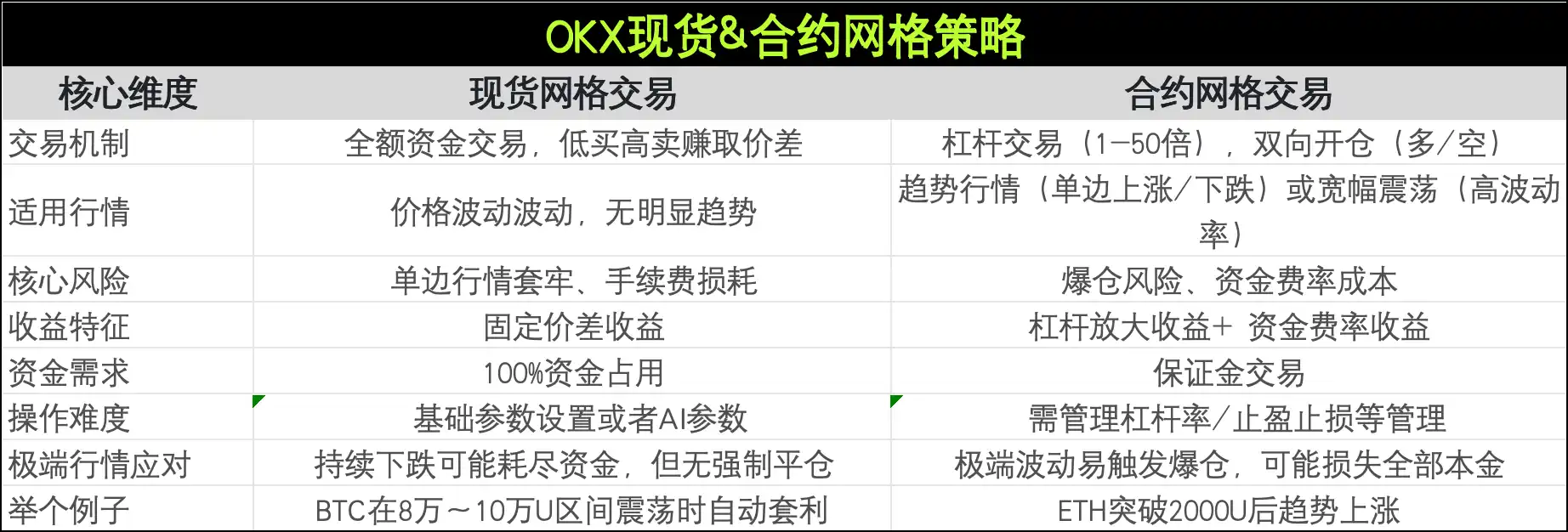
OKX's spot grid is suitable for conservative users, while the contract grid is suitable for advanced users since the contract grid has a higher capital utilization rate but comes with liquidation risks, so strict risk control is necessary. Any investment above 0U is acceptable, with a low participation threshold. Grid trading is an automated quantitative trading strategy that divides the price range into multiple grids, allowing you to buy low and sell high automatically to capture arbitrage opportunities arising from market fluctuations. Based on the application scenario, the contract grid is further divided into long, short, and neutral modes to adapt to different market trends. OKX spot & contract grid supports customizable parameters or AI parameters, enabling users to simply invest U with a single click, making it very convenient.
二、If You Want to Profit from Dip Buying and Rebound
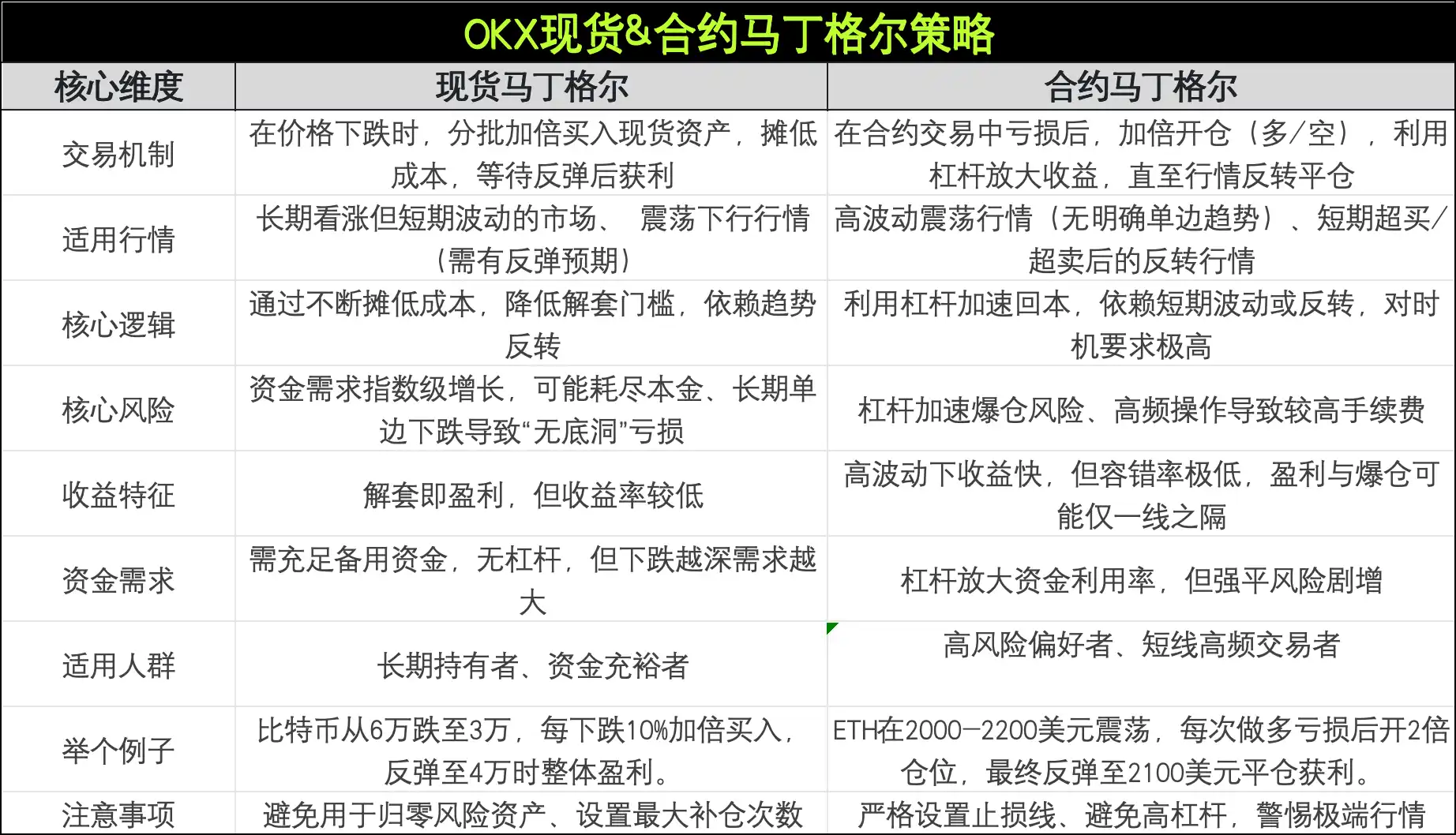
OKX provides both spot and contract Martingale strategies. As a high-risk strategy, Martingale is essentially a "counter-trend scaling in" strategy, so beginners should use it with caution! Experienced traders need to focus on trend analysis and strict risk management. The Martingale strategy, also known as Dollar Cost Averaging (DCA), is a position management-focused trading method with the core principle of "add to losing positions to average down, reset upon profit," where after every loss, the trading amount is doubled until a win is achieved. The basic assumption of this strategy is that as long as the capital is large enough, the ultimate win will make up for all previous losses and bring profits.
Three, Earn Interest Without Watching the Market
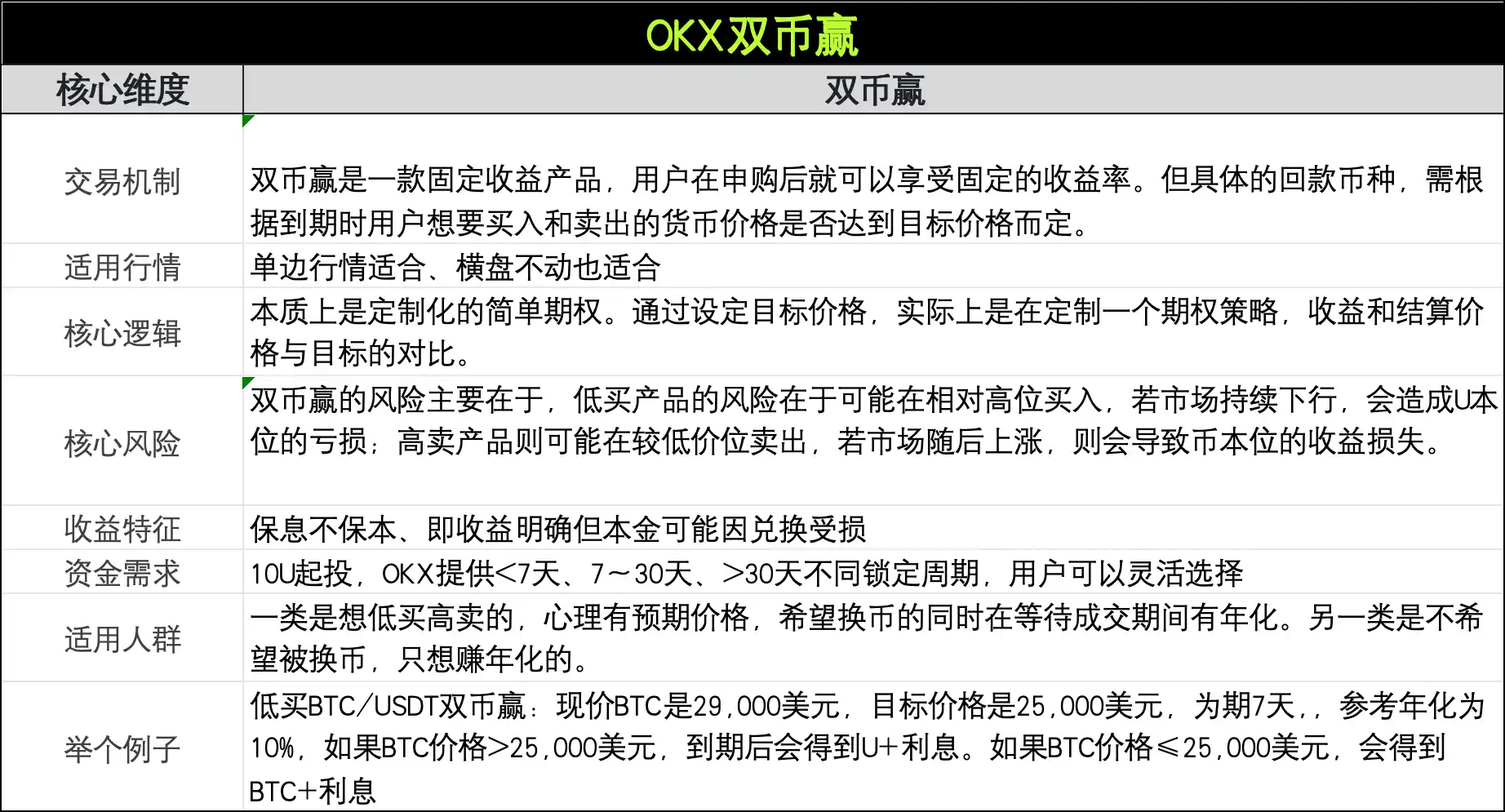
Dual Currency Yield is suitable for those who are uncertain about the market direction but wish to earn returns, hodlers, and users who are not willing to engage in high-frequency trading. Dual Currency Yield is a "capital-protected non-principal-guaranteed" structured product created by OKX, which can help users buy or sell digital assets at a target price while earning additional returns. Users can subscribe to Dual Currency Yield, trade major coin pairs such as BTC - USDT, ETH - USDT, to enjoy stable returns in either currency. However, it is worth noting that after the trigger event, the asset may be converted into another. Therefore, OKX has launched an ETH/BTC coin-based Dual Currency Yield, supporting BTC and ETH investments, to achieve buying low and selling high. Compared to USD-based Dual Currency Yield, it provides a new way to earn returns, zero fees for converting between two major cryptocurrencies, continuous interest accrual, and the core highlight of not missing out on the market by converting to USDT, helping users hodl without worry.
Four, Protect Your Principal
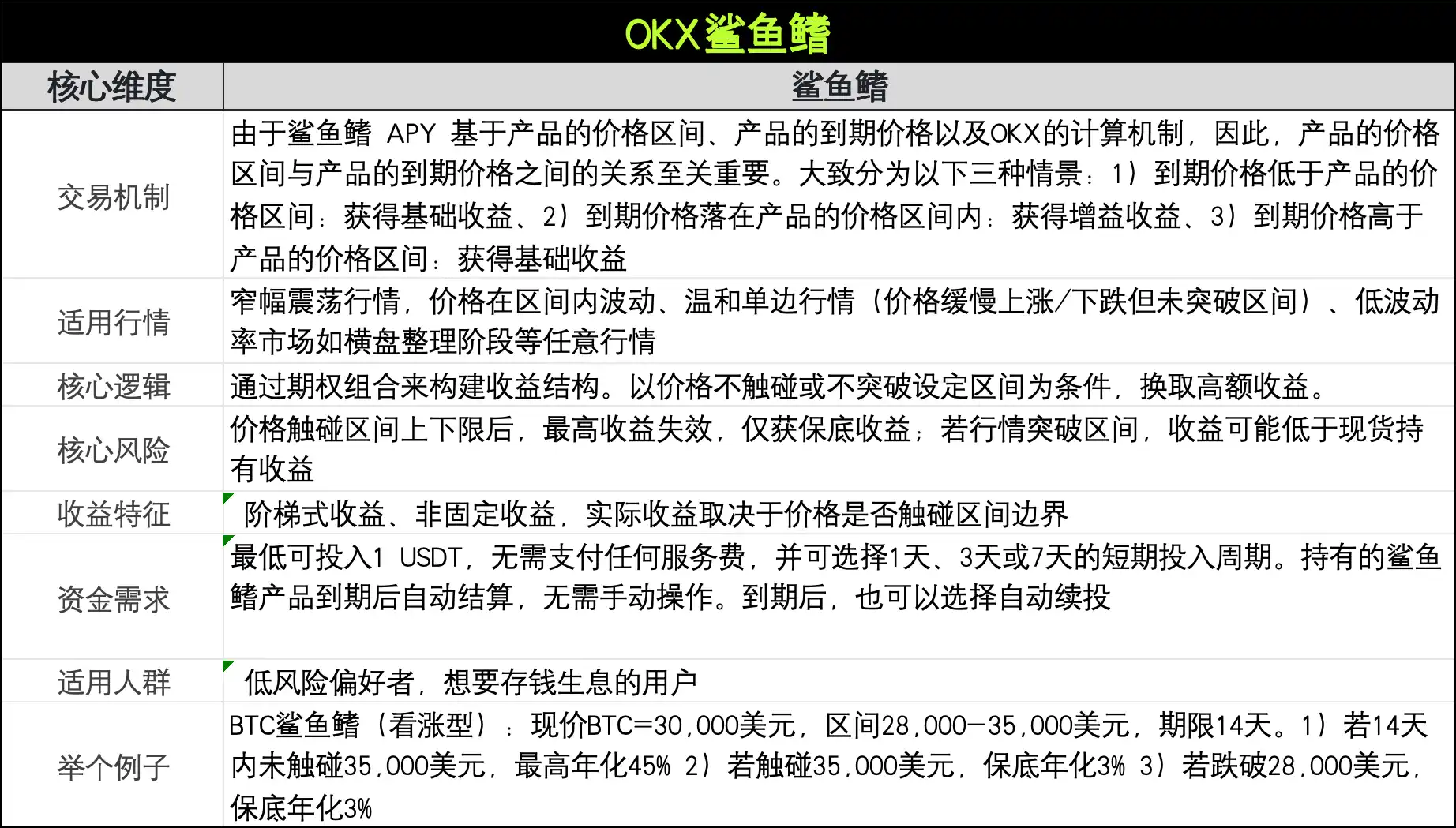
OKX Shark Fin is suitable for those who don't mind earning more or less but are unwilling to bear the risk of losing their principal. Its core feature is to enjoy guaranteed returns while also participating in the market to earn fluctuating/additional returns. By tracking price fluctuations, users can earn annualized returns in USDT, BETH, OKSOL, and other assets during market swings. If the market performs as expected, higher additional rewards can be unlocked. OKX Shark Fin offers flexible investment periods of 1 day, 3 days, and 7 days, allowing users to participate without the need to watch the market. Users can freely choose based on market predictions and fund arrangements, easily gaining stable returns. OKX provides both bullish and bearish Shark Fins, allowing users to buy both types to cover both upward and downward movements, increasing costs but diversifying risks. Additionally, users can participate when the panic index soars, with the platform offering higher annualized returns during high volatility. In conclusion, Shark Fin is suitable as a "cash management tool" to earn returns with idle funds in a clear oscillation range, but position management is still required.
Five, Earn Both Price Appreciation and Interest Income Simultaneously
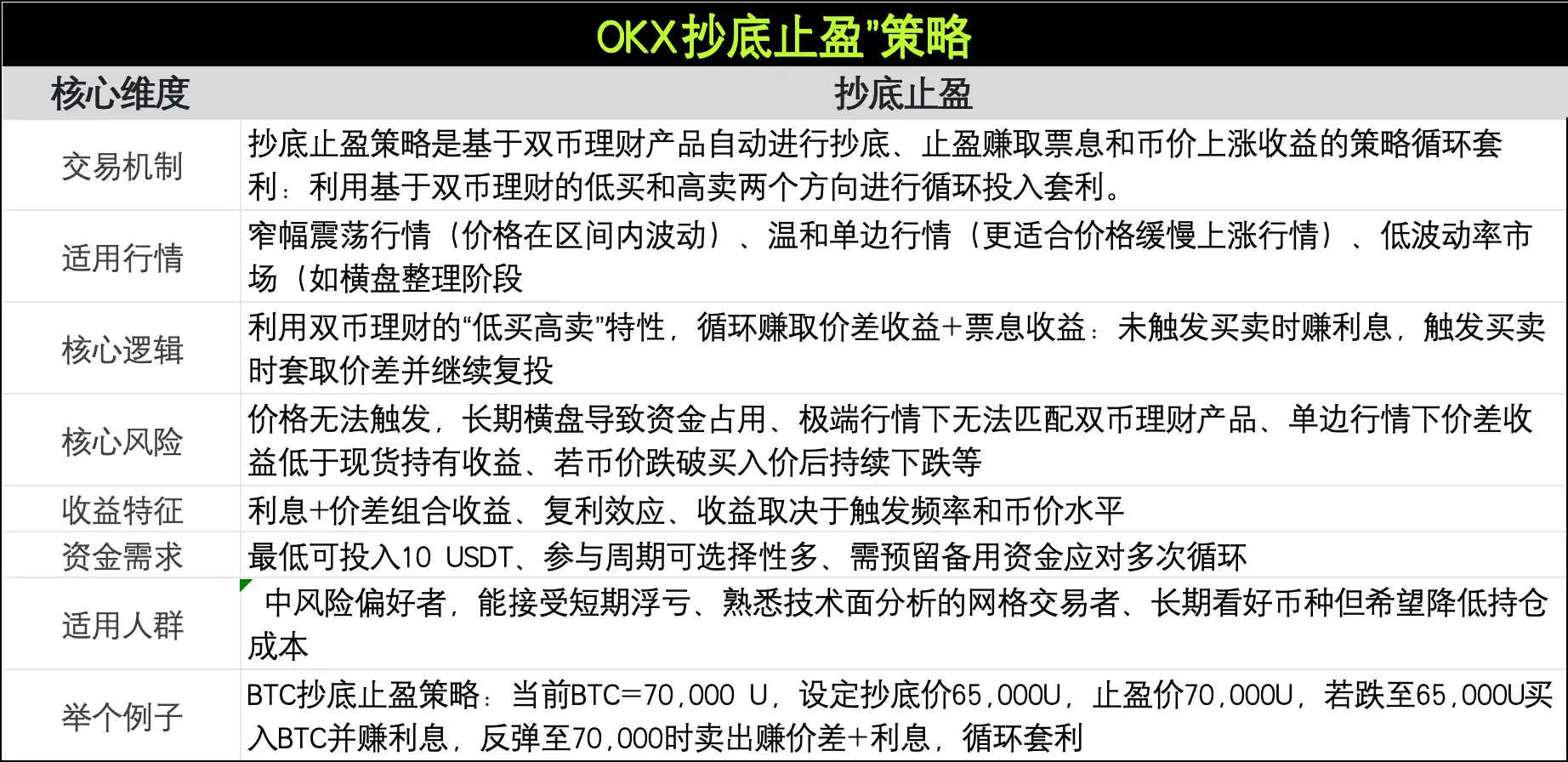
OKX Buy Low, Sell High Strategy is a strategy loop arbitrage based on dual currency financial products that automatically buys low, sells high, and earns interest and price appreciation: using the dual currency financial product for arbitrage through buying low and selling high. USD-based return: invest in USDT, use dual currency financial products to buy low, once the buy low is successful, then take profit to earn the price difference and interest income. This strategy currently supports only BTC and ETH, but the system can flexibly match based on the user's target price, minimum annualized rate, and maximum investment period. Furthermore, OKX Buy Low, Sell High Strategy provides two modes: Basic Mode and Advanced Mode. In Basic Mode, the price is set as a fixed absolute value, such as 75,000 USDT, suitable for scenarios with clear support/resistance levels and low flexibility. In Advanced Mode, the price is set as a dynamic ratio, such as a 5% market price drop, suitable for scenarios with no clear levels but anticipating a percentage of fluctuations, with high flexibility.
Choosing the Right Tool Based on Market Conditions
At the core of trading is not predicting the market, but selecting the right tool to deal with different market conditions. During market fluctuations, blindly chasing highs and selling lows will only lead to an account meltdown—not explosive gains, but explosions. Smart traders do not gamble with the market; instead, they use tools to turn every market movement into an opportunity of their own. For example, OKX's Spot Grid Trading is suitable for laid-back players who are too lazy to watch the charts but still want to profit from price swings; whereas, Futures Grid Trading is an advanced tool with high capital utilization but requires strict risk management. Dual Currency Yield allows hodlers to no longer "HODL and lose," enabling them to earn additional income regardless of whether the market is rising or falling; meanwhile, Shark Fin is a blessing for conservative users who prioritize capital preservation over maximizing gains.
There are three types of people in the market: those who rely on luck, experiencing rollercoaster gains and losses; those who rely on knowledge, employing technical analysis and strategy execution; and those who rely on tools, automating complex trading and maximizing profits. The first two types compete with emotion and experience, while the third type, known as "tool users," emerges victorious. OKX's diverse strategies and structured products prevent you from being controlled by emotions and instead let the tools execute your plans. For instance, U-denominated Dual Currency Yield suits traders who aim for stable returns while waiting for the right entry point, while Grid Trading is suitable for users seeking continuous arbitrage opportunities to profit from market volatility.
"The market does not lose money; it is the retail traders who lose." Although this statement may be harsh, it underscores a harsh reality: the gap between speculation and trading is wider than that between a bull market and a bear market. If you are still relying on "impulse trading," your opponents may have already calculated every trade with precision. Choosing the right tool is the crucial first step to turning the market into an ATM. OKX has offered a range of strategic tools, whether for conservative arbitrage or high-risk speculation, there is always a tool that suits you. Instead of relying on luck, use tools to tilt the odds in your favor.
Disclaimer:
This article is for reference only. The views expressed in this article are those of the author and do not necessarily represent the views of OKX. This article does not intend to provide (i) investment advice or investment recommendations; (ii) an offer or solicitation for the purchase, sale, or holding of digital assets; or (iii) financial, accounting, legal, or tax advice. We do not guarantee the accuracy, completeness, or usefulness of such information. Holding digital assets (including stablecoins and NFTs) involves high risks and may experience significant volatility. You should carefully consider whether trading or holding digital assets is suitable for your financial situation. For your specific circumstances, please consult your legal/tax/investment professional. You are responsible for understanding and complying with relevant local laws and regulations.
This article is contributed content and does not represent the views of BlockBeats.
You may also like

Which City Will Be the Crypto Capital? A Look at the 2025 Crypto-Friendly City Index
Deep Dive into Dubai's Crypto Dream: Illusion, Capital, and Decentralized Empire
Four.meme: How to Turn the BSC Chain into a DeFi Meme Wonderland Using AI Concept
Each to Their Own, Every Public Blockchain Has Its Purpose
If MicroStrategy were forced to sell BTC, how much selling pressure would it bring to the market?
In the midst of the RWA Craze, will Cryptocurrency Rise as the New Financial System or Fall as a Traditional Satellite?
Interview with Cat CEO: I'm in Japan, Selling My House for Cryptocurrency
Dissecting Saylor's Bitcoin Financial Magic: Stock Price Triples Since Last October
Michael J. Saylor's Strategic Bet: Bitcoin's Premium Issuance and Capital Control
This Week in Review | Binance Initiates Listing and Delisting Voting; Identity of '50x Leverage' Whale Revealed
Strategy Reset: Is the "Buy Buy Buy" Mode Back On? A Comprehensive Analysis of the New Financing Plan
Redot Pay has completed a $40 million Series A round. Will Lightspeed Venture Partners and Sequoia Capital create a payment giant in the crypto world?
Doesn't cryptocurrency payment always feel a bit precarious? The wallet operations are cumbersome, the asset volatility is intimidating, and with the fog of regulation, the average person trying to buy a cup of coffee with cryptocurrency feels like they are embarking on an adventure. Ever since the $40 billion evaporation due to the UST collapse in 2022, "stablecoin" briefly became synonymous with risk, and the market's confidence in stablecoins has been fluctuating.
But change is underway. On March 13, 2025, the U.S. Senate Banking Committee passed the Stablecoin Regulation Act by 18 to 6, providing greater clarity on the compliance path for mainstream stablecoins like USDT and USDC. With the market's confidence restored, the cornerstone of trust in cryptocurrency payments is being solidified. Riding this wave of enthusiasm, the cryptocurrency payment platform Redot Pay announced on March 14 that it had completed a $40 million Series A funding round. The round was led by Lightspeed with participation from A-list institutions such as Sequoia China. The company's goal is to make cryptocurrency payments as easy as swiping a bank card, requiring no technical knowledge so that even those without a bank account can easily participate.
CEO Michael Gao stated, "What we are doing is solving real-world problems—making transparency and inclusivity our driving force."
Founded in April 2023 and headquartered in Hong Kong, Redot Pay has emerged as a rising star in the cryptocurrency payment field. In less than two years, it has attracted over 3 million users. Redot Pay's mission is to enable global users, especially those without bank accounts, to easily access financial services. In other words, it is not just a transaction tool but also the entryway for many into the global financial system.
This round of funding will help Redot Pay accelerate the expansion of its global payment network, transforming cryptocurrency payments from being lofty to being more integrated into daily life. In the future, whether you are ordering a latte in a Hong Kong cafe, purchasing handicrafts in the Southeast Asian market, or sending cross-border remittances to family, Redot Pay may become your payment method.
Specific public information about the founder and core team of Redot Pay is relatively limited, and the core team maintains a low profile. CEO Michael Gao is a graduate of Nanyang Technological University in Singapore. Before founding Redot Pay, he served as the CEO of ChainUp Technology in Hong Kong and was responsible for global sales, showcasing strong business acumen and market insight.
Another co-founder, Jonathan Chan, is also a veteran in the industry. Teaming up with Gao, the two hope to make cryptocurrency payments no longer a game for geeks and speculators but a simple daily operation like swiping a bank card.
Fundraising is not just about "getting money to do things" but more like finding a group of "angel investors" to endorse you, help smoothen your path, and fill in the gaps. This time, Redot Pay has received support from a wave of top-tier investment institutions.
The lead investor for this round of funding is Lightspeed. This venture capital giant established in 2000 has a keen investment eye, having nurtured star companies like Snapchat and Affirm. This means that Redot Pay has not only received $40 million but also gained a "life mentor," bringing strategic guidance and global network resources, especially in consumer technology and financial technology.
Looking at the participating lineup, Sequoia Capital China has deep roots in the Asian market and is considered the "West Point Military Academy of the Entrepreneurial Circle." Galaxy Ventures is a veteran player in the crypto field, while DST Global Partners, Accel, and Vertex Ventures are no pushovers. When these big players make a move, it's basically a bet that Redot Pay will become the next giant in the cryptocurrency payment sector.
With this background, Redot Pay may have deeper cooperation with giants like Visa and StriatX in the future. The speed of entering new markets may be faster than taking a high-speed rail. With the endorsement of top institutions to stabilize its footing and avoid pitfalls, this round of funding not only added $40 million to Redot Pay's account but also came with a VIP pass.
Market demand has never been so strong. The enthusiasm for cryptocurrency payments is rapidly rising, shifting from a previous "future vision" to an "immediate opportunity." Currently, there are still 1.3 billion people worldwide without bank accounts, unable to easily access financial services. They have smartphones, they have networks, the only thing missing is a simple, efficient payment method.
Inflationary pressures, exchange rate fluctuations, and outdated financial infrastructure make people more eager than ever for decentralized payment methods. Of course, Redot Pay is not the only player on this track. Competitors like Triple-A are also entering the cryptocurrency payment space. To stand out, Redot Pay needs to excel in user experience and ecosystem integration. Is the payment process smooth enough? Is fiat currency exchange low-cost? Are there enough partner merchants? These are key factors determining success. Users won't pay the price for complex technology. Only if it's truly simple and user-friendly can it become the "Alipay" of the cryptocurrency payment era.
The core goal of Redot Pay is to completely change the stereotype of cryptocurrency payments being "complex, high-threshold, and inconvenient." In November 2023, Redot Pay launched the Visa physical card, supporting global ATM withdrawals, allowing users to directly cash out their cryptocurrency assets.
Simultaneously, a virtual card was also introduced, compatible with ApplePay and GooglePay, enabling users to spend cryptocurrency directly at offline stores or e-commerce platforms just like using a traditional bank card. In December 2024, the platform integrated with the Solana network, followed by joining the Arbitrum ecosystem in February 2025. By leveraging the advantages of these high-performance blockchains, transaction costs are reduced, and payment speed is increased.
Compared to payment platforms that still rely on a single chain, Redot Pay's multi-chain integration strategy is undoubtedly more forward-thinking, providing users with a smoother payment experience. In terms of ecosystem partnerships, Redot Pay is also accelerating the implementation of applications, with collaborations with StraitX and Visa, enabling it to take the lead in the retail payment market in Singapore.
In less than two years, Redot Pay's user base has exceeded 3 million, a growth rate that clearly demonstrates its high market fit. Redot Pay is using technological innovation and practical application to prove that it is not just a "concept hype" shell company but a true dark horse aiming to make cryptocurrency payments mainstream. The current market situation provides a window of opportunity for its expansion, but amidst the industry's rapid development, changes in regulatory policies must not be ignored. Balancing compliance and innovation to stay ahead will be the key challenge for Redot Pay moving forward.
Market Maker Operations Behind the Scenes: The Full Operation Chain of a Coin Circle "Harvester"
IOSG Founder: From Hong Kong to Denver, Ethereum Is Entering a "Dunkirk Moment"
Strategic Reserve and Power Play: The Crypto Order of the Trump Era
External Innovation vs. Internal Dilemma: Crypto Sailing Through the Fog
TrumpCoin Enriches Chinese, Sparks Division in US Crypto Community
Why Did I Choose to Stake my Shiba Inu on Worldchain?
Which City Will Be the Crypto Capital? A Look at the 2025 Crypto-Friendly City Index
Deep Dive into Dubai's Crypto Dream: Illusion, Capital, and Decentralized Empire
Four.meme: How to Turn the BSC Chain into a DeFi Meme Wonderland Using AI Concept
Each to Their Own, Every Public Blockchain Has Its Purpose
If MicroStrategy were forced to sell BTC, how much selling pressure would it bring to the market?
In the midst of the RWA Craze, will Cryptocurrency Rise as the New Financial System or Fall as a Traditional Satellite?
Popular coins
Latest Crypto News


Customer Support:@weikecs
Business Cooperation:@weikecs
Quant Trading & MM:bd@weex.com
VIP Services:support@weex.com
 App
App