
- Buy Crypto
- Markets
- Futures
- Spot
- Copy Trade
 WE-Launch
Market Maker Operations Behind the Scenes: The Full Operation Chain of a Coin Circle "Harvester"

Original Article Title: "Behind the GPS, SHELL Meltdown: The Complete Operation Chain of a Crypto Harvesting Machine"
Original Article Author: Fairy, ChainCatcher
Liquidity is the lifeline of maintaining price stability, and liquidity providers are the guardians of this lifeline. However, what chaos ensues when these guardians turn into "predators"?
Within 20 minutes of GPS's listing on an exchange, the price plummeted below the opening price, dropping 74% from a high of $0.15. SHELL fell from $0.7 to $0.26. Both GPS and SHELL tokens displayed nearly identical price charts, as if manipulated by the same invisible hand.
With Binance's investigation and continuous community whistleblowing, this event quickly became the weekend topic for everyone. A hidden interest chain slowly emerged, and names like Web3Port, Whisper, and May Liu were thrust into the spotlight. The backstage of the meltdown was more astonishing than imagined...
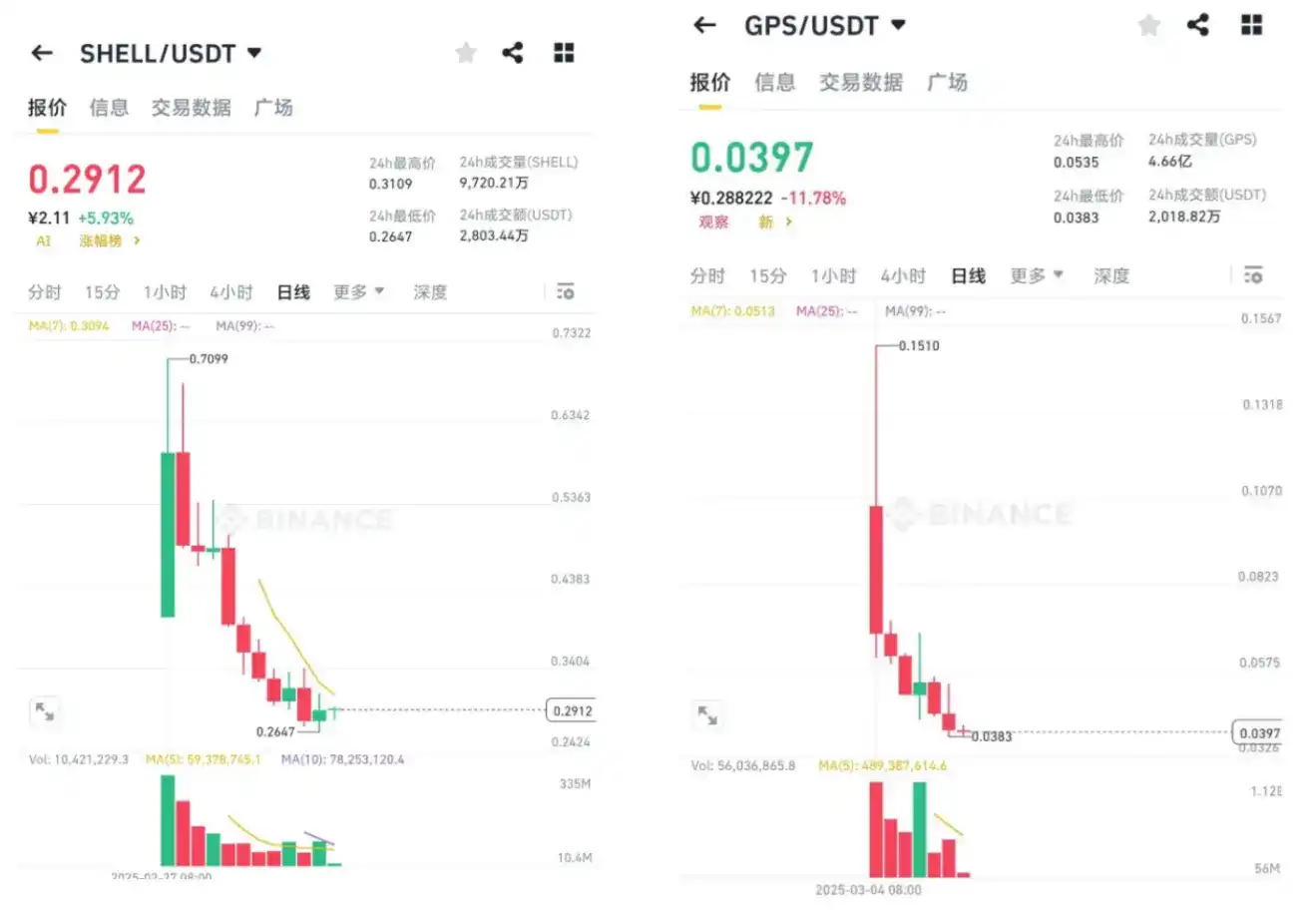
GPS, SHELL Price Chart
One-Sided Liquidation by Liquidity Provider Leads to Price Collapse
A Binance announcement revealed that the recent abnormal price of GPS was directly caused by a specific liquidity provider. This liquidity provider engaged in only selling operations within 21 hours, entirely neglecting its buy-side obligation, and dumped a large amount of 70 million GPS tokens, profiting approximately $5 million. This sell-off action led to a crash in the token price, nearly depleting market liquidity.
Subsequently, Binance's investigation found that both of these crypto projects had entrusted the same liquidity provider to manage their token liquidity.
As a result, Binance delisted the liquidity provider and prohibited it from continuing market-making activities on the platform. Furthermore, Binance confiscated the profits gained by the liquidity provider through its illicit operations and plans to use these funds to compensate the affected users of the GPS and SHELL projects. The specific compensation plan will be further announced by the project teams.
Unveiling the Mastermind: The Complete Chain of Market Manipulation
As the event escalated, the community swiftly dug deeper, revealing the true face of the mastermind behind the scenes. This event not only exposed a market-manipulating liquidity provider but also uncovered a long-active arbitrage chain in the crypto world.
The crypto KOL @_FORAB revealed that the passive market maker of GPS and SHELL is GSR, while the active market maker is the Shanghai-based team Web3Port.
Further investigation found that Web3Port leveraged token lending to its affiliated market maker Whisper, which, under Web3Port's Binance account, received internal approval and executed consecutive sell-offs, eventually leading to a market crash. Multiple industry insiders confirmed that Web3Port and Whisper are part of the same team, forming a complete arbitrage chain from token acquisition to cash-out.
May Liu and the "Arbitrage Pipeline"
Web3Port partner May Liu's long-standing business operation in the crypto circle has come to light—a specialized arbitrage pipeline targeting project teams and exchanges from Spark Digital Capital to Web3Port, and then to Whisper.
· Spark Digital Capital Era (VC Disguise):
May Liu operated in the crypto circle under the guise of a VC firm, primarily engaging in market-making outsourcing and financial advisory (FA) business. By packaging projects, she obtained free tokens, which Spark Digital Capital then persuaded other VC firms to invest in, turning these genuinely investing VCs into "bagholders," while she engaged in risk-free arbitrage.
· Web3Port Incubator (Free Token in Exchange for Services):
After 2021 and 2022, as VC competition intensified, project teams became increasingly reluctant to provide tokens for free, challenging this arbitrage model. Therefore, May Liu founded the Web3Port Incubator, catering to early-stage projects, providing packaging, guidance, connecting with VC resources, in exchange for 1%-3% of free token allocation.
· Whisper Market Maker (Cash-Out Outlet):
Relying solely on free tokens was insufficient to complete the arbitrage. Therefore, Web3Port also established the Whisper market maker, ostensibly providing liquidity to project teams but actually offering a cash-out channel for "their own free tokens." Through internal authorization, Whisper could conduct large-scale token sell-offs on exchanges like Binance, cash out, and exit, with retail investors becoming long-term "ATMs".
@_FORAB says, "The so-called Binance Express, to some extent, they have indeed achieved it, and for a long time."

A Controversy Arises: Who Should Be Held Responsible for This 'Trash Market'?
Blaming the Market Maker Doesn't Hold Up
@yuyue_chris says, "The project team is essentially an 'ATM,' with the market maker responsible for helping the project team cash out the tokens and distributing the proceeds according to the agreed-upon ratio. In this relationship of intertwined interests, the unilateral action of the market maker to sell off large quantities against the project team's wishes is highly unlikely."
@silverfang88 says, "I think the decision to dump was most likely made jointly by the project and the market maker. In a bearish market, the market maker may advise the project team to sell early, not to hold, because 'Binance new listings always cascade sell,' and the project team acknowledges this, eventually reaching a consensus that together triggered the continuous sell-off in the market.
On the other hand, the project team itself failed to attract enough buying pressure, with insufficient market depth. It couldn't withstand the selling pressure or expand the order book, leading to sell orders consistently dominating, driving the price downward.
Game of Greatness mentioned how the NYSE's past market makers used openly available exchange information to exploit information asymmetry and manipulate the market to harvest retail investors."
@0xJamesXXX says, "Another overlooked issue is that according to the project team's publicly disclosed tokenomics, investors/incubators' tokens are far from unlocking. But why does this institution have so many already unlocked tokens to sell? Is the project team deceiving investors? Or are they using other unlocked tokens, like those received through airdrops, to sell these tokens?"
All Parties Acting Evil for Self-Gain, the Entire Value Chain Needs Reflection
@forgivenever says, "The reason the market is currently in this predicament is that the entire industry's value chain is full of all parties acting evil, yet pretending to be ignorant.
Blaming individual scapegoats does not help solve the problem. What truly needs reflection is how exchanges, VCs, project teams, KOLs, market makers, and all other links have collectively led to the situation where retail investors are repeatedly harvested."
Regarding Binance's handling of this incident, there are also many opinions in the market:
@armonio_liang said, "If Binance's move is aimed at reshaping industry rules and promoting the improvement of the exchange regulatory system, I support it. Looking back at Wall Street's development, many regulatory systems originated from industry self-regulation to achieve a healthier market environment.
However, if this action is merely a one-time clean-up operation aimed at reallocating the interests between institutions and retail investors, then the exclusion of market makers appears more arbitrary and less convincing than in traditional financial markets."
Supporters: Binance Cleansing the Market Environment
"Thumbs up for Binance. If there is no cost to wrongdoing, even the originally neutral will gradually lean towards evil."
"Protecting user interests, combating violations, Binance's move is very powerful. Hopefully, other exchanges can follow suit to jointly maintain market order."
"Binance has shown its commitment to the community and its pursuit of industry fairness."
Opponents: Intervening in Market Free Competition
"Although the approach is very just, this is not very decentralized."
"Binance's 'iron-fist' rectification this time, is it aimed at protecting retail investors' interests, or is it intended to further strengthen its control over the market? After all, the subtle relationship between exchanges and market makers is well known in the industry, and Binance itself may not necessarily be able to stay outside this system."

This storm triggered by the GoPlus and MyShell events has brought out deep-seated conflicts of interest and regulatory flaws in the crypto industry. Blaming individual market makers for market chaos is oversimplifying and overlooking the roles of exchanges, VCs, projects, KOLs, and others in the benefit chain.
So, who should be held responsible for this 'trash market'?
In the future, it may only be an endless 'Great Game'...
You may also like

Which City Will Be the Crypto Capital? A Look at the 2025 Crypto-Friendly City Index
Deep Dive into Dubai's Crypto Dream: Illusion, Capital, and Decentralized Empire
Four.meme: How to Turn the BSC Chain into a DeFi Meme Wonderland Using AI Concept
Each to Their Own, Every Public Blockchain Has Its Purpose
If MicroStrategy were forced to sell BTC, how much selling pressure would it bring to the market?
In the midst of the RWA Craze, will Cryptocurrency Rise as the New Financial System or Fall as a Traditional Satellite?
Interview with Cat CEO: I'm in Japan, Selling My House for Cryptocurrency
Dissecting Saylor's Bitcoin Financial Magic: Stock Price Triples Since Last October
Michael J. Saylor's Strategic Bet: Bitcoin's Premium Issuance and Capital Control
Here we go! These OKX products will help you easily navigate through choppy markets
This Week in Review | Binance Initiates Listing and Delisting Voting; Identity of '50x Leverage' Whale Revealed
Strategy Reset: Is the "Buy Buy Buy" Mode Back On? A Comprehensive Analysis of the New Financing Plan
Redot Pay has completed a $40 million Series A round. Will Lightspeed Venture Partners and Sequoia Capital create a payment giant in the crypto world?
Doesn't cryptocurrency payment always feel a bit precarious? The wallet operations are cumbersome, the asset volatility is intimidating, and with the fog of regulation, the average person trying to buy a cup of coffee with cryptocurrency feels like they are embarking on an adventure. Ever since the $40 billion evaporation due to the UST collapse in 2022, "stablecoin" briefly became synonymous with risk, and the market's confidence in stablecoins has been fluctuating.
But change is underway. On March 13, 2025, the U.S. Senate Banking Committee passed the Stablecoin Regulation Act by 18 to 6, providing greater clarity on the compliance path for mainstream stablecoins like USDT and USDC. With the market's confidence restored, the cornerstone of trust in cryptocurrency payments is being solidified. Riding this wave of enthusiasm, the cryptocurrency payment platform Redot Pay announced on March 14 that it had completed a $40 million Series A funding round. The round was led by Lightspeed with participation from A-list institutions such as Sequoia China. The company's goal is to make cryptocurrency payments as easy as swiping a bank card, requiring no technical knowledge so that even those without a bank account can easily participate.
CEO Michael Gao stated, "What we are doing is solving real-world problems—making transparency and inclusivity our driving force."
Founded in April 2023 and headquartered in Hong Kong, Redot Pay has emerged as a rising star in the cryptocurrency payment field. In less than two years, it has attracted over 3 million users. Redot Pay's mission is to enable global users, especially those without bank accounts, to easily access financial services. In other words, it is not just a transaction tool but also the entryway for many into the global financial system.
This round of funding will help Redot Pay accelerate the expansion of its global payment network, transforming cryptocurrency payments from being lofty to being more integrated into daily life. In the future, whether you are ordering a latte in a Hong Kong cafe, purchasing handicrafts in the Southeast Asian market, or sending cross-border remittances to family, Redot Pay may become your payment method.
Specific public information about the founder and core team of Redot Pay is relatively limited, and the core team maintains a low profile. CEO Michael Gao is a graduate of Nanyang Technological University in Singapore. Before founding Redot Pay, he served as the CEO of ChainUp Technology in Hong Kong and was responsible for global sales, showcasing strong business acumen and market insight.
Another co-founder, Jonathan Chan, is also a veteran in the industry. Teaming up with Gao, the two hope to make cryptocurrency payments no longer a game for geeks and speculators but a simple daily operation like swiping a bank card.
Fundraising is not just about "getting money to do things" but more like finding a group of "angel investors" to endorse you, help smoothen your path, and fill in the gaps. This time, Redot Pay has received support from a wave of top-tier investment institutions.
The lead investor for this round of funding is Lightspeed. This venture capital giant established in 2000 has a keen investment eye, having nurtured star companies like Snapchat and Affirm. This means that Redot Pay has not only received $40 million but also gained a "life mentor," bringing strategic guidance and global network resources, especially in consumer technology and financial technology.
Looking at the participating lineup, Sequoia Capital China has deep roots in the Asian market and is considered the "West Point Military Academy of the Entrepreneurial Circle." Galaxy Ventures is a veteran player in the crypto field, while DST Global Partners, Accel, and Vertex Ventures are no pushovers. When these big players make a move, it's basically a bet that Redot Pay will become the next giant in the cryptocurrency payment sector.
With this background, Redot Pay may have deeper cooperation with giants like Visa and StriatX in the future. The speed of entering new markets may be faster than taking a high-speed rail. With the endorsement of top institutions to stabilize its footing and avoid pitfalls, this round of funding not only added $40 million to Redot Pay's account but also came with a VIP pass.
Market demand has never been so strong. The enthusiasm for cryptocurrency payments is rapidly rising, shifting from a previous "future vision" to an "immediate opportunity." Currently, there are still 1.3 billion people worldwide without bank accounts, unable to easily access financial services. They have smartphones, they have networks, the only thing missing is a simple, efficient payment method.
Inflationary pressures, exchange rate fluctuations, and outdated financial infrastructure make people more eager than ever for decentralized payment methods. Of course, Redot Pay is not the only player on this track. Competitors like Triple-A are also entering the cryptocurrency payment space. To stand out, Redot Pay needs to excel in user experience and ecosystem integration. Is the payment process smooth enough? Is fiat currency exchange low-cost? Are there enough partner merchants? These are key factors determining success. Users won't pay the price for complex technology. Only if it's truly simple and user-friendly can it become the "Alipay" of the cryptocurrency payment era.
The core goal of Redot Pay is to completely change the stereotype of cryptocurrency payments being "complex, high-threshold, and inconvenient." In November 2023, Redot Pay launched the Visa physical card, supporting global ATM withdrawals, allowing users to directly cash out their cryptocurrency assets.
Simultaneously, a virtual card was also introduced, compatible with ApplePay and GooglePay, enabling users to spend cryptocurrency directly at offline stores or e-commerce platforms just like using a traditional bank card. In December 2024, the platform integrated with the Solana network, followed by joining the Arbitrum ecosystem in February 2025. By leveraging the advantages of these high-performance blockchains, transaction costs are reduced, and payment speed is increased.
Compared to payment platforms that still rely on a single chain, Redot Pay's multi-chain integration strategy is undoubtedly more forward-thinking, providing users with a smoother payment experience. In terms of ecosystem partnerships, Redot Pay is also accelerating the implementation of applications, with collaborations with StraitX and Visa, enabling it to take the lead in the retail payment market in Singapore.
In less than two years, Redot Pay's user base has exceeded 3 million, a growth rate that clearly demonstrates its high market fit. Redot Pay is using technological innovation and practical application to prove that it is not just a "concept hype" shell company but a true dark horse aiming to make cryptocurrency payments mainstream. The current market situation provides a window of opportunity for its expansion, but amidst the industry's rapid development, changes in regulatory policies must not be ignored. Balancing compliance and innovation to stay ahead will be the key challenge for Redot Pay moving forward.
IOSG Founder: From Hong Kong to Denver, Ethereum Is Entering a "Dunkirk Moment"
Strategic Reserve and Power Play: The Crypto Order of the Trump Era
External Innovation vs. Internal Dilemma: Crypto Sailing Through the Fog
TrumpCoin Enriches Chinese, Sparks Division in US Crypto Community
Why Did I Choose to Stake my Shiba Inu on Worldchain?
Which City Will Be the Crypto Capital? A Look at the 2025 Crypto-Friendly City Index
Deep Dive into Dubai's Crypto Dream: Illusion, Capital, and Decentralized Empire
Four.meme: How to Turn the BSC Chain into a DeFi Meme Wonderland Using AI Concept
Each to Their Own, Every Public Blockchain Has Its Purpose
If MicroStrategy were forced to sell BTC, how much selling pressure would it bring to the market?
In the midst of the RWA Craze, will Cryptocurrency Rise as the New Financial System or Fall as a Traditional Satellite?
Popular coins
Latest Crypto News


Customer Support:@weikecs
Business Cooperation:@weikecs
Quant Trading & MM:bd@weex.com
VIP Services:support@weex.com
 App
App